Blog

Understanding assistance dogs in the UK

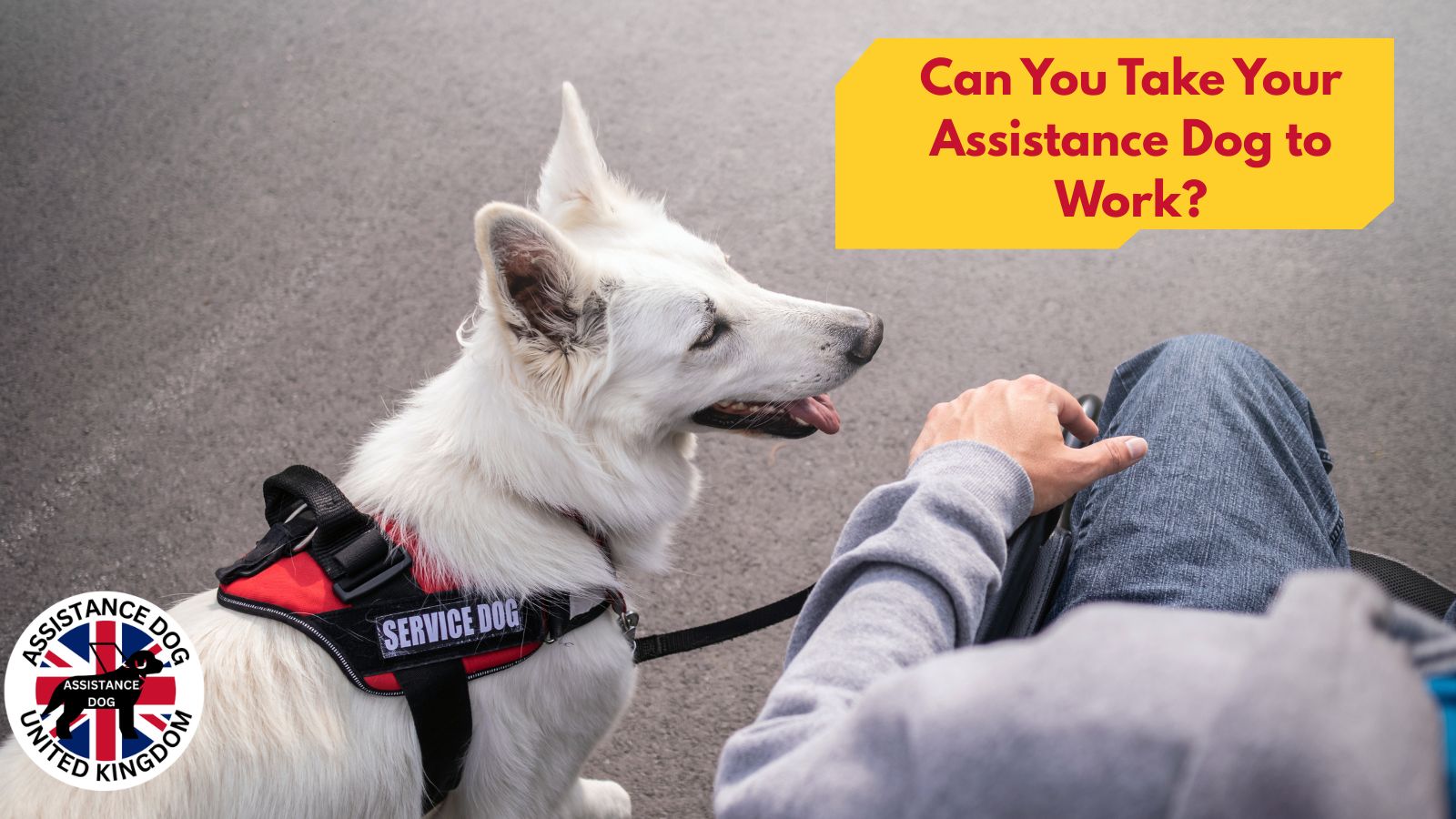
Can You Take Your Assistance Dog to Work?

February 28, 2026

Can You Take Your Assistance Dog to Work in the UK? Your Legal Rights Explained.

Yes in most cases, you can take your assistance dog to work in the UK.

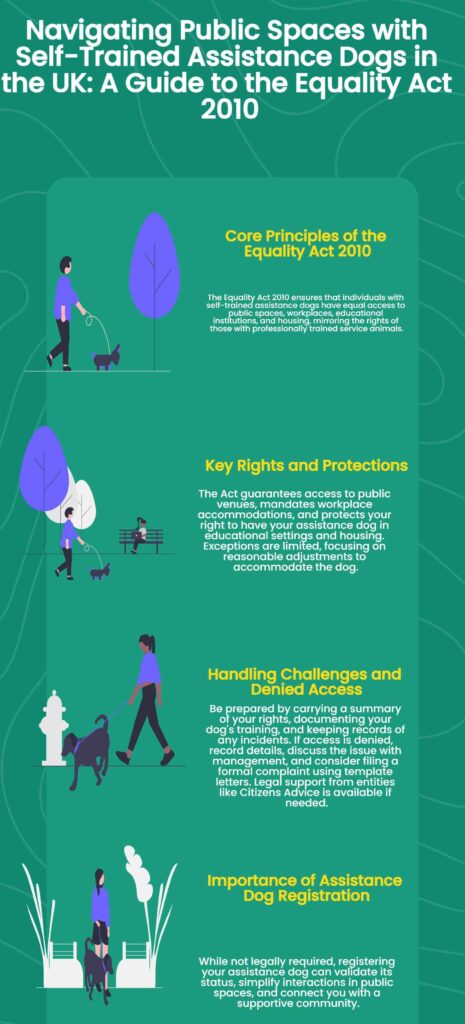
Under the Equality Act 2010, employers have a legal duty to make reasonable adjustments for disabled employees. If you rely on an assistance dog at work in the UK, a blanket “no dogs” policy cannot automatically override your rights.

This guide explains what the law says, what reasonable adjustments mean in practice, and what to do if your employer refuses your request.


What the Equality Act 2010 Says About Assistance Dogs at Work

The Equality Act 2010 protects disabled people from discrimination in the workplace. This protection applies to recruitment, employment terms, and working conditions.

If your disability means you rely on an assistance dog, your employer must consider allowing the dog as a reasonable adjustment.

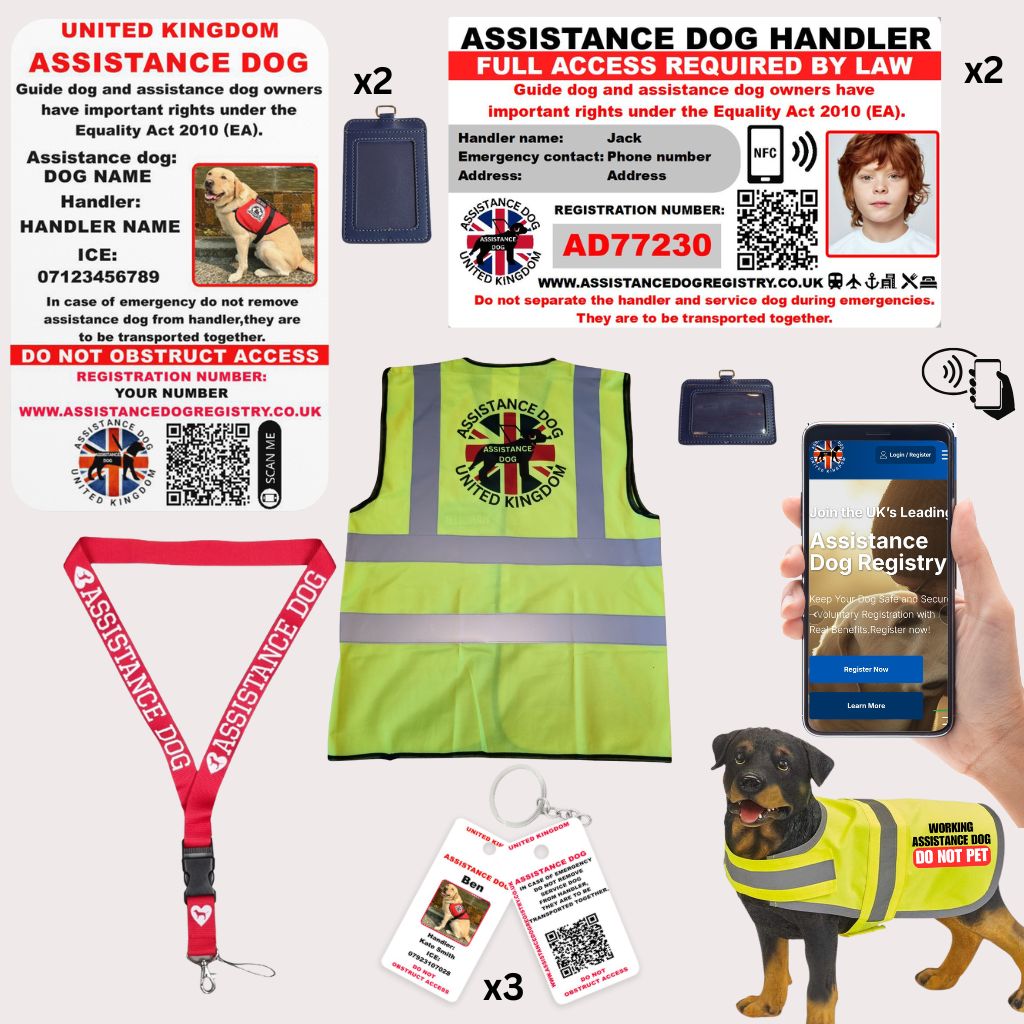
Importantly, UK law does not distinguish between charity-trained and owner-trained assistance dogs. There is also no legal requirement for registration, a vest, or formal ID. However, many handlers choose to carry voluntary identification to reduce friction in workplace conversations.


What Are “Reasonable Adjustments” in the Workplace?

Reasonable adjustments are changes that remove barriers for disabled employees. The goal is to prevent disadvantage caused by disability.

In practice, adjustments involving an assistance dog may include:

  • Allowing the dog during working hours
  • Providing space for the dog to rest
  • Adjusting desk layout or seating arrangements
  • Allowing short breaks for water or toileting
  • Informing colleagues appropriately (without disclosing medical details)

What counts as “reasonable” depends on factors such as employer size, cost, and the nature of the work environment. However, refusing outright without consideration is unlikely to be lawful.


Can an Employer Refuse an Assistance Dog Because of Allergies?

Allergies are a common concern. However, one employee’s allergy does not automatically override another employee’s disability rights.

Employers must balance both needs.

Possible solutions include:

  • Adjusting seating arrangements
  • Separating workspaces
  • Improving ventilation
  • Using air purifiers
  • Adjusting schedules

The key point is that employers must explore alternatives before excluding the assistance dog completely.


What to Do If Your Employer Says No

If your employer refuses your request, take these steps:

1. Put Your Request in Writing

Reference the Equality Act 2010 and explain how your dog supports your disability.

2. Escalate Through HR

If informal discussions fail, request a formal review of reasonable adjustments.

3. Contact ACAS

ACAS provides free, impartial workplace advice. Visit acas.org.uk or call 0300 123 1100.

4. Consider Legal Advice

If reasonable adjustments are refused without justification, you may have grounds for a disability discrimination claim.


Access to Work: Government Support

The Access to Work scheme provides financial support for disabled employees in the UK.

This support may include specialist equipment, travel costs, or other assistance to help you stay in work.

Although it does not replace your employer’s legal duties, it can make workplace adjustments easier to implement.

Learn more at gov.uk/access-to-work.

Register your assistance dog today and enjoy every sunny moment without setbacks.

🎟️ Sign Up for the Lifetime Package Today

💡 Click here to learn more & register


FAQ

1. What is an assistance dog?

An assistance dog is trained to perform specific tasks to aid individuals with disabilities, enhancing their independence and quality of life.

Wikipedia

2. Why is socialization important for assistance dogs?

Proper socialization ensures assistance dogs remain calm, focused, and well-behaved in various public settings, enabling them to perform their duties effectively.

3. At what age should I start socializing my assistance dog?

It's beneficial to begin socialization during puppyhood; however, with patience and consistent training, dogs of any age can learn to navigate public environments confidently.

4. How long does it take to socialize an assistance dog?

The duration varies based on the dog's temperament, previous experiences, and the consistency of training. Regular, positive exposure to different environments is key.

5. Can I socialize my assistance dog if they are older?

Yes, older dogs can be socialized successfully. While it may require more time and patience, with positive reinforcement, they can adapt to new situations.

6. What should I do if my assistance dog shows fear in public?

If your dog exhibits fear, calmly remove them from the situation and gradually reintroduce the stimulus at a comfortable distance, rewarding calm behavior.

7. How do I handle public distractions during training?

Teach focus commands like "watch me" to redirect your dog's attention. Gradual exposure to distractions, paired with positive reinforcement, can improve focus.

8. Are there specific public places ideal for socialization?

Begin with quiet areas like parks, then progress to busier environments such as cafes, public transport, and shopping centres as your dog becomes more comfortable.

9. How can I ensure my assistance dog behaves appropriately around other animals?

Controlled introductions and rewarding calm behaviour are essential. Consistent training helps your dog remain focused on their tasks, even around other animals.

10. What are the legal requirements for assistance dogs in public places?

In many regions, assistance dogs are permitted in public areas to support their handlers. It's important to familiarize yourself with local laws and regulations regarding assistance dogs.

Learn more about our Lifelong Partner Package

Learn More – Additional Assistance Dog Letter Templates

If you found this travel guide useful, you may also benefit from these other essential assistance dog letter templates we’ve published:

📌 Housing Accommodation Request Letter – Need to request reasonable accommodation from your landlord? This template ensures your rights under the Equality Act 2010 are respected.

📌 Workplace Assistance Dog Request Letter – If you need accommodations to bring your assistance dog to work, this letter outlines your legal rights and reasonable adjustments your employer should consider.

📌 Medical Confirmation of Need for an Assistance Dog – A doctor’s letter template to confirm your need for an assistance dog for public access, travel, and daily life.

🔹 More templates are coming soon! Let us know if you have specific needs, and we’ll create more resources to support assistance dog handlers.

Read more

The 5 Most Hurtful Things People Say to Assistance Dog Handlers (And How to Respond)

February 6, 2026

Assistance dog handlers often face comments that sting, drain confidence, or create pressure to “prove” something they should never have to prove. If you’ve ever walked away replaying a sentence in your head, this guide is for you.

Below are five common remarks people search for online, plus real-world scenarios and calm, factual responses you can use without oversharing personal information.

Short, calm phrases can reduce conflict and protect your energy.

1) “You don’t look disabled.”

This often happens quietly. You’re in a queue, or walking into a shop, and someone looks from your dog to you and back again. Then it lands:

“You don’t look disabled.”

In that moment, many handlers feel exposed  like their body has failed an invisible test. Invisible disability is real, and it is common.

A calm response you can use

“Not all disabilities are visible.”

If you want a slightly firmer version

“Disability isn’t always visible.”

2) “Is that a real assistance dog?”

This one usually arrives with suspicion. A stranger or staff member pauses, watches your dog, and asks “real” as if you’re being audited in public.

“Is that a real assistance dog?”

It can feel like you’re being forced to defend your life, especially when you’re already managing anxiety, overwhelm, or fatigue.

A calm response you can use

“Yes. My dog assists me with my disability.”

Keep it simple. You’re stating function, not inviting debate.

3) “We don’t allow dogs in here.”

This is the moment many handlers dread: you’ve already entered the space, you’re trying to stay regulated, and someone approaches with a rule meant for pets.

“Sorry, we don’t allow dogs.”

Even when you know your rights, being challenged can spike stress fast especially if the interaction is public, loud, or confrontational.

A calm response you can use

“Assistance dogs are legally allowed to accompany their handler.”

If the person seems open to learning, you can add one short line: “This is different from pet access.”

Want a deeper breakdown? Read: Assistance dog access rights in the UK.

4) “Where’s your ID or proof?”

This one often comes from staff trying to “follow policy” — but it still creates pressure. You might hear it at a reception desk, a restaurant entrance, or during a tense moment at the till.

“Do you have ID?”

The hardest part isn’t the question. It’s the feeling that access depends on paperwork — when you’re already stretched thin.

A calm response you can use

“There’s no legal requirement for ID for assistance dogs in the UK.”

If you want to keep it cooperative: “I’m happy to explain the guidance if it helps.”

5) “That’s just an emotional support dog.”

This one can feel dismissive. Sometimes it’s said with a shrug, sometimes with an eye-roll, and it can instantly make a handler feel small.

“That’s just an emotional support dog.”

Labels get messy online. The simplest way to stay grounded is to bring the conversation back to what your dog does.

A calm response you can use

“My dog is trained to assist with my disability.”

No argument. No defence. Just function.

A calmer way to handle these moments

You are never required to share private medical details. Your rights exist regardless of whether you carry paperwork.

That said, many handlers choose optional support tools (like a short law summary card or profile) because it can reduce stressful back-and-forth and help the law speak for itself when words are hard to find.

It’s always optional. The goal is relief, not permission.

Download your free digital Assistance Dog Law Card See optional support tools


Our Assistance Dog Registry offers smart, professional tools to help you:

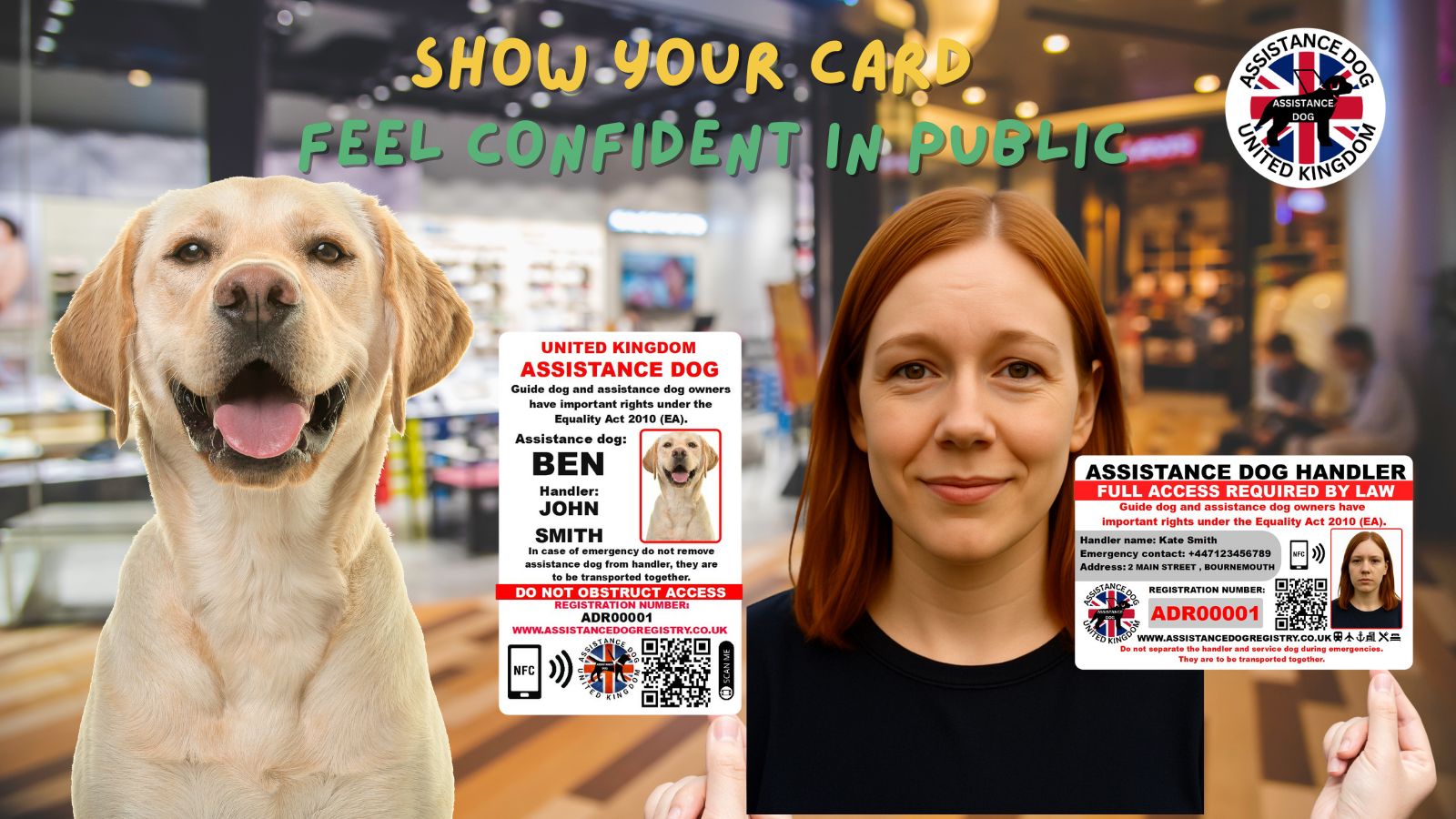
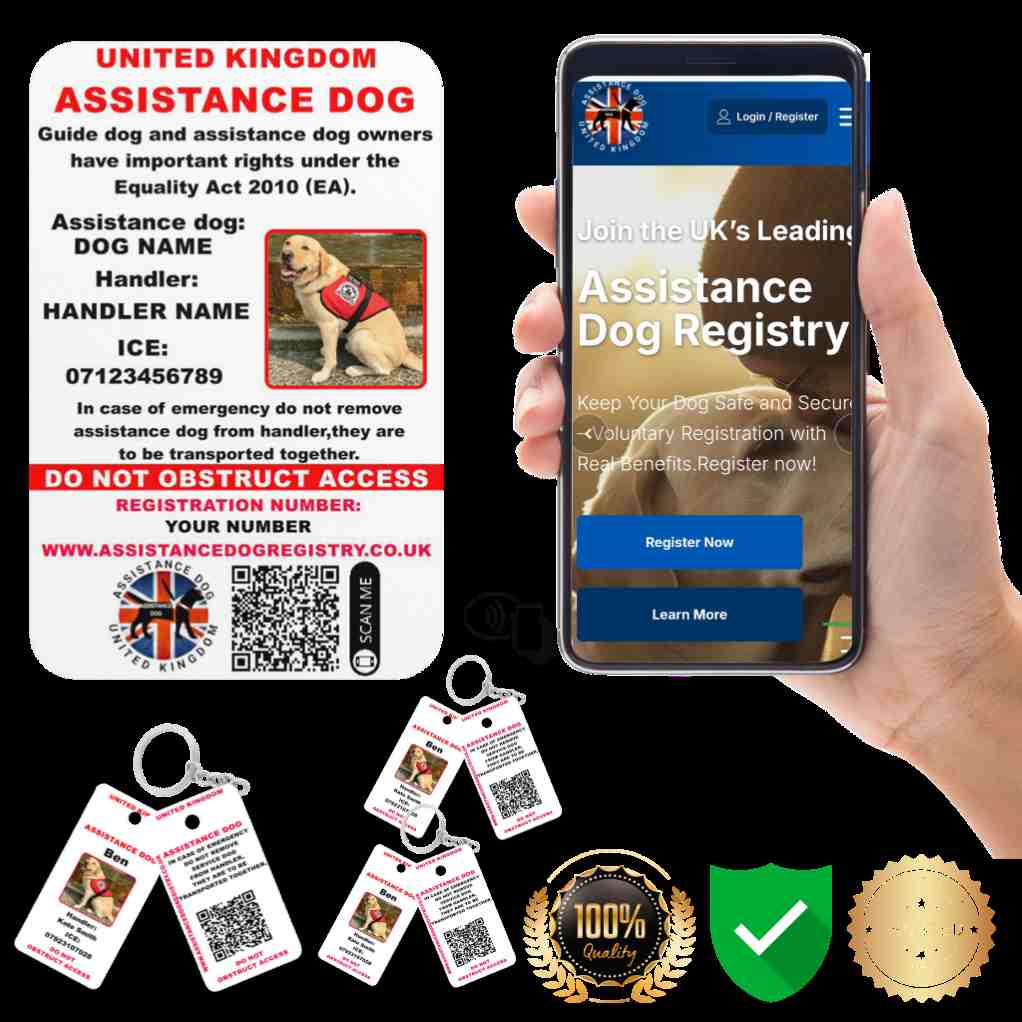
  • Instantly show your dog’s role and legal rights with Smart ID Cards
  • Provide staff with proof via a QR Code linked to the Equality Act 2010
  • Present your custom dog profile and handler details in seconds
  • Wear your support gear with confidence (lanyard, dog tags, vest)
  • Enjoy the benefits of voluntary registration that supports your rights without replacing or contradicting the law

Stay Confident

You deserve peace of mind when you're out enjoying the sunshine. With proper registration and public-friendly ID tools, you can confidently navigate the spaces where others still need educating.

Register your assistance dog today and enjoy every sunny moment without setbacks.

🎟️ Sign Up for the Lifetime Package Today

💡 Click here to learn more & register


FAQ

1. What is an assistance dog?

An assistance dog is trained to perform specific tasks to aid individuals with disabilities, enhancing their independence and quality of life.

Wikipedia

2. Why is socialization important for assistance dogs?

Proper socialization ensures assistance dogs remain calm, focused, and well-behaved in various public settings, enabling them to perform their duties effectively.

3. At what age should I start socializing my assistance dog?

It's beneficial to begin socialization during puppyhood; however, with patience and consistent training, dogs of any age can learn to navigate public environments confidently.

4. How long does it take to socialize an assistance dog?

The duration varies based on the dog's temperament, previous experiences, and the consistency of training. Regular, positive exposure to different environments is key.

5. Can I socialize my assistance dog if they are older?

Yes, older dogs can be socialized successfully. While it may require more time and patience, with positive reinforcement, they can adapt to new situations.

6. What should I do if my assistance dog shows fear in public?

If your dog exhibits fear, calmly remove them from the situation and gradually reintroduce the stimulus at a comfortable distance, rewarding calm behavior.

7. How do I handle public distractions during training?

Teach focus commands like "watch me" to redirect your dog's attention. Gradual exposure to distractions, paired with positive reinforcement, can improve focus.

8. Are there specific public places ideal for socialization?

Begin with quiet areas like parks, then progress to busier environments such as cafes, public transport, and shopping centres as your dog becomes more comfortable.

9. How can I ensure my assistance dog behaves appropriately around other animals?

Controlled introductions and rewarding calm behaviour are essential. Consistent training helps your dog remain focused on their tasks, even around other animals.

10. What are the legal requirements for assistance dogs in public places?

In many regions, assistance dogs are permitted in public areas to support their handlers. It's important to familiarize yourself with local laws and regulations regarding assistance dogs.

Learn more about our Lifelong Partner Package

Learn More – Additional Assistance Dog Letter Templates

If you found this travel guide useful, you may also benefit from these other essential assistance dog letter templates we’ve published:

📌 Housing Accommodation Request Letter – Need to request reasonable accommodation from your landlord? This template ensures your rights under the Equality Act 2010 are respected.

📌 Workplace Assistance Dog Request Letter – If you need accommodations to bring your assistance dog to work, this letter outlines your legal rights and reasonable adjustments your employer should consider.

📌 Medical Confirmation of Need for an Assistance Dog – A doctor’s letter template to confirm your need for an assistance dog for public access, travel, and daily life.

🔹 More templates are coming soon! Let us know if you have specific needs, and we’ll create more resources to support assistance dog handlers.

Read more

Travelling Abroad With an Assistance Dog

December 2, 2025

What UK Handlers Need to Know in 2025 and 2026

Based on guidance from GoCompare original article: GoCompare Travel Insurance with Pets Guide

Travelling overseas with an assistance dog requires careful preparation. Rules for documentation, airline policies and border requirements apply to all dogs, even highly trained assistance animals. This guide summarises the essential information from GoCompare’s 2025 pet travel update, adapted specifically for UK assistance dog handlers.


Why Assistance Dogs Need Their Own Travel Insurance

Your personal travel insurance does not cover your assistance dog’s medical needs abroad. Even the best-trained dogs can experience unexpected health issues while travelling, so having proper cover is important.

Travel insurance for dogs can help with:

  • Emergency vet treatment overseas
  • Changes to travel plans caused by illness or injury
  • Lost, stolen or damaged travel documents (e.g., Animal Health Certificate)
  • Emergency repatriation back to the UK
  • Extra accommodation and travel costs if your dog cannot travel as planned
  • Holiday cancellation if your assistance dog needs urgent treatment

While there is no legal requirement for pet travel insurance, it offers valuable protection and peace of mind.


Typical Travel Insurance Cover for Assistance Dogs

What is usually covered?

  • ✔ Emergency vet bills abroad
  • ✔ Quarantine fees if your dog becomes ill
  • ✔ Replacement documents if lost or damaged
  • ✔ Emergency flights or transport home
  • ✔ Holiday cancellation due to your dog’s urgent medical needs
  • ✔ Extra accommodation or transport if plans change unexpectedly
  • ✔ Repeat tick or tapeworm treatment if your return is delayed

What is usually not covered?

  • ✖ Travelling without correct documents (AHC, microchip, vaccinations)
  • ✖ Pre-existing conditions not declared to the insurer
  • ✖ Non-emergency treatment abroad
  • ✖ Claims without proof of purchase or receipts
  • ✖ Certain liability claims outside the UK

What Affects the Cost of Assistance Dog Travel Insurance?

Costs depend on:

  • Your dog’s breed and age
  • Existing medical conditions
  • Destination country
  • Length of trip
  • Policy limits and cover type

According to Defaqto data in the GoCompare report:

  • 61% of pet insurance policies include overseas cover as standard
  • 19% offer it as an optional add-on

Essential Preparation for Travelling With an Assistance Dog

1. Vaccinations at least 21 days before travel

Your dog must be microchipped and vaccinated against rabies.

2. Animal Health Certificate (AHC) within 10 days before entering the EU

An AHC is required for every journey from Great Britain to any EU country or Northern Ireland.

3. Pre-travel health check 1 month before travel

Your vet will assess whether your dog is fit to travel and whether any conditions need to be managed beforehand.

4. Review your insurance 1–2 months before departure

Check for:

  • Emergency vet fee limits
  • Quarantine cover
  • Emergency repatriation cover
  • Time limits for trips abroad

Pet Travel Scheme (PETS)

PETS allows dogs to travel without quarantine between participating countries.

Your assistance dog must have:

  • A microchip
  • A valid rabies vaccination
  • An Animal Health Certificate
  • Treatment for tapeworm/ticks depending on destination

Note: Great Britain pet passports are no longer valid for EU travel.


Airline Rules for Assistance Dogs

Most airlines allow registered assistance dogs to travel in the cabin at no additional cost. However, policies vary between carriers.

General airline rules:

  • Your dog may sit in the floor space by your feet
  • You must notify the airline before travelling
  • Additional seats may be required if extra space is needed
  • All health and travel documentation must be valid

Airlines that allow pets (and assistance dogs):

  • British Airways
  • Emirates
  • Lufthansa
  • TUI
  • Air France–KLM

Airlines that do not allow pets (but allow assistance dogs):

  • easyJet
  • Jet2
  • Ryanair

Eurostar, Ferry and Eurotunnel Travel

Eurostar

  • Pets not permitted
  • ✔ Registered assistance dogs are allowed (book 24 hours in advance)

Ferries

  • Most allow assistance dogs free of charge
  • Dogs may stay with the handler in public areas
  • Some ferries provide pet lounges or kennels

Eurotunnel LeShuttle

  • Pets and assistance dogs allowed
  • Dogs stay in the car with you for the entire journey
  • Exercise areas available on both sides

Tips for Travelling With an Assistance Dog

Travelling by car

  • Keep your dog secure with a harness or crate
  • Ensure a comfortable temperature
  • Never leave your dog unattended in the vehicle

Travelling by plane

  • Use an airline-approved harness or lead
  • Book direct flights where possible
  • Avoid sedation unless your vet approves it
  • Stay calm — your dog senses your emotions

Travelling on public transport

  • Check each operator’s pet and assistance dog policy
  • Keep your dog close and under control
  • Choose quieter areas where possible

Special Considerations for Assistance Dogs

Assistance dogs are recognised differently from pets. Transport providers must make reasonable adjustments to support accessibility.

Most providers allow:

  • Free travel for your assistance dog
  • Access to public areas, cabins and lounges
  • Priority boarding or support if needed

Always notify the operator in advance for the smoothest experience.


Source Attribution

This article is an adapted summary tailored for assistance dog handlers. It is based on the original GoCompare guide:

A Guide to Travel Insurance with Pets
Original publication last updated: 19 June 2025


Our Assistance Dog Registry offers smart, professional tools to help you:

  • Instantly show your dog’s role and legal rights with Smart ID Cards
  • Provide staff with proof via a QR Code linked to the Equality Act 2010
  • Present your custom dog profile and handler details in seconds
  • Wear your support gear with confidence (lanyard, dog tags, vest)
  • Enjoy the benefits of voluntary registration that supports your rights without replacing or contradicting the law

Stay Confident

You deserve peace of mind when you're out enjoying the sunshine. With proper registration and public-friendly ID tools, you can confidently navigate the spaces where others still need educating.

Register your assistance dog today and enjoy every sunny moment without setbacks.

🎟️ Sign Up for the Lifetime Package Today

💡 Click here to learn more & register


FAQ

1. What is an assistance dog?

An assistance dog is trained to perform specific tasks to aid individuals with disabilities, enhancing their independence and quality of life.

Wikipedia

2. Why is socialization important for assistance dogs?

Proper socialization ensures assistance dogs remain calm, focused, and well-behaved in various public settings, enabling them to perform their duties effectively.

3. At what age should I start socializing my assistance dog?

It's beneficial to begin socialization during puppyhood; however, with patience and consistent training, dogs of any age can learn to navigate public environments confidently.

4. How long does it take to socialize an assistance dog?

The duration varies based on the dog's temperament, previous experiences, and the consistency of training. Regular, positive exposure to different environments is key.

5. Can I socialize my assistance dog if they are older?

Yes, older dogs can be socialized successfully. While it may require more time and patience, with positive reinforcement, they can adapt to new situations.

6. What should I do if my assistance dog shows fear in public?

If your dog exhibits fear, calmly remove them from the situation and gradually reintroduce the stimulus at a comfortable distance, rewarding calm behavior.

7. How do I handle public distractions during training?

Teach focus commands like "watch me" to redirect your dog's attention. Gradual exposure to distractions, paired with positive reinforcement, can improve focus.

8. Are there specific public places ideal for socialization?

Begin with quiet areas like parks, then progress to busier environments such as cafes, public transport, and shopping centres as your dog becomes more comfortable.

9. How can I ensure my assistance dog behaves appropriately around other animals?

Controlled introductions and rewarding calm behaviour are essential. Consistent training helps your dog remain focused on their tasks, even around other animals.

10. What are the legal requirements for assistance dogs in public places?

In many regions, assistance dogs are permitted in public areas to support their handlers. It's important to familiarize yourself with local laws and regulations regarding assistance dogs.

Learn more about our Lifelong Partner Package

Learn More – Additional Assistance Dog Letter Templates

If you found this travel guide useful, you may also benefit from these other essential assistance dog letter templates we’ve published:

📌 Housing Accommodation Request Letter – Need to request reasonable accommodation from your landlord? This template ensures your rights under the Equality Act 2010 are respected.

📌 Workplace Assistance Dog Request Letter – If you need accommodations to bring your assistance dog to work, this letter outlines your legal rights and reasonable adjustments your employer should consider.

📌 Medical Confirmation of Need for an Assistance Dog – A doctor’s letter template to confirm your need for an assistance dog for public access, travel, and daily life.

🔹 More templates are coming soon! Let us know if you have specific needs, and we’ll create more resources to support assistance dog handlers.

Read more

What Counts as an Assistance Dog in the UK and Who Can Train One?

October 23, 2025
If you’ve ever wondered exactly what qualifies as an assistance dog in the UK, you’re not alone.

One of the most common questions from both dog owners and business owners is whether a dog must be trained by a charity to count as an assistance dog. The short answer is no but the confusion comes from how the law was originally written.

This guide explains what the Equality Act 2010 actually says, what the current legal guidance means in practice, and who can train an assistance dog today.


Understanding What the Law Says

The Equality Act 2010 protects disabled people who rely on assistance dogs.
Section 173 of the Act defines an assistance dog as:

“a dog which has been trained by a prescribed charity to assist a disabled person.”

That wording was drafted over a decade ago when only a few charities such as Guide Dogs for the Blind and Hearing Dogs for Deaf People were operating publicly. At the time, most assistance dogs came from those organisations, which is why the law used the phrase “prescribed charity.”

However, as the role of assistance dogs expanded, this definition became outdated. Thousands of disabled people now train their own dogs, and these dogs perform essential tasks such as medical alerts, mobility support, psychiatric interruption, and deep-pressure therapy. These owner-trained dogs are equally protected under the Equality Act when accompanying their handlers in public.


The Modern Legal Interpretation

The official body responsible for enforcing the Equality Act the Equality and Human Rights Commission (EHRC) has made the current position clear.
According to its guidance for businesses and service providers:

“Whilst there is no legal requirement for an assistance dog to be trained, most are likely to be trained either by their owner or by a specialist organisation.”

This means there is no requirement for a dog to be trained by a charity.
What matters legally is that the dog has been trained by anyone to carry out specific tasks that mitigate a person’s disability, and that it behaves safely and responsibly in public spaces.

(Source: Equality and Human Rights Commission Assistance dogs: a guide for all businesses and service providers)
(Source: Equality Act 2010, Section 173 legislation.gov.uk)


What Counts as an Assistance Dog?

An assistance dog is a working dog trained to perform one or more tasks directly related to a person’s disability. Examples include:

• Guiding a person with visual impairment
• Alerting to sounds or alarms for people who are deaf
• Detecting medical changes such as low blood sugar or seizures
• Providing stability, retrieving items, or opening doors for mobility support
• Interrupting panic attacks or performing grounding tasks for PTSD and anxiety

A dog does not need to wear a vest, carry a certificate, or belong to a specific charity to qualify. Identification and training records can be useful, but the key factors are the dog’s behaviour, control, and purpose.


Owner-Trained vs Charity-Trained Dogs

Both owner-trained and charity-trained dogs can meet the same standards.
Charity-trained dogs usually follow a structured, accredited program, while owner-trained dogs are customised to the handler’s unique needs. What matters is reliability and behaviour in public.

Many handlers choose to train their own dogs because waiting lists for charity programs can be long, or because they need a dog trained for a very specific type of task. Others begin training with the support of independent instructors or local trainers familiar with disability-specific skills.


Common Myths About Assistance Dogs

Myth 1: The dog must be trained by a registered charity.
False. There is no such legal requirement in the UK. The EHRC confirms that dogs can be trained by their owners.

Myth 2: You must have an ID card or certificate.
False. No government issued ID exists. Handlers often carry identification voluntarily to avoid misunderstandings, but it is not mandatory.

Myth 3: Emotional support animals have the same rights.
False. Emotional support animals, though valuable, are not automatically recognised as assistance dogs under UK law. The key difference is that assistance dogs are trained to perform specific disability-related tasks.


Responsibilities of Handlers and Businesses

For Handlers
• Your dog must remain under control at all times.
• The dog should be clean, calm, and non-disruptive in public places.
• Use of a harness, vest, or information card is optional but often helps educate others.
• Carry a polite information card summarising your rights and your dog’s training purpose.

For Businesses
• Do not ask for proof or paperwork there is no legal registration system.
• You may politely ask, “Is the dog required because of a disability?” and “What tasks is it trained to perform?”
• Only refuse entry if there is a legitimate safety or health reason, such as restricted access to sterile medical areas.
• Treat assistance dog handlers with the same respect as any other customer.


Why the Law Protects Owner-Trained Dogs

The Equality Act focuses on the rights of the disabled person, not the method of training.
If a dog performs tasks that mitigate a disability and behaves appropriately in public, it meets the spirit of the law regardless of who trained it. The aim of the Act is inclusion ensuring disabled people can access shops, restaurants, housing, and transport without discrimination.

This modern interpretation allows freedom, fairness, and independence for thousands of disabled people who rely on their self-trained or privately trained assistance dogs every day.


Our Mission and Why the Registry Exists

The Assistance Dog Registry UK was created to make everyday life smoother and more respectful for assistance dog handlers across the country. Our mission is to promote understanding, visibility, and equal access for everyone who depends on a trained assistance dog whether charity-trained or owner-trained.

We operate as a voluntary, educational registry to help businesses and the public recognise genuine assistance dogs and to reduce the conflicts and confusion that often arise at doors, shops, or public venues. Every registration helps raise awareness, protect rights, and show that responsible handlers and well-trained dogs are part of a positive, inclusive community.

By joining the registry, you’re not simply creating a profile or receiving an information card — you’re supporting a nationwide movement for dignity, respect, and equal treatment under the law.

Together, we are helping the UK become a place where assistance dog handlers are recognised and welcomed everywhere.


Our Assistance Dog Registry offers smart, professional tools to help you:

  • Instantly show your dog’s role and legal rights with Smart ID Cards
  • Provide staff with proof via a QR Code linked to the Equality Act 2010
  • Present your custom dog profile and handler details in seconds
  • Wear your support gear with confidence (lanyard, dog tags, vest)
  • Enjoy the benefits of voluntary registration that supports your rights without replacing or contradicting the law

Stay Confident This Summer

You deserve peace of mind when you're out enjoying the sunshine. With proper registration and public-friendly ID tools, you can confidently navigate the spaces where others still need educating.

Register your assistance dog today and enjoy every sunny moment without setbacks.

🎟️ Sign Up for the Lifetime Package Today

💡 Click here to learn more & register


FAQ

1. What is an assistance dog?

An assistance dog is trained to perform specific tasks to aid individuals with disabilities, enhancing their independence and quality of life.

Wikipedia

2. Why is socialization important for assistance dogs?

Proper socialization ensures assistance dogs remain calm, focused, and well-behaved in various public settings, enabling them to perform their duties effectively.

3. At what age should I start socializing my assistance dog?

It's beneficial to begin socialization during puppyhood; however, with patience and consistent training, dogs of any age can learn to navigate public environments confidently.

4. How long does it take to socialize an assistance dog?

The duration varies based on the dog's temperament, previous experiences, and the consistency of training. Regular, positive exposure to different environments is key.

5. Can I socialize my assistance dog if they are older?

Yes, older dogs can be socialized successfully. While it may require more time and patience, with positive reinforcement, they can adapt to new situations.

6. What should I do if my assistance dog shows fear in public?

If your dog exhibits fear, calmly remove them from the situation and gradually reintroduce the stimulus at a comfortable distance, rewarding calm behavior.

7. How do I handle public distractions during training?

Teach focus commands like "watch me" to redirect your dog's attention. Gradual exposure to distractions, paired with positive reinforcement, can improve focus.

8. Are there specific public places ideal for socialization?

Begin with quiet areas like parks, then progress to busier environments such as cafes, public transport, and shopping centres as your dog becomes more comfortable.

9. How can I ensure my assistance dog behaves appropriately around other animals?

Controlled introductions and rewarding calm behaviour are essential. Consistent training helps your dog remain focused on their tasks, even around other animals.

10. What are the legal requirements for assistance dogs in public places?

In many regions, assistance dogs are permitted in public areas to support their handlers. It's important to familiarize yourself with local laws and regulations regarding assistance dogs.

Learn more about our Lifelong Partner Package

Learn More – Additional Assistance Dog Letter Templates

If you found this travel guide useful, you may also benefit from these other essential assistance dog letter templates we’ve published:

📌 Housing Accommodation Request Letter – Need to request reasonable accommodation from your landlord? This template ensures your rights under the Equality Act 2010 are respected.

📌 Workplace Assistance Dog Request Letter – If you need accommodations to bring your assistance dog to work, this letter outlines your legal rights and reasonable adjustments your employer should consider.

📌 Medical Confirmation of Need for an Assistance Dog – A doctor’s letter template to confirm your need for an assistance dog for public access, travel, and daily life.

🔹 More templates are coming soon! Let us know if you have specific needs, and we’ll create more resources to support assistance dog handlers.

Read more

Do Assistance Dogs Need Proof of Training?

September 10, 2025
What Businesses and Handlers Need to Know in the UK

There is often confusion about the legal requirements for assistance dogs in the United Kingdom.
Do assistance dogs need proof of training? Can a business legally refuse entry without certification? What happens if the dog is not behaving appropriately?

This article explains the Equality Act 2010, addresses common misconceptions, and outlines what both dog handlers and businesses need to know.

In This Article, You Will Learn:

  1. Whether assistance dogs in the UK need proof of training under the Equality Act 2010.
  2. When and why a business can legally refuse entry to an assistance dog.
  3. The responsibilities of handlers vs. businesses in public access situations.
  4. How voluntary registration helps reduce disputes and provide reassurance.

Do Assistance Dogs Need Proof of Training in the UK?

The Equality Act 2010 makes it clear: assistance dogs do not need proof of training or certification to have public access rights.

  • Handlers are legally allowed to train their own dog.
  • There is no legal requirement for charity or third-party training.
  • Businesses cannot demand medical proof of a disability.

Voluntary assistance dog registries exist to provide supportive tools such as ID cards, online profiles, tags, and vests. These are not legal certificates but help reduce disputes and provide reassurance in everyday situations.


Can a Business Refuse Entry to an Assistance Dog?

In most cases, refusing access to an assistance dog would be considered disability discrimination under the Equality Act 2010.

However, businesses do have rights and responsibilities. They may refuse entry or ask a handler to remove their dog if the dog:

  • Is not under control
  • Shows aggressive or disruptive behaviour
  • Poses a genuine health or safety risk
  • Causes hygiene concerns, such as not being house-trained

The law protects access for well-trained and well-behaved assistance dogs, but it does not require businesses to accept unsafe behaviour.


Comparison of Responsibilities: Handlers and Businesses

Handlers (Dog Owners)Businesses / Service Providers
May train their own assistance dog (charity training not required).Must allow access for assistance dogs in line with the Equality Act 2010.
Do not need to show proof of training or disability.Cannot demand medical evidence or certification of training.
Must ensure the dog is well-behaved, calm, and safe in public.May ask a dog to leave if it is disruptive, unsafe, or unhygienic.
Responsible for the dog’s health and welfare (vaccinations, parasite treatments, veterinary care).Can set reasonable rules around behaviour, while ensuring compliance with disability rights law.
Can use voluntary registries to obtain ID cards, tags, and vests for reassurance.Can accept ID cards or vests as supportive evidence, but these are not mandatory under the law.

Lifetime Assistance Dog Package

Why More Handlers Are Registering Voluntarily

Voluntary registration is especially helpful for:

  • Owner-trained assistance dogs
  • Handlers with invisible disabilities
  • People who face regular public access issues
  • Anyone who wants to avoid confrontation or stress

Your dog’s rights don’t change,but the way others treat you can.


Real Feedback from UK Handlers

“Before I registered, I was challenged everywhere. Now, I just show my card or let them scan the tag—problem solved.”
Alex, Autism Assistance Dog Handler

“The lifetime option paid off within a month. I’ve never had to argue with shop staff again.”
Melanie, Chronic Illness Handler

“I feel safer knowing if something happens to me, people can scan Max’s tag and see his ICE contact and allergy notes.”
James, PTSD Handler


Assistance Dog Registry UK Plans Which One’s Right for You?

We offer three flexible options:

🟩 Lifetime Package (Most Popular)

  • One-time payment
  • 4 Smart ID Cards (Dog + Handler)
  • 3 QR-Enabled Dog Tags
  • 2 Card Holders
  • Hi-Vis Dog & Handler Vests
  • Full Profile Access + Emergency Info
  • Free Replacement Card

🟨 Annual Premium

  • Renewed each year
  • Includes cards, tags, lanyard, and profile access
  • Flexible updates anytime

🟧 Monthly Premium

  • Budget-friendly monthly option
  • All the same tools spread the cost
  • Cancel anytime

👉 View Lifetime Package
👉 Compare All Plans


Do You Really Need to Register? Final Thoughts

Voluntary registration is not legally required but it offers powerful benefits:

✅ Faster public access
✅ Fewer arguments
✅ Emergency protection
✅ Peace of mind

If you're tired of being questioned, explaining yourself, or worrying in public spaces registration can be your daily support system.


Register once. Reduce stress forever.
Join the growing number of UK handlers who’ve said:
"It’s not about proving your right it’s about making life easier."


Our Assistance Dog Registry offers smart, professional tools to help you:

  • Instantly show your dog’s role and legal rights with Smart ID Cards
  • Provide staff with proof via a QR Code linked to the Equality Act 2010
  • Present your custom dog profile and handler details in seconds
  • Wear your support gear with confidence (lanyard, dog tags, vest)
  • Enjoy the benefits of voluntary registration that supports your rights without replacing or contradicting the law

Stay Confident This Summer

You deserve peace of mind when you're out enjoying the sunshine. With proper registration and public-friendly ID tools, you can confidently navigate the spaces where others still need educating.

Register your assistance dog today and enjoy every sunny moment without setbacks.

🎟️ Sign Up for the Lifetime Package Today

💡 Click here to learn more & register


FAQ

1. What is an assistance dog?

An assistance dog is trained to perform specific tasks to aid individuals with disabilities, enhancing their independence and quality of life.

Wikipedia

2. Why is socialization important for assistance dogs?

Proper socialization ensures assistance dogs remain calm, focused, and well-behaved in various public settings, enabling them to perform their duties effectively.

3. At what age should I start socializing my assistance dog?

It's beneficial to begin socialization during puppyhood; however, with patience and consistent training, dogs of any age can learn to navigate public environments confidently.

4. How long does it take to socialize an assistance dog?

The duration varies based on the dog's temperament, previous experiences, and the consistency of training. Regular, positive exposure to different environments is key.

5. Can I socialize my assistance dog if they are older?

Yes, older dogs can be socialized successfully. While it may require more time and patience, with positive reinforcement, they can adapt to new situations.

6. What should I do if my assistance dog shows fear in public?

If your dog exhibits fear, calmly remove them from the situation and gradually reintroduce the stimulus at a comfortable distance, rewarding calm behavior.

7. How do I handle public distractions during training?

Teach focus commands like "watch me" to redirect your dog's attention. Gradual exposure to distractions, paired with positive reinforcement, can improve focus.

8. Are there specific public places ideal for socialization?

Begin with quiet areas like parks, then progress to busier environments such as cafes, public transport, and shopping centres as your dog becomes more comfortable.

9. How can I ensure my assistance dog behaves appropriately around other animals?

Controlled introductions and rewarding calm behaviour are essential. Consistent training helps your dog remain focused on their tasks, even around other animals.

10. What are the legal requirements for assistance dogs in public places?

In many regions, assistance dogs are permitted in public areas to support their handlers. It's important to familiarize yourself with local laws and regulations regarding assistance dogs.

Learn more about our Lifelong Partner Package

Learn More – Additional Assistance Dog Letter Templates

If you found this travel guide useful, you may also benefit from these other essential assistance dog letter templates we’ve published:

📌 Housing Accommodation Request Letter – Need to request reasonable accommodation from your landlord? This template ensures your rights under the Equality Act 2010 are respected.

📌 Workplace Assistance Dog Request Letter – If you need accommodations to bring your assistance dog to work, this letter outlines your legal rights and reasonable adjustments your employer should consider.

📌 Medical Confirmation of Need for an Assistance Dog – A doctor’s letter template to confirm your need for an assistance dog for public access, travel, and daily life.

🔹 More templates are coming soon! Let us know if you have specific needs, and we’ll create more resources to support assistance dog handlers.

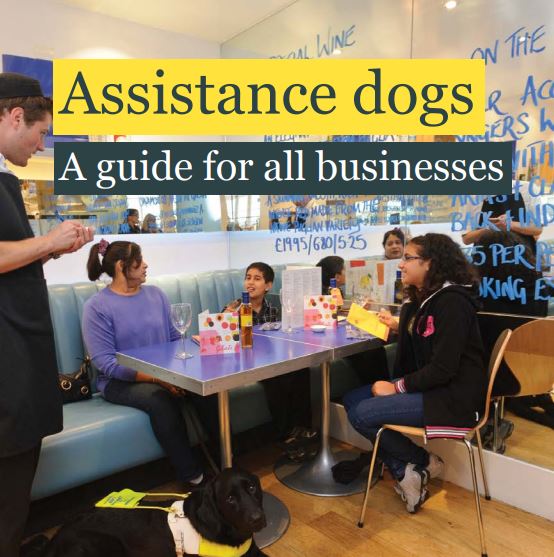
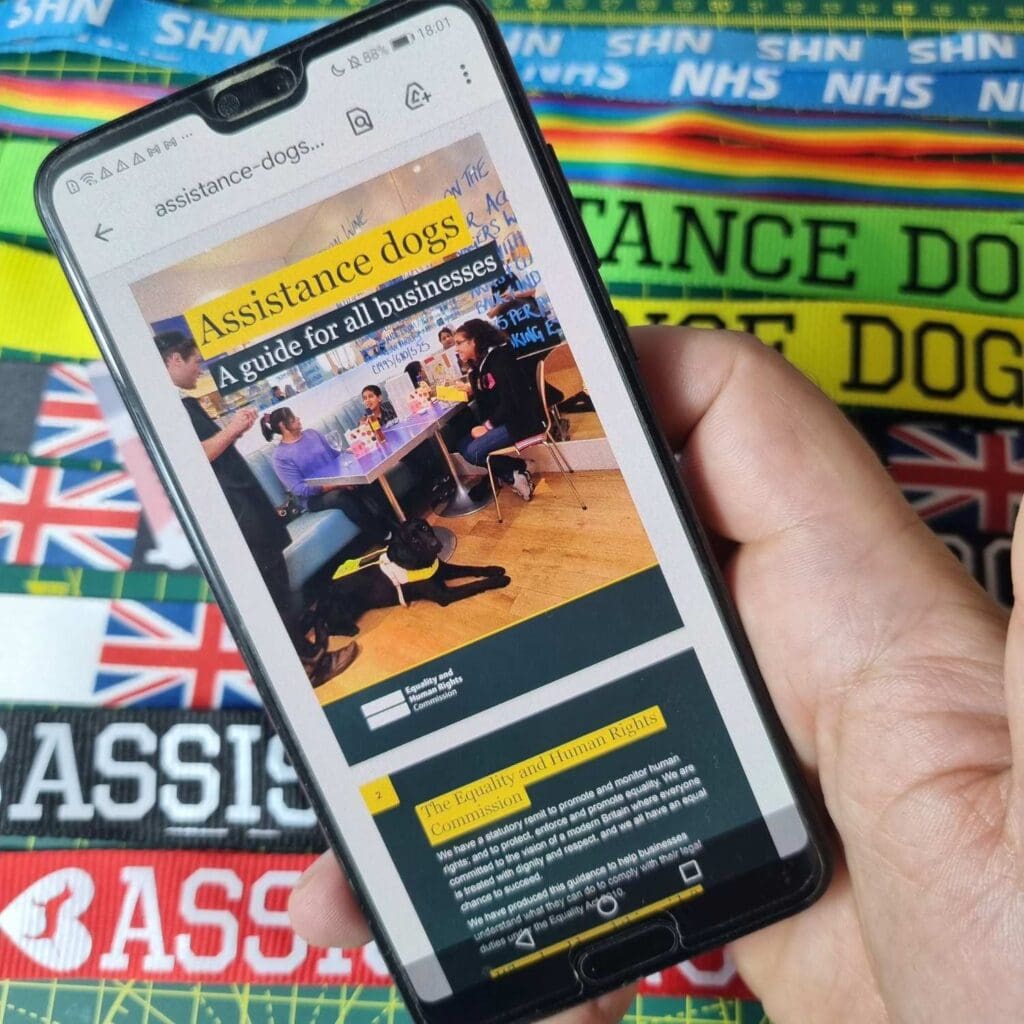
assistance-dogs-a-guide-for-all-businesses
Read more

£7,000 for Assistance Dog Registration?

August 18, 2025
Voluntary Registration vs. Expensive Scams

Many people in the UK have been told they must pay thousands of pounds to “register” or “train” their dog as an assistance dog. One customer recently shared that she was quoted over £7,000 by an organisation claiming to “officially register” her dog.

The truth is simple: you do not need to pay thousands to have a recognised assistance dog in the UK.


What the Law Says About Assistance Dogs in the UK

Under the Equality Act 2010, assistance dogs are recognised based on what they do, not who trained them or how much you paid.

  • There is no official government register for assistance dogs.
  • You are legally allowed to train your own dog, as long as it meets behaviour and task standards.
  • Businesses and service providers must make reasonable adjustments so disabled people with assistance dogs are not discriminated against.

✅ In other words: you do not need to spend thousands to be legally protected.


Why Do Some Organisations Charge So Much?

Some organisations take advantage of the lack of public knowledge about assistance dog law. They market themselves as “official” or “government-approved” registries, when in reality no such thing exists in the UK.

These groups often:

  • Use official-sounding names or government-style logos to appear legitimate.
  • Promise “certificates,” “licenses,” or “official registrations” for thousands of pounds.
  • Claim your dog won’t be recognised in public unless you pay their fees.
  • Pressure vulnerable people by suggesting they could be refused access without their service.

👉 The reality: these are misleading claims. Paying £5,000–£7,000 does not give your dog any more legal rights than the Equality Act 2010 already provides.

Unfortunately, many disabled people already under financial strain feel forced into paying these fees because they believe it’s the only way to protect themselves. Some later discover they have been scammed when businesses still refuse entry, despite their “official” papers.

Red Flags to Watch For

  • Any organisation claiming to be “government-approved.”
  • Being asked for thousands of pounds for “registration” or “recognition.”
  • Promises of special access rights that go beyond the Equality Act 2010.
  • Pressure tactics, such as suggesting you could lose your legal protection without paying.

✅ Remember: your rights come from UK law, not from private companies.


What’s the Affordable Alternative?

While you don’t need to register your dog, many handlers choose voluntary registration as a supportive tool.

At AssistanceDogRegistry.co.uk, you can:

  • Receive smart ID cards and dog tags linked to an online profile.
  • Show proof instantly to the public and service providers.
  • Gain confidence and peace of mind in daily life.

💡 Our packages start from under £100 - not thousands.

Lifetime Assistance Dog Package

Why More Handlers Are Registering Voluntarily

Voluntary registration is especially helpful for:

  • Owner-trained assistance dogs
  • Handlers with invisible disabilities
  • People who face regular public access issues
  • Anyone who wants to avoid confrontation or stress

Your dog’s rights don’t change,but the way others treat you can.


Real Feedback from UK Handlers

“Before I registered, I was challenged everywhere. Now, I just show my card or let them scan the tag—problem solved.”
Alex, Autism Assistance Dog Handler

“The lifetime option paid off within a month. I’ve never had to argue with shop staff again.”
Melanie, Chronic Illness Handler

“I feel safer knowing if something happens to me, people can scan Max’s tag and see his ICE contact and allergy notes.”
James, PTSD Handler


Assistance Dog Registry UK Plans Which One’s Right for You?

We offer three flexible options:

🟩 Lifetime Package (Most Popular)

  • One-time payment
  • 4 Smart ID Cards (Dog + Handler)
  • 3 QR-Enabled Dog Tags
  • 2 Card Holders
  • Hi-Vis Dog & Handler Vests
  • Full Profile Access + Emergency Info
  • Free Replacement Card

🟨 Annual Premium

  • Renewed each year
  • Includes cards, tags, lanyard, and profile access
  • Flexible updates anytime

🟧 Monthly Premium

  • Budget-friendly monthly option
  • All the same tools spread the cost
  • Cancel anytime

👉 View Lifetime Package
👉 Compare All Plans


Do You Really Need to Register? Final Thoughts

Voluntary registration is not legally required but it offers powerful benefits:

✅ Faster public access
✅ Fewer arguments
✅ Emergency protection
✅ Peace of mind

If you're tired of being questioned, explaining yourself, or worrying in public spaces registration can be your daily support system.


Register once. Reduce stress forever.
Join the growing number of UK handlers who’ve said:
"It’s not about proving your right it’s about making life easier."


Our Assistance Dog Registry offers smart, professional tools to help you:

  • Instantly show your dog’s role and legal rights with Smart ID Cards
  • Provide staff with proof via a QR Code linked to the Equality Act 2010
  • Present your custom dog profile and handler details in seconds
  • Wear your support gear with confidence (lanyard, dog tags, vest)
  • Enjoy the benefits of voluntary registration that supports your rights without replacing or contradicting the law

Stay Confident This Summer

You deserve peace of mind when you're out enjoying the sunshine. With proper registration and public-friendly ID tools, you can confidently navigate the spaces where others still need educating.

Register your assistance dog today and enjoy every sunny moment without setbacks.

🎟️ Sign Up for the Lifetime Package Today

💡 Click here to learn more & register


FAQ

1. What is an assistance dog?

An assistance dog is trained to perform specific tasks to aid individuals with disabilities, enhancing their independence and quality of life.

Wikipedia

2. Why is socialization important for assistance dogs?

Proper socialization ensures assistance dogs remain calm, focused, and well-behaved in various public settings, enabling them to perform their duties effectively.

3. At what age should I start socializing my assistance dog?

It's beneficial to begin socialization during puppyhood; however, with patience and consistent training, dogs of any age can learn to navigate public environments confidently.

4. How long does it take to socialize an assistance dog?

The duration varies based on the dog's temperament, previous experiences, and the consistency of training. Regular, positive exposure to different environments is key.

5. Can I socialize my assistance dog if they are older?

Yes, older dogs can be socialized successfully. While it may require more time and patience, with positive reinforcement, they can adapt to new situations.

6. What should I do if my assistance dog shows fear in public?

If your dog exhibits fear, calmly remove them from the situation and gradually reintroduce the stimulus at a comfortable distance, rewarding calm behavior.

7. How do I handle public distractions during training?

Teach focus commands like "watch me" to redirect your dog's attention. Gradual exposure to distractions, paired with positive reinforcement, can improve focus.

8. Are there specific public places ideal for socialization?

Begin with quiet areas like parks, then progress to busier environments such as cafes, public transport, and shopping centres as your dog becomes more comfortable.

9. How can I ensure my assistance dog behaves appropriately around other animals?

Controlled introductions and rewarding calm behaviour are essential. Consistent training helps your dog remain focused on their tasks, even around other animals.

10. What are the legal requirements for assistance dogs in public places?

In many regions, assistance dogs are permitted in public areas to support their handlers. It's important to familiarize yourself with local laws and regulations regarding assistance dogs.

Learn more about our Lifelong Partner Package

Learn More – Additional Assistance Dog Letter Templates

If you found this travel guide useful, you may also benefit from these other essential assistance dog letter templates we’ve published:

📌 Housing Accommodation Request Letter – Need to request reasonable accommodation from your landlord? This template ensures your rights under the Equality Act 2010 are respected.

📌 Workplace Assistance Dog Request Letter – If you need accommodations to bring your assistance dog to work, this letter outlines your legal rights and reasonable adjustments your employer should consider.

📌 Medical Confirmation of Need for an Assistance Dog – A doctor’s letter template to confirm your need for an assistance dog for public access, travel, and daily life.

🔹 More templates are coming soon! Let us know if you have specific needs, and we’ll create more resources to support assistance dog handlers.

Read more

Should You Register Your Assistance Dog in the UK?

August 1, 2025
Voluntary Registration vs. No Registration What’s Best for You?

In the UK, registering your assistance dog is completely voluntary. You don’t need a license or government approval to have your rights under the Equality Act 2010.

However, many handlers choose to register their dog through a voluntary registry like AssistanceDogRegistry.co.uk to make everyday life easier and more secure.


What You Get with a Voluntary Assistance Dog Registration

When you register your dog with AssistanceDogRegistry.co.uk, you receive:

  • Smart Assistance Dog ID Cards (for both dog and handler)
  • NFC and QR-Enabled Dog Tags (link to your dog's profile)
  • Full Online Profile Access
  • Emergency Contact Info accessible via QR
  • Hi-Vis Vest and Lanyard for visibility and safety

These tools are designed to reduce confrontation, improve public understanding, and give you peace of mind.


Voluntary Registration vs. Not Registering

Here’s how they compare in real life:

SituationWith RegistrationWithout Registration
Public access challengesShow card or tap tag doneMay need to explain your rights
Dealing with staff or securityFast visual trustRisk of refusal or questions
In emergenciesQR links to ICE contacts and medical infoNo external access to vital info
Emotional impactMore confidence and less anxietyMay feel under pressure
First impressionsLooks official, avoids debateMay be questioned more often
Lifetime Assistance Dog Package

Why More Handlers Are Registering Voluntarily

Voluntary registration is especially helpful for:

  • Owner-trained assistance dogs
  • Handlers with invisible disabilities
  • People who face regular public access issues
  • Anyone who wants to avoid confrontation or stress

Your dog’s rights don’t change,but the way others treat you can.


Real Feedback from UK Handlers

“Before I registered, I was challenged everywhere. Now, I just show my card or let them scan the tag—problem solved.”
Alex, Autism Assistance Dog Handler

“The lifetime option paid off within a month. I’ve never had to argue with shop staff again.”
Melanie, Chronic Illness Handler

“I feel safer knowing if something happens to me, people can scan Max’s tag and see his ICE contact and allergy notes.”
James, PTSD Handler


Assistance Dog Registry UK Plans Which One’s Right for You?

We offer three flexible options:

🟩 Lifetime Package (Most Popular)

  • One-time payment
  • 4 Smart ID Cards (Dog + Handler)
  • 3 QR-Enabled Dog Tags
  • 2 Card Holders
  • Hi-Vis Dog & Handler Vests
  • Full Profile Access + Emergency Info
  • Free Replacement Card

🟨 Annual Premium

  • Renewed each year
  • Includes cards, tags, lanyard, and profile access
  • Flexible updates anytime

🟧 Monthly Premium

  • Budget-friendly monthly option
  • All the same tools spread the cost
  • Cancel anytime

👉 View Lifetime Package
👉 Compare All Plans


Do You Really Need to Register? Final Thoughts

Voluntary registration is not legally required but it offers powerful benefits:

✅ Faster public access
✅ Fewer arguments
✅ Emergency protection
✅ Peace of mind

If you're tired of being questioned, explaining yourself, or worrying in public spaces registration can be your daily support system.


Register once. Reduce stress forever.
Join the growing number of UK handlers who’ve said:
"It’s not about proving your right it’s about making life easier."


Our Assistance Dog Registry offers smart, professional tools to help you:

  • Instantly show your dog’s role and legal rights with Smart ID Cards
  • Provide staff with proof via a QR Code linked to the Equality Act 2010
  • Present your custom dog profile and handler details in seconds
  • Wear your support gear with confidence (lanyard, dog tags, vest)
  • Enjoy the benefits of voluntary registration that supports your rights without replacing or contradicting the law

Stay Confident This Summer

You deserve peace of mind when you're out enjoying the sunshine. With proper registration and public-friendly ID tools, you can confidently navigate the spaces where others still need educating.

Register your assistance dog today and enjoy every sunny moment without setbacks.

🎟️ Sign Up for the Lifetime Package Today

💡 Click here to learn more & register


FAQ

1. What is an assistance dog?

An assistance dog is trained to perform specific tasks to aid individuals with disabilities, enhancing their independence and quality of life.

Wikipedia

2. Why is socialization important for assistance dogs?

Proper socialization ensures assistance dogs remain calm, focused, and well-behaved in various public settings, enabling them to perform their duties effectively.

3. At what age should I start socializing my assistance dog?

It's beneficial to begin socialization during puppyhood; however, with patience and consistent training, dogs of any age can learn to navigate public environments confidently.

4. How long does it take to socialize an assistance dog?

The duration varies based on the dog's temperament, previous experiences, and the consistency of training. Regular, positive exposure to different environments is key.

5. Can I socialize my assistance dog if they are older?

Yes, older dogs can be socialized successfully. While it may require more time and patience, with positive reinforcement, they can adapt to new situations.

6. What should I do if my assistance dog shows fear in public?

If your dog exhibits fear, calmly remove them from the situation and gradually reintroduce the stimulus at a comfortable distance, rewarding calm behavior.

7. How do I handle public distractions during training?

Teach focus commands like "watch me" to redirect your dog's attention. Gradual exposure to distractions, paired with positive reinforcement, can improve focus.

8. Are there specific public places ideal for socialization?

Begin with quiet areas like parks, then progress to busier environments such as cafes, public transport, and shopping centres as your dog becomes more comfortable.

9. How can I ensure my assistance dog behaves appropriately around other animals?

Controlled introductions and rewarding calm behaviour are essential. Consistent training helps your dog remain focused on their tasks, even around other animals.

10. What are the legal requirements for assistance dogs in public places?

In many regions, assistance dogs are permitted in public areas to support their handlers. It's important to familiarize yourself with local laws and regulations regarding assistance dogs.

Learn more about our Lifelong Partner Package

Learn More – Additional Assistance Dog Letter Templates

If you found this travel guide useful, you may also benefit from these other essential assistance dog letter templates we’ve published:

📌 Housing Accommodation Request Letter – Need to request reasonable accommodation from your landlord? This template ensures your rights under the Equality Act 2010 are respected.

📌 Workplace Assistance Dog Request Letter – If you need accommodations to bring your assistance dog to work, this letter outlines your legal rights and reasonable adjustments your employer should consider.

📌 Medical Confirmation of Need for an Assistance Dog – A doctor’s letter template to confirm your need for an assistance dog for public access, travel, and daily life.

🔹 More templates are coming soon! Let us know if you have specific needs, and we’ll create more resources to support assistance dog handlers.

Read more

Summer Survival Guide for Assistance Dogs & Their Handlers

July 11, 2025
Assistance Dog Summer Safety Tips

1️⃣ Hydration Comes First

Always carry fresh, cool water for your dog—whether you're out for errands, training, or just a walk.
💧 Pro tip: Use a collapsible water bowl for easy access.


2️⃣ Watch Out for Hot Surfaces

Pavements and sand can burn your dog’s paws. Test the surface with your hand: if it’s too hot for you, it’s too hot for them.
🐾 Try walking during cooler hours—early mornings or evenings.


3️⃣ Keep Cool Indoors

Ensure your dog has a shady, well-ventilated space at home. Fans, cooling mats, or damp towels can help.
❄️ Never leave your dog in a parked car—temperatures rise fast, even with windows cracked.


4️⃣ Sun Protection Matters

Light-coloured or short-haired dogs can get sunburnt. Pet-safe sunscreen on their nose, ears, and belly can prevent burns.


5️⃣ Watch for Signs of Heatstroke

Be alert for:

  • Excessive panting or drooling
  • Lethargy
  • Vomiting
  • Weakness
    If you spot any of these, seek vet care immediately.

🎒 Don’t Forget Identification

Always make sure your dog wears their ID tag and carries their Assistance Dog ID Card.

Emergencies can happen, and proper identification helps keep your team together.


✅ Quick Checklist for Summer Outings:

  • 🧴 Water & collapsible bowl
  • 🐶 Cooling vest or mat
  • 🦴 Treats (heat-safe)
  • 🪪 Assistance Dog ID & Emergency Info
  • 🧢 Optional: Dog-safe sunscreen & paw balm

💡 Final Tip:

Every dog is different. Monitor your dog closely and adjust your plans based on their needs and the day’s conditions.


Our Assistance Dog Registry offers smart, professional tools to help you:

  • Instantly show your dog’s role and legal rights with Smart ID Cards
  • Provide staff with proof via a QR Code linked to the Equality Act 2010
  • Present your custom dog profile and handler details in seconds
  • Wear your support gear with confidence (lanyard, dog tags, vest)
  • Enjoy the benefits of voluntary registration that supports your rights without replacing or contradicting the law

Stay Confident This Summer

You deserve peace of mind when you're out enjoying the sunshine. With proper registration and public-friendly ID tools, you can confidently navigate the spaces where others still need educating.

Register your assistance dog today and enjoy every sunny moment without setbacks.

🎟️ Sign Up for the Lifetime Package Today

💡 Click here to learn more & register


FAQ

1. What is an assistance dog?

An assistance dog is trained to perform specific tasks to aid individuals with disabilities, enhancing their independence and quality of life.

Wikipedia

2. Why is socialization important for assistance dogs?

Proper socialization ensures assistance dogs remain calm, focused, and well-behaved in various public settings, enabling them to perform their duties effectively.

3. At what age should I start socializing my assistance dog?

It's beneficial to begin socialization during puppyhood; however, with patience and consistent training, dogs of any age can learn to navigate public environments confidently.

4. How long does it take to socialize an assistance dog?

The duration varies based on the dog's temperament, previous experiences, and the consistency of training. Regular, positive exposure to different environments is key.

5. Can I socialize my assistance dog if they are older?

Yes, older dogs can be socialized successfully. While it may require more time and patience, with positive reinforcement, they can adapt to new situations.

6. What should I do if my assistance dog shows fear in public?

If your dog exhibits fear, calmly remove them from the situation and gradually reintroduce the stimulus at a comfortable distance, rewarding calm behavior.

7. How do I handle public distractions during training?

Teach focus commands like "watch me" to redirect your dog's attention. Gradual exposure to distractions, paired with positive reinforcement, can improve focus.

8. Are there specific public places ideal for socialization?

Begin with quiet areas like parks, then progress to busier environments such as cafes, public transport, and shopping centres as your dog becomes more comfortable.

9. How can I ensure my assistance dog behaves appropriately around other animals?

Controlled introductions and rewarding calm behaviour are essential. Consistent training helps your dog remain focused on their tasks, even around other animals.

10. What are the legal requirements for assistance dogs in public places?

In many regions, assistance dogs are permitted in public areas to support their handlers. It's important to familiarize yourself with local laws and regulations regarding assistance dogs.

Learn more about our Lifelong Partner Package

Learn More – Additional Assistance Dog Letter Templates

If you found this travel guide useful, you may also benefit from these other essential assistance dog letter templates we’ve published:

📌 Housing Accommodation Request Letter – Need to request reasonable accommodation from your landlord? This template ensures your rights under the Equality Act 2010 are respected.

📌 Workplace Assistance Dog Request Letter – If you need accommodations to bring your assistance dog to work, this letter outlines your legal rights and reasonable adjustments your employer should consider.

📌 Medical Confirmation of Need for an Assistance Dog – A doctor’s letter template to confirm your need for an assistance dog for public access, travel, and daily life.

🔹 More templates are coming soon! Let us know if you have specific needs, and we’ll create more resources to support assistance dog handlers.

Read more

Your 2025 legal guide is now available

June 25, 2025
Assistance Dogs Still Being Refused?

If you’ve ever been refused entry to a shop, café, taxi, or doctor’s office because of your assistance dog this guide is for you.

Under the Equality Act 2010, you’re protected from discrimination. But the sad truth is: many people, including staff and business owners, don’t know the law. That’s why we created the 2025 Assistance Dog Rights Guide to give you clear, printable answers when you need them most.

✅ What's Inside the Free Guide:

  • What the Equality Act 2010 actually says
  • Answers for common public access challenges
  • How to handle staff or businesses that say “no dogs”
Assistance-Dog-Rights-Registry-Guide-2025-1

Our Assistance Dog Registry offers smart, professional tools to help you:

  • Instantly show your dog’s role and legal rights with Smart ID Cards
  • Provide staff with proof via a QR Code linked to the Equality Act 2010
  • Present your custom dog profile and handler details in seconds
  • Wear your support gear with confidence (lanyard, dog tags, vest)
  • Enjoy the benefits of voluntary registration that supports your rights without replacing or contradicting the law

🔗 Need Help Explaining the Law?

That’s exactly why we offer our Assistance Dog Info Cards, QR tags, and online profiles — to help you explain your rights quickly and clearly.

As we develop new partnerships, our goal is to give you even more legal power in your corner. Until then, keep standing strong — and remember, you’re not alone.What You Can Do Now

  1. Know your rights: You are protected under the Equality Act 2010.
  2. Be prepared: Don’t wait for a refusal to wish you had documentation.
  3. Register today: Our lifetime or monthly options come with everything you need to make public access smoother and less stressful.

Stay Confident This Summer

You deserve peace of mind when you're out enjoying the sunshine. With proper registration and public-friendly ID tools, you can confidently navigate the spaces where others still need educating.

Register your assistance dog today and enjoy every sunny moment without setbacks.

🎟️ Sign Up for the Lifetime Package Today

💡 Click here to learn more & register


FAQ

1. What is an assistance dog?

An assistance dog is trained to perform specific tasks to aid individuals with disabilities, enhancing their independence and quality of life.

Wikipedia

2. Why is socialization important for assistance dogs?

Proper socialization ensures assistance dogs remain calm, focused, and well-behaved in various public settings, enabling them to perform their duties effectively.

3. At what age should I start socializing my assistance dog?

It's beneficial to begin socialization during puppyhood; however, with patience and consistent training, dogs of any age can learn to navigate public environments confidently.

4. How long does it take to socialize an assistance dog?

The duration varies based on the dog's temperament, previous experiences, and the consistency of training. Regular, positive exposure to different environments is key.

5. Can I socialize my assistance dog if they are older?

Yes, older dogs can be socialized successfully. While it may require more time and patience, with positive reinforcement, they can adapt to new situations.

6. What should I do if my assistance dog shows fear in public?

If your dog exhibits fear, calmly remove them from the situation and gradually reintroduce the stimulus at a comfortable distance, rewarding calm behavior.

7. How do I handle public distractions during training?

Teach focus commands like "watch me" to redirect your dog's attention. Gradual exposure to distractions, paired with positive reinforcement, can improve focus.

8. Are there specific public places ideal for socialization?

Begin with quiet areas like parks, then progress to busier environments such as cafes, public transport, and shopping centres as your dog becomes more comfortable.

9. How can I ensure my assistance dog behaves appropriately around other animals?

Controlled introductions and rewarding calm behaviour are essential. Consistent training helps your dog remain focused on their tasks, even around other animals.

10. What are the legal requirements for assistance dogs in public places?

In many regions, assistance dogs are permitted in public areas to support their handlers. It's important to familiarize yourself with local laws and regulations regarding assistance dogs.

Learn more about our Lifelong Partner Package

Learn More – Additional Assistance Dog Letter Templates

If you found this travel guide useful, you may also benefit from these other essential assistance dog letter templates we’ve published:

📌 Housing Accommodation Request Letter – Need to request reasonable accommodation from your landlord? This template ensures your rights under the Equality Act 2010 are respected.

📌 Workplace Assistance Dog Request Letter – If you need accommodations to bring your assistance dog to work, this letter outlines your legal rights and reasonable adjustments your employer should consider.

📌 Medical Confirmation of Need for an Assistance Dog – A doctor’s letter template to confirm your need for an assistance dog for public access, travel, and daily life.

🔹 More templates are coming soon! Let us know if you have specific needs, and we’ll create more resources to support assistance dog handlers.

Read more

Legal Support on the Horizon

June 16, 2025
Assistance Dogs Still Being Refused?

We’re excited to share that Assistance Dog Registry is currently in discussions with a senior solicitor from a well-respected Human Rights law firm. While we can’t reveal names just yet, the focus of this potential collaboration is to bring stronger legal support and advocacy for individuals with owner-trained assistance dogs across the UK.

Why is this important?

Because every week, we hear from people who are denied entry into shops, taxis, or public spaces, even though they have a fully trained assistance dog and are protected by law under the Equality Act 2010.


What to Do If You’ve Been Illegally Refused Entry

Sadly, we’re hearing from more and more of you about being refused access to shops, taxis, cafés, housing, or other services simply for having an owner-trained assistance dog.

This is not just frustrating it may be illegal.
Under the Equality Act 2010, disabled people who rely on assistance dogs are protected from discrimination in most public settings. The law doesn’t require your dog to be trained by a charity. Owner-trained dogs are equally valid.

If you’re ever refused service, here’s what to do:


✅ Step-by-Step: If Someone Refuses You Entry

1. Stay calm and document the incident.
Take note of the time, location, business name, and who you spoke to. If possible, discreetly record video or audio. This can help later.

2. Politely explain your legal rights.
Let them know your dog is an assistance dog under the Equality Act 2010, and that you’re protected from discrimination regardless of where your dog was trained.

You can show your Assistance Dog Profile, tags, or support cards especially those linked to our registry.

3. Request the manager or owner.
In many cases, the staff simply don’t know the law. Speaking to someone higher up may resolve it.

4. Follow up in writing.
Send an email or letter to the business explaining what happened and referencing the Equality Act. Ask for a response. This creates a paper trail.

5. Report it.
You can report discrimination to:

  • Your local council (especially for taxis, housing, or public venues)
  • The Equality Advisory Support Service (EASS)
  • Citizens Advice
  • In some cases, the police (if you’re threatened or harassed)

Our Assistance Dog Registry offers smart, professional tools to help you:

  • Instantly show your dog’s role and legal rights with Smart ID Cards
  • Provide staff with proof via a QR Code linked to the Equality Act 2010
  • Present your custom dog profile and handler details in seconds
  • Wear your support gear with confidence (lanyard, dog tags, vest)
  • Enjoy the benefits of voluntary registration that supports your rights without replacing or contradicting the law

🔗 Need Help Explaining the Law?

That’s exactly why we offer our Assistance Dog Info Cards, QR tags, and online profiles — to help you explain your rights quickly and clearly.

As we develop new partnerships, our goal is to give you even more legal power in your corner. Until then, keep standing strong — and remember, you’re not alone.What You Can Do Now

  1. Know your rights: You are protected under the Equality Act 2010.
  2. Be prepared: Don’t wait for a refusal to wish you had documentation.
  3. Register today: Our lifetime or monthly options come with everything you need to make public access smoother and less stressful.

Stay Confident This Summer

You deserve peace of mind when you're out enjoying the sunshine. With proper registration and public-friendly ID tools, you can confidently navigate the spaces where others still need educating.

Register your assistance dog today and enjoy every sunny moment without setbacks.

🎟️ Sign Up for the Lifetime Package Today

💡 Click here to learn more & register


FAQ

1. What is an assistance dog?

An assistance dog is trained to perform specific tasks to aid individuals with disabilities, enhancing their independence and quality of life.

Wikipedia

2. Why is socialization important for assistance dogs?

Proper socialization ensures assistance dogs remain calm, focused, and well-behaved in various public settings, enabling them to perform their duties effectively.

3. At what age should I start socializing my assistance dog?

It's beneficial to begin socialization during puppyhood; however, with patience and consistent training, dogs of any age can learn to navigate public environments confidently.

4. How long does it take to socialize an assistance dog?

The duration varies based on the dog's temperament, previous experiences, and the consistency of training. Regular, positive exposure to different environments is key.

5. Can I socialize my assistance dog if they are older?

Yes, older dogs can be socialized successfully. While it may require more time and patience, with positive reinforcement, they can adapt to new situations.

6. What should I do if my assistance dog shows fear in public?

If your dog exhibits fear, calmly remove them from the situation and gradually reintroduce the stimulus at a comfortable distance, rewarding calm behavior.

7. How do I handle public distractions during training?

Teach focus commands like "watch me" to redirect your dog's attention. Gradual exposure to distractions, paired with positive reinforcement, can improve focus.

8. Are there specific public places ideal for socialization?

Begin with quiet areas like parks, then progress to busier environments such as cafes, public transport, and shopping centres as your dog becomes more comfortable.

9. How can I ensure my assistance dog behaves appropriately around other animals?

Controlled introductions and rewarding calm behaviour are essential. Consistent training helps your dog remain focused on their tasks, even around other animals.

10. What are the legal requirements for assistance dogs in public places?

In many regions, assistance dogs are permitted in public areas to support their handlers. It's important to familiarize yourself with local laws and regulations regarding assistance dogs.

Learn more about our Lifelong Partner Package

Learn More – Additional Assistance Dog Letter Templates

If you found this travel guide useful, you may also benefit from these other essential assistance dog letter templates we’ve published:

📌 Housing Accommodation Request Letter – Need to request reasonable accommodation from your landlord? This template ensures your rights under the Equality Act 2010 are respected.

📌 Workplace Assistance Dog Request Letter – If you need accommodations to bring your assistance dog to work, this letter outlines your legal rights and reasonable adjustments your employer should consider.

📌 Medical Confirmation of Need for an Assistance Dog – A doctor’s letter template to confirm your need for an assistance dog for public access, travel, and daily life.

🔹 More templates are coming soon! Let us know if you have specific needs, and we’ll create more resources to support assistance dog handlers.

Read more

Sunshine, Support, and Setbacks

May 15, 2025
Assistance Dogs Still Being Refused?

With spring and summer in full swing, there's no better time to enjoy the outdoors with your assistance dog. Whether it’s a trip to a festival, a stroll through the garden centre, or a coffee in the sun at your local pub, the warmer weather opens up a world of possibility. But sadly, not every place is as welcoming as it should be.

While the Equality Act 2010 protects your right to access public spaces with an assistance dog, many venues and businesses still misunderstand or overlook this law. That misunderstanding can turn a peaceful day into a stressful confrontation.


Common Places Where Handlers Still Face Refusals

Even in 2025, assistance dog handlers continue to be refused access in places like:

  • Outdoor Cafés & Beer Gardens (e.g., Wetherspoons)
  • Garden Centres & Plant Nurseries
  • High Street Clothing Stores
  • Supermarkets & Small Convenience Shops
  • Food Stalls with "No Dogs" Signs
  • Open-Air Events or Local Community Fairs
  • Train & Bus Services with Uninformed Staff
  • Campsites & Caravan Parks

These are all places where public access should be granted, yet misunderstandings persist. Being caught off guard can be upsetting — especially if you're just trying to enjoy a normal day out.


You Shouldn't Have to Choose Between Fresh Air and Your Support

Your assistance dog is essential to your independence. You’ve put in the time and training, and you shouldn’t have to justify yourself at every door. That’s where proof of registration and legal clarity can make all the difference.

Many people still believe that assistance dogs must be trained by a charity or organization. However, in the UK, owner-trained assistance dogs are fully legal and protected under the Equality Act 2010, as long as the dog is trained to mitigate a disability.

To support handlers of owner-trained assistance dogs, we offer a voluntary registration service that gives you the tools you need to help educate others and avoid unnecessary confrontations. Our registry does not certify or license dogs, because that is not required by UK law. Instead, it provides helpful documentation and smart identification tools that make life easier for handlers.

Our Assistance Dog Registry offers smart, professional tools to help you:

  • Instantly show your dog’s role and legal rights with Smart ID Cards
  • Provide staff with proof via a QR Code linked to the Equality Act 2010
  • Present your custom dog profile and handler details in seconds
  • Wear your support gear with confidence (lanyard, dog tags, vest)
  • Enjoy the benefits of voluntary registration that supports your rights without replacing or contradicting the law

What You Can Do Now

  1. Know your rights: You are protected under the Equality Act 2010.
  2. Be prepared: Don’t wait for a refusal to wish you had documentation.
  3. Register today: Our lifetime or monthly options come with everything you need to make public access smoother and less stressful.

Stay Confident This Summer

You deserve peace of mind when you're out enjoying the sunshine. With proper registration and public-friendly ID tools, you can confidently navigate the spaces where others still need educating.

Register your assistance dog today and enjoy every sunny moment without setbacks.

🎟️ Sign Up for the Lifetime Package Today

💡 Click here to learn more & register


FAQ

1. What is an assistance dog?

An assistance dog is trained to perform specific tasks to aid individuals with disabilities, enhancing their independence and quality of life.

Wikipedia

2. Why is socialization important for assistance dogs?

Proper socialization ensures assistance dogs remain calm, focused, and well-behaved in various public settings, enabling them to perform their duties effectively.

3. At what age should I start socializing my assistance dog?

It's beneficial to begin socialization during puppyhood; however, with patience and consistent training, dogs of any age can learn to navigate public environments confidently.

4. How long does it take to socialize an assistance dog?

The duration varies based on the dog's temperament, previous experiences, and the consistency of training. Regular, positive exposure to different environments is key.

5. Can I socialize my assistance dog if they are older?

Yes, older dogs can be socialized successfully. While it may require more time and patience, with positive reinforcement, they can adapt to new situations.

6. What should I do if my assistance dog shows fear in public?

If your dog exhibits fear, calmly remove them from the situation and gradually reintroduce the stimulus at a comfortable distance, rewarding calm behavior.

7. How do I handle public distractions during training?

Teach focus commands like "watch me" to redirect your dog's attention. Gradual exposure to distractions, paired with positive reinforcement, can improve focus.

8. Are there specific public places ideal for socialization?

Begin with quiet areas like parks, then progress to busier environments such as cafes, public transport, and shopping centres as your dog becomes more comfortable.

9. How can I ensure my assistance dog behaves appropriately around other animals?

Controlled introductions and rewarding calm behaviour are essential. Consistent training helps your dog remain focused on their tasks, even around other animals.

10. What are the legal requirements for assistance dogs in public places?

In many regions, assistance dogs are permitted in public areas to support their handlers. It's important to familiarize yourself with local laws and regulations regarding assistance dogs.

Learn more about our Lifelong Partner Package

Learn More – Additional Assistance Dog Letter Templates

If you found this travel guide useful, you may also benefit from these other essential assistance dog letter templates we’ve published:

📌 Housing Accommodation Request Letter – Need to request reasonable accommodation from your landlord? This template ensures your rights under the Equality Act 2010 are respected.

📌 Workplace Assistance Dog Request Letter – If you need accommodations to bring your assistance dog to work, this letter outlines your legal rights and reasonable adjustments your employer should consider.

📌 Medical Confirmation of Need for an Assistance Dog – A doctor’s letter template to confirm your need for an assistance dog for public access, travel, and daily life.

🔹 More templates are coming soon! Let us know if you have specific needs, and we’ll create more resources to support assistance dog handlers.

Read more

Can a Pub Refuse Your Assistance Dog?

May 12, 2025
Why Wetherspoon's Policy May Be Illegal

Imagine relying on your assistance dog to manage daily life, only to be refused entry to a pub. Sadly, this scenario happens more often than it should — and recent incidents involving Wetherspoon pubs have highlighted a troubling pattern. But what does the law actually say? When is a refusal illegal? And most importantly, what can you do if this happens to you?

In this post, we’ll break down the legal rights of assistance dog owners, use Wetherspoon as a case study, and give you practical steps to take when you're faced with an unlawful refusal.

assistance-dogs-a-guide-for-all-businesses

What the Equality Act 2010 Says The Equality Act 2010 is the main piece of legislation protecting disabled individuals in the UK. It clearly states that service providers — including pubs, shops, and restaurants — must make "reasonable adjustments" to ensure people with disabilities can access their services. This includes allowing assistance dogs.

Crucially, the law does not require assistance dogs to be trained by a charity or Assistance Dogs UK (ADUK) member. Owner-trained assistance dogs are equally protected under the Equality Act. Denying access based on where a dog was trained is legally irrelevant.

Refusing entry to someone with a legitimate assistance dog can be classed as disability discrimination, which is illegal. In most cases, there are no valid exceptions.


Wetherspoon's Policy: Where They Get It Wrong Wetherspoon’s official website claims they only allow assistance dogs trained by ADUK-accredited charities. They state:

"The exceptions to the policy are trained guide dogs and also assistance dogs with Assistance Dogs UK-accredited training."

This wording is problematic because it excludes a significant number of owner-trained assistance dogs — dogs that are fully protected under UK law. This has led to multiple incidents where handlers have been refused service, even after explaining their rights.

One reported case involved a 13-year-old with fibromyalgia and PTSD being denied entry while using a registered assistance dog. In another case, a mental health support dog was refused and the handler was escorted out. These are not just unfortunate mistakes — they may be illegal actions.


How a Refusal Affects Assistance Dog Handlers Being denied access can be deeply distressing for someone who relies on an assistance dog. It can:

  • Trigger anxiety or PTSD symptoms
  • Cause public humiliation
  • Limit social inclusion
  • Reinforce stigma and misunderstanding

More than that, it shows a complete lack of understanding of the Equality Act. These refusals suggest that some businesses prioritize internal policy over legal rights — a dangerous and discriminatory approach.


What You Can Do If You Are Refused If you’re ever refused entry to a pub, including a Wetherspoon location, follow these steps:

  1. Stay calm and ask to speak to a manager.
    • Explain that your dog is an assistance dog and the refusal may be unlawful under the Equality Act.
  2. Carry supporting proof.
    • While not legally required, an ID card, QR code linked to your online profile, or vest that says "Assistance Dog" can help clarify things.
  3. Ask the manager to review the Equality Act.
    • Many are simply uninformed, and a polite reminder of the law may resolve the situation.
  4. Document the refusal.
    • Record names, times, and what was said. Take photos if needed. Ask for written confirmation of the refusal.
  5. File a formal complaint.
    • Contact the head office of the company in writing. Detail the event and cite the Equality Act.
  6. Report it to the Equality Advisory Support Service (EASS).
    • The EASS provides free legal advice and may help escalate the issue.
  7. Seek public support if necessary.
    • Social media attention often prompts quicker responses. Use it strategically, not emotionally.

Your Rights as an Owner-Trained Assistance Dog Handler Wetherspoon’s reliance on ADUK accreditation is misleading. Many owner-trained dogs meet or exceed the standards of charity-trained dogs. They are trained to assist with real disabilities and have the same public access rights.

You do not need a dog trained by Guide Dogs UK, Dogs for Good, or any other charity to have legal protection.

You do not need to carry a license, registration, or official certificate. The law is based on need and function, not paperwork.


Our Position at Assistance Dog Registry We believe every legitimate handler should be treated with dignity and equality. That’s why our registration platform supports owner-trained teams with:

  • Smart ID cards with QR code links to a secure handler profile
  • Custom dog tags, lanyards, and vest options
  • Educational content on public access laws

Our goal is not to “police” access, but to empower you with tools that promote understanding and reduce conflict.


Final Thoughts: It’s Time for Change When big brands like Wetherspoon misinterpret the law, they put vulnerable individuals at risk. Refusing an assistance dog is not just an inconvenience. It’s discriminatory and potentially unlawful.

If you’ve experienced a refusal, know that you have rights. Use your voice, document your experience, and demand better. The Equality Act is on your side — and so are we.

🎟️ Sign Up for the Lifetime Package Today

💡 Click here to learn more & register


FAQ

1. What is an assistance dog?

An assistance dog is trained to perform specific tasks to aid individuals with disabilities, enhancing their independence and quality of life.

Wikipedia

2. Why is socialization important for assistance dogs?

Proper socialization ensures assistance dogs remain calm, focused, and well-behaved in various public settings, enabling them to perform their duties effectively.

3. At what age should I start socializing my assistance dog?

It's beneficial to begin socialization during puppyhood; however, with patience and consistent training, dogs of any age can learn to navigate public environments confidently.

4. How long does it take to socialize an assistance dog?

The duration varies based on the dog's temperament, previous experiences, and the consistency of training. Regular, positive exposure to different environments is key.

5. Can I socialize my assistance dog if they are older?

Yes, older dogs can be socialized successfully. While it may require more time and patience, with positive reinforcement, they can adapt to new situations.

6. What should I do if my assistance dog shows fear in public?

If your dog exhibits fear, calmly remove them from the situation and gradually reintroduce the stimulus at a comfortable distance, rewarding calm behavior.

7. How do I handle public distractions during training?

Teach focus commands like "watch me" to redirect your dog's attention. Gradual exposure to distractions, paired with positive reinforcement, can improve focus.

8. Are there specific public places ideal for socialization?

Begin with quiet areas like parks, then progress to busier environments such as cafes, public transport, and shopping centres as your dog becomes more comfortable.

9. How can I ensure my assistance dog behaves appropriately around other animals?

Controlled introductions and rewarding calm behaviour are essential. Consistent training helps your dog remain focused on their tasks, even around other animals.

10. What are the legal requirements for assistance dogs in public places?

In many regions, assistance dogs are permitted in public areas to support their handlers. It's important to familiarize yourself with local laws and regulations regarding assistance dogs.

Learn more about our Lifelong Partner Package

Learn More – Additional Assistance Dog Letter Templates

If you found this travel guide useful, you may also benefit from these other essential assistance dog letter templates we’ve published:

📌 Housing Accommodation Request Letter – Need to request reasonable accommodation from your landlord? This template ensures your rights under the Equality Act 2010 are respected.

📌 Workplace Assistance Dog Request Letter – If you need accommodations to bring your assistance dog to work, this letter outlines your legal rights and reasonable adjustments your employer should consider.

📌 Medical Confirmation of Need for an Assistance Dog – A doctor’s letter template to confirm your need for an assistance dog for public access, travel, and daily life.

🔹 More templates are coming soon! Let us know if you have specific needs, and we’ll create more resources to support assistance dog handlers.

Read more

Your Dog Is More Than a Companion

May 8, 2025

Now Your Rights Are in Your Pocket.

Every day across the UK, thousands of disabled people rely on their assistance dogs for independence, support, and safety. These dogs are more than companions — they are a vital part of daily life. But too often, handlers face confusion or even discrimination from businesses that don’t understand the law.

That’s why we’ve made an important upgrade to every Assistance Dog Registry ID card: a built-in QR code linking directly to the official Equality and Human Rights Commission guide, “Assistance Dogs: A Guide for All Businesses.”

This blog explains:

  • What’s inside that guide
  • Why we linked it to every card
  • How this empowers handlers
  • And why ID cards and vests — while not legally required — remain essential tools for real-world access

🧾 What Is the PDF Guide?

This downloadable PDF, created by the Equality and Human Rights Commission, explains in plain terms how businesses must treat assistance dog handlers under the Equality Act 2010.

It’s designed for staff at shops, restaurants, hotels, taxis, banks, and more. It explains their legal obligations and what happens when those aren’t met.

assistance-dogs-a-guide-for-all-businesses

You can download the guide here:


📲 Why We Added a QR Code to Our ID Cards

We know from experience that even well-trained assistance dogs are sometimes challenged in public spaces. Many business owners still falsely believe that:

  • Only guide dogs are legally recognized
  • Assistance dogs must be trained by a charity
  • An ID card or vest is required for legal access

All of this is incorrect. But we also know that the burden of educating others shouldn't fall on you in stressful moments.

That’s why we embedded this official guide into your card with a QR code. One quick scan — and you can show the business exactly what the law says.


🔍 What the Guide Actually Says

Let’s break down the most important sections of the Equality and Human Rights Commission’s official guide — and how they affect you.


✅ 1. Owner-Trained Assistance Dogs Are Legal

“Assistance dogs can also be owner trained and the owner selects their own dog to fit their own requirements.” (Page 5)

You are not legally required to use an Assistance Dogs UK (ADUK) member charity to train your dog. Owner-trained dogs — provided they are trained to behave properly in public — are equally protected under the Equality Act.

This is essential for people with non-visible disabilities, PTSD, mobility needs, or complex conditions not supported by charity waitlists.


✅ 2. ID Cards and Vests Are Optional — But Still Valuable

“The law does not require the dog to wear a harness or jacket... Some users carry ID books... Again, this is not a legal requirement and assistance dog users should not be refused a service simply because they do not possess an ID book.” (Page 5)

Here’s the truth: the law doesn’t require you to wear a vest or carry a card. But reality is different. Without visual identification, you may be challenged more often — leading to awkward or confrontational moments.

That’s why most handlers still choose to carry:

  • An ID card to show their rights
  • A high-visibility vest for clarity in public
  • Dog tags and QR links to make education easier

These aren’t legal requirements — they’re tools for smoother, stress-free experiences.

✅ 3. “No Dogs” Policies Are Not Valid

    “A ‘no dogs’ policy will have a worse impact on disabled people using assistance dogs and could be indirect discrimination unless the policy can be objectively justified.” (Page 9)

This is one of the most misunderstood parts of the law. A business cannot use a “no dogs allowed” policy to refuse your entry. If they do, they could face legal claims under disability discrimination law.

Even if someone inside is allergic or has cultural concerns, the business must make reasonable adjustments — like separating seating — not banning you entirely

.

✅ 4. Emotional and Psychological Support Is Valid

    “Assistance dogs... can also provide emotional and psychological wellbeing and improve the confidence of disabled people who use them.” (Page 12)

Mental health matters. Whether your dog helps with panic attacks, PTSD, autism, anxiety, or another condition — you are protected.

There is no law stating that emotional support is not valid if it relates to a diagnosed disability that impacts your daily life.

🛡️ How Our Cards and Vests Help

Limited Time: Save £30 on the Premium Assistance Dog Plan

Today, we honour the courage, sacrifice, and resilience of all who fought for freedom. VE Day reminds us that strength often comes in silence — and in the loyal companionship of those who walk beside us, human or canine. 🐾
To mark this important day, we're offering a special VE Day Discount for our Lifetime Assistance Dog Registration Package — a small way to honour big sacrifices.
Use code VICTORY30 at checkout. 

valid until:10thof May 2025

Now that you understand what’s legally required — here’s why thousands of handlers still choose our tools.

🎟️ ID Cards with QR Code

    Easy to show in seconds

    Professionally designed for credibility

    Includes QR link to the official government guide

🦺 Hi-Vis Assistance Dog Vests

    Clear message for the public and businesses

    UK flag design and bold “Assistance Dog” label

    Optional customization for added clarity

🐶 Dog Tags with QR Access

    Small, discreet, and powerful

    Links directly to your dog’s online profile, including medical info and legal guidance

📝 Real Stories, Real Impact

Handlers have told us time and time again that these tools make all the difference:

    “Since I got the card and vest, I haven’t had a single issue in shops.”

    — Laura, Manchester

    “When a taxi driver questioned me, I showed him the QR code on the back of my card — and that was the end of it.”

    — James, Birmingham

It’s not about proving anything to the law. It’s about making daily life smoother, safer, and more respectful.

🐾 Take Action Today

We believe every assistance dog handler should feel empowered, protected, and confident in public.

Our Lifetime Assistance Dog Registration Package includes:

    Two NFC-enabled ID cards

    QR code linking to the official government guide

    Three laser-engraved dog tags

    Digital profile access

    Optional high-visibility vest

    Free card replacement if lost

🎟️ Sign Up for the Lifetime Package Today

💡 Click here to learn more & register


FAQ

1. What is an assistance dog?

An assistance dog is trained to perform specific tasks to aid individuals with disabilities, enhancing their independence and quality of life.

Wikipedia

2. Why is socialization important for assistance dogs?

Proper socialization ensures assistance dogs remain calm, focused, and well-behaved in various public settings, enabling them to perform their duties effectively.

3. At what age should I start socializing my assistance dog?

It's beneficial to begin socialization during puppyhood; however, with patience and consistent training, dogs of any age can learn to navigate public environments confidently.

4. How long does it take to socialize an assistance dog?

The duration varies based on the dog's temperament, previous experiences, and the consistency of training. Regular, positive exposure to different environments is key.

5. Can I socialize my assistance dog if they are older?

Yes, older dogs can be socialized successfully. While it may require more time and patience, with positive reinforcement, they can adapt to new situations.

6. What should I do if my assistance dog shows fear in public?

If your dog exhibits fear, calmly remove them from the situation and gradually reintroduce the stimulus at a comfortable distance, rewarding calm behavior.

7. How do I handle public distractions during training?

Teach focus commands like "watch me" to redirect your dog's attention. Gradual exposure to distractions, paired with positive reinforcement, can improve focus.

8. Are there specific public places ideal for socialization?

Begin with quiet areas like parks, then progress to busier environments such as cafes, public transport, and shopping centres as your dog becomes more comfortable.

9. How can I ensure my assistance dog behaves appropriately around other animals?

Controlled introductions and rewarding calm behaviour are essential. Consistent training helps your dog remain focused on their tasks, even around other animals.

10. What are the legal requirements for assistance dogs in public places?

In many regions, assistance dogs are permitted in public areas to support their handlers. It's important to familiarize yourself with local laws and regulations regarding assistance dogs.

Learn more about our Lifelong Partner Package

Learn More – Additional Assistance Dog Letter Templates

If you found this travel guide useful, you may also benefit from these other essential assistance dog letter templates we’ve published:

📌 Housing Accommodation Request Letter – Need to request reasonable accommodation from your landlord? This template ensures your rights under the Equality Act 2010 are respected.

📌 Workplace Assistance Dog Request Letter – If you need accommodations to bring your assistance dog to work, this letter outlines your legal rights and reasonable adjustments your employer should consider.

📌 Medical Confirmation of Need for an Assistance Dog – A doctor’s letter template to confirm your need for an assistance dog for public access, travel, and daily life.

🔹 More templates are coming soon! Let us know if you have specific needs, and we’ll create more resources to support assistance dog handlers.

Read more

How to Register Your Dog as an Assistance Dog in the UK

April 29, 2025

Have you ever wondered whether you can register your dog as an assistance dog in the United Kingdom?

You’re not alone. Many people—especially those living with invisible disabilities—rely on their dogs for daily support but don’t know where to start when it comes to formal recognition.

The good news is, the UK legal system already supports you more than you might think. And while there’s no official government register for assistance dogs, you can take steps to validate your dog’s role and protect your rights when accessing public places, shops, transport, and services.

In this blog, we’ll walk you through how to register your dog as an assistance dog, the legal framework behind it, and why many owners choose voluntary ID and registration options for peace of mind.


Understanding Assistance Dog Rights Under UK Law

Let’s start with the foundation: the Equality Act 2010. This legislation protects people with disabilities from discrimination and ensures they have equal access to goods, services, and facilities—including with their assistance dog.

Under this law:

  • You are not required to get your dog from a specific charity or organization.
  • There is no legal requirement to pass a formal test or certification.
  • You have a right to train your own dog, as long as it performs tasks that support your disability.

This may surprise some people. A lot of misinformation floats around online, and even some businesses believe only guide dogs or charity-issued dogs are legitimate. That’s simply not true under UK law.


Can I Train My Own Assistance Dog?

Yes, absolutely. In fact, many owners train their dogs themselves or work with professional dog trainers to create a plan tailored to their specific needs.

You know your condition better than anyone else. Whether your dog is trained to interrupt panic attacks, alert to sounds, assist with mobility, or provide grounding during episodes of PTSD—what matters is that they perform a task that directly helps you manage your disability.

There’s no government-issued test or license. What matters is the dog’s behaviour and training—especially in public.


So... No Certification At All?

Correct. There’s no official registry run by the government. But that doesn’t mean carrying proof isn’t helpful.

Many owners opt to use voluntary assistance dog ID cards, high-visibility vests, and NFC/QR code-linked profiles from reputable registries like ours at assistancedogregistry.co.uk. These tools provide:

  • Peace of mind when accessing public places
  • An easy way to explain your dog’s role to businesses or the public
  • A sense of security, especially for those with social anxiety or hidden disabilities
  • Emergency contact information, medical notes, and verification features linked to your dog’s profile

What Makes a Dog an “Assistance Dog”?

In the UK, an assistance dog is defined as a dog that has been trained to help a person with a disability. This help can be physical (mobility support), sensory (hearing or sight alerts), mental health-based (emotional regulation, panic interruption), or even a combination.

Examples of trained tasks include:

  • Picking up dropped items
  • Interrupting flashbacks or meltdowns
  • Providing balance or mobility support
  • Alerting to sounds or medical events

If your dog performs tasks that directly help you manage your condition, they can qualify as an assistance dog under the Equality Act.


Step-by-Step: How to Register with a Voluntary Registry

Since there’s no government-run process, the steps below explain how to take the most meaningful action to validate your dog’s status:

✅ Step 1: Make Sure Your Dog Is Well-Trained

Even without a formal test, you want to make sure your dog is calm, non-aggressive, responsive to commands, and well-behaved in public.

If you're still in training, that's okay too—as long as you're actively working on it.

✅ Step 2: Choose a Trusted Voluntary Registry

Registries like assistancedogregistry.co.uk provide custom ID cards, dog tags, online profiles, and more.

What you get:

Lifetime Assistance Dog Package

✅ Step 3: Complete the Online Application

This includes uploading your dog’s photo, adding your details, and describing the tasks your dog performs. You don’t need to submit medical records, but you’ll be asked to agree to a declaration that confirms your dog meets the legal criteria.

✅ Step 4: Choose a Package

You can select from digital-only options to physical packages including ID cards, tags, and lanyards. Many users choose the lifetime package to avoid recurring fees and benefit from free replacement cards if needed.


Why Register If It’s Not Required?

Great question. While not required by law, registration can:

  • Prevent confrontation: Business owners are more likely to respect your rights if you present clear identification.
  • Support training: Many public access issues arise during the training phase. An ID helps explain your dog’s role.
  • Assist in emergencies: Emergency personnel can access your NFC/QR profile if something happens to you.
  • Offer peace of mind: Especially for hidden disabilities like autism, anxiety, or PTSD, simply avoiding uncomfortable conversations can be worth it.

What If My Dog Is Still Young or in Training?

You can still register! Many owners register young dogs to help raise awareness early and ease access during the training period. It’s important that you continue working with your dog to ensure they remain well-behaved and responsive, but there’s no need to wait years before you get started.

Just be honest in your registration, and make sure your dog is wearing appropriate gear when in public.


Final Thoughts

Navigating assistance dog rights in the UK can be confusing—especially when businesses themselves aren’t fully informed. But don’t let that stop you. You have rights, and your dog plays a vital role in your independence and wellbeing.

At the Assistance Dog Registry, we’re here to support you with ID cards, tools, and resources that help bridge the gap between what the law allows—and what society expects.

Start your registration today and give your assistance dog the visibility they deserve.


✅ Ready to Register Your Dog?

Start your journey here-Create your profile. Order your card. Walk into public spaces with your head high.


🎟️ Sign Up for the Lifetime Package Today

💡 Click here to learn more & register


FAQ

1. What is an assistance dog?

An assistance dog is trained to perform specific tasks to aid individuals with disabilities, enhancing their independence and quality of life.

Wikipedia

2. Why is socialization important for assistance dogs?

Proper socialization ensures assistance dogs remain calm, focused, and well-behaved in various public settings, enabling them to perform their duties effectively.

3. At what age should I start socializing my assistance dog?

It's beneficial to begin socialization during puppyhood; however, with patience and consistent training, dogs of any age can learn to navigate public environments confidently.

4. How long does it take to socialize an assistance dog?

The duration varies based on the dog's temperament, previous experiences, and the consistency of training. Regular, positive exposure to different environments is key.

5. Can I socialize my assistance dog if they are older?

Yes, older dogs can be socialized successfully. While it may require more time and patience, with positive reinforcement, they can adapt to new situations.

6. What should I do if my assistance dog shows fear in public?

If your dog exhibits fear, calmly remove them from the situation and gradually reintroduce the stimulus at a comfortable distance, rewarding calm behavior.

7. How do I handle public distractions during training?

Teach focus commands like "watch me" to redirect your dog's attention. Gradual exposure to distractions, paired with positive reinforcement, can improve focus.

8. Are there specific public places ideal for socialization?

Begin with quiet areas like parks, then progress to busier environments such as cafes, public transport, and shopping centres as your dog becomes more comfortable.

9. How can I ensure my assistance dog behaves appropriately around other animals?

Controlled introductions and rewarding calm behaviour are essential. Consistent training helps your dog remain focused on their tasks, even around other animals.

10. What are the legal requirements for assistance dogs in public places?

In many regions, assistance dogs are permitted in public areas to support their handlers. It's important to familiarize yourself with local laws and regulations regarding assistance dogs.

Learn more about our Lifelong Partner Package

Learn More – Additional Assistance Dog Letter Templates

If you found this travel guide useful, you may also benefit from these other essential assistance dog letter templates we’ve published:

📌 Housing Accommodation Request Letter – Need to request reasonable accommodation from your landlord? This template ensures your rights under the Equality Act 2010 are respected.

📌 Workplace Assistance Dog Request Letter – If you need accommodations to bring your assistance dog to work, this letter outlines your legal rights and reasonable adjustments your employer should consider.

📌 Medical Confirmation of Need for an Assistance Dog – A doctor’s letter template to confirm your need for an assistance dog for public access, travel, and daily life.

🔹 More templates are coming soon! Let us know if you have specific needs, and we’ll create more resources to support assistance dog handlers.

Read more

Can Emotional Support Dogs Be Assistance Dogs in the UK?

April 22, 2025

If your dog helps with your mental health, the Equality Act may already protect you — here's how to make sure.

Sometimes, Healing Comes on Four Legs

Imagine this: You’re walking into a shop, dog by your side, heart racing. You’re not trying to cause a scene. You’re just trying to get groceries, maybe some fresh air, maybe take your mind off the panic that’s been sitting in your chest since 9am.

Then someone says, “Sorry, dogs aren’t allowed.”

Your hands go clammy. You stammer. You know your dog helps — with your anxiety, your PTSD, your depression — but how do you prove it?

Here’s the truth many people don’t realise:

If your dog supports your mental health in a way that helps manage a disability, it may already qualify as an assistance dog under the Equality Act 2010.

Let’s break it down.


🧠 What Is an Emotional Support Animal (ESA)?

An Emotional Support Animal (ESA) provides comfort and companionship that helps relieve symptoms of a mental health condition. While the UK doesn’t have a formal ESA legal status (unlike the USA), that doesn’t mean your dog has no protection.

In fact, in many cases, ESAs can meet the legal criteria of an assistance dog — as long as they’re trained to help you manage your condition.


📜 What the Equality Act 2010 Really Says

The Equality Act 2010 protects people with disabilities — including mental health conditions like:

  • Anxiety disorders
  • Depression
  • PTSD
  • Autism
  • OCD
  • Bipolar disorder
  • And many others

If your condition is long-term and has a substantial impact on daily life, it is legally recognised as a disability.

And here’s the key:

The law doesn’t restrict assistance dogs to guide dogs or those trained by charities.
You can train your dog yourself. And emotional support tasks can count.


🐕 When an ESA Becomes an Assistance Dog

If your dog is trained — even by you — to assist with your disability, then under UK law, it may be considered an assistance dog.

That means:

✅ You have a right to bring them into shops, cafés, public transport, and taxis
✅ Landlords can’t ban them under "no pets" rules
✅ You’re protected from discrimination

Examples of ESA tasks that qualify:

  • Grounding you during anxiety attacks
  • Interrupting harmful behaviours (like picking or panic spirals)
  • Providing deep pressure therapy by lying across your lap
  • Waking you from night terrors
  • Helping you stay calm in crowded public places

These aren’t “just comforting.” These are active support tasks — and they qualify under the law.


🎯 The Problem: Public Confusion and Lack of ID

Unfortunately, most businesses don’t know this.

They often assume only dogs from big-name charities like Guide Dogs are legitimate. This leads to:

  • Refusals at entrances
  • Embarrassing confrontations
  • Stress that defeats the purpose of the support dog

That’s why many ESA owners are choosing to register their dog as an assistance dog — and carry ID cards and supporting materials.

It’s not about “official registration” (because no government database exists).
It’s about educating others and protecting yourself.


🛡️ Why Register with the Assistance Dog Registry?

At AssistanceDogRegistry.co.uk, we help owner-trained assistance dog handlers:

  • 📘 Understand their legal rights
  • 🪪 Access personalised ID cards, tags, and vests
  • 🔒 Create an online profile linked to a QR code or NFC card
  • 💬 Communicate clearly in public spaces without confrontation

We’re not here to gatekeep. We’re here to empower.

Whether your dog provides emotional support or helps you in specific ways every day, we believe your story deserves to be seen and respected.


❤️ Real People, Real Impact

We’ve heard from hundreds of people just like you:

  • Veterans with PTSD whose dogs keep them grounded
  • Autistic adults who rely on their dog’s calm presence
  • Trauma survivors who can finally travel alone again
  • Young women facing panic attacks in supermarkets — until they wore a vest that said “Assistance Dog”

Every one of these people thought, “But my dog’s just an ESA.”

Until they realised: that’s all an assistance dog needs to be.


🐾 Still Wondering If Your ESA Qualifies?

Here are 3 questions to ask yourself:

  1. Does my dog help me manage a diagnosed condition or disability?
  2. Have I trained (or am I training) them to support me in public situations?
  3. Do they help me access daily life in ways I couldn’t do alone?

If the answer is yes — you’re not “faking” anything.

You’re protected. You deserve confidence, not conflict.


📢 Final Thought: Claim Your Rights — Without Fear

The world is slowly catching up. But you don’t need to wait.

Registering your emotional support dog as an assistance dog isn't cheating the system — it’s using the rights the system already gives you.

Because sometimes, healing really does come on four legs.
And healing deserves protection.


✅ Ready to Register Your Dog?

Start your journey here-Create your profile. Order your card. Walk into public spaces with your head high.


🎟️ Sign Up for the Lifetime Package Today

💡 Click here to learn more & register


FAQ

1. What is an assistance dog?

An assistance dog is trained to perform specific tasks to aid individuals with disabilities, enhancing their independence and quality of life.

Wikipedia

2. Why is socialization important for assistance dogs?

Proper socialization ensures assistance dogs remain calm, focused, and well-behaved in various public settings, enabling them to perform their duties effectively.

3. At what age should I start socializing my assistance dog?

It's beneficial to begin socialization during puppyhood; however, with patience and consistent training, dogs of any age can learn to navigate public environments confidently.

4. How long does it take to socialize an assistance dog?

The duration varies based on the dog's temperament, previous experiences, and the consistency of training. Regular, positive exposure to different environments is key.

5. Can I socialize my assistance dog if they are older?

Yes, older dogs can be socialized successfully. While it may require more time and patience, with positive reinforcement, they can adapt to new situations.

6. What should I do if my assistance dog shows fear in public?

If your dog exhibits fear, calmly remove them from the situation and gradually reintroduce the stimulus at a comfortable distance, rewarding calm behavior.

7. How do I handle public distractions during training?

Teach focus commands like "watch me" to redirect your dog's attention. Gradual exposure to distractions, paired with positive reinforcement, can improve focus.

8. Are there specific public places ideal for socialization?

Begin with quiet areas like parks, then progress to busier environments such as cafes, public transport, and shopping centres as your dog becomes more comfortable.

9. How can I ensure my assistance dog behaves appropriately around other animals?

Controlled introductions and rewarding calm behaviour are essential. Consistent training helps your dog remain focused on their tasks, even around other animals.

10. What are the legal requirements for assistance dogs in public places?

In many regions, assistance dogs are permitted in public areas to support their handlers. It's important to familiarize yourself with local laws and regulations regarding assistance dogs.

Learn more about our Lifelong Partner Package

Learn More – Additional Assistance Dog Letter Templates

If you found this travel guide useful, you may also benefit from these other essential assistance dog letter templates we’ve published:

📌 Housing Accommodation Request Letter – Need to request reasonable accommodation from your landlord? This template ensures your rights under the Equality Act 2010 are respected.

📌 Workplace Assistance Dog Request Letter – If you need accommodations to bring your assistance dog to work, this letter outlines your legal rights and reasonable adjustments your employer should consider.

📌 Medical Confirmation of Need for an Assistance Dog – A doctor’s letter template to confirm your need for an assistance dog for public access, travel, and daily life.

🔹 More templates are coming soon! Let us know if you have specific needs, and we’ll create more resources to support assistance dog handlers.

Read more

Why So Many Handlers Still Register with AssistanceDogRegistry.co.uk

April 17, 2025

Even though it’s not a legal requirement to register your assistance dog in the UK, thousands of handlers still choose to do it every year.

Here’s why:

Proof you can show instantly — With ID cards, dog tags, and NFC-enabled profiles, you never have to explain everything from scratch again.

Feel more confident in public — Many handlers say that having a professionally printed ID card with legal references gives them peace of mind when questioned.

No need to rely on a charity — Especially for owner-trained dogs, our voluntary registry gives you recognition and support.

Linked to real legal rights — Every card references the Equality Act 2010 and comes with a QR profile that handlers can update anytime.

Peace of mind for carers, parents, and vulnerable users — If anything happens, your dog's info and emergency contacts are accessible.

It's voluntary, ethical, and transparent — We make it clear that this is not a legal requirement. We’re here to support, not mislead.

So no — you don’t have to register. But here’s why doing so can help you take control of difficult public situations and feel more prepared.

Let’s break it down:


🚫 Is Registration Legally Required in the UK?

The short answer: No.

Under the Equality Act 2010, disabled people in the UK have the right to be accompanied by their assistance dog without needing any certificate, license, or official registration.

Your rights are based on your need — not a piece of paper.

However, this law is often misunderstood — by shop staff, security, taxi drivers, and even some local councils.

So even if you're fully protected under the law, you may still be challenged.

That's where registration can help, even if it’s not legally required.


😕 Why So Much Confusion?

Many handlers report things like:

  • “The restaurant manager asked for a certificate or ID card.”
  • “The bus driver said my dog needed to be charity-trained.”
  • “My GP said I need to register the dog with the council.”

These situations can be frustrating and emotionally draining.

And while you don’t have to show any proof, let’s be honest —

Sometimes it’s easier to show something than to argue your rights every single time.

That’s why so many people choose to register voluntarily — not to earn their rights, but to stand by them with more confidence.


✅ What You Get When You Register Voluntarily

At AssistanceDogRegistry.co.uk, we offer:

  • Four high-quality ID cards (for the dog + handler)
  • Three custom dog tags with QR codes
  • Assistance dog lanyard and card holders
  • HI viz vets for handler and assistance dog
  • Online profile you can update any time
  • NFC tap technology — show proof without logging in
  • Your rights printed clearly on the cards (Equality Act 2010)
  • Free replacement card if one is lost or damaged
  • A clear record in case of emergency

This is all part of our Lifetime Package, designed for handler-trained dogs and their real-life needs.


🧠 Real Reasons Handlers Choose to Register

Here’s what our users often say:

🗣️ “People used to question me all the time. Now they just see the badge and move on.”

🗣️ “I trained my own dog. I didn’t go through a charity. This gives me something that feels official — and it’s backed by law.”

🗣️ “I’ve had issues at airports and shops. With the tag and card, I’ve had fewer problems.”

🗣️ “Even though I know the law, I get less anxiety when I carry something with me.”

🗣️ “Having the QR code means if anything happens to me, emergency staff know what to do.”


🔍 Watch Out: Not All ‘Registries’ Are Equal

Unfortunately, some websites:

🚫 Mislead people into thinking registration is mandatory
🚫 Sell generic “service dog” badges with no UK legal basis
🚫 Don’t offer any actual profile or data backup
🚫 Aren’t transparent about what you're getting

We’re different:

  • We explain the law up front.
  • We don’t use scare tactics.
  • We offer real value — no gimmicks.
  • We operate from the UK and follow UK laws.

✉️ Real-World Example

A recent customer wrote to us saying:

“I was told by a council officer I needed to register. When I challenged them, they backed down — but it left me shaken. I signed up here because it gives me confidence to walk into public spaces again.”

Others have shared similar stories:

  • Denied access to taxis
  • Confronted by shop staff
  • Struggled to explain medical conditions

They didn’t need to register — but they’re glad they did.


🐾 Especially Useful for:

  • Owner-trained assistance dogs (no charity paperwork)
  • Autistic children and families needing quick recognition
  • Handlers with PTSD or invisible disabilities
  • People tired of being asked invasive questions

💬 In Summary: No, You Don’t Have To. But Here’s Why You Might Want To.

Registering your assistance dog with a voluntary service like ours is not about proving yourself.

It’s about protecting your peace.

It’s about avoiding confrontations.

And it’s about being ready, so your focus stays where it matters — on your own safety and wellbeing.


🎟️ Sign Up for the Lifetime Package Today

💡 Click here to learn more & register


FAQ

1. What is an assistance dog?

An assistance dog is trained to perform specific tasks to aid individuals with disabilities, enhancing their independence and quality of life.

Wikipedia

2. Why is socialization important for assistance dogs?

Proper socialization ensures assistance dogs remain calm, focused, and well-behaved in various public settings, enabling them to perform their duties effectively.

3. At what age should I start socializing my assistance dog?

It's beneficial to begin socialization during puppyhood; however, with patience and consistent training, dogs of any age can learn to navigate public environments confidently.

4. How long does it take to socialize an assistance dog?

The duration varies based on the dog's temperament, previous experiences, and the consistency of training. Regular, positive exposure to different environments is key.

5. Can I socialize my assistance dog if they are older?

Yes, older dogs can be socialized successfully. While it may require more time and patience, with positive reinforcement, they can adapt to new situations.

6. What should I do if my assistance dog shows fear in public?

If your dog exhibits fear, calmly remove them from the situation and gradually reintroduce the stimulus at a comfortable distance, rewarding calm behavior.

7. How do I handle public distractions during training?

Teach focus commands like "watch me" to redirect your dog's attention. Gradual exposure to distractions, paired with positive reinforcement, can improve focus.

8. Are there specific public places ideal for socialization?

Begin with quiet areas like parks, then progress to busier environments such as cafes, public transport, and shopping centres as your dog becomes more comfortable.

9. How can I ensure my assistance dog behaves appropriately around other animals?

Controlled introductions and rewarding calm behaviour are essential. Consistent training helps your dog remain focused on their tasks, even around other animals.

10. What are the legal requirements for assistance dogs in public places?

In many regions, assistance dogs are permitted in public areas to support their handlers. It's important to familiarize yourself with local laws and regulations regarding assistance dogs.

Learn more about our Lifelong Partner Package

Learn More – Additional Assistance Dog Letter Templates

If you found this travel guide useful, you may also benefit from these other essential assistance dog letter templates we’ve published:

📌 Housing Accommodation Request Letter – Need to request reasonable accommodation from your landlord? This template ensures your rights under the Equality Act 2010 are respected.

📌 Workplace Assistance Dog Request Letter – If you need accommodations to bring your assistance dog to work, this letter outlines your legal rights and reasonable adjustments your employer should consider.

📌 Medical Confirmation of Need for an Assistance Dog – A doctor’s letter template to confirm your need for an assistance dog for public access, travel, and daily life.

🔹 More templates are coming soon! Let us know if you have specific needs, and we’ll create more resources to support assistance dog handlers.

Read more

Man Refused Pub Entry Over Assistance Dog – What UK Law Really Says

April 14, 2025
A Recent Real-Life Incident Raises a Serious Question

A recent BBC report interviewed a man who was refused service at a Wetherspoon pub simply because he had an assistance dog. The staff didn’t recognise his rights, and the manager demanded ID that isn't required by law.

This real incident highlights a growing problem: many public venues still don’t understand the legal protections for assistance dog handlers.

Could this happen to you?
If you rely on an assistance dog—whether owner-trained or charity-trained—you need to know exactly where you stand. This guide explains your rights and what to do if they’re challenged.


What the Law Says About Assistance Dogs in the UK

Under the Equality Act 2010, disabled individuals in the UK have the legal right to be accompanied by an assistance dog in shops, restaurants, cafés, taxis, and all other public spaces.

Here’s what the law does not require:

  • You do not need to show ID for your dog
  • Your dog does not need to be trained by a registered charity
  • There is no official government-issued licence or certificate for assistance dogs

As long as your dog is trained to assist with a disability and behaves appropriately in public, you are legally protected.


Yes, Owner-Trained Assistance Dogs Are Legal

Many people still believe only charity-trained dogs qualify. This is false. The law protects all properly trained assistance dogs, including those trained by their owners.

This means:

  • You don't need to go through an organisation like Guide Dogs UK
  • If your dog is trained to perform tasks related to your disability and behaves well in public, your rights are protected

So Why Do These Incidents Keep Happening?

Because many businesses simply don’t know the law. They assume a lack of ID means the dog isn't legitimate. Unfortunately, this leads to illegal refusals, embarrassment, and discrimination—like what happened in the BBC story.


Voluntary ID Cards: Not Required, But Helpful

While you are not legally obligated to carry identification, many handlers choose to carry voluntary ID cards or wear a recognisable vest to:

  • Avoid confrontation
  • Educate others on the spot
  • Diffuse uncomfortable situations quickly
  • Provide peace of mind in public
Lifetime Access

How the Voluntary Assistance Dog Registry Helps

That’s exactly why we created AssistanceDogRegistry.co.uk. Our Lifetime Registration Package gives real handlers practical tools to reduce the chance of being questioned or denied access.

With our package, you’ll receive:

  • Two official ID cards (handler + dog)
  • QR- and NFC-linked dog tags with your profile
  • A secure online profile showing your assistance dog’s status
  • A lanyard, card holder, and optional vest
  • No subscription – one-time lifetime setup

While this does not replace legal rights, it gives you visible, convenient support to help educate others and protect your dignity in public spaces.

See the Lifetime Package Here »


What Should Businesses Know?

Businesses must understand that:

  • Asking for proof may breach the Equality Act
  • Denying entry to a legitimate assistance dog is discrimination
  • Not all disabilities are visible – and not all valid assistance dogs have a charity badge

Educating staff on these facts isn’t optional — it’s a legal and moral responsibility.


Final Thoughts

Disability shouldn’t come with humiliation.
But it will — unless we educate, clarify, and support each other.

If you or someone you love relies on an assistance dog, take a moment to know your rights — and consider tools that can help avoid confusion when it matters most.

Together, we can make public spaces safer and more respectful for those who rely on assistance dogs every day.

Important: The law does not require a dog to be trained by a charity. Owner-trained dogs are legally recognized as long as they perform specific tasks that assist with a disability.


🚫 Is Registration Legally Required? No. There is no legal requirement to register your assistance dog in the UK. Your rights are protected based on what your dog does, not whether they appear on a registry.


✅ So Why Register Voluntarily? While it's not mandatory, registering your dog can:

  • Provide easy-to-present proof via smart ID cards and tags
  • Help in public access situations
  • Offer support materials (law cards, housing letters, GP templates)
  • Include NFC cards and QR dog tags that link to your profile
  • Help recover your dog if lost

🌟 Spotlight: Lifelong Partnership Package One of our most popular options is the Lifelong Partnership Package, which includes:

  • Two smart ID cards
  • Dog tags with QR codes
  • Online profile with medical/emergency info
  • Lanyard, card holder, and high-visibility gear
  • One-time payment, no ongoing fees
  • Free yearly replacement card

📄 Busting Common Myths:

  • You don’t need to be trained by a charity to be legitimate
  • You don’t need government-issued certification
  • Businesses can’t legally refuse entry based on training source
  • Assistance dogs have legal protection under the Equality Act

🏡 Your Rights in Public and Housing Your dog is considered an auxiliary aid — like a wheelchair or hearing aid. That means:

  • Shops, restaurants, and services must grant you access
  • Landlords must make reasonable adjustments, even with "no pets" policies

🚩 Final Thoughts Whether you're training your own dog or using a professionally trained one, your rights matter. Tools like voluntary registration, ID cards, and digital profiles can make life easier and smoother for both you and your dog.

🎟️ Sign Up for the Lifetime Package Today

💡 Click here to learn more & register


FAQ

1. What is an assistance dog?

An assistance dog is trained to perform specific tasks to aid individuals with disabilities, enhancing their independence and quality of life.

Wikipedia

2. Why is socialization important for assistance dogs?

Proper socialization ensures assistance dogs remain calm, focused, and well-behaved in various public settings, enabling them to perform their duties effectively.

3. At what age should I start socializing my assistance dog?

It's beneficial to begin socialization during puppyhood; however, with patience and consistent training, dogs of any age can learn to navigate public environments confidently.

4. How long does it take to socialize an assistance dog?

The duration varies based on the dog's temperament, previous experiences, and the consistency of training. Regular, positive exposure to different environments is key.

5. Can I socialize my assistance dog if they are older?

Yes, older dogs can be socialized successfully. While it may require more time and patience, with positive reinforcement, they can adapt to new situations.

6. What should I do if my assistance dog shows fear in public?

If your dog exhibits fear, calmly remove them from the situation and gradually reintroduce the stimulus at a comfortable distance, rewarding calm behavior.

7. How do I handle public distractions during training?

Teach focus commands like "watch me" to redirect your dog's attention. Gradual exposure to distractions, paired with positive reinforcement, can improve focus.

8. Are there specific public places ideal for socialization?

Begin with quiet areas like parks, then progress to busier environments such as cafes, public transport, and shopping centres as your dog becomes more comfortable.

9. How can I ensure my assistance dog behaves appropriately around other animals?

Controlled introductions and rewarding calm behaviour are essential. Consistent training helps your dog remain focused on their tasks, even around other animals.

10. What are the legal requirements for assistance dogs in public places?

In many regions, assistance dogs are permitted in public areas to support their handlers. It's important to familiarize yourself with local laws and regulations regarding assistance dogs.

Important Assistance Dog Letter Templates

📌 Housing Accommodation Request Letter – Need to request reasonable accommodation from your landlord? This template ensures your rights under the Equality Act 2010 are respected.

📌 Workplace Assistance Dog Request Letter – If you need accommodations to bring your assistance dog to work, this letter outlines your legal rights and reasonable adjustments your employer should consider.

📌 Medical Confirmation of Need for an Assistance Dog – A doctor’s letter template to confirm your need for an assistance dog for public access, travel, and daily life.

Read more

Understanding Assistance Dogs in the UK:

March 27, 2025
Assistance dogs can change lives.

Whether you're already a handler or considering training your own dog, it's important to understand the legal protections, responsibilities, and benefits surrounding assistance dogs in the UK.

We've just released a new podcast episode that dives into the most common questions people have about assistance dogs, owner training, public access rights, and voluntary registration. This blog post recaps the key takeaways.

✨ Watch or Listen:

🔗 What Is an Assistance Dog in the UK? Under the Equality Act 2010, an assistance dog is defined as any dog trained to assist someone with a disability. This includes not only guide dogs for the visually impaired but also dogs trained to help with hearing impairments, mobility challenges, medical alerts (e.g., epilepsy or diabetes), PTSD, autism, and more.

Important: The law does not require a dog to be trained by a charity. Owner-trained dogs are legally recognized as long as they perform specific tasks that assist with a disability.


🚫 Is Registration Legally Required? No. There is no legal requirement to register your assistance dog in the UK. Your rights are protected based on what your dog does, not whether they appear on a registry.


✅ So Why Register Voluntarily? While it's not mandatory, registering your dog can:

  • Provide easy-to-present proof via smart ID cards and tags
  • Help in public access situations
  • Offer support materials (law cards, housing letters, GP templates)
  • Include NFC cards and QR dog tags that link to your profile
  • Help recover your dog if lost

🌟 Spotlight: Lifelong Partnership Package One of our most popular options is the Lifelong Partnership Package, which includes:

  • Two smart ID cards
  • Dog tags with QR codes
  • Online profile with medical/emergency info
  • Lanyard, card holder, and high-visibility gear
  • One-time payment, no ongoing fees
  • Free yearly replacement card

📄 Busting Common Myths:

  • You don’t need to be trained by a charity to be legitimate
  • You don’t need government-issued certification
  • Businesses can’t legally refuse entry based on training source
  • Assistance dogs have legal protection under the Equality Act

🏡 Your Rights in Public and Housing Your dog is considered an auxiliary aid — like a wheelchair or hearing aid. That means:

  • Shops, restaurants, and services must grant you access
  • Landlords must make reasonable adjustments, even with "no pets" policies

🚩 Final Thoughts Whether you're training your own dog or using a professionally trained one, your rights matter. Tools like voluntary registration, ID cards, and digital profiles can make life easier and smoother for both you and your dog.

🎟️ Sign Up for the Lifetime Package Today

💡 Click here to learn more & register


FAQ

1. What is an assistance dog?

An assistance dog is trained to perform specific tasks to aid individuals with disabilities, enhancing their independence and quality of life.

Wikipedia

2. Why is socialization important for assistance dogs?

Proper socialization ensures assistance dogs remain calm, focused, and well-behaved in various public settings, enabling them to perform their duties effectively.

3. At what age should I start socializing my assistance dog?

It's beneficial to begin socialization during puppyhood; however, with patience and consistent training, dogs of any age can learn to navigate public environments confidently.

4. How long does it take to socialize an assistance dog?

The duration varies based on the dog's temperament, previous experiences, and the consistency of training. Regular, positive exposure to different environments is key.

5. Can I socialize my assistance dog if they are older?

Yes, older dogs can be socialized successfully. While it may require more time and patience, with positive reinforcement, they can adapt to new situations.

6. What should I do if my assistance dog shows fear in public?

If your dog exhibits fear, calmly remove them from the situation and gradually reintroduce the stimulus at a comfortable distance, rewarding calm behavior.

7. How do I handle public distractions during training?

Teach focus commands like "watch me" to redirect your dog's attention. Gradual exposure to distractions, paired with positive reinforcement, can improve focus.

8. Are there specific public places ideal for socialization?

Begin with quiet areas like parks, then progress to busier environments such as cafes, public transport, and shopping centres as your dog becomes more comfortable.

9. How can I ensure my assistance dog behaves appropriately around other animals?

Controlled introductions and rewarding calm behaviour are essential. Consistent training helps your dog remain focused on their tasks, even around other animals.

10. What are the legal requirements for assistance dogs in public places?

In many regions, assistance dogs are permitted in public areas to support their handlers. It's important to familiarize yourself with local laws and regulations regarding assistance dogs.

Important Assistance Dog Letter Templates

📌 Housing Accommodation Request Letter – Need to request reasonable accommodation from your landlord? This template ensures your rights under the Equality Act 2010 are respected.

📌 Workplace Assistance Dog Request Letter – If you need accommodations to bring your assistance dog to work, this letter outlines your legal rights and reasonable adjustments your employer should consider.

📌 Medical Confirmation of Need for an Assistance Dog – A doctor’s letter template to confirm your need for an assistance dog for public access, travel, and daily life.

Read more

Unlock Your Journey: Essential Rights for UK Self-Trained Assistance Dogs

March 25, 2025
A Practical Legal Guide to Empowering Your Journey

Venture confidently into public spaces with your self-trained assistance dog, armed with the knowledge of your legal rights in the UK. This guide simplifies the complexities of the Equality Act 2010, focusing on how it supports you and your canine partner.

Understanding the Equality Act 2010:
At the heart of disability rights in the UK, the Equality Act 2010 is pivotal for assistance dog handlers. It guarantees that those relying on self-trained dogs receive the same access as professionally trained service animals, emphasizing inclusivity and accessibility.

Key Rights Under the Equality Act 2010:

  • Access to Public Spaces: Your right to enter public venues with your assistance dog is protected. Understand the few exceptions and how to navigate them.
  • Workplace Adaptations: Employers must accommodate your assistance dog, ensuring you can perform your job effectively.
  • Education and Housing Rights: From universities to rented homes, your rights to have your assistance dog by your side are clear and enforceable.

Navigating Challenges with Confidence:

  • Be Prepared: Carry a summary of your rights. Knowledge is power, and being able to articulate your rights can defuse potential conflicts.
  • Document Everything: Keep a log of your dog’s training and any incidents to support your position if challenged.

Immediate Steps If Denied Access:

  1. Record Details: Note what happened, who was involved, and where.
  2. Discuss: Talk to the establishment’s management calmly and clearly.
  3. Formal Complaint: Use template letters to draft a complaint if the issue isn’t resolved on the spot.
  4. Legal Support: Seek advice from entities like Citizens Advice if you need further assistance.
  5. Public Advocacy: Sharing your story can rally community support and drive change.

Why Register Your Assistance Dog?

While not mandatory, registration validates your dog’s status, facilitating smoother public interactions and providing access to a supportive community.

Conclusion:
Embrace your rights under the Equality Act 2010. With this guide, you’re equipped to face public spaces with your self-trained assistance dog not just as a companion, but as a recognized and respected part of your life.

🎟️ Sign Up for the Lifetime Package Today

💡 Click here to learn more & register


FAQ

1. What is an assistance dog?

An assistance dog is trained to perform specific tasks to aid individuals with disabilities, enhancing their independence and quality of life.

Wikipedia

2. Why is socialization important for assistance dogs?

Proper socialization ensures assistance dogs remain calm, focused, and well-behaved in various public settings, enabling them to perform their duties effectively.

3. At what age should I start socializing my assistance dog?

It's beneficial to begin socialization during puppyhood; however, with patience and consistent training, dogs of any age can learn to navigate public environments confidently.

4. How long does it take to socialize an assistance dog?

The duration varies based on the dog's temperament, previous experiences, and the consistency of training. Regular, positive exposure to different environments is key.

5. Can I socialize my assistance dog if they are older?

Yes, older dogs can be socialized successfully. While it may require more time and patience, with positive reinforcement, they can adapt to new situations.

6. What should I do if my assistance dog shows fear in public?

If your dog exhibits fear, calmly remove them from the situation and gradually reintroduce the stimulus at a comfortable distance, rewarding calm behavior.

7. How do I handle public distractions during training?

Teach focus commands like "watch me" to redirect your dog's attention. Gradual exposure to distractions, paired with positive reinforcement, can improve focus.

8. Are there specific public places ideal for socialization?

Begin with quiet areas like parks, then progress to busier environments such as cafes, public transport, and shopping centres as your dog becomes more comfortable.

9. How can I ensure my assistance dog behaves appropriately around other animals?

Controlled introductions and rewarding calm behaviour are essential. Consistent training helps your dog remain focused on their tasks, even around other animals.

10. What are the legal requirements for assistance dogs in public places?

In many regions, assistance dogs are permitted in public areas to support their handlers. It's important to familiarize yourself with local laws and regulations regarding assistance dogs.

Important Assistance Dog Letter Templates

📌 Housing Accommodation Request Letter – Need to request reasonable accommodation from your landlord? This template ensures your rights under the Equality Act 2010 are respected.

📌 Workplace Assistance Dog Request Letter – If you need accommodations to bring your assistance dog to work, this letter outlines your legal rights and reasonable adjustments your employer should consider.

📌 Medical Confirmation of Need for an Assistance Dog – A doctor’s letter template to confirm your need for an assistance dog for public access, travel, and daily life.

Read more

Training Tips for Owner-Trained Assistance Dogs: A Comprehensive Guide

March 20, 2025
Empowering Handlers to Successfully Train Their Service Companions

Introduction: Training an assistance dog on your own can be a rewarding yet challenging journey. This guide is designed to help handlers who choose to train their assistance dogs independently, providing them with essential tips and techniques to ensure their success. From basic obedience to specific task training, let’s explore how you can effectively train your future service companion.

Understanding the Basics: Before diving into training specifics, it’s crucial to understand what makes a good assistance dog. Traits such as calmness, intelligence, and a willingness to learn are foundational. Begin with basic obedience training, which is the cornerstone for any assistance dog. Commands like sit, stay, come, and heel should be mastered before moving on to more complex tasks.

Socialization and Exposure: One of the most important aspects of training an assistance dog is socialization. Expose your dog to different environments, people, and other animals as early and as often as possible. This exposure helps your dog become adaptable and comfortable in various situations, reducing anxiety or distraction in public spaces.

Task-Specific Training: Depending on your needs, your assistance dog will need to perform specific tasks. This could include retrieving objects, opening doors, or providing stability and support. Break down each task into small, manageable steps and train consistently. Use positive reinforcement such as treats, praise, and play to encourage and reward your dog.

Consistency and Patience: Consistency is key in any form of training. Set a regular training schedule and stick to it. Be patient and understanding—some days might be more challenging than others. Remember, training an assistance dog is a marathon, not a sprint, and building a strong, trusting relationship with your dog is essential.

Handling Distractions: Training your dog to handle distractions is crucial for an assistance dog. Gradually introduce distractions during training sessions, starting from minimal to more significant distractions. This teaches your dog to focus on you and the task at hand, regardless of the environment.

Health and Wellness: A healthy dog is a trainable dog. Ensure your assistance dog is well-cared for, with regular veterinary check-ups, a nutritious diet, and plenty of exercise. Mental health is just as important, so provide your dog with mental stimulation through toys, puzzles, and new challenges.

Record Keeping and Progress Tracking: Keep a training log to track your progress and any challenges you encounter. This can be invaluable for reviewing what works, what doesn’t, and adjusting your training methods accordingly.

Seeking Professional Help: While training your dog independently, don’t hesitate to seek professional help when needed. Attending workshops, consulting with professional trainers, or joining support groups can provide you with additional support and guidance.

Mastering the Recall Command: The recall command is one of the most important skills your assistance dog can learn. It ensures that your dog can return to you promptly in any situation, which is crucial for both safety and management. Effective training for recall includes:

  • Choosing a distinct command such as "come" or "here" and using a cheerful voice.
  • Starting in a controlled environment with few distractions and gradually introducing more.
  • Using positive reinforcements like treats, praise, or play when your dog comes to you.
  • Practicing with increasing distances and incorporating a long leash if needed.

Teaching 'Leave It' – A Vital Impulse Control Skill: "Leave it" is an essential command that helps prevent your dog from picking up dangerous or unwanted items. Steps to train this include:

  • Starting with a treat in your closed fist, say "leave it." Reward your dog from your other hand if they obey.
  • As your dog masters the skill, place the treat on the floor and cover it with your hand, continuing to use the "leave it" command.
  • Gradually move this practice to more realistic situations where you use the command to stop them from approaching real-life temptations.
  • Always reinforce the behavior with high-value rewards and ensure regular practice.

Conclusion: Training your own assistance dog is a profound journey that enhances the bond between you and your dog. By following these tips, you can equip your dog with the skills needed to assist you effectively. Remember, every dog is different, so adapt these strategies to suit your dog’s personality and capabilities.

🎟️ Sign Up for the Lifetime Package Today

💡 Click here to learn more & register


FAQ

1. What is an assistance dog?

An assistance dog is trained to perform specific tasks to aid individuals with disabilities, enhancing their independence and quality of life.

Wikipedia

2. Why is socialization important for assistance dogs?

Proper socialization ensures assistance dogs remain calm, focused, and well-behaved in various public settings, enabling them to perform their duties effectively.

3. At what age should I start socializing my assistance dog?

It's beneficial to begin socialization during puppyhood; however, with patience and consistent training, dogs of any age can learn to navigate public environments confidently.

4. How long does it take to socialize an assistance dog?

The duration varies based on the dog's temperament, previous experiences, and the consistency of training. Regular, positive exposure to different environments is key.

5. Can I socialize my assistance dog if they are older?

Yes, older dogs can be socialized successfully. While it may require more time and patience, with positive reinforcement, they can adapt to new situations.

6. What should I do if my assistance dog shows fear in public?

If your dog exhibits fear, calmly remove them from the situation and gradually reintroduce the stimulus at a comfortable distance, rewarding calm behavior.

7. How do I handle public distractions during training?

Teach focus commands like "watch me" to redirect your dog's attention. Gradual exposure to distractions, paired with positive reinforcement, can improve focus.

8. Are there specific public places ideal for socialization?

Begin with quiet areas like parks, then progress to busier environments such as cafes, public transport, and shopping centres as your dog becomes more comfortable.

9. How can I ensure my assistance dog behaves appropriately around other animals?

Controlled introductions and rewarding calm behaviour are essential. Consistent training helps your dog remain focused on their tasks, even around other animals.

10. What are the legal requirements for assistance dogs in public places?

In many regions, assistance dogs are permitted in public areas to support their handlers. It's important to familiarize yourself with local laws and regulations regarding assistance dogs.

Important Assistance Dog Letter Templates

📌 Housing Accommodation Request Letter – Need to request reasonable accommodation from your landlord? This template ensures your rights under the Equality Act 2010 are respected.

📌 Workplace Assistance Dog Request Letter – If you need accommodations to bring your assistance dog to work, this letter outlines your legal rights and reasonable adjustments your employer should consider.

📌 Medical Confirmation of Need for an Assistance Dog – A doctor’s letter template to confirm your need for an assistance dog for public access, travel, and daily life.

Read more

Owner-Trained vs. Charity-Trained Assistance Dogs: Which Path Is Right for You?

March 13, 2025
How to Ensure Your Owner-Trained Assistance Dog Is Accepted

Assistance dogs play a crucial role in helping people with disabilities lead more independent lives. Whether guiding visually impaired individuals, assisting with mobility, or providing medical alerts, these highly trained dogs make a significant impact. However, many people are unaware that assistance dogs can be owner-trained or charity-trained—each with its advantages and challenges.

In this blog post, we’ll explore the key differences between owner-trained and charity-trained assistance dogs, dispel common myths, and clarify legal rights under the Equality Act 2010 in the UK.

Understanding Assistance Dogs

An assistance dog is trained to perform specific tasks to assist an individual with a disability. These tasks can include:

  • Guiding a person with visual impairments
  • Alerting someone with hearing loss to important sounds
  • Providing mobility support for those with physical disabilities
  • Recognizing and responding to medical conditions such as epilepsy or diabetes
  • Offering psychiatric assistance for mental health conditions

While many people think only guide dogs or service dogs from charities qualify as assistance dogs, UK law does not require an assistance dog to be charity-trained to receive public access rights.

What Is a Charity-Trained Assistance Dog?

Charity-trained assistance dogs are professionally trained by non-profit organizations, such as:

  • Guide Dogs UK (for the visually impaired)
  • Hearing Dogs for Deaf People
  • Dogs for Good (for physical disabilities and autism support)
  • Canine Partners (for mobility assistance)

Benefits of a Charity-Trained Assistance Dog

  1. Highly Specialized Training – These dogs undergo extensive training (usually 18+ months) with professional trainers.
  2. No Upfront Cost – The dog is provided free of charge or at a minimal fee.
  3. Public Recognition & Acceptance – Many businesses recognize charity-trained assistance dogs, reducing access issues.
  4. Support & Ongoing Training – Handlers receive post-placement support from the charity.

Challenges of a Charity-Trained Assistance Dog

  1. Long Waiting Lists – Many charities have 2-4 year waiting periods due to high demand.
  2. Strict Eligibility Criteria – Applicants must meet specific medical and lifestyle requirements.
  3. Limited Training for Unique Disabilities – Charity-trained dogs focus on common disabilities, meaning some people might not qualify.
  4. No Control Over Dog Selection – Handlers do not get to choose their dog, as the charity matches dogs based on availability and suitability.

What Is an Owner-Trained Assistance Dog?

An owner-trained assistance dog is one that an individual personally trains to assist with their specific disability. Training can be done independently or with the help of professional dog trainers.

Benefits of an Owner-Trained Assistance Dog

  1. Customized Training – Owners can tailor training to fit their specific needs and daily lifestyle.
  2. No Waiting List – Handlers can start training immediately rather than waiting for a charity-trained dog.
  3. Choice of Dog – Owners can select a breed that best suits their disability and personal preferences.
  4. Lower Costs – While professional training courses may cost money, overall expenses are often lower than charity-trained programs.

Challenges of an Owner-Trained Assistance Dog

  1. Time & Commitment – It requires extensive dedication, often 1-2 years of consistent training.
  2. Knowledge & Expertise – Owners must learn about positive reinforcement, behavior shaping, and public access training.
  3. Public Acceptance Issues – Some businesses may be skeptical of owner-trained assistance dogs.
  4. No Official Certification Required in the UK – Some people assume that assistance dogs must be registered, which is false. However, owner-trained assistance dogs may face more public scrutiny.

Legal Rights of Assistance Dog Handlers in the UK

Under the Equality Act 2010, an assistance dog is legally recognized if:

  • The handler has a disability.
  • The dog is trained to perform specific tasks related to that disability.
  • The dog has been trained by either a professional organization or the owner.

Common Myths Debunked

Myth: Only Charity-Trained Dogs Are Legal Assistance Dogs ✔️ Fact: UK law does not require dogs to be trained by a charity. Owner-trained dogs are fully legal.

Myth: Assistance Dogs Must Be Certified ✔️ Fact: There is no legal certification or registration requirement for assistance dogs in the UK.

Myth: Businesses Can Refuse Entry to Owner-Trained Assistance Dogs ✔️ Fact: Under the Equality Act, businesses must allow access to assistance dogs, regardless of whether they were charity-trained or owner-trained.

How to Ensure Your Owner-Trained Assistance Dog Is Accepted

Even though the law protects owner-trained assistance dogs, education and preparation can help ensure smoother public access.

1. Train to High Public Access Standards

  • Ensure your dog is well-behaved in public settings.
  • Your dog should remain calm in busy environments and respond to commands reliably.

2. Have Proper Identification

  • While ID cards are not required, having an ID badge, vest, or documentation can reduce confrontations.
  • Our Assistance Dog Law Cards provide a clear explanation of your rights under the Equality Act 2010.

3. Educate Businesses

  • Many businesses simply don’t understand the law.
  • If challenged, politely explain that UK law does not require assistance dogs to be charity-trained.
  • Carry a law card or printed information to show staff.

Final Thoughts: Which Option Is Right for You?

The choice between an owner-trained and charity-trained assistance dog depends on your needs, lifestyle, and resources.

Choose a Charity-Trained Dog if: ✔️ You want a fully trained dog from a professional organization. ✔️ You are willing to wait several years for a placement. ✔️ You need ongoing support and guidance.

Choose an Owner-Trained Dog if: ✔️ You want full control over the training process. ✔️ You need a dog immediately and don’t want to wait for a charity placement. ✔️ You’re willing to invest time in learning proper training techniques.

Regardless of which path you choose, assistance dogs provide invaluable support for individuals with disabilities. If you’re considering training your own dog, be patient, stay committed, and know that you have legal rights protecting your access to public places.


dog is protected by law. If a landlord refuses, remind them of their legal obligations under the Equality Act 2010 and provide reasonable documentation. For added credibility, consider registering your assistance dog with our voluntary registry for ID cards, NFC verification, and legal support.

🎟️ Sign Up for the Lifetime Package Today

💡 Click here to learn more & register


FAQ

1. What is an assistance dog?

An assistance dog is trained to perform specific tasks to aid individuals with disabilities, enhancing their independence and quality of life.

Wikipedia

2. Why is socialization important for assistance dogs?

Proper socialization ensures assistance dogs remain calm, focused, and well-behaved in various public settings, enabling them to perform their duties effectively.

3. At what age should I start socializing my assistance dog?

It's beneficial to begin socialization during puppyhood; however, with patience and consistent training, dogs of any age can learn to navigate public environments confidently.

4. How long does it take to socialize an assistance dog?

The duration varies based on the dog's temperament, previous experiences, and the consistency of training. Regular, positive exposure to different environments is key.

5. Can I socialize my assistance dog if they are older?

Yes, older dogs can be socialized successfully. While it may require more time and patience, with positive reinforcement, they can adapt to new situations.

6. What should I do if my assistance dog shows fear in public?

If your dog exhibits fear, calmly remove them from the situation and gradually reintroduce the stimulus at a comfortable distance, rewarding calm behavior.

7. How do I handle public distractions during training?

Teach focus commands like "watch me" to redirect your dog's attention. Gradual exposure to distractions, paired with positive reinforcement, can improve focus.

8. Are there specific public places ideal for socialization?

Begin with quiet areas like parks, then progress to busier environments such as cafes, public transport, and shopping centres as your dog becomes more comfortable.

9. How can I ensure my assistance dog behaves appropriately around other animals?

Controlled introductions and rewarding calm behaviour are essential. Consistent training helps your dog remain focused on their tasks, even around other animals.

10. What are the legal requirements for assistance dogs in public places?

In many regions, assistance dogs are permitted in public areas to support their handlers. It's important to familiarize yourself with local laws and regulations regarding assistance dogs.

Important Assistance Dog Letter Templates

📌 Housing Accommodation Request Letter – Need to request reasonable accommodation from your landlord? This template ensures your rights under the Equality Act 2010 are respected.

📌 Workplace Assistance Dog Request Letter – If you need accommodations to bring your assistance dog to work, this letter outlines your legal rights and reasonable adjustments your employer should consider.

📌 Medical Confirmation of Need for an Assistance Dog – A doctor’s letter template to confirm your need for an assistance dog for public access, travel, and daily life.

Read more

Can Landlords Refuse Assistance Dogs?

March 12, 2025
Your Legal Rights Explained. Free letter templates below.

Many tenants with disabilities face challenges when renting a property, especially when landlords enforce strict ‘no pets’ policies. If you have an assistance dog, you might wonder—can a landlord refuse to accommodate my dog? The answer lies in your rights under the Equality Act 2010 and reasonable accommodations landlords are legally required to make.

Understanding Your Rights Under the Equality Act 2010

In the UK, the Equality Act 2010 protects individuals with disabilities from discrimination, ensuring they have equal access to housing, employment, and public services. This protection extends to assistance dogs, even if the property has a ‘no pets’ policy.

💡 Key Legal Protections:

  • Assistance dogs are not considered pets under the Equality Act 2010.
  • Landlords must make reasonable adjustments to allow tenants with disabilities to keep their assistance dogs.
  • It is unlawful to refuse tenancy solely because of an assistance dog.

What If a Landlord Says No?

If your landlord refuses to allow your assistance dog, you have several options:

  1. Educate Them on the Law – Many landlords are unaware that assistance dogs are legally protected. Providing them with information on the Equality Act 2010 can clarify their obligations.
  2. Provide Supporting Documents – While there is no legal requirement for registration, having ID cards, vet records, or a doctor’s letter confirming your need for an assistance dog can help.
  3. Seek Mediation – If the landlord is hesitant, offering to meet and discuss concerns can sometimes resolve issues amicably.
  4. File a Discrimination Complaint – If all else fails, you can contact the Equality Advisory and Support Service (EASS) or take legal action for discrimination.

How a Voluntary Assistance Dog Registration Can Help

While assistance dogs in the UK do not require official certification, many handlers find that having a recognized registration helps when dealing with landlords, travel companies, and businesses.

Latest Research & News Updates – Updates on recent legal cases, research findings, and news related to assistance dogs in the UK.

Personalized ID Cards & Dog Tags – Visibly identify your assistance dog.

NFC-Enabled Profile – Quick and easy verification with a smartphone.

Template: Request for Assistance Dog Accommodation Letter

If your landlord is hesitant about allowing your assistance dog, use this ready-to-download template to formally request accommodation and assert your legal rights.

Template 1:For registered dogs on assistancedogregistry.co.uk

Loader Loading...
EAD Logo Taking too long?

Reload Reload document
| Open Open in new tab

Template 2:Letter for non registered assistance dog.

Loader Loading...
EAD Logo Taking too long?

Reload Reload document
| Open Open in new tab

If you experience any issues accessing the templates, feel free to contact us at [email protected], and we’ll be happy to email them to you directly

Final Thoughts

Your right to live with your assistance dog is protected by law. If a landlord refuses, remind them of their legal obligations under the Equality Act 2010 and provide reasonable documentation. For added credibility, consider registering your assistance dog with our voluntary registry for ID cards, NFC verification, and legal support.

🎟️ Sign Up for the Lifetime Package Today

💡 Click here to learn more & register


FAQ

1. What is an assistance dog?

An assistance dog is trained to perform specific tasks to aid individuals with disabilities, enhancing their independence and quality of life.

Wikipedia

2. Why is socialization important for assistance dogs?

Proper socialization ensures assistance dogs remain calm, focused, and well-behaved in various public settings, enabling them to perform their duties effectively.

3. At what age should I start socializing my assistance dog?

It's beneficial to begin socialization during puppyhood; however, with patience and consistent training, dogs of any age can learn to navigate public environments confidently.

4. How long does it take to socialize an assistance dog?

The duration varies based on the dog's temperament, previous experiences, and the consistency of training. Regular, positive exposure to different environments is key.

5. Can I socialize my assistance dog if they are older?

Yes, older dogs can be socialized successfully. While it may require more time and patience, with positive reinforcement, they can adapt to new situations.

6. What should I do if my assistance dog shows fear in public?

If your dog exhibits fear, calmly remove them from the situation and gradually reintroduce the stimulus at a comfortable distance, rewarding calm behavior.

7. How do I handle public distractions during training?

Teach focus commands like "watch me" to redirect your dog's attention. Gradual exposure to distractions, paired with positive reinforcement, can improve focus.

8. Are there specific public places ideal for socialization?

Begin with quiet areas like parks, then progress to busier environments such as cafes, public transport, and shopping centres as your dog becomes more comfortable.

9. How can I ensure my assistance dog behaves appropriately around other animals?

Controlled introductions and rewarding calm behaviour are essential. Consistent training helps your dog remain focused on their tasks, even around other animals.

10. What are the legal requirements for assistance dogs in public places?

In many regions, assistance dogs are permitted in public areas to support their handlers. It's important to familiarize yourself with local laws and regulations regarding assistance dogs.

Learn more about our Lifelong Partner Package

Learn More – Additional Assistance Dog Letter Templates

If you found this travel guide useful, you may also benefit from these other essential assistance dog letter templates we’ve published:

📌 Housing Accommodation Request Letter – Need to request reasonable accommodation from your landlord? This template ensures your rights under the Equality Act 2010 are respected.

📌 Workplace Assistance Dog Request Letter – If you need accommodations to bring your assistance dog to work, this letter outlines your legal rights and reasonable adjustments your employer should consider.

📌 Medical Confirmation of Need for an Assistance Dog – A doctor’s letter template to confirm your need for an assistance dog for public access, travel, and daily life.

🔹 More templates are coming soon! Let us know if you have specific needs, and we’ll create more resources to support assistance dog handlers.

Read more

Flying with an Assistance Dog? Here’s What You Must Know.

March 11, 2025
Have you ever dreamed of traveling, but the stress of flying with your assistance dog held you back?

For many assistance dog handlers, the idea of air travel brings a mix of excitement and anxiety. While others pack their bags without a second thought, you’re left wondering:

  • Will my owner-trained assistance dog be accepted?
  • Will the airline understand my rights?
  • What extra steps do I need to take to ensure a smooth flight?

You're not alone. Many handlers face these uncertainties because assistance dog policies vary between airlines, and not all staff are properly trained on the Equality Act 2010—a law that protects your rights to travel with your assistance dog, regardless of where it was trained.

This guide will walk you through your legal rights, what airlines expect, and how to prepare for your journey so you can board your flight with confidence.


Your Legal Rights as an Assistance Dog Handler

Under the Equality Act 2010, individuals with disabilities are legally protected from discrimination, ensuring equal access to services—including air travel.

What does this mean for you?

Your assistance dog does NOT need to be trained by a specific organization. Owner-trained dogs are legally recognized just like those from accredited programs.
Airlines and airport staff cannot deny you access simply because your dog was not trained by a charity.
You have the right to reasonable accommodations, such as seating arrangements that allow your dog to stay with you comfortably.

📌 But here’s the challenge: Not all airline staff are familiar with these laws. That’s why having proper documentation can make a huge difference in avoiding unnecessary delays or questioning at the airport.


Airline Policies & Preparations

Each airline has different rules for traveling with assistance dogs, so it’s essential to prepare ahead of time.

📞 Advance Notification
Most airlines require you to inform them at least 48-72 hours before your flight. For example:

  • Virgin Atlantic requires notification 72 hours in advance.
  • British Airways recommends using a suitable harness to keep your dog safe during the flight.

📑 Documents That Can Help
While there is no legal requirement to provide ID or paperwork, carrying documentation that confirms your dog’s role can reduce stress and make interactions with airline staff smoother.

💉 Health & Safety Measures
Make sure your dog is:

  • Comfortable with travel (exposing them to busy environments before flying helps).
  • Up-to-date on vaccinations (some countries require proof of this).
  • Equipped with a secure harness to ensure they remain safe throughout the flight.

✈️ What If an Airline Questions Your Dog?
Unfortunately, some airline staff may still challenge your right to fly with your assistance dog—especially if they are unfamiliar with UK laws.

🚀 That’s why we’ve created a Downloadable Assistance Dog Travel Letter Template to help you communicate your rights quickly and efficiently.

Template 1:For registered dogs on assistancedogregistry.co.uk / Success rate 92% /

Loader Loading...
EAD Logo Taking too long?

Reload Reload document
| Open Open in new tab

Download

Template 2:Letter for non registered assistance dog./Success rate 72%/

Loader Loading...
EAD Logo Taking too long?

Reload Reload document
| Open Open in new tab

Download

This letter references the Equality Act 2010, confirming your dog’s legal status as an assistance animal. It is designed to be presented to airline staff, ensuring a smoother boarding experience.


Enhance Your Travel Experience with Our Lifetime Registration Package

Many handlers tell us the biggest challenge of traveling is proving their dog’s status over and over again. That’s where our Lifetime Registration Package comes in.

📌 With Lifetime Registration, you get:

🔹 Official ID Cards & Dog Tags – Clearly display your dog’s assistance status, making it easier for staff to recognize.

🔹 NFC-Enabled Digital Profile – A simple scan provides instant verification of your dog’s credentials—no need for long explanations!

🔹 Legal Guidance & Resources – Access expert-backed information so you can travel without fear of being turned away.

🎟️ Sign Up for the Lifetime Package Today
💡 Click here to learn more & register


Your Next Flight Starts Here

Traveling with an assistance dog shouldn’t feel like an obstacle course. By understanding your rights, preparing in advance, and having the right documents & ID, you can make air travel as smooth as possible.

Let’s make your next trip stress-free. Get your Assistance Dog Travel Letter & Lifetime Registration Package today!Registry can support your partnership?

Learn more about our Lifelong Partner Package

FAQ

1. What is an assistance dog?

An assistance dog is trained to perform specific tasks to aid individuals with disabilities, enhancing their independence and quality of life.

Wikipedia

2. Why is socialization important for assistance dogs?

Proper socialization ensures assistance dogs remain calm, focused, and well-behaved in various public settings, enabling them to perform their duties effectively.

3. At what age should I start socializing my assistance dog?

It's beneficial to begin socialization during puppyhood; however, with patience and consistent training, dogs of any age can learn to navigate public environments confidently.

4. How long does it take to socialize an assistance dog?

The duration varies based on the dog's temperament, previous experiences, and the consistency of training. Regular, positive exposure to different environments is key.

5. Can I socialize my assistance dog if they are older?

Yes, older dogs can be socialized successfully. While it may require more time and patience, with positive reinforcement, they can adapt to new situations.

6. What should I do if my assistance dog shows fear in public?

If your dog exhibits fear, calmly remove them from the situation and gradually reintroduce the stimulus at a comfortable distance, rewarding calm behavior.

7. How do I handle public distractions during training?

Teach focus commands like "watch me" to redirect your dog's attention. Gradual exposure to distractions, paired with positive reinforcement, can improve focus.

8. Are there specific public places ideal for socialization?

Begin with quiet areas like parks, then progress to busier environments such as cafes, public transport, and shopping centers as your dog becomes more comfortable.

9. How can I ensure my assistance dog behaves appropriately around other animals?

Controlled introductions and rewarding calm behavior are essential. Consistent training helps your dog remain focused on their tasks, even around other animals.

10. What are the legal requirements for assistance dogs in public places?

In many regions, assistance dogs are permitted in public areas to support their handlers. It's important to familiarize yourself with local laws and regulations regarding assistance dogs.

Learn more about our Lifelong Partner Package

Learn More – Additional Assistance Dog Letter Templates

If you found this travel guide useful, you may also benefit from these other essential assistance dog letter templates we’ve published:

📌 Housing Accommodation Request Letter – Need to request reasonable accommodation from your landlord? This template ensures your rights under the Equality Act 2010 are respected.

📌 Workplace Assistance Dog Request Letter – If you need accommodations to bring your assistance dog to work, this letter outlines your legal rights and reasonable adjustments your employer should consider.

📌 Medical Confirmation of Need for an Assistance Dog – A doctor’s letter template to confirm your need for an assistance dog for public access, travel, and daily life.

🔹 More templates are coming soon! Let us know if you have specific needs, and we’ll create more resources to support assistance dog handlers.

Loader Loading...
EAD Logo Taking too long?

Reload Reload document
| Open Open in new tab
Read more

Why Every Assistance Dog Handler Needs These Letters

March 5, 2025

If you own an assistance dog, you’ve likely encountered situations where you needed to explain your rights. Whether it’s accessing public places, securing housing, or requesting accommodations at work, having the right documentation can make all the difference.

To help you, we’ve created three essential Assistance Dog Letter Templates that you can download and customize for your needs. These letters can:

✅ Ensure smooth public access experiences
✅ Help you request reasonable accommodations at work
✅ Prevent housing discrimination by landlords


1.1. Confirmation of Need for an Assistance Dog Letter

Many individuals with disabilities require an assistance dog for support in their daily lives, but they often face challenges when proving their legitimate need for one. A formal letter from a doctor can help validate this need and provide documentation that can be used when accessing public spaces, housing, and workplace accommodations.

This letter serves to:

  • Confirm the medical necessity of an assistance dog based on the individual's condition.
  • Support accessibility and accommodations in public places and housing situations.
  • Help navigate potential challenges from landlords, employers, and businesses that may question the legitimacy of an assistance dog.
Loader Loading...
EAD Logo Taking too long?

Reload Reload document
| Open Open in new tab

2. Housing Accommodation Request Letter

Under UK law, landlords cannot refuse tenancy to someone simply because they have an assistance dog. However, some may not be aware of this, leading to unnecessary complications. This letter:

  • Cites the relevant legal protections for assistance dog owners
  • Requests reasonable accommodation from the landlord
  • Provides a professional and structured format to increase effectiveness
Loader Loading...
EAD Logo Taking too long?

Reload Reload document
| Open Open in new tab


3. Workplace Accommodation Request Letter

If you need to bring your assistance dog to work, this letter helps you formally request accommodations under the Equality Act 2010. It includes:

  • A formal request for workplace adjustments
  • An explanation of how the assistance dog supports your daily functions
  • Legal references supporting your rights
Loader Loading...
EAD Logo Taking too long?

Reload Reload document
| Open Open in new tab
Lifetime Access
Need these letters plus official ID tools and full support?
🎟️ Sign Up for the Lifetime Package Today

How to Use These Templates

  • Customize the template with your name, dog’s details, and any specific requirements.
  • Print or email the letter when needed.
  • Keep a copy with you for reference in case of disputes.

Having the right documents on hand can save you time, frustration, and unnecessary legal challenges.

🔹 Need more assistance? Consider upgrading to our Lifetime Package, which includes additional resources, ID cards, and ongoing support.

Help Others – Share This Resource!

If you found these templates useful, share this post with other assistance dog handlers who may need them. Let’s work together to ensure equal access and fair treatment for all!

Ready to learn more about how the Assistance Dog Registry can support your partnership?

Learn more about our Lifelong Partner Package

FAQ

1. What is an assistance dog?

An assistance dog is trained to perform specific tasks to aid individuals with disabilities, enhancing their independence and quality of life.

Wikipedia

2. Why is socialization important for assistance dogs?

Proper socialization ensures assistance dogs remain calm, focused, and well-behaved in various public settings, enabling them to perform their duties effectively.

3. At what age should I start socializing my assistance dog?

It's beneficial to begin socialization during puppyhood; however, with patience and consistent training, dogs of any age can learn to navigate public environments confidently.

4. How long does it take to socialize an assistance dog?

The duration varies based on the dog's temperament, previous experiences, and the consistency of training. Regular, positive exposure to different environments is key.

5. Can I socialize my assistance dog if they are older?

Yes, older dogs can be socialized successfully. While it may require more time and patience, with positive reinforcement, they can adapt to new situations.

6. What should I do if my assistance dog shows fear in public?

If your dog exhibits fear, calmly remove them from the situation and gradually reintroduce the stimulus at a comfortable distance, rewarding calm behavior.

7. How do I handle public distractions during training?

Teach focus commands like "watch me" to redirect your dog's attention. Gradual exposure to distractions, paired with positive reinforcement, can improve focus.

8. Are there specific public places ideal for socialization?

Begin with quiet areas like parks, then progress to busier environments such as cafes, public transport, and shopping centers as your dog becomes more comfortable.

9. How can I ensure my assistance dog behaves appropriately around other animals?

Controlled introductions and rewarding calm behavior are essential. Consistent training helps your dog remain focused on their tasks, even around other animals.

10. What are the legal requirements for assistance dogs in public places?

In many regions, assistance dogs are permitted in public areas to support their handlers. It's important to familiarize yourself with local laws and regulations regarding assistance dogs.

Learn more about our Lifelong Partner Package

Read more

How to Socialize Your Assistance Dog for Everyday Public Situations

February 19, 2025

Proper socialization is crucial for assistance dogs to ensure they remain calm, confident, and well-behaved in all public settings.

Whether you are training a new puppy or helping your assistance dog adjust to new environments, building strong social skills is a key part of their success. Here’s how to get started:

Why Socialization Matters

Socialization helps your dog become comfortable with different sights, sounds, and experiences. For an assistance dog, this is especially important, as they will accompany you into busy and sometimes stressful public spaces. A well-socialized dog is less likely to react negatively to unexpected situations, making outings smoother and safer for both of you.

Start Early and Go Slow

If possible, begin socializing your dog as a puppy. Introduce them gradually to:

  • Different types of people (children, elderly, individuals using wheelchairs, etc.)
  • Other dogs and pets
  • Urban environments, including buses, shops, and crowded streets
  • Noisy places such as train stations, markets, or cafes

Take it slow—pushing your dog too quickly can overwhelm them. Focus on creating positive experiences.

Expose Your Dog to Real-Life Scenarios

To ensure your dog can handle everyday situations, practice in environments they are likely to encounter:

  • Supermarkets and shops
  • Cafes and restaurants
  • Public transport
  • Medical offices
  • Schools or community centers

Focus on Calmness and Positive Reinforcement

Reward your dog for calm behavior with treats, praise, or their favorite toy. If they show signs of stress, remove them from the situation and try again later. Consistent positive reinforcement builds their confidence.

Handle Common Challenges

Noise Sensitivity

Loud sounds like sirens or construction work can startle dogs. Gradually desensitize your dog by introducing noise at a low volume and increasing it over time.

Approaches from Strangers

Teach your dog to remain focused on you when people approach. Use a command like “watch me” and reward their attention.

Overstimulation

If your dog gets excited or anxious in crowds, practice short visits, gradually increasing the time spent in these environments.

Reinforce Good Behavior Consistently

Good behavior must be reinforced every time. Even after your dog becomes confident, regular practice is important to maintain their skills.

The Long-Term Benefits

A well-socialized assistance dog provides you with freedom, confidence, and peace of mind. They can accompany you anywhere, ensuring your safety and support without causing disruption.

Final Tip

Stay patient and flexible. Every dog learns at their own pace. Your bond will strengthen as you work together, and your dog will grow into a calm, capable companion.


Helpful Resources for Your Journey:

Assistance Dog Registry – Join a community of handlers and access helpful tools.

Assistance Dog Law Cards – Help you explain your legal rights in public.

ID Cards & NFC Tags – Provide quick information about your dog’s role and your contact details.

Ready to learn more about how the Assistance Dog Registry can support your partnership?

Learn more about our Lifelong Partner Package

FAQ

1. What is an assistance dog?

An assistance dog is trained to perform specific tasks to aid individuals with disabilities, enhancing their independence and quality of life.

Wikipedia

2. Why is socialization important for assistance dogs?

Proper socialization ensures assistance dogs remain calm, focused, and well-behaved in various public settings, enabling them to perform their duties effectively.

3. At what age should I start socializing my assistance dog?

It's beneficial to begin socialization during puppyhood; however, with patience and consistent training, dogs of any age can learn to navigate public environments confidently.

4. How long does it take to socialize an assistance dog?

The duration varies based on the dog's temperament, previous experiences, and the consistency of training. Regular, positive exposure to different environments is key.

5. Can I socialize my assistance dog if they are older?

Yes, older dogs can be socialized successfully. While it may require more time and patience, with positive reinforcement, they can adapt to new situations.

6. What should I do if my assistance dog shows fear in public?

If your dog exhibits fear, calmly remove them from the situation and gradually reintroduce the stimulus at a comfortable distance, rewarding calm behavior.

7. How do I handle public distractions during training?

Teach focus commands like "watch me" to redirect your dog's attention. Gradual exposure to distractions, paired with positive reinforcement, can improve focus.

8. Are there specific public places ideal for socialization?

Begin with quiet areas like parks, then progress to busier environments such as cafes, public transport, and shopping centers as your dog becomes more comfortable.

9. How can I ensure my assistance dog behaves appropriately around other animals?

Controlled introductions and rewarding calm behavior are essential. Consistent training helps your dog remain focused on their tasks, even around other animals.

10. What are the legal requirements for assistance dogs in public places?

In many regions, assistance dogs are permitted in public areas to support their handlers. It's important to familiarize yourself with local laws and regulations regarding assistance dogs.

Learn more about our Lifelong Partner Package

Read more

Training Your Own Assistance Dog in the UK: Is It Right for You?

February 18, 2025

For many people living with disabilities, an assistance dog is more than just a pet – they are a lifeline. These amazing dogs help with daily tasks, give confidence, and provide freedom. But what if you could train your own assistance dog?

In the UK, more and more people are choosing to owner-train their assistance dogs. This can be an incredible journey, but it’s not for everyone. Before you start, it’s important to understand what’s involved and what your legal rights are.

This is Part 1 of our 5-part series: Training Your Own Assistance Dog in the UK. We’ll guide you through every step of the journey. Let’s begin!


Is Owner-Training Right for You?

Training your own assistance dog can be rewarding, but it also takes time, patience, and hard work. Here are some things to think about before you start:

The Pros:

  • You build a deep bond with your dog from day one.
  • Your dog can be trained specifically to suit your disability and lifestyle.
  • You don’t need to wait years for a charity-trained dog.

The Cons:

  • Training takes a lot of time and effort.
  • It can be stressful if your dog struggles.
  • Public doubt: Some people may question your dog’s legitimacy because they don’t understand the law.

What Does the Law Say in the UK?

Many new handlers worry about certification or tests like the “PAT Test” – but this is a myth!

Under the Equality Act 2010, owner-trained assistance dogs have the same legal rights as charity-trained dogs.

You do not need a certificate or to pass a special test for your dog to have public access rights.

What matters is that your dog is trained to assist with your disability and behaves well in public.

Key Legal Facts:

  • No legal certification is required in the UK.
  • You cannot be refused access if your dog is trained to help with your disability.
  • You can train your dog yourself and still have full public access rights.

Knowing your rights is important. Carrying an Assistance Dog Law Card can help you feel confident when out in public and avoid awkward questions.


Is Your Dog Suitable for Assistance Work?

Not every dog is suited to be an assistance dog. Your dog needs to be:

  • Calm and confident in busy places.
  • Friendly but able to focus on you.
  • Healthy and physically able to help with tasks.

If you are choosing a puppy, consider:

  • Breed and temperament – some breeds are easier to train.
  • Your lifestyle and disability needs – what tasks will your dog need to perform?

Popular breeds for assistance dogs include:

  • Labrador Retriever
  • Golden Retriever
  • Poodle
  • Mixed breeds with calm temperaments

Final Thoughts – Are You Ready to Start?

If you feel that owner-training your assistance dog is right for you, it can be a life-changing experience.

Take your time, learn your rights, and prepare for the journey ahead.

In Part 2, we will cover Obedience and Socialization – The Foundation for Your Assistance Dog’s Success.


Helpful Resources for Your Journey:

Assistance Dog Registry – Join a community of handlers and access helpful tools.

Assistance Dog Law Cards – Help you explain your legal rights in public.

ID Cards & NFC Tags – Provide quick information about your dog’s role and your contact details.

Ready to learn more about how the Assistance Dog Registry can support your partnership?

Learn more about our Lifelong Partner Package

Read more

Owner-Trained vs. Charity-Trained Assistance Dogs: Which Path Is Right for You?

February 16, 2025

For many individuals living with disabilities, an assistance dog is more than just a companion—it's a lifeline to independence, confidence, and daily freedom. But the journey to partnering with an assistance dog can take different paths, each with its own unique challenges and rewards.

In this comprehensive guide, we'll explore the two primary options for obtaining an assistance dog in the UK: charity-trained and owner-trained. We'll also discuss legal rights, public access challenges, and valuable resources for handlers, including the benefits of registering with the Assistance Dog Registry.

Charity-Trained Assistance Dogs: Professional Expertise and Support

Charity-trained assistance dogs are provided by specialized organizations that raise and train dogs to assist individuals with disabilities. These dogs undergo extensive training using humane, reward-based methods before being carefully matched with a handler.

Benefits of Charity-Trained Dogs:

  • Professionally trained to high standards
  • Pre-matched for temperament and skills
  • Ongoing support from the charity

Challenges of Charity-Trained Dogs:

  • Long waiting lists (often 2-3 years)
  • Strict eligibility requirements
  • Potentially stressful application process

"Receiving my charity-trained assistance dog changed my life. The wait was long, but the professional training and ongoing support have been invaluable." - Sarah, assistance dog handler

Owner-Trained Assistance Dogs: Personalized Approach and Deep Bonds

Owner-training involves taking full responsibility for selecting, raising, and training a dog to meet your specific needs. This path demands dedication, patience, and a thorough understanding of dog behavior and assistance tasks.

Benefits of Owner-Trained Dogs:

  • Customized training tailored to your lifestyle
  • Builds a deep bond from day one
  • No need to wait for charity availability
  • Potentially lower costs

Challenges of Owner-Trained Dogs:

  • Time-consuming and emotionally demanding
  • Risk of training setbacks
  • Potential public skepticism and misunderstanding

"Owner-training my assistance dog was challenging, but incredibly rewarding. The bond we've formed is unbreakable, and I've tailored his skills to my exact needs." - Mark, owner-trainer

Legal Rights and Public Access for Assistance Dogs in the UK

Under the Equality Act 2010, both owner-trained and charity-trained assistance dogs have equal rights to access public spaces. There is no legal requirement for certification or specific testing. However, handlers often face challenges due to public misconceptions.

Common Misconceptions:

  • Myth: All assistance dogs must be certified or pass a specific test
  • Reality: No legal certification is required under UK law
  • Myth: Only guide dogs for the blind have public access rights
  • Reality: Assistance dogs for various disabilities have equal rights

Support Resources for Assistance Dog Handlers

While not legally required, many handlers find that having clear identification and resources can significantly reduce public access challenges and boost confidence.

The Assistance Dog Registry's "Lifelong Partner" Package

The Assistance Dog Registry offers a comprehensive support package designed to empower handlers throughout their partnership with their assistance dog.

Key Benefits:

  • Official ID card and vest for clear public identification
  • Enhanced legal support resources for confidently navigating access issues
  • Access to a supportive community of fellow handlers
  • Ongoing discounts on products and services

"Registering with the Assistance Dog Registry opened a door to my confidence. The ID card and vest have helped me feel seen, understood, and respected in public." - Emma, registered handler

Making Your Decision: Charity-Trained or Owner-Trained?

Choosing between a charity-trained or owner-trained assistance dog is a personal decision that depends on your individual needs, resources, and circumstances. Consider the following factors:

  • Your disability-specific requirements
  • Available time and energy for training
  • Financial resources
  • Support network
  • Urgency of need

Whichever path you choose, remember that the ultimate goal is a well-trained, reliable dog that significantly improves your quality of life. Both charity-training and owner-training are valid paths, each deserving of respect and support.

Conclusion: Empowering Your Journey with an Assistance Dog

Whether you opt for a charity-trained dog or embark on the owner-training journey, partnering with an assistance dog can be life-changing. By understanding your options, knowing your rights, and accessing valuable resources like the Assistance Dog Registry's "Lifelong Partner" package, you can navigate this journey with confidence and support.

Ready to learn more about how the Assistance Dog Registry can support your partnership?

Learn more about our Lifelong Partner Package

Read more

Why Some Assistance Dogs Are Turned Away – Don’t Let It Be You

February 15, 2025

Why Some Assistance Dogs Are Turned Away – Don’t Let It Be You

For many assistance dog handlers, their dog is not just a companion but a vital support system that makes daily life more accessible and less stressful. However, despite legal protections, some handlers still face the distressing experience of being turned away from shops, cafes, or public spaces.

Why does this happen? More importantly, how can you ensure it doesn’t happen to you?

The Reality: Why Are Assistance Dogs Refused Entry?

While UK law is clear that assistance dogs have the right to accompany their handlers into public places under the Equality Act 2010, not everyone is aware of or respects this law. Businesses sometimes deny entry due to:

  • Lack of Awareness: Staff may not be trained or informed about assistance dog rights.
  • Confusion with Pet Policies: Some assume any dog, regardless of role, is not allowed.
  • Doubts About Legitimacy: If the dog is not wearing visible identification or the handler lacks proof, businesses may question the dog’s status.

The Emotional Impact on Handlers

Being refused entry can be deeply upsetting. It undermines your confidence, disrupts your day, and can feel like a personal attack. Many handlers report feeling humiliated or anxious about venturing out again.

How to Protect Yourself from Refusal

Visual Clarity is Key:

Lifetime Assistance Dog Package
  • A high-visibility vest clearly marked “Assistance Dog” can eliminate confusion.
  • Carrying an ID card that outlines your dog’s role and your legal rights offers quick proof.
  • A lanyard or badge can reinforce that you and your dog are a recognized team.

Real Stories: How Gear Changed Everything

Samantha, a handler from Manchester, recalls: “Before getting a vest and ID card, I was constantly questioned. Since registering with the Assistance Dog Registry and using their full kit, I feel confident. People see the vest, the ID, and there are no questions. I finally feel respected.”

Registration Isn’t Mandatory – But It Helps

It is important to note that there is no official or mandatory registration system in the UK for assistance dogs. However, having clear visual indicators, such as a registry ID card and vest, can drastically reduce confrontations.

Equip Yourself with Confidence

Our Lifelong Partner Package is designed to give you the tools to face public spaces confidently. It includes:

  • High-visibility vest
  • Two personalized ID cards
  • Dog tags
  • Lanyard and badge holder

These tools don’t grant legal status but serve as a visual reassurance to the public and businesses, helping to ensure you and your dog are welcomed, not questioned.

Your Rights Matter – Show Them

Don’t let lack of awareness or doubt ruin your day. Equip yourself and your dog with the gear that signals your rights loud and clear.

Learn more about our Lifelong Partner Package

Read more

The First Time I Took My Assistance Dog into a Shop

February 14, 2025

How It Changed Everything

I remember the day so clearly. My heart was racing as I stood outside the small corner shop with Daisy, my black and tan dog, sitting patiently by my side. She looked up at me with her gentle eyes, sensing my nerves. This was our first real test together. After months of training Daisy to be my assistance dog, today was the day we would finally step into the world as a team.

Daisy wasn’t professionally trained by an organization. I had trained her myself, from the ground up. Every sit, stay, and gentle lead through busy streets had been a journey we shared. And though I knew she was ready, I was terrified. What if they didn’t let us in? What if someone challenged me?

But we were prepared. I had registered Daisy with the Assistance Dog Registry and received our bright yellow high-visibility vest and her personalized ID card. These weren’t just accessories to me. They were our shield against doubt—a visual reassurance to the world that Daisy was more than a pet; she was my support, my freedom.

My stomach knotted. This was exactly what I feared. But I had rehearsed this moment in my mind so many times. I smiled, though my voice trembled slightly. “She’s my assistance dog. She’s trained to support me.”

The assistant hesitated, clearly unsure. I reached for Daisy’s ID card, attached neatly to my lanyard. I showed it to her, pointing to the legal information printed on the back. “Under the Equality Act, she has the right to accompany me in public spaces,” I explained.

I watched the assistant’s eyes scan the card, then flick back to Daisy’s vest, which clearly read “Assistance Dog” in bold letters. Relief softened her features. “Oh, I didn’t realize. Of course, you’re welcome,” she said.

That simple exchange might seem small to others, but to me, it was monumental. It was the difference between feeling excluded and feeling human. The vest and ID card didn’t just open a door to the shop; they opened a door to my confidence.

From that day forward, everything changed. I no longer left home fearing confrontation. I knew Daisy and I had the tools to handle it. We were seen, understood, and respected.

Training my own assistance dog was a hard journey, but registering with the Assistance Dog Registry was the final step that made it all come together. That first shop visit proved to me that we were ready for the world—and that the world was ready for us.

Read more

Your Rights as an Assistance Dog Owner in the UK: What You Need to Know

February 13, 2025

This guide is for owner-trained and assistance dog handlers using voluntary support tools like law cards, lanyards, or vests. You already have legal rights — these tools just help explain them, if needed.
Living with an assistance dog can be life-changing, offering vital support and independence.

However, many owners face confusion and challenges when navigating public spaces, housing, or travel. Knowing your rights as an assistance dog handler is essential to ensure you and your dog are treated fairly and legally.

In this guide, we break down the key legal rights you have as an assistance dog owner in the UK, helping you feel confident when out and about.

What Is an Assistance Dog?

An assistance dog is a specially trained dog that supports individuals with disabilities, medical conditions, or mental health needs. These dogs help with tasks such as:

  • Guiding the visually impaired
  • Alerting those with hearing impairments
  • Assisting with mobility and physical tasks
  • Providing support for individuals with autism or PTSD

Assistance dogs are not pets; they are working dogs that offer essential support to their handlers.

Your Legal Rights Under the Equality Act 2010

The Equality Act 2010 is the primary law protecting assistance dog owners in the UK. It ensures that individuals with disabilities are not discriminated against. This protection extends to those who rely on assistance dogs.

Key Rights You Have:

  • Access to Public Spaces: You and your assistance dog must be allowed access to shops, restaurants, hotels, and other public venues. Businesses cannot refuse entry simply because of your dog.
  • Transport: Public transport services, including buses, taxis, trains, and airlines, must accommodate assistance dogs. Drivers and staff cannot deny you a ride because of your dog.
  • Housing: Landlords and housing providers must make reasonable adjustments to accommodate assistance dogs, even if their policies typically prohibit pets.
  • Employment: Employers are required to make reasonable adjustments to ensure you can work with your assistance dog.

What If You Are Refused Entry?

Sadly, some businesses and individuals are still unaware of these laws. If you are ever refused entry or treated unfairly, here’s what you should do:

  1. Stay Calm and Educate: Inform the person that the Equality Act 2010 grants you the legal right to access with your assistance dog.
  2. Carry Evidence: While it is not a legal requirement, having an Assistance Dog ID Card, a lanyard, or a law card can help demonstrate your rights and defuse conflicts quickly.
  3. Report the Incident: If you experience discrimination, you can report it to the Equality Advisory and Support Service (EASS) or seek legal advice.

Common Myths About Assistance Dogs

“Only Guide Dogs Are Recognized.”

False. The Equality Act 2010 covers all types of assistance dogs, not just guide dogs for the blind. Dogs assisting with hearing, mobility, autism, PTSD, and other conditions are equally protected.

“Assistance Dogs Must Be Registered or Certified.”

False. There is no legal requirement to register or certify an assistance dog in the UK. However, voluntary registration platforms like the Assistance Dog Registry can help you demonstrate your dog’s role and provide peace of mind in public situations.

How an ID Card or Law Card Can Help You

Although you don’t legally need an ID card, many owners find that having a professional-looking Assistance Dog ID Card and Law Card reduces conflicts. These items serve as quick visual proof of your dog’s role and your rights, making it easier to educate others.

At Assistance Dog Registry, we offer customizable ID cards, lanyards, and law cards designed specifically for UK assistance dog owners. Our products are trusted by thousands of handlers across the UK to navigate daily life with confidence.

Final Tips for Confident Handling

  • Know Your Rights: Familiarize yourself with the Equality Act 2010 so you can confidently explain your legal protections.
  • Be Prepared: Carry an Assistance Dog ID Card, law card, and lanyard to reduce stress during public outings.
  • Stand Firm: If someone challenges you, assert your rights calmly and politely. Most disputes are resolved once the law is clarified.

Supporting You Every Step of the Way

Navigating the world with an assistance dog can sometimes feel overwhelming, but knowing your rights empowers you. At Assistance Dog Registry, we are here to support you with helpful resources and practical tools like our ID cards and registration service.

Click here to explore our Assistance Dog ID Cards and Law Cards.

Stay confident, stay protected, and enjoy the freedom your assistance dog brings.


Read more

Empower Your Journey: Train an Assistance Dog for Autism

October 29, 2024

Training your own assistance dog can be incredibly rewarding, especially when supporting a loved one with Autism Spectrum Disorder (ASD). Assistance dogs provide comfort, companionship, and essential help for children and adults with autism. Owner-trained dogs can be just as effective as professionally trained ones.

What Is an Owner-Trained Assistance Dog for Autism?

An owner-trained assistance dog for autism is a dog trained by the owner to provide assistance to a person with ASD. Unlike dogs provided by charities or professional organizations, owner-trained dogs offer:

Lower costs since you aren't paying for professional training programs.

Personalized training tailored to the individual's unique needs.

A deeper bond formed during the training process, which creates a strong partnership.

Benefits of Assistance Dogs for Autism

Owner-trained assistance dogs provide a wide range of benefits to individuals with autism and their families, such as:

Emotional and Behavioral Support

  • Assistance dogs provide emotional stability during stressful situations.
  • They offer deep pressure therapy by leaning against the person during times of anxiety.
  • Dogs act as a calming presence, which helps reduce meltdowns.

    Social Interaction and Independence

    • Assistance dogs serve as social bridges, making it easier for individuals with autism to connect with others.
    • They encourage social interactions, whether at school, in the park, or in public settings.
    • The presence of a dog can help boost the confidence of a child with autism, allowing them to feel more independent.

    Safety and Security

    • Assistance dogs can be trained to prevent bolting in crowded or unsafe areas.
    • They help families feel more at ease when in public by staying close to the person they assist.

    Training Your Own Assistance Dog: The Key Steps

    Golden retriever assistance dog wearing a harness in a colorful playground.
    A well-trained assistance dog wearing a harness, taking a break at the playground.

    Training an assistance dog for autism requires time, patience, and dedication, but it is achievable with the right guidance. Here are some steps to help you get started:

    Start with Basic Obedience Training

    • Begin by teaching basic obedience commands such as sit, stay, and come. These are foundational skills that every assistance dog needs.
    • Consistency is key—spend time each day reinforcing these skills to build your dog's discipline.

    Specialized Autism Support Training

    • Train your dog to recognize signs of anxiety or stress in the person with autism. This might include pacing, repetitive behaviors, or signs of a meltdown.
    • Practice task-specific training: teach your dog to nudge, lean, or lay on the person when they need calming.
    • Work on public access training, ensuring your dog is well-behaved in public spaces and can handle a variety of environments.

    Legal Rights for Owner-Trained Assistance Dogs

    Under the Equality Act 2010, assistance dogs, including those that are owner-trained, have the same rights as those trained by professional organizations. This means your assistance dog has the legal right to accompany you in public places, providing crucial support for you or your loved one with autism.

    Your dog's registration with the Assistance Dog Registry can also help make access smoother, as it ensures your dog's role is clearly recognized by businesses and the public.

    Tips for Success When Training Your Assistance Dog

    • Be patient: Training can take time, especially when teaching complex tasks. Stay consistent, and celebrate small victories along the way.
    • Socialize your dog: Expose your dog to different people, places, and situations to ensure they are comfortable in a variety of environments.
    • Use positive reinforcement: Reward-based training is particularly effective. Use treats, praise, and play as rewards for a job well done.

    The Advantages of Registering Your Assistance Dog

    While registering your assistance dog is voluntary, it has many benefits:

    Assistance Dog Registration ID Card and Mobile Login Interface
    Join the UK's Leading Assistance Dog Registry – Voluntary registration with premium features including personalized ID cards and easy online access
    • Easier access: Registered assistance dogs often experience fewer issues when entering public places.
    • Identification: An ID card or NFC tag makes it easier for you to communicate your dog’s role as a working animal to others.
    • Community support: Being part of the Assistance Dog Registry community means having access to resources, discounts, and information that can support your journey.

    Real Stories: Owner-Trained Assistance Dogs Changing Lives

    Families who have trained their own assistance dogs often share stories of transformation:

    • Sarah, mother of an 8-year-old with autism, describes how training their dog Max helped her son feel less anxious in new environments.
    • John, an adult with autism, says his assistance dog gave him the confidence to navigate daily life independently, improving his quality of life.

    Conclusion

    Training your own assistance dog for autism is an empowering journey. Not only does it create a strong bond between you and your dog, but it also provides personalized support that truly meets the needs of the person with autism. With patience, dedication, and the right support, owner-trained assistance dogs can offer life-changing benefits, helping individuals with autism lead more fulfilling lives.

    Learn More and Register Your Assistance Dog

    If you’re considering training your own assistance dog, explore how the Assistance Dog Registry can help you every step of the way. Register today and become part of a supportive community dedicated to enhancing the lives of those with autism through the power of assistance dogs.

    Read more

    Unlock the Power of Assistance Dogs in Everyday Living

    September 13, 2024

    Assistance dogs are more than just loyal companions—they provide critical support to individuals with disabilities, helping them navigate everyday life with greater independence and confidence. These specially trained dogs are capable of performing a wide range of tasks that help their handlers overcome physical, sensory, and mental challenges. Whether it's guiding a person with visual impairment, alerting a person who is deaf, or providing physical assistance to someone with mobility issues, assistance dogs significantly enhance the quality of life for their handlers.

    In this blog, we’ll dive into the various roles assistance dogs play, the different types of assistance dogs, and how they help individuals live fuller, more independent lives.

    Types of Assistance Dogs

    There are several categories of assistance dogs, each trained to meet the specific needs of their handler. Some of the most common types include:

    • Guide Dogs: These dogs assist people who are visually impaired or blind by helping them navigate obstacles, cross streets, and travel independently.
    • Hearing Dogs: Hearing dogs are trained to alert individuals who are deaf or hard of hearing to important sounds, such as alarms, doorbells, or phone calls. They help their handlers become aware of their surroundings through touch cues.
    • Mobility Assistance Dogs: These dogs help individuals with physical disabilities by performing tasks such as retrieving items, opening doors, helping with balance, and even assisting with dressing or undressing.
    • Medical Alert Dogs: Medical alert dogs are trained to detect changes in a person's health, such as blood sugar levels for people with diabetes or signs of an impending seizure for those with epilepsy. They alert their handlers to take action, such as administering medication or seeking help.
    • Psychiatric Service Dogs: These dogs provide support to individuals with mental health conditions, such as anxiety, PTSD, or depression. They are trained to perform tasks like interrupting panic attacks, providing deep pressure therapy, and creating a safe space for their handler in public.
    • Assistance Dog for Autism

    Each of these types of assistance dogs is specifically trained to respond to the unique needs of their handler, ensuring that they can navigate daily life with fewer obstacles.

    Assistance Dog Registration ID Card and Mobile Login Interface
    Join the UK's Leading Assistance Dog Registry – Voluntary registration with premium features including personalized ID cards and easy online access

    Tasks That Assistance Dogs Perform

    Assistance dogs are trained to perform a variety of tasks that help their handlers manage day-to-day challenges. These tasks depend on the specific needs of the handler but often include:

    • Guidance and Navigation: Guide dogs help people who are visually impaired or blind avoid obstacles, navigate busy streets, and safely reach their destination.
    • Sound Alerting: Hearing dogs alert their handlers to important sounds, such as smoke alarms, doorbells, or approaching vehicles, by physically nudging or leading them toward the source of the sound.
    • Retrieving Items: Mobility assistance dogs can fetch objects for their handlers, such as dropped items, phones, or medication. They can also pull wheelchairs or assist with standing and walking.
    • Medical Alerts: Medical alert dogs can sense changes in their handler's body, such as a drop in blood sugar levels or the onset of a seizure, and alert them to take necessary precautions.
    • Emotional Support: Psychiatric service dogs provide emotional grounding during panic attacks, flashbacks, or periods of intense anxiety. They can also create physical space in crowded areas or offer comfort through touch.

    These tasks are essential for individuals who rely on their assistance dog for physical, emotional, or medical support, making everyday tasks more manageable and helping to prevent accidents or medical emergencies.

    Assistance Dogs and Independence

    One of the greatest benefits of having an assistance dog is the increased independence it provides to people with disabilities. With an assistance dog by their side, individuals who might otherwise struggle with certain activities can confidently participate in everyday tasks such as shopping, traveling, and working.

    For example, a guide dog can enable a person who is visually impaired to travel safely and independently, while a mobility assistance dog can help someone with limited mobility manage tasks that might otherwise require human assistance. Medical alert dogs can also provide peace of mind, knowing that their handler will be warned of impending health issues like seizures or hypoglycemia before they occur.

    This newfound independence can have a profound impact on the lives of assistance dog handlers, allowing them to lead fuller, more active lives without relying as heavily on others for help.

    Emotional and Psychological Support

    Beyond the physical tasks they perform, assistance dogs also offer emotional and psychological support. For many handlers, an assistance dog provides companionship and reduces feelings of isolation, especially for those who may have difficulty leaving their homes or engaging with others due to their disability.

    Psychiatric service dogs are particularly skilled at providing emotional grounding, helping individuals manage conditions like anxiety, depression, and PTSD. These dogs can recognize signs of distress and provide comfort by offering tactile stimulation, such as nudging or lying across their handler’s body, to reduce anxiety and improve emotional stability.

    The bond between a handler and their assistance dog is often incredibly strong, offering a sense of comfort, safety, and emotional well-being that goes far beyond the tasks the dog is trained to perform.

    Training and Standards for Assistance Dogs

    In the UK, assistance dogs can be trained by accredited organizations or by their owners. Regardless of the training method, assistance dogs must meet certain behavior standards, particularly when in public spaces. They need to remain calm, focused, and well-behaved in various environments, from busy city streets to quiet cafes. This level of training ensures that the dog can perform its duties effectively without causing disruption.

    While assistance dogs are not required to wear specific identification or certification, it is highly recommended that they wear vests or harnesses that signal their role as assistance animals. This helps avoid misunderstandings in public spaces and reinforces their right to access areas where pets are normally prohibited.

    Legal Rights and Protections

    In the UK, the Equality Act 2010 ensures that assistance dogs and their handlers have the legal right to access public spaces, services, and facilities without discrimination. Businesses and service providers must accommodate assistance dogs, even in places where pets are typically not allowed. Refusing entry to an assistance dog or treating the handler unfavorably due to the presence of the dog is considered unlawful discrimination.

    Whether the dog is owner-trained or professionally trained, it plays a critical role in supporting the handler’s independence and well-being. Ensuring that assistance dogs are welcomed and treated appropriately in public spaces is key to upholding the rights and dignity of individuals with disabilities.

    Conclusion

    Assistance dogs are vital companions that enable individuals with disabilities to lead more independent, confident, and fulfilling lives. Whether they are trained to guide, alert, support, or provide emotional grounding, these dogs perform life-changing tasks that improve the quality of life for their handlers.

    If you have an assistance dog, consider registering them through our free registration process to ensure they receive the recognition and support they deserve. Visit our website to learn more about how your dog can help you navigate the world with greater independence and peace of mind.

    Read more

    Empower Yourself: Know Your Rights for Assistance Dogs in Public

    September 13, 2024

    Assistance dogs provide invaluable support to people with disabilities, helping them live more independent lives. However, many people are unaware of the legal rights that both assistance dogs and their handlers are entitled to, particularly in public spaces. In the UK, the Equality Act 2010 grants crucial legal protections to assistance dog users, ensuring they can access the same services and facilities as anyone else, without discrimination. Here, we will explore the key legal rights assistance dogs and their handlers have when navigating public spaces.

    Public Access Rights: The Equality Act 2010

    The Equality Act 2010 is the primary piece of legislation that governs the rights of disabled individuals in the UK, including assistance dog users. Under this act, assistance dogs are legally recognized as a form of auxiliary aid that enables people with disabilities to access goods, services, and facilities. As such, the act requires businesses, service providers, and public spaces to make "reasonable adjustments" to accommodate both the handler and their assistance dog.

    What Are 'Reasonable Adjustments'?

    Reasonable adjustments refer to modifications or accommodations that must be made by businesses or service providers to ensure that disabled individuals can access their services without facing barriers. When it comes to assistance dogs, reasonable adjustments might include allowing the dog into spaces that typically prohibit pets, such as restaurants, supermarkets, hotels, or public transport. The key factor is that these adjustments must not impose an unreasonable burden on the business while ensuring the handler's right to access is respected.

    Where Can Assistance Dogs Go?

    Assistance dogs are allowed in most public spaces, including:

    • Shops and Retail Stores: Whether it's a small boutique or a large supermarket, assistance dogs must be permitted inside stores with their handlers.
    • Restaurants, Cafes, and Pubs: Food establishments are required to allow assistance dogs, even if they have a no-pets policy.
    • Hotels and Accommodation: Assistance dogs must be allowed to stay with their handlers in hotels, guest houses, or B&Bs. There should be no additional charge for the presence of the assistance dog.
    • Public Transport: Assistance dogs are permitted on all forms of public transport, including buses, trains, and taxis, as well as planes (subject to specific airline policies).
    • Healthcare Facilities: While certain areas of healthcare facilities (like operating rooms) may be restricted for safety reasons, assistance dogs are generally allowed in most areas of hospitals and clinics.

    Understanding the Role of Assistance Dogs

    The purpose of an assistance dog is to assist individuals with disabilities in performing tasks that they may struggle to do themselves. For instance, guide dogs help visually impaired individuals navigate the world around them, while hearing dogs assist those who are deaf by alerting them to important sounds. Other assistance dogs might provide physical support, fetch items, or alert to medical conditions like seizures or low blood sugar.

    Because of the essential role these dogs play, denying access to an assistance dog is akin to denying a person access to their disability aid—something that is both discriminatory and illegal under the Equality Act 2010.

    The Importance of Training for Assistance Dogs

    In the UK, assistance dogs can be either owner-trained or professionally trained by accredited organizations. Regardless of where or how the dog is trained, it must behave appropriately in public settings and reliably perform tasks that support the handler. The dog should remain calm and well-mannered in various environments, from busy streets to quiet cafes, ensuring it does not pose a risk or cause a disturbance.

    While businesses cannot demand proof of training or certification, they do have the right to ask the handler to remove the dog if it is behaving aggressively or disruptively.

    What If You Face Discrimination?

    Despite the legal protections in place, some assistance dog users still face discrimination when trying to access public spaces. If a business or service provider refuses entry to an assistance dog without a valid reason (such as health and safety concerns), this can be considered unlawful discrimination under the Equality Act.

    If you find yourself in a situation where your assistance dog is denied access, there are several steps you can take:

    1. Speak Calmly and Assert Your Rights: Politely explain that your assistance dog is legally entitled to be with you under the Equality Act 2010. It can help to refer to your dog as an "assistance dog" rather than a "service dog" or "support dog," as this terminology is more widely recognized in the UK.
    2. Request to Speak to a Manager: If staff members are unfamiliar with the law, ask to speak with a manager who may be better informed about their legal obligations.
    3. File a Complaint: If the situation cannot be resolved on the spot, you can file a formal complaint with the business. Many businesses have complaints procedures in place for these kinds of situations.
    4. Seek Legal Advice: In cases of persistent or serious discrimination, you may need to seek legal advice or contact a disability rights organization for support.

    Can Businesses Refuse Assistance Dogs?

    While the Equality Act grants strong protections for assistance dogs, there are limited circumstances where businesses can refuse entry. These exceptions are typically related to health and safety concerns, such as:

    • Food Hygiene in Kitchens: While assistance dogs must be allowed in restaurants, they may be restricted from food preparation areas, such as kitchens, due to hygiene regulations.
    • Allergies or Phobias: If another customer or staff member has a severe allergy to dogs, reasonable adjustments should be made to accommodate both parties. However, this does not automatically mean the assistance dog should be refused entry. Instead, businesses should attempt to find a solution that works for everyone, such as seating the two parties in separate areas of the establishment.

    It is important to note that a general dislike or fear of dogs is not a valid reason to refuse entry to an assistance dog.

    Conclusion

    The legal rights of assistance dog handlers in the UK are robust and designed to ensure that disabled individuals can live independently and access public spaces with minimal barriers. The Equality Act 2010 provides crucial protections that prohibit discrimination and require businesses and service providers to accommodate assistance dogs.

    Understanding your rights as an assistance dog handler—and educating businesses about these rights—can help ensure a more inclusive society where assistance dog users are treated with respect and dignity.

    Read more

    A Guide to the UK’s Assistance Dog Laws and Regulations

    September 12, 2024

    Assistance dogs provide critical support for individuals with disabilities, offering them increased independence and the ability to navigate the world more freely. In the United Kingdom, there are specific laws and regulations that safeguard the rights of assistance dog users, ensuring they can access public spaces and services without facing unnecessary barriers or discrimination. This guide explores the key legislation and rules that govern assistance dogs in the UK, with a focus on the legal protections offered to both the dogs and their handlers.

    Equality Act 2010: The Legal Foundation

    The Equality Act 2010 serves as the cornerstone for assistance dog laws in the UK. This legislation protects individuals from discrimination based on disability, and it recognizes assistance dogs as a crucial auxiliary aid for disabled individuals. Under this act, disabled individuals who rely on assistance dogs are granted specific rights that protect their access to public places, goods, services, and facilities.

    The Equality Act requires businesses and service providers to make "reasonable adjustments" to accommodate disabled individuals. These adjustments extend to allowing assistance dogs into places where pets are typically prohibited, such as restaurants, retail stores, public transportation, and educational institutions. The act ensures that assistance dog users are not unfairly treated or denied services simply because they rely on an animal for support.

    Public Access Rights: Where Assistance Dogs Can Go

    One of the most important legal protections afforded to assistance dog users is the right to access public spaces with their dogs. This means that assistance dogs must be allowed to accompany their handlers into virtually all public areas, including:

    • Shops and Retail Stores: Assistance dogs must be permitted in all types of stores, from large supermarkets to small boutiques, even if the store has a strict "no pets" policy.
    • Restaurants, Cafes, and Pubs: Food establishments cannot refuse entry to assistance dogs. They must accommodate the handler and their dog, even in spaces where pets are normally prohibited.
    • Hotels and B&Bs: Hotels and accommodation providers are legally required to allow assistance dogs to stay with their handlers, and they cannot charge additional fees for the dog’s stay.
    • Public Transport: Assistance dogs are allowed on all forms of public transport, including buses, trains, trams, taxis, and planes.
    • Healthcare Facilities: Assistance dogs must be granted access to hospitals, clinics, and other healthcare facilities, though there may be specific areas (like operating rooms) where access is restricted for health and safety reasons.

    It is important to note that refusing entry to an assistance dog without a legitimate reason is considered a form of discrimination under the Equality Act. Businesses and service providers that violate these rules could face legal consequences, including fines and compensation claims from affected individuals.

    Owner-Trained Assistance Dogs: A Unique Aspect of UK Law

    A distinctive feature of the UK’s assistance dog laws is the recognition that assistance dogs can be trained by their owners, rather than exclusively through accredited organizations. This is significant because it broadens access to assistance dogs for individuals who may not be able to afford or access formal training programs.

    Owner-trained assistance dogs can be just as effective as those trained by organizations, provided they meet high standards of behavior and are able to perform tasks that assist their handler’s specific needs. The process of training an assistance dog typically involves teaching them to perform tasks such as retrieving items, guiding their handler, alerting them to sounds, or providing physical support. In the case of owner-trained dogs, it is the responsibility of the handler to ensure that the dog is well-behaved in public, responds to commands reliably, and does not pose a threat or nuisance to others.

    Reasonable Adjustments for Assistance Dog Handlers

    The concept of "reasonable adjustments" is central to the protections provided by the Equality Act. For assistance dog users, these adjustments ensure that they can access services without facing unnecessary challenges. Some examples of reasonable adjustments include:

    • Allowing Assistance Dogs in Pet-Free Zones: Whether it's a retail store, hotel, or public transport, businesses and service providers must permit assistance dogs, even in areas where pets are normally forbidden. This is because assistance dogs are recognized as auxiliary aids, not pets, under the law.
    • Providing Additional Support: In some cases, additional assistance may be required, such as helping the handler navigate within a building or offering alternative services if certain areas are inaccessible to the dog.
    • Training Staff to Handle Requests Appropriately: Businesses are encouraged to train their staff to recognize and accommodate assistance dog users. This includes understanding the rights of the handler and knowing how to provide appropriate assistance without causing embarrassment or inconvenience.

    Businesses’ Responsibility and Legal Consequences

    It is essential for businesses and service providers to comply with the legal requirements set out by the Equality Act. Failure to do so can result in legal action being taken against them. If a business refuses entry to an assistance dog or discriminates against the handler, the individual affected can file a complaint or seek legal recourse.

    In addition to fines, businesses may be required to pay compensation for any distress, humiliation, or inconvenience caused by their failure to accommodate the assistance dog and its handler. The law aims to ensure that disabled individuals are able to participate fully in society without facing undue hardship or discrimination.

    Assistance Dogs in Schools and Workplaces

    The legal protections for assistance dog users also extend to educational institutions and workplaces. Schools, colleges, and universities must make reasonable adjustments to allow assistance dogs on their premises, ensuring that students with disabilities can fully participate in educational activities. Similarly, employers are required to accommodate assistance dogs in the workplace, provided that the presence of the dog does not pose a risk to health and safety.

    In both educational and employment settings, the process of accommodating an assistance dog often involves creating a support plan that outlines how the dog will be integrated into the environment, what support the handler will need, and any potential challenges that may need to be addressed.

    Conclusion

    The UK’s laws and regulations surrounding assistance dogs provide strong protections for individuals with disabilities, ensuring they have equal access to public spaces, services, and employment opportunities. The Equality Act 2010 serves as the foundation for these protections, requiring businesses and service providers to make reasonable adjustments to accommodate assistance dog handlers.

    Whether the assistance dog is owner-trained or professionally trained, the law recognizes the essential role these animals play in the lives of disabled individuals. By understanding and complying with these laws, both assistance dog users and businesses can help create a more inclusive society that supports the rights and needs of all individuals.

    Read more
    Assistance Dog Registry user
    linkedin facebook pinterest youtube rss twitter instagram facebook-blank rss-blank linkedin-blank pinterest youtube twitter instagram