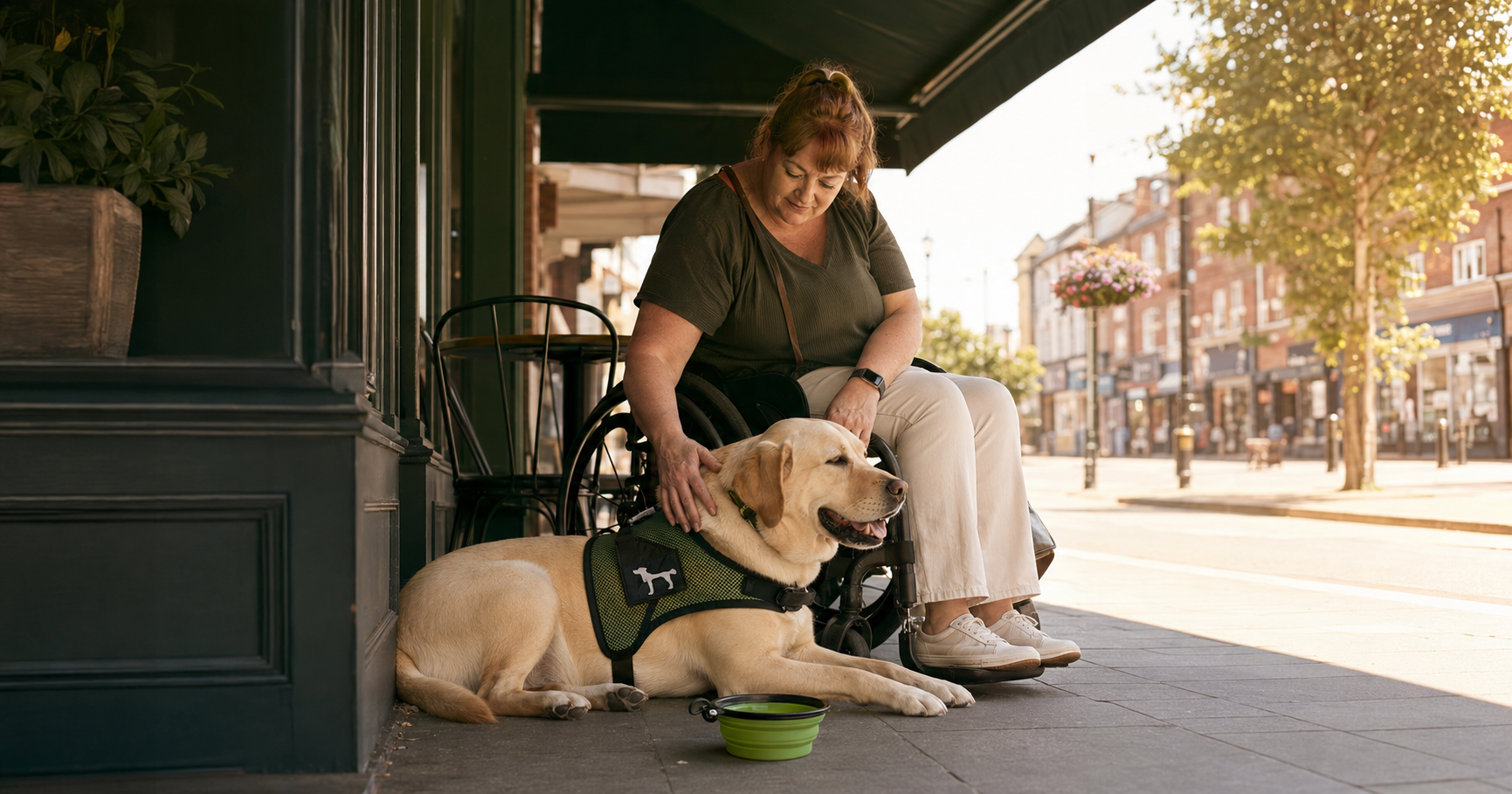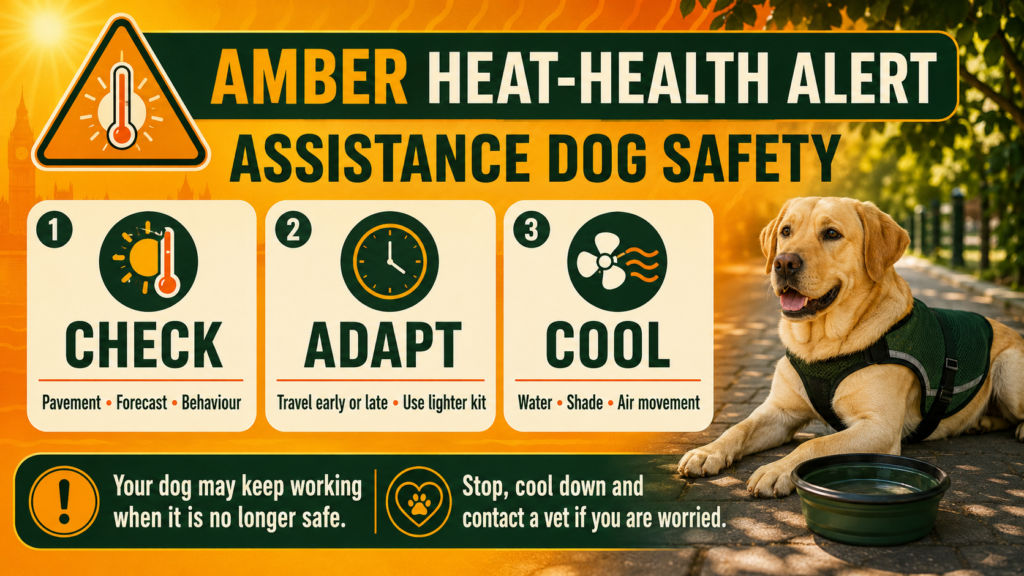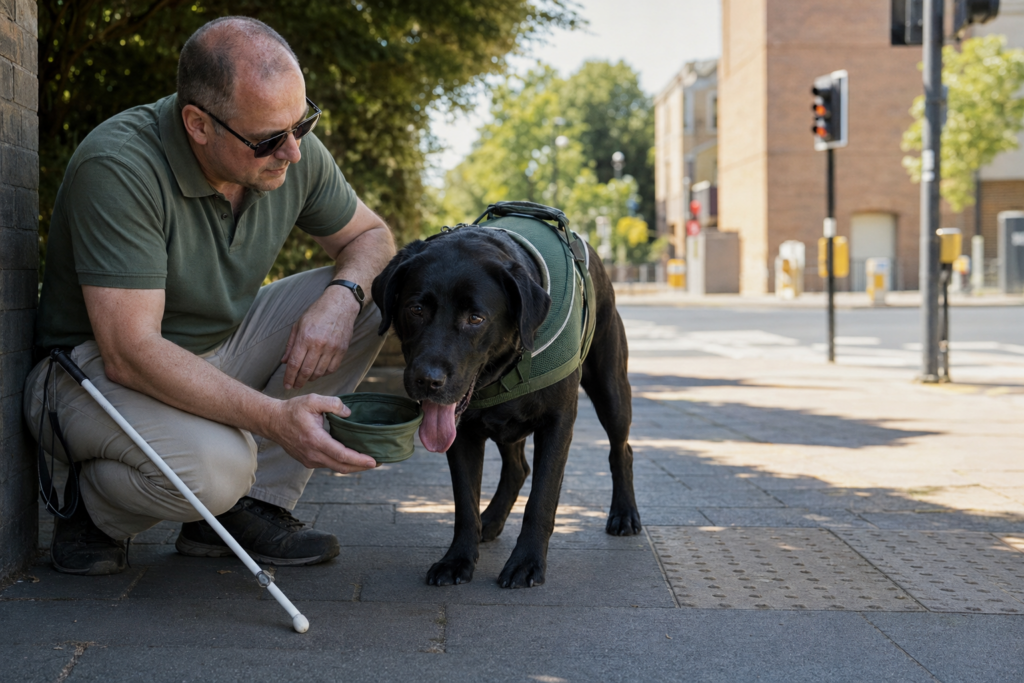
Always carry fresh, cool water for your dog—whether you're out for errands, training, or just a walk. 💧 Pro tip: Use a collapsible water bowl for easy access.
2️⃣ Watch Out for Hot Surfaces
Pavements and sand can burn your dog’s paws. Test the surface with your hand: if it’s too hot for you, it’s too hot for them. 🐾 Try walking during cooler hours—early mornings or evenings.
3️⃣ Keep Cool Indoors
Ensure your dog has a shady, well-ventilated space at home. Fans, cooling mats, or damp towels can help. ❄️ Never leave your dog in a parked car—temperatures rise fast, even with windows cracked.
4️⃣ Sun Protection Matters
Light-coloured or short-haired dogs can get sunburnt. Pet-safe sunscreen on their nose, ears, and belly can prevent burns.
5️⃣ Watch for Signs of Heatstroke
Be alert for:
Excessive panting or drooling
Lethargy
Vomiting
Weakness If you spot any of these, seek vet care immediately.
🎒 Don’t Forget Identification
Always make sure your dog wears their ID tag and carries their Assistance Dog ID Card.
Emergencies can happen, and proper identification helps keep your team together.
✅ Quick Checklist for Summer Outings:
🧴 Water & collapsible bowl
🐶 Cooling vest or mat
🦴 Treats (heat-safe)
🪪 Assistance Dog ID & Emergency Info
🧢 Optional: Dog-safe sunscreen & paw balm
💡 Final Tip:
Every dog is different. Monitor your dog closely and adjust your plans based on their needs and the day’s conditions.
Our Assistance Dog Registry offers smart, professional tools to help you:
Instantly show your dog’s role and legal rights with Smart ID Cards
Provide staff with proof via a QR Code linked to the Equality Act 2010
Wear your support gear with confidence (lanyard, dog tags, vest)
Enjoy the benefits of voluntary registration that supports your rights without replacing or contradicting the law
Stay Confident This Summer
You deserve peace of mind when you're out enjoying the sunshine. With proper registration and public-friendly ID tools, you can confidently navigate the spaces where others still need educating.
Register your assistance dog today and enjoy every sunny moment without setbacks.
2. Why is socialization important for assistance dogs?
Proper socialization ensures assistance dogs remain calm, focused, and well-behaved in various public settings, enabling them to perform their duties effectively.
3. At what age should I start socializing my assistance dog?
It's beneficial to begin socialization during puppyhood; however, with patience and consistent training, dogs of any age can learn to navigate public environments confidently.
4. How long does it take to socialize an assistance dog?
The duration varies based on the dog's temperament, previous experiences, and the consistency of training. Regular, positive exposure to different environments is key.
5. Can I socialize my assistance dog if they are older?
Yes, older dogs can be socialized successfully. While it may require more time and patience, with positive reinforcement, they can adapt to new situations.
6. What should I do if my assistance dog shows fear in public?
If your dog exhibits fear, calmly remove them from the situation and gradually reintroduce the stimulus at a comfortable distance, rewarding calm behavior.
7. How do I handle public distractions during training?
Teach focus commands like "watch me" to redirect your dog's attention. Gradual exposure to distractions, paired with positive reinforcement, can improve focus.
8. Are there specific public places ideal for socialization?
Begin with quiet areas like parks, then progress to busier environments such as cafes, public transport, and shopping centres as your dog becomes more comfortable.
9. How can I ensure my assistance dog behaves appropriately around other animals?
Controlled introductions and rewarding calm behaviour are essential. Consistent training helps your dog remain focused on their tasks, even around other animals.
10. What are the legal requirements for assistance dogs in public places?
In many regions, assistance dogs are permitted in public areas to support their handlers. It's important to familiarize yourself with local laws and regulations regarding assistance dogs.
Learn More – Additional Assistance Dog Letter Templates
If you found this travel guide useful, you may also benefit from these other essential assistance dog letter templates we’ve published:
📌 Housing Accommodation Request Letter– Need to request reasonable accommodation from your landlord? This template ensures your rights under the Equality Act 2010 are respected.
📌 Workplace Assistance Dog Request Letter – If you need accommodations to bring your assistance dog to work, this letter outlines your legal rights and reasonable adjustments your employer should consider.
🔹 More templates are coming soon! Let us know if you have specific needs, and we’ll create more resources to support assistance dog handlers.

ADR
Written & reviewed by the ADR Team Assistance Dog Registry, supporting UK assistance dog handlers since 2020
We're a UK-based team dedicated to assistance dog handlers. Since 2020 we've supplied 20,000+ assistance dog ID cards and supported thousands of handlers, owner-trained and charity-trained alike. Our guidance on the Equality Act 2010 and assistance dog access rights is referenced in UK public-sector accessibility policy and relied on by NHS staff, employers and carers. We're not a government body: registration is voluntary, and we'll always tell you so honestly. Learn more about us → | [email protected]

Dog Years to Human Years: Why the Seven-Year Rule Is a Myth
The old "multiply by seven" trick is charming, memorable, and wrong. Here is how dogs really age, why size matters more than most people realise, and what it means when your dog works as an assistance dog.
📖 7 min read·By the ADR Team·Updated July 2026
Key takeaways
One dog year does not equal seven human years. Dogs age fastest in their first two years, then slow down.
A dog's first year is worth roughly 15 human years, and by age two most dogs are around 24 in human terms.
Size changes the maths. After age two, small dogs add about four human years annually; giant breeds closer to seven.
Large and giant dogs reach "senior" earlier than small dogs, so age classification depends on size, breed and health.
Age alone never decides whether a dog can assist a disabled handler — health, training, temperament and the tasks performed matter far more.
Uses your device's voice. No data sent to anyone.
How dog ageing really works
Three stages, not one flat multiplier.
1
Year one ≈ 15 human years
Puppies grow up fast. By their first birthday most dogs are physically closer to a human teenager than a young child.
2
Year two brings them to ≈ 24
The second year adds roughly nine more human years. After this, the fast growth is over and ageing slows.
3
After two, +4 to +7 per year by size
Small dogs add about four human years each year; medium five; large six; giant seven. Size is the deciding factor.
If your dog is one year old, they are not the equivalent of a seven-year-old human. In physical terms they are far more grown up than that. Dogs pack most of their ageing into the first two years of life, then settle into a slower pace that depends heavily on their size. A practical, modern way to estimate your dog's age counts the first year as about 15 human years, the second year as about nine more (reaching roughly 24), and then adds four to seven human years for every year after that, depending on whether your dog is small, medium, large or giant.
If you would rather not do the sums, our free Dog Age Calculator works it out instantly once you enter your dog's age and size.
A one-year-old dog is closer to a human teenager than to a seven-year-old child. That single fact is why the "times seven" rule falls apart.
Where the "seven dog years" myth came from
The idea that one dog year equals seven human years has been repeated for generations, but its origins owe more to memorable maths than to biology. The simplest version of the story is that someone once divided a typical human lifespan of around 70 years by a typical dog lifespan of around 10, arrived at a tidy ratio of seven to one, and the phrase stuck because it was so easy to remember.
The trouble is that it treats ageing as a straight line, as if a dog gains the same amount of maturity every single year from birth to old age. Real dogs do nothing of the sort. A puppy reaches sexual maturity, adult size and most of its adult behaviour within roughly the first year or two, something no seven-year-old child has done. Then, once that early sprint is over, ageing slows to a gentler pace that varies from breed to breed. The seven-year rule captures neither the early sprint nor the later variation, which is why vets have long since moved past it.
What the science actually says
Modern veterinary guidance describes ageing in life stages rather than as a flat annual multiplier. Frameworks used widely in practice, including the American Animal Hospital Association (AAHA) Canine Life Stage Guidelines and material from the American Veterinary Medical Association (AVMA), group dogs into puppy, young adult, mature adult and senior phases, with the boundaries shifting according to size and breed.
Research has taken it further. A 2019 study published in the journal Cell Systems compared chemical changes in the DNA of dogs and humans, effectively reading a biological "clock" written into the genome. The authors found that dogs age rapidly early in life and then far more slowly, and they proposed a curved, non-linear formula rather than a simple multiplier. The details of any single formula are less important than the headline it confirms: dog ageing is front-loaded and size-sensitive, and the old rule of thumb simply does not reflect it.
None of this replaces your own vet. Averages and calculators describe populations, not the individual dog asleep at your feet. Breed, weight, diet, dental health, exercise and genetics all shift the picture, so treat any estimate as a helpful guide rather than a diagnosis.
Dog age chart by size
This chart shows the estimated human-age equivalent for common ages, using the same size-based model as our calculator. Read it as a guide to converting dog years to human years, not as a medical measurement.
Dog age
Small
Medium
Large
Giant
1 year
15
15
15
15
2 years
24
24
24
24
3 years
28
29
30
31
5 years
36
39
42
45
7 years
44
49
54
59
10 years
56
64
72
80
12 years
64
74
84
94
15 years
76
89
102
115
Try this
Want the exact figure for your own dog, including part-years in months? Use the free tool.
Here is the part the old rule misses entirely: a small dog and a giant dog of the same age are usually not at the same life stage. In general, smaller dogs tend to live longer and age more gently in their later years, while large and giant breeds often reach old age sooner. That is why, once a dog is past two, we add fewer human years for a small dog and more for a giant one.
Exactly why large dogs age faster is still being studied, but shorter average lifespans in bigger breeds are well documented. Body size, growth rate and breed all play a part, alongside individual health and lifestyle. The practical takeaway is simple: judge your dog's stage by its size and condition, not by a one-size-fits-all number.
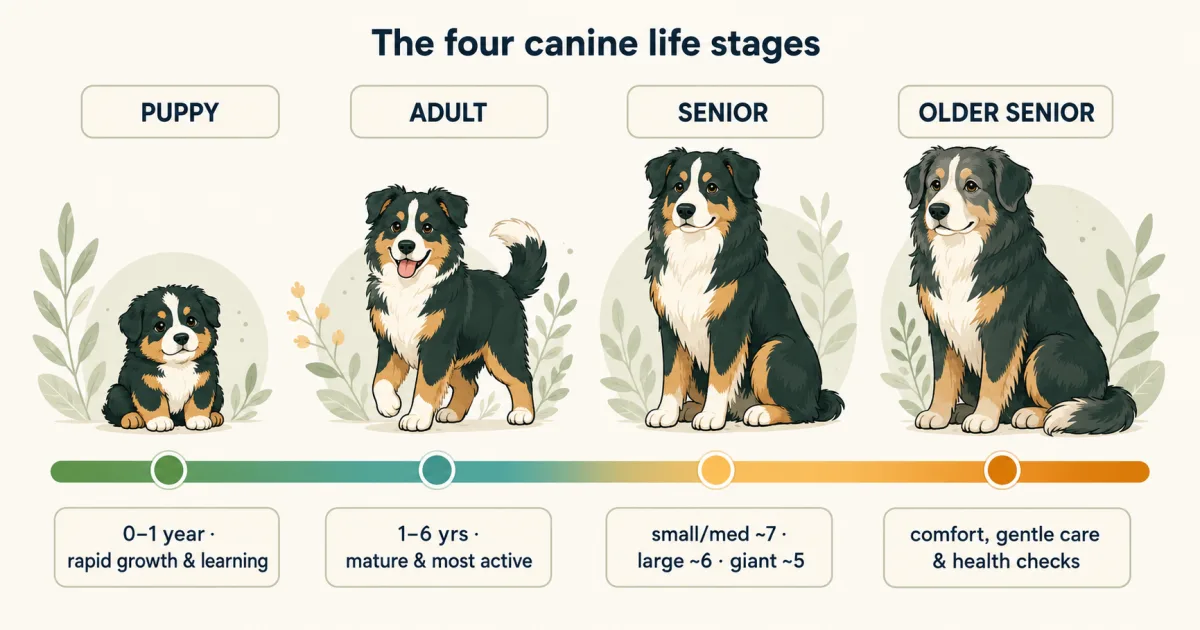
Puppy, adult, senior: the four life stages
Most dogs move through four broad life stages, and larger dogs tend to reach the senior stage earlier than small ones.
Puppy: rapid growth and learning, usually up to around one year.
Adult: physically mature and typically at their most active and capable.
Senior: a gradual slowing down. Small and medium dogs often reach this around seven, large dogs around six, and giant dogs around five.
Older senior: a greater need for comfort, gentle routines, softer workloads and regular health checks.
Why age matters for assistance dogs
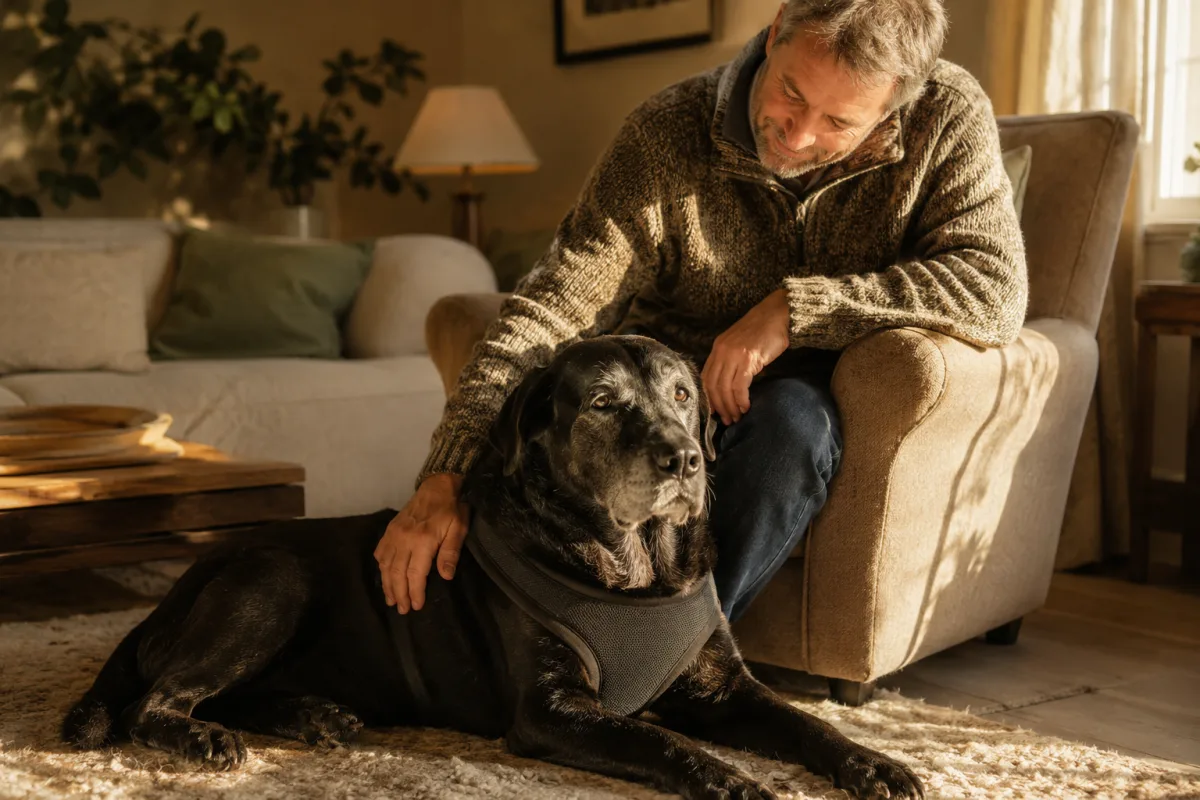
For handlers who rely on an assistance dog, a dog's real life stage is practical information, not just a talking point. Assistance dogs can work at very different ages depending on their health, temperament, training and the tasks they perform. A younger dog may still be learning its role and building reliability, while an older dog may take on fewer or lighter duties and need more rest between them.
Understanding where your dog sits on that curve helps you plan sensibly: how much to ask of them on a long day out, when to build in recovery time, and when to start thinking about a successor so there is no sudden gap in support. If you are new to all of this, our overview of assistance dog registration in the UK is a good starting point, and our free digital assistance dog law card is a simple everyday tool to have on your phone.
🐕
Free tool: the Dog Age Calculator
Enter your dog's age and size for an instant estimate in human years, plus their life stage. No sign-up needed.
Yes, in some cases. If a dog is healthy, well trained, comfortable, safe and genuinely able to perform the tasks its handler needs, age by itself is not a barrier. Plenty of experienced assistance dogs continue to provide valuable support well into their later years.
What matters is being honest about comfort and workload. An older assistance dog may do fewer tasks, work shorter days or need adaptations to keep it comfortable, and thoughtful handlers plan ahead for retirement and, eventually, a successor dog. Age is one input into that planning, never the whole decision.
Does age affect registration with ADR?
Assistance Dog Registry is a voluntary registry and support service. Age alone does not automatically prevent a dog from being registered. What matters is that the dog is trained to assist with a disability-related need, is under control and is suitable for the role. ADR does not decide legal status and does not issue legal certification; it provides a practical way to hold and share your assistance dog's information, including an online profile, QR and NFC verification tools and optional ID cards.
The law gives you rights. ADR gives you the tools to explain them.
If your dog assists you with a disability-related need, ADR can help you create a clear online profile, QR and NFC verification tools and optional ID cards to present your assistance dog information more confidently.
Join 4,600+ UK handlers. Practical guidance and law updates. No spam.
🐾 Lifelong Partner package
A permanent profile, smart ID cards, dog tags and clear QR-linked information for landlords, agents and public access situations. The law gives you rights; ADR gives you the everyday tools to explain them.
The age figures here use a practical, size-based model consistent with veterinary life-stage guidance and research into canine ageing. They are estimates for general guidance and are not a substitute for advice from your own vet. Written and reviewed by the ADR team against reputable veterinary sources.
If you spot anything that needs updating, contact us.
ADR
The Assistance Dog Registry UK TeamVerified
Founded by Norbert Szeverenyi · 6,000+ UK handlers supported · Materials reviewed against reputable veterinary and official guidance.
This article is general information, not veterinary advice. Age estimates are approximate and vary by breed, health and individual dog.
For advice about your dog's health, ageing or fitness to work, please speak to your own vet or a suitable veterinary charity such as PDSA or Blue Cross.
Key terms explained
Dog year
One calendar year of a dog's life. It does not equal a fixed number of human years.
Human-age equivalent
An estimate of how old a dog would be if measured on a human scale, based on size and life stage.
Life stage
A broad phase of a dog's life: puppy, adult, senior or older senior.
Senior dog
A dog entering later life; reached earlier by large and giant breeds than by small dogs.
Owner-trained assistance dog
A dog trained by its disabled handler, rather than by a specific charity, to help with a disability-related need.
UK Heatwave Warning: Keeping Your Assistance Dog Safe Without Losing Your Independence
Your assistance dog may be willing to keep working. In this heat, that is exactly the problem. What every handler should know while amber alerts cover England.
By the ADR Team · Updated 15 July 2026 · 9 min read
Key takeaways
Amber heat health alerts cover most of England until 9pm on Friday 18 July, with temperatures of 34 to 35°C in places. This is the third UK heatwave of 2026.
Assistance dogs are trained to keep working, which means they often hide the early signs of overheating. Slowing down, lagging or lying down in heat is information, not disobedience.
Roughly 1 in 7 dogs that develop heatstroke die, and during heat-alert periods that has risen to around 1 in 4. Exercise triggers about three quarters of cases.
Your legal rights do not depend on a vest. In extreme heat you can remove or swap heavy kit for lightweight ID without losing Equality Act 2010 protection.
You can ask shops, cafés and venues for somewhere cool to wait. That is a reasonable request from a disabled customer, and most staff will help when asked clearly.
The three-step heatwave routine: check, adapt, cool. Save or screenshot this for your phone.Table of contents
If the pavement fails the seven-second test, if your dog is slowing down, or if the UKHSA alert for your region is amber or red, your assistance dog should not be working outside in the middle of the day.
That is hard advice to follow when your dog is your independence. This guide is not the usual "keep pets cool" checklist. It is about the specific problem handlers face this week: what to do when the dog you rely on cannot safely do its job, how to adapt essential journeys, and how to handle an emergency where both of you are struggling in the heat.
This is general information, not legal or veterinary advice. If your dog shows signs of heatstroke, contact a vet immediately. If you feel unwell in the heat, call 111, or 999 in an emergency.
Why this heatwave is different for assistance dog handlers
The UK Health Security Agency has issued amber heat health alerts for the East Midlands, East of England, London, the North West, the South East, the South West and the West Midlands, running until 9pm on Friday 18 July. Parts of southern England are forecast to reach 34 to 35°C before thunderstorms break the heat over the weekend, according to the Met Office.
An amber alert means the whole population may be at risk, not just people who are already vulnerable. For handlers there is a double exposure. Many disabilities that lead people to work with an assistance dog, including heart conditions, POTS and other forms of dysautonomia, MS, diabetes and some medications, also make the handler less heat tolerant. So the handler is at higher risk at exactly the moment the dog is too.
The British Veterinary Association reports that vets see around five times more heatstroke cases during extremely hot weather, and warns that animals can develop heatstroke even at rest in hot rooms, conservatories and vehicles. Research from the Royal Veterinary College's VetCompass programme found that about 1 in 7 dogs presenting with heat-related illness die, rising to around 1 in 4 during official heat-alert periods, and that exercise triggers roughly 75% of cases. Flat-faced breeds are around four times more likely to be affected.
Working is exercise. A guide, medical alert or mobility dog walking to the shops in 33°C heat is inside that 75%.
How do I spot overheating in a dog that is trained to keep going?
This is the part generic advice misses. Assistance dogs are selected and trained for persistence. Many will keep tasking well past the point a pet dog would have flopped in the shade. You cannot wait for your dog to quit, because a good assistance dog often will not.
Watch for the early signals:
Heavy, continuous panting with a wide, spatula-shaped tongue
Lagging behind you, breaking pace, or drifting toward shade when normally glued to position
Excessive drooling, or thick sticky saliva
Seeking any pause: sitting at kerbs longer, lying down at stops
Gums or tongue turning dark red
Glassy eyes, reduced responsiveness to cues it normally never misses
Later signs are an emergency: wobbling or weakness, vomiting or diarrhoea, confusion, collapse, or seizures. At that point cool the dog and get to a vet urgently.
Treat any deviation from normal working behaviour in heat as data. A dog that "misbehaves" at 2pm in July is usually a dog telling you something.
Hot pavements, buses and waiting outside shops
Asphalt in direct sun can be 20°C or more hotter than the air. On a 30°C day, tarmac can exceed 50°C, hot enough to burn paw pads during a normal walking pace. Use the RSPCA-recommended check: press the back of your hand on the pavement for seven seconds. If you cannot hold it there comfortably, it is too hot for your dog's pads.
Three situations catch handlers out:
Public transport. Buses and older trains can run several degrees hotter than the street, and dogs lie on the floor where ventilation is worst. Travel outside peak hours, choose the coolest part of the carriage, carry water, and book Passenger Assist for rail journeys so you are not left standing on an exposed platform.
Waiting outside. Never leave your assistance dog tied outside a shop in this weather, and remember you almost never have to. Your dog has the right to come in with you under the Equality Act 2010.
Standing on hot ground. Queues are worse than walking, because pads stay in contact with the same hot spot. Stand on painted lines, grass or shaded paving where you can, or ask to wait inside.
Should I remove my assistance dog's vest in extreme heat?
Yes, if the vest is contributing to heat load, take it off. Nothing in UK law requires an assistance dog to wear a vest, harness cape or any identifying kit. Your rights under the Equality Act 2010 come from your disability and your dog's training, not from what the dog is wearing.
Practical options for heatwave working:
Swap a padded cape for a lightweight mesh or hi-vis strip that identifies the dog without insulating it
Keep ID at hand instead of on the dog: a digital assistance dog law card on your phone, or a physical ID card, answers questions a vest would normally pre-empt
If your dog is registered with ADR, the QR profile on its tag does the explaining even when the vest is at home in a drawer
If a member of staff challenges you because the dog "doesn't look like an assistance dog" without its jacket, stay calm and explain: "Assistance dogs are not required to wear a vest. In this heat it isn't safe. Here is my dog's ID." You can show your card or QR profile page if it helps the conversation.
What cooling kit should a handler actually carry?
Small amounts of water, often, in the shade. The whole kit below fits in one bag.
Keep it light, because you are carrying it in a heatwave too:
Affiliate note: some links below go to Amazon. As an Amazon Associate, Assistance Dog Registry earns from qualifying purchases at no extra cost to you. We only link products that match the advice in this article.
A spray bottle or a small towel you can wet. Cooling the belly, groin, armpits and paws helps. Recent RVC guidance is clear that cool or even cold water is safe and effective for conscious dogs; the old "cold water causes shock" myth has been debunked. Cool first, then transport to a vet if needed.
Cooling mat or cooling coat, used correctly. A cooling coat only works while it is wet. A dry, warm cooling coat becomes insulation. Re-wet it regularly or take it off. Our picks: the Pecute gel self-cooling mat for rest stops and the car, the Petface cooling summer dog coat as a lighter alternative to a working vest, and the All For Paws Chill Out cooling bandana when a full coat is too much.
A cheap foldable umbrella. Instant portable shade at bus stops and in queues, for both of you.
Your own heat kit. Electrolyte sachets or tablets (we like HIGH5 ZERO electrolyte tablets, sugar-free and light to carry), your medication, and a card or phone lock screen that says you have an assistance dog, in case you become unwell.
Skip dog boots for heat. They protect pads from contact burns but trap heat, and dogs lose heat through their paws. The better answer is not walking on ground that fails the seven-second test.
Your heatwave kit: six things worth carrying
The picks from this guide in one place. Affiliate links: as an Amazon Associate, ADR earns from qualifying purchases at no extra cost to you.
COTOP Portable Dog Water Bottle
★★★★½ 4.6
One-hand water on the move, so you can offer small drinks often without unclipping the lead.
Can I ask a shop or café for somewhere cool to wait?
Yes, and you should. Service providers have a duty under the Equality Act 2010 to make reasonable adjustments for disabled customers. In a heatwave, "somewhere cooler for my assistance dog and me to wait" is about as reasonable as requests get: a seat away from the window, a spot near the air conditioning, a bowl of water, or being served while seated instead of queueing.
Use this wording
"I'm disabled and this is my assistance dog. The heat is dangerous for both of us today. Could we wait somewhere cooler, and could I trouble you for a bowl of water for the dog?"
Most staff say yes immediately. If somewhere refuses both entry and any adjustment, note the time and place, stay polite, and see our membership plans for the ID and support resources that make these conversations easier.
How do I plan essential journeys around the temperature?
Go early or late. The BVA advises restricting exercise to cooler times of day. Below roughly 20°C is comfortable for most dogs; be cautious above 25°C and treat 28°C and higher as high risk for working outside.
Check the forecast the night before and front-load your week. The Met Office expects this heat to break around 18 to 19 July; anything that can wait until next week probably should.
Shorten the exposed segments. A taxi or a lift for the sun-baked mile to the station, then the dog works normally indoors, is a smart trade.
Map your cool points. Supermarkets, libraries, shopping centres and places of worship are air-conditioned refuges where your dog has the right to accompany you.
If in doubt, do not go out. No routine errand is worth heatstroke.
What if my dog cannot safely work at all today?
Some days this week, the safest decision is that the dog stays home in a cool room with water and airflow. That does not have to cost you the whole day:
Move what you can online: repeat prescriptions, click-and-collect, grocery delivery, video GP appointments
Ask for human help for one specific leg: a neighbour, family member, or the shop's own staff ("Could someone help me find these three items? My assistance dog can't work in this heat.")
Rearrange non-urgent appointments and say why; "my assistance dog cannot safely travel in the heat alert" is a reason services should accommodate
If your dog performs safety-critical tasks such as medical alert, tighten your backup measures for the day: extra monitoring, check-in calls with someone you trust, and staying somewhere cool yourself
A rest day in a heatwave is not lost training. It is what keeps your dog able to work for the next ten summers.
Emergency: your dog is overheating and you are unwell too
Heat emergencies rarely pick one of you. Decide the plan now, not on the pavement:
Get both of you out of the sun and stop all activity. Shade, or better, any air-conditioned building. This is an emergency; ask for help loudly and specifically: "I'm disabled, my assistance dog has heatstroke, I need water and somewhere cool."
Cool the dog immediately. Pour cool water over its body, soak the belly and paws, and get air moving over wet fur. Offer small drinks. Cool first, transport second.
If you are the one deteriorating, you come first. Call 999 and tell the operator you have an assistance dog with you, so responders plan for the dog. Your dog's ADR tag and QR profile let anyone helping you identify the dog and your emergency contact when you cannot speak; that is exactly the situation the Lifelong Partner profile was designed for.
Call the nearest vet as you cool the dog, not after. Signs like collapse, vomiting or confusion need veterinary treatment even if the dog seems to recover.
Handler checklist: before you leave the house this week
☐ Checked UKHSA alert level and today's peak temperature
☐ Journey planned for before 9am or after 7pm where possible
☐ Seven-second pavement test at the door
☐ Water bottle and collapsible bowl packed (for both of you)
☐ Heavy vest swapped for lightweight ID, law card or QR profile ready
☐ Cool waiting points identified along the route
☐ Emergency contact visible on dog tag and your phone lock screen
☐ Honest answer to: "Would I make my dog do this if it could refuse?"
Missing something from the kit? The heat breaks this weekend, but there will be more. Amazon next-day delivery covers everything on this list. (Affiliate links, see note above.)
Handlers are used to pushing through. Most of us have worked our dogs on days we should not have worked ourselves. This week, the bravest decision is often the boring one: go at 7am, take the taxi, ask for the seat by the air conditioning, or stay home and let the dog sleep on the cold kitchen floor.
Your dog would work for you at 35°C without complaint. That is exactly why it must be you who says no.
Disclaimer: This article is general information, not legal advice and not veterinary advice. If your dog shows signs of heatstroke, contact a vet immediately. For heat-related health concerns of your own, call NHS 111 or 999 in an emergency. For disability rights questions, contact Citizens Advice, the EHRC or a qualified solicitor. This article contains Amazon affiliate links; as an Amazon Associate, Assistance Dog Registry earns from qualifying purchases.
Key terms explained
Heat health alert
A UKHSA warning system for England rating heat risk yellow, amber or red by region.
Heatstroke (heat-related illness)
A dangerous rise in body temperature that overwhelms a dog's ability to cool itself.
Seven-second test
Pressing the back of your hand to the pavement for seven seconds to check it is safe for paws.
Reasonable adjustment
A change a service provider must consider making so a disabled person is not disadvantaged, under the Equality Act 2010.
Assistance dog
A dog trained to perform tasks that mitigate a person's disability. UK law does not require it to wear a vest or be registered.
New 2026 renting rules: does "no pets" still apply to assistance dogs?
The Renters' Rights Act changed pet requests in England from 1 May 2026. But assistance dogs are not ordinary pets. Here is what handlers, landlords and letting agents need to understand.
📖 9 min read·By the ADR Team·Updated 8 May 2026
Key takeaways
From 1 May 2026, private tenants in England can ask to keep an ordinary pet — but assistance dogs are different.
An assistance dog is not a pet. It supports a disabled person and is covered by the Equality Act 2010.
A "no pets" clause is not a blanket refusal — landlords must consider a "reasonable adjustment".
Always ask in writing using the Equality Act 2010 framing. Keep every reply.
Voluntary registration helps the conversation but the legal right comes from disability law, not a card.
Uses your device's voice. No data sent to anyone.
Handler action: ask in writing
A simple three-step approach to a reasonable-adjustment request.
If you rely on an assistance dog because of a disability, a landlord or letting agent should not treat your dog like an ordinary pet.
The new renting rules in England mean private tenants can ask to keep a pet, and landlords must consider the request fairly. That is good news for renters generally. But assistance dogs sit in a different category. They are connected to disability rights and reasonable adjustments under the Equality Act 2010.
So if a tenancy agreement says "no pets", that does not automatically settle the matter.
For an assistance dog handler, the better question is:
Is allowing the assistance dog a reasonable adjustment so the disabled tenant can live in the property without being disadvantaged?
In many cases, the answer will be yes.
This article explains the difference between pets and assistance dogs, what changed from 1 May 2026, what to put in writing, and how voluntary ID, a QR-linked profile and clear documentation can make the conversation easier.
This is general information, not legal advice. If you are at risk of losing your home or being refused a tenancy, speak to Citizens Advice, Shelter, a housing adviser or a qualified legal professional.
What changed in England from 1 May 2026?
The Renters' Rights Act changed private renting rules in England from 1 May 2026.
One of the changes is that private tenants can ask to keep a pet in the property. GOV.UK says tenants can ask to keep a pet and the landlord must consider the request. GOV.UK also says the landlord should give a reason if they refuse.
For ordinary pets, the new process matters because it gives tenants a clearer route than before. A landlord can no longer simply ignore the request or refuse without a fair reason.
But this is where assistance dog handlers need to be careful:
An assistance dog is not just a lifestyle pet request.
An assistance dog supports a disabled person. It may help with mobility, medical alert, psychiatric tasks, autism support, seizure response, or another disability-related task. The dog is part of the handler's ability to live safely and independently.
That means the Equality Act conversation still matters.
Are assistance dogs covered by the new pet rules?
The new pet rules help ordinary renters ask for permission to keep a pet.
Shelter's 2026 guidance is clear: assistance dogs are recognised under the Equality Act. The new pet rules do not replace that position. Shelter notes that where a tenant needs an assistance dog, the landlord may need to make reasonable adjustments.
In plain English:
A pet request is about permission.
An assistance dog request is about disability access.
A "no pets" clause should not be applied as a blanket refusal to an assistance dog.
This does not mean every situation is automatic. The exact facts still matter: the property, the dog, the tenant's needs, any genuine health and safety issue, and whether the request is reasonable.
But it does mean a landlord should not simply say:
"The tenancy says no pets, so no."
That answer is too shallow when the dog is an assistance dog.
What should handlers ask for?
Ask for a reasonable adjustment in writing.
Keep the message calm, short and factual. You do not need to explain your full medical history. You only need to explain enough for the landlord or letting agent to understand that:
you are disabled under the Equality Act 2010,
you rely on an assistance dog,
the dog is trained or being trained to support you with disability-related tasks,
you are asking for the "no pets" rule to be adjusted so you can live in the property with your assistance dog.
Here is a simple version:
Use this wording
I am requesting a reasonable adjustment under the Equality Act 2010. I am a disabled person and I rely on my assistance dog, [DOG NAME], to support me with disability-related needs. I am asking that any "no pets" clause or pet restriction is adjusted to allow my assistance dog to live with me at the property.
If your dog is registered with Assistance Dog Registry, you can add:
Optional add-on
My dog also has a voluntary assistance dog profile and ID record, which I can share by QR link if helpful. I understand registration is not a legal requirement, but it gives clear information about my dog's role and emergency details.
That is the right tone: transparent, practical and legally accurate.
What information can help?
A landlord or agent may not understand assistance dogs. Many still think only guide dogs count, or that every assistance dog must come from a charity. That is not a safe assumption.
Helpful information can include:
your dog's name and role,
whether the dog is fully trained or in training,
the tasks the dog performs in broad terms,
confirmation that the dog is calm, house-trained and under control,
a vet record or vaccination confirmation if relevant,
a short explanation that assistance dogs are disability support, not ordinary pets,
You do not need to disclose private medical details beyond what is necessary.
Get UK assistance dog law updates
Join thousands of UK handlers. We email when the law changes. No spam.
What if the landlord says "but the property is no pets"?
A calm reply:
Calm reply
I understand the property has a no-pets rule. My request is different because this is an assistance dog connected to my disability. I am asking you to consider this as a reasonable adjustment under the Equality Act 2010, rather than as an ordinary pet request.
If they still refuse, ask for the decision in writing:
If they still refuse
Please can you confirm the reason for refusal in writing, including whether you have considered the request as a disability-related reasonable adjustment?
This matters because a written refusal gives you something concrete to take to an adviser.
Handlers should be careful with language. Registration is useful but voluntary. It does not create the legal right. The legal right comes from disability law and reasonable adjustments.
A good response is:
Good response
There is no official UK government register for assistance dogs. My dog's voluntary registration and ID are provided to make communication easier, not because registration is legally required. The legal issue is that I rely on an assistance dog because of my disability.
This keeps you honest and avoids giving the landlord the wrong impression.
📄
Free download: 2026 Assistance Dog Housing Request Pack
5-page printable pack — the difference, what to include, copy-paste landlord email, and a refusal record sheet.
Real life is not a calm legal seminar. It is emails, viewings, agents, rushed phone calls — and people who do not know the difference between pets and assistance dogs.
an easy way to show information without repeating your whole story.
It does not replace the Equality Act. It supports the conversation around it.
For housing, that can be especially helpful because a landlord or letting agent often wants clear, tidy information they can understand quickly.
Handler checklist: before you message a landlord
Gather these first
your tenancy or advert reference,
the exact "no pets" wording if there is one,
your dog's role in one sentence,
a short description of your dog's behaviour at home,
any useful evidence, such as ID profile, training notes or vet information,
the date you first asked,
a copy of every email or message.
Keep everything in writing where possible.
Copy-paste landlord email
Subject: Reasonable adjustment request — assistance dog
Dear [Landlord/Agent Name],
I am writing to request a reasonable adjustment under the Equality Act 2010.
I am a disabled person and I rely on my assistance dog, [DOG NAME], to support me with disability-related needs. [DOG NAME] is trained/being trained to assist me and is not an ordinary pet.
I understand the property/tenancy includes a "no pets" rule. I am asking you to adjust that rule so that my assistance dog can live with me at the property.
[DOG NAME] is house-trained, kept under control, and I am happy to provide a brief profile with practical information about their role, behaviour and emergency details.
Please confirm in writing that this request has been considered as a disability-related reasonable adjustment.
Kind regards, [YOUR NAME]
Final thought
The 2026 renting changes are a step forward for pet-owning tenants in England.
But if you are an assistance dog handler, do not let anyone flatten your situation into a basic "pet permission" question.
Your dog is not just a pet.
Your dog is part of how you access daily life, safety and independence.
A good landlord should understand that. A good letting agent should know how to handle it. And if they do not, clear written information can make the next step easier.
Found this useful? Share it.
Help another handler avoid a "no pets" headache. One click sends it.
The Assistance Dog Registry UK team has spent years supporting owner-trained and charity-trained handlers across the UK. We only publish materials that are carefully researched against the latest UK statutes (Equality Act 2010, Renters' Rights Act 2026), official guidance from GOV.UK, Shelter and the Equality and Human Rights Commission, and the day-to-day experiences of thousands of UK handlers we have helped.
If you spot anything that needs updating, contact us — we revise our guides as the law and guidance evolve.
Was this guide helpful?
✓ Thanks — glad this helped. Share it with another handler?
Assistance Dog Registry has supported thousands of UK assistance dog handlers since 2020, supplying 20,000+ ID cards. Articles reviewed against UK primary legislation and official EHRC, GOV.UK, Citizens Advice and NHS guidance. About ADR
This article is general information, not legal advice. Every renting situation depends on the specific tenancy, property, dog and handler circumstances. Nothing on this page creates a solicitor-client relationship between you and Assistance Dog Registry UK.
If your housing is at risk, you have been refused a tenancy, or you face discrimination, please seek specialist advice from Citizens Advice, Shelter, the EHRC, a qualified housing adviser, or a solicitor regulated by the SRA.
Key terms explained
Reasonable adjustment
A change a landlord, business or service must reasonably consider so a disabled person is not put at a disadvantage.
Equality Act 2010
The UK law that protects disabled people from discrimination in housing, work and access to services.
Renters' Rights Act 2026
New private renting rules in England, in force from 1 May 2026, including a clearer process for tenants to request a pet.
Assistance dog
A dog trained — by a charity or by the handler — to perform tasks that mitigate a person's disability.
Voluntary registration
A non-statutory record of an assistance dog. It supports practical communication but does not, by itself, create the legal right to access.
';});}window.rr26SubmitComment=function(e){e.preventDefault();var f=e.target;var btn=document.getElementById('rr26-comment-submit');var res=document.getElementById('rr26-comment-result');btn.disabled=true;btn.textContent='Posting…';var data={post:5361,author_name:f.author_name.value.trim(),author_email:f.author_email.value.trim(),content:f.content.value.trim()};fetch('/wp-json/wp/v2/comments',{method:'POST',credentials:'omit',headers:{'Content-Type':'application/json'},body:JSON.stringify(data)}).then(function(r){return r.json().then(function(j){return{ok:r.ok,status:r.status,j:j};});}).then(function(r){btn.disabled=false;btn.textContent='Post comment';if(r.ok){f.reset();res.style.display='block';res.style.background='#edf6f3';res.style.border='1px solid #b8d7cc';res.style.color='#12342b';res.innerHTML='✓ Thanks — your comment has been received. It will appear here after our team reviews it (usually within a day).';setTimeout(function(){res.style.display='none';},10000);}else{res.style.display='block';res.style.background='#fff8e5';res.style.border='1px solid #f0c36a';res.style.color='#5a4318';res.innerHTML='Could not post: '+(r.j&&r.j.message?r.j.message:'Please try again.');}}).catch(function(err){btn.disabled=false;btn.textContent='Post comment';res.style.display='block';res.style.background='#fff8e5';res.style.border='1px solid #f0c36a';res.style.color='#5a4318';res.textContent='Network error — please try again.';});return false;};loadComments();})();
Keep reading
More UK assistance dog law guides from the ADR team.
Assistance Dog Registryenvelope-oprintimagemap-markerfacebook-squarefacebookenvelopelinkedinxingyoutube-playinstagrampaper-planepinterest-pwhatsappcommentingx-twitterusertagcalendar-fullclock
Manage Consent
To provide the best experiences, we use technologies like cookies to store and/or access device information. Consenting to these technologies will allow us to process data such as browsing behavior or unique IDs on this site. Not consenting or withdrawing consent, may adversely affect certain features and functions.
Functional
Always active
The technical storage or access is strictly necessary for the legitimate purpose of enabling the use of a specific service explicitly requested by the subscriber or user, or for the sole purpose of carrying out the transmission of a communication over an electronic communications network.
Preferences
The technical storage or access is necessary for the legitimate purpose of storing preferences that are not requested by the subscriber or user.
Statistics
The technical storage or access that is used exclusively for statistical purposes.The technical storage or access that is used exclusively for anonymous statistical purposes. Without a subpoena, voluntary compliance on the part of your Internet Service Provider, or additional records from a third party, information stored or retrieved for this purpose alone cannot usually be used to identify you.
Marketing
The technical storage or access is required to create user profiles to send advertising, or to track the user on a website or across several websites for similar marketing purposes.