The Assistance Dog Registry is a platform where you can voluntarily register your assistance dog. It provides quick access to essential information about your dog and helps ensure they are recognized as a service animal when in public spaces.
No, registering your assistance dog is not a legal requirement in the UK. However, registering your dog can provide additional benefits like quick access to important information, easy identification, and recovery if your dog is lost.
By registering your dog, you get access to features like easy identification through QR codes, assistance in finding your dog if they are lost, and immediate access to vital information such as your dog's medical needs or training history.
Yes, in the UK, owners are allowed to train their own assistance dogs. There is no requirement for the dog to be trained by a formal institution, but the dog should be well-behaved and capable of performing tasks that mitigate the handler's disability.
Under the Equality Act 2010, assistance dog owners are legally protected to access public places and services without discrimination. This means that businesses and service providers must allow access to assistance dogs, whether they are professionally trained or owner-trained. The law classifies assistance dogs as "auxiliary aids" and denies service only in exceptional circumstances.
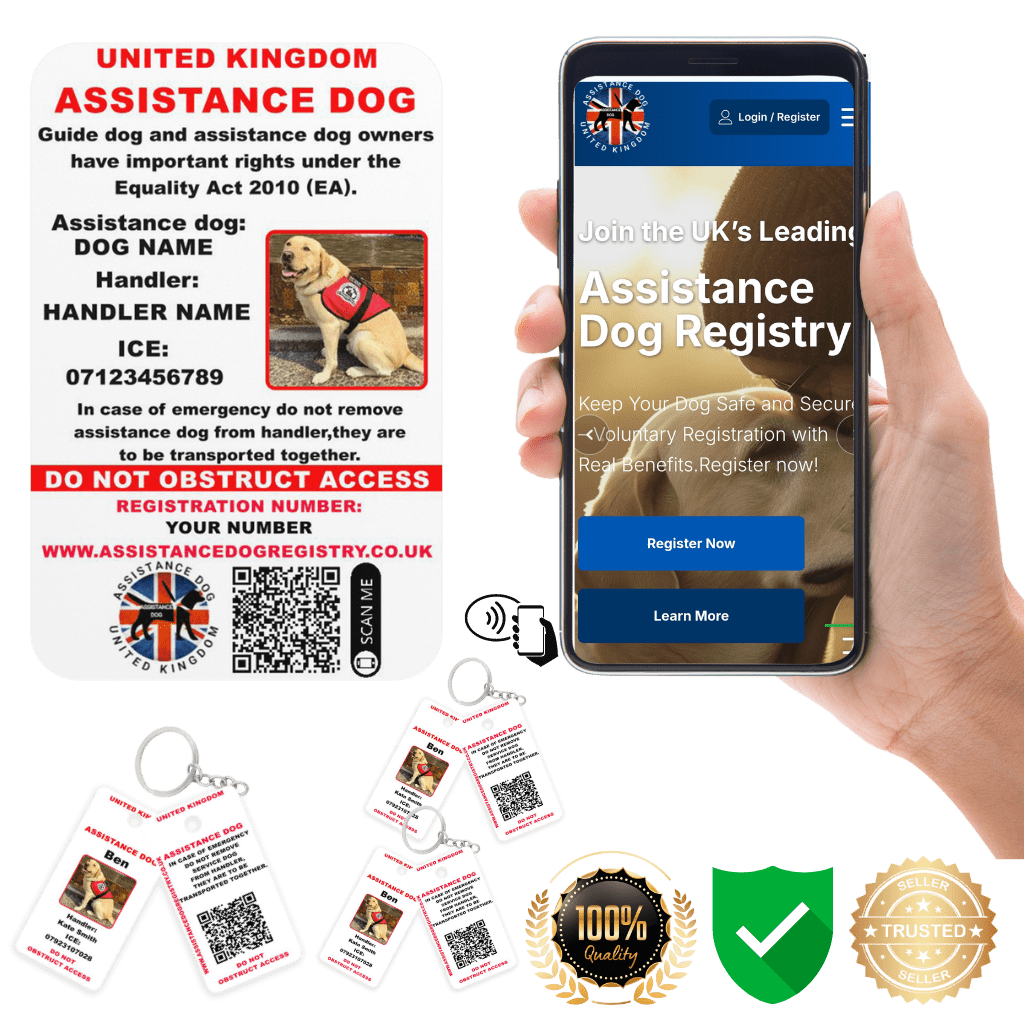
If a business refuses entry to you and your assistance dog, it is likely unlawful discrimination. Our Assistance Dog Registry provides an ID card and NFC-enabled tags that can help communicate your rights and your dog’s status effectively.
To learn more about your rights as an assistance dog handler, please see Equality Act 2010.
In the UK, an assistance dog is a trained companion that helps people with disabilities or specific health conditions, assisting them in daily activities and improving their quality of life. Dogs that qualify as assistance dogs typically have specialized training to support physical, sensory, or mental health needs, providing essential services like guiding, alerting, and assisting with tasks.
While professional training can be helpful, owners can train their own assistance dogs, provided they meet the necessary behavior and service standards to ensure public safety.
Assistance dogs can support individuals with a wide range of conditions, including physical disabilities, hearing or visual impairments, and certain medical conditions requiring alert systems (such as diabetes or epilepsy).
Additionally, mental health conditions, such as PTSD and severe anxiety, may also qualify if the dog can perform specific tasks to alleviate the symptoms. At assistancedogregistry.co.uk, we welcome dog registrations for various conditions.
To prove your dog is an assistance dog in the UK, you can register them on assistancedogregistry.co.uk. Once registered, you’ll receive an ID card and other materials that help demonstrate your dog’s status as a trained assistance dog. This documentation is helpful when entering public spaces, as it shows that your dog is an officially recognized assistance dog.
Additionally, many people find it beneficial to carry certification cards and documentation to clarify their rights and help avoid misunderstandings in public settings.
John
The Assistance Dog Registry is a platform where you can voluntarily register your assistance dog. It provides quick access to essential information about your dog and helps ensure they are recognized as a service animal when in public spaces.
No, registering your assistance dog is not a legal requirement in the UK. However, registering your dog can provide additional benefits like quick access to important information, easy identification, and recovery if your dog is lost.
By registering your dog, you get access to features like easy identification through QR codes, assistance in finding your dog if they are lost, and immediate access to vital information such as your dog's medical needs or training history.
Yes, in the UK, owners are allowed to train their own assistance dogs. There is no requirement for the dog to be trained by a formal institution, but the dog should be well-behaved and capable of performing tasks that mitigate the handler's disability.
Under the Equality Act 2010, assistance dog owners are legally protected to access public places and services without discrimination. This means that businesses and service providers must allow access to assistance dogs, whether they are professionally trained or owner-trained. The law classifies assistance dogs as "auxiliary aids" and denies service only in exceptional circumstances.
If a business refuses entry to you and your assistance dog, it is likely unlawful discrimination. Our Assistance Dog Registry provides an ID card and NFC-enabled tags that can help communicate your rights and your dog’s status effectively.
To learn more about your rights as an assistance dog handler, please see Equality Act 2010.
In the UK, an assistance dog is a trained companion that helps people with disabilities or specific health conditions, assisting them in daily activities and improving their quality of life. Dogs that qualify as assistance dogs typically have specialized training to support physical, sensory, or mental health needs, providing essential services like guiding, alerting, and assisting with tasks.
While professional training can be helpful, owners can train their own assistance dogs, provided they meet the necessary behavior and service standards to ensure public safety.
Assistance dogs can support individuals with a wide range of conditions, including physical disabilities, hearing or visual impairments, and certain medical conditions requiring alert systems (such as diabetes or epilepsy).
Additionally, mental health conditions, such as PTSD and severe anxiety, may also qualify if the dog can perform specific tasks to alleviate the symptoms. At assistancedogregistry.co.uk, we welcome dog registrations for various conditions.
To prove your dog is an assistance dog in the UK, you can register them on assistancedogregistry.co.uk. Once registered, you’ll receive an ID card and other materials that help demonstrate your dog’s status as a trained assistance dog. This documentation is helpful when entering public spaces, as it shows that your dog is an officially recognized assistance dog.
Additionally, many people find it beneficial to carry certification cards and documentation to clarify their rights and help avoid misunderstandings in public settings.
Lucy
The Assistance Dog Registry is a platform where you can voluntarily register your assistance dog. It provides quick access to essential information about your dog and helps ensure they are recognized as a service animal when in public spaces.
No, registering your assistance dog is not a legal requirement in the UK. However, registering your dog can provide additional benefits like quick access to important information, easy identification, and recovery if your dog is lost.
By registering your dog, you get access to features like easy identification through QR codes, assistance in finding your dog if they are lost, and immediate access to vital information such as your dog's medical needs or training history.
Yes, in the UK, owners are allowed to train their own assistance dogs. There is no requirement for the dog to be trained by a formal institution, but the dog should be well-behaved and capable of performing tasks that mitigate the handler's disability.
Under the Equality Act 2010, assistance dog owners are legally protected to access public places and services without discrimination. This means that businesses and service providers must allow access to assistance dogs, whether they are professionally trained or owner-trained. The law classifies assistance dogs as "auxiliary aids" and denies service only in exceptional circumstances.
If a business refuses entry to you and your assistance dog, it is likely unlawful discrimination. Our Assistance Dog Registry provides an ID card and NFC-enabled tags that can help communicate your rights and your dog’s status effectively.
To learn more about your rights as an assistance dog handler, please see Equality Act 2010.
In the UK, an assistance dog is a trained companion that helps people with disabilities or specific health conditions, assisting them in daily activities and improving their quality of life. Dogs that qualify as assistance dogs typically have specialized training to support physical, sensory, or mental health needs, providing essential services like guiding, alerting, and assisting with tasks.
While professional training can be helpful, owners can train their own assistance dogs, provided they meet the necessary behavior and service standards to ensure public safety.
Assistance dogs can support individuals with a wide range of conditions, including physical disabilities, hearing or visual impairments, and certain medical conditions requiring alert systems (such as diabetes or epilepsy).
Additionally, mental health conditions, such as PTSD and severe anxiety, may also qualify if the dog can perform specific tasks to alleviate the symptoms. At assistancedogregistry.co.uk, we welcome dog registrations for various conditions.
To prove your dog is an assistance dog in the UK, you can register them on assistancedogregistry.co.uk. Once registered, you’ll receive an ID card and other materials that help demonstrate your dog’s status as a trained assistance dog. This documentation is helpful when entering public spaces, as it shows that your dog is an officially recognized assistance dog.
Additionally, many people find it beneficial to carry certification cards and documentation to clarify their rights and help avoid misunderstandings in public settings.
Registering my dog with premium package,the ID cards made it easier to take my dog on public transport without questions.
Sarah
Pro Handler
The support and resources provided have been invaluable. I highly recommend the premium membership
John
Pro Handler
Having my dog registered has given me a newfound sense of independence
Lucy
Pro Handler
The Assistance Dog Registry is a platform where you can voluntarily register your assistance dog. It provides quick access to essential information about your dog and helps ensure they are recognized as a service animal when in public spaces.
No, registering your assistance dog is not a legal requirement in the UK. However, registering your dog can provide additional benefits like quick access to important information, easy identification, and recovery if your dog is lost.
By registering your dog, you get access to features like easy identification through QR codes, assistance in finding your dog if they are lost, and immediate access to vital information such as your dog's medical needs or training history.
Yes, in the UK, owners are allowed to train their own assistance dogs. There is no requirement for the dog to be trained by a formal institution, but the dog should be well-behaved and capable of performing tasks that mitigate the handler's disability.
Under the Equality Act 2010, assistance dog owners are legally protected to access public places and services without discrimination. This means that businesses and service providers must allow access to assistance dogs, whether they are professionally trained or owner-trained. The law classifies assistance dogs as "auxiliary aids" and denies service only in exceptional circumstances.
If a business refuses entry to you and your assistance dog, it is likely unlawful discrimination. Our Assistance Dog Registry provides an ID card and NFC-enabled tags that can help communicate your rights and your dog’s status effectively.
To learn more about your rights as an assistance dog handler, please see Equality Act 2010.
In the UK, an assistance dog is a trained companion that helps people who need support with daily activities due to mobility challenges or other conditions, improving their quality of life. Dogs that qualify as assistance dogs typically have specialised training to support different needs, providing essential services like guiding, alerting and assisting with tasks.
While professional training can be helpful, owners can train their own assistance dogs, provided they meet the necessary behaviour and service standards to ensure public safety.
Assistance dogs can provide valuable support for people in many different situations, such as helping with mobility, guiding, alerting, or offering task-based assistance in daily life.
At assistancedogregistry.co.uk, we welcome registrations from owners whose dogs are trained to carry out specific tasks that help their handler in practical, everyday ways.
To prove your dog is an assistance dog in the UK, you can register them on assistancedogregistry.co.uk. Once registered, you’ll receive an ID card and other materials that help demonstrate your dog’s status as a trained assistance dog. This documentation is helpful when entering public spaces, as it shows that your dog is an officially recognized assistance dog.
Additionally, many people find it beneficial to carry certification cards and documentation to clarify their rights and help avoid misunderstandings in public settings.
No. In the UK, assistance dogs are legally protected under the Equality Act 2010, regardless of how they are trained. Service dogs is the U.S. term for the same type of working dogs. Emotional Support Animals (ESAs) do not have legal access rights in the UK.
No, registration is not required under UK law. Assistance dog handlers are protected under the Equality Act 2010 if their dog is trained to perform tasks related to their disability.
Under the Equality Act 2010, businesses and landlords are required to make reasonable adjustments to allow access for assistance dogs. If you are refused access, you can:
Politely remind them of their obligations under the Equality Act 2010.
Share official government or Equality and Human Rights Commission guidance on assistance dog access rights.
If necessary, submit a complaint to the Equality Advisory and Support Service (EASS).
No. While ADUK (Assistance Dogs UK) is a recognized coalition, it is not the only valid organization. Owner-trained assistance dogs have the same legal rights as those trained by an organization.
No, councils cannot legally require registration. The Equality Act 2010 protects owner-trained assistance dogs without any need for certification.
No, we do not provide legal advice. For legal disputes, contact Citizens Advice or a disability rights solicitor.
To provide the best experiences, we use technologies like cookies to store and/or access device information. Consenting to these technologies will allow us to process data such as browsing behavior or unique IDs on this site. Not consenting or withdrawing consent, may adversely affect certain features and functions.
Functional
Always active
The technical storage or access is strictly necessary for the legitimate purpose of enabling the use of a specific service explicitly requested by the subscriber or user, or for the sole purpose of carrying out the transmission of a communication over an electronic communications network.
Preferences
The technical storage or access is necessary for the legitimate purpose of storing preferences that are not requested by the subscriber or user.
Statistics
The technical storage or access that is used exclusively for statistical purposes.The technical storage or access that is used exclusively for anonymous statistical purposes. Without a subpoena, voluntary compliance on the part of your Internet Service Provider, or additional records from a third party, information stored or retrieved for this purpose alone cannot usually be used to identify you.
Marketing
The technical storage or access is required to create user profiles to send advertising, or to track the user on a website or across several websites for similar marketing purposes.