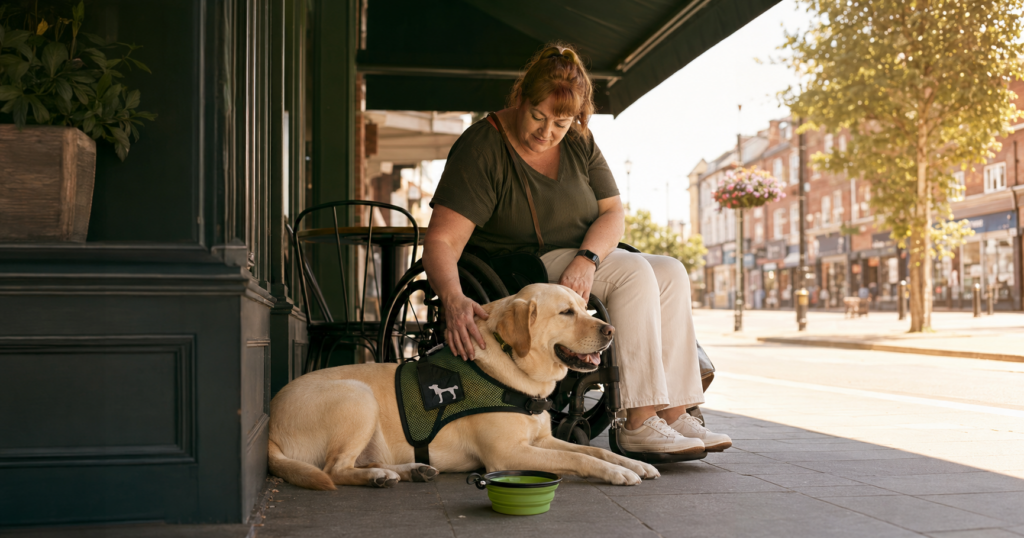
Your assistance dog may be willing to keep working. In this heat, that is exactly the problem. What every handler should know while amber alerts cover England.
By the ADR Team · Updated 15 July 2026 · 9 min read
Key takeaways
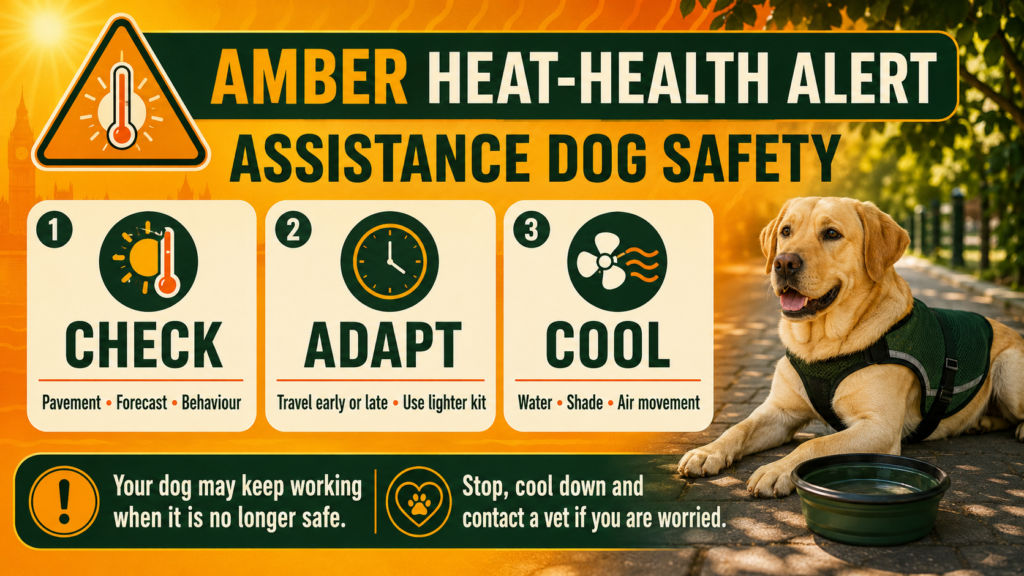
If the pavement fails the seven-second test, if your dog is slowing down, or if the UKHSA alert for your region is amber or red, your assistance dog should not be working outside in the middle of the day.
That is hard advice to follow when your dog is your independence. This guide is not the usual "keep pets cool" checklist. It is about the specific problem handlers face this week: what to do when the dog you rely on cannot safely do its job, how to adapt essential journeys, and how to handle an emergency where both of you are struggling in the heat.
This is general information, not legal or veterinary advice. If your dog shows signs of heatstroke, contact a vet immediately. If you feel unwell in the heat, call 111, or 999 in an emergency.
The UK Health Security Agency has issued amber heat health alerts for the East Midlands, East of England, London, the North West, the South East, the South West and the West Midlands, running until 9pm on Friday 18 July. Parts of southern England are forecast to reach 34 to 35°C before thunderstorms break the heat over the weekend, according to the Met Office.
An amber alert means the whole population may be at risk, not just people who are already vulnerable. For handlers there is a double exposure. Many disabilities that lead people to work with an assistance dog, including heart conditions, POTS and other forms of dysautonomia, MS, diabetes and some medications, also make the handler less heat tolerant. So the handler is at higher risk at exactly the moment the dog is too.
The British Veterinary Association reports that vets see around five times more heatstroke cases during extremely hot weather, and warns that animals can develop heatstroke even at rest in hot rooms, conservatories and vehicles. Research from the Royal Veterinary College's VetCompass programme found that about 1 in 7 dogs presenting with heat-related illness die, rising to around 1 in 4 during official heat-alert periods, and that exercise triggers roughly 75% of cases. Flat-faced breeds are around four times more likely to be affected.
Working is exercise. A guide, medical alert or mobility dog walking to the shops in 33°C heat is inside that 75%.
This is the part generic advice misses. Assistance dogs are selected and trained for persistence. Many will keep tasking well past the point a pet dog would have flopped in the shade. You cannot wait for your dog to quit, because a good assistance dog often will not.
Watch for the early signals:
Later signs are an emergency: wobbling or weakness, vomiting or diarrhoea, confusion, collapse, or seizures. At that point cool the dog and get to a vet urgently.
Treat any deviation from normal working behaviour in heat as data. A dog that "misbehaves" at 2pm in July is usually a dog telling you something.
Asphalt in direct sun can be 20°C or more hotter than the air. On a 30°C day, tarmac can exceed 50°C, hot enough to burn paw pads during a normal walking pace. Use the RSPCA-recommended check: press the back of your hand on the pavement for seven seconds. If you cannot hold it there comfortably, it is too hot for your dog's pads.
Three situations catch handlers out:
Public transport. Buses and older trains can run several degrees hotter than the street, and dogs lie on the floor where ventilation is worst. Travel outside peak hours, choose the coolest part of the carriage, carry water, and book Passenger Assist for rail journeys so you are not left standing on an exposed platform.
Waiting outside. Never leave your assistance dog tied outside a shop in this weather, and remember you almost never have to. Your dog has the right to come in with you under the Equality Act 2010.
Standing on hot ground. Queues are worse than walking, because pads stay in contact with the same hot spot. Stand on painted lines, grass or shaded paving where you can, or ask to wait inside.
Yes, if the vest is contributing to heat load, take it off. Nothing in UK law requires an assistance dog to wear a vest, harness cape or any identifying kit. Your rights under the Equality Act 2010 come from your disability and your dog's training, not from what the dog is wearing.
Practical options for heatwave working:
If a member of staff challenges you because the dog "doesn't look like an assistance dog" without its jacket, stay calm and explain: "Assistance dogs are not required to wear a vest. In this heat it isn't safe. Here is my dog's ID." You can show your card or QR profile page if it helps the conversation.
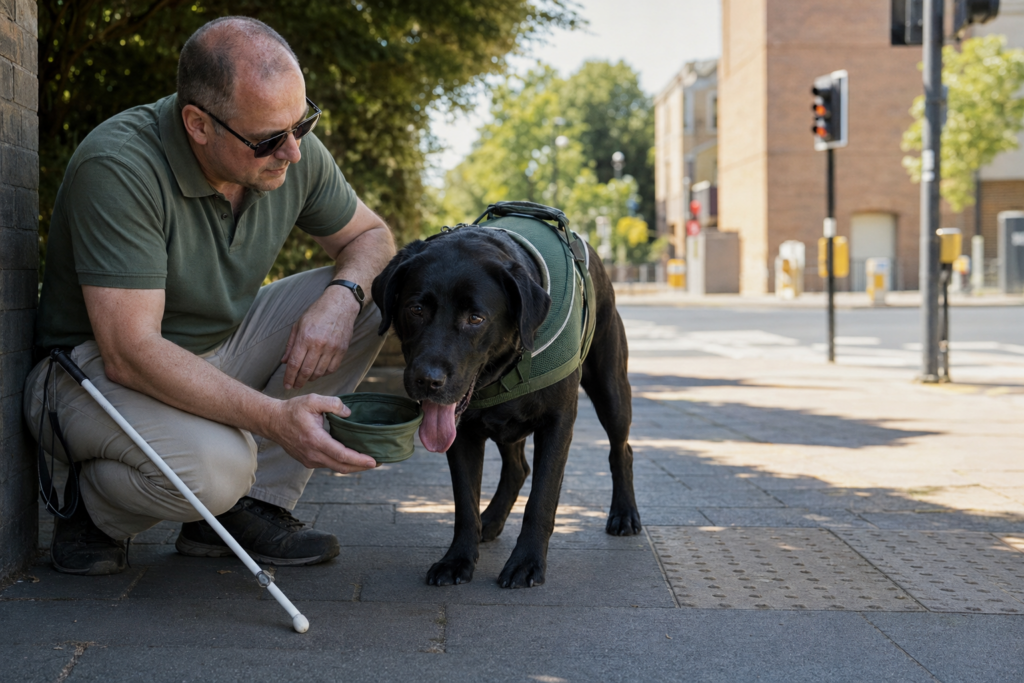
Keep it light, because you are carrying it in a heatwave too:
Affiliate note: some links below go to Amazon. As an Amazon Associate, Assistance Dog Registry earns from qualifying purchases at no extra cost to you. We only link products that match the advice in this article.
Skip dog boots for heat. They protect pads from contact burns but trap heat, and dogs lose heat through their paws. The better answer is not walking on ground that fails the seven-second test.
Your heatwave kit: six things worth carrying
The picks from this guide in one place. Affiliate links: as an Amazon Associate, ADR earns from qualifying purchases at no extra cost to you.
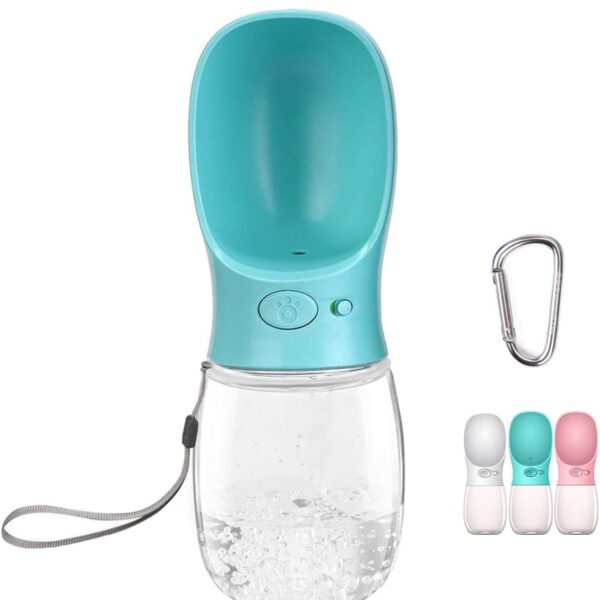
COTOP Portable Dog Water Bottle
★★★★½ 4.6
One-hand water on the move, so you can offer small drinks often without unclipping the lead.
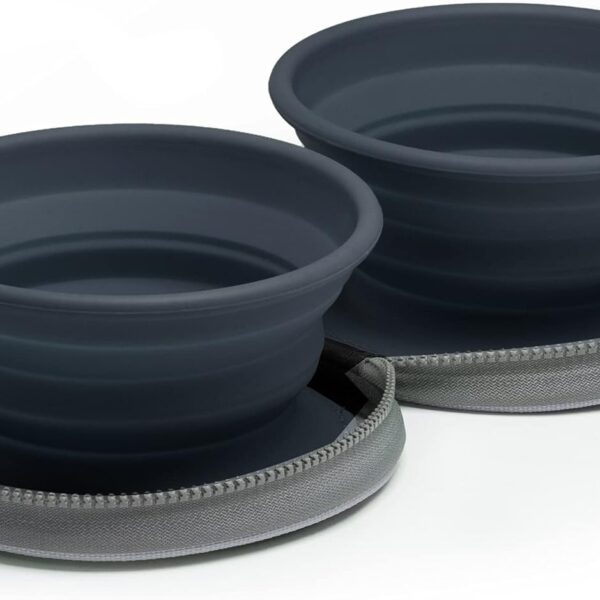
Colapz Collapsible Bowl Set
★★★★★ 4.8
Folds flat with a travel case that clips to a harness or bag. The highest-rated item on this list.

Pecute Gel Self-Cooling Mat
★★★★ 4.3
No fridge, no water, no power. A cool place to lie in the car, at work, or at rest stops.
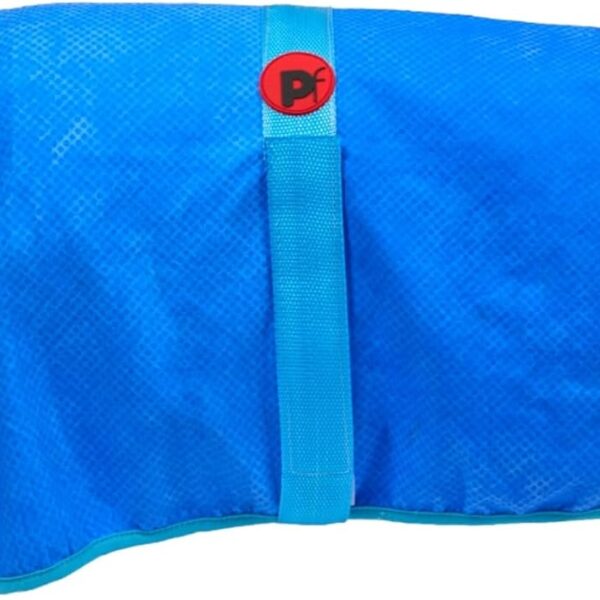
Petface Cooling Summer Coat
★★★★½ 4.5
Soak, wring, wear. A lighter evaporative layer for days when the working vest stays home.

All For Paws Chill Out Bandana
★★★★ 4.4
Cooling where it counts, around the neck, when a full coat is too much for your dog.

HIGH5 ZERO Electrolyte Tablets
★★★★½ 4.6
For you, not the dog. Sugar-free hydration that weighs nothing in the kit bag.
Yes, and you should. Service providers have a duty under the Equality Act 2010 to make reasonable adjustments for disabled customers. In a heatwave, "somewhere cooler for my assistance dog and me to wait" is about as reasonable as requests get: a seat away from the window, a spot near the air conditioning, a bowl of water, or being served while seated instead of queueing.
Use this wording
"I'm disabled and this is my assistance dog. The heat is dangerous for both of us today. Could we wait somewhere cooler, and could I trouble you for a bowl of water for the dog?"
Most staff say yes immediately. If somewhere refuses both entry and any adjustment, note the time and place, stay polite, and see our membership plans for the ID and support resources that make these conversations easier.
Some days this week, the safest decision is that the dog stays home in a cool room with water and airflow. That does not have to cost you the whole day:
A rest day in a heatwave is not lost training. It is what keeps your dog able to work for the next ten summers.
Heat emergencies rarely pick one of you. Decide the plan now, not on the pavement:
Missing something from the kit? The heat breaks this weekend, but there will be more. Amazon next-day delivery covers everything on this list. (Affiliate links, see note above.)
Handlers are used to pushing through. Most of us have worked our dogs on days we should not have worked ourselves. This week, the bravest decision is often the boring one: go at 7am, take the taxi, ask for the seat by the air conditioning, or stay home and let the dog sleep on the cold kitchen floor.
Your dog would work for you at 35°C without complaint. That is exactly why it must be you who says no.
Disclaimer: This article is general information, not legal advice and not veterinary advice. If your dog shows signs of heatstroke, contact a vet immediately. For heat-related health concerns of your own, call NHS 111 or 999 in an emergency. For disability rights questions, contact Citizens Advice, the EHRC or a qualified solicitor. This article contains Amazon affiliate links; as an Amazon Associate, Assistance Dog Registry earns from qualifying purchases.