Can you take your assistance dog to work — UK guide

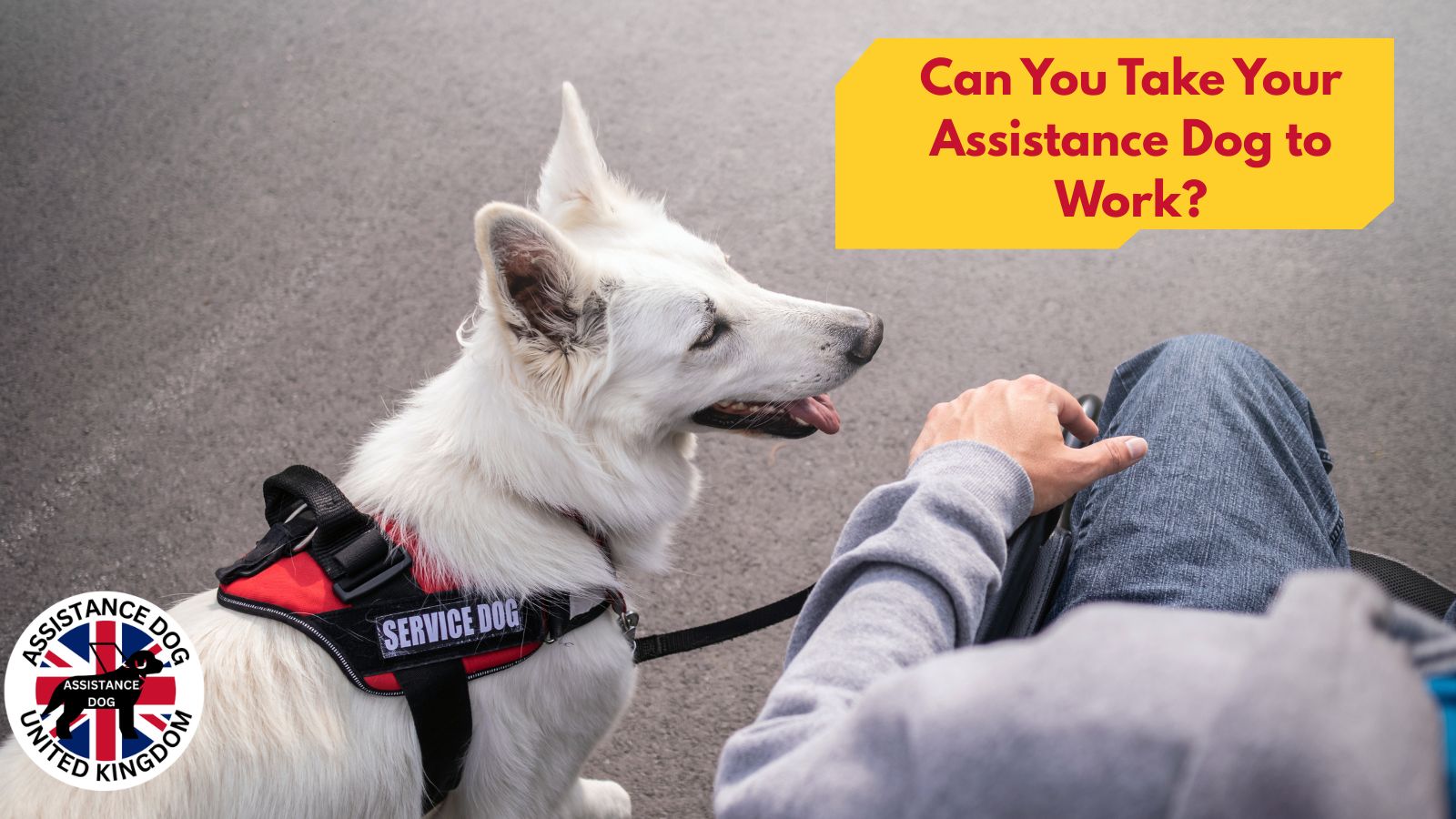
Can You Take Your Assistance Dog to Work?

Can You Take Your Assistance Dog to Work in the UK? Your Legal Rights Explained.

Yes in most cases, you can take your assistance dog to work in the UK.

Under the Equality Act 2010, employers have a legal duty to make reasonable adjustments for disabled employees. If you rely on an assistance dog at work in the UK, a blanket “no dogs” policy cannot automatically override your rights.

This guide explains what the law says, what reasonable adjustments mean in practice, and what to do if your employer refuses your request.


What the Equality Act 2010 Says About Assistance Dogs at Work

The Equality Act 2010 protects disabled people from discrimination in the workplace. This protection applies to recruitment, employment terms, and working conditions.

If your disability means you rely on an assistance dog, your employer must consider allowing the dog as a reasonable adjustment.

Importantly, UK law does not distinguish between charity-trained and owner-trained assistance dogs. There is also no legal requirement for registration, a vest, or formal ID. However, many handlers choose to carry voluntary identification to reduce friction in workplace conversations.


What Are “Reasonable Adjustments” in the Workplace?

Reasonable adjustments are changes that remove barriers for disabled employees. The goal is to prevent disadvantage caused by disability.

In practice, adjustments involving an assistance dog may include:

  • Allowing the dog during working hours
  • Providing space for the dog to rest
  • Adjusting desk layout or seating arrangements
  • Allowing short breaks for water or toileting
  • Informing colleagues appropriately (without disclosing medical details)

What counts as “reasonable” depends on factors such as employer size, cost, and the nature of the work environment. However, refusing outright without consideration is unlikely to be lawful.


Can an Employer Refuse an Assistance Dog Because of Allergies?

Allergies are a common concern. However, one employee’s allergy does not automatically override another employee’s disability rights.

Employers must balance both needs.

Possible solutions include:

  • Adjusting seating arrangements
  • Separating workspaces
  • Improving ventilation
  • Using air purifiers
  • Adjusting schedules

The key point is that employers must explore alternatives before excluding the assistance dog completely.


What to Do If Your Employer Says No

If your employer refuses your request, take these steps:

1. Put Your Request in Writing

Reference the Equality Act 2010 and explain how your dog supports your disability.

2. Escalate Through HR

If informal discussions fail, request a formal review of reasonable adjustments.

3. Contact ACAS

ACAS provides free, impartial workplace advice. Visit acas.org.uk or call 0300 123 1100.

4. Consider Legal Advice

If reasonable adjustments are refused without justification, you may have grounds for a disability discrimination claim.


Access to Work: Government Support

The Access to Work scheme provides financial support for disabled employees in the UK.

This support may include specialist equipment, travel costs, or other assistance to help you stay in work.

Although it does not replace your employer’s legal duties, it can make workplace adjustments easier to implement.

Learn more at gov.uk/access-to-work.

Legal Information Disclaimer

This article is provided for general informational purposes only and does not constitute legal advice. Employment situations vary, and the application of the Equality Act 2010 depends on individual circumstances. For advice specific to your situation, consider speaking with ACAS or a qualified employment solicitor.

Register your assistance dog today and enjoy every sunny moment without setbacks.

🎟️ Sign Up for the Lifetime Package Today

💡 Click here to learn more & register


Frequently Asked Questions

Can I take my assistance dog to work in the UK?

Often yes. Under the Equality Act 2010 employers must make reasonable adjustments for disabled employees, which can include allowing an assistance dog in the workplace.

Does my employer have to allow my assistance dog?

An employer should allow it as a reasonable adjustment unless they can show it would cause a genuine, significant problem. Refusing without good reason may be unlawful.

How do I ask my employer to bring my assistance dog?

Make a written request explaining your disability and how the dog helps, framed as a reasonable adjustment. A short letter or occupational health note can support it.

What if my workplace has a no-pets policy?

An assistance dog is not a pet. A no-pets policy does not remove your right to request reasonable adjustments under the Equality Act 2010.

Can colleagues' allergies stop me bringing my assistance dog?

Not automatically. The employer must balance both needs and look for reasonable adjustments, such as separate spaces, rather than simply refusing.

Sources

Learn more about our Lifelong Partner Package

Learn More – Additional Assistance Dog Letter Templates

If you found this travel guide useful, you may also benefit from these other essential assistance dog letter templates we’ve published:

📌 Housing Accommodation Request Letter – Need to request reasonable accommodation from your landlord? This template ensures your rights under the Equality Act 2010 are respected.

📌 Workplace Assistance Dog Request Letter – If you need accommodations to bring your assistance dog to work, this letter outlines your legal rights and reasonable adjustments your employer should consider.

📌 Medical Confirmation of Need for an Assistance Dog – A doctor’s letter template to confirm your need for an assistance dog for public access, travel, and daily life.

🔹 More templates are coming soon! Let us know if you have specific needs, and we’ll create more resources to support assistance dog handlers.


ADR
Written & reviewed by the ADR Team
Assistance Dog Registry, supporting UK assistance dog handlers since 2020

We're a UK-based team dedicated to assistance dog handlers. Since 2020 we've supplied 20,000+ assistance dog ID cards and supported thousands of handlers, owner-trained and charity-trained alike. Our guidance on the Equality Act 2010 and assistance dog access rights is referenced in UK public-sector accessibility policy and relied on by NHS staff, employers and carers. We're not a government body: registration is voluntary, and we'll always tell you so honestly. Learn more about us →  |  [email protected]

Related Post

More Helpful Guides for Handlers

Est. Reading: 13 minutes

The Aviation Exception: How UK Airlines Created a Barrier the Equality Act Never Required

An assistance dog wearing a yellow working vest waits calmly at a UK airport gate with their handler

ADR Investigation · UK Aviation

The Aviation Exception: How UK Airlines Created a Barrier the Equality Act Never Required

Owner-trained assistance dogs are legally protected on every UK street, in every shop, restaurant and taxi. So why do most UK airlines treat them as second-class? The answer is a narrow safety exception in the Equality Act, stretched until it broke.

📖 9 min read· By the ADR Team· Updated June 2026

Key takeaways
  • The Equality Act 2010 makes no distinction between charity-trained and owner-trained assistance dogs. The EHRC's own business guidance is explicit: owner-trained dogs have the same access rights as guide dogs.
  • Most UK airlines require ADI or IGDF accreditation, two private accreditation networks with no statutory authority over UK aviation. ADI is a US non-profit. IGDF is a UK charity. Neither sets UK law.
  • Airlines invoke a narrow "safety" exception in Schedule 3, Part 7 of the Equality Act that was written for genuine aircraft-specific risks, not for blanket paperwork requirements.
  • Behavioural assessment is the proportionate alternative. It is already standard in every UK café, taxi, train, hotel, NHS surgery and even American airlines. Airlines could adopt it for an estimated £20,000-£50,000 in cabin crew training.
  • Even Assistance Dogs UK (ADUK), the umbrella body for the airlines' own preferred accreditation networks, has publicly called for reform that includes dogs trained outside member organisations.

Get UK assistance dog law updates

Join 4,600+ UK handlers. We email when the law changes. No spam.

Uses your device's built-in voice. No data sent externally.
Three steps if a UK airline refuses your owner-trained assistance dog
No special qualifications needed. The law is on your side.
1
Document the refusal in writing
Get the staff member's name, the reason given, the exact wording of the policy invoked. Photograph any signage. Note the time and location. This becomes evidence.
2
File a formal complaint within 14 days
Write to the airline's accessibility officer citing Equality Act 2010 Sections 20 and 29. Copy in the Civil Aviation Authority. Request written justification for the safety carve-out being invoked.
3
Contact the Equality Advisory and Support Service
EASS provides free advice on disability discrimination claims. They can guide you through the County Court claim process and help calculate compensation. The deadline is 6 months from the incident.
📋 Table of contents (click to expand)
  1. What the law actually says
  2. Why most disabled people own-train
  3. The aviation carve-out, and how it's being stretched
  4. What the airlines would say
  5. The behavioural-assessment alternative
  6. And the discrimination happens on land
  7. Even the establishment is calling for reform
  8. Where this goes
  9. Frequently asked questions

Sarah can take her owner-trained assistance dog into a supermarket. She can take the same dog into a restaurant. She can board a train. She can stay in a hotel. She can visit her GP. She can enter a shopping centre.

Yet when she arrives at an airport, she may suddenly be told that her dog is no longer recognised.

Nothing about Sarah's disability has changed.

Nothing about the dog's behaviour has changed.

Nothing about the law protecting disabled people has changed.

Only the industry has changed.

That contradiction sits at the heart of one of the most overlooked disability-rights disputes in modern Britain.

This is the story of how UK aviation came to require something the law has never required, and why, if it ever ends up in court, the result is genuinely difficult to predict.

What the law actually says

Under the Equality Act 2010, service providers cannot discriminate against disabled people. Section 29 covers the provision of services. Section 20 imposes a positive duty to make reasonable adjustments. The Equality and Human Rights Commission's own business guidance, published in 2017 and still in force, is explicit on the question of assistance dogs:

"Assistance dogs can also be owner trained and the owner selects their own dog to fit their own requirements."

That single sentence, in the official guidance from the UK's statutory equality regulator, settles the question for every café, every taxi, every shop, every hotel, every hospital, every train, every bus, and every dentist in the country. An owner-trained assistance dog has the same access rights as a guide dog trained by Guide Dogs UK, a hearing dog trained by Hearing Dogs for Deaf People, or a mobility partner trained by Canine Partners. The law does not look at who trained the dog. It looks at whether the dog assists a disabled person, and whether the dog is under control.

This isn't a quirk of British law. The Americans with Disabilities Act, under regulation 28 CFR 36.302(c), is equally explicit: service animals may be owner-trained, and service providers may ask only two questions before granting access. No certification. No registry. No paperwork. Two of the most established disability legal frameworks in the world, both saying the same thing.

Why most disabled people own-train

Charity-trained assistance dogs are extraordinary animals, produced by extraordinary organisations doing genuinely vital work. But for the average disabled person seeking an assistance dog in the UK today, charity training isn't a choice. It's a queue:

PathwayReality
Guide Dogs UKFree, but 18 to 24 months of assessment and waitlist
Hearing Dogs for Deaf PeopleFree, but 2 to 3 year waitlist
Canine PartnersFree, but 3 to 5 year waitlist, narrow disability eligibility
Dogs for GoodVariable, often 2 years or more
Private trainers£15,000 to £40,000+ per dog
Owner-trained, owner-funded£500 to £3,000 in equipment + classes

For the disabilities that don't fit any charity's eligibility criteria, chronic illness, epilepsy, mental health conditions, certain autoimmune disorders, there is no charity waitlist at all. The choice is between paying a private trainer £15,000 to £40,000, or training the dog yourself for a fraction of that cost.

An owner-trained assistance dog settled peacefully on the wooden floor of a British café, welcomed under the Equality Act 2010

Owner-training, then, isn't a fringe preference. It is the realistic and often the only path for the majority of disabled people in the UK who need a working dog. The law recognises this. Civil society recognises this. Every UK ground service from the corner shop to the NHS recognises this. And then the customer reaches the airport.

The aviation carve-out, and how it's being stretched

The Equality Act 2010 contains a narrow exception. Schedule 3, Part 7 allows aviation services to treat disabled people less favourably where it is necessary for safety, or required to comply with international aviation agreements, or compelled by the physical limitations of the aircraft.

That exception was written for genuine aircraft-specific safety risks: turbulence, cabin pressure, evacuation procedures, weight limits. It was not written as a blanket licence to demand particular paperwork from particular handlers.

Yet that is what has happened. Most UK-based airlines now require, as a condition of carriage, that an assistance dog be accredited by Assistance Dogs International or the International Guide Dog Federation, two respected private accreditation networks that together cover roughly 100 to 140 member training organisations worldwide. ADI is a US non-profit headquartered in Ohio. IGDF is a UK-registered charity based in Reading. Neither is a government body. Neither sets UK law. Neither has any statutory authority over UK aviation.

What they have, from the airline's perspective, is something more useful: a piece of paper. And the moment an airline accepts that paper as the only acceptable proof of an assistance dog's status, the airline has created an extra-legal entry barrier that the Equality Act 2010 was specifically designed to prevent.

What the airlines would say

Airlines would argue that their policies exist for safety, consistency and operational practicality. Cabin crew are not dog trainers. Boarding decisions often need to be made quickly. Airlines may also point to liability concerns if an animal behaves unpredictably in a confined aircraft cabin.

These concerns are not trivial. An aircraft is not a café. A poorly-behaved dog at 35,000 feet cannot be asked to leave. Cabin crew already manage a substantial workload under safety-critical conditions, and adding individual animal assessment to that workload is a genuine operational question.

The question, however, is whether excluding every owner-trained assistance dog is a proportionate response to those concerns, particularly when the Equality Act requires service providers to consider reasonable adjustments wherever possible, and particularly when comparable industries have found ways to manage exactly the same risk.

The behavioural-assessment alternative

The safety exception in equality law is not a blank cheque. To rely on it, a service provider has to show that the restriction is proportionate, that it is necessary, and that there is no less discriminatory alternative.

There is a less discriminatory alternative. It is the same alternative used by every café, every taxi, every hotel, every train, every hospital, every restaurant, every NHS surgery, and every American airline operating under federal DOT rules: observe the dog's behaviour.

A uniformed staff member calmly assesses a working assistance dog by behaviour rather than paperwork, the alternative airlines could adopt

A working assistance dog can be assessed in minutes by a trained member of cabin crew at the boarding gate. Sit. Down. Stay. Settle at the handler's feet. Quiet voice control by the owner. No barking, no aggression, no soiling indoors. Every other industry that hosts assistance dogs uses this assessment, because behaviour is what matters. Behaviour is the actual safety variable. Behaviour is observable, on the spot, by anyone with four hours of training.

A modest training programme for cabin crew would cost airlines an estimated £20,000 to £50,000 to roll out across an entire workforce. That cost is small enough that the courts have repeatedly held similar measures to be reasonable adjustments that service providers must make under Section 20 of the Equality Act.

Whether current airline policies would survive judicial scrutiny remains largely untested. No UK court has yet been asked to directly examine whether blanket ADI/IGDF requirements are a proportionate response to genuine aviation safety concerns. However, disability-rights lawyers may argue that less discriminatory alternatives already exist, particularly where a dog's behaviour can be assessed individually rather than assumed from documentation alone.

That question remains open. But it is increasingly difficult to ignore.

And the discrimination happens on land

There is a further point that legal observers find compelling. The moment of refusal, the moment a handler is told their dog cannot fly, happens at a check-in counter, or a boarding gate, or a service desk. It happens on the ground, before any aircraft is involved. It is a decision made by ground staff, in a building, looking at a dog, applying a written policy.

There is nothing aviation-specific about that decision. The same conditions that apply to a hotel reception apply to a check-in desk. The safety carve-out in the Equality Act was written to cover constraints inherent to the aircraft itself, not the discretion of a member of ground staff applying an internal policy. Whether the carve-out reaches that far is a question the courts have never been asked to decide.

Even the establishment is calling for reform

This isn't a fringe complaint from owner-trainers. Assistance Dogs UK, the umbrella body for the fourteen British charities all accredited by ADI or IGDF, has itself publicly stated:

"ADUK believes that we urgently need clearer definitions in law of assistance dogs, alongside consistent standards for training and welfare that all working assistance dogs can aim to meet, whether trained by ADUK members or otherwise."

When the umbrella body for the airlines' own preferred accreditation networks publicly calls for reform that would explicitly include dogs trained outside that network, the policy position of the airlines has been overtaken by the consensus of the sector. The airlines are now defending a standard that the standard-setters themselves no longer think is acceptable.

Were you refused boarding?

Assistance Dog Registry UK is collecting first-hand accounts from handlers refused, questioned or delayed at UK airports because their assistance dog was owner-trained. Your story may be quoted anonymously in our follow-up reporting.

Tell us your story →

Final thought

Three things need to happen.

First, government needs to clarify that the safety carve-out in the Equality Act applies only to genuine aircraft-specific risks, not to ground-staff documentation requirements. The Department for Transport and the Equality and Human Rights Commission could resolve this with a single piece of guidance.

Second, airlines need to do what every other comparable industry already does: train their staff to assess assistance dog behaviour individually, and accept any dog that meets a behavioural standard, regardless of who trained it.

Third, disabled handlers need to know their rights. A refused boarding is not necessarily a verdict. It may be the start of a discrimination claim that, on current legal grounds, has a real chance of succeeding.

Until one of these things happens, the gap between what UK law says about owner-trained assistance dogs and what UK aviation does about them will remain one of the quietest, longest-running pieces of unequal treatment in British disability rights. It is time it ended.

🐾 Lifelong Partner package

A permanent profile, smart ID cards, dog tags and clear QR-linked information for airlines, landlords, agents and public access situations. The fastest way to evidence your dog's assistance role.

See the Lifelong Partner plan →

Frequently asked questions

Are UK airlines legally allowed to refuse my owner-trained assistance dog?

Airlines rely on a narrow safety exception in Schedule 3, Part 7 of the Equality Act 2010. Whether that exception genuinely covers blanket ADI/IGDF requirements has never been tested in a UK court. In practice, most refusals are based on policy interpretation rather than settled law. A refused handler with a well-behaved dog and a clear paper trail has a real prospect of bringing a successful discrimination claim.

What's the difference between ADI/IGDF accreditation and UK assistance dog rights?

ADI and IGDF accredit training organisations, not individual dogs. UK assistance dog rights under the Equality Act 2010 apply to the dog and handler regardless of who trained the dog. ADI/IGDF accreditation is a private quality mark, not a legal requirement for assistance dog status in the UK.

Can I claim compensation if a UK airline refuses my owner-trained assistance dog?

Yes, potentially. Compensation under the Equality Act 2010 typically covers injury to feelings (£900 to £49,300 under the current Vento bands), out-of-pocket costs (rebooked flights, accommodation), and in some cases aggravated damages. Claims are usually filed in the County Court within six months of the incident. The Equality Advisory and Support Service offers free guidance.

Will I have problems flying back to the UK from abroad?

Possibly. Many non-UK airlines apply similar ADI/IGDF requirements, and destination country animal-import rules add another layer. The Equality Act 2010 generally applies only to UK-based airlines or to services provided in the UK. For inbound flights, you may need to rely on the carrier's own accessibility policy, the destination country's disability law, or international aviation rules.

Where do I report a refused boarding incident?

Three places. First, the airline's own accessibility complaints process. Second, the Civil Aviation Authority's Passenger Advice and Complaints Team (CAA-PACT), which oversees airline accessibility complaints in the UK. Third, the Equality Advisory and Support Service (EASS) for disability discrimination guidance. Documenting the refusal in writing within 24 hours is essential.

Found this useful? Share it with someone who needs it.
Was this investigation helpful?
About this investigation

This article is the first in an ADR investigative series examining structural barriers facing UK owner-trained assistance dog handlers. It draws on the Equality Act 2010, current EHRC business guidance, the Civil Aviation Authority Code of Practice, the public statements of Assistance Dogs UK, and published accreditation policies of ADI and IGDF. Last updated June 2026.

ADR
The Assistance Dog Registry UK TeamVerified

Founded by Norbert Szeverenyi. 6,000+ UK handlers supported. Materials reviewed against UK statute and official EHRC, Shelter and GOV.UK guidance.

Disclaimer

This article is general information, not legal advice. It reflects ADR's analysis of publicly available UK law and policy at the date of publication.

Handlers refused boarding by a UK airline are encouraged to contact the Equality Advisory and Support Service, Citizens Advice, the EHRC, or a qualified solicitor before taking action.

📚 Glossary (click to expand)
ADI, Assistance Dogs International
US-based non-profit umbrella organisation founded 1986, headquartered in Maumee, Ohio. Accredits ~140 assistance dog training programmes worldwide.
IGDF, International Guide Dog Federation
UK-registered charity (no. 1062441) based in Reading. Accredits ~100 guide dog organisations worldwide.
ADUK, Assistance Dogs UK
UK umbrella body (charity no. 1119538), established 1995. Represents the 14 British assistance dog charities accredited by ADI and/or IGDF.
EHRC, Equality and Human Rights Commission
UK statutory equality regulator. Publishes binding business guidance on the Equality Act 2010.
EASS, Equality Advisory and Support Service
Free UK government-funded helpline providing advice on discrimination and human rights issues. Phone 0808 800 0082.
Vento Bands
Court guidance for "injury to feelings" compensation in discrimination cases. Updated annually. Current bands run £900 (lower) to £49,300 (upper).
🔗 Sources & further reading
Assistance Dog Registryusertagcalendar-fullclock
linkedin facebook pinterest youtube rss twitter instagram facebook-blank rss-blank linkedin-blank pinterest youtube twitter instagram