Blog

Understanding assistance dogs in the UK

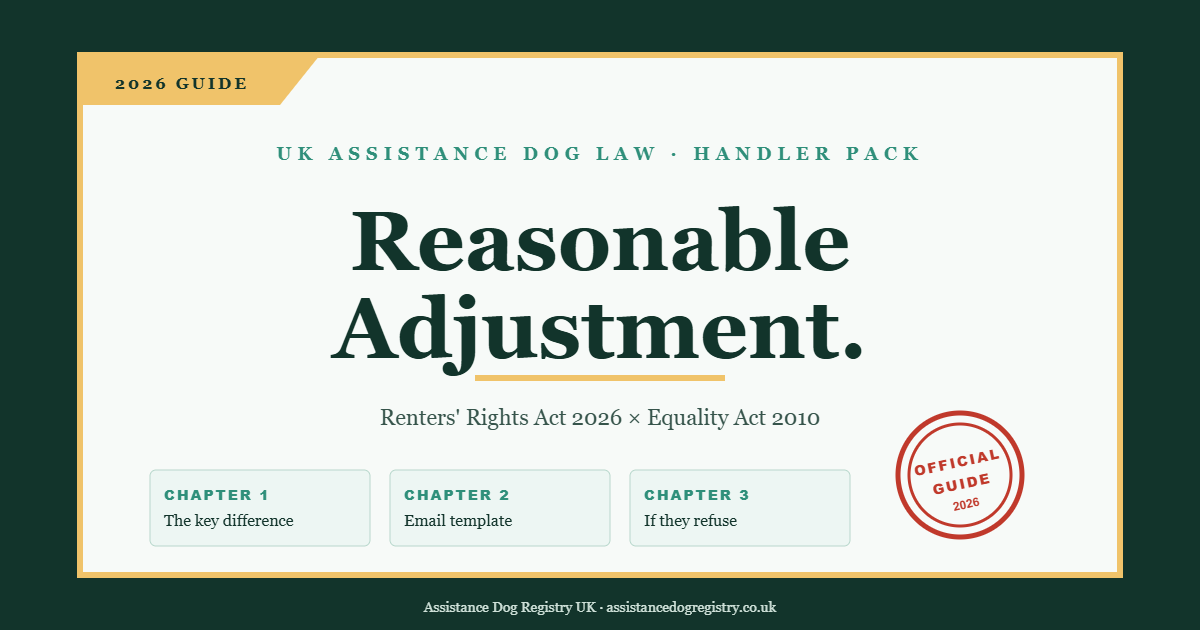
The UK Assistance Dog Rights Pocket Guide 2026 — Your Free Download

April 18, 2026

🇬🇧 2026 Edition · Free

A plain-English guide, a printable pocket card, and five response scripts for the next time someone questions your dog.

16 pages. Updated for 2026. Free. Yours to keep, print, or share.

Nobody should have to defend their dog at the door of a café

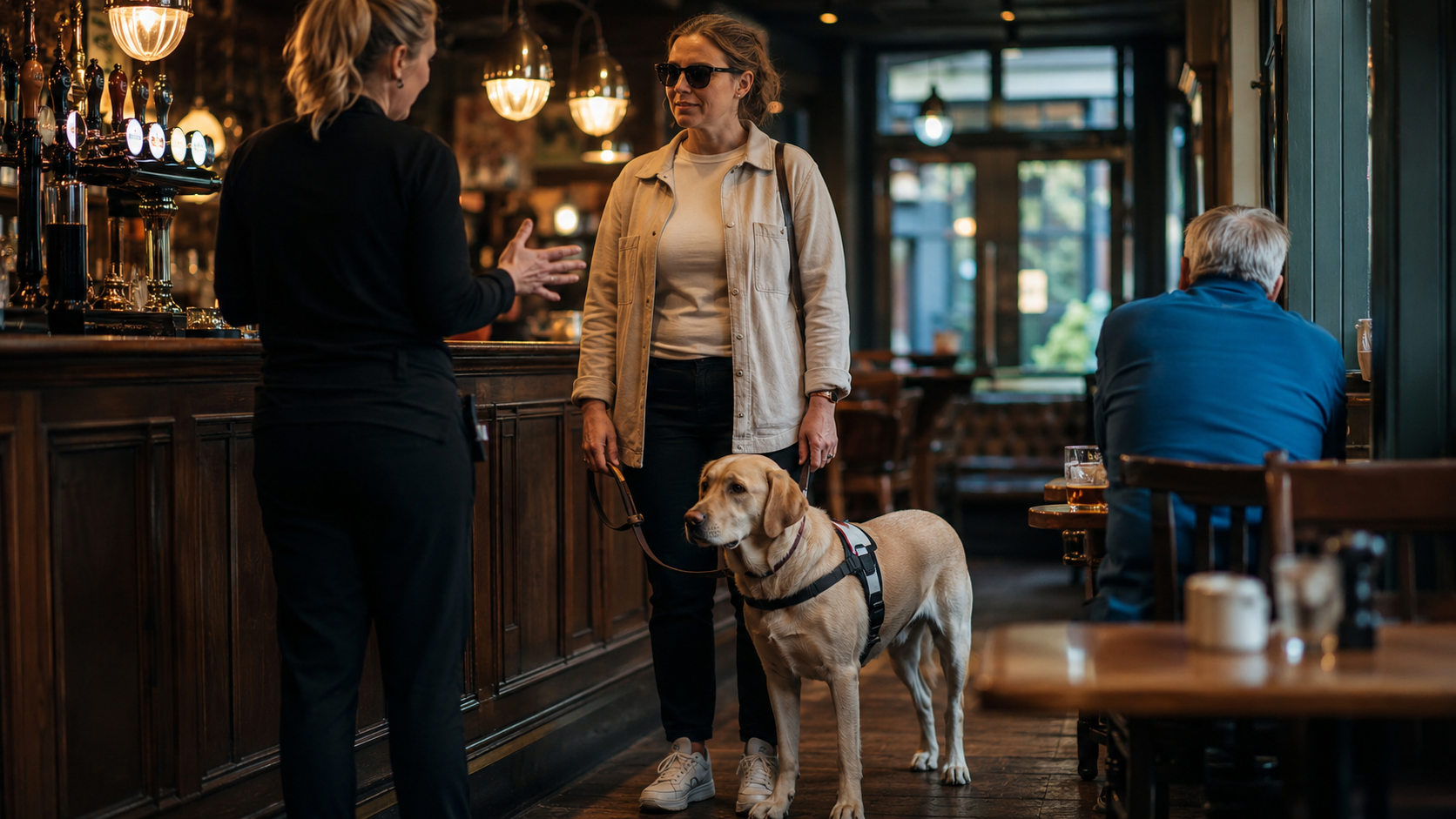
Last week, a handler wrote to us about a trip to her local coffee shop. She'd been going there for months. Same staff, same routine. Her dog, Bailey, curled quietly at her feet while she worked on her laptop.

Then a new manager started.

"Sorry — no pets." That was the first line. Then came the harder one: "Is that a real assistance dog?"

She froze. She knew her rights. She'd read the Equality Act. But in the moment, with other customers looking, she couldn't find the words. She packed up and left.

That evening, she sat in her car and cried. Not because of the coffee shop. Because she thought she'd been prepared, and she wasn't.

If you've ever had a version of that day, this guide is for you.

What's in the 2026 Pocket Guide

Five new sections for 2026. Everything else from 2025, updated where the law moved.

New for 2026 · 01

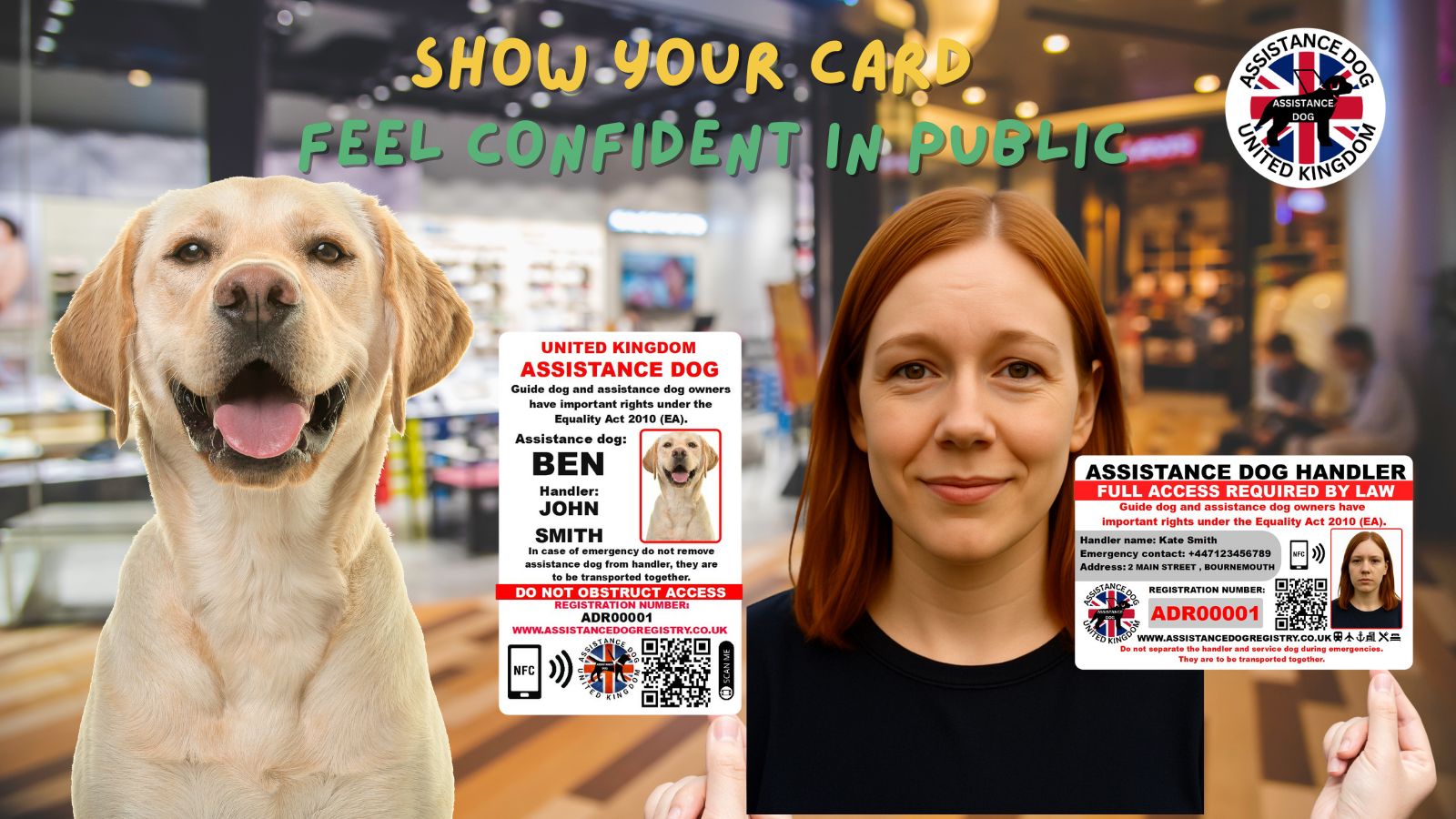
A pocket rights card you can print and carry

One side lists your protections under the Equality Act 2010 in plain English. The other side gives you the exact wording to use if someone challenges you. Sized to fit any card wallet or lanyard holder. Print once. Stop remembering.

New for 2026 · 02

Five response scripts for real confrontations

We asked handlers across the UK what they wished they'd said. Then we wrote it down. Specific scripts for:

  • Being turned away at a shop, café, or restaurant
  • A landlord saying "no pets" at a viewing
  • A taxi driver refusing the ride
  • A colleague or manager questioning you at work
  • A stranger who decides to educate you in public

Each script is short. Kind. Firm. You can read it straight off your phone if you need to.

New for 2026 · 03

A dedicated section for mental health handlers

If your dog helps you with anxiety, PTSD, autism, or another mental health condition, the conversation at the door is often harder. The new guide has a section just for you, with task-training notes specific to mental health assistance — deep pressure therapy, interruption, perimeter scanning, sensory support, meltdown prevention.

New for 2026 · 04

A landlord letter template

If your current landlord is pushing back, there's a copy-paste letter in the guide. It cites the Equality Act 2010 and the Housing Act. It's polite. It's firm. It's designed to end the conversation.

New for 2026 · 05

An employer accommodation template

For when you need to bring your assistance dog to work and HR doesn't know what to do. Includes the reasonable-adjustment framing, the escalation path through ACAS, and what to do if your employer refuses.

Download · Free · 16 pages

Download your 2026 Pocket Guide

A4 PDF. Print at home or keep it on your phone. No sign-up required.

⬇ Download the free PDF

5.8 MB · Print-ready · Works on phone or desktop

Who this guide is for

It's for you if any of these sound familiar:


  • You've trained your own dog, or are still training, and you're not sure if you "count"

  • You're a mental health handler whose dog's role isn't visible to strangers

  • You've been refused somewhere in the last year

  • You're thinking of registering your dog but haven't yet

  • You already carry an ADR card and want the pocket reference

  • You know another handler who could use it — forward freely

Your rights haven't changed. Your language can.

Under the Equality Act 2010, your assistance dog is protected in almost every setting where the public has access. Shops, cafés, restaurants, pubs, hotels, taxis, buses, trains, planes, workplaces, hospitals, schools, GP surgeries, dentists, hairdressers. The law doesn't distinguish between a charity-trained dog and one you've trained yourself.

But knowing the law and using the law are two different things. Most handlers lose the argument at the door not because they're wrong — but because the staff are faster. Staff are trained to ask certain questions. Most handlers don't have a script.

This guide gives you the counter-script. It's not a replacement for a registration card — it's the words to go with the card. The combination stops most conversations in ten seconds.

The three tiers, briefly

Registration is voluntary and separate from the guide. The guide is free whether you register or not.

Basic Yearly

£29.50/year

Digital-only. Your dog's profile, a registered ADR ID number, and a public verification page. No physical kit.

Most chosen

Premium Yearly

£59.50/year

Membership plus the full physical kit — 2× NFC Smart ID cards, 3× personalised plastic ID tags, hi-vis "Do Not Pet" vest, leather card holder, branded lanyard. Free replacements if lost.

Lifelong Partner

£129.50 once

Everything in Premium, plus a dedicated handler card and handler hi-vis vest. You pay once. You never renew.

A note from us

We've registered thousands of UK dogs since we started. Many were trained by the handlers themselves — at home, with patience, sometimes over years. Handlers come to us with a wide range of disabilities, visible and invisible. Most have been questioned at least once in public. Some of them have cried in a car park afterwards.

None of that is fair. The law is clear. The reality, sometimes, isn't.

What we can do is make it harder for the reality to win. That's what this guide exists for.

Your dog works for you. We're here to make sure the rest of the world knows it.

— The team at the Assistance Dog Registry

Read more

Can a Business Legally Refuse an Assistance Dog in the UK?

March 10, 2026
Your Rights Under the Equality Act 2010

If you rely on an assistance dog, one of the most stressful situations you can experience is being challenged in public.

You walk into a café, shop, or restaurant and a member of staff suddenly says:

“Sorry, no dogs allowed.”

People look at you. You feel embarrassed, frustrated, and unsure how to respond.

Many assistance dog handlers experience this at some point. The problem is that many businesses simply do not understand the law.

So the question is:

Can a business legally refuse an assistance dog in the UK?

In most situations, the answer is no.

Understanding your legal rights can make these situations much easier to handle.


The Law: The Equality Act 2010

The legal protection for assistance dog handlers in the UK comes from the Equality Act 2010.

Under this law, businesses must make reasonable adjustments so disabled people can access services in the same way as everyone else.

For many disabled people, an assistance dog is an essential part of daily life. These dogs perform important tasks such as:

  • guiding people with visual impairments
  • alerting to medical conditions
  • providing mobility support
  • assisting with psychiatric or neurological disabilities

Because of this, refusing entry to someone simply because they are accompanied by an assistance dog can amount to disability discrimination.

This means businesses should usually allow assistance dogs into places such as:

  • shops
  • cafés and restaurants
  • taxis and public transport
  • hotels and accommodation
  • supermarkets
  • public buildings

Even if a business normally has a “no dogs” policy, assistance dogs are generally an exception.


Do Assistance Dogs Need to Be Registered in the UK?

This is one of the most common misunderstandings.

Under the Equality Act 2010, assistance dogs do not need to be officially registered with any government organisation.

The law does not require:

  • registration
  • ID cards
  • special jackets or vests
  • certification from a particular training organisation

Many assistance dogs in the UK are owner-trained, and they can still be protected under the Equality Act as long as they assist a disabled person with tasks related to their disability.

However, misunderstandings still happen because many businesses are not fully aware of how the law works.


What Businesses Are Allowed to Ask

Although businesses should not refuse access simply because of the dog, staff may ask reasonable questions to understand the situation.

For example, they may ask:

  • Is this an assistance dog required because of a disability?
  • What tasks does the dog help you with?

These questions help staff understand that the dog is working and not simply a pet.

However, businesses should not demand medical proof or detailed personal information about your disability.

You are not required to disclose private medical details in order to access services.


What To Do If You Are Refused Entry

If a business refuses your assistance dog, the situation can feel upsetting and confrontational. However, staying calm often helps resolve the issue quickly.

Here are some practical steps you can take.

Stay calm and explain politely

Many staff members simply do not understand the law. Calmly explaining that your dog is an assistance dog protected under the Equality Act can often resolve the situation.

Ask to speak with a manager

Managers are usually more familiar with policies and may resolve the issue quickly.

Briefly explain the Equality Act

You can explain that refusing access because of an assistance dog may be considered disability discrimination under the Equality Act 2010.

Document the incident if necessary

If the problem continues, you may wish to note the business name, location, and what happened. This information can be useful if you decide to make a complaint later.

Most situations resolve quickly once staff understand the legal position.


Why Some Handlers Carry Identification

Although identification is not legally required, many assistance dog handlers choose to carry tools that help avoid misunderstandings.

These may include:

These tools can help staff quickly understand the situation and often prevent uncomfortable confrontations.

Many handlers find that clear identification helps make everyday interactions smoother.


Optional Registry Profiles for Assistance Dog Handlers

Some handlers choose to create a profile in the Assistance Dog Registry to make communication easier when questions arise.

A registry profile can include:

  • handler and dog information
  • optional identification cards
  • an online profile that can be shown if requested

While registration is not required by law, many handlers find that having clear information available helps avoid misunderstandings in public places.


Lifetime Membership With Payment Plans

For handlers who want long-term access to their registry profile and identification tools, the Lifetime Partner Membership offers a permanent option.

This can include:

  • a permanent registry profile
  • a personalised assistance dog ID card
  • a handler and dog information page
  • optional identification accessories

To make this easier for handlers, the Lifetime membership can also be purchased using payment plan options such as Klarna or Clearpay. This allows the cost to be split into smaller payments rather than paying everything upfront.


Final Thoughts

Being challenged in public with an assistance dog can be frustrating, especially when you know your dog is helping you live independently.

The important thing to remember is that under the Equality Act 2010, businesses are generally required to make reasonable adjustments for disabled people. This usually includes allowing assistance dogs to enter premises even if pets are normally not allowed.

Understanding your rights can help you handle these situations calmly and confidently.

At the same time, many handlers choose to carry identification or maintain a registry profile to make everyday interactions easier and avoid unnecessary conflict.

As awareness improves, situations like these should become less common. Until then, having clear information available can make a big difference.

Legal Information Disclaimer

This article is provided for general informational purposes only and does not constitute legal advice.

While every effort has been made to ensure the information is accurate at the time of writing, laws and regulations may change and individual circumstances can vary.

Nothing in this article should be taken as professional legal advice. If you require advice regarding your specific situation, you should contact a qualified legal professional or a relevant support organisation.

For independent guidance on disability rights in the UK, you may contact the Citizens Advice consumer service or seek advice from a qualified solicitor specialising in disability discrimination law.

ACAS Helpline:
📱 0300 123 1100 — Monday to Friday, 8am–6pm (standard UK call rates apply)

Text Relay (for people who are deaf or have speech impairments):
☎️ 18001 0300 123 1100

Register your assistance dog today and enjoy every sunny moment without setbacks.

🎟️ Sign Up for the Lifetime Package Today

💡 Click here to learn more & register


FAQ

1. What is an assistance dog?

An assistance dog is trained to perform specific tasks to aid individuals with disabilities, enhancing their independence and quality of life.

Wikipedia

2. Why is socialization important for assistance dogs?

Proper socialization ensures assistance dogs remain calm, focused, and well-behaved in various public settings, enabling them to perform their duties effectively.

3. At what age should I start socializing my assistance dog?

It's beneficial to begin socialization during puppyhood; however, with patience and consistent training, dogs of any age can learn to navigate public environments confidently.

4. How long does it take to socialize an assistance dog?

The duration varies based on the dog's temperament, previous experiences, and the consistency of training. Regular, positive exposure to different environments is key.

5. Can I socialize my assistance dog if they are older?

Yes, older dogs can be socialized successfully. While it may require more time and patience, with positive reinforcement, they can adapt to new situations.

6. What should I do if my assistance dog shows fear in public?

If your dog exhibits fear, calmly remove them from the situation and gradually reintroduce the stimulus at a comfortable distance, rewarding calm behavior.

7. How do I handle public distractions during training?

Teach focus commands like "watch me" to redirect your dog's attention. Gradual exposure to distractions, paired with positive reinforcement, can improve focus.

8. Are there specific public places ideal for socialization?

Begin with quiet areas like parks, then progress to busier environments such as cafes, public transport, and shopping centres as your dog becomes more comfortable.

9. How can I ensure my assistance dog behaves appropriately around other animals?

Controlled introductions and rewarding calm behaviour are essential. Consistent training helps your dog remain focused on their tasks, even around other animals.

10. What are the legal requirements for assistance dogs in public places?

In many regions, assistance dogs are permitted in public areas to support their handlers. It's important to familiarize yourself with local laws and regulations regarding assistance dogs.

Learn more about our Lifelong Partner Package

Learn More – Additional Assistance Dog Letter Templates

If you found this travel guide useful, you may also benefit from these other essential assistance dog letter templates we’ve published:

📌 Housing Accommodation Request Letter – Need to request reasonable accommodation from your landlord? This template ensures your rights under the Equality Act 2010 are respected.

📌 Workplace Assistance Dog Request Letter – If you need accommodations to bring your assistance dog to work, this letter outlines your legal rights and reasonable adjustments your employer should consider.

📌 Medical Confirmation of Need for an Assistance Dog – A doctor’s letter template to confirm your need for an assistance dog for public access, travel, and daily life.

🔹 More templates are coming soon! Let us know if you have specific needs, and we’ll create more resources to support assistance dog handlers.

Read more

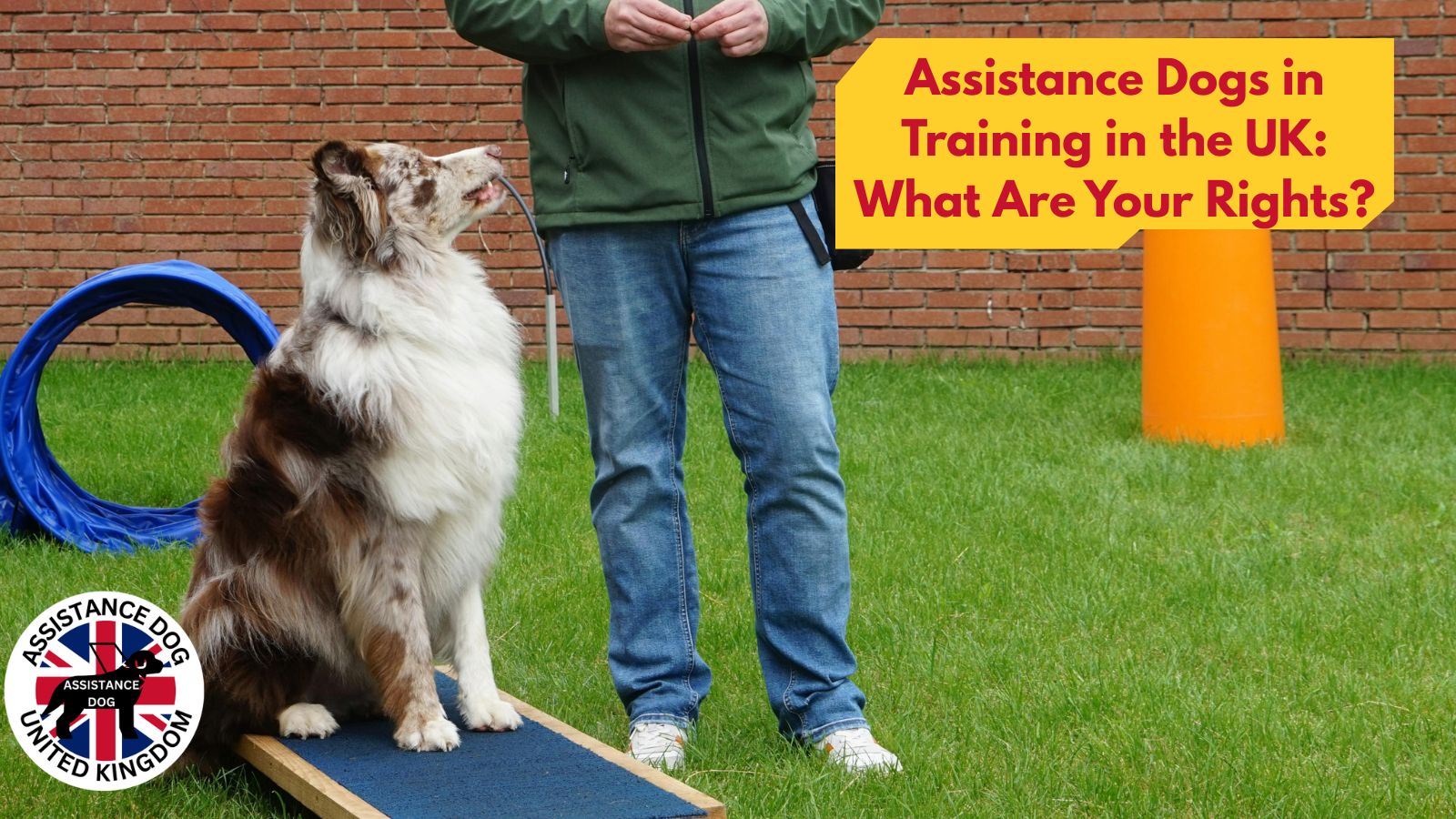
Assistance Dogs in Training in the UK: What Are Your Rights?

March 3, 2026

If you are training your own assistance dog, one question comes up repeatedly:

“Do assistance dogs in training have legal rights in the UK?”

This is one of the most misunderstood areas of UK assistance dog law and it’s also the stage where handlers report the highest level of anxiety and public challenge.

You don’t want confrontation.
You don’t want to be challenged in front of others.
You don’t want to say the wrong thing.

So let’s break this down clearly, practically, and honestly.

Do Assistance Dogs in Training Have Legal Protection Under the Equality Act 2010?

The Equality Act 2010 protects disabled people who use an assistance dog trained to perform tasks related to their disability.

The law does not:

  • Require registration
  • Require certification
  • Require ID cards
  • Require charity affiliation
  • Require the dog to come from a specific organisation

Legal protection attaches to the disabled person, not the organisation that trained the dog.

However, the key issue is behaviour and function.

If your dog is being trained to perform disability-related tasks and behaves appropriately in public, protection may apply.

If your dog is disruptive, uncontrolled, or not yet capable of reliable public behaviour, a business may lawfully ask you to leave based on behaviour not because the dog is “in training.”

Behaviour determines strength of position.

The Legal Grey Area: Why “In Training” Creates Confusion

The Equality Act does not define the phrase “assistance dog in training.”

This is where confusion starts.

In practice:

  • A dog that already performs trained tasks and is well behaved is clearly protected.
  • A young puppy still learning obedience is harder to defend as an assistance dog in legal terms.

This is why many experienced UK trainers advise:

Build reliability first.
Introduce complex public environments gradually.

The stronger the behaviour, the stronger your legal footing.

Assistance Dog in Training Info Card

Can Shops, Cafés or Taxis Refuse an Assistance Dog in Training?

If your dog is:

  • Calm
  • Under control
  • Not barking, lunging or sniffing excessively
  • Clearly task-focused

Refusal purely because the dog is “in training” may amount to discrimination.

However, if the dog is:

  • Reacting to other dogs
  • Not toilet trained
  • Jumping, whining or disruptive
  • Unable to settle

A business may lawfully refuse entry based on behaviour.

This distinction matters.

Businesses cannot refuse based on a blanket “no dogs” policy.

They can refuse based on genuine disruption.

Why the Training Phase Creates the Most Public Friction

This is something many new handlers are not prepared for.

During the training stage, you may experience:

  • More questioning from staff
  • More public attention
  • More uncertainty
  • More “Where’s the paperwork?” moments
  • More second-guessing

Even when you are legally correct, confrontation is emotionally exhausting.

This is not a legal weakness.
It is a human reality.

Voluntary Registration During Training: Why Many Handlers Choose It

There is no official UK assistance dog register.

You are not legally required to register your assistance dog whether fully trained or still in training.

However, many owner-trainers choose to create a structured assistance dog profile during the training phase.

Not because the law requires it.

But because real-world experience shows it reduces anxiety and confrontation.

Instead of arguing, they can calmly reference structured documentation.

Instead of explaining repeatedly, they can present:

  • A clear handler declaration
  • A task outline
  • A summary of Equality Act protections
  • A professional, consistent format

This does not create legal rights.

It does not replace behaviour.

But it often changes the dynamic of the conversation.

Handlers frequently report that simply knowing they have structured documentation reduces their own anxiety even when they never need to show it.

Confidence influences body language.
Body language influences public response.

During training, that psychological support matters.

Public Transport and Dogs in Training

Taxi drivers have specific legal duties under UK law. Refusing an assistance dog without a valid medical exemption can be a criminal offence.

However, in practice, dogs in training are more likely to be questioned.

If your dog is:

  • Calm
  • Under control
  • Clearly task-oriented

You are in a stronger position.

If your dog is visibly unsettled or reactive, the situation becomes more complex.

Again, behaviour is the foundation.

What To Say If You Are Challenged

If someone questions you, remain calm.

You may be asked:

  • “Is this an assistance dog?”
  • “Is it fully trained?”
  • “Do you have proof?”

You are not required to disclose your medical condition.

A calm response might be:

“My dog is being trained to perform tasks related to my disability and is under control.”

If the dog is behaving appropriately and access is refused purely because it is “in training,” you may consider following up with a written complaint referencing the Equality Act 2010.

Documentation of interactions can be helpful.

Common Myths About Assistance Dogs in Training

Myth: Dogs in training have no rights.
Reality: Protection depends on disability status and behaviour.

Myth: You must register your dog to have rights.
Reality: There is no official UK register.

Myth: Businesses can demand certification.
Reality: There is no mandatory certification system.

Myth: Puppies automatically qualify.
Reality: Task function and public behaviour determine legitimacy.

Should You Train in Public Before Your Dog Is Ready?

Rushing public access too early often creates negative experiences that slow long-term progress.

Gradual exposure protects:

  • Your dog’s confidence
  • Your own confidence
  • Your credibility in public

Strong foundation first.
Complex environments second.Legal rights are strongest when behaviour is strongest.

Legal Information Disclaimer

This article provides general guidance only and does not constitute legal advice.
For advice specific to your situation, contact ACAS or a qualified legal professional.

ACAS Helpline:
📱 0300 123 1100 — Monday to Friday, 8am–6pm (standard UK call rates apply)

Text Relay (for people who are deaf or have speech impairments):
☎️ 18001 0300 123 1100

Register your assistance dog today and enjoy every sunny moment without setbacks.

🎟️ Sign Up for the Lifetime Package Today

💡 Click here to learn more & register


FAQ

1. What is an assistance dog?

An assistance dog is trained to perform specific tasks to aid individuals with disabilities, enhancing their independence and quality of life.

Wikipedia

2. Why is socialization important for assistance dogs?

Proper socialization ensures assistance dogs remain calm, focused, and well-behaved in various public settings, enabling them to perform their duties effectively.

3. At what age should I start socializing my assistance dog?

It's beneficial to begin socialization during puppyhood; however, with patience and consistent training, dogs of any age can learn to navigate public environments confidently.

4. How long does it take to socialize an assistance dog?

The duration varies based on the dog's temperament, previous experiences, and the consistency of training. Regular, positive exposure to different environments is key.

5. Can I socialize my assistance dog if they are older?

Yes, older dogs can be socialized successfully. While it may require more time and patience, with positive reinforcement, they can adapt to new situations.

6. What should I do if my assistance dog shows fear in public?

If your dog exhibits fear, calmly remove them from the situation and gradually reintroduce the stimulus at a comfortable distance, rewarding calm behavior.

7. How do I handle public distractions during training?

Teach focus commands like "watch me" to redirect your dog's attention. Gradual exposure to distractions, paired with positive reinforcement, can improve focus.

8. Are there specific public places ideal for socialization?

Begin with quiet areas like parks, then progress to busier environments such as cafes, public transport, and shopping centres as your dog becomes more comfortable.

9. How can I ensure my assistance dog behaves appropriately around other animals?

Controlled introductions and rewarding calm behaviour are essential. Consistent training helps your dog remain focused on their tasks, even around other animals.

10. What are the legal requirements for assistance dogs in public places?

In many regions, assistance dogs are permitted in public areas to support their handlers. It's important to familiarize yourself with local laws and regulations regarding assistance dogs.

Learn more about our Lifelong Partner Package

Learn More – Additional Assistance Dog Letter Templates

If you found this travel guide useful, you may also benefit from these other essential assistance dog letter templates we’ve published:

📌 Housing Accommodation Request Letter – Need to request reasonable accommodation from your landlord? This template ensures your rights under the Equality Act 2010 are respected.

📌 Workplace Assistance Dog Request Letter – If you need accommodations to bring your assistance dog to work, this letter outlines your legal rights and reasonable adjustments your employer should consider.

📌 Medical Confirmation of Need for an Assistance Dog – A doctor’s letter template to confirm your need for an assistance dog for public access, travel, and daily life.

🔹 More templates are coming soon! Let us know if you have specific needs, and we’ll create more resources to support assistance dog handlers.

Read more

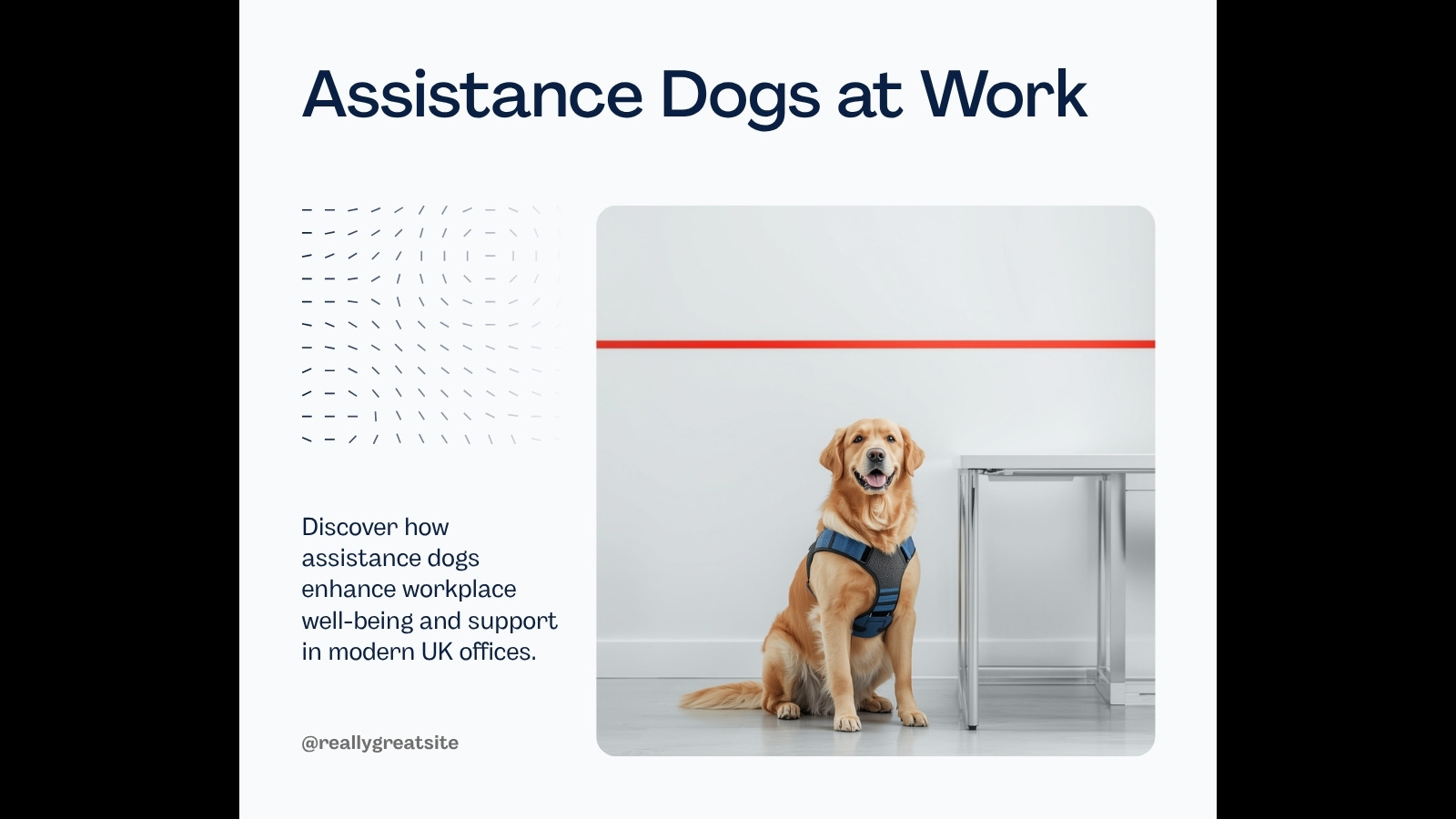
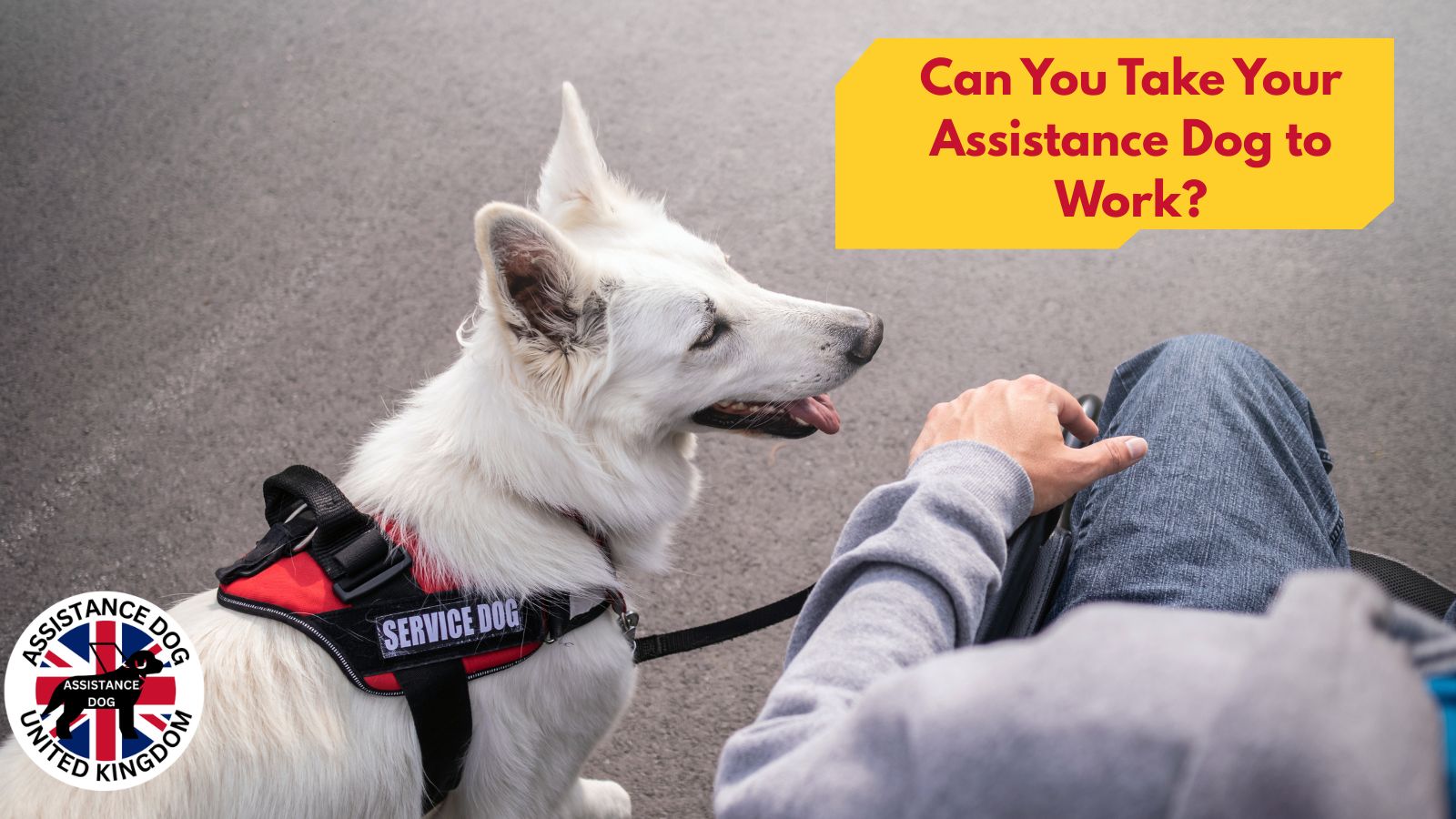
Can You Take Your Assistance Dog to Work?

February 28, 2026

Can You Take Your Assistance Dog to Work in the UK? Your Legal Rights Explained.

Yes in most cases, you can take your assistance dog to work in the UK.

Under the Equality Act 2010, employers have a legal duty to make reasonable adjustments for disabled employees. If you rely on an assistance dog at work in the UK, a blanket “no dogs” policy cannot automatically override your rights.

This guide explains what the law says, what reasonable adjustments mean in practice, and what to do if your employer refuses your request.


What the Equality Act 2010 Says About Assistance Dogs at Work

The Equality Act 2010 protects disabled people from discrimination in the workplace. This protection applies to recruitment, employment terms, and working conditions.

If your disability means you rely on an assistance dog, your employer must consider allowing the dog as a reasonable adjustment.

Importantly, UK law does not distinguish between charity-trained and owner-trained assistance dogs. There is also no legal requirement for registration, a vest, or formal ID. However, many handlers choose to carry voluntary identification to reduce friction in workplace conversations.


What Are “Reasonable Adjustments” in the Workplace?

Reasonable adjustments are changes that remove barriers for disabled employees. The goal is to prevent disadvantage caused by disability.

In practice, adjustments involving an assistance dog may include:

  • Allowing the dog during working hours
  • Providing space for the dog to rest
  • Adjusting desk layout or seating arrangements
  • Allowing short breaks for water or toileting
  • Informing colleagues appropriately (without disclosing medical details)

What counts as “reasonable” depends on factors such as employer size, cost, and the nature of the work environment. However, refusing outright without consideration is unlikely to be lawful.


Can an Employer Refuse an Assistance Dog Because of Allergies?

Allergies are a common concern. However, one employee’s allergy does not automatically override another employee’s disability rights.

Employers must balance both needs.

Possible solutions include:

  • Adjusting seating arrangements
  • Separating workspaces
  • Improving ventilation
  • Using air purifiers
  • Adjusting schedules

The key point is that employers must explore alternatives before excluding the assistance dog completely.


What to Do If Your Employer Says No

If your employer refuses your request, take these steps:

1. Put Your Request in Writing

Reference the Equality Act 2010 and explain how your dog supports your disability.

2. Escalate Through HR

If informal discussions fail, request a formal review of reasonable adjustments.

3. Contact ACAS

ACAS provides free, impartial workplace advice. Visit acas.org.uk or call 0300 123 1100.

4. Consider Legal Advice

If reasonable adjustments are refused without justification, you may have grounds for a disability discrimination claim.


Access to Work: Government Support

The Access to Work scheme provides financial support for disabled employees in the UK.

This support may include specialist equipment, travel costs, or other assistance to help you stay in work.

Although it does not replace your employer’s legal duties, it can make workplace adjustments easier to implement.

Learn more at gov.uk/access-to-work.

Legal Information Disclaimer

This article is provided for general informational purposes only and does not constitute legal advice. Employment situations vary, and the application of the Equality Act 2010 depends on individual circumstances. For advice specific to your situation, consider speaking with ACAS or a qualified employment solicitor.

Register your assistance dog today and enjoy every sunny moment without setbacks.

🎟️ Sign Up for the Lifetime Package Today

💡 Click here to learn more & register


FAQ

1. What is an assistance dog?

An assistance dog is trained to perform specific tasks to aid individuals with disabilities, enhancing their independence and quality of life.

Wikipedia

2. Why is socialization important for assistance dogs?

Proper socialization ensures assistance dogs remain calm, focused, and well-behaved in various public settings, enabling them to perform their duties effectively.

3. At what age should I start socializing my assistance dog?

It's beneficial to begin socialization during puppyhood; however, with patience and consistent training, dogs of any age can learn to navigate public environments confidently.

4. How long does it take to socialize an assistance dog?

The duration varies based on the dog's temperament, previous experiences, and the consistency of training. Regular, positive exposure to different environments is key.

5. Can I socialize my assistance dog if they are older?

Yes, older dogs can be socialized successfully. While it may require more time and patience, with positive reinforcement, they can adapt to new situations.

6. What should I do if my assistance dog shows fear in public?

If your dog exhibits fear, calmly remove them from the situation and gradually reintroduce the stimulus at a comfortable distance, rewarding calm behavior.

7. How do I handle public distractions during training?

Teach focus commands like "watch me" to redirect your dog's attention. Gradual exposure to distractions, paired with positive reinforcement, can improve focus.

8. Are there specific public places ideal for socialization?

Begin with quiet areas like parks, then progress to busier environments such as cafes, public transport, and shopping centres as your dog becomes more comfortable.

9. How can I ensure my assistance dog behaves appropriately around other animals?

Controlled introductions and rewarding calm behaviour are essential. Consistent training helps your dog remain focused on their tasks, even around other animals.

10. What are the legal requirements for assistance dogs in public places?

In many regions, assistance dogs are permitted in public areas to support their handlers. It's important to familiarize yourself with local laws and regulations regarding assistance dogs.

Learn more about our Lifelong Partner Package

Learn More – Additional Assistance Dog Letter Templates

If you found this travel guide useful, you may also benefit from these other essential assistance dog letter templates we’ve published:

📌 Housing Accommodation Request Letter – Need to request reasonable accommodation from your landlord? This template ensures your rights under the Equality Act 2010 are respected.

📌 Workplace Assistance Dog Request Letter – If you need accommodations to bring your assistance dog to work, this letter outlines your legal rights and reasonable adjustments your employer should consider.

📌 Medical Confirmation of Need for an Assistance Dog – A doctor’s letter template to confirm your need for an assistance dog for public access, travel, and daily life.

🔹 More templates are coming soon! Let us know if you have specific needs, and we’ll create more resources to support assistance dog handlers.

Read more

What Counts as an Assistance Dog in the UK and Who Can Train One?

October 23, 2025
If you’ve ever wondered exactly what qualifies as an assistance dog in the UK, you’re not alone.

One of the most common questions from both dog owners and business owners is whether a dog must be trained by a charity to count as an assistance dog. The short answer is no but the confusion comes from how the law was originally written.

This guide explains what the Equality Act 2010 actually says, what the current legal guidance means in practice, and who can train an assistance dog today.


Understanding What the Law Says

The Equality Act 2010 protects disabled people who rely on assistance dogs.
Section 173 of the Act defines an assistance dog as:

“a dog which has been trained by a prescribed charity to assist a disabled person.”

That wording was drafted over a decade ago when only a few charities such as Guide Dogs for the Blind and Hearing Dogs for Deaf People were operating publicly. At the time, most assistance dogs came from those organisations, which is why the law used the phrase “prescribed charity.”

However, as the role of assistance dogs expanded, this definition became outdated. Thousands of disabled people now train their own dogs, and these dogs perform essential tasks such as medical alerts, mobility support, psychiatric interruption, and deep-pressure therapy. These owner-trained dogs are equally protected under the Equality Act when accompanying their handlers in public.


The Modern Legal Interpretation

The official body responsible for enforcing the Equality Act the Equality and Human Rights Commission (EHRC) has made the current position clear.
According to its guidance for businesses and service providers:

“Whilst there is no legal requirement for an assistance dog to be trained, most are likely to be trained either by their owner or by a specialist organisation.”

This means there is no requirement for a dog to be trained by a charity.
What matters legally is that the dog has been trained by anyone to carry out specific tasks that mitigate a person’s disability, and that it behaves safely and responsibly in public spaces.

(Source: Equality and Human Rights Commission Assistance dogs: a guide for all businesses and service providers)
(Source: Equality Act 2010, Section 173 legislation.gov.uk)


What Counts as an Assistance Dog?

An assistance dog is a working dog trained to perform one or more tasks directly related to a person’s disability. Examples include:

• Guiding a person with visual impairment
• Alerting to sounds or alarms for people who are deaf
• Detecting medical changes such as low blood sugar or seizures
• Providing stability, retrieving items, or opening doors for mobility support
• Interrupting panic attacks or performing grounding tasks for PTSD and anxiety

A dog does not need to wear a vest, carry a certificate, or belong to a specific charity to qualify. Identification and training records can be useful, but the key factors are the dog’s behaviour, control, and purpose.


Owner-Trained vs Charity-Trained Dogs

Both owner-trained and charity-trained dogs can meet the same standards.
Charity-trained dogs usually follow a structured, accredited program, while owner-trained dogs are customised to the handler’s unique needs. What matters is reliability and behaviour in public.

Many handlers choose to train their own dogs because waiting lists for charity programs can be long, or because they need a dog trained for a very specific type of task. Others begin training with the support of independent instructors or local trainers familiar with disability-specific skills.


Common Myths About Assistance Dogs

Myth 1: The dog must be trained by a registered charity.
False. There is no such legal requirement in the UK. The EHRC confirms that dogs can be trained by their owners.

Myth 2: You must have an ID card or certificate.
False. No government issued ID exists. Handlers often carry identification voluntarily to avoid misunderstandings, but it is not mandatory.

Myth 3: Emotional support animals have the same rights.
False. Emotional support animals, though valuable, are not automatically recognised as assistance dogs under UK law. The key difference is that assistance dogs are trained to perform specific disability-related tasks.


Responsibilities of Handlers and Businesses

For Handlers
• Your dog must remain under control at all times.
• The dog should be clean, calm, and non-disruptive in public places.
• Use of a harness, vest, or information card is optional but often helps educate others.
• Carry a polite information card summarising your rights and your dog’s training purpose.

For Businesses
• Do not ask for proof or paperwork there is no legal registration system.
• You may politely ask, “Is the dog required because of a disability?” and “What tasks is it trained to perform?”
• Only refuse entry if there is a legitimate safety or health reason, such as restricted access to sterile medical areas.
• Treat assistance dog handlers with the same respect as any other customer.


Why the Law Protects Owner-Trained Dogs

The Equality Act focuses on the rights of the disabled person, not the method of training.
If a dog performs tasks that mitigate a disability and behaves appropriately in public, it meets the spirit of the law regardless of who trained it. The aim of the Act is inclusion ensuring disabled people can access shops, restaurants, housing, and transport without discrimination.

This modern interpretation allows freedom, fairness, and independence for thousands of disabled people who rely on their self-trained or privately trained assistance dogs every day.


Our Mission and Why the Registry Exists

The Assistance Dog Registry UK was created to make everyday life smoother and more respectful for assistance dog handlers across the country. Our mission is to promote understanding, visibility, and equal access for everyone who depends on a trained assistance dog whether charity-trained or owner-trained.

We operate as a voluntary, educational registry to help businesses and the public recognise genuine assistance dogs and to reduce the conflicts and confusion that often arise at doors, shops, or public venues. Every registration helps raise awareness, protect rights, and show that responsible handlers and well-trained dogs are part of a positive, inclusive community.

By joining the registry, you’re not simply creating a profile or receiving an information card — you’re supporting a nationwide movement for dignity, respect, and equal treatment under the law.

Together, we are helping the UK become a place where assistance dog handlers are recognised and welcomed everywhere.


Our Assistance Dog Registry offers smart, professional tools to help you:

  • Instantly show your dog’s role and legal rights with Smart ID Cards
  • Provide staff with proof via a QR Code linked to the Equality Act 2010
  • Present your custom dog profile and handler details in seconds
  • Wear your support gear with confidence (lanyard, dog tags, vest)
  • Enjoy the benefits of voluntary registration that supports your rights without replacing or contradicting the law

Stay Confident This Summer

You deserve peace of mind when you're out enjoying the sunshine. With proper registration and public-friendly ID tools, you can confidently navigate the spaces where others still need educating.

Register your assistance dog today and enjoy every sunny moment without setbacks.

🎟️ Sign Up for the Lifetime Package Today

💡 Click here to learn more & register


FAQ

1. What is an assistance dog?

An assistance dog is trained to perform specific tasks to aid individuals with disabilities, enhancing their independence and quality of life.

Wikipedia

2. Why is socialization important for assistance dogs?

Proper socialization ensures assistance dogs remain calm, focused, and well-behaved in various public settings, enabling them to perform their duties effectively.

3. At what age should I start socializing my assistance dog?

It's beneficial to begin socialization during puppyhood; however, with patience and consistent training, dogs of any age can learn to navigate public environments confidently.

4. How long does it take to socialize an assistance dog?

The duration varies based on the dog's temperament, previous experiences, and the consistency of training. Regular, positive exposure to different environments is key.

5. Can I socialize my assistance dog if they are older?

Yes, older dogs can be socialized successfully. While it may require more time and patience, with positive reinforcement, they can adapt to new situations.

6. What should I do if my assistance dog shows fear in public?

If your dog exhibits fear, calmly remove them from the situation and gradually reintroduce the stimulus at a comfortable distance, rewarding calm behavior.

7. How do I handle public distractions during training?

Teach focus commands like "watch me" to redirect your dog's attention. Gradual exposure to distractions, paired with positive reinforcement, can improve focus.

8. Are there specific public places ideal for socialization?

Begin with quiet areas like parks, then progress to busier environments such as cafes, public transport, and shopping centres as your dog becomes more comfortable.

9. How can I ensure my assistance dog behaves appropriately around other animals?

Controlled introductions and rewarding calm behaviour are essential. Consistent training helps your dog remain focused on their tasks, even around other animals.

10. What are the legal requirements for assistance dogs in public places?

In many regions, assistance dogs are permitted in public areas to support their handlers. It's important to familiarize yourself with local laws and regulations regarding assistance dogs.

Learn more about our Lifelong Partner Package

Learn More – Additional Assistance Dog Letter Templates

If you found this travel guide useful, you may also benefit from these other essential assistance dog letter templates we’ve published:

📌 Housing Accommodation Request Letter – Need to request reasonable accommodation from your landlord? This template ensures your rights under the Equality Act 2010 are respected.

📌 Workplace Assistance Dog Request Letter – If you need accommodations to bring your assistance dog to work, this letter outlines your legal rights and reasonable adjustments your employer should consider.

📌 Medical Confirmation of Need for an Assistance Dog – A doctor’s letter template to confirm your need for an assistance dog for public access, travel, and daily life.

🔹 More templates are coming soon! Let us know if you have specific needs, and we’ll create more resources to support assistance dog handlers.

Read more

Your 2025 legal guide is now available

June 25, 2025
Assistance Dogs Still Being Refused?

If you’ve ever been refused entry to a shop, café, taxi, or doctor’s office because of your assistance dog this guide is for you.

Under the Equality Act 2010, you’re protected from discrimination. But the sad truth is: many people, including staff and business owners, don’t know the law. That’s why we created the 2025 Assistance Dog Rights Guide to give you clear, printable answers when you need them most.

✅ What's Inside the Free Guide:

  • What the Equality Act 2010 actually says
  • Answers for common public access challenges
  • How to handle staff or businesses that say “no dogs”
Assistance-Dog-Rights-Registry-Guide-2025-1

Our Assistance Dog Registry offers smart, professional tools to help you:

  • Instantly show your dog’s role and legal rights with Smart ID Cards
  • Provide staff with proof via a QR Code linked to the Equality Act 2010
  • Present your custom dog profile and handler details in seconds
  • Wear your support gear with confidence (lanyard, dog tags, vest)
  • Enjoy the benefits of voluntary registration that supports your rights without replacing or contradicting the law

🔗 Need Help Explaining the Law?

That’s exactly why we offer our Assistance Dog Info Cards, QR tags, and online profiles — to help you explain your rights quickly and clearly.

As we develop new partnerships, our goal is to give you even more legal power in your corner. Until then, keep standing strong — and remember, you’re not alone.What You Can Do Now

  1. Know your rights: You are protected under the Equality Act 2010.
  2. Be prepared: Don’t wait for a refusal to wish you had documentation.
  3. Register today: Our lifetime or monthly options come with everything you need to make public access smoother and less stressful.

Stay Confident This Summer

You deserve peace of mind when you're out enjoying the sunshine. With proper registration and public-friendly ID tools, you can confidently navigate the spaces where others still need educating.

Register your assistance dog today and enjoy every sunny moment without setbacks.

🎟️ Sign Up for the Lifetime Package Today

💡 Click here to learn more & register


FAQ

1. What is an assistance dog?

An assistance dog is trained to perform specific tasks to aid individuals with disabilities, enhancing their independence and quality of life.

Wikipedia

2. Why is socialization important for assistance dogs?

Proper socialization ensures assistance dogs remain calm, focused, and well-behaved in various public settings, enabling them to perform their duties effectively.

3. At what age should I start socializing my assistance dog?

It's beneficial to begin socialization during puppyhood; however, with patience and consistent training, dogs of any age can learn to navigate public environments confidently.

4. How long does it take to socialize an assistance dog?

The duration varies based on the dog's temperament, previous experiences, and the consistency of training. Regular, positive exposure to different environments is key.

5. Can I socialize my assistance dog if they are older?

Yes, older dogs can be socialized successfully. While it may require more time and patience, with positive reinforcement, they can adapt to new situations.

6. What should I do if my assistance dog shows fear in public?

If your dog exhibits fear, calmly remove them from the situation and gradually reintroduce the stimulus at a comfortable distance, rewarding calm behavior.

7. How do I handle public distractions during training?

Teach focus commands like "watch me" to redirect your dog's attention. Gradual exposure to distractions, paired with positive reinforcement, can improve focus.

8. Are there specific public places ideal for socialization?

Begin with quiet areas like parks, then progress to busier environments such as cafes, public transport, and shopping centres as your dog becomes more comfortable.

9. How can I ensure my assistance dog behaves appropriately around other animals?

Controlled introductions and rewarding calm behaviour are essential. Consistent training helps your dog remain focused on their tasks, even around other animals.

10. What are the legal requirements for assistance dogs in public places?

In many regions, assistance dogs are permitted in public areas to support their handlers. It's important to familiarize yourself with local laws and regulations regarding assistance dogs.

Learn more about our Lifelong Partner Package

Learn More – Additional Assistance Dog Letter Templates

If you found this travel guide useful, you may also benefit from these other essential assistance dog letter templates we’ve published:

📌 Housing Accommodation Request Letter – Need to request reasonable accommodation from your landlord? This template ensures your rights under the Equality Act 2010 are respected.

📌 Workplace Assistance Dog Request Letter – If you need accommodations to bring your assistance dog to work, this letter outlines your legal rights and reasonable adjustments your employer should consider.

📌 Medical Confirmation of Need for an Assistance Dog – A doctor’s letter template to confirm your need for an assistance dog for public access, travel, and daily life.

🔹 More templates are coming soon! Let us know if you have specific needs, and we’ll create more resources to support assistance dog handlers.

Read more

Legal Support on the Horizon

June 16, 2025
Assistance Dogs Still Being Refused?

We’re excited to share that Assistance Dog Registry is currently in discussions with a senior solicitor from a well-respected Human Rights law firm. While we can’t reveal names just yet, the focus of this potential collaboration is to bring stronger legal support and advocacy for individuals with owner-trained assistance dogs across the UK.

Why is this important?

Because every week, we hear from people who are denied entry into shops, taxis, or public spaces, even though they have a fully trained assistance dog and are protected by law under the Equality Act 2010.


What to Do If You’ve Been Illegally Refused Entry

Sadly, we’re hearing from more and more of you about being refused access to shops, taxis, cafés, housing, or other services simply for having an owner-trained assistance dog.

This is not just frustrating it may be illegal.
Under the Equality Act 2010, disabled people who rely on assistance dogs are protected from discrimination in most public settings. The law doesn’t require your dog to be trained by a charity. Owner-trained dogs are equally valid.

If you’re ever refused service, here’s what to do:


✅ Step-by-Step: If Someone Refuses You Entry

1. Stay calm and document the incident.
Take note of the time, location, business name, and who you spoke to. If possible, discreetly record video or audio. This can help later.

2. Politely explain your legal rights.
Let them know your dog is an assistance dog under the Equality Act 2010, and that you’re protected from discrimination regardless of where your dog was trained.

You can show your Assistance Dog Profile, tags, or support cards especially those linked to our registry.

3. Request the manager or owner.
In many cases, the staff simply don’t know the law. Speaking to someone higher up may resolve it.

4. Follow up in writing.
Send an email or letter to the business explaining what happened and referencing the Equality Act. Ask for a response. This creates a paper trail.

5. Report it.
You can report discrimination to:

  • Your local council (especially for taxis, housing, or public venues)
  • The Equality Advisory Support Service (EASS)
  • Citizens Advice
  • In some cases, the police (if you’re threatened or harassed)

Our Assistance Dog Registry offers smart, professional tools to help you:

  • Instantly show your dog’s role and legal rights with Smart ID Cards
  • Provide staff with proof via a QR Code linked to the Equality Act 2010
  • Present your custom dog profile and handler details in seconds
  • Wear your support gear with confidence (lanyard, dog tags, vest)
  • Enjoy the benefits of voluntary registration that supports your rights without replacing or contradicting the law

🔗 Need Help Explaining the Law?

That’s exactly why we offer our Assistance Dog Info Cards, QR tags, and online profiles — to help you explain your rights quickly and clearly.

As we develop new partnerships, our goal is to give you even more legal power in your corner. Until then, keep standing strong — and remember, you’re not alone.What You Can Do Now

  1. Know your rights: You are protected under the Equality Act 2010.
  2. Be prepared: Don’t wait for a refusal to wish you had documentation.
  3. Register today: Our lifetime or monthly options come with everything you need to make public access smoother and less stressful.

Stay Confident This Summer

You deserve peace of mind when you're out enjoying the sunshine. With proper registration and public-friendly ID tools, you can confidently navigate the spaces where others still need educating.

Register your assistance dog today and enjoy every sunny moment without setbacks.

🎟️ Sign Up for the Lifetime Package Today

💡 Click here to learn more & register


FAQ

1. What is an assistance dog?

An assistance dog is trained to perform specific tasks to aid individuals with disabilities, enhancing their independence and quality of life.

Wikipedia

2. Why is socialization important for assistance dogs?

Proper socialization ensures assistance dogs remain calm, focused, and well-behaved in various public settings, enabling them to perform their duties effectively.

3. At what age should I start socializing my assistance dog?

It's beneficial to begin socialization during puppyhood; however, with patience and consistent training, dogs of any age can learn to navigate public environments confidently.

4. How long does it take to socialize an assistance dog?

The duration varies based on the dog's temperament, previous experiences, and the consistency of training. Regular, positive exposure to different environments is key.

5. Can I socialize my assistance dog if they are older?

Yes, older dogs can be socialized successfully. While it may require more time and patience, with positive reinforcement, they can adapt to new situations.

6. What should I do if my assistance dog shows fear in public?

If your dog exhibits fear, calmly remove them from the situation and gradually reintroduce the stimulus at a comfortable distance, rewarding calm behavior.

7. How do I handle public distractions during training?

Teach focus commands like "watch me" to redirect your dog's attention. Gradual exposure to distractions, paired with positive reinforcement, can improve focus.

8. Are there specific public places ideal for socialization?

Begin with quiet areas like parks, then progress to busier environments such as cafes, public transport, and shopping centres as your dog becomes more comfortable.

9. How can I ensure my assistance dog behaves appropriately around other animals?

Controlled introductions and rewarding calm behaviour are essential. Consistent training helps your dog remain focused on their tasks, even around other animals.

10. What are the legal requirements for assistance dogs in public places?

In many regions, assistance dogs are permitted in public areas to support their handlers. It's important to familiarize yourself with local laws and regulations regarding assistance dogs.

Learn more about our Lifelong Partner Package

Learn More – Additional Assistance Dog Letter Templates

If you found this travel guide useful, you may also benefit from these other essential assistance dog letter templates we’ve published:

📌 Housing Accommodation Request Letter – Need to request reasonable accommodation from your landlord? This template ensures your rights under the Equality Act 2010 are respected.

📌 Workplace Assistance Dog Request Letter – If you need accommodations to bring your assistance dog to work, this letter outlines your legal rights and reasonable adjustments your employer should consider.

📌 Medical Confirmation of Need for an Assistance Dog – A doctor’s letter template to confirm your need for an assistance dog for public access, travel, and daily life.

🔹 More templates are coming soon! Let us know if you have specific needs, and we’ll create more resources to support assistance dog handlers.

Read more

Can Emotional Support Dogs Be Assistance Dogs in the UK?

April 22, 2025

If your dog helps with your mental health, the Equality Act may already protect you — here's how to make sure.

Sometimes, Healing Comes on Four Legs

Imagine this: You’re walking into a shop, dog by your side, heart racing. You’re not trying to cause a scene. You’re just trying to get groceries, maybe some fresh air, maybe take your mind off the panic that’s been sitting in your chest since 9am.

Then someone says, “Sorry, dogs aren’t allowed.”

Your hands go clammy. You stammer. You know your dog helps — with your anxiety, your PTSD, your depression — but how do you prove it?

Here’s the truth many people don’t realise:

If your dog supports your mental health in a way that helps manage a disability, it may already qualify as an assistance dog under the Equality Act 2010.

Let’s break it down.


🧠 What Is an Emotional Support Animal (ESA)?

An Emotional Support Animal (ESA) provides comfort and companionship that helps relieve symptoms of a mental health condition. While the UK doesn’t have a formal ESA legal status (unlike the USA), that doesn’t mean your dog has no protection.

In fact, in many cases, ESAs can meet the legal criteria of an assistance dog — as long as they’re trained to help you manage your condition.


📜 What the Equality Act 2010 Really Says

The Equality Act 2010 protects people with disabilities — including mental health conditions like:

  • Anxiety disorders
  • Depression
  • PTSD
  • Autism
  • OCD
  • Bipolar disorder
  • And many others

If your condition is long-term and has a substantial impact on daily life, it is legally recognised as a disability.

And here’s the key:

The law doesn’t restrict assistance dogs to guide dogs or those trained by charities.
You can train your dog yourself. And emotional support tasks can count.


🐕 When an ESA Becomes an Assistance Dog

If your dog is trained — even by you — to assist with your disability, then under UK law, it may be considered an assistance dog.

That means:

✅ You have a right to bring them into shops, cafés, public transport, and taxis
✅ Landlords can’t ban them under "no pets" rules
✅ You’re protected from discrimination

Examples of ESA tasks that qualify:

  • Grounding you during anxiety attacks
  • Interrupting harmful behaviours (like picking or panic spirals)
  • Providing deep pressure therapy by lying across your lap
  • Waking you from night terrors
  • Helping you stay calm in crowded public places

These aren’t “just comforting.” These are active support tasks — and they qualify under the law.


🎯 The Problem: Public Confusion and Lack of ID

Unfortunately, most businesses don’t know this.

They often assume only dogs from big-name charities like Guide Dogs are legitimate. This leads to:

  • Refusals at entrances
  • Embarrassing confrontations
  • Stress that defeats the purpose of the support dog

That’s why many ESA owners are choosing to register their dog as an assistance dog — and carry ID cards and supporting materials.

It’s not about “official registration” (because no government database exists).
It’s about educating others and protecting yourself.


🛡️ Why Register with the Assistance Dog Registry?

At AssistanceDogRegistry.co.uk, we help owner-trained assistance dog handlers:

  • 📘 Understand their legal rights
  • 🪪 Access personalised ID cards, tags, and vests
  • 🔒 Create an online profile linked to a QR code or NFC card
  • 💬 Communicate clearly in public spaces without confrontation

We’re not here to gatekeep. We’re here to empower.

Whether your dog provides emotional support or helps you in specific ways every day, we believe your story deserves to be seen and respected.


❤️ Real People, Real Impact

We’ve heard from hundreds of people just like you:

  • Veterans with PTSD whose dogs keep them grounded
  • Autistic adults who rely on their dog’s calm presence
  • Trauma survivors who can finally travel alone again
  • Young women facing panic attacks in supermarkets — until they wore a vest that said “Assistance Dog”

Every one of these people thought, “But my dog’s just an ESA.”

Until they realised: that’s all an assistance dog needs to be.


🐾 Still Wondering If Your ESA Qualifies?

Here are 3 questions to ask yourself:

  1. Does my dog help me manage a diagnosed condition or disability?
  2. Have I trained (or am I training) them to support me in public situations?
  3. Do they help me access daily life in ways I couldn’t do alone?

If the answer is yes — you’re not “faking” anything.

You’re protected. You deserve confidence, not conflict.


📢 Final Thought: Claim Your Rights — Without Fear

The world is slowly catching up. But you don’t need to wait.

Registering your emotional support dog as an assistance dog isn't cheating the system — it’s using the rights the system already gives you.

Because sometimes, healing really does come on four legs.
And healing deserves protection.


✅ Ready to Register Your Dog?

Start your journey here-Create your profile. Order your card. Walk into public spaces with your head high.


🎟️ Sign Up for the Lifetime Package Today

💡 Click here to learn more & register


FAQ

1. What is an assistance dog?

An assistance dog is trained to perform specific tasks to aid individuals with disabilities, enhancing their independence and quality of life.

Wikipedia

2. Why is socialization important for assistance dogs?

Proper socialization ensures assistance dogs remain calm, focused, and well-behaved in various public settings, enabling them to perform their duties effectively.

3. At what age should I start socializing my assistance dog?

It's beneficial to begin socialization during puppyhood; however, with patience and consistent training, dogs of any age can learn to navigate public environments confidently.

4. How long does it take to socialize an assistance dog?

The duration varies based on the dog's temperament, previous experiences, and the consistency of training. Regular, positive exposure to different environments is key.

5. Can I socialize my assistance dog if they are older?

Yes, older dogs can be socialized successfully. While it may require more time and patience, with positive reinforcement, they can adapt to new situations.

6. What should I do if my assistance dog shows fear in public?

If your dog exhibits fear, calmly remove them from the situation and gradually reintroduce the stimulus at a comfortable distance, rewarding calm behavior.

7. How do I handle public distractions during training?

Teach focus commands like "watch me" to redirect your dog's attention. Gradual exposure to distractions, paired with positive reinforcement, can improve focus.

8. Are there specific public places ideal for socialization?

Begin with quiet areas like parks, then progress to busier environments such as cafes, public transport, and shopping centres as your dog becomes more comfortable.

9. How can I ensure my assistance dog behaves appropriately around other animals?

Controlled introductions and rewarding calm behaviour are essential. Consistent training helps your dog remain focused on their tasks, even around other animals.

10. What are the legal requirements for assistance dogs in public places?

In many regions, assistance dogs are permitted in public areas to support their handlers. It's important to familiarize yourself with local laws and regulations regarding assistance dogs.

Learn more about our Lifelong Partner Package

Learn More – Additional Assistance Dog Letter Templates

If you found this travel guide useful, you may also benefit from these other essential assistance dog letter templates we’ve published:

📌 Housing Accommodation Request Letter – Need to request reasonable accommodation from your landlord? This template ensures your rights under the Equality Act 2010 are respected.

📌 Workplace Assistance Dog Request Letter – If you need accommodations to bring your assistance dog to work, this letter outlines your legal rights and reasonable adjustments your employer should consider.

📌 Medical Confirmation of Need for an Assistance Dog – A doctor’s letter template to confirm your need for an assistance dog for public access, travel, and daily life.

🔹 More templates are coming soon! Let us know if you have specific needs, and we’ll create more resources to support assistance dog handlers.

Read more

Why So Many Handlers Still Register with AssistanceDogRegistry.co.uk

April 17, 2025

Even though it’s not a legal requirement to register your assistance dog in the UK, thousands of handlers still choose to do it every year.

Here’s why:

Proof you can show instantly — With ID cards, dog tags, and NFC-enabled profiles, you never have to explain everything from scratch again.

Feel more confident in public — Many handlers say that having a professionally printed ID card with legal references gives them peace of mind when questioned.

No need to rely on a charity — Especially for owner-trained dogs, our voluntary registry gives you recognition and support.

Linked to real legal rights — Every card references the Equality Act 2010 and comes with a QR profile that handlers can update anytime.

Peace of mind for carers, parents, and vulnerable users — If anything happens, your dog's info and emergency contacts are accessible.

It's voluntary, ethical, and transparent — We make it clear that this is not a legal requirement. We’re here to support, not mislead.

So no — you don’t have to register. But here’s why doing so can help you take control of difficult public situations and feel more prepared.

Let’s break it down:


🚫 Is Registration Legally Required in the UK?

The short answer: No.

Under the Equality Act 2010, disabled people in the UK have the right to be accompanied by their assistance dog without needing any certificate, license, or official registration.

Your rights are based on your need — not a piece of paper.

However, this law is often misunderstood — by shop staff, security, taxi drivers, and even some local councils.

So even if you're fully protected under the law, you may still be challenged.

That's where registration can help, even if it’s not legally required.


😕 Why So Much Confusion?

Many handlers report things like:

  • “The restaurant manager asked for a certificate or ID card.”
  • “The bus driver said my dog needed to be charity-trained.”
  • “My GP said I need to register the dog with the council.”

These situations can be frustrating and emotionally draining.

And while you don’t have to show any proof, let’s be honest —

Sometimes it’s easier to show something than to argue your rights every single time.

That’s why so many people choose to register voluntarily — not to earn their rights, but to stand by them with more confidence.


✅ What You Get When You Register Voluntarily

At AssistanceDogRegistry.co.uk, we offer:

  • Four high-quality ID cards (for the dog + handler)
  • Three custom dog tags with QR codes
  • Assistance dog lanyard and card holders
  • HI viz vets for handler and assistance dog
  • Online profile you can update any time
  • NFC tap technology — show proof without logging in
  • Your rights printed clearly on the cards (Equality Act 2010)
  • Free replacement card if one is lost or damaged
  • A clear record in case of emergency

This is all part of our Lifetime Package, designed for handler-trained dogs and their real-life needs.


🧠 Real Reasons Handlers Choose to Register

Here’s what our users often say:

🗣️ “People used to question me all the time. Now they just see the badge and move on.”

🗣️ “I trained my own dog. I didn’t go through a charity. This gives me something that feels official — and it’s backed by law.”

🗣️ “I’ve had issues at airports and shops. With the tag and card, I’ve had fewer problems.”

🗣️ “Even though I know the law, I get less anxiety when I carry something with me.”

🗣️ “Having the QR code means if anything happens to me, emergency staff know what to do.”


🔍 Watch Out: Not All ‘Registries’ Are Equal

Unfortunately, some websites:

🚫 Mislead people into thinking registration is mandatory
🚫 Sell generic “service dog” badges with no UK legal basis
🚫 Don’t offer any actual profile or data backup
🚫 Aren’t transparent about what you're getting

We’re different:

  • We explain the law up front.
  • We don’t use scare tactics.
  • We offer real value — no gimmicks.
  • We operate from the UK and follow UK laws.

✉️ Real-World Example

A recent customer wrote to us saying:

“I was told by a council officer I needed to register. When I challenged them, they backed down — but it left me shaken. I signed up here because it gives me confidence to walk into public spaces again.”

Others have shared similar stories:

  • Denied access to taxis
  • Confronted by shop staff
  • Struggled to explain medical conditions

They didn’t need to register — but they’re glad they did.


🐾 Especially Useful for:

  • Owner-trained assistance dogs (no charity paperwork)
  • Autistic children and families needing quick recognition
  • Handlers with PTSD or invisible disabilities
  • People tired of being asked invasive questions

💬 In Summary: No, You Don’t Have To. But Here’s Why You Might Want To.

Registering your assistance dog with a voluntary service like ours is not about proving yourself.

It’s about protecting your peace.

It’s about avoiding confrontations.

And it’s about being ready, so your focus stays where it matters — on your own safety and wellbeing.


🎟️ Sign Up for the Lifetime Package Today

💡 Click here to learn more & register


FAQ

1. What is an assistance dog?

An assistance dog is trained to perform specific tasks to aid individuals with disabilities, enhancing their independence and quality of life.

Wikipedia

2. Why is socialization important for assistance dogs?

Proper socialization ensures assistance dogs remain calm, focused, and well-behaved in various public settings, enabling them to perform their duties effectively.

3. At what age should I start socializing my assistance dog?

It's beneficial to begin socialization during puppyhood; however, with patience and consistent training, dogs of any age can learn to navigate public environments confidently.

4. How long does it take to socialize an assistance dog?

The duration varies based on the dog's temperament, previous experiences, and the consistency of training. Regular, positive exposure to different environments is key.

5. Can I socialize my assistance dog if they are older?

Yes, older dogs can be socialized successfully. While it may require more time and patience, with positive reinforcement, they can adapt to new situations.

6. What should I do if my assistance dog shows fear in public?

If your dog exhibits fear, calmly remove them from the situation and gradually reintroduce the stimulus at a comfortable distance, rewarding calm behavior.

7. How do I handle public distractions during training?

Teach focus commands like "watch me" to redirect your dog's attention. Gradual exposure to distractions, paired with positive reinforcement, can improve focus.

8. Are there specific public places ideal for socialization?

Begin with quiet areas like parks, then progress to busier environments such as cafes, public transport, and shopping centres as your dog becomes more comfortable.

9. How can I ensure my assistance dog behaves appropriately around other animals?

Controlled introductions and rewarding calm behaviour are essential. Consistent training helps your dog remain focused on their tasks, even around other animals.

10. What are the legal requirements for assistance dogs in public places?

In many regions, assistance dogs are permitted in public areas to support their handlers. It's important to familiarize yourself with local laws and regulations regarding assistance dogs.

Learn more about our Lifelong Partner Package

Learn More – Additional Assistance Dog Letter Templates

If you found this travel guide useful, you may also benefit from these other essential assistance dog letter templates we’ve published:

📌 Housing Accommodation Request Letter – Need to request reasonable accommodation from your landlord? This template ensures your rights under the Equality Act 2010 are respected.

📌 Workplace Assistance Dog Request Letter – If you need accommodations to bring your assistance dog to work, this letter outlines your legal rights and reasonable adjustments your employer should consider.

📌 Medical Confirmation of Need for an Assistance Dog – A doctor’s letter template to confirm your need for an assistance dog for public access, travel, and daily life.

🔹 More templates are coming soon! Let us know if you have specific needs, and we’ll create more resources to support assistance dog handlers.

Read more

Man Refused Pub Entry Over Assistance Dog – What UK Law Really Says

April 14, 2025
A Recent Real-Life Incident Raises a Serious Question

A recent BBC report interviewed a man who was refused service at a Wetherspoon pub simply because he had an assistance dog. The staff didn’t recognise his rights, and the manager demanded ID that isn't required by law.

This real incident highlights a growing problem: many public venues still don’t understand the legal protections for assistance dog handlers.

Could this happen to you?
If you rely on an assistance dog—whether owner-trained or charity-trained—you need to know exactly where you stand. This guide explains your rights and what to do if they’re challenged.


What the Law Says About Assistance Dogs in the UK

Under the Equality Act 2010, disabled individuals in the UK have the legal right to be accompanied by an assistance dog in shops, restaurants, cafés, taxis, and all other public spaces.

Here’s what the law does not require:

  • You do not need to show ID for your dog
  • Your dog does not need to be trained by a registered charity
  • There is no official government-issued licence or certificate for assistance dogs

As long as your dog is trained to assist with a disability and behaves appropriately in public, you are legally protected.


Yes, Owner-Trained Assistance Dogs Are Legal

Many people still believe only charity-trained dogs qualify. This is false. The law protects all properly trained assistance dogs, including those trained by their owners.

This means:

  • You don't need to go through an organisation like Guide Dogs UK
  • If your dog is trained to perform tasks related to your disability and behaves well in public, your rights are protected

So Why Do These Incidents Keep Happening?

Because many businesses simply don’t know the law. They assume a lack of ID means the dog isn't legitimate. Unfortunately, this leads to illegal refusals, embarrassment, and discrimination—like what happened in the BBC story.


Voluntary ID Cards: Not Required, But Helpful

While you are not legally obligated to carry identification, many handlers choose to carry voluntary ID cards or wear a recognisable vest to:

  • Avoid confrontation
  • Educate others on the spot
  • Diffuse uncomfortable situations quickly
  • Provide peace of mind in public
Lifetime Access

How the Voluntary Assistance Dog Registry Helps

That’s exactly why we created AssistanceDogRegistry.co.uk. Our Lifetime Registration Package gives real handlers practical tools to reduce the chance of being questioned or denied access.

With our package, you’ll receive:

  • Two official ID cards (handler + dog)
  • QR- and NFC-linked dog tags with your profile
  • A secure online profile showing your assistance dog’s status
  • A lanyard, card holder, and optional vest
  • No subscription – one-time lifetime setup

While this does not replace legal rights, it gives you visible, convenient support to help educate others and protect your dignity in public spaces.

See the Lifetime Package Here »


What Should Businesses Know?

Businesses must understand that:

  • Asking for proof may breach the Equality Act
  • Denying entry to a legitimate assistance dog is discrimination
  • Not all disabilities are visible – and not all valid assistance dogs have a charity badge

Educating staff on these facts isn’t optional — it’s a legal and moral responsibility.


Final Thoughts

Disability shouldn’t come with humiliation.
But it will — unless we educate, clarify, and support each other.

If you or someone you love relies on an assistance dog, take a moment to know your rights — and consider tools that can help avoid confusion when it matters most.

Together, we can make public spaces safer and more respectful for those who rely on assistance dogs every day.

Important: The law does not require a dog to be trained by a charity. Owner-trained dogs are legally recognized as long as they perform specific tasks that assist with a disability.


🚫 Is Registration Legally Required? No. There is no legal requirement to register your assistance dog in the UK. Your rights are protected based on what your dog does, not whether they appear on a registry.


✅ So Why Register Voluntarily? While it's not mandatory, registering your dog can:

  • Provide easy-to-present proof via smart ID cards and tags
  • Help in public access situations
  • Offer support materials (law cards, housing letters, GP templates)
  • Include NFC cards and QR dog tags that link to your profile
  • Help recover your dog if lost

🌟 Spotlight: Lifelong Partnership Package One of our most popular options is the Lifelong Partnership Package, which includes:

  • Two smart ID cards
  • Dog tags with QR codes
  • Online profile with medical/emergency info
  • Lanyard, card holder, and high-visibility gear
  • One-time payment, no ongoing fees
  • Free yearly replacement card

📄 Busting Common Myths:

  • You don’t need to be trained by a charity to be legitimate
  • You don’t need government-issued certification
  • Businesses can’t legally refuse entry based on training source
  • Assistance dogs have legal protection under the Equality Act

🏡 Your Rights in Public and Housing Your dog is considered an auxiliary aid — like a wheelchair or hearing aid. That means:

  • Shops, restaurants, and services must grant you access
  • Landlords must make reasonable adjustments, even with "no pets" policies

🚩 Final Thoughts Whether you're training your own dog or using a professionally trained one, your rights matter. Tools like voluntary registration, ID cards, and digital profiles can make life easier and smoother for both you and your dog.

🎟️ Sign Up for the Lifetime Package Today

💡 Click here to learn more & register


FAQ

1. What is an assistance dog?

An assistance dog is trained to perform specific tasks to aid individuals with disabilities, enhancing their independence and quality of life.

Wikipedia

2. Why is socialization important for assistance dogs?

Proper socialization ensures assistance dogs remain calm, focused, and well-behaved in various public settings, enabling them to perform their duties effectively.

3. At what age should I start socializing my assistance dog?

It's beneficial to begin socialization during puppyhood; however, with patience and consistent training, dogs of any age can learn to navigate public environments confidently.

4. How long does it take to socialize an assistance dog?

The duration varies based on the dog's temperament, previous experiences, and the consistency of training. Regular, positive exposure to different environments is key.

5. Can I socialize my assistance dog if they are older?

Yes, older dogs can be socialized successfully. While it may require more time and patience, with positive reinforcement, they can adapt to new situations.

6. What should I do if my assistance dog shows fear in public?

If your dog exhibits fear, calmly remove them from the situation and gradually reintroduce the stimulus at a comfortable distance, rewarding calm behavior.

7. How do I handle public distractions during training?

Teach focus commands like "watch me" to redirect your dog's attention. Gradual exposure to distractions, paired with positive reinforcement, can improve focus.

8. Are there specific public places ideal for socialization?

Begin with quiet areas like parks, then progress to busier environments such as cafes, public transport, and shopping centres as your dog becomes more comfortable.

9. How can I ensure my assistance dog behaves appropriately around other animals?

Controlled introductions and rewarding calm behaviour are essential. Consistent training helps your dog remain focused on their tasks, even around other animals.

10. What are the legal requirements for assistance dogs in public places?

In many regions, assistance dogs are permitted in public areas to support their handlers. It's important to familiarize yourself with local laws and regulations regarding assistance dogs.

Important Assistance Dog Letter Templates

📌 Housing Accommodation Request Letter – Need to request reasonable accommodation from your landlord? This template ensures your rights under the Equality Act 2010 are respected.

📌 Workplace Assistance Dog Request Letter – If you need accommodations to bring your assistance dog to work, this letter outlines your legal rights and reasonable adjustments your employer should consider.

📌 Medical Confirmation of Need for an Assistance Dog – A doctor’s letter template to confirm your need for an assistance dog for public access, travel, and daily life.

Read more

Can Landlords Refuse Assistance Dogs?

March 12, 2025
Your Legal Rights Explained. Free letter templates below.

Many tenants with disabilities face challenges when renting a property, especially when landlords enforce strict ‘no pets’ policies. If you have an assistance dog, you might wonder—can a landlord refuse to accommodate my dog? The answer lies in your rights under the Equality Act 2010 and reasonable accommodations landlords are legally required to make.

Understanding Your Rights Under the Equality Act 2010

In the UK, the Equality Act 2010 protects individuals with disabilities from discrimination, ensuring they have equal access to housing, employment, and public services. This protection extends to assistance dogs, even if the property has a ‘no pets’ policy.

💡 Key Legal Protections:

  • Assistance dogs are not considered pets under the Equality Act 2010.
  • Landlords must make reasonable adjustments to allow tenants with disabilities to keep their assistance dogs.
  • It is unlawful to refuse tenancy solely because of an assistance dog.

What If a Landlord Says No?

If your landlord refuses to allow your assistance dog, you have several options:

  1. Educate Them on the Law – Many landlords are unaware that assistance dogs are legally protected. Providing them with information on the Equality Act 2010 can clarify their obligations.
  2. Provide Supporting Documents – While there is no legal requirement for registration, having ID cards, vet records, or a doctor’s letter confirming your need for an assistance dog can help.
  3. Seek Mediation – If the landlord is hesitant, offering to meet and discuss concerns can sometimes resolve issues amicably.
  4. File a Discrimination Complaint – If all else fails, you can contact the Equality Advisory and Support Service (EASS) or take legal action for discrimination.

How a Voluntary Assistance Dog Registration Can Help

While assistance dogs in the UK do not require official certification, many handlers find that having a recognized registration helps when dealing with landlords, travel companies, and businesses.

Latest Research & News Updates – Updates on recent legal cases, research findings, and news related to assistance dogs in the UK.

Personalized ID Cards & Dog Tags – Visibly identify your assistance dog.

NFC-Enabled Profile – Quick and easy verification with a smartphone.

Template: Request for Assistance Dog Accommodation Letter

If your landlord is hesitant about allowing your assistance dog, use this ready-to-download template to formally request accommodation and assert your legal rights.

Template 1:For registered dogs on assistancedogregistry.co.uk

Loader Loading...
EAD Logo Taking too long?

Reload Reload document
| Open Open in new tab

Template 2:Letter for non registered assistance dog.

Loader Loading...
EAD Logo Taking too long?

Reload Reload document
| Open Open in new tab

If you experience any issues accessing the templates, feel free to contact us at [email protected], and we’ll be happy to email them to you directly

Final Thoughts

Your right to live with your assistance dog is protected by law. If a landlord refuses, remind them of their legal obligations under the Equality Act 2010 and provide reasonable documentation. For added credibility, consider registering your assistance dog with our voluntary registry for ID cards, NFC verification, and legal support.

🎟️ Sign Up for the Lifetime Package Today

💡 Click here to learn more & register


FAQ

1. What is an assistance dog?

An assistance dog is trained to perform specific tasks to aid individuals with disabilities, enhancing their independence and quality of life.

Wikipedia

2. Why is socialization important for assistance dogs?

Proper socialization ensures assistance dogs remain calm, focused, and well-behaved in various public settings, enabling them to perform their duties effectively.

3. At what age should I start socializing my assistance dog?

It's beneficial to begin socialization during puppyhood; however, with patience and consistent training, dogs of any age can learn to navigate public environments confidently.

4. How long does it take to socialize an assistance dog?

The duration varies based on the dog's temperament, previous experiences, and the consistency of training. Regular, positive exposure to different environments is key.

5. Can I socialize my assistance dog if they are older?

Yes, older dogs can be socialized successfully. While it may require more time and patience, with positive reinforcement, they can adapt to new situations.

6. What should I do if my assistance dog shows fear in public?

If your dog exhibits fear, calmly remove them from the situation and gradually reintroduce the stimulus at a comfortable distance, rewarding calm behavior.

7. How do I handle public distractions during training?

Teach focus commands like "watch me" to redirect your dog's attention. Gradual exposure to distractions, paired with positive reinforcement, can improve focus.

8. Are there specific public places ideal for socialization?

Begin with quiet areas like parks, then progress to busier environments such as cafes, public transport, and shopping centres as your dog becomes more comfortable.

9. How can I ensure my assistance dog behaves appropriately around other animals?

Controlled introductions and rewarding calm behaviour are essential. Consistent training helps your dog remain focused on their tasks, even around other animals.

10. What are the legal requirements for assistance dogs in public places?

In many regions, assistance dogs are permitted in public areas to support their handlers. It's important to familiarize yourself with local laws and regulations regarding assistance dogs.

Learn more about our Lifelong Partner Package

Learn More – Additional Assistance Dog Letter Templates

If you found this travel guide useful, you may also benefit from these other essential assistance dog letter templates we’ve published:

📌 Housing Accommodation Request Letter – Need to request reasonable accommodation from your landlord? This template ensures your rights under the Equality Act 2010 are respected.

📌 Workplace Assistance Dog Request Letter – If you need accommodations to bring your assistance dog to work, this letter outlines your legal rights and reasonable adjustments your employer should consider.

📌 Medical Confirmation of Need for an Assistance Dog – A doctor’s letter template to confirm your need for an assistance dog for public access, travel, and daily life.

🔹 More templates are coming soon! Let us know if you have specific needs, and we’ll create more resources to support assistance dog handlers.

Read more

Your Rights as an Assistance Dog Owner in the UK: What You Need to Know

February 13, 2025

This guide is for owner-trained and assistance dog handlers using voluntary support tools like law cards, lanyards, or vests. You already have legal rights — these tools just help explain them, if needed.

Living with an assistance dog can be life-changing, offering vital support and independence.

However, many owners face confusion and challenges when navigating public spaces, housing, or travel. Knowing your rights as an assistance dog handler is essential to ensure you and your dog are treated fairly and legally.

In this guide, we break down the key legal rights you have as an assistance dog owner in the UK, helping you feel confident when out and about.

What Is an Assistance Dog?

An assistance dog is a specially trained dog that supports individuals with disabilities, medical conditions, or mental health needs. These dogs help with tasks such as:

  • Guiding the visually impaired
  • Alerting those with hearing impairments
  • Assisting with mobility and physical tasks
  • Providing support for individuals with autism or PTSD

Assistance dogs are not pets; they are working dogs that offer essential support to their handlers.

Your Legal Rights Under the Equality Act 2010

The Equality Act 2010 is the primary law protecting assistance dog owners in the UK. It ensures that individuals with disabilities are not discriminated against. This protection extends to those who rely on assistance dogs.

Key Rights You Have:

  • Access to Public Spaces: You and your assistance dog must be allowed access to shops, restaurants, hotels, and other public venues. Businesses cannot refuse entry simply because of your dog.
  • Transport: Public transport services, including buses, taxis, trains, and airlines, must accommodate assistance dogs. Drivers and staff cannot deny you a ride because of your dog.
  • Housing: Landlords and housing providers must make reasonable adjustments to accommodate assistance dogs, even if their policies typically prohibit pets.
  • Employment: Employers are required to make reasonable adjustments to ensure you can work with your assistance dog.

What If You Are Refused Entry?

Sadly, some businesses and individuals are still unaware of these laws. If you are ever refused entry or treated unfairly, here’s what you should do:

  1. Stay Calm and Educate: Inform the person that the Equality Act 2010 grants you the legal right to access with your assistance dog.
  2. Carry Evidence: While it is not a legal requirement, having an Assistance Dog ID Card, a lanyard, or a law card can help demonstrate your rights and defuse conflicts quickly.
  3. Report the Incident: If you experience discrimination, you can report it to the Equality Advisory and Support Service (EASS) or seek legal advice.

Common Myths About Assistance Dogs

“Only Guide Dogs Are Recognized.”

False. The Equality Act 2010 covers all types of assistance dogs, not just guide dogs for the blind. Dogs assisting with hearing, mobility, autism, PTSD, and other conditions are equally protected.

“Assistance Dogs Must Be Registered or Certified.”

False. There is no legal requirement to register or certify an assistance dog in the UK. However, voluntary registration platforms like the Assistance Dog Registry can help you demonstrate your dog’s role and provide peace of mind in public situations.

How an ID Card or Law Card Can Help You

Although you don’t legally need an ID card, many owners find that having a professional-looking Assistance Dog ID Card and Law Card reduces conflicts. These items serve as quick visual proof of your dog’s role and your rights, making it easier to educate others.

At Assistance Dog Registry, we offer customizable ID cards, lanyards, and law cards designed specifically for UK assistance dog owners. Our products are trusted by thousands of handlers across the UK to navigate daily life with confidence.

Final Tips for Confident Handling

  • Know Your Rights: Familiarize yourself with the Equality Act 2010 so you can confidently explain your legal protections.
  • Be Prepared: Carry an Assistance Dog ID Card, law card, and lanyard to reduce stress during public outings.
  • Stand Firm: If someone challenges you, assert your rights calmly and politely. Most disputes are resolved once the law is clarified.

Supporting You Every Step of the Way

Navigating the world with an assistance dog can sometimes feel overwhelming, but knowing your rights empowers you. At Assistance Dog Registry, we are here to support you with helpful resources and practical tools like our ID cards and registration service.

Click here to explore our Assistance Dog ID Cards and Law Cards.

Stay confident, stay protected, and enjoy the freedom your assistance dog brings.


Read more

Empower Yourself: Know Your Rights for Assistance Dogs in Public

September 13, 2024

Assistance dogs provide invaluable support to people with disabilities, helping them live more independent lives. However, many people are unaware of the legal rights that both assistance dogs and their handlers are entitled to, particularly in public spaces. In the UK, the Equality Act 2010 grants crucial legal protections to assistance dog users, ensuring they can access the same services and facilities as anyone else, without discrimination. Here, we will explore the key legal rights assistance dogs and their handlers have when navigating public spaces.

Public Access Rights: The Equality Act 2010

The Equality Act 2010 is the primary piece of legislation that governs the rights of disabled individuals in the UK, including assistance dog users. Under this act, assistance dogs are legally recognized as a form of auxiliary aid that enables people with disabilities to access goods, services, and facilities. As such, the act requires businesses, service providers, and public spaces to make "reasonable adjustments" to accommodate both the handler and their assistance dog.

What Are 'Reasonable Adjustments'?

Reasonable adjustments refer to modifications or accommodations that must be made by businesses or service providers to ensure that disabled individuals can access their services without facing barriers. When it comes to assistance dogs, reasonable adjustments might include allowing the dog into spaces that typically prohibit pets, such as restaurants, supermarkets, hotels, or public transport. The key factor is that these adjustments must not impose an unreasonable burden on the business while ensuring the handler's right to access is respected.

Where Can Assistance Dogs Go?

Assistance dogs are allowed in most public spaces, including:

  • Shops and Retail Stores: Whether it's a small boutique or a large supermarket, assistance dogs must be permitted inside stores with their handlers.
  • Restaurants, Cafes, and Pubs: Food establishments are required to allow assistance dogs, even if they have a no-pets policy.
  • Hotels and Accommodation: Assistance dogs must be allowed to stay with their handlers in hotels, guest houses, or B&Bs. There should be no additional charge for the presence of the assistance dog.
  • Public Transport: Assistance dogs are permitted on all forms of public transport, including buses, trains, and taxis, as well as planes (subject to specific airline policies).
  • Healthcare Facilities: While certain areas of healthcare facilities (like operating rooms) may be restricted for safety reasons, assistance dogs are generally allowed in most areas of hospitals and clinics.

Understanding the Role of Assistance Dogs

The purpose of an assistance dog is to assist individuals with disabilities in performing tasks that they may struggle to do themselves. For instance, guide dogs help visually impaired individuals navigate the world around them, while hearing dogs assist those who are deaf by alerting them to important sounds. Other assistance dogs might provide physical support, fetch items, or alert to medical conditions like seizures or low blood sugar.

Because of the essential role these dogs play, denying access to an assistance dog is akin to denying a person access to their disability aid—something that is both discriminatory and illegal under the Equality Act 2010.

The Importance of Training for Assistance Dogs

In the UK, assistance dogs can be either owner-trained or professionally trained by accredited organizations. Regardless of where or how the dog is trained, it must behave appropriately in public settings and reliably perform tasks that support the handler. The dog should remain calm and well-mannered in various environments, from busy streets to quiet cafes, ensuring it does not pose a risk or cause a disturbance.

While businesses cannot demand proof of training or certification, they do have the right to ask the handler to remove the dog if it is behaving aggressively or disruptively.

What If You Face Discrimination?

Despite the legal protections in place, some assistance dog users still face discrimination when trying to access public spaces. If a business or service provider refuses entry to an assistance dog without a valid reason (such as health and safety concerns), this can be considered unlawful discrimination under the Equality Act.

If you find yourself in a situation where your assistance dog is denied access, there are several steps you can take:

  1. Speak Calmly and Assert Your Rights: Politely explain that your assistance dog is legally entitled to be with you under the Equality Act 2010. It can help to refer to your dog as an "assistance dog" rather than a "service dog" or "support dog," as this terminology is more widely recognized in the UK.
  2. Request to Speak to a Manager: If staff members are unfamiliar with the law, ask to speak with a manager who may be better informed about their legal obligations.
  3. File a Complaint: If the situation cannot be resolved on the spot, you can file a formal complaint with the business. Many businesses have complaints procedures in place for these kinds of situations.
  4. Seek Legal Advice: In cases of persistent or serious discrimination, you may need to seek legal advice or contact a disability rights organization for support.

Can Businesses Refuse Assistance Dogs?

While the Equality Act grants strong protections for assistance dogs, there are limited circumstances where businesses can refuse entry. These exceptions are typically related to health and safety concerns, such as:

  • Food Hygiene in Kitchens: While assistance dogs must be allowed in restaurants, they may be restricted from food preparation areas, such as kitchens, due to hygiene regulations.
  • Allergies or Phobias: If another customer or staff member has a severe allergy to dogs, reasonable adjustments should be made to accommodate both parties. However, this does not automatically mean the assistance dog should be refused entry. Instead, businesses should attempt to find a solution that works for everyone, such as seating the two parties in separate areas of the establishment.

It is important to note that a general dislike or fear of dogs is not a valid reason to refuse entry to an assistance dog.

Conclusion

The legal rights of assistance dog handlers in the UK are robust and designed to ensure that disabled individuals can live independently and access public spaces with minimal barriers. The Equality Act 2010 provides crucial protections that prohibit discrimination and require businesses and service providers to accommodate assistance dogs.

Understanding your rights as an assistance dog handler—and educating businesses about these rights—can help ensure a more inclusive society where assistance dog users are treated with respect and dignity.

Read more

A Guide to the UK’s Assistance Dog Laws and Regulations

September 12, 2024

Assistance dogs provide critical support for individuals with disabilities, offering them increased independence and the ability to navigate the world more freely. In the United Kingdom, there are specific laws and regulations that safeguard the rights of assistance dog users, ensuring they can access public spaces and services without facing unnecessary barriers or discrimination. This guide explores the key legislation and rules that govern assistance dogs in the UK, with a focus on the legal protections offered to both the dogs and their handlers.

Equality Act 2010: The Legal Foundation

The Equality Act 2010 serves as the cornerstone for assistance dog laws in the UK. This legislation protects individuals from discrimination based on disability, and it recognizes assistance dogs as a crucial auxiliary aid for disabled individuals. Under this act, disabled individuals who rely on assistance dogs are granted specific rights that protect their access to public places, goods, services, and facilities.

The Equality Act requires businesses and service providers to make "reasonable adjustments" to accommodate disabled individuals. These adjustments extend to allowing assistance dogs into places where pets are typically prohibited, such as restaurants, retail stores, public transportation, and educational institutions. The act ensures that assistance dog users are not unfairly treated or denied services simply because they rely on an animal for support.

Public Access Rights: Where Assistance Dogs Can Go

One of the most important legal protections afforded to assistance dog users is the right to access public spaces with their dogs. This means that assistance dogs must be allowed to accompany their handlers into virtually all public areas, including:

  • Shops and Retail Stores: Assistance dogs must be permitted in all types of stores, from large supermarkets to small boutiques, even if the store has a strict "no pets" policy.
  • Restaurants, Cafes, and Pubs: Food establishments cannot refuse entry to assistance dogs. They must accommodate the handler and their dog, even in spaces where pets are normally prohibited.
  • Hotels and B&Bs: Hotels and accommodation providers are legally required to allow assistance dogs to stay with their handlers, and they cannot charge additional fees for the dog’s stay.
  • Public Transport: Assistance dogs are allowed on all forms of public transport, including buses, trains, trams, taxis, and planes.
  • Healthcare Facilities: Assistance dogs must be granted access to hospitals, clinics, and other healthcare facilities, though there may be specific areas (like operating rooms) where access is restricted for health and safety reasons.

It is important to note that refusing entry to an assistance dog without a legitimate reason is considered a form of discrimination under the Equality Act. Businesses and service providers that violate these rules could face legal consequences, including fines and compensation claims from affected individuals.

Owner-Trained Assistance Dogs: A Unique Aspect of UK Law

A distinctive feature of the UK’s assistance dog laws is the recognition that assistance dogs can be trained by their owners, rather than exclusively through accredited organizations. This is significant because it broadens access to assistance dogs for individuals who may not be able to afford or access formal training programs.

Owner-trained assistance dogs can be just as effective as those trained by organizations, provided they meet high standards of behavior and are able to perform tasks that assist their handler’s specific needs. The process of training an assistance dog typically involves teaching them to perform tasks such as retrieving items, guiding their handler, alerting them to sounds, or providing physical support. In the case of owner-trained dogs, it is the responsibility of the handler to ensure that the dog is well-behaved in public, responds to commands reliably, and does not pose a threat or nuisance to others.

Reasonable Adjustments for Assistance Dog Handlers

The concept of "reasonable adjustments" is central to the protections provided by the Equality Act. For assistance dog users, these adjustments ensure that they can access services without facing unnecessary challenges. Some examples of reasonable adjustments include:

  • Allowing Assistance Dogs in Pet-Free Zones: Whether it's a retail store, hotel, or public transport, businesses and service providers must permit assistance dogs, even in areas where pets are normally forbidden. This is because assistance dogs are recognized as auxiliary aids, not pets, under the law.
  • Providing Additional Support: In some cases, additional assistance may be required, such as helping the handler navigate within a building or offering alternative services if certain areas are inaccessible to the dog.
  • Training Staff to Handle Requests Appropriately: Businesses are encouraged to train their staff to recognize and accommodate assistance dog users. This includes understanding the rights of the handler and knowing how to provide appropriate assistance without causing embarrassment or inconvenience.

Businesses’ Responsibility and Legal Consequences

It is essential for businesses and service providers to comply with the legal requirements set out by the Equality Act. Failure to do so can result in legal action being taken against them. If a business refuses entry to an assistance dog or discriminates against the handler, the individual affected can file a complaint or seek legal recourse.

In addition to fines, businesses may be required to pay compensation for any distress, humiliation, or inconvenience caused by their failure to accommodate the assistance dog and its handler. The law aims to ensure that disabled individuals are able to participate fully in society without facing undue hardship or discrimination.

Assistance Dogs in Schools and Workplaces

The legal protections for assistance dog users also extend to educational institutions and workplaces. Schools, colleges, and universities must make reasonable adjustments to allow assistance dogs on their premises, ensuring that students with disabilities can fully participate in educational activities. Similarly, employers are required to accommodate assistance dogs in the workplace, provided that the presence of the dog does not pose a risk to health and safety.

In both educational and employment settings, the process of accommodating an assistance dog often involves creating a support plan that outlines how the dog will be integrated into the environment, what support the handler will need, and any potential challenges that may need to be addressed.

Conclusion

The UK’s laws and regulations surrounding assistance dogs provide strong protections for individuals with disabilities, ensuring they have equal access to public spaces, services, and employment opportunities. The Equality Act 2010 serves as the foundation for these protections, requiring businesses and service providers to make reasonable adjustments to accommodate assistance dog handlers.

Whether the assistance dog is owner-trained or professionally trained, the law recognizes the essential role these animals play in the lives of disabled individuals. By understanding and complying with these laws, both assistance dog users and businesses can help create a more inclusive society that supports the rights and needs of all individuals.

Read more

Browse by Topic

Find guidance organised by UK assistance dog law, training, travel and handler support.
Assistance Dog Registry user
linkedin facebook pinterest youtube rss twitter instagram facebook-blank rss-blank linkedin-blank pinterest youtube twitter instagram