Your Rights as an Assistance Dog Owner in the UK

Your Rights as an Assistance Dog Owner in the UK: What You Need to Know

This guide is for owner-trained and assistance dog handlers using voluntary support tools like law cards, lanyards, or vests. You already have legal rights — these tools just help explain them, if needed.

Living with an assistance dog can be life-changing, offering vital support and independence.

However, many owners face confusion and challenges when navigating public spaces, housing, or travel. Knowing your rights as an assistance dog handler is essential to ensure you and your dog are treated fairly and legally.

In this guide, we break down the key legal rights you have as an assistance dog owner in the UK, helping you feel confident when out and about.

What Is an Assistance Dog?

An assistance dog is a specially trained dog that supports individuals with disabilities, medical conditions, or mental health needs. These dogs help with tasks such as:

  • Guiding the visually impaired
  • Alerting those with hearing impairments
  • Assisting with mobility and physical tasks
  • Providing support for individuals with autism or PTSD

Assistance dogs are not pets; they are working dogs that offer essential support to their handlers.

Your Legal Rights Under the Equality Act 2010

The Equality Act 2010 is the primary law protecting assistance dog owners in the UK. It ensures that individuals with disabilities are not discriminated against. This protection extends to those who rely on assistance dogs.

Key Rights You Have:

  • Access to Public Spaces: You and your assistance dog must be allowed access to shops, restaurants, hotels, and other public venues. Businesses cannot refuse entry simply because of your dog.
  • Transport: Public transport services, including buses, taxis, trains, and airlines, must accommodate assistance dogs. Drivers and staff cannot deny you a ride because of your dog.
  • Housing: Landlords and housing providers must make reasonable adjustments to accommodate assistance dogs, even if their policies typically prohibit pets.
  • Employment: Employers are required to make reasonable adjustments to ensure you can work with your assistance dog.

What If You Are Refused Entry?

Sadly, some businesses and individuals are still unaware of these laws. If you are ever refused entry or treated unfairly, here’s what you should do:

  1. Stay Calm and Educate: Inform the person that the Equality Act 2010 grants you the legal right to access with your assistance dog.
  2. Carry Evidence: While it is not a legal requirement, having an Assistance Dog ID Card, a lanyard, or a law card can help demonstrate your rights and defuse conflicts quickly.
  3. Report the Incident: If you experience discrimination, you can report it to the Equality Advisory and Support Service (EASS) or seek legal advice.

Common Myths About Assistance Dogs

“Only Guide Dogs Are Recognized.”

False. The Equality Act 2010 covers all types of assistance dogs, not just guide dogs for the blind. Dogs assisting with hearing, mobility, autism, PTSD, and other conditions are equally protected.

“Assistance Dogs Must Be Registered or Certified.”

False. There is no legal requirement to register or certify an assistance dog in the UK. However, voluntary registration platforms like the Assistance Dog Registry can help you demonstrate your dog’s role and provide peace of mind in public situations.

How an ID Card or Law Card Can Help You

Although you don’t legally need an ID card, many owners find that having a professional-looking Assistance Dog ID Card and Law Card reduces conflicts. These items serve as quick visual proof of your dog’s role and your rights, making it easier to educate others.

At Assistance Dog Registry, we offer customizable ID cards, lanyards, and law cards designed specifically for UK assistance dog owners. Our products are trusted by thousands of handlers across the UK to navigate daily life with confidence.

Final Tips for Confident Handling

  • Know Your Rights: Familiarize yourself with the Equality Act 2010 so you can confidently explain your legal protections.
  • Be Prepared: Carry an Assistance Dog ID Card, law card, and lanyard to reduce stress during public outings.
  • Stand Firm: If someone challenges you, assert your rights calmly and politely. Most disputes are resolved once the law is clarified.

Supporting You Every Step of the Way

Navigating the world with an assistance dog can sometimes feel overwhelming, but knowing your rights empowers you. At Assistance Dog Registry, we are here to support you with helpful resources and practical tools like our ID cards and registration service.

Click here to explore our Assistance Dog ID Cards and Law Cards.

Stay confident, stay protected, and enjoy the freedom your assistance dog brings.


ADR
Written & reviewed by the ADR Team
Assistance Dog Registry, supporting UK assistance dog handlers since 2020

We're a UK-based team dedicated to assistance dog handlers. Since 2020 we've supplied 20,000+ assistance dog ID cards and supported thousands of handlers, owner-trained and charity-trained alike. Our guidance on the Equality Act 2010 and assistance dog access rights is referenced in UK public-sector accessibility policy and relied on by NHS staff, employers and carers. We're not a government body: registration is voluntary, and we'll always tell you so honestly. Learn more about us →  |  [email protected]

Know someone this would help?

WhatsAppFacebookX

Related Post

More Helpful Guides for Handlers

Person using a phone at home with their assistance dog resting beside them
Est. Reading: 7 minutes

Free Assistance Dog Registration and ID in the UK: What Is Free, What Is Not

Person using a phone at home with their assistance dog resting beside them
UK Assistance Dog Law

Free Assistance Dog Registration and ID in the UK: What Is Free, What Is Not

You do not have to pay anyone to have your rights, and some useful things really are free. Here is an honest guide to what costs nothing, what costs money and why, and how to spot a bad “free” offer.

📖 6 min read·By the ADR Team·Updated October 2026

Key takeaways
  • No law requires you to register an assistance dog, and no government register or certificate exists. Registration is voluntary.
  • Some useful things are genuinely free: a personalised digital law card, a design-your-own ID card you can save to your phone, a free rights assistant, and two weeks free on a digital profile.
  • Printed cards, tags and vests cost money because they are made and posted. A free digital card is not the same as a physical card with a number a business can check.
  • Treat any “official” or “certified” claim as a warning sign. No registry can create legal rights, ours included.

If you have searched for free assistance dog registration, you will have seen a mix of useful pages, expensive pages and a few that look like they were built to take your money. This guide sorts the three.

Nothing in UK law makes you register

The Commission's guidance for businesses says assistance dog users should not be refused a service simply because they do not possess an ID book, and that the law does not require the dog to wear a harness or jacket. Your right of access comes from being a disabled person with a trained assistance dog, and owner-trained dogs are recognised. Our rights page has the quotations and the sources.

That means “free” and “paid” are not about whether you have rights. They are about whether you want something to show people, and what kind.

What is genuinely free

  • The free digital law card. A personalised card with your name and your dog's name, sent to you by email as a PDF. It explains your rights in plain English and links to the official guidance. We are clear that it is not proof or certification.
  • The free ID card designer. Design a card for your dog and one for yourself and get a full resolution copy by email, with no watermark, ready to keep on your phone or print.
  • The Rights Assistant. A free tool that answers questions about your rights in plain language.
  • The access report form. If you are refused, you can record what happened. It keeps a record for our research. We do not contact the business for you.
  • Two weeks free on a digital profile. The digital profile plan (£2.95 a month after the free fortnight) includes a digital ID card for Apple Wallet and Google Wallet. Nothing is posted. See the Basic Monthly plan.

What costs money, and why

A physical card, tags, a lanyard, holders and a vest have to be made, packed and posted, so they cost money wherever you buy them. Our options, as they stand today:

  • Premium Monthly: £6.95 a month plus a one off £3.95 postage. It includes two ID cards, three tags, a lanyard and a card holder.
  • Lifelong Partner Pack: £129.50 once, plus £3.95 postage, with no renewals. It adds two handler ID cards, leather holders and a hi-viz vest for you and one for your dog. At £6.95 a month you would pass £129.50 in about 19 months.

You can see everything side by side on the plans page. You do not need any of it to use your rights.

How to spot a bad “free” or “official” offer

  • It says it is official, government or national. There is no official UK register to be part of.
  • It promises legal rights or guaranteed access. No card or registry can do that, and an honest one says so.
  • It sells a “certificate” with no check of the dog or handler. A certificate that anyone can buy proves nothing.
  • The free part has no end. Look for the line where the free offer turns into a charge, and make sure you can see it before you hand over details.
  • There is no company information, privacy policy or contact address. You are being asked for your name, your dog's photo and your address.

We do not certify dogs, assess training or create legal rights, and we say so on our own pages. If a registry will not say that plainly, ask yourself why.

“Free assistance dog” is a different question

Some people searching for free registration are really asking how to get an assistance dog without paying for one. We do not supply dogs. Charities place trained assistance dogs with disabled people, usually with long waiting lists and their own eligibility rules, and Assistance Dogs UK is the coalition of the main ones. Our guide to what counts as an assistance dog and who can train one explains the owner-trained route.

A simple order to do things in

  • Step 1. Get the free digital law card. It takes a couple of minutes.
  • Step 2. Design your free ID card and save the copy to your phone.
  • Step 3. Use them for a few weeks. If you find you want something physical that a business can check, look at the plans. If not, you have spent nothing.

Start with the free law card

Your name, your dog's name and your rights in plain English, on your phone. It is free, there is no payment, and nothing is posted.

Get the free law card

Want a printed card with a photo and an ID number that can be checked? See the registration plans.

Written for handlers in the UK. It is general information, not legal advice about your own situation. Prices were checked on 10 October 2026 and can change. If you need advice on your own case, the Equality Advisory and Support Service is free.

Frequently asked questions

Can I register an assistance dog for free in the UK?

There is no official government register, so registration is a voluntary private service. Some things are free: our free digital law card, our free ID card designer, and the first two weeks of a digital profile. Physical cards, tags, vests and lanyards are printed and posted, so those cost money.

Is there an official UK government assistance dog register?

No. UK law does not require an assistance dog to be registered, and no government scheme issues certificates. Any website that says otherwise is not telling you the truth.

Is a free assistance dog ID card legal proof?

No card, free or paid, is legal proof or certification, and none creates legal rights. The law protects a disabled person with a trained assistance dog whether or not they carry a card. A card is a convenient way to show who you are and to start a calm conversation.

Do I have to register my assistance dog to use my rights?

No. The Commission's guidance says assistance dog users should not be refused a service simply because they do not possess an ID book, and the law does not require any certification.

What is the difference between a free ESA registration and an assistance dog card?

An assistance dog is trained to carry out tasks for a disabled person, and has legal access rights in the UK. An emotional support dog provides comfort and does not have automatic public access. Our sister service ESA Support UK offers a voluntary private registry for emotional support animals, which creates no legal rights.

Handler and assistance dog waiting calmly on a station platform
Est. Reading: 9 minutes

Taxis, Buses and Trains With an Assistance Dog: What the Law Covers and Where It Stops

Handler and assistance dog waiting calmly on a station platform
UK Assistance Dog Law

Taxis, Buses and Trains With an Assistance Dog: What the Law Covers and Where It Stops

Taxi drivers cannot charge you extra, bus drivers must let you on and trains carry assistance dogs free. But the strongest rules use a narrow definition of assistance dog, and that matters if your dog is owner-trained.

📖 8 min read·By the ADR Team·Updated October 2026

Key takeaways
  • Taxis and minicabs (England and Wales): a qualifying assistance dog must be carried, with no extra charge, and refusing is a criminal offence. Only a medical exemption certificate, with a notice displayed on the vehicle, excuses a driver.
  • Buses: the driver must let you on, and can refuse only for reasons such as no suitable space or full capacity. They cannot ask you to get off early.
  • Trains: National Rail says assistance dogs always ride for free, with no cleaning charge.
  • The catch for owner-trained handlers: the specific taxi and bus rules use a statutory definition of assistance dog that may not include your dog. The general duty not to discriminate still applies, but it is a civil complaint, not a criminal offence.

Getting from A to B is the point where many handlers are refused most often, and where the law is less simple than most guides admit. Here is what each rule actually says, and what to do when someone breaks it.

Taxis (England and Wales)

Section 168 of the Equality Act 2010 sets out what the driver of a licensed taxi must do when it has been hired by or for a disabled person accompanied by an assistance dog. The driver must carry the dog and allow it to remain with the disabled person, and must not make, or propose to make, any additional charge for doing so. Failing to comply is an offence. On conviction the fine can be up to level 3 on the standard scale, which is £1,000.

A driver can be excused only by an exemption certificate. Section 169 says the licensing authority must issue one if satisfied it is appropriate on medical grounds, and the exemption applies only while the certificate is in force and the prescribed notice of the exemption is displayed on the taxi. A driver who says they are allergic, or just do not like dogs, has no exemption unless that certificate and notice exist.

Minicabs and private hire

Section 170 covers private hire vehicles, and it goes further, because the booking itself is protected. It is an offence for a private hire operator to fail or refuse to accept a booking because the passenger will be accompanied by an assistance dog. It is an offence for the operator or the driver to make, or propose to make, an additional charge for carrying the dog. And it is an offence for the driver to refuse to carry out an accepted booking for that reason. The fine is again up to level 3. Section 171 provides the same kind of medical exemption certificate, and the same requirement that the notice is displayed on the vehicle.

If you booked by app or phone and the driver cancelled when they saw the dog, that is the offence described in section 170. Note the time, the booking reference, the vehicle registration and the driver's licence number if it is displayed, then report it to the council that licensed the vehicle.

Buses and coaches

Government guidance on buses and coaches says the driver must let you on if you have an assistance dog. They can refuse only if there is no suitable space for the dog, letting you on would take the vehicle over its maximum seating or standing capacity, or you have bulky belongings, or something that is likely to annoy other passengers or that could injure someone or damage property. Your dog must sit under or in front of your seat and must not block the aisle or exit. Once you are on board, the driver is not allowed to ask you to get off early.

Trains

National Rail operates an Assistance Dogs Travel Scheme, supported by Assistance Dogs UK. It says assistance dogs always ride for free, and that no cleaning charge will be applied, whichever train company you travel with. An assistance dog may join you in the restaurant car if a suitable table and seat is available, and if not, staff will do their best to serve you at your seat or berth. Train companies can differ in details, so check your operator's page before a long trip.

The catch: which dogs count

Here is the part most guides skip. The criminal duties for taxis and private hire use the definition of “assistance dog” in section 173 of the Act. It covers four kinds of dog: a dog trained to guide a blind person; a dog trained to assist a deaf person; a dog trained by a prescribed charity to assist a disabled person whose disability is epilepsy, or affects their mobility, manual dexterity, physical co-ordination or ability to lift, carry or otherwise move everyday objects; and a dog of a prescribed category trained to assist someone with another kind of disability that has been prescribed in regulations. The government's bus and coach guidance uses essentially the same list for the bus rules.

If you are an owner-trained handler, particularly if your dog helps with a condition such as PTSD, anxiety, autism or diabetes, your dog may sit outside that definition. We do not say that to discourage you. We say it because you should know which tool you are holding when you stand at a taxi rank.

What still protects you if your dog is outside the definition

A taxi firm, a bus operator and a train company are all providers of a service to the public. The Equality Act's general rules apply to them: they must not treat a disabled person worse because of their disability, and they must make reasonable adjustments, and carrying a disabled person's assistance dog is a typical example of a reasonable adjustment. Our rights page sets out the Commission's guidance and the remedies. The difference is the route. A civil complaint, and in the end a claim in the County Court, is for you to bring. A criminal offence can be reported to the licensing authority, who decide whether to act.

Not sure which category your dog falls into? Do not stay silent at the kerb. Say clearly that you are a disabled person travelling with your assistance dog and ask the driver or operator to confirm the reason for any refusal. A refusal given in writing, or a message you can screenshot, is worth far more than a disagreement at the door.

What to do on the day

  • Stay calm and be specific. “I am a disabled person travelling with my assistance dog” is clearer than a legal speech.
  • Ask for the reason. Ask them to say why, and ask for it in writing if you can. For a licensed taxi or minicab, ask whether they hold an exemption certificate and whether the notice is displayed.
  • Record the details. Date, time, place, the vehicle registration or bus number, the operator, and the driver's name or licence number if you can see it.
  • Report it. For licensed taxis and private hire, report to the council that licenses the driver. For buses and trains, complain to the operator. You can also use our access report form, which keeps a record for our research. We do not contact the business on your behalf.
  • Get free advice if you want to take it further. The Equality Advisory and Support Service is free.

If you are in Northern Ireland or Scotland

This guide describes the law as it applies in England and Wales. Northern Ireland has its own disability discrimination law, and Scotland has its own licensing arrangements for taxis. If you live or travel there, check the local position before you rely on the figures above.

Keep your rights in your pocket

A free digital law card you can show on your phone, with your dog's name on it, so the conversation starts calmly. It explains your rights in plain English and links to the official guidance. It is not proof or certification, it is just clear information.

Get the free law card

Prefer something physical with a photo and an ID number that can be checked? See the registration plans.

Written for handlers in the UK. It is general information, not legal advice about your own situation. The statutory wording is on legislation.gov.uk (Equality Act 2010, sections 168 to 171 and 173). If you need advice on your own case, the Equality Advisory and Support Service is free.

Frequently asked questions

Can a taxi driver charge extra for an assistance dog?

No. Under section 168 of the Equality Act 2010 a licensed taxi driver must carry a qualifying assistance dog, allow it to stay with the disabled passenger, and must not make or propose to make an additional charge. Failing to comply is an offence with a fine of up to level 3 on the standard scale.

Can a taxi driver refuse my assistance dog because they are allergic?

Only if they hold a medical exemption certificate from their licensing authority and the prescribed notice of exemption is displayed on the vehicle. A driver who simply says they are allergic, or dislikes dogs, has no exemption.

Can a minicab or private hire booking be refused because of my dog?

No. Under section 170 it is an offence for a private hire operator to refuse or fail to accept a booking because the passenger will be accompanied by a qualifying assistance dog, for the operator or driver to charge extra, or for the driver to refuse to carry the passenger for that reason. A driver is excused only with a valid exemption certificate and the notice displayed.

Can a bus driver refuse an assistance dog?

Government guidance says the driver must let you on if you have an assistance dog, and may refuse only if there is no suitable space, you would take the bus over its capacity, or the passenger has bulky belongings or something likely to annoy or injure others. The dog must sit under or in front of your seat without blocking the aisle or exit, and once you are on, the driver cannot ask you to get off early.

Do assistance dogs travel free on trains?

National Rail says assistance dogs always ride for free, with no cleaning charge, whichever train company you use. An assistance dog may join you in the restaurant car if a suitable table is available. Operators can differ in small ways, so check yours before a long journey.

Does all this apply to an owner-trained assistance dog?

It depends on the dog. The criminal taxi and private hire duties, and the specific bus rules, use a narrow statutory definition of assistance dog: guide dogs, hearing dogs, dogs trained by prescribed charities for epilepsy or physical disabilities, and any categories prescribed in regulations. An owner-trained dog may fall outside that definition. You are still protected by the general duty on service providers not to discriminate against disabled people and to make reasonable adjustments, but the route is a civil complaint rather than a criminal offence.
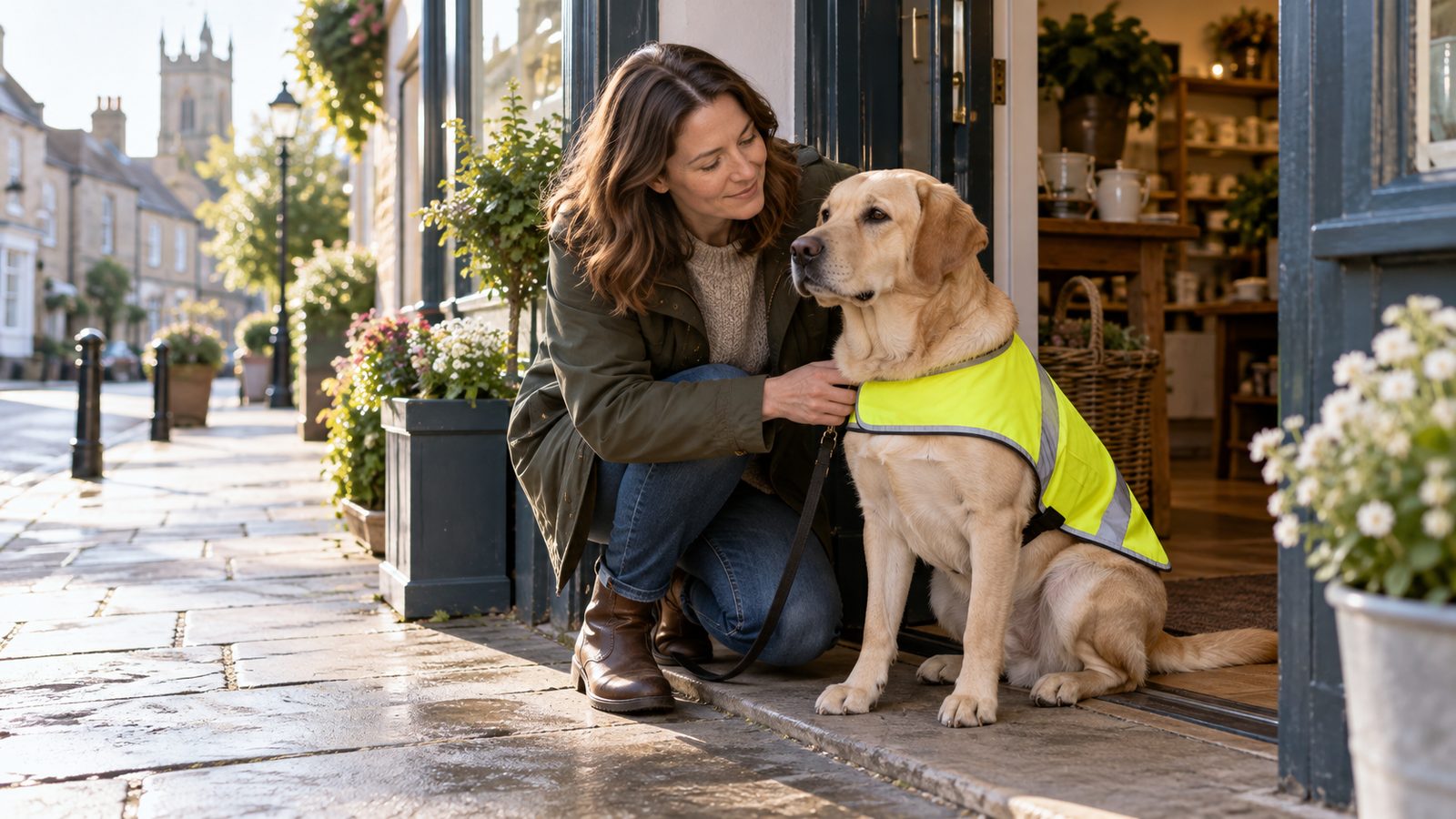
Handler beside a labrador wearing a hi-vis vest at a shop doorway
Est. Reading: 7 minutes

Do Assistance Dogs Have to Wear a Vest in the UK?

Handler beside a labrador wearing a hi-vis vest at a shop doorway
UK Assistance Dog Law

Do Assistance Dogs Have to Wear a Vest in the UK?

No, the law does not require one. Here is what the law says, why most handlers wear one anyway, and what to look for if you are buying.

📖 5 min read·By the ADR Team·Updated October 2026

Key takeaways
  • No law requires an assistance dog to wear a vest, harness or jacket. The Equality and Human Rights Commission says so in its guidance for businesses.
  • A vest is not proof of anything. It carries no legal weight, and anyone can buy one.
  • Most handlers still use one, because of what it does at the door. Staff see a working dog before they ask a question, and the public is asked not to distract.
  • Buy for fit and plain wording. Be wary of any vest or badge that claims to be “official” or “certified”, because there is no official UK scheme behind it.

If you have ever been stopped in a shop and heard “where is his jacket?” as though it were a rule, you are not alone. It is one of the most common things handlers are told, and it is one of the easiest to answer.

The short answer: no

The official guidance for businesses, published by the Equality and Human Rights Commission, states that “the law does not require the dog to wear a harness or jacket” and that “assistance dog users should not be refused a service simply because they do not possess an ID book.” You can read how we summarise that guidance, with the sources, on our UK assistance dog rights page.

A shop, pub or taxi firm may have its own preferences, but it has no legal power to demand a jacket, a harness or a booklet before it serves you. Refusing you on that basis alone is on weak legal ground.

Why most handlers wear one anyway

If the law does not require it, why do so many handlers use a vest? Because of what happens in the ten seconds after you walk in.

  • It answers the question before it is asked. A security guard or shop assistant who can see at a glance that the dog is working is far less likely to challenge you. Most challenges are a guess at a half remembered rule, and a vest ends the guessing.
  • It asks the public not to distract. A clear “working assistance dog, do not pet” message reduces strangers reaching down to stroke your dog. It is a request, not an order, but most people respect it.
  • It keeps your dog visible. Reflective trim helps on dark evenings, at roadsides and in crowded stations.
  • It signals to other dog owners to keep their dogs back, which protects a dog that is concentrating on a job.

What a vest does not do

A vest does not give you rights. Your rights come from being a disabled person with a trained assistance dog, and they exist whether or not the dog wears anything. It also does not prove training, and it does not register the dog anywhere. Anyone can buy a vest from any website, which is why some businesses still ask for more.

That is the honest reason we think a vest works best alongside something with a name and a number on it. A card or registry profile attaches a real identity to the dog, which is something a bought vest never can. It is voluntary, and it is what people who have nothing to hide are happy to offer. Our guide to who can certify an assistance dog explains what exists and what does not.

“In training” vests

A vest that says “assistance dog in training” asks people to respect a dog that is still learning. It is useful, but a dog in training is not in the same legal position as a trained assistance dog working with its handler. Our guide to assistance dogs in training and your rights goes through the detail.

How to choose a vest

  • Measure first. Chest girth and back length matter more than the dog's weight. Check the size chart before you order, and leave room for the dog to move and breathe.
  • Look for adjustable straps and reflective trim. A secure but comfortable fit is what keeps a dog willing to wear it all day.
  • Choose light, breathable material in summer. A heavy vest on a hot day is a welfare problem, not a convenience. Our heatwave guide for handlers covers working in hot weather.
  • Keep the wording plain. “Working assistance dog, do not pet” says everything needed. Avoid anything that says “certified”, “official” or “registered by the government”. None of those are true of any vest, and a false claim invites the very challenge you are trying to avoid.
  • Do not worry about colour. There is no official colour. Charity-trained dogs wear their charity's branding, and owner-trained handlers choose what is visible and comfortable.

Where a vest fits in your kit

Think of three moments. The vest stops most challenges from starting. An ID card or lanyard ends the ones that do start, in seconds. A registry profile is the name on the record if anyone wants to check. Each does a different job, and none of them is a legal requirement.

Our hi-vis assistance dog vest

Reflective strips, adjustable velcro straps, lightweight 100% polyester, and a clear “working assistance dog, do not pet” print. Sizes S, M and L, £20. Also available in pink, and in an “assistance dog in training” version.

See the vests

You can buy a vest anywhere. Prefer everything in one box? The Lifelong Partner Pack includes a hi-viz vest for your dog and one for you, plus ID cards, tags and holders.

Written for handlers in the UK. It is general information, not legal advice about your own situation. If you need advice on your own case, the Equality Advisory and Support Service is free.

Frequently asked questions

Does an assistance dog have to wear a vest in the UK?

No. The Equality and Human Rights Commission's guidance for businesses says the law does not require an assistance dog to wear a harness or jacket. Many handlers choose to use one because it tells staff and the public that the dog is working.

Can a business refuse my assistance dog because it is not wearing a jacket?

A business cannot lawfully insist on a jacket, harness or ID book. The Commission's guidance says assistance dog users should not be refused a service simply because they do not have an ID book, and the same reasoning applies to a jacket. If it happens, ask for the reason and the decision in writing.

What colour should an assistance dog vest be?

There is no official colour in UK law. Charity-trained dogs often wear their charity's own branded jacket. Choose something visible, comfortable and clearly worded.

Can I put a vest on my pet dog so we can go in somewhere?

No. A vest tells people a dog is working. Using one to gain access for a pet is misleading and makes life harder for genuine handlers. The right of access comes from being a disabled person with a trained assistance dog, not from the vest.

Does a 'do not pet' vest stop people touching my dog?

No. It is a polite request, not a legal order, and most people respect it. If someone ignores it, a calm, firm repeat usually works.

1 2 3 … 11
Assistance Dog Registryusertagcalendar-fullclock
linkedin facebook pinterest youtube rss twitter instagram facebook-blank rss-blank linkedin-blank pinterest youtube twitter instagram