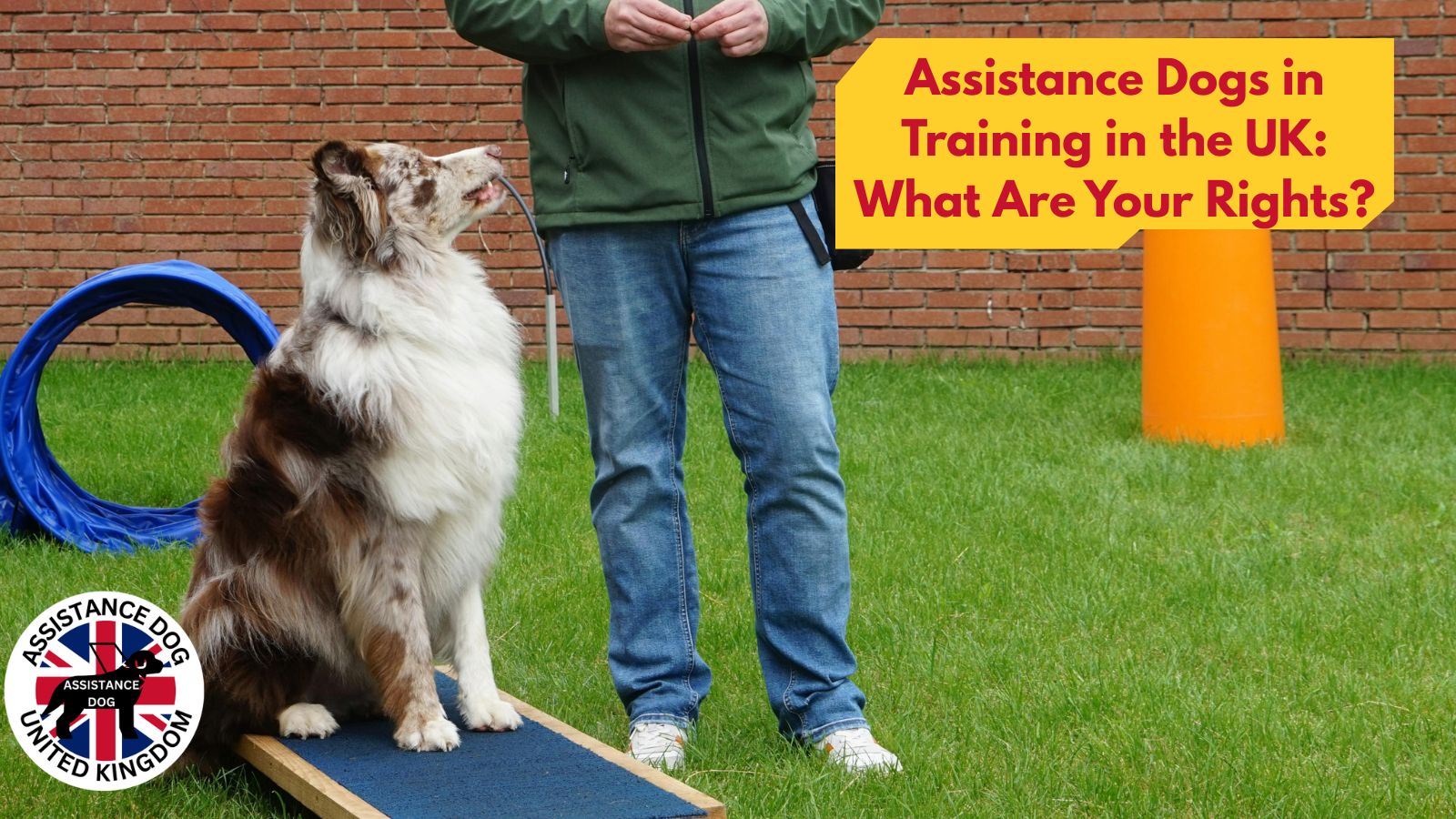
Imagine relying on your assistance dog to manage daily life, only to be refused entry to a pub. Sadly, this scenario happens more often than it should — and recent incidents involving Wetherspoon pubs have highlighted a troubling pattern. But what does the law actually say? When is a refusal illegal? And most importantly, what can you do if this happens to you?
In this post, we’ll break down the legal rights of assistance dog owners, use Wetherspoon as a case study, and give you practical steps to take when you're faced with an unlawful refusal.
What the Equality Act 2010 Says The Equality Act 2010 is the main piece of legislation protecting disabled individuals in the UK. It clearly states that service providers — including pubs, shops, and restaurants — must make "reasonable adjustments" to ensure people with disabilities can access their services. This includes allowing assistance dogs.
Crucially, the law does not require assistance dogs to be trained by a charity or Assistance Dogs UK (ADUK) member. Owner-trained assistance dogs are equally protected under the Equality Act. Denying access based on where a dog was trained is legally irrelevant.
Refusing entry to someone with a legitimate assistance dog can be classed as disability discrimination, which is illegal. In most cases, there are no valid exceptions.
Wetherspoon's Policy: Where They Get It Wrong Wetherspoon’s official website claims they only allow assistance dogs trained by ADUK-accredited charities. They state:
"The exceptions to the policy are trained guide dogs and also assistance dogs with Assistance Dogs UK-accredited training."
This wording is problematic because it excludes a significant number of owner-trained assistance dogs — dogs that are fully protected under UK law. This has led to multiple incidents where handlers have been refused service, even after explaining their rights.
One reported case involved a 13-year-old with fibromyalgia and PTSD being denied entry while using a registered assistance dog. In another case, a mental health support dog was refused and the handler was escorted out. These are not just unfortunate mistakes — they may be illegal actions.
How a Refusal Affects Assistance Dog Handlers Being denied access can be deeply distressing for someone who relies on an assistance dog. It can:
More than that, it shows a complete lack of understanding of the Equality Act. These refusals suggest that some businesses prioritize internal policy over legal rights — a dangerous and discriminatory approach.
What You Can Do If You Are Refused If you’re ever refused entry to a pub, including a Wetherspoon location, follow these steps:
Your Rights as an Owner-Trained Assistance Dog Handler Wetherspoon’s reliance on ADUK accreditation is misleading. Many owner-trained dogs meet or exceed the standards of charity-trained dogs. They are trained to assist with real disabilities and have the same public access rights.
You do not need a dog trained by Guide Dogs UK, Dogs for Good, or any other charity to have legal protection.
You do not need to carry a license, registration, or official certificate. The law is based on need and function, not paperwork.
Our Position at Assistance Dog Registry We believe every legitimate handler should be treated with dignity and equality. That’s why our registration platform supports owner-trained teams with:
Our goal is not to “police” access, but to empower you with tools that promote understanding and reduce conflict.
Final Thoughts: It’s Time for Change When big brands like Wetherspoon misinterpret the law, they put vulnerable individuals at risk. Refusing an assistance dog is not just an inconvenience. It’s discriminatory and potentially unlawful.
If you’ve experienced a refusal, know that you have rights. Use your voice, document your experience, and demand better. The Equality Act is on your side — and so are we.
🎟️ Sign Up for the Lifetime Package Today
💡 Click here to learn more & register
FAQ
1. What is an assistance dog?
An assistance dog is trained to perform specific tasks to aid individuals with disabilities, enhancing their independence and quality of life.
2. Why is socialization important for assistance dogs?
Proper socialization ensures assistance dogs remain calm, focused, and well-behaved in various public settings, enabling them to perform their duties effectively.
3. At what age should I start socializing my assistance dog?
It's beneficial to begin socialization during puppyhood; however, with patience and consistent training, dogs of any age can learn to navigate public environments confidently.
4. How long does it take to socialize an assistance dog?
The duration varies based on the dog's temperament, previous experiences, and the consistency of training. Regular, positive exposure to different environments is key.
5. Can I socialize my assistance dog if they are older?
Yes, older dogs can be socialized successfully. While it may require more time and patience, with positive reinforcement, they can adapt to new situations.
6. What should I do if my assistance dog shows fear in public?
If your dog exhibits fear, calmly remove them from the situation and gradually reintroduce the stimulus at a comfortable distance, rewarding calm behavior.
7. How do I handle public distractions during training?
Teach focus commands like "watch me" to redirect your dog's attention. Gradual exposure to distractions, paired with positive reinforcement, can improve focus.
8. Are there specific public places ideal for socialization?
Begin with quiet areas like parks, then progress to busier environments such as cafes, public transport, and shopping centres as your dog becomes more comfortable.
9. How can I ensure my assistance dog behaves appropriately around other animals?
Controlled introductions and rewarding calm behaviour are essential. Consistent training helps your dog remain focused on their tasks, even around other animals.
10. What are the legal requirements for assistance dogs in public places?
In many regions, assistance dogs are permitted in public areas to support their handlers. It's important to familiarize yourself with local laws and regulations regarding assistance dogs.
Learn more about our Lifelong Partner Package
If you found this travel guide useful, you may also benefit from these other essential assistance dog letter templates we’ve published:
📌 Housing Accommodation Request Letter – Need to request reasonable accommodation from your landlord? This template ensures your rights under the Equality Act 2010 are respected.
📌 Workplace Assistance Dog Request Letter – If you need accommodations to bring your assistance dog to work, this letter outlines your legal rights and reasonable adjustments your employer should consider.
📌 Medical Confirmation of Need for an Assistance Dog – A doctor’s letter template to confirm your need for an assistance dog for public access, travel, and daily life.
🔹 More templates are coming soon! Let us know if you have specific needs, and we’ll create more resources to support assistance dog handlers.

A recent BBC report interviewed a man who was refused service at a Wetherspoon pub simply because he had an assistance dog. The staff didn’t recognise his rights, and the manager demanded ID that isn't required by law.
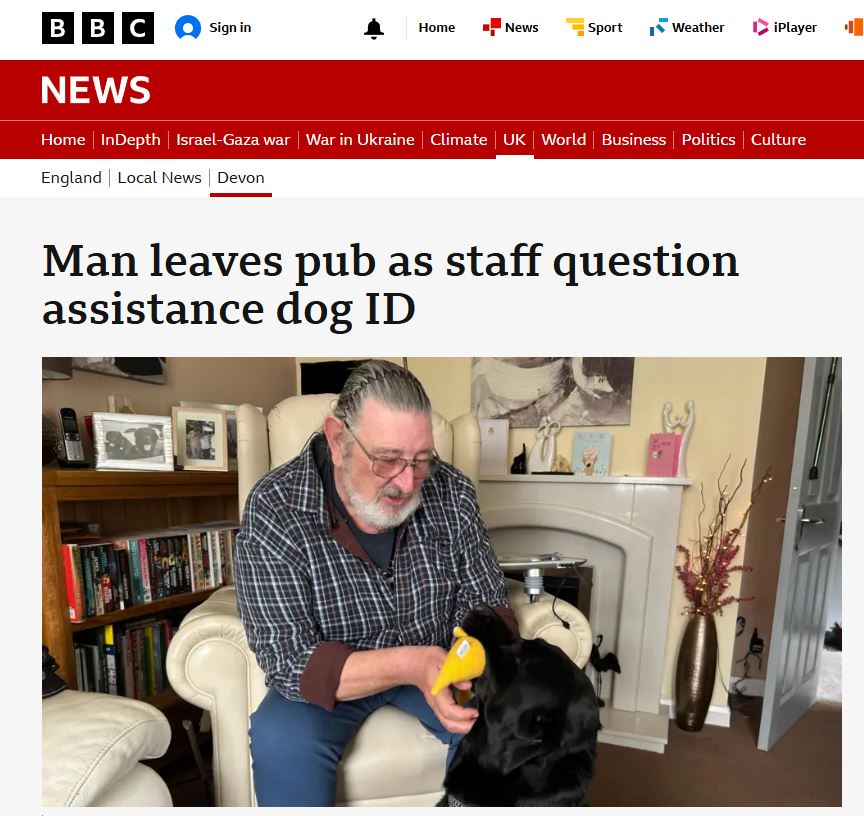
This real incident highlights a growing problem: many public venues still don’t understand the legal protections for assistance dog handlers.
Could this happen to you?
If you rely on an assistance dog—whether owner-trained or charity-trained—you need to know exactly where you stand. This guide explains your rights and what to do if they’re challenged.
Under the Equality Act 2010, disabled individuals in the UK have the legal right to be accompanied by an assistance dog in shops, restaurants, cafés, taxis, and all other public spaces.
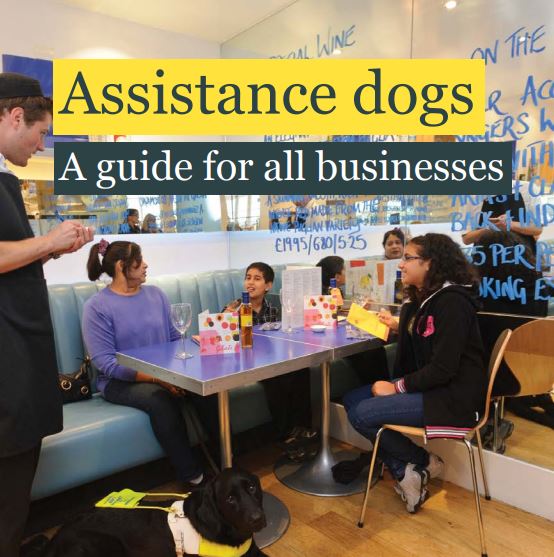
Here’s what the law does not require:
As long as your dog is trained to assist with a disability and behaves appropriately in public, you are legally protected.
Many people still believe only charity-trained dogs qualify. This is false. The law protects all properly trained assistance dogs, including those trained by their owners.
This means:
Because many businesses simply don’t know the law. They assume a lack of ID means the dog isn't legitimate. Unfortunately, this leads to illegal refusals, embarrassment, and discrimination—like what happened in the BBC story.
While you are not legally obligated to carry identification, many handlers choose to carry voluntary ID cards or wear a recognisable vest to:
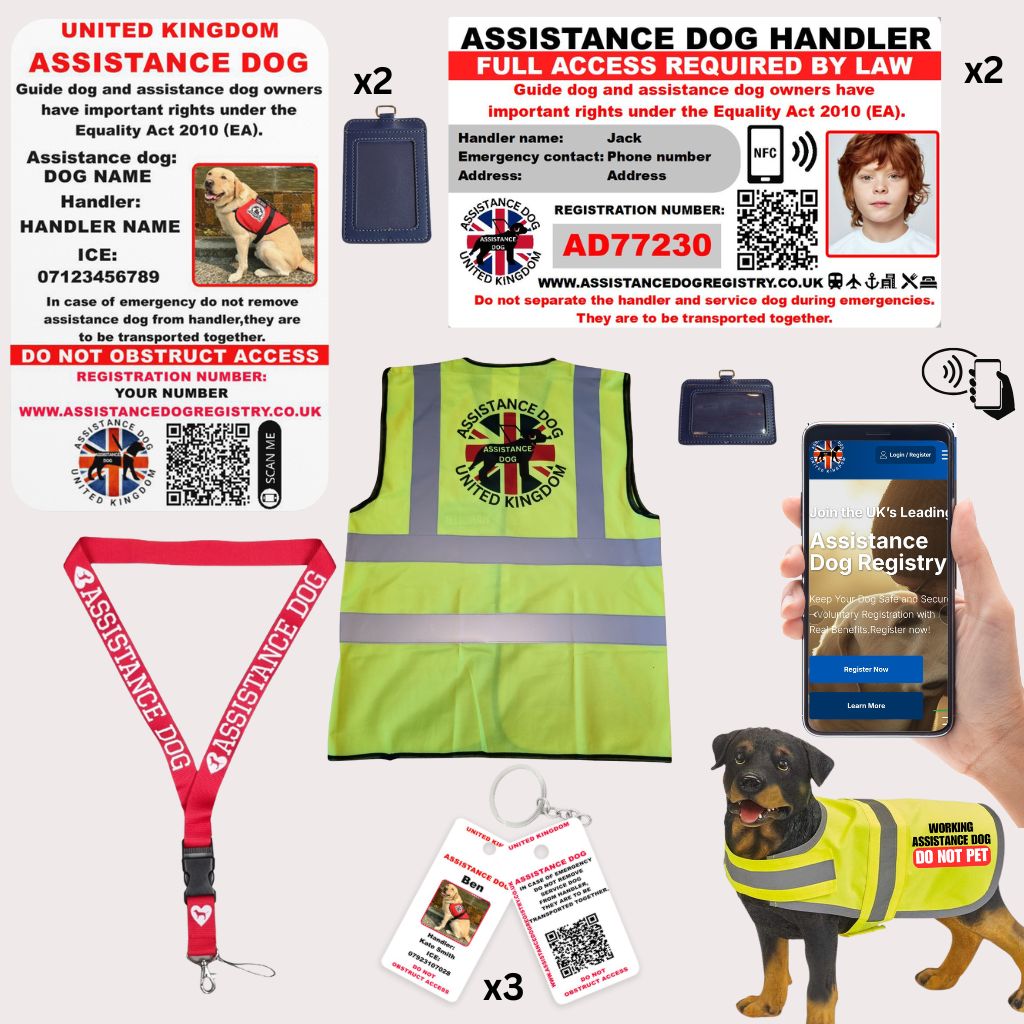
That’s exactly why we created AssistanceDogRegistry.co.uk. Our Lifetime Registration Package gives real handlers practical tools to reduce the chance of being questioned or denied access.
With our package, you’ll receive:
While this does not replace legal rights, it gives you visible, convenient support to help educate others and protect your dignity in public spaces.
See the Lifetime Package Here »
Businesses must understand that:
Educating staff on these facts isn’t optional — it’s a legal and moral responsibility.
Disability shouldn’t come with humiliation.
But it will — unless we educate, clarify, and support each other.
If you or someone you love relies on an assistance dog, take a moment to know your rights — and consider tools that can help avoid confusion when it matters most.
Together, we can make public spaces safer and more respectful for those who rely on assistance dogs every day.
Important: The law does not require a dog to be trained by a charity. Owner-trained dogs are legally recognized as long as they perform specific tasks that assist with a disability.
🚫 Is Registration Legally Required? No. There is no legal requirement to register your assistance dog in the UK. Your rights are protected based on what your dog does, not whether they appear on a registry.
✅ So Why Register Voluntarily? While it's not mandatory, registering your dog can:
🌟 Spotlight: Lifelong Partnership Package One of our most popular options is the Lifelong Partnership Package, which includes:
📄 Busting Common Myths:
🏡 Your Rights in Public and Housing Your dog is considered an auxiliary aid — like a wheelchair or hearing aid. That means:
🚩 Final Thoughts Whether you're training your own dog or using a professionally trained one, your rights matter. Tools like voluntary registration, ID cards, and digital profiles can make life easier and smoother for both you and your dog.
🎟️ Sign Up for the Lifetime Package Today
💡 Click here to learn more & register
FAQ
1. What is an assistance dog?
An assistance dog is trained to perform specific tasks to aid individuals with disabilities, enhancing their independence and quality of life.
2. Why is socialization important for assistance dogs?
Proper socialization ensures assistance dogs remain calm, focused, and well-behaved in various public settings, enabling them to perform their duties effectively.
3. At what age should I start socializing my assistance dog?
It's beneficial to begin socialization during puppyhood; however, with patience and consistent training, dogs of any age can learn to navigate public environments confidently.
4. How long does it take to socialize an assistance dog?
The duration varies based on the dog's temperament, previous experiences, and the consistency of training. Regular, positive exposure to different environments is key.
5. Can I socialize my assistance dog if they are older?
Yes, older dogs can be socialized successfully. While it may require more time and patience, with positive reinforcement, they can adapt to new situations.
6. What should I do if my assistance dog shows fear in public?
If your dog exhibits fear, calmly remove them from the situation and gradually reintroduce the stimulus at a comfortable distance, rewarding calm behavior.
7. How do I handle public distractions during training?
Teach focus commands like "watch me" to redirect your dog's attention. Gradual exposure to distractions, paired with positive reinforcement, can improve focus.
8. Are there specific public places ideal for socialization?
Begin with quiet areas like parks, then progress to busier environments such as cafes, public transport, and shopping centres as your dog becomes more comfortable.
9. How can I ensure my assistance dog behaves appropriately around other animals?
Controlled introductions and rewarding calm behaviour are essential. Consistent training helps your dog remain focused on their tasks, even around other animals.
10. What are the legal requirements for assistance dogs in public places?
In many regions, assistance dogs are permitted in public areas to support their handlers. It's important to familiarize yourself with local laws and regulations regarding assistance dogs.
📌 Housing Accommodation Request Letter – Need to request reasonable accommodation from your landlord? This template ensures your rights under the Equality Act 2010 are respected.
📌 Workplace Assistance Dog Request Letter – If you need accommodations to bring your assistance dog to work, this letter outlines your legal rights and reasonable adjustments your employer should consider.
📌 Medical Confirmation of Need for an Assistance Dog – A doctor’s letter template to confirm your need for an assistance dog for public access, travel, and daily life.
The Czech Republic is one of the UK's quieter European favourites. Around a million UK residents visit each year, with the overwhelming majority heading for Prague on city breaks and a smaller crowd venturing further afield to Český Krumlov, Brno or the spa towns of western Bohemia. Prague, in practice, is pet-friendly and walkable, and many UK handlers have reported smooth trips.
Legally, however, the Czech Republic is one of the more restrictive European destinations for a UK owner-trained handler. The framework is built around Act No. 329/2011 Coll. on the Provision of Allowances to Persons with Disabilities, amended in 2021 to strengthen public-access rights, but still anchored to Czech national certification. Owner-trained dogs do not have an explicit recognition pathway.
Nothing in this article is intended to discourage travel. Prague is accessible and welcoming in practice, and plenty of UK handlers visit the Czech Republic successfully. But the legal framework is strict, the airline gate still applies, and the overland route is long, so planning matters.
The Czech Republic recognises as an assistance dog ("asistenční pes") a dog trained by a Czech organisation meeting national standards, typically requiring 18 to 24 months of structured training followed by a certification exam. Certified dogs and their handlers have statutory public-access rights across hospitality, retail, public services and transport under the 2021 amendments to Act No. 329/2011. Guide dogs and other recognised assistance-dog types are both covered.
There is no published recognition pathway for owner-trained dogs or for foreign-certified dogs outside the main international networks. UK handlers with dogs certified by Assistance Dogs International (ADI) or the International Guide Dog Federation (IGDF) are in the strongest practical position because those credentials are broadly accepted in central Europe. UK owner-trained handlers fall outside the statutory framework.
For the flight itself, British Airways, easyJet, Ryanair and Smartwings (the main Czech carrier following Czech Airlines' 2021 closure) all apply the ADI or IGDF standard for in-cabin assistance-dog carriage. A UK owner-trained handler cannot reliably get into the cabin on these carriers. The Czech Republic is long by road from the UK, so the surface alternative is realistic only for committed drivers.
The controlling statute is Act No. 329/2011 Coll. on the Provision of Allowances to Persons with Disabilities. The 2021 amendment to the Act (in force since January 2022) introduced more explicit public-access rights for handlers with certified guide or assistance dogs, and tightened the penalties on service providers who refuse access. That amendment has been widely covered in Czech civil society analysis, including by Liberties.eu.
The certification framework sits in related Ministry of Labour and Social Affairs (MPSV) regulations and the practice of recognised Czech training organisations. Certification generally requires:
The Act does not contain an explicit pathway for recognising dogs trained outside the Czech framework, and in practice certification is treated as a national matter. The Czech Public Defender of Rights (Veřejný ochránce práv) has considered access complaints from Czech handlers and has consistently framed the national certification framework as the controlling instrument. There is no published pathway for UK owner-trained dogs.
In law, this means that a UK owner-trained handler in the Czech Republic does not enjoy the statutory public-access rights that the Act grants to certified handlers. That is a different position from Ireland (broad statute) and closer to Hungary's and Poland's.
Prague, in day-to-day practice, is a dog-friendly city. Dogs are widely seen in cafés, on the metro, in parks, and in many casual restaurants. General pet-tolerance works in the favour of assistance-dog handlers, because an assistance dog in a professional harness is rarely challenged in Prague and will often go entirely unnoticed.
Outside Prague, the picture is more variable. Brno, Ostrava, Plzeň and the smaller spa towns apply more traditional rules. Tourist-focused venues in Český Krumlov are generally accommodating.
Across the country, Czech staff look for the harness and the handler's composure. A clear, professional assistance-dog vest does most of the work. Without it, an unbranded dog in a Czech restaurant is treated as a pet, and some venues will refuse. Chain supermarkets tend to apply stricter rules than independent shops.
The specific pressure point for a UK owner-trained handler is the statute itself. If a venue refuses and you try to cite Czech law, you are in a difficult position because Czech law does not in fact recognise your dog as an asistenční pes. The argument has to be made on goodwill, presentation and the venue's discretion. In Prague the venue usually agrees; outside Prague, less reliably.
The major airlines on UK to Czech Republic routes all restrict in-cabin assistance-dog acceptance to dogs accredited by ADI or IGDF.
This is a genuine tension worth naming. The Equality Act 2010 protects UK handlers regardless of training provider. The airlines carrying UK handlers out of UK airports do not mirror that framework and instead rely on a narrower, industry-defined standard. Whether that narrower standard is compatible with UK equality law in every case is a question that has not been tested comprehensively in the courts, but it is a question handler organisations are raising with increasing frequency. For now, the working reality is that a UK owner-trained handler cannot rely on an automatic right to bring their dog in the cabin on these carriers, and should plan accordingly.
Separately from the recognition question, your dog has to meet UK pet-export and EU pet-import rules to enter the Czech Republic.
You will need:
These requirements apply regardless of training route.
Assume you arrive in the Czech Republic. What should you expect day to day?
Hotels. Prague's international chains and boutique hotels are generally welcoming. Many Czech hotels accept pets more broadly, which works in your favour. Book direct and confirm the assistance-dog arrangement in writing.
Restaurants and cafés. Prague is unusually dog-friendly by European standards. Many cafés and casual restaurants welcome dogs as a matter of course. Assistance dogs in a vest are almost never challenged in Prague. Fine-dining restaurants may ask more questions, and tourist-trap places around the Old Town Square can be inconsistent. Outdoor terraces are almost always fine.
Shops and supermarkets. Tesco Czech, Albert, Lidl, Kaufland and Billa operate no-dogs rules in principle but are inconsistent in practice. An assistance-dog vest usually works. Small independent shops are more flexible.
Public transport. Prague Integrated Transport (PID) formally recognises certified Czech assistance dogs. For UK owner-trained handlers, the practical approach is to travel with the dog leashed and muzzled where required (Czech public transport rules on dogs generally require muzzles on the metro, trams and buses; assistance dogs in Czech certification are exempt, but for a UK owner-trained dog a muzzle the dog tolerates is worth carrying). Czech Railways (České dráhy) applies similar rules.
Museums, galleries, major attractions. Most major Czech museums accept certified assistance dogs. For UK owner-trained handlers, expect to have a conversation at the door. Prague Castle, the Jewish Quarter and the National Museum generally accommodate.
Taxis and rideshare. Uber, Bolt and Liftago operate in Prague. Individual drivers sometimes refuse dogs; a polite explanation and a calm dog usually solves this. If not, cancel and request another.
Three practical options a UK owner-trained handler has.
Some airlines will assess owner-trained assistance dogs on a case-by-case basis. If you try this route, contact the airline's special assistance team at least 72 hours before travel, provide everything you have in writing (training log, letter from your GP or consultant, video evidence of the dog's task work, photos in professional harness, ADR registration documentation) and be prepared for a conservative response.
If the airline declines in-cabin carriage, your dog can usually still travel as a pet in the hold on some carriers, though not on most low-cost airlines. Whether that is acceptable for your dog's role and welfare is a decision only you can make.
Surface crossings do not apply ADI or IGDF gatekeeping. They treat your dog as a pet for boarding purposes and rely on the standard veterinary paperwork described in Section 5. Eurotunnel LeShuttle from Folkestone to Calais is the fastest crossing. From there, it is a long drive through France, Belgium, Germany and into the Czech Republic. Nuremberg or Dresden to Prague makes a sensible final leg, each about three hours by car, and both cities are common overnight stops.
This is a realistic option for UK owner-trained handlers who want to visit Prague without the airline gate in the way. Two days each way with overnight stops is typical.
If this is your first European trip with your owner-trained dog and you want a softer entry point before tackling the Czech Republic, consider routing through the Netherlands. Dutch law is the most welcoming in the EU for owner-trained handlers, effectively rights-based rather than certificate-based. The Harwich to Hook of Holland overnight ferry with Stena Line is a direct, pet-friendly crossing. You can then drive, train or fly into the Czech Republic from there.
It is worth being honest about this. An Assistance Dog Registry card has no legal force in the Czech Republic. Czech law recognises only dogs certified by Czech national training organisations meeting national standards, and no UK-issued document qualifies for that status.
What an ADR card does is change the practical conversation. Czech venue staff are not lawyers. A professional card, a QR-linked online profile that verifies in any language including Czech, a vest or harness on the dog, and a calm, prepared handler produce a very different outcome from an unbranded dog with no documentation at all. Prague's baseline dog-friendliness combined with visible documentation usually produces a smooth experience.
That is social standing, not legal standing, and it is worth distinguishing clearly. In the Czech Republic your card is a practical tool that reduces refusals at the door. It is not a legal right of access.
If a Czech business refuses to admit you and your dog, the practical hierarchy is:
The Czech Republic is legally strict but practically manageable, especially in Prague. The 2021 amendments to Act No. 329/2011 strengthened rights for Czech-certified handlers but did not open a recognition pathway for UK owner-trained dogs. At the door, however, the baseline dog-friendliness of Czech culture and the visibility of a professional vest usually carry the day.
Plan for the airline gate by either flying ADI/IGDF-compatible or driving. Pack a clear professional vest and your ADR documentation. A muzzle the dog tolerates is worth having for metro and tram use. Accept that you have no statutory backing if a venue refuses, but know that most Prague venues will not.
Once you land back in Bristol or Manchester, the Equality Act 2010 is still there. Your dog is still the same trained assistance dog. The Czech Republic is a trip; your UK rights are the constant.
Assistance Dog Registry is an independent UK registry for owner-trained and charity-trained assistance dogs. Our cards, QR-linked profiles and handler documentation give you something professional to show when you need to have a conversation at a hotel, a restaurant, or a departure gate.
Over 6,000 UK handlers have already registered.
No. Czech law grants public-access rights to dogs certified by Czech national training organisations meeting national standards. There is no published recognition pathway for UK owner-trained dogs or for foreign certificates outside the main international networks.
Under published policy, no. All four require the dog to be accredited by an ADI or IGDF member organisation. Some will consider owner-trained dogs case-by-case with significant documentation, but this is not guaranteed.
Yes. Prague is one of the more dog-friendly European capitals. Dogs are widely seen in cafés, on public transport and in parks. This general pet-tolerance helps assistance-dog handlers even without Czech certification.
Czech public transport rules generally require muzzles on dogs on the metro, trams and buses. Czech-certified assistance dogs are exempt. UK owner-trained handlers are not covered by that exemption, so a muzzle the dog tolerates is worth packing.
No. No UK-issued document has legal force in the Czech Republic. However, a professional ID card, QR-linked profile and vest significantly reduce refusals at the door because Czech venue staff respond to clear, formal presentation.
A microchip, a valid rabies vaccination (minimum 21 days before travel), and a Great Britain Animal Health Certificate issued within 10 days of entry to the EU. These are veterinary rules, separate from the assistance-dog legal framework.
Stay calm, ask for the manager, show your documentation, and if you are still refused, record the incident and report it to the Czech Public Defender of Rights or the Czech Trade Inspection Authority. Share it with ADR to contribute to the wider evidence record.
This guide is part of a growing series covering the legal position for UK owner-trained assistance dog handlers in every major European destination.
Each country guide covers the same things: what the law actually says, what the airlines actually require, what happens at the door, how to plan the trip, and how to respond to problems.
About the author: This guide was prepared by the team at Assistance Dog Registry, the UK's most-read independent voluntary registry for assistance dog handlers. Our guides cover owner-trained and charity-trained dogs alike, with a focus on practical, plain-English information UK handlers can actually use.
Disclaimer: This article is provided as general guidance only and does not constitute legal advice. Czech law and airline policy change; verify current rules with the airline and, where relevant, the Czech Public Defender of Rights before you travel. For legal advice on a particular situation, consult a qualified solicitor in the relevant jurisdiction.
Last updated: April 2026. This page is reviewed annually.
The Republic of Ireland is one of the most popular short-trip destinations for UK residents. In 2024, UK residents made 3.6 million visits to Ireland, making it the UK's eighth most visited country overall and by far the easiest European destination to reach with a dog. The common language, the common travel area history, the ferry route from Holyhead, and a legal framework that is statutorily warmer than most of Europe all combine to make Ireland a strong option for UK handlers.
The picture is not perfect, though. Irish law is welcoming on paper, but practical access experiences have lagged well behind the statute, and the airline gate still applies on flights. This guide sets out what the Equal Status Acts 2000 to 2018 actually protect, what airlines and ferry operators require, what UK owner-trained handlers typically experience on the ground, and how to plan a trip that uses Ireland's unique geography to your advantage.
Nothing in this article is intended to discourage travel. Ireland is, on balance, one of the easier European destinations for a UK owner-trained handler, particularly if you take the ferry. But the on-the-ground reality is patchier than the law suggests, and that difference is worth understanding before you go.
Ireland's Equal Status Acts prohibit service providers (shops, hotels, restaurants, transport operators) from refusing service to a person with an assistance dog. The statute is broadly framed, does not name a specific training body, and is in principle available to any handler whose dog performs a genuine disability-related task. That is unusually generous by European standards.
In practice, Irish businesses and officials are most familiar with dogs trained by Irish Guide Dogs for the Blind and a small number of similar accredited programmes. Sector reports describe owner-trained dogs as not automatically receiving formal service-dog recognition, and RTÉ reported in December 2023 that 83% of Irish guide and assistance dog owners had experienced a negative access incident in the previous 12 months. So the statute is warm and the practice is patchy.
For the flight itself, British Airways, easyJet, Ryanair and Aer Lingus all apply the Assistance Dogs International (ADI) or International Guide Dog Federation (IGDF) accreditation standard for in-cabin assistance-dog carriage. A UK owner-trained handler cannot reliably get into the cabin on these carriers. The ferry route between Holyhead and Dublin is the practical answer for most UK owner-trained handlers.
The core Irish protection is the Equal Status Acts 2000 to 2018. Section 4 requires reasonable accommodation for disabled people, and established Irish Human Rights and Equality Commission guidance treats refusing an assistance dog handler as prohibited discrimination. Hospitality, retail, public transport and public services are all covered. Sections of the Health Act 1947 on food premises have been interpreted to allow assistance dogs in restaurants, and the general expectation in Irish public authority guidance is that a working assistance dog is admitted.
The statute does not limit itself to a particular training body. There is no provision in the Equal Status Acts equivalent to the Spanish regional-certification model or the Polish accredited-training model. In that sense Ireland sits much closer to the UK framework than to most of continental Europe.
However, there is a gap between the letter of the law and the reality. Disability Act 2005 gives public bodies duties to promote accessibility, but enforcement of access refusals typically runs through the Workplace Relations Commission under the equality legislation, which is a slow and paperwork-heavy route. In day-to-day encounters, businesses tend to default to what they are familiar with, which is a guide dog from Irish Guide Dogs. An unfamiliar dog in an unbranded harness is more likely to attract a conversation.
Sector reports and handler bodies have recorded for some time that owner-trained dogs do not automatically receive formal service-dog recognition in Irish practice. That is different from saying they are legally excluded: the statute does not exclude them. It is an observation about what Irish businesses and staff actually accept on sight.
Ireland is a country where a well-prepared UK handler with an owner-trained dog usually has a smoother time than they would expect, particularly in hospitality. Irish pubs, cafés, restaurants and small hotels are generally welcoming. Staff are often willing to take the handler's word for it. A calm dog, a professional harness and a polite handler are typically enough.
The places where problems more commonly appear are chain supermarkets, large retail, and some hotel chains with group-level no-pets rules. Dublin, Cork and Galway have more experience of assistance dogs than smaller rural towns, which can work in either direction depending on the venue.
The RTÉ figure (83% of Irish assistance-dog owners reporting a negative access experience in 12 months) is a sobering backdrop. Most of those incidents involved Irish-trained dogs, not UK owner-trained visitors, which suggests that the issue is less about where the dog came from and more about a baseline level of confusion at the door. An Irish handler with an Irish Guide Dogs dog gets refused; a UK handler with an ADR card and a calm dog may well not. The point is not that Ireland is hostile but that conversations do happen, and you should be ready for them.
All four of the airlines that dominate UK to Ireland routes apply ADI or IGDF accreditation standards for in-cabin assistance-dog acceptance.
There is a genuine tension worth naming. The Equality Act 2010 protects UK handlers regardless of training provider. The airlines carrying UK handlers out of UK airports do not mirror that framework and instead rely on a narrower, industry-defined standard. Whether that narrower standard is compatible with UK equality law in every case is a question handlers and handler organisations are raising with increasing frequency. For now, the working reality is that a UK owner-trained handler cannot rely on an automatic right to bring their dog in the cabin on these carriers, and should plan accordingly.
Because the ferry route from Holyhead to Dublin is short, frequent and pet-friendly, Ireland is one of the few EU destinations where UK owner-trained handlers have a genuinely attractive alternative to flying.
Ireland has two particular veterinary quirks UK handlers need to be aware of. The country is tapeworm-free, and it enforces that status with a strict pre-entry treatment window.
You will need:
On the return to Great Britain, no additional tapeworm treatment is required because Ireland itself is tapeworm-free. Always check the current GOV.UK pet travel rules and the Irish Department of Agriculture pet travel rules within a few weeks of travel because details change.
These requirements apply regardless of training route. A charity-trained guide dog and an owner-trained assistance dog face the same veterinary paperwork.
Assume you arrive in Ireland. What should you expect day to day?
Hotels. Irish hotels are generally accommodating. Book direct and confirm the assistance-dog arrangement in writing. Chains and small independents alike will usually have a policy that covers you under the Equal Status Acts, even if they describe it as a goodwill exception.
Pubs, restaurants and cafés. Ireland's hospitality culture is probably the most dog-friendly in Europe. Pubs in particular are frequently open to dogs in general, not just assistance dogs. Restaurants and cafés are usually fine. Fine-dining venues may ask more questions.
Shops and supermarkets. Access is legally protected but practically inconsistent. SuperValu, Dunnes, Tesco Ireland and Lidl generally admit assistance dogs without debate; smaller shops tend to be flexible. Expect occasional conversations in larger chain supermarkets.
Public transport. Dublin Bus, Luas, DART and Irish Rail all recognise assistance dogs under Equal Status Acts obligations. There is no requirement for a specific certificate in law, but travel staff often look for a harness or ID card.
Museums, galleries, major attractions. Almost universally accessible. Trinity College's Book of Kells exhibit, the National Museum, the Guinness Storehouse and Kilmainham Gaol all admit assistance dogs.
Taxis. Taxis are required by Irish law to carry assistance dogs and cannot charge extra. In practice, a handful of drivers refuse. Report refusals to the National Transport Authority.
Three practical options a UK owner-trained handler has.
This is the obvious answer for most UK owner-trained handlers. Stena Line and Irish Ferries both run Holyhead to Dublin, a crossing of about three and a half hours, multiple times a day, with pet-friendly options. Stena Line also runs Fishguard to Rosslare and Liverpool Birkenhead to Belfast (Northern Ireland, then a short drive south). P&O runs Cairnryan to Larne.
Surface crossings do not apply ADI or IGDF gatekeeping. They treat your dog under the standard pet-travel regime. Once aboard, pets usually stay in the vehicle on deck, or in a pet-friendly cabin where available. Pet-friendly cabins are limited and book up quickly, particularly in summer; book early.
This option sidesteps the airline gate entirely. For UK owner-trained handlers, ferry is the default choice for Ireland.
Some airlines will assess owner-trained assistance dogs on a case-by-case basis, particularly on short hops to Dublin and Cork. This is not guaranteed and the wording in published airline policies is conservative. If you try this route, contact the airline's special assistance team at least 72 hours before travel, provide everything you have in writing (training log, letter from your GP or consultant, video evidence of the dog's task work, photos in professional harness, ADR registration documentation) and be prepared for a conservative response.
Given that the ferry is easy, most UK owner-trained handlers do not bother with this route for Ireland specifically.
Flights from UK airports to Belfast International or Belfast City are domestic flights within the UK, so the Equality Act 2010 applies to the carriage of your dog. This gives you a rights-based position on the flight itself. Once in Belfast, the drive to Dublin is about two hours, with no border control for passengers. Note that Northern Ireland is part of the UK, so you do not need an AHC or tapeworm treatment for the flight, but crossing south into the Republic of Ireland triggers the EU pet-import and tapeworm rules described in Section 5. This is a legitimate and sometimes useful workaround for handlers who want the legal protection of a UK domestic flight.
An Assistance Dog Registry card has no special statutory status in Ireland, but it also does not need to. The Equal Status Acts protect your right of access without reference to any particular certificate. What your ADR card does is answer the first question Irish staff usually ask, which is not "is this dog legally protected" but "is this actually an assistance dog or just a pet".
A professional ID card, a QR-linked online profile that verifies in any language, a vest or harness on the dog, and a calm, prepared handler produce a very different outcome from an unbranded dog with no documentation. In a country where 83% of assistance-dog handlers report negative access experiences, removing ambiguity at the front door matters.
That is practical standing, not legal standing. In Ireland your rights exist whether or not you have an ADR card. The card is the tool that helps ensure those rights are not tested at every venue.
If an Irish business refuses to admit you and your dog, the practical hierarchy is:
Ireland is, on balance, the most accessible European destination for a UK owner-trained handler. The law is warm, the ferry is easy, the language is common, and the culture is broadly dog-friendly. If you are new to travelling abroad with an assistance dog, Ireland is a good first trip.
The caveats are real but manageable. The airline gate still applies to flights, which is why the ferry is the default. The day-to-day reality can be patchier than the statute suggests, which is why documentation still helps. And the tapeworm rule is strict, which is why your vet needs to be briefed carefully.
None of that makes Ireland impossible. It makes Ireland a country where the UK owner-trained community has a better-than-usual chance of a smooth trip. Plan the route, plan the vet appointment, and enjoy it.
Assistance Dog Registry is an independent UK registry for owner-trained and charity-trained assistance dogs. Our cards, QR-linked profiles and handler documentation give you something professional to show when you need to have a conversation at a hotel, a restaurant, or a departure gate.
Over 6,000 UK handlers have already registered.
Yes, in principle. The Equal Status Acts 2000 to 2018 prohibit refusing service to a person with an assistance dog, and the statute is not limited to a specific training body. In practice, Irish businesses are most familiar with dogs from Irish Guide Dogs for the Blind, and owner-trained dogs can attract more questions at the door.
Under published policy, no. All four require the dog to be accredited by an ADI or IGDF member organisation. Some will consider owner-trained dogs case-by-case with significant documentation, but this is not guaranteed.
Yes, and this is the recommended route for most UK owner-trained handlers. Stena Line and Irish Ferries run Holyhead to Dublin multiple times a day with pet-friendly options. The ferry does not apply airline ADI or IGDF rules.
Your dog must be treated against Echinococcus multilocularis by a vet between 24 and 120 hours before arrival in Ireland, and the treatment must be recorded on your Great Britain Animal Health Certificate. Missing this window means the dog is refused entry.
The Equal Status Acts already give you legal rights in Ireland regardless of documentation. What an ADR card does is reduce the number of conversations you have to have at the door by providing a clear, professional signal that this is an assistance dog.
A microchip, a valid rabies vaccination (minimum 21 days before travel), a Great Britain Animal Health Certificate issued within 10 days of entry, and tapeworm treatment between 24 and 120 hours before arrival.
Stay calm, ask for the manager, cite the Equal Status Acts, and if you are still refused, record the incident and report it to the Workplace Relations Commission. Share it with ADR to contribute to the wider evidence record.
This guide is part of a growing series covering the legal position for UK owner-trained assistance dog handlers in every major European destination.
Each country guide covers the same things: what the law actually says, what the airlines actually require, what happens at the door, how to plan the trip, and how to respond to problems.
About the author: This guide was prepared by the team at Assistance Dog Registry, the UK's most-read independent voluntary registry for assistance dog handlers. Our guides cover owner-trained and charity-trained dogs alike, with a focus on practical, plain-English information UK handlers can actually use.
Disclaimer: This article is provided as general guidance only and does not constitute legal advice. Irish law and airline policy change; verify current rules with the airline and, where relevant, the Irish Department of Agriculture and Workplace Relations Commission before you travel. For legal advice on a particular situation, consult a qualified solicitor in the relevant jurisdiction.
Last updated: April 2026. This page is reviewed annually.

If you rely on an assistance dog, one of the most stressful situations you can experience is being challenged in public.
You walk into a café, shop, or restaurant and a member of staff suddenly says:
“Sorry, no dogs allowed.”
People look at you. You feel embarrassed, frustrated, and unsure how to respond.
Many assistance dog handlers experience this at some point. The problem is that many businesses simply do not understand the law.
So the question is:
Can a business legally refuse an assistance dog in the UK?
In most situations, the answer is no.
Understanding your legal rights can make these situations much easier to handle.
The legal protection for assistance dog handlers in the UK comes from the Equality Act 2010.
Under this law, businesses must make reasonable adjustments so disabled people can access services in the same way as everyone else.
For many disabled people, an assistance dog is an essential part of daily life. These dogs perform important tasks such as:
Because of this, refusing entry to someone simply because they are accompanied by an assistance dog can amount to disability discrimination.
This means businesses should usually allow assistance dogs into places such as:
Even if a business normally has a “no dogs” policy, assistance dogs are generally an exception.
This is one of the most common misunderstandings.
Under the Equality Act 2010, assistance dogs do not need to be officially registered with any government organisation.
The law does not require:
Many assistance dogs in the UK are owner-trained, and they can still be protected under the Equality Act as long as they assist a disabled person with tasks related to their disability.
However, misunderstandings still happen because many businesses are not fully aware of how the law works.
Although businesses should not refuse access simply because of the dog, staff may ask reasonable questions to understand the situation.
For example, they may ask:
These questions help staff understand that the dog is working and not simply a pet.
However, businesses should not demand medical proof or detailed personal information about your disability.
You are not required to disclose private medical details in order to access services.
If a business refuses your assistance dog, the situation can feel upsetting and confrontational. However, staying calm often helps resolve the issue quickly.
Here are some practical steps you can take.
Many staff members simply do not understand the law. Calmly explaining that your dog is an assistance dog protected under the Equality Act can often resolve the situation.
Managers are usually more familiar with policies and may resolve the issue quickly.
You can explain that refusing access because of an assistance dog may be considered disability discrimination under the Equality Act 2010.
If the problem continues, you may wish to note the business name, location, and what happened. This information can be useful if you decide to make a complaint later.
Most situations resolve quickly once staff understand the legal position.
Although identification is not legally required, many assistance dog handlers choose to carry tools that help avoid misunderstandings.
These may include:
These tools can help staff quickly understand the situation and often prevent uncomfortable confrontations.
Many handlers find that clear identification helps make everyday interactions smoother.
Some handlers choose to create a profile in the Assistance Dog Registry to make communication easier when questions arise.
A registry profile can include:
While registration is not required by law, many handlers find that having clear information available helps avoid misunderstandings in public places.
For handlers who want long-term access to their registry profile and identification tools, the Lifetime Partner Membership offers a permanent option.
This can include:
To make this easier for handlers, the Lifetime membership can also be purchased using payment plan options such as Klarna or Clearpay. This allows the cost to be split into smaller payments rather than paying everything upfront.
Being challenged in public with an assistance dog can be frustrating, especially when you know your dog is helping you live independently.
The important thing to remember is that under the Equality Act 2010, businesses are generally required to make reasonable adjustments for disabled people. This usually includes allowing assistance dogs to enter premises even if pets are normally not allowed.
Understanding your rights can help you handle these situations calmly and confidently.
At the same time, many handlers choose to carry identification or maintain a registry profile to make everyday interactions easier and avoid unnecessary conflict.
As awareness improves, situations like these should become less common. Until then, having clear information available can make a big difference.
This article is provided for general informational purposes only and does not constitute legal advice.
While every effort has been made to ensure the information is accurate at the time of writing, laws and regulations may change and individual circumstances can vary.
Nothing in this article should be taken as professional legal advice. If you require advice regarding your specific situation, you should contact a qualified legal professional or a relevant support organisation.
For independent guidance on disability rights in the UK, you may contact the Citizens Advice consumer service or seek advice from a qualified solicitor specialising in disability discrimination law.
ACAS Helpline:
📱 0300 123 1100 — Monday to Friday, 8am–6pm (standard UK call rates apply)
Text Relay (for people who are deaf or have speech impairments):
☎️ 18001 0300 123 1100
Register your assistance dog today and enjoy every sunny moment without setbacks.
💡 Click here to learn more & register
FAQ
1. What is an assistance dog?
An assistance dog is trained to perform specific tasks to aid individuals with disabilities, enhancing their independence and quality of life.
2. Why is socialization important for assistance dogs?
Proper socialization ensures assistance dogs remain calm, focused, and well-behaved in various public settings, enabling them to perform their duties effectively.
3. At what age should I start socializing my assistance dog?
It's beneficial to begin socialization during puppyhood; however, with patience and consistent training, dogs of any age can learn to navigate public environments confidently.
4. How long does it take to socialize an assistance dog?
The duration varies based on the dog's temperament, previous experiences, and the consistency of training. Regular, positive exposure to different environments is key.
5. Can I socialize my assistance dog if they are older?
Yes, older dogs can be socialized successfully. While it may require more time and patience, with positive reinforcement, they can adapt to new situations.
6. What should I do if my assistance dog shows fear in public?
If your dog exhibits fear, calmly remove them from the situation and gradually reintroduce the stimulus at a comfortable distance, rewarding calm behavior.
7. How do I handle public distractions during training?
Teach focus commands like "watch me" to redirect your dog's attention. Gradual exposure to distractions, paired with positive reinforcement, can improve focus.
8. Are there specific public places ideal for socialization?
Begin with quiet areas like parks, then progress to busier environments such as cafes, public transport, and shopping centres as your dog becomes more comfortable.
9. How can I ensure my assistance dog behaves appropriately around other animals?
Controlled introductions and rewarding calm behaviour are essential. Consistent training helps your dog remain focused on their tasks, even around other animals.
10. What are the legal requirements for assistance dogs in public places?
In many regions, assistance dogs are permitted in public areas to support their handlers. It's important to familiarize yourself with local laws and regulations regarding assistance dogs.
Learn more about our Lifelong Partner Package
If you found this travel guide useful, you may also benefit from these other essential assistance dog letter templates we’ve published:
📌 Housing Accommodation Request Letter – Need to request reasonable accommodation from your landlord? This template ensures your rights under the Equality Act 2010 are respected.
📌 Workplace Assistance Dog Request Letter – If you need accommodations to bring your assistance dog to work, this letter outlines your legal rights and reasonable adjustments your employer should consider.
📌 Medical Confirmation of Need for an Assistance Dog – A doctor’s letter template to confirm your need for an assistance dog for public access, travel, and daily life.
🔹 More templates are coming soon! Let us know if you have specific needs, and we’ll create more resources to support assistance dog handlers.

Many tenants with disabilities face challenges when renting a property, especially when landlords enforce strict ‘no pets’ policies. If you have an assistance dog, you might wonder—can a landlord refuse to accommodate my dog? The answer lies in your rights under the Equality Act 2010 and reasonable accommodations landlords are legally required to make.
In the UK, the Equality Act 2010 protects individuals with disabilities from discrimination, ensuring they have equal access to housing, employment, and public services. This protection extends to assistance dogs, even if the property has a ‘no pets’ policy.
💡 Key Legal Protections:
If your landlord refuses to allow your assistance dog, you have several options:
While assistance dogs in the UK do not require official certification, many handlers find that having a recognized registration helps when dealing with landlords, travel companies, and businesses.
Latest Research & News Updates – Updates on recent legal cases, research findings, and news related to assistance dogs in the UK.
Personalized ID Cards & Dog Tags – Visibly identify your assistance dog.
NFC-Enabled Profile – Quick and easy verification with a smartphone.
If your landlord is hesitant about allowing your assistance dog, use this ready-to-download template to formally request accommodation and assert your legal rights.
Template 1:For registered dogs on assistancedogregistry.co.uk
 Loading...
Template 2:Letter for non registered assistance dog.
Loading...
If you experience any issues accessing the templates, feel free to contact us at [email protected], and we’ll be happy to email them to you directly
Your right to live with your assistance dog is protected by law. If a landlord refuses, remind them of their legal obligations under the Equality Act 2010 and provide reasonable documentation. For added credibility, consider registering your assistance dog with our voluntary registry for ID cards, NFC verification, and legal support.
🎟️ Sign Up for the Lifetime Package Today
💡 Click here to learn more & register
FAQ
1. What is an assistance dog?
An assistance dog is trained to perform specific tasks to aid individuals with disabilities, enhancing their independence and quality of life.
2. Why is socialization important for assistance dogs?
Proper socialization ensures assistance dogs remain calm, focused, and well-behaved in various public settings, enabling them to perform their duties effectively.
3. At what age should I start socializing my assistance dog?
It's beneficial to begin socialization during puppyhood; however, with patience and consistent training, dogs of any age can learn to navigate public environments confidently.
4. How long does it take to socialize an assistance dog?
The duration varies based on the dog's temperament, previous experiences, and the consistency of training. Regular, positive exposure to different environments is key.
5. Can I socialize my assistance dog if they are older?
Yes, older dogs can be socialized successfully. While it may require more time and patience, with positive reinforcement, they can adapt to new situations.
6. What should I do if my assistance dog shows fear in public?
If your dog exhibits fear, calmly remove them from the situation and gradually reintroduce the stimulus at a comfortable distance, rewarding calm behavior.
7. How do I handle public distractions during training?
Teach focus commands like "watch me" to redirect your dog's attention. Gradual exposure to distractions, paired with positive reinforcement, can improve focus.
8. Are there specific public places ideal for socialization?
Begin with quiet areas like parks, then progress to busier environments such as cafes, public transport, and shopping centres as your dog becomes more comfortable.
9. How can I ensure my assistance dog behaves appropriately around other animals?
Controlled introductions and rewarding calm behaviour are essential. Consistent training helps your dog remain focused on their tasks, even around other animals.
10. What are the legal requirements for assistance dogs in public places?
In many regions, assistance dogs are permitted in public areas to support their handlers. It's important to familiarize yourself with local laws and regulations regarding assistance dogs.
Learn more about our Lifelong Partner Package
If you found this travel guide useful, you may also benefit from these other essential assistance dog letter templates we’ve published:
📌 Housing Accommodation Request Letter – Need to request reasonable accommodation from your landlord? This template ensures your rights under the Equality Act 2010 are respected.
📌 Workplace Assistance Dog Request Letter – If you need accommodations to bring your assistance dog to work, this letter outlines your legal rights and reasonable adjustments your employer should consider.
📌 Medical Confirmation of Need for an Assistance Dog – A doctor’s letter template to confirm your need for an assistance dog for public access, travel, and daily life.
🔹 More templates are coming soon! Let us know if you have specific needs, and we’ll create more resources to support assistance dog handlers.

Proper socialization is crucial for assistance dogs to ensure they remain calm, confident, and well-behaved in all public settings.
Whether you are training a new puppy or helping your assistance dog adjust to new environments, building strong social skills is a key part of their success. Here’s how to get started:
Socialization helps your dog become comfortable with different sights, sounds, and experiences. For an assistance dog, this is especially important, as they will accompany you into busy and sometimes stressful public spaces. A well-socialized dog is less likely to react negatively to unexpected situations, making outings smoother and safer for both of you.
If possible, begin socializing your dog as a puppy. Introduce them gradually to:
Take it slow—pushing your dog too quickly can overwhelm them. Focus on creating positive experiences.
To ensure your dog can handle everyday situations, practice in environments they are likely to encounter:
Reward your dog for calm behavior with treats, praise, or their favorite toy. If they show signs of stress, remove them from the situation and try again later. Consistent positive reinforcement builds their confidence.
Loud sounds like sirens or construction work can startle dogs. Gradually desensitize your dog by introducing noise at a low volume and increasing it over time.
Teach your dog to remain focused on you when people approach. Use a command like “watch me” and reward their attention.
If your dog gets excited or anxious in crowds, practice short visits, gradually increasing the time spent in these environments.
Good behavior must be reinforced every time. Even after your dog becomes confident, regular practice is important to maintain their skills.
A well-socialized assistance dog provides you with freedom, confidence, and peace of mind. They can accompany you anywhere, ensuring your safety and support without causing disruption.
Stay patient and flexible. Every dog learns at their own pace. Your bond will strengthen as you work together, and your dog will grow into a calm, capable companion.
Helpful Resources for Your Journey:
Assistance Dog Registry – Join a community of handlers and access helpful tools.
Assistance Dog Law Cards – Help you explain your legal rights in public.
ID Cards & NFC Tags – Provide quick information about your dog’s role and your contact details.
Ready to learn more about how the Assistance Dog Registry can support your partnership?
Learn more about our Lifelong Partner Package
FAQ
1. What is an assistance dog?
An assistance dog is trained to perform specific tasks to aid individuals with disabilities, enhancing their independence and quality of life.
2. Why is socialization important for assistance dogs?
Proper socialization ensures assistance dogs remain calm, focused, and well-behaved in various public settings, enabling them to perform their duties effectively.
3. At what age should I start socializing my assistance dog?
It's beneficial to begin socialization during puppyhood; however, with patience and consistent training, dogs of any age can learn to navigate public environments confidently.
4. How long does it take to socialize an assistance dog?
The duration varies based on the dog's temperament, previous experiences, and the consistency of training. Regular, positive exposure to different environments is key.
5. Can I socialize my assistance dog if they are older?
Yes, older dogs can be socialized successfully. While it may require more time and patience, with positive reinforcement, they can adapt to new situations.
6. What should I do if my assistance dog shows fear in public?
If your dog exhibits fear, calmly remove them from the situation and gradually reintroduce the stimulus at a comfortable distance, rewarding calm behavior.
7. How do I handle public distractions during training?
Teach focus commands like "watch me" to redirect your dog's attention. Gradual exposure to distractions, paired with positive reinforcement, can improve focus.
8. Are there specific public places ideal for socialization?
Begin with quiet areas like parks, then progress to busier environments such as cafes, public transport, and shopping centers as your dog becomes more comfortable.
9. How can I ensure my assistance dog behaves appropriately around other animals?
Controlled introductions and rewarding calm behavior are essential. Consistent training helps your dog remain focused on their tasks, even around other animals.
10. What are the legal requirements for assistance dogs in public places?
In many regions, assistance dogs are permitted in public areas to support their handlers. It's important to familiarize yourself with local laws and regulations regarding assistance dogs.
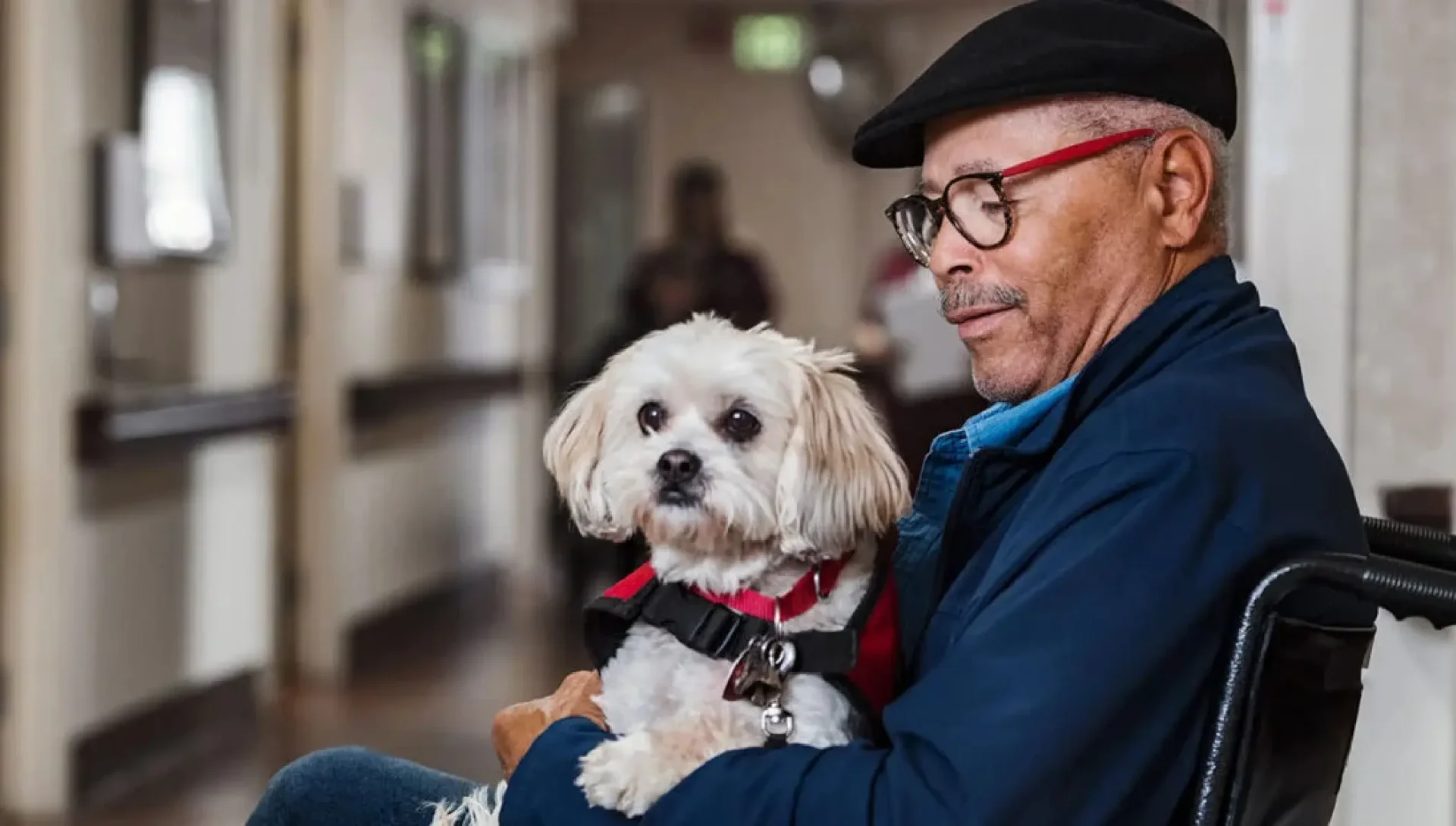
Assistance dogs provide invaluable support to people with disabilities, helping them live more independent lives. However, many people are unaware of the legal rights that both assistance dogs and their handlers are entitled to, particularly in public spaces. In the UK, the Equality Act 2010 grants crucial legal protections to assistance dog users, ensuring they can access the same services and facilities as anyone else, without discrimination. Here, we will explore the key legal rights assistance dogs and their handlers have when navigating public spaces.
The Equality Act 2010 is the primary piece of legislation that governs the rights of disabled individuals in the UK, including assistance dog users. Under this act, assistance dogs are legally recognized as a form of auxiliary aid that enables people with disabilities to access goods, services, and facilities. As such, the act requires businesses, service providers, and public spaces to make "reasonable adjustments" to accommodate both the handler and their assistance dog.

Reasonable adjustments refer to modifications or accommodations that must be made by businesses or service providers to ensure that disabled individuals can access their services without facing barriers. When it comes to assistance dogs, reasonable adjustments might include allowing the dog into spaces that typically prohibit pets, such as restaurants, supermarkets, hotels, or public transport. The key factor is that these adjustments must not impose an unreasonable burden on the business while ensuring the handler's right to access is respected.
Where Can Assistance Dogs Go?
Assistance dogs are allowed in most public spaces, including:
The purpose of an assistance dog is to assist individuals with disabilities in performing tasks that they may struggle to do themselves. For instance, guide dogs help visually impaired individuals navigate the world around them, while hearing dogs assist those who are deaf by alerting them to important sounds. Other assistance dogs might provide physical support, fetch items, or alert to medical conditions like seizures or low blood sugar.
Because of the essential role these dogs play, denying access to an assistance dog is akin to denying a person access to their disability aid—something that is both discriminatory and illegal under the Equality Act 2010.
In the UK, assistance dogs can be either owner-trained or professionally trained by accredited organizations. Regardless of where or how the dog is trained, it must behave appropriately in public settings and reliably perform tasks that support the handler. The dog should remain calm and well-mannered in various environments, from busy streets to quiet cafes, ensuring it does not pose a risk or cause a disturbance.
While businesses cannot demand proof of training or certification, they do have the right to ask the handler to remove the dog if it is behaving aggressively or disruptively.
Despite the legal protections in place, some assistance dog users still face discrimination when trying to access public spaces. If a business or service provider refuses entry to an assistance dog without a valid reason (such as health and safety concerns), this can be considered unlawful discrimination under the Equality Act.
If you find yourself in a situation where your assistance dog is denied access, there are several steps you can take:
While the Equality Act grants strong protections for assistance dogs, there are limited circumstances where businesses can refuse entry. These exceptions are typically related to health and safety concerns, such as:
It is important to note that a general dislike or fear of dogs is not a valid reason to refuse entry to an assistance dog.
The legal rights of assistance dog handlers in the UK are robust and designed to ensure that disabled individuals can live independently and access public spaces with minimal barriers. The Equality Act 2010 provides crucial protections that prohibit discrimination and require businesses and service providers to accommodate assistance dogs.
Understanding your rights as an assistance dog handler—and educating businesses about these rights—can help ensure a more inclusive society where assistance dog users are treated with respect and dignity.
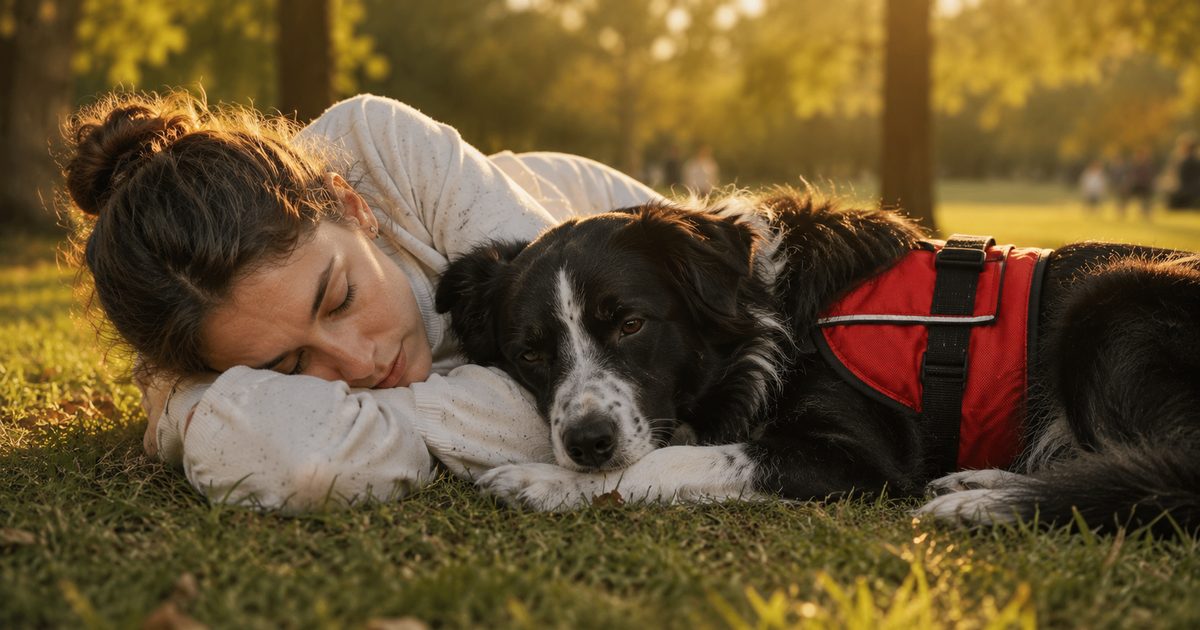
Epilepsy dogs save lives, but the terminology, the training routes and the legal rights that come with them are widely misunderstood. Here is what handlers, families and employers need to know.
The terms "epilepsy alert dog" and "epilepsy response dog" are often used interchangeably in popular conversation. They describe two very different things, and the distinction matters enormously, practically, scientifically and legally.
A seizure alert dog warns its handler before a seizure begins. This is predictive behaviour: the dog detects something in the handler's body, almost certainly biochemical, possibly olfactory, and communicates it through an observable signal, typically pawing, circling, persistent nose nudging or refusing to leave the handler's side. A genuine alert gives the handler time to reach a safe place, call for help, take medication or lie down on a surface where a fall cannot cause injury. The time window varies from a few minutes to over an hour.
A seizure response dog does not predict seizures. Instead, it is trained to perform specific actions during or after a seizure: lying across the handler's body, fetching a phone or alerting device, moving furniture away, staying present through the postictal phase, or activating a medical alert system. These tasks do not require any ability to sense biochemical changes in advance. They are trained responses to observable events, a falling body, a convulsion, stillness, that a dog can reliably learn.
This distinction shapes everything: the training route you can realistically pursue, the type of help you will actually receive, and the expectations you should set with your neurology team and support network.
"Not every dog that appears to react before a seizure is alerting. Some are responding to very early, subtle physical changes the handler has not yet noticed. The result may look identical from the outside, but the mechanism, and the reliability, can be very different."
The exact tasks an epilepsy assistance dog performs depend on the dog, the handler's seizure pattern, the handler's living situation and the training approach used. There is no single fixed list. That said, the most commonly trained and documented tasks fall into the following categories.
Pre-seizure alerting. The dog signals to the handler, typically through pawing, barking, circling or body-pressing, that a seizure is imminent. This gives the handler time to reach a safe position, contact someone or take prophylactic medication. This behaviour is the rarest and most complex of all epilepsy dog tasks. It cannot be reliably trained in every dog and is not universally achievable.
Positional assistance during a seizure. Many response dogs are trained to lie across the handler's torso during a tonic-clonic seizure. This serves two purposes: it can help limit the physical spread of convulsive movements, and it provides a grounding physical presence. Some dogs are trained to use their body to prevent a handler from rolling into dangerous positions.
Injury prevention during a fall. Some dogs are trained to position themselves alongside their handler during a detected aura or at the first sign of collapse, acting as a physical buffer against falls onto hard surfaces. This requires extremely precise and individually tailored training.
Fetching help or activating an alert device. A dog can be trained to fetch a phone, press a large-button alarm, activate a medical alert pendant or find a named person in the home. This is one of the most reliable and trainable response tasks, and it is particularly valuable for people who live alone.
Staying through the postictal phase. The period after a generalised seizure, the postictal phase, can last from minutes to hours. Handlers may be confused, physically exhausted, frightened or temporarily unable to move. A trained epilepsy response dog will stay with the handler, provide deep pressure therapy if trained to do so, and remain calm, providing both practical and emotional grounding through recovery.
Deep pressure therapy (DPT). DPT involves the dog applying firm, sustained pressure to the handler's body, usually the lap, torso or legs, on a specific cue or in response to a trained trigger. For some handlers, DPT during or after a seizure reduces distress and supports faster recovery. It can also be used in the lead-up to a known seizure trigger or during periods of heightened anxiety about seizure risk.
The question of whether dogs can genuinely predict seizures before any observable change occurs in their handler, and if so, how, is one of the most contested and carefully studied questions in the field of medical assistance animals.
The most widely accepted theory is olfactory. A number of studies, including research conducted by Medical Detection Dogs in collaboration with the University of Birmingham, have found that the human body produces detectable volatile organic compounds (VOCs) during seizure activity. If these compounds are released in the pre-ictal phase, before the seizure begins, a dog with a well-developed olfactory system trained to associate a specific scent with an alert behaviour could, in theory, detect the coming seizure before the handler is aware of it.
A 2021 study published in Scientific Reports by Catala et al. found evidence that seizures produce a distinctive odour across different seizure types, and that trained dogs could identify it with high accuracy in controlled conditions. This provided some of the strongest empirical support to date for the biological basis of seizure scent detection.
However, several significant caveats apply in real-world settings.
First, not all seizure types produce the same olfactory signature, or any detectable one. Absence seizures, focal seizures without obvious motor involvement and certain forms of non-convulsive status epilepticus may not generate the same chemical profile as a generalised tonic-clonic seizure.
Second, even in dogs that clearly appear to alert before seizures, researchers cannot always determine whether the dog is detecting a genuine biochemical pre-ictal signal or responding to very subtle behavioural or physical changes in the handler, changes so early in the seizure process that neither the handler nor observers have noticed them, but which are still technically post-ictal in origin.
Third, and most importantly for anyone considering this route, the ability to alert before a seizure cannot be trained to order. It appears to be a capacity that some dogs develop, sometimes spontaneously, sometimes through targeted scent training. It cannot be guaranteed in any individual dog, even one from a reputable charity training programme specifically focused on this task. This is why Medical Detection Dogs and others working in this area are careful in how they describe what they can and cannot promise prospective handlers.
What this means in practice: if you are considering an epilepsy assistance dog, do not base your entire safety plan on the expectation that your dog will alert. A well-trained response dog whose tasks begin at the moment of seizure onset is both more reliably achievable and provides life-changing support in its own right.
If you are interested in a charity-trained epilepsy alert dog in the UK, the landscape is narrow. Medical Detection Dogs is the only ADUK-accredited charity in the UK currently training epilepsy alert dogs. Based in Great Horwood, Buckinghamshire, their programme involves rigorous scent training and extensive assessment of both the dog and the handler's seizure profile.
Their waiting list regularly exceeds three years. Selection criteria are strict: candidates typically need a confirmed diagnosis from a specialist neurologist, a documented seizure pattern that is frequent enough to provide reliable training data, sufficient cognitive and physical capacity to handle and care for a trained working dog, and a living environment suitable for a working dog. Many genuinely epileptic people with a real need for assistance do not meet all of these criteria simultaneously, or face the wait time as an insurmountable barrier.
For people seeking a seizure response dog rather than a true alert dog, a small number of other assistance dog organisations offer programmes, though none currently hold ADUK accreditation specifically for this task type. The broader assistance dog charity sector in the UK is under significant capacity pressure, and demand for all types of medical alert dogs substantially outstrips what accredited programmes can provide.
"Medical Detection Dogs is the only ADUK-accredited charity training epilepsy alert dogs in the UK. Their waiting list regularly exceeds 3 years, and selection criteria are strict. For the majority of epilepsy handlers, owner-training a seizure response dog, working with a clinical behaviourist and neurologist, is both legal and practical. The Equality Act 2010 makes no distinction between charity-trained and owner-trained dogs."
The answer depends sharply on what you are asking the dog to do.
For seizure response tasks, owner-training is realistic. Teaching a dog to fetch a phone, activate an alert device, lie across your body on cue, stay with you during and after a seizure and move through postictal recovery by your side, these are achievable training goals for a suitable dog with a capable handler and good professional support. They require time, consistency and ideally the input of a qualified clinical animal behaviourist (one registered with the Animal Behaviour and Training Council, or ABTC), but they are not beyond the reach of a motivated and prepared owner-trainer.
For seizure alert, genuine biochemical pre-seizure detection, the picture is more complex. The trained element of alert work involves conditioning the dog to perform a specific alert behaviour in response to a seizure scent sample. This is technically an owner-trainable task, and some individuals have worked with clinical behaviourists and specialist scent trainers to attempt it. However, the fundamental limitation is not the training: it is whether the individual dog has the olfactory sensitivity and stability to detect and respond to the scent reliably in the chaos of real life, under varying conditions and across different seizure types. Many dogs that undergo scent training do not develop a reliable alert, or develop an alert that is inconsistent in the field. This is not a failure of the handler or the trainer. It is a reflection of biological variation.
What does a realistic owner-training journey look like? It typically involves: a period of careful breed and individual dog selection; foundation obedience and public access training (essential before any task work begins); engagement with a clinical animal behaviourist who has experience with medical alert dogs; close liaison with your neurology team to document your seizure pattern and inform training decisions; and a realistic timeline of 12 to 24 months before the dog is ready to work reliably in public settings.
Organisations that support owner-trainers in the UK, such as Support Dogs, some regional assistance dog training groups, and independent clinical behaviourists with medical assistance dog experience, can provide varying levels of guidance. The quality and availability of this support varies significantly by region, and there is no single national body governing owner-trainer support in the way ADUK governs its member charities.
An epilepsy assistance dog, whether charity-trained or owner-trained, works as part of a wider management plan for a condition that is medically complex. The involvement of your neurology team is not a bureaucratic requirement: it is genuinely useful.
Your neurologist or epilepsy nurse can provide a detailed written description of your seizure type, frequency and pattern. This information shapes training in concrete ways. A dog being trained to respond to generalised tonic-clonic seizures needs to learn very different cues and tasks from one being trained to assist a handler whose seizures begin with focal onset and involve primarily absence-type presentations. A dog that has been trained to a specific seizure profile and then placed with a handler whose seizures present differently may not reliably perform the tasks it has been trained for.
Your neurologist can also help you communicate the nature of your condition to employers, housing providers or schools when questions arise about whether your dog is genuinely medically necessary. While no UK law requires you to provide such documentation as a condition of access, and landlords and service providers cannot demand a letter from your doctor as proof, having clear documentation available can de-escalate difficult situations quickly.
A clinical animal behaviourist registered with the ABTC brings a different set of expertise. They can assess whether your dog has the temperament, drives and learning capacity for assistance work; design a training programme that maps your dog's developing skills to your specific medical needs; advise on the progression of public access training; and help you troubleshoot if trained tasks break down or become inconsistent in real-world settings. Clinical behaviourists are distinct from general dog trainers: their qualification involves university-level study of animal behaviour and is regulated through a professional register.
The combination of neurological input on the medical side and behaviour science expertise on the training side gives owner-trainers the best realistic foundation for success. Neither alone is sufficient.
The Equality Act 2010 defines disability at section 6 as a physical or mental impairment that has a substantial and long-term adverse effect on the person's ability to carry out normal day-to-day activities. "Substantial" means more than minor or trivial. "Long-term" means 12 months or more, likely to last 12 months, or likely to last for the rest of the person's life.
The vast majority of people with epilepsy will meet this definition, but it is worth being precise about why. The test is not whether you have a confirmed epilepsy diagnosis, it is whether the condition substantially affects your daily life. For many people with epilepsy, the impact is not only the seizures themselves but the restrictions they impose: the inability to drive, the need for supervision during activities that would otherwise be safe, the impact of antiepileptic medication on cognition and alertness, the anxiety around unpredictable seizure occurrence, and the postictal fatigue that can follow a seizure event.
Even people with well-controlled epilepsy, whose seizures are infrequent or currently suppressed by medication, may still qualify if the underlying condition has a substantial long-term effect on how they live and work. The Equality Act 2010 Schedule 1 makes clear that the effect of an impairment is to be assessed without the benefit of measures taken to treat or correct it, with one specific exception for spectacles and contact lenses. This means that if your medication stopped working tomorrow, the question is whether your epilepsy would then substantially affect your daily life, not whether it does so today while your medication is effective.
There is no minimum seizure frequency required. A person who has two tonic-clonic seizures per year but cannot safely shower, cook, drive or walk near traffic without risk may well meet the legal definition. A person with dozens of brief absence seizures daily whose activities are substantially restricted will almost certainly meet it.
An epilepsy assistance dog, regardless of whether it is charity-trained or owner-trained, carries full public access rights under the Equality Act 2010. This covers a wider range of settings than many handlers realise, and it is worth being specific about each.
Schools and educational settings. Part 6 of the Equality Act 2010 covers schools, further education and higher education. A child or student with epilepsy whose assistance dog is a reasonable auxiliary aid is entitled to bring that dog to educational settings. The school or institution must make a reasonable adjustment under section 20 of the Act. A blanket no-dogs policy applied without individual assessment is almost certainly unlawful. Head teachers and SENCO teams that are uncertain should consult the EHRC's technical guidance on schools.
Workplaces. Part 5 of the Act covers employment. An employer has a duty to make reasonable adjustments for a disabled employee. Where an employee requires their assistance dog as part of their daily functioning, allowing the dog into the workplace is likely to be a reasonable adjustment, unless the employer can demonstrate a genuine, proportionate justification for refusing it. A blanket pet policy is not a proportionate justification. An employer who refuses should expect the matter to proceed to an employment tribunal.
Transport. This is the one area where the specific definition in section 173 of the Act applies. Under Part 12, only dogs trained by named ADUK-accredited charities are explicitly referenced for taxi and private hire vehicle purposes. However, this does not mean that transport providers can freely refuse other assistance dogs. The general service provisions under Part 3 still apply to transport operators, and a refusal to carry a disabled person and their trained assistance dog may still constitute unlawful discrimination under sections 29 and 20 of the Act. Rail operators and bus and coach companies are covered by specific Passenger Rights regulations that broadly require them to accommodate assistance animals.
Hospitals and healthcare settings. NHS settings and private healthcare providers are service providers under Part 3 of the Act. They cannot routinely exclude assistance dogs from clinical areas. Infection control considerations may apply in specific circumstances, operating theatres, sterile environments, intensive care units, but these must be assessed individually and proportionately, not applied as a blanket rule. A patient who depends on their epilepsy assistance dog and is admitted to hospital has the right to be assessed individually, not refused automatically.
Shops, restaurants, hotels and other services. All are covered by Part 3 of the Equality Act. A business that refuses entry to a handler with a registered assistance dog, demands proof of ADUK accreditation, or asks a disabled handler to leave their dog outside is likely committing unlawful discrimination.
Your legal rights on one card. Show it to shops, transport staff, employers and anyone who challenges your dog. Wallet-sized and QR-linked to your dog's full profile.
In principle yes, though temperament and drives matter far more than breed. The most commonly used breeds for medical alert work are Labradors, Golden Retrievers, Standard Poodles and their crosses, primarily because of their combination of trainability, biddability, stable temperament and suitability for public access environments. That said, many dogs of other breeds and mixed heritage have successfully been trained as epilepsy response dogs. The dog should have calm, confident temperament; good environmental stability (unfazed by crowded, loud or unfamiliar settings); and sufficient working drive to maintain trained tasks reliably over time. A behaviourist assessment of your individual dog's suitability before beginning assistance work training is strongly advisable.
This is one of the most important questions in seizure alert dog science and it does not always have a clean answer. Researchers distinguish between true pre-ictal alerting, behaviour triggered by a biochemical change that precedes any observable change in the handler, and very early behavioural cue detection, where the dog is responding to subtle, involuntary changes in the handler's behaviour, posture or movement that precede the seizure but are not the result of a conscious signal. Both can appear identical to the observer. Keeping a detailed log that records the dog's alert behaviour, the time it occurred and the time the seizure began can help. A clinical behaviourist with medical alert dog experience can help you assess what your dog is doing and design a protocol to test it more rigorously.
Yes. Landlords, whether private, social or housing association, are service providers under Part 3 of the Equality Act 2010, and they are also bound by the reasonable adjustments duty. A blanket no-pets clause in a tenancy agreement cannot lawfully be applied to exclude a disabled tenant's genuine assistance dog without individual assessment. In February 2024, the government also updated the model tenancy agreement to remove default no-pets clauses, and the Renters' Rights Bill, when enacted, will further tighten landlord obligations in this area. If a landlord refuses your assistance dog or threatens eviction, contact Shelter (0808 800 4444) or Citizens Advice as a first step. Discriminating against a disabled tenant on the basis of their assistance dog is unlawful and the tenant has legal recourse.
You do not have a legal obligation to disclose your diagnosis or the nature of your disability to your employer. However, in order to trigger the reasonable adjustments duty under Part 5 of the Equality Act, your employer needs to know, or reasonably ought to know, that you are disabled and that you require a specific adjustment. In practice, bringing an assistance dog to work requires a conversation: you will need to notify your employer of your need, describe the dog's role in sufficient terms for them to assess the adjustment request, and allow them a reasonable opportunity to consider it. You are not required to produce medical evidence of your diagnosis or hand over clinical letters. Stating that you have a medical condition that qualifies as a disability under the Equality Act and that your dog performs specific tasks that you require at work is sufficient to trigger the employer's duty.
Yes. Part 6 of the Equality Act 2010 covers schools. A school is required to make reasonable adjustments for a disabled pupil, and where an assistance dog is part of the child's management plan, the school must give individual consideration to allowing the dog. Blanket no-animals policies cannot be applied without an individual assessment. Schools will have legitimate questions about care of the dog during the school day, who is responsible for taking the dog to the toilet, what happens if the dog is unwell, how the dog is accommodated in classes, and these are reasonable operational questions the family should be prepared to address. They are not grounds for refusal. IPSEA (Independent Provider of Special Education Advice) and the SENCO team at the school are useful contacts if the school is reluctant to engage.
Was this article helpful?
This article was researched using published peer-reviewed research, EHRC technical guidance, legislation.gov.uk, NHS clinical resources, and primary sources from Medical Detection Dogs and ADUK. We update our articles when the law or official guidance changes.
If you spot anything that needs updating, contact us here.
Founded by Norbert Szeverenyi. Supporting 6,000+ UK handlers. Articles reviewed against UK primary legislation and official EHRC, GOV.UK, Citizens Advice and NHS guidance.
This article provides general information, not legal or medical advice. Epilepsy is a complex and individual condition. Training an assistance dog involves significant commitment and should always involve qualified professional input.
For legal questions about access rights, contact Citizens Advice or the Equality and Human Rights Commission (helpline: 0808 800 0082). For clinical questions about epilepsy management, speak to your neurologist or epilepsy specialist nurse.
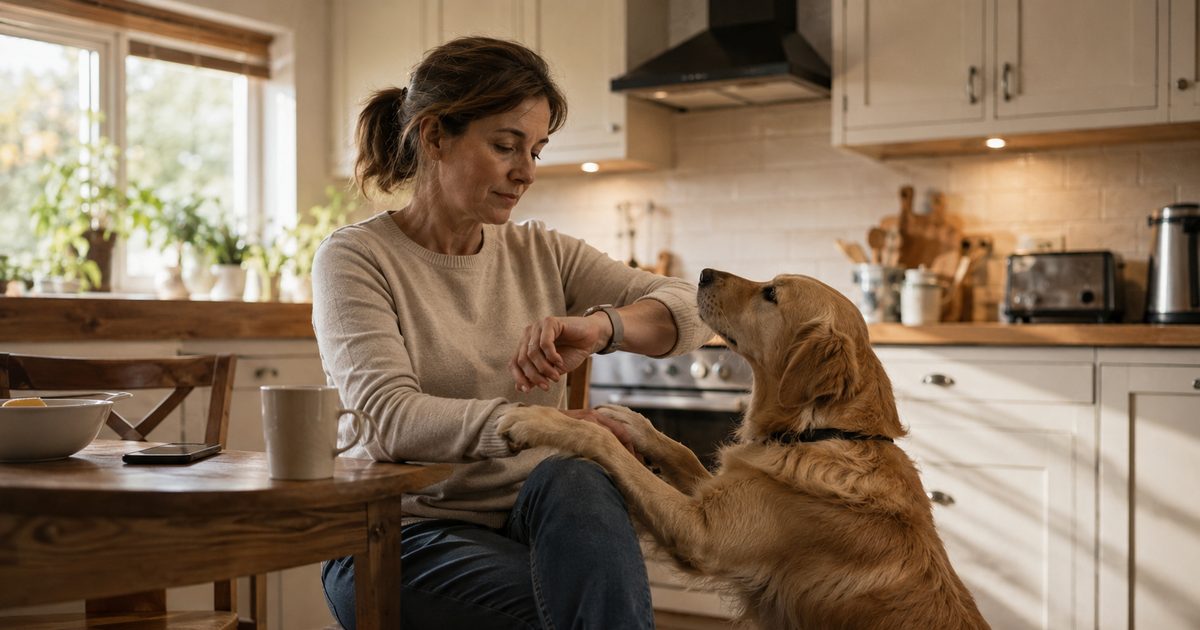
Fewer than 20 ADUK-accredited diabetic alert dogs are trained in the UK each year. Against 400,000 people with Type 1 diabetes, that makes owner-training the only realistic route for most handlers, and under the Equality Act 2010, a self-trained DAD carries exactly the same public access rights.
A diabetic alert dog, commonly referred to as a DAD, is an assistance dog trained to detect the physiological changes associated with dangerous blood sugar events and alert their handler before the situation becomes a medical emergency. The mechanism is rooted in chemistry, not intuition.
When blood glucose drops significantly, the body's response triggers a cascade of metabolic changes. One measurable result is a rise in isoprene, a volatile organic compound detectable in breath and sweat. During hypoglycaemia unawareness, a condition affecting many people with Type 1 diabetes where the body no longer produces the usual warning signs of a low, this chemical signal may be the only early indicator available. Dogs, with their extraordinary olfactory sensitivity, can be trained to detect this signal reliably.
The alert itself is a trained behaviour, not a spontaneous reaction. Handlers and trainers work to shape a specific, consistent response: commonly persistent pawing at the handler's hand or leg, nose-nudging, staring, barking, or retrieving a specific object such as a glucose testing kit or phone. The goal is an alert that is unambiguous, repeatable, and performed at the earliest point of scent detection, ideally before a CGM device would have triggered an alarm.
"Many handlers report their dog alerts five to fifteen minutes before their CGM device. For someone with hypoglycaemia unawareness, that window is not a convenience, it is the difference between a conscious treatment and a medical emergency."
While any person with diabetes could theoretically benefit from a trained alert dog, the evidence for meaningful impact is strongest in three groups: people with Type 1 diabetes, people with brittle diabetes, and people with hypoglycaemia unawareness.
Type 1 diabetes involves total dependence on exogenous insulin, which creates an inherent risk of hypoglycaemia, particularly overnight, during physical activity, or during illness. The unpredictability of insulin sensitivity makes low blood sugar events difficult to anticipate. A DAD adds a biological early-warning layer on top of whatever technology a handler uses.
Brittle diabetes refers to a particularly unstable form of Type 1 where blood glucose levels fluctuate wildly and unpredictably despite best management efforts. People with brittle diabetes may experience multiple severe episodes per week. A DAD can provide a degree of safety net that technology alone cannot fully replicate.
Hypoglycaemia unawareness is the condition where the body has lost its natural early-warning response to low blood sugar, the shaking, sweating and anxiety that most people experience. Without these cues, a person can become severely hypoglycaemic with no subjective warning at all. A DAD trained to detect the early scent signature of a hypo can provide that warning in place of the body's lost signalling system.
People with Type 2 diabetes who manage their condition with insulin may also benefit, particularly if they have developed hypoglycaemia unawareness as a result of long-term insulin therapy. For those managing Type 2 with diet or non-insulin medication alone, the risk of severe hypoglycaemia is minimal and the case for a DAD is correspondingly weaker.
Scientific study of diabetic alert dogs has grown substantially over the past decade. The picture that emerges is encouraging, though researchers are careful to note that study designs vary and that real-world performance depends heavily on training quality and the individual dog.
A 2016 study published in PLOS ONE by researchers at the University of Cambridge confirmed that trained dogs could reliably detect breath samples from people experiencing hypoglycaemia at significantly above-chance accuracy. The researchers identified isoprene as the key VOC associated with hypo detection, establishing for the first time the likely chemical basis for the behaviour that DAD handlers had been reporting anecdotally for years.
A 2019 systematic review published in Diabetic Medicine examined evidence from multiple countries. It found that handlers of medical alert dogs generally reported reductions in severe hypoglycaemic episodes, improvements in HbA1c levels, and improvements in quality of life, including reduced anxiety and greater confidence in undertaking daily activities. Limitations noted included reliance on self-report data and small sample sizes.
Research into hyperglycaemia alerting is less advanced. Dogs appear to detect high blood sugar events through acetone-related VOCs associated with ketosis, though the reliability data for hyper alerts is less consistent than for hypo detection. Most training programmes prioritise hypo alerting for this reason, treating hyper alerts as a secondary and useful addition rather than a primary function.
Assistance Dogs UK (ADUK) is the voluntary coalition of UK assistance dog charities that have achieved accreditation through Assistance Dogs International or the International Guide Dog Federation. In the context of diabetic alert dogs specifically, ADUK accreditation represents an extraordinary bottleneck.
Only two ADUK-accredited charities in the UK currently train diabetic alert dogs. Their combined annual output is fewer than 20 dogs. Against a UK Type 1 diabetes population of around 400,000, this makes the charitable route effectively inaccessible for the vast majority of people who might benefit. Waiting lists at these organisations run to three to five years, and applicants must meet strict eligibility criteria that many people with well-managed diabetes may not satisfy.
This is not a criticism of those charities. Training a reliable medical alert dog takes two to three years, requires specialist expertise, and costs between £30,000 and £50,000 per dog. The economics of scaling that model to meet demand simply do not work without a fundamental change in funding. That change has not happened.
The result is that owner-training, either completely independently or with the support of a professional dog trainer or clinical animal behaviourist, has become the primary pathway for handlers who need a diabetic alert dog. This is not a compromise or a workaround. It is a legitimate, legal and well-established route that carries the same rights under UK law as a charity-trained dog.
"Only two ADUK-accredited charities in the UK train diabetic alert dogs, and their combined annual output is fewer than 20 dogs. Against a UK Type 1 population of around 400,000, this makes owner-training the only realistic route for most handlers. Legally, a self-trained or independently trained diabetic alert dog carries exactly the same public access rights."
Under the Equality Act 2010, the question is not who trained the dog. The question is whether the handler is disabled within the meaning of the Act, and whether the dog is an auxiliary aid that mitigates the effects of that disability. A person with Type 1 diabetes and hypoglycaemia unawareness qualifies as disabled under section 6. A dog trained to detect and alert to blood sugar events is an auxiliary aid. Training organisation is irrelevant to both questions.
An ADR registration gives you a QR-linked online profile, smart ID card and NFC tag that shops, restaurants and transport providers respond to. Your dog's role is verified. Your access rights are documented. Over 6,000 UK handlers are already registered.
Training a diabetic alert dog is a structured, multi-stage process. It is not simply a matter of exposing a dog to blood glucose changes and hoping it learns what to do. Each stage builds on the last, and the process typically takes 18 months to three years to complete to a reliable standard.
Stage 1: Scent sample collection. The handler collects saliva or breath samples during confirmed blood glucose events, ideally at the point of a hypo or hyper, before treatment. These samples, usually collected onto gauze and frozen in airtight containers, form the training material. Getting this right is critical: the scent must be collected at the point of the event, not after glucose has been taken.
Stage 2: Scent imprinting. The dog is introduced to the scent samples using positive reinforcement. The dog learns to identify and select the correct scent from an array, initially in controlled conditions. This phase can take several months, depending on the dog's aptitude and the consistency of training sessions.
Stage 3: Alert behaviour shaping. Once the dog reliably identifies the target scent, a specific alert behaviour is introduced and reinforced. The behaviour must be one the dog can perform clearly regardless of the setting, at home, in a supermarket, in a car, during the night. Common choices include pawing, a specific nose-touch, or retrieving a designated object.
Stage 4: Proofing in real life. The dog must learn to perform the alert behaviour in every environment it will encounter, busy streets, shops, transport, offices, schools. This is the longest and most demanding stage. The dog must maintain its alerting behaviour reliably regardless of distractions.
Stage 5: Public access training. Any assistance dog working in public spaces must behave impeccably. This means walking calmly on a lead, settling quietly in public places, ignoring food and other dogs, and not approaching strangers without permission. Public access behaviour is not optional, it is what distinguishes an assistance dog from a pet in a public space.
Working with a professional dog trainer or clinical animal behaviourist throughout this process is strongly recommended, even if the handler is doing most of the day-to-day training themselves. A professional can identify problems early, assess progress objectively, and ensure the alert behaviour is being shaped correctly. Organisations such as the Association of Pet Behaviour Counsellors (APBC) and the Animal Behaviour and Training Council (ABTC) maintain registers of accredited practitioners.
A diabetic alert dog is a powerful tool, but it is not a flawless one. Setting realistic expectations before embarking on the training journey is important for the handler, the dog, and the handler's clinical team.
No dog alerts correctly 100 per cent of the time. Miss rates occur, particularly as a dog ages, if its training is not maintained, or during periods of illness or stress in the dog itself. Environmental factors, strong competing scents, changes in the handler's diet, or changes in the specific VOC signature of the handler's events over time, can also affect reliability.
False positives, alerts when blood glucose is actually within range, are common in the early stages of training and should diminish with experience. A high false-positive rate in an established DAD may indicate that training maintenance is needed, or that the dog is alerting to emotional or environmental cues rather than the metabolic scent.
The relationship between a DAD and CGM technology is complementary, not competitive. Most experienced handlers use both. The CGM provides objective data; the DAD may alert earlier and can also alert when a device is not worn, has failed, or is out of range. Many handlers also report that the dog alerts during overnight hypos, a situation where a CGM alarm may be missed by someone who sleeps deeply.
The psychological benefit of a DAD is also significant and should not be underestimated. Many handlers with hypoglycaemia unawareness describe living in a state of chronic anxiety, unable to drive, sleep alone, or exercise without fear of a severe episode. A reliable DAD can restore a degree of independence and confidence that medication and technology alone cannot provide.
A diabetic alert dog that is trained to mitigate the effects of its handler's disability is an assistance dog under UK equality law. The handler has full public access rights under the Equality Act 2010. This is not a grey area.
Under Part 3 of the Act, service providers, including shops, restaurants, hotels, transport operators, cinemas, leisure centres and any other business or organisation that provides services to the public, must not discriminate against a disabled person. Refusing entry or service to a handler with an assistance dog, without an objective justification unrelated to the dog's trained role, is unlawful disability discrimination.
Crucially, no law in the UK requires an assistance dog to be ADUK-accredited in order to have these rights. The definition of "assistance dog" in section 173 of the Equality Act 2010 applies only to Part 12 of the Act, taxi and private hire vehicle licensing. Outside that narrow transport context, the legal test is functional: is the handler disabled, and does the dog mitigate the effects of that disability? An owner-trained or independently trained DAD passes that test.
A service provider who refuses entry to a DAD handler on the grounds that the dog is not ADUK-accredited, is not wearing a specific vest, or does not carry a particular ID card, may be committing unlawful indirect discrimination. A handler who is refused access can report the incident to the Equality Advisory and Support Service (EASS), seek conciliation, or bring county court proceedings.
Registering your DAD with the Assistance Dog Registry provides documentation that many venues and transport operators find reassuring, a verified online profile with QR code, a professional ID card and NFC tag. This documentation does not legally change your rights, but in practice it often prevents confrontations before they arise.
Training and working with a diabetic alert dog is a significant undertaking that should be discussed with your diabetes care team, your consultant endocrinologist, diabetologist or diabetes specialist nurse, from the outset.
Your clinical team can help assess whether a DAD is appropriate for your specific situation. They can document your diagnosis and the impact of your diabetes on daily life, documentation that may be needed when registering your dog, applying for training support, or asserting your rights with a service provider. For people with hypoglycaemia unawareness, clinical documentation of that condition specifically can strengthen any access rights assertion.
Your team should also be aware that a DAD may influence how you manage your diabetes day to day. Some handlers become more confident undertaking exercise or reducing overnight alert thresholds on their CGM in the presence of a reliable DAD. These decisions should be made collaboratively with clinical input, not unilaterally.
Diabetes UK, the charity, has published guidance for people considering an alert dog and can provide signposting to training resources and support organisations.
Yes, in many cases. There is no requirement to start with a specific breed or a puppy. Dogs of many breeds and mixed breeds have been successfully trained as DADs. The key factors are temperament (calm, focused, eager to work with the handler), olfactory ability, and willingness to perform a trained behaviour reliably. Some adult dogs with an established bond with the handler have an advantage in scent imprinting because they are already highly attuned to the handler's body chemistry. A professional assessment by a clinical animal behaviourist can help determine whether your dog has the right attributes before committing to the training process.
Yes. Any dog trained to perform a specific task that mitigates the effects of a handler's disability qualifies as an assistance dog for the purposes of the Equality Act 2010, outside the narrow transport provisions of section 173. Diabetes, particularly Type 1 with hypoglycaemia unawareness, typically qualifies as a disability under section 6 of the Act. A dog trained to detect and alert to blood glucose events is performing a task that mitigates the effects of that disability. ADUK accreditation is not required.
The full training process, from scent imprinting through to reliable public access behaviour, typically takes 18 months to three years. Scent imprinting alone can take several months, and proofing the alert behaviour across all environments takes considerably longer. Training is never truly complete: maintenance training is essential throughout the dog's working life to keep alert reliability high. Most handlers work with a professional trainer at least periodically throughout the process rather than undertaking it entirely alone.
Not lawfully, unless the service provider can demonstrate an objective justification that is proportionate and unrelated to your dog's trained assistance role. Refusing a diabetic alert dog handler entry because the dog is not ADUK-accredited, is not wearing a vest, or does not have a specific ID card is not a lawful justification. If you are refused access, note the details, ask for the refusal in writing, and report it to the Equality Advisory and Support Service (EASS) on 0808 800 0082. An ADR registration card and profile can help prevent confrontations in the first place.
No, and it should not be treated as a replacement. A DAD and a CGM serve complementary functions. The CGM provides objective, real-time blood glucose data and is accurate within measurable tolerances. A DAD may alert earlier to developing events and can provide an alert when a device is not worn or has failed. Most experienced handlers use both simultaneously. Clinical decisions about target ranges, alarm thresholds and insulin dosing should always be made in consultation with your diabetes care team regardless of whether you have a DAD.
Was this article helpful?
This article was researched using peer-reviewed scientific literature, EHRC guidance, Diabetes UK publications, and official UK legislation. All legal citations have been checked against legislation.gov.uk. We update our articles when the law or official guidance changes.
If you spot anything that needs updating, contact us here.
Founded by Norbert Szeverenyi. Supporting 6,000+ UK handlers. Articles reviewed against UK primary legislation and official EHRC, GOV.UK, Diabetes UK and Equality Advisory Service guidance.
This article provides general information, not medical or legal advice. Diabetic alert dogs are not a substitute for clinical diabetes management. The law in this area involves individual facts and circumstances.
For medical decisions, always consult your diabetes care team. For legal questions, contact the Equality Advisory and Support Service (0808 800 0082), Citizens Advice, or the Equality and Human Rights Commission.
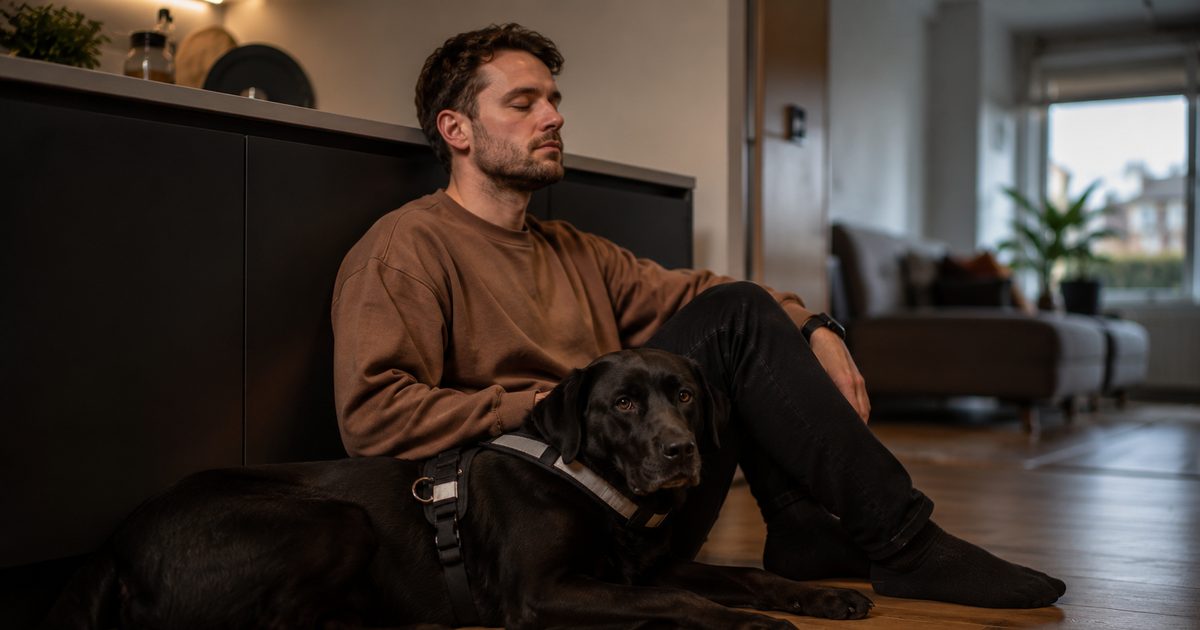
There is no ADUK-accredited charity providing PTSD assistance dogs in the UK. Owner-training, with a qualified behaviourist and clinical support, is the main route, and it gives you the same legal standing as any charity-trained dog. Here is everything you need to know.
A PTSD assistance dog, more precisely called a psychiatric assistance dog, is a dog trained to perform specific, discrete tasks that mitigate the effects of Post-Traumatic Stress Disorder on its handler. This is a critically important distinction: a psychiatric assistance dog is not an emotional support animal (ESA). The difference is not semantic. It is legal.
An emotional support animal provides comfort through its presence alone. It has no specific training and, in the UK, has no special legal status or public access rights beyond those of any pet. A PTSD assistance dog, by contrast, performs observable, trained behaviours that address a disability-related need. That trained task work is what makes it an assistance dog in law, and what gives it the same public access rights as a guide dog for a blind person.
The confusion between ESAs and assistance dogs causes real harm. People with PTSD who need a legitimately trained assistance dog are sometimes told their dog is "just an emotional support animal" and refused access to shops, transport or housing. This article explains the distinction, the law that protects you, and how to build a legally defensible case for your dog's status.
"The distinction between a PTSD assistance dog and an emotional support animal is not semantic, it is legal. Trained task work is what makes a dog an assistance dog in UK law, and what gives it full public access rights."
To qualify as an assistance dog in UK law, the dog must perform trained tasks that mitigate the effects of the handler's disability. "Making me feel calmer" is not a trained task. The following are:
Nightmare interruption. The dog is trained to wake the handler during a nightmare or night terror using a specific, deliberate behaviour, pawing, nudging, licking or a trained vocalisation. This is learned through repeated conditioning and can be confirmed as a discrete task. It directly addresses one of the most common and debilitating symptoms of PTSD: disrupted sleep.
Room checks and perimeter patrol. The dog searches a room on a verbal or hand signal command, moving through the space systematically and returning to the handler to indicate the room is clear. This addresses hypervigilance, the constant, exhausting threat-monitoring that characterises PTSD, by outsourcing the check to a trained animal.
Creating personal space in crowds. The dog learns to position itself directly behind the handler in public spaces, walking heel-to-heel, so that no person can approach from behind without first encountering the dog. This is particularly effective for handlers who experience acute distress when someone enters their blind spot.
Grounding during flashbacks and dissociation. Deep pressure therapy (DPT) involves the dog applying firm pressure, typically lying across the handler's lap or pressing against their legs, during a dissociative episode or flashback. The physical sensation anchors the handler in the present moment. This is a trained behaviour, not spontaneous contact, and it can be documented as part of a training log.
Medication reminders. Trained to alert at set times using a timer or to fetch medication when the handler is in a dissociative or avoidant state, the dog ensures consistent compliance with a prescribed treatment regime. Missed medication during PTSD episodes is a documented clinical problem; a trained reminder addresses it directly.
Alerting to dissociation. Some dogs are trained to recognise the physiological or behavioural signals that precede a dissociative episode, changes in breathing rhythm, prolonged stillness, altered vocal tone, and to alert before the episode fully takes hold. This gives the handler time to move to a safe location, use a coping strategy or contact support.
Any one of these tasks, consistently performed on cue and demonstrably linked to the handler's disability, is sufficient to establish the dog's assistance dog status in UK law. A dog that performs multiple tasks has an even stronger evidential basis.
Yes, in most cases. The Equality Act 2010 defines disability in section 6 as a physical or mental impairment that has a substantial and long-term adverse effect on the person's ability to carry out normal day-to-day activities. "Substantial" means more than minor or trivial. "Long-term" means the condition has lasted or is likely to last 12 months or more.
PTSD, particularly complex or chronic PTSD, routinely meets this threshold. A person who cannot travel on public transport, leave the house without a safety protocol, sleep without nightmares, or function in crowded environments is experiencing substantial adverse effects on day-to-day activities. A clinical diagnosis from a GP, psychiatrist or psychologist is strong supporting evidence, although the Act does not technically require a formal diagnosis label: it requires the functional effect.
The EHRC's Equality Act guidance is explicit that mental health conditions are covered under the definition. PTSD appears by name in examples used in official guidance. There is no serious legal argument that chronic PTSD does not amount to a disability within the meaning of the Act.
Some of the most significant work in PTSD assistance dog training in the UK is happening in the veterans community. Organisations including Hounds for Heroes, PTSD Resolution and a number of smaller veteran-led charities have explored or supported the use of assistance dogs alongside other therapies for former Armed Forces personnel.
The need is well-documented. Combat stress affects a significant proportion of veterans, and PTSD, often combined with physical injury, is one of the most common presentations in veteran mental health services. Traditional talking therapies are effective for many, but not universally so, and for veterans whose PTSD involves severe hypervigilance, social avoidance and night disturbance, an assistance dog can address symptoms that medication and therapy alone do not.
Veterans with PTSD dogs have consistently reported improvements in sleep quality, willingness to leave the house, ability to use public transport, and reduction in hypervigilance episodes. The dog serves both as a practical task partner and as a social bridge, the visible presence of a working dog often makes interactions easier in ways that reduce the social isolation common in veteran PTSD.
Veteran handlers should be aware of two specific points. First, Service charities such as the Royal British Legion and SSAFA may be able to provide funding support toward training costs or ADR registration. Second, the Ministry of Defence does not formally endorse any specific assistance dog organisation, but the Veterans UK welfare team can direct veterans to relevant civilian support.
"For veterans whose PTSD involves severe hypervigilance and night disturbance, an assistance dog can address symptoms that medication and therapy alone do not. The dog serves as both a practical task partner and a social bridge."
ADUK, Assistance Dogs UK, is the national coalition of UK assistance dog charities that have achieved accreditation through Assistance Dogs International or the International Guide Dog Federation. Its member organisations include Guide Dogs, Hearing Dogs for Deaf People, Dogs for Good, Medical Detection Dogs and others. They provide excellent services for specific disability types.
But there is a gap that is important to understand clearly.
ADUK does not accredit any PTSD-specific assistance dog charities. There are no ADUK-accredited organisations providing PTSD dogs in the UK. This is not a failing of ADUK, it reflects the complexity of psychiatric assistance dog training, the relatively recent recognition of this need, and the volunteer and funding models of the member charities. The charitable sector simply has not developed a programme in this area to ADUK accreditation standard.
What this means in practice is significant. A person with PTSD cannot go on a waiting list for a charity-trained PTSD assistance dog in the UK in the way a visually impaired person can apply to Guide Dogs. That route does not exist. Owner-training, supported by a clinical behaviourist and your GP or psychiatrist, is the only realistic route available to the overwhelming majority of people who need a PTSD assistance dog.
Legally, this puts your dog on entirely equal footing with any charity-trained dog. The Equality Act 2010 does not define assistance dog by reference to ADUK membership. The definition for public access purposes in services and housing depends on whether the person is disabled and whether the dog performs trained tasks that mitigate that disability, not on who trained the dog. A venue that refuses your owner-trained PTSD assistance dog on the grounds that it is not ADUK-accredited is applying a criterion the law does not support.
This position is confirmed by ADUK itself, which states publicly that ADUK accreditation is not a legal requirement for public access and that disabled people are not required to produce evidence of ADUK membership to exercise their rights.
Owner-training your PTSD assistance dog with a qualified clinical behaviourist, and with documented support from your GP or psychiatrist, gives your dog the same legal public access rights as a dog trained by any ADUK member charity.
The absence of an ADUK-accredited PTSD dog charity is not a barrier to legal recognition. It is simply the current landscape, and the law accounts for it.
Owner-training a PTSD assistance dog is a substantial commitment. It typically takes 12 to 24 months of structured work before a dog is ready for public access. The process has three distinct pillars: task training, public access preparation, and clinical documentation.
Tasks must be deliberately trained, not spontaneous. A dog that happens to lick your face when you cry is not performing a trained task. A dog that has been conditioned to perform a specific, repeatable behaviour in response to a specific cue, whether that cue is a command, a physiological signal, or a timer, is performing a trained task. Every task should be documented in a training log with dates, duration of sessions, method, and the handler's assessment of reliability.
The most important tasks to establish early are those that directly address the most debilitating symptoms. For most PTSD presentations, this means nightmare interruption and room checks, because sleep disruption and hypervigilance are the symptoms that most limit daily function. DPT and grounding behaviours can be developed in parallel, but they require the dog to have the confidence and body awareness to apply controlled pressure, this is not appropriate to train in very young dogs.
A PTSD assistance dog that is reliable in your home but reactive in public is not yet an assistance dog in the practical sense. Public access training means systematic, progressive exposure to the environments in which the dog will work: supermarkets, public transport, cafes, hospitals, crowded streets. The dog must be able to work calmly in all of these without being distracted, reactive to other dogs, or showing stress behaviours.
A qualified clinical animal behaviourist (CCAB) or a trainer accredited by the Animal Behaviour and Training Council (ABTC) should assess the dog's public access readiness. They will look at the dog's response to unexpected stimuli, ability to settle under a table or in a waiting area, response to other dogs and strangers, and whether the dog can perform its tasks reliably under distraction. This assessment should be documented.
This is the element that many handlers overlook, and it is the element that matters most when your dog's status is challenged. Your documentation package should include:
This documentation does not give your dog any additional legal rights, it already has those, but it makes it significantly easier to respond to challenges from venues, transport operators or housing providers, and it provides the foundation for an ADR registration profile.

A PTSD assistance dog, owner-trained or charity-trained, has full public access rights under the Equality Act 2010. This means your dog is entitled to accompany you in all public-facing premises and on all public transport. There are no exceptions based on the type of disability or the organisation that trained the dog.
All premises open to the public. Shops, supermarkets, restaurants, cafes, bars, cinemas, theatres, hotels, GP surgeries, hospitals, banks, leisure centres, and any other place that provides goods or services to the public must not refuse entry to a disabled person with an assistance dog. This duty falls under Part 3 of the Equality Act 2010, which covers the provision of services.
All public transport. Bus, rail, London Underground, tram, taxi, private hire vehicle, ferry and domestic air travel are all covered. The specific transport provisions in Part 12 of the Act reference ADUK charities for taxi licensing purposes, but this does not restrict assistance dog rights on other forms of transport. An owner-trained PTSD assistance dog is entitled to travel on all public transport.
Workplaces. An employer has a duty to make reasonable adjustments for a disabled employee under Part 5 of the Equality Act. Permitting an assistance dog in the workplace is likely to be a reasonable adjustment for an employee with PTSD. This does not mean permission is automatic, it means the employer must engage with the request seriously and demonstrate a legitimate reason if they decline.
Housing. A landlord's blanket no-pets policy does not automatically extend to assistance dogs. Under Part 4 of the Equality Act, a landlord may be required to make a reasonable adjustment, which could include allowing an assistance dog, to avoid placing a disabled person at a substantial disadvantage.
When you are challenged. You are not legally required to carry documentation, but having your ADR ID card, QR-linked profile and training log available significantly reduces the practical friction of access challenges. If a venue refuses entry, ask them to put the refusal in writing with reasons. A refusal without justification may constitute disability discrimination and can be reported to the EHRC or pursued through the county court.
An ADR registration gives you a QR-linked online profile, smart ID card and NFC tag that venue staff, transport operators and housing providers actually respond to. Over 6,000 UK handlers are already registered.
One of the most consistent difficulties reported by handlers with psychiatric assistance dogs is the scepticism they face, from venue staff, from members of the public, and sometimes from family members, that their dog is a "real" assistance dog. This scepticism has a particular edge in the PTSD context because the disability is invisible. A guide dog handler's need is self-evident. A PTSD assistance dog handler does not appear, to a casual observer, to need anything.
This scepticism is a form of disability discrimination even when it is not legally actionable, it creates an environment in which disabled people must justify themselves in ways non-disabled people never do. It is worth being direct about this rather than offering strategies for accommodating it: the burden of proof does not lie with the disabled person. You do not owe a cafe manager a medical history.
That said, practical tools help. A calm, confident presentation of your ADR ID card, which shows your dog's registered status, name, trained tasks and QR-linked profile, resolves most access challenges without confrontation. Training your dog in a vest or harness with a clear "assistance dog" label reduces the number of challenges you face before you even speak. And understanding your rights well enough to state them clearly, "This is a trained assistance dog and I have the legal right to be here under the Equality Act 2010", is the most effective de-escalation tool available.
For persistent or hostile challenges, the EHRC helpline (0808 800 0082) is free and can advise on whether a specific refusal amounts to discrimination. Citizens Advice can help you understand your options. If a venue refuses you and you want to take action, keeping a record of the date, time, what was said and any witnesses is the starting point.
"The burden of proof does not lie with the disabled person. You do not owe a cafe manager a medical history. A calm, confident statement of your rights under the Equality Act 2010 is the most effective tool available."
Your legal rights on one card. Show it to venue staff, transport operators and anyone who challenges you. Wallet-sized and QR-linked to your ADR profile.
No. An emotional support animal (ESA) provides comfort through its presence alone and has no special legal status or public access rights in the UK. A PTSD assistance dog performs specific, deliberately trained tasks that mitigate the effects of the handler's PTSD, such as nightmare interruption, room checks, or deep pressure therapy during flashbacks. It is this trained task work that makes it an assistance dog in UK law, with full public access rights.
Currently, there are no ADUK-accredited charities providing PTSD-specific assistance dogs in the UK. Some charities, including certain veteran-focused organisations, are exploring this area, but no accredited programme exists. Owner-training with a qualified clinical behaviourist, supported by your GP or psychiatrist, is the main route available to the overwhelming majority of people who need a PTSD assistance dog in the UK.
Yes. Under the Equality Act 2010, public access rights in services and housing depend on whether you are disabled and whether your dog is trained to perform tasks that mitigate your disability, not on who trained the dog. There is no legal distinction between owner-trained and charity-trained assistance dogs in the context of access to shops, restaurants, transport or housing.
There is no single breed requirement. The most important qualities are temperament, calm, sociable, non-reactive, easily focused, rather than breed. Labrador Retrievers, Golden Retrievers, Standard Poodles and Labradoodles are commonly used because they tend to display these qualities reliably, but individuals of many breeds have performed this work successfully. A qualified behaviourist can assess whether a specific dog is a suitable candidate before you invest significant time in training.
Typically 12 to 24 months of structured training before the dog is reliably performing its tasks in public access environments. The timeline depends on the dog's starting age and temperament, the complexity of the tasks being trained, and the handler's ability to train consistently. Starting with a puppy adds several months before formal task training can begin. An existing adult dog with a suitable temperament may progress more quickly.
Was this article helpful?
This article was researched using the Equality Act 2010, EHRC technical guidance, published clinical literature on psychiatric assistance dogs, and publicly available guidance from Assistance Dogs UK, Citizens Advice and GOV.UK. All legal citations have been checked against legislation.gov.uk. We update our articles when the law or official guidance changes.
If you spot anything that needs updating, contact us here.
Founded by Norbert Szeverenyi. Supporting 6,000+ UK handlers. Articles reviewed against UK primary legislation and official EHRC, GOV.UK, Citizens Advice and Shelter guidance.
This article provides general information, not legal advice. The law in this area involves individual facts and circumstances. What applies in one situation may not apply in another.
If your access rights are being denied, seek advice from Citizens Advice, the Equality and Human Rights Commission (helpline: 0808 800 0082), or a qualified solicitor specialising in disability discrimination.
Autism assistance dogs are fully legal in the UK, owner-training is the primary realistic route for most families. Here is everything you need to know about tasks, legal rights, training, and how ADR registration protects you in public.
The term "autism assistance dog" covers a wide spectrum of trained behaviours. Unlike guide dogs, which perform a narrow and well-understood set of tasks, autism assistance dogs are trained to the specific needs of the individual, which is why the work they do varies significantly from handler to handler.
That said, there are six categories of task that recur consistently across autistic handlers of all ages. Understanding these tasks matters not only for families considering a dog, but for anyone who might challenge an autism assistance dog in a public setting. These dogs are not pets performing cute tricks: they are performing safety-critical work.
Grounding during sensory overwhelm or anxiety. The dog applies physical pressure, typically nudging, leaning against, or placing a paw on the handler, at the onset of anxiety or sensory overload. The physical sensation interrupts the escalating cycle and redirects the handler's nervous system. Many autistic people describe this as their dog providing a reliable, non-verbal anchor that words or instructions cannot replicate.
Interrupting meltdowns and self-injurious behaviour. Trained autism dogs learn to recognise early cues, behavioural and physiological, that precede a meltdown or self-injurious episode. The dog intervenes at this early stage: nudging, licking, pawing, or applying body pressure. In many cases the intervention prevents full escalation. This task requires the dog to have learned an individual's specific warning signals, which is one reason personal familiarity between dog and handler is a significant advantage for owner-trained dogs.
Tracking and preventing bolting. For families of autistic children who bolt, a serious and potentially life-threatening behaviour, a trained dog on a fixed-length tether can prevent a child from running into traffic or becoming lost. Some dogs are also trained to track a child who has already bolted, using scent discrimination. This application is almost exclusively relevant to younger children.
Tethering for children. A specially designed harness connects the child to the dog at all times when in public. The dog is trained to walk beside the child, providing both a physical anchor and a source of sensory comfort. The child focuses on the dog rather than on overwhelming environmental stimuli, which reduces the likelihood of a bolting incident. Tethering requires the dog to be large enough to provide a meaningful counterweight, typically a medium to large breed.
Deep pressure therapy (DPT). The dog lies across or against the handler, providing sustained firm pressure. This activates the parasympathetic nervous system and reduces cortisol levels. DPT is used both as a preventive measure during high-stress environments and as an intervention during or after a distressing episode. It is particularly effective for autistic handlers who find physical touch from humans difficult but respond well to animal contact.
Preventing bolting and providing a safe focus. Beyond tethering, dogs can be trained to walk at a consistent pace, stop at kerbs, and wait at entrances, cues that autistic children and adults can read and follow more reliably than verbal instructions from a human. The dog's presence also provides a structured, predictable social anchor in unpredictable environments like shopping centres, transport hubs and school corridors.
"An autism assistance dog does not need to perform a dramatic rescue to qualify under UK law. A dog that consistently prevents sensory overwhelm from becoming a crisis is performing a genuinely life-changing assistance task."
Under UK law, there is no formal gatekeeping process that determines whether a person qualifies for an autism assistance dog. The relevant legal test is set out in the Equality Act 2010: a person qualifies as disabled if they have a physical or mental impairment that has a substantial and long-term adverse effect on their ability to carry out normal day-to-day activities. Autism spectrum condition (ASC) meets this test for a great many autistic people, though the Act assesses each person individually.
Importantly, the law covers both adults and children. There is no minimum age requirement. A family with an autistic child who needs a tethered dog for bolting prevention has the same legal basis for an assistance dog as an autistic adult who uses a dog for sensory grounding at work.
The practical question is less about legal qualification and more about readiness: whether the individual can engage with a dog safely, whether the household can support a working dog, and whether the dog has been trained to a standard that genuinely mitigates the individual's specific needs.
There is also no requirement that an autism diagnosis come from a particular type of clinician, or that it be formally verified before a dog can be used as an assistance animal. What matters, if anyone ever challenges your dog's status, is that you can explain clearly what tasks the dog performs and how those tasks relate to the effects of your or your child's disability.
Families researching autism assistance dogs will encounter two routes: applying to a charity for a trained dog, or training a dog themselves with professional support. Neither route is inherently superior, but the practical realities of each are very different, and most families are not given an accurate picture of the charity route when they begin their search.
The charity route involves applying to one of a small number of UK charities that place dogs with autistic people. These charities assess the applicant, select and train a dog over one to two years, and then carry out a placement process that includes follow-up support. The dogs are trained to a high standard by experienced professionals.
The drawbacks are significant. Waiting lists run from three to five years from initial application to placement. Selection is highly competitive, and many applicants are declined. The cost to the charity of providing a dog is over £25,000 per placement, which means that charitable funding cycles, volunteer availability and demand all affect how many dogs can be placed each year. Families cannot choose the breed or individual dog. And because placement priority is often given to children, autistic adults may find the waiting time even longer.
The owner-training route involves the family selecting a dog with suitable temperament and working with a qualified assistance dog behaviourist to train the dog to perform specific tasks. This process typically takes 12 to 24 months of consistent, structured training. It is demanding, but it is the route that most families who end up with an autism assistance dog actually take, not because they preferred it on paper, but because the alternative meant waiting years for a child who needed help now.
Owner-trained dogs carry identical legal rights to charity-trained dogs in shops, restaurants, public transport, schools and workplaces under the Equality Act 2010. The training organisation is legally irrelevant. An owner-trained dog that has been properly socialised, task-trained and is under control in public has the same protections as a dog that cost a charity £25,000 to produce.
| Factor | Charity-trained | Owner-trained |
|---|---|---|
| Waiting time | 3–5 years | 12–24 months training |
| Cost to family | Free (charity-funded) | Dog + behaviourist fees |
| Dog selection | Chosen by charity | Family's choice |
| Task customisation | Standard programme | Fully tailored to individual |
| Legal rights | Full (Equality Act) | Full (Equality Act) |
| Availability | Highly selective | Open to all who can commit |
Assistance Dogs UK (ADUK) is a coalition of UK assistance dog charities that have achieved accreditation through Assistance Dogs International or the International Guide Dog Federation. ADUK accreditation represents a genuine quality standard, and the charities within the coalition do important work.
But the numbers tell a sobering story about capacity.
There are fewer than 10 ADUK-accredited charities in the UK that work with autistic people. Combined, these organisations place approximately 100 dogs per year across all types of autism assistance placement. The diagnosed autism population in the UK is over 700,000 people, and rising as diagnostic criteria improve and access to assessment widens.
The arithmetic is stark. Even if every one of those 100 annual placements went to someone who had never had a dog before, it would take seven thousand years to reach every autistic person in the UK who might benefit. In practice, placements are concentrated on those with the highest documented need, children are often prioritised over adults, and many applicants are declined after waiting years.
Owner-training, supported by a qualified canine behaviourist, is therefore not a fallback or a lesser option. It is the route that the system's capacity makes necessary, and it is a route that the law explicitly supports. The Equality Act 2010 does not define an assistance dog by reference to its training organisation. It asks whether the dog performs tasks that mitigate the effects of a disability. An owner-trained dog that does this is an assistance dog in the eyes of the law, period.
The legal basis for an autism assistance dog's public access rights in the UK rests on the Equality Act 2010. The Act is broad in scope and applies to virtually every public-facing setting. What follows is a plain-English breakdown of how the law applies in the settings most relevant to autistic handlers and their families.
In schools. A school, whether state, academy, free school or independent, is a provider of education and a service. Under Part 6 of the Equality Act, schools must not discriminate against a disabled pupil and must make reasonable adjustments. A head teacher who refuses an autism assistance dog at the school gates is not exercising a general discretion: they are potentially committing unlawful disability discrimination. The school does not need to accept the dog unconditionally, they can ask about the dog's tasks, ask for evidence of training, and make reasonable operational arrangements, but a blanket refusal without individual assessment is almost certainly unlawful.
In shops and restaurants. Part 3 of the Equality Act covers service providers, which includes every shop, restaurant, cafe, supermarket and leisure venue in the UK. A business that refuses entry to an assistance dog handler is refusing to provide a service on grounds that relate to the person's disability. This is direct discrimination. There is no "no dogs" exemption for food businesses: health and hygiene legislation in the UK contains specific exceptions for assistance dogs, and businesses that refuse entry using hygiene as a pretext are relying on a misunderstanding of that legislation.
On public transport. Buses, trains, trams and the London Underground are all covered. While section 173 of the Equality Act defines assistance dogs for taxi licensing purposes only (using ADUK-charity dog definitions), the broader anti-discrimination provisions of Parts 3 and 12 still apply. A rail operator that refuses a passenger with an autism assistance dog is refusing to provide a service to a disabled person and must demonstrate a proportionate justification to avoid liability.
In workplaces. Part 5 of the Equality Act covers employment. An autistic employee who uses an assistance dog has the right to request that reasonable adjustments be made to allow the dog into their workplace. An employer who refuses without considering the adjustment individually is likely failing the reasonable adjustments duty. The duty is anticipatory: employers should have considered this possibility in their disability inclusion policies, not just when it first arises.
In rented accommodation and hotels. Part 4 of the Act covers premises. A landlord who includes a "no pets" clause in a tenancy agreement must still consider whether refusing an assistance dog amounts to a failure to make a reasonable adjustment for a disabled tenant. The Equality and Human Rights Commission's guidance makes clear that blanket pet bans are difficult to apply without individual assessment where the animal concerned is an assistance dog.
Owner-training an autism assistance dog is a significant commitment. Most families who approach it realistically and with professional support succeed, but it helps to know what the journey looks like before you begin.
Choosing the right dog (weeks 0–8). Breed and individual temperament matter enormously. Assistance dog work requires a dog that is calm in novel environments, resilient to loud or unpredictable behaviour, willing to work closely with a person who may be distressed, and food or play motivated enough to train consistently. Labrador Retrievers, Golden Retrievers, and Standard Poodles are frequently used for autism assistance work, but breed is less important than individual character. Work with a behaviourist from the beginning to assess candidate dogs before you commit.
Foundation socialisation (months 2–6). Before any task training begins, the dog must be thoroughly socialised: supermarkets, school corridors, public transport, busy streets, restaurants. The dog must learn to remain calm, focused and controllable in every environment the handler uses. This phase cannot be rushed. A dog that is task-trained but not reliably public-access ready is not yet an assistance dog.
Public access training (months 4–12). Loose-lead walking, sustained attention, ignoring food on the ground, ignoring other dogs, settling calmly in restaurants and waiting rooms, riding in lifts, all of these must be trained to a reliable standard. Many behaviourists use the ADUK public access test criteria as a benchmark, even for owner-trained dogs.
Task training (months 6–18). Once the dog is solid in public, task training begins in earnest. Tasks are built in small, consistent increments. Grounding behaviours, for example, are typically trained by marking and rewarding any physical contact the dog initiates during moments of arousal or distress, then shaping this into a reliable and deliberate behaviour.
Consolidation and real-world reliability (months 12–24). A task trained in the living room must be generalised to every environment the handler uses. This takes time and deliberate practice. The dog should be performing all trained tasks reliably across a range of environments before being considered ready for full working status.
Registration and ongoing support. Once working, the dog can be registered with the Assistance Dog Registry, providing documented evidence of the dog's assistance role and the handler's disability. Ongoing training is important: tasks should be maintained and refreshed regularly, and new tasks can be added as the handler's needs evolve.
There is no legal requirement to register your autism assistance dog with any organisation. Your rights under the Equality Act do not depend on it. So why does registration matter?
The honest answer is: not in law, but in practice.
When a shop manager tells you that you cannot bring your dog in, or a school secretary calls you to say the head teacher has decided the dog cannot be on the premises, you are in a real-time confrontation where paperwork matters. In that moment, the person in front of you does not know your rights, does not know your dog's training history, and may be acting on nothing more than a vague sense that "you need special documentation" to have an assistance dog.
ADR registration gives you something to show. Your dog's registration card and certificate document the dog's name, registration number, trained tasks, and your status as a handler. This does not create legal rights that did not exist before, but it resolves most disputes on the spot, before they escalate into formal complaints or tribunal proceedings.
ADR's register is open to all assistance dogs regardless of training route. An owner-trained autism assistance dog that has been properly task-trained is eligible to register. The process involves submitting your dog's details and trained tasks, and the registry provides documentation that you can carry at all times.
For families whose children use autism assistance dogs at school, an ADR registration card can be particularly valuable. It gives the school something to note on file, something to reference when questions arise about public access on school trips, and something to show supply teachers or unfamiliar staff who may not be aware of the arrangement.
Open to all owner-trained and charity-trained dogs. Provides documented evidence of your dog's assistance role regardless of how they were trained.
Was this article helpful?
This article was researched using published Equality Act guidance, EHRC technical guidance, National Autistic Society resources, ADUK published materials, and first-hand accounts from UK families and self-advocates. All legal citations have been checked against legislation.gov.uk. We update our articles when the law or official guidance changes.
If you spot anything that needs updating, contact us here.
Founded by Norbert Szeverenyi. Supporting 6,000+ UK handlers. Articles reviewed against UK primary legislation and official EHRC, GOV.UK, Citizens Advice and National Autistic Society guidance.
This article provides general information, not legal advice. The law in this area involves individual facts and circumstances. What applies in one situation may not apply in another.
If you face a public access dispute or a refusal that is not resolved quickly, seek guidance from Citizens Advice, the Equality and Human Rights Commission (helpline: 0808 800 0082), or a solicitor specialising in disability discrimination.

Thousands of UK dog owners believe they have an Emotional Support Animal with legal rights. The law disagrees entirely. Here is what the Equality Act 2010 actually says, why the confusion exists, and what it means for your dogs recognition and access rights.
The starting point for any serious conversation about dog rights in the UK is the Equality Act 2010. It is the only legislation that matters here, and it is not ambiguous.
In the context of services, premises and education, the situations where public access questions actually arise, the Equality Act does not use a single prescriptive definition of "assistance dog." Instead, it uses the concept of an auxiliary aid. Under section 20(5), a service provider must provide an auxiliary aid where doing so would remove a substantial disadvantage faced by a disabled person. A dog trained to assist a disabled person is an auxiliary aid. The law does not specify who trained the dog, what organisation certified it, or what kind of disability is involved.
For transport specifically, section 173 of the Act does provide a narrower definition: it names certain prescribed charity organisations whose dogs have particular protections in taxi and private hire licensing. But this transport-specific clause does not define which dogs have protection in shops, restaurants, housing, hotels or universities. Those settings are governed by the broader auxiliary aid framework, and in that framework, the test is simply whether the dog is trained to assist the disabled person in front of you.
This is the legal foundation on which every assistance dogs rights in the UK rests. It is not complicated, but it is widely misunderstood, often to the detriment of handlers who have done everything right.
"The Equality Act 2010 does not require a dog to be trained by a charity, registered with ADUK or certified by any body. It requires the dog to be trained to assist a disabled person. That is the only legal standard that exists."
The term "Emotional Support Animal", almost always abbreviated to ESA, comes from the United States. In the US, it has a specific legal history. The Fair Housing Act allows ESAs in certain rental accommodation with landlord approval, and until 2021 the Air Carrier Access Act required airlines to accept ESAs in the cabin. Many US states have their own additional ESA protections.
None of this applies in the United Kingdom. The UK has never passed any legislation using the term "Emotional Support Animal." There is no UK regulation, statutory instrument, government policy or case law that creates a legal category called ESA. The term does not appear in the Equality Act 2010. It does not appear in any housing legislation. It does not appear in any transport regulation.
An ESA, in the context that the phrase is most commonly understood, a dog that provides emotional comfort and companionship to its owner, without performing specific trained tasks, is simply a pet in UK law. It is a well-loved pet. It may provide real and meaningful emotional support to a person with a mental health condition. But it does not have legal access rights to shops, restaurants, transport, hotels or most rental accommodation under UK law.
This distinction is not a technicality. It has real consequences for the thousands of UK dog owners who have purchased ESA certificates from websites, attached ESA badges to their dogs harnesses, and genuinely believed they were entitled to take their animal into spaces that do not permit pets. They were not. The certificates they purchased have no legal standing in the UK. The businesses that turned them away were almost certainly acting within their rights.
The single most important difference between a trained assistance dog and an ESA in the UK is this: one has the right to go almost anywhere with its handler; the other has no such right.
A trained assistance dog accompanying a disabled person is protected under the Equality Act 2010. A service provider, a restaurant, supermarket, taxi, hotel, shop, gym, hospital, that refuses entry to a properly trained assistance dog is almost certainly committing unlawful disability discrimination. The handler does not need to carry paperwork. They do not need to show certification. The dog does not need to wear a vest, though many handlers choose to use one for practical reasons. The legal right exists regardless.
An ESA in the UK has none of these protections. A coffee shop that refuses an ESA is not discriminating unlawfully. A landlord who declines to allow an ESA on a no-pets tenancy is not breaching the Equality Act in the way a landlord refusing a trained assistance dog might be. A taxi driver who declines an ESA is not committing a criminal offence, whereas a driver who refuses a trained assistance dog in some circumstances may well be.
The difference is task training. An assistance dog is trained to do something specific: detect a drop in blood glucose, interrupt a self-harm behaviour, guide its handler around obstacles, retrieve medication, provide deep pressure during a dissociative episode. Those trained responses are what the law recognises and protects. An ESAs comfort and presence, while genuinely valuable to its owner, does not attract the same legal protection because it does not meet the threshold of trained assistance.
Given how clear the legal picture is, the persistence of ESA confusion in the UK requires an explanation. There are three main sources.
US influence. The United States has a detailed, multi-layered system of animal-assisted support law that distinguishes between service animals, ESAs and therapy animals, each with different rights in different settings. American television, films, social media accounts and news outlets are consumed widely in the UK. When a US creator explains ESA rights, UK viewers absorb that content without necessarily understanding it describes a different legal system entirely.
Social media. Short-form video content about ESAs is enormously popular. Most of it is created in the United States and much of it is legally accurate for that jurisdiction. But content about "how to get your ESA registered" or "ESA rights in public places" regularly reaches UK audiences who apply the information to their own situation, where it is simply wrong.
Commercial certification websites. A significant and growing industry sells "ESA certificates," "ESA letters," "ESA ID cards" and "ESA registration" to UK consumers. These products are sold as though they confer legal rights. They do not. The websites that sell them operate in a legal grey area that is not technically fraudulent, they often include small-print disclaimers, but the marketing implies a legitimacy the products do not have. Someone who pays £40 for an ESA certificate and a branded vest is not breaking any law, but they are paying for something with no legal effect in the UK. If they then attempt to enter a venue relying on that certificate, they may find themselves in a confrontation and ultimately be refused.
"ESA certificates sold by UK websites have no legal basis. There is no UK register of ESAs, no government body that issues ESA letters and no certification that gives an ESA legal access rights in the UK. Paying for one gives you a piece of paper, not a legal right."
Understanding where the lines fall matters for every handler trying to navigate access challenges. The comparison below covers the most common questions handlers ask when trying to understand where their dog sits legally.
Here is where many handlers encounter a second layer of confusion, even after they understand the ESA question. They know their dog is a trained assistance dog, not just an ESA, but then they encounter the suggestion that only ADUK-accredited dogs are "real" assistance dogs.
This is incorrect, and it matters enormously for the majority of UK assistance dog handlers.
Assistance Dogs UK (ADUK) is an umbrella organisation representing a small number of UK charities that train assistance dogs and have achieved accreditation through Assistance Dogs International or the International Guide Dog Federation. The organisations within ADUK include Guide Dogs, Hearing Dogs for Deaf People, Dogs for Good and a handful of others. They train excellent dogs and do important work.
But ADUK represents a very small slice of the UK assistance dog community. Waiting lists for charity-trained assistance dogs commonly run to two or three years. Owner-trained assistance dogs, dogs trained by their handlers, often with support from independent trainers or training organisations that are not ADUK members, are now the majority of UK assistance dogs in active use. They are trained to perform specific tasks. Their handlers are disabled. Their rights under the Equality Act 2010 are identical to those of charity-trained dogs.
ADUK accreditation is often wrongly cited as proof of legitimacy, but the law only requires the dog to be trained to assist a disabled person. ADUK represents a small number of charities and does not cover the majority of UK assistance dog handlers. Any business, landlord or institution that demands ADUK accreditation before permitting an assistance dog is applying a standard the law does not require, and in many cases is committing unlawful discrimination by doing so.
What ADR registration provides is different from ADUK accreditation. ADR is a registry, a formal record of a handlers assistance dog, open to all properly trained assistance dogs regardless of who trained them. Whether your dog was trained by Guide Dogs, by an independent trainer or by you over three years, if it is trained to assist your disability, ADR registration gives you and your dog equal recognition, a QR-linked public profile and an ID card that clearly communicates your dogs status to any business, landlord or authority that challenges you.
ADR registration is open to all properly trained assistance dogs, charity-trained, owner-trained, independently trained. Get a QR-linked profile, smart ID card and NFC tag that access checkers actually respond to. Over 6,000 UK handlers are already registered.
Yes, and this is one of the most important things to understand for handlers who currently think of their dog as an ESA.
If your dog currently provides emotional support and companionship but does not perform specific trained tasks, it is, in the strict legal sense, an ESA. It does not have public access rights in the UK. But this is not a permanent or fixed category. It describes the dogs current training level, not its potential.
Many dogs that started as companions have been trained to perform specific psychiatric assistance tasks and have crossed the threshold from emotional support animal into legally recognised assistance dog. The tasks involved in psychiatric assistance dog work include:
If a dog is trained to perform even one of these tasks reliably and on cue, it has crossed the legal threshold from companion animal to trained assistance dog under UK law. The handler becomes entitled to the full protections of the Equality Act 2010. The dogs status changes not through registration or certification, but through training.
This is why the question "Is my dog an ESA or an assistance dog?" is best answered by asking a different question: Has my dog been trained to do something specific that assists my disability? If yes, it is an assistance dog under UK law, regardless of what anyone has called it previously. If no, it is not, but the path from one to the other is open.
"The distinction between an ESA and an assistance dog is not about the dogs breed, temperament or even the handlers diagnosis. It is about one thing: has the dog been trained to perform a specific task that assists the handlers disability? If yes, the law protects it. If no, the law does not."
No. There is no UK government-recognised ESA certificate. Websites that sell ESA certificates, ESA letters or ESA registration in the UK are selling products that have no legal standing under UK law. The Equality Act 2010, the only legislation that matters here, does not recognise the ESA category. Purchasing a certificate will not give your dog legal access rights in the UK.
Yes. ADUK accreditation is not a legal requirement for an assistance dog to have public access rights in the UK. The Equality Act 2010 requires only that the dog is trained to assist a disabled person with a specific disability-related task. ADUK represents a small number of charities and does not cover the majority of UK assistance dog handlers. Owner-trained assistance dogs have identical legal rights to charity-trained dogs in services, housing and education contexts.
Not as of right. A shop or restaurant can refuse an ESA because the ESA category has no legal standing under UK law. If the dog is a pet, even a beloved and genuinely beneficial companion for someone with a mental health condition, the business is legally permitted to apply its no-pets policy. Only trained assistance dogs, performing specific disability-related tasks, carry the legal protection that makes such refusals potentially unlawful discrimination.
The law does not specify a list of tasks. It requires the dog to be trained to assist a disabled person, meaning it performs a specific behaviour or response that mitigates the effects of the persons disability. Common tasks include medical alerts (detecting seizures, blood glucose changes), psychiatric assistance behaviours (grounding, interruption of self-harm, room searches), guide work, hearing alerts and mobility assistance. The task must be trained and reliable, not simply the dogs natural calming presence.
You can register your trained assistance dog with the Assistance Dog Registry UK regardless of who trained your dog. ADR registration gives you a QR-linked online profile, a smart ID card and an NFC tag that helps you communicate your dogs status clearly. Registration is open to charity-trained, owner-trained and independently trained assistance dogs. Register at assistancedogregistry.co.uk/register/.
Your legal rights on one card. Show it to shops, transport staff, landlords and anyone who challenges your dogs access rights. Wallet-sized and QR-linked.
Have an Emotional Support Animal?
ESA Support UK has you covered
If your dog provides emotional support rather than trained disability assistance, visit ESA Support UK, the UKs dedicated resource for ESA documentation, handler ID cards and guidance on what emotional support animals can and cannot do in the UK.
Was this article helpful?
This article was researched using the Equality Act 2010, EHRC published guidance, official ADUK documentation and UK government policy materials. All legal citations have been checked against legislation.gov.uk. We update our articles when the law or official guidance changes.
If you spot anything that needs updating, contact us here.
Founded by Norbert Szeverenyi. Supporting 6,000+ UK handlers. Articles reviewed against UK primary legislation and official EHRC, GOV.UK, Citizens Advice and Shelter guidance.
This article provides general information, not legal advice. The law in this area involves individual facts and circumstances. What applies in one situation may not apply in another.
If your access rights are being challenged, seek advice from Citizens Advice, the Equality and Human Rights Commission (helpline: 0808 800 0082), or a qualified solicitor specialising in disability discrimination.

A university refusing your assistance dog because it is not ADUK accredited is almost certainly breaking the law. Here is exactly what the law says, what you can do today, and why accommodation teams need to take note.
The short answer is almost certainly not. A university that refuses a disabled student's assistance dog from on-campus accommodation is almost certainly committing unlawful disability discrimination under the Equality Act 2010. The longer answer is that thousands of students and their families do not know this, accommodation offices sometimes do not know this, and that information gap causes real harm.
We received a call from a student currently living through exactly this situation. Their university accommodation team told them that only dogs trained and accredited by Assistance Dogs UK (ADUK) would be permitted in halls. The student's dog is owner-trained. The student is disabled and relies on the dog daily. The university told them they could not stay.
That decision is legally wrong. This article explains why, what the student can do, and what university accommodation teams need to understand before they make decisions like this again.
"There is no UK statute, regulation or statutory instrument that requires an assistance dog to be trained by an ADUK member in order to have legal protection in education or housing. ADUK itself says this on its own website."
University accommodation is not a grey area under UK equality law. The Equality Act 2010 is explicit.
Section 91 of the Act places obligations directly on the "responsible body" of a higher education institution. That responsible body must not discriminate against a student or prospective student in the way it affords them access to a benefit, facility or service. On-campus accommodation is a benefit, facility or service. There is no serious legal argument that it is not.
Section 20 sets out the three-part reasonable adjustments duty. A university must change any provision, criterion or practice that puts a disabled student at a substantial disadvantage compared to non-disabled students. A blanket no-dogs policy applied without any consideration of whether the dog is an assistance animal needed by a disabled student is precisely such a provision. It places the disabled student at a substantial disadvantage: they either go without their dog or they go without housing.
Section 21 makes this unmistakeable: a failure to comply with the reasonable adjustments duty is itself a form of discrimination. There is no general justification defence for a failure to adjust.
Section 149 — the Public Sector Equality Duty — applies to universities as public bodies. They must have due regard to the need to eliminate discrimination and advance equality of opportunity for disabled people. A written policy that categorically excludes owner-trained assistance dogs from halls is very difficult to reconcile with that duty.
The EHRC's own technical guidance on further and higher education makes one additional point that many universities miss: the reasonable adjustments duty is anticipatory. A university cannot wait until a student with an assistance dog knocks on the accommodation office door and then scramble to work something out. Policies and procedures must be in place in advance. A university with no clear assistance dog policy for halls may already be in breach of the Act before any individual student has even applied.
One of the most common and damaging misunderstandings in this area is the belief that only charity-trained or ADUK-accredited dogs have legal rights as assistance animals. This is false.
Under the Equality Act 2010, the relevant question in an education or housing context is whether the person is disabled within the meaning of section 6 of the Act, and whether the dog is an auxiliary aid that mitigates the effects of that disability. Training organisation plays no role in answering either of those questions.
A dog trained by its handler over three years to detect a medical episode carries the same legal protection under Parts 3 and 6 of the Equality Act as a dog trained by a charity. The law does not distinguish between them. A university that treats them differently is applying a distinction the law does not make.

Waiting times for charity-trained assistance dogs in the UK are commonly two to three years. Many students with a genuine need for an assistance dog will arrive at university with an owner-trained dog, not because they chose an easier route, but because the alternative was to wait through their entire degree. The law accounts for this reality. University policies must too.
Many organisations that wrongly demand ADUK accreditation point to section 173 of the Equality Act 2010 as their justification. It is worth being precise about what that section actually does.
Section 173 defines "assistance dog" for the purposes of Part 12 of the Act only. Part 12 covers transport: taxis, private hire vehicles and public transport. Within that narrow context, section 173 names a list of prescribed charities whose dogs receive specific protections in taxi licensing law.
That definition does not apply to Parts 3 or 6 of the Act, which govern services and education. It does not define which dogs have any assistance animal protection in shops, restaurants, hotels, universities or housing. It is a transport-specific clause, and using it to justify a blanket "ADUK-only" policy in halls is a fundamental misreading of the statute.
There is one further irony. ADUK itself is explicit on this point. ADUK's own published guidance states that disabled people are not legally required to carry identification for their assistance dog, and that ADUK does not restrict public access rights to its member partnerships. A university demanding ADUK accreditation is going further than ADUK itself asks. The accrediting body has said the restriction is not required. The university imposing it anyway has no legal basis for doing so.
"ADUK has stated publicly that disabled people are not required to carry ID for their assistance dog and that ADUK does not restrict access to its member partnerships only. A university demanding ADUK accreditation is going further than ADUK itself asks."
The EHRC confirmed the same principle in early 2026 when it formally warned JD Wetherspoon that its policy of requiring ADUK photo ID before admitting assistance dogs may breach the Equality Act 2010. A university with a written policy that does the same thing faces identical legal exposure.
This is not a theoretical argument. A tribunal has already considered the exact issue and found against the organisation imposing an ADUK-only criterion.
In 2023, the First-tier Tribunal for Scotland (Health and Education Chamber) decided case reference FTS/HEC/AC/23/0199. An education authority had adopted a blanket policy that only dogs trained by ADUK or an ADUK-accredited body would be considered. The tribunal found that this approach was itself unlawful. By adopting a blanket criterion, the responsible body had made it impossible to ever actually investigate whether a dog was capable of performing assistance tasks. The policy prevented a fair assessment from taking place. That failure was the breach.
The Equality Act 2010 applies across England, Scotland and Wales. The principle the tribunal applied is not confined to Scotland. A university in any part of the UK that adopts the same blanket approach is exposed to the same finding.
If your university accommodation team has refused your assistance dog, or has told you that your dog must be ADUK accredited, take these steps in order.
Step 1: Get the refusal in writing. Do not accept a verbal decision. Email the accommodation office and ask them to confirm in writing the reason for the refusal and the specific policy they are applying. This creates the paper trail you need for every step that follows. Keep every email, letter and note of phone conversations.
Step 2: Contact the Disability Office. Your university's disability or student services team may not be aware of what the accommodation office has done. Contact them in writing. Request a formal reasonable adjustments assessment under section 20 of the Equality Act 2010. Send the template letter below.
Step 3: Use the internal complaints procedure. Every UK university must have a formal student complaints process. A refusal to accommodate your assistance dog is a disability discrimination complaint. Submit it formally, in writing, citing section 91 and section 20 of the Equality Act 2010. Ask the university to issue a Completion of Procedures letter when the internal process concludes. You need this letter before you can escalate externally.
Step 4: The Office of the Independent Adjudicator (OIA). Once you have your Completion of Procedures letter, you can bring a complaint to the OIA within 12 months. The OIA is free, independent and covers all member universities in England and Wales. It can require universities to pay compensation and change their policies. If it finds in a student's favour, the finding is published.
Step 5: The Equality and Human Rights Commission. The EHRC has statutory enforcement powers. It can issue compliance notices, conduct formal investigations and require organisations to change their practices. If your situation involves what appears to be a systemic policy rather than an individual mistake, contact the EHRC directly.
Step 6: County court. A county court claim for disability discrimination under the Equality Act 2010 does not require a solicitor to initiate. Damages are uncapped in principle. The Vento guidelines set bands for injury to feelings: the middle band currently runs from £12,600 to £37,700 and the upper band from £37,700 to £62,900 for the most serious cases. Financial losses, such as costs of alternative accommodation or missed education, are claimable separately. Citizens Advice and Disability Rights UK can both provide initial guidance at no cost.
Copy and adapt this letter. Send it by email and keep a copy. Replace the bracketed sections with your own details.
Dear [Name / Accommodation Services Team],
I am writing to formally request a reasonable adjustment under section 20 of the Equality Act 2010 regarding your decision to refuse my assistance dog from university accommodation.
I am a disabled person within the meaning of section 6 of the Equality Act 2010. My dog is an assistance animal that I rely on to mitigate the effects of my disability. The dog is owner-trained. There is no provision of UK law that requires an assistance dog to be trained by an ADUK member or any other specific organisation in order to benefit from legal protections under Parts 3 and 6 of the Equality Act 2010. The definition at section 173 of the Act applies only to Part 12 transport provisions and does not govern education or housing.
University accommodation is a benefit, facility or service within the meaning of section 91 of the Act. A blanket policy requiring ADUK accreditation as a precondition for accommodation constitutes a provision, criterion or practice that places me at a substantial disadvantage compared to non-disabled students. This is indirect discrimination unless the university can demonstrate it is a proportionate means of achieving a legitimate aim. I respectfully submit that it cannot.
I ask you to confirm in writing within five working days whether you will revise this decision. If you do not, I will escalate this matter through the university's formal complaints procedure, the Office of the Independent Adjudicator and, if necessary, the county court.
Yours sincerely,
[Your full name]
[Student number]
[Course and year]
[Date]
If you work in a university accommodation office, disability services team or student welfare role, this section is written directly for you. Please read it carefully before the next request from a student with an assistance dog lands on your desk.
We understand that many accommodation teams are acting in good faith. Some have been told by management or legal teams that ADUK accreditation is a reasonable requirement. Some have inherited policies written years ago by people who were not specialists in equality law. Some are worried about how to verify that a dog is genuinely trained. These are real concerns, and they deserve a real answer.
But the answer to those concerns cannot be a blanket "ADUK only" rule. That rule is almost certainly unlawful. And the consequences of applying it to a student who then pursues their legal rights are far more disruptive and expensive than the process of getting your policy right now.
Here is what the law requires you to do.
When a student with an assistance dog requests accommodation, you must assess their request individually. You must consider whether the dog is an auxiliary aid that the student needs to mitigate the effects of their disability. You must make any reasonable adjustment that would allow the student to access accommodation on an equal basis with non-disabled students. ADUK accreditation is not a proxy for this assessment. It is a voluntary quality standard that some organisations have achieved. It tells you nothing about whether this student needs this dog in this accommodation.
ADUK has published a quick guide specifically for further and higher education providers titled "Welcoming Students with Assistance Dogs in FE and HE." It is free and available from the ADUK website. It explicitly states that students are not required to have ADUK-registered dogs. If you have not read it, read it today. ADUK itself is telling you that your ADUK-only policy goes beyond what is required or appropriate.
It is important to be precise here, because this is not a one-sided picture. Universities do have legitimate interests and the law recognises them.
What a university cannot do:
What a university can legitimately do:
The key distinction is this: a university can manage the process of accommodating an assistance dog. It cannot use process as a reason to refuse. If a dog is genuinely not behaving as a trained assistance dog, if it is aggressive, uncontrolled or presents a real risk to other students, there is a legitimate basis for acting on that behaviour. But the dog's training organisation is not evidence of its behaviour, and the absence of ADUK accreditation is not evidence of danger.
Your legal rights on one card. Show it to accommodation teams, landlords, cafes and anyone who challenges you. Wallet-sized and QR-linked.
University legal teams should be aware that the exposure from an unlawful refusal of an assistance dog in halls is not trivial.
Office of the Independent Adjudicator (OIA). The OIA reviews complaints from students at member institutions in England and Wales after the internal complaints process has concluded. It can find against a university and require it to pay financial compensation to the student, change its policies and provide evidence of compliance. OIA findings are published, even if the student's identity is anonymised. A published finding that a university discriminated against a disabled student over an assistance dog would attract significant attention.
Equality and Human Rights Commission (EHRC). The EHRC has formal enforcement powers under the Equality Act 2006. It can conduct formal investigations, issue compliance notices and enter binding agreements. Where a university policy is systemic rather than an individual error, the EHRC is in a position to require institution-wide change. Its warning to JD Wetherspoon in early 2026 demonstrates its willingness to engage with exactly this type of blanket accreditation requirement.
County court. A student who has been unlawfully refused accommodation can bring a county court claim for disability discrimination. Injury to feelings damages under the Vento guidelines currently reach up to £62,900 in the most serious cases. Add financial losses (cost of private accommodation, travel, disruption to studies), and potential psychiatric harm if the situation has caused a mental health impact, and the potential award becomes significant. Legal costs may also be awarded against the university. There is no cap on the overall award.
Office for Students (OfS). The OfS regulates English universities and has the power to take action where registered providers fail in their obligations to students. A pattern of failures to support disabled students is within scope of OfS scrutiny.
Reputational damage. In the current environment of heightened public and media attention on assistance dog discrimination, a named university would face considerable reputational consequences. Student unions, disability charities, national press and social media would all engage with a story of a disabled student forced out of halls over a dog they legally have the right to keep.
"The cost of revising a university accommodation policy is a few hours of staff time. The cost of defending an unlawful refusal in the county court, OIA and public scrutiny is far greater. The right decision is also the straightforward one."
An ADR registration gives you a QR-linked online profile, smart ID card and NFC tag that accommodation teams, landlords and access checkers actually respond to. Over 6,000 UK handlers are already registered.
Waiting times for charity-trained assistance dogs in the UK range from 18 months to three years or more. The demand for assistance dogs continues to grow. The number of people who are owner-training their dogs, either independently or with the support of training organisations that are not ADUK members, is increasing year on year.
The students arriving at UK universities over the next five years will include many more people with owner-trained assistance dogs than universities have seen before. Universities that have not thought carefully about their policies now will face these situations repeatedly, and the legal framework will not change to accommodate policies that exclude owner-trained dogs. Those policies are already unlawful.
The universities that are getting this right are worth noting. Newcastle University has a published assistance dog policy for halls that grounds any refusal only in genuine health and safety concerns and requires individual assessment. Bangor University explicitly acknowledges owner-trained assistance dogs in its campus animal policy. These are not unusual positions. They are the legally correct ones, and they protect both the student and the institution.
If you are a student starting university and you have an owner-trained assistance dog, you do not need to accept a refusal. The law is on your side. Use it.
If you are an accommodation professional reading this, you now have everything you need to review your policy and get it right. The time to do that is before the next student asks, not after.
Was this article helpful?
This article was researched using published tribunal decisions, EHRC guidance, parliamentary committee evidence and official university policy documents. All legal citations have been checked against legislation.gov.uk. We update our articles when the law or official guidance changes.
If you spot anything that needs updating, contact us here.
Founded by Norbert Szeverenyi. Supporting 6,000+ UK handlers. Articles reviewed against UK primary legislation and official EHRC, GOV.UK, Citizens Advice and Shelter guidance.
This article provides general information, not legal advice. The law in this area involves individual facts and circumstances. What applies in one situation may not apply in another.
If your access to accommodation is at risk, seek advice from Citizens Advice, Shelter, the Equality and Human Rights Commission (helpline: 0808 800 0082), or a qualified solicitor specialising in disability discrimination.


The Renters' Rights Act changed pet requests in England from 1 May 2026. But assistance dogs are not ordinary pets. Here is what handlers, landlords and letting agents need to understand.
📖 9 min read·By the ADR Team·Updated 8 May 2026
If you rely on an assistance dog because of a disability, a landlord or letting agent should not treat your dog like an ordinary pet.
The new renting rules in England mean private tenants can ask to keep a pet, and landlords must consider the request fairly. That is good news for renters generally. But assistance dogs sit in a different category. They are connected to disability rights and reasonable adjustments under the Equality Act 2010.
So if a tenancy agreement says "no pets", that does not automatically settle the matter.
For an assistance dog handler, the better question is:
Is allowing the assistance dog a reasonable adjustment so the disabled tenant can live in the property without being disadvantaged?
In many cases, the answer will be yes.
This article explains the difference between pets and assistance dogs, what changed from 1 May 2026, what to put in writing, and how voluntary ID, a QR-linked profile and clear documentation can make the conversation easier.
This is general information, not legal advice. If you are at risk of losing your home or being refused a tenancy, speak to Citizens Advice, Shelter, a housing adviser or a qualified legal professional.
The Renters' Rights Act changed private renting rules in England from 1 May 2026.
One of the changes is that private tenants can ask to keep a pet in the property. GOV.UK says tenants can ask to keep a pet and the landlord must consider the request. GOV.UK also says the landlord should give a reason if they refuse.
For ordinary pets, the new process matters because it gives tenants a clearer route than before. A landlord can no longer simply ignore the request or refuse without a fair reason.
But this is where assistance dog handlers need to be careful:
An assistance dog is not just a lifestyle pet request.
An assistance dog supports a disabled person. It may help with mobility, medical alert, psychiatric tasks, autism support, seizure response, or another disability-related task. The dog is part of the handler's ability to live safely and independently.
That means the Equality Act conversation still matters.
The new pet rules help ordinary renters ask for permission to keep a pet.
Shelter's 2026 guidance is clear: assistance dogs are recognised under the Equality Act. The new pet rules do not replace that position. Shelter notes that where a tenant needs an assistance dog, the landlord may need to make reasonable adjustments.
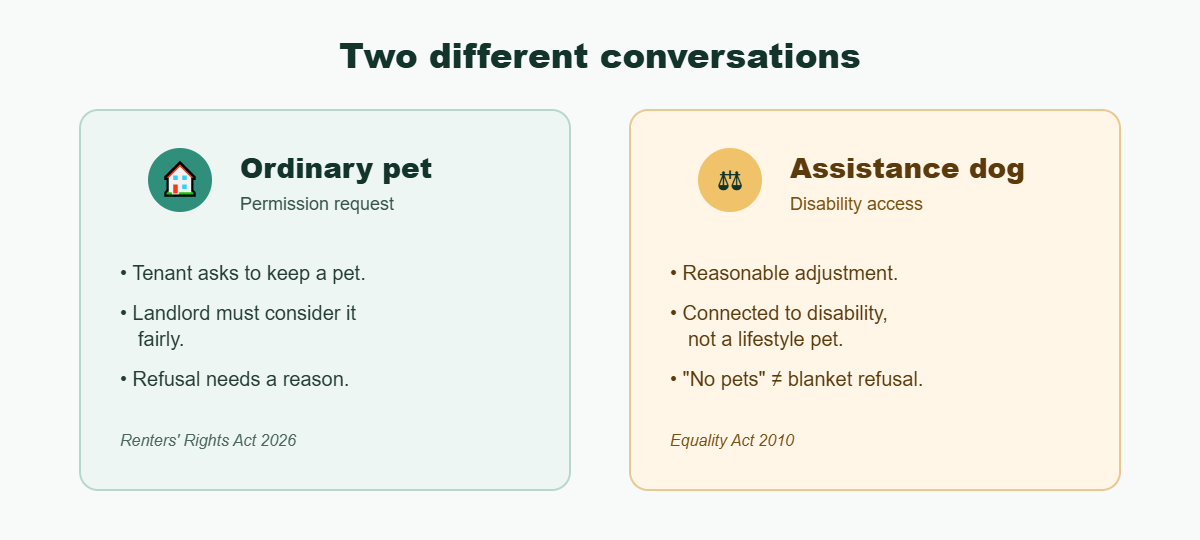
In plain English:
This does not mean every situation is automatic. The exact facts still matter: the property, the dog, the tenant's needs, any genuine health and safety issue, and whether the request is reasonable.
But it does mean a landlord should not simply say:
"The tenancy says no pets, so no."
That answer is too shallow when the dog is an assistance dog.
Ask for a reasonable adjustment in writing.
Keep the message calm, short and factual. You do not need to explain your full medical history. You only need to explain enough for the landlord or letting agent to understand that:
Here is a simple version:
I am requesting a reasonable adjustment under the Equality Act 2010. I am a disabled person and I rely on my assistance dog, [DOG NAME], to support me with disability-related needs. I am asking that any "no pets" clause or pet restriction is adjusted to allow my assistance dog to live with me at the property.
If your dog is registered with Assistance Dog Registry, you can add:
My dog also has a voluntary assistance dog profile and ID record, which I can share by QR link if helpful. I understand registration is not a legal requirement, but it gives clear information about my dog's role and emergency details.
That is the right tone: transparent, practical and legally accurate.
A landlord or agent may not understand assistance dogs. Many still think only guide dogs count, or that every assistance dog must come from a charity. That is not a safe assumption.
Helpful information can include:
You do not need to disclose private medical details beyond what is necessary.
A calm reply:
I understand the property has a no-pets rule. My request is different because this is an assistance dog connected to my disability. I am asking you to consider this as a reasonable adjustment under the Equality Act 2010, rather than as an ordinary pet request.
If they still refuse, ask for the decision in writing:
Please can you confirm the reason for refusal in writing, including whether you have considered the request as a disability-related reasonable adjustment?
This matters because a written refusal gives you something concrete to take to an adviser.
There is no government-run assistance dog register in the UK.
Handlers should be careful with language. Registration is useful but voluntary. It does not create the legal right. The legal right comes from disability law and reasonable adjustments.
A good response is:
There is no official UK government register for assistance dogs. My dog's voluntary registration and ID are provided to make communication easier, not because registration is legally required. The legal issue is that I rely on an assistance dog because of my disability.
This keeps you honest and avoids giving the landlord the wrong impression.
5-page printable pack — the difference, what to include, copy-paste landlord email, and a refusal record sheet.
Download the PDF (free)Your rights do not come from a card.
Real life is not a calm legal seminar. It is emails, viewings, agents, rushed phone calls — and people who do not know the difference between pets and assistance dogs.
That is why many handlers choose the Lifelong Partner package. It gives you:
It does not replace the Equality Act. It supports the conversation around it.
For housing, that can be especially helpful because a landlord or letting agent often wants clear, tidy information they can understand quickly.
Keep everything in writing where possible.
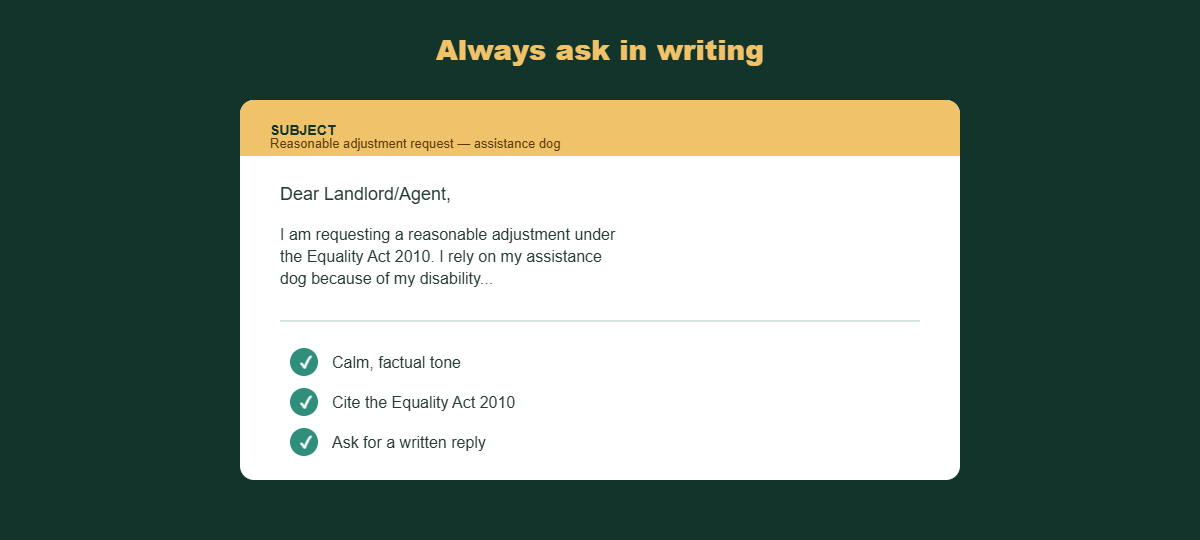
Subject: Reasonable adjustment request — assistance dog
Dear [Landlord/Agent Name],
I am writing to request a reasonable adjustment under the Equality Act 2010.
I am a disabled person and I rely on my assistance dog, [DOG NAME], to support me with disability-related needs. [DOG NAME] is trained/being trained to assist me and is not an ordinary pet.
I understand the property/tenancy includes a "no pets" rule. I am asking you to adjust that rule so that my assistance dog can live with me at the property.
[DOG NAME] is house-trained, kept under control, and I am happy to provide a brief profile with practical information about their role, behaviour and emergency details.
Please confirm in writing that this request has been considered as a disability-related reasonable adjustment.
Kind regards,
[YOUR NAME]
The 2026 renting changes are a step forward for pet-owning tenants in England.
But if you are an assistance dog handler, do not let anyone flatten your situation into a basic "pet permission" question.
Your dog is not just a pet.
Your dog is part of how you access daily life, safety and independence.
A good landlord should understand that. A good letting agent should know how to handle it. And if they do not, clear written information can make the next step easier.
Help another handler avoid a "no pets" headache. One click sends it.
A permanent profile, smart ID cards, dog tags and clear QR-linked information for landlords, agents and public access situations.
See the Lifelong Partner plan →The Assistance Dog Registry UK team has spent years supporting owner-trained and charity-trained handlers across the UK. We only publish materials that are carefully researched against the latest UK statutes (Equality Act 2010, Renters' Rights Act 2026), official guidance from GOV.UK, Shelter and the Equality and Human Rights Commission, and the day-to-day experiences of more than 6,000 UK handlers we have helped.
If you spot anything that needs updating, contact us — we revise our guides as the law and guidance evolve.
Founded by Norbert Szeverenyi · 6,000+ UK handlers supported · Materials reviewed against UK statute and official EHRC, Shelter and GOV.UK guidance.
This article is general information, not legal advice. Every renting situation depends on the specific tenancy, property, dog and handler circumstances. Nothing on this page creates a solicitor-client relationship between you and Assistance Dog Registry UK.
If your housing is at risk, you have been refused a tenancy, or you face discrimination, please seek specialist advice from Citizens Advice, Shelter, the EHRC, a qualified housing adviser, or a solicitor regulated by the SRA.
Got a question or experience to share? Comments are reviewed before they appear — usually within a day.
Loading comments…
More UK assistance dog law guides from the ADR team.
Every refusal matters. Every airline that tells a UK handler their owner-trained dog is not "recognised", every restaurant in Paris or Barcelona that points at the door, every hotel that discovers its pet policy after the guest arrives — these are not one-off stories. They are a pattern.
We are collecting that pattern. If you have been refused access abroad, or at a UK airport or on a UK-departing flight, take three minutes and tell us what happened. Your story becomes evidence, and evidence is what eventually changes the rules.
Assistance Dog Registry maintains the UK's most-read independent register of assistance dog handlers. We do not accredit training. We do not run a charity trainer network. We register handlers and their dogs, provide practical documentation, and increasingly we are the organisation that tells the story of what is actually happening to UK handlers at the border, in the aeroplane cabin, at the restaurant door, and in the complaint system afterwards.
Our 2026 research on 23 overseas destinations mapped the legal position country by country. What it cannot map is the lived experience of UK handlers right now, in real time, on real trips. That is what this form is for.
We will use your story, anonymised if you prefer, in four ways:
The form below asks for the facts. You do not need to be polished or exhaustive. Short and specific is more useful than long and vague.
Form embed placeholder. The live form is built in Forminator and embedded here via shortcode. See the "Share your story" field list below for what is captured.
Your submission goes directly to our private records. Within 48 hours, someone from the ADR team will reply to confirm receipt and, if you have indicated you are happy to be contacted further, to ask any follow-up questions.
Nothing is made public without your explicit approval. If we want to use your story in an article, a press pitch, or a policy submission, we will write the text we plan to publish and send it to you first for approval or changes. No ambushes, no surprises.
If you have indicated you prefer to stay anonymous, we will strip all identifying details before anything reaches a public context. Anonymous submissions still count in the aggregate numbers we report.
This form is for documenting past refusals and incidents. It is not a hotline for live, in-progress problems. If you are currently being refused access abroad and need immediate practical advice, the fastest routes are:
You can still share the story with us afterwards. Often the most useful evidence comes from handlers who document carefully in the moment and send us everything once they are home.
We treat every submission as confidential. We do not sell data. We do not share identifying information with third parties without your permission. We are registered with the Information Commissioner's Office and our handling of your data is governed by UK GDPR.
Our full privacy policy covers the details. The short version: you tell us what you want, we use it only in the ways you have agreed to, and you can ask us to delete your record at any time.
This is the structure of the Forminator form that will be embedded above. It is documented here so handlers can prepare their submission in advance if they prefer.
If you have an upcoming trip, consider logging your travel plans and sending us a short note afterwards on how it went, good or bad. Positive experiences are useful too, because they tell us which airlines, airports, and countries are actually getting this right.
You can also register your assistance dog with ADR, which keeps your documentation consistent and helps us speak with authority about the size and reach of the UK handler community.
Privacy: Submissions are confidential. See our privacy policy. Last updated: April 2026.
Malta is a long-standing UK favourite. Around 600,000 UK visitors arrive each year, drawn to Valletta, Sliema, St Julian's and Gozo, and the historic UK-Malta link means English is an official language. So if you are a UK handler with an owner-trained assistance dog, Malta is a logical candidate for a Mediterranean break.
The catch is that Malta does not have a specific assistance-dog statute. At home, the Equality Act 2010 protects every UK handler, whether the dog was trained by a charity, an independent trainer, or the handler themselves. In Malta, that is not the rule. This guide explains what the Maltese legal picture actually is, what the airlines require, what happens at the door, and how to plan a Malta trip honestly rather than optimistically.
Nothing here is meant to put you off. UK handlers visit Malta successfully every year, and English-speaking hospitality staff make conversations easier than in many other destinations. But the statutory backing you have at home is not waiting for you at Luqa, and that is worth understanding before you book.
Malta has no specific assistance-dog law. The Equal Opportunities (Persons with Disability) Act, Cap. 413 references assistance aids only indirectly and does not set out a concrete public-access right for handlers and their dogs. There is no Maltese guide-dog or assistance-dog training school on the island; all certified dogs in Malta come from foreign schools, and practical recognition depends on that foreign certificate.
Most UK-based airlines flying to Malta, including British Airways, easyJet, Jet2, Ryanair and TUI, restrict in-cabin assistance-dog acceptance to dogs accredited by Assistance Dogs International (ADI) or the International Guide Dog Federation (IGDF). KM Malta Airlines, the successor to Air Malta, accepts assistance dogs via a specific application form and expects ADI or IGDF-type credentials.
The practical consequence is this. A UK owner-trained handler has full legal public-access rights at home under the Equality Act 2010. Those rights do not travel with you to Valletta, and the airline carrying you there may decline your dog in the cabin. Once on the ground, public access depends on a competent-authority-certified harness and, in the public sector, on goodwill. Private-sector compliance is inconsistent.
Malta has no specific assistance-dog statute. There is no dedicated Maltese law that sets out public-access rights for handlers and their dogs in the way the Equality Act 2010 does in the United Kingdom.
What exists is the Equal Opportunities (Persons with Disability) Act (Cap. 413), which provides a general disability-rights framework and references assistance aids only indirectly. Malta is a party to the UN Convention on the Rights of Persons with Disabilities, and the general anti-discrimination framework covers disability. But none of that translates into a specific, enforceable right to bring an assistance dog into any particular venue.
One important practical feature of the Maltese system is that there is no domestic guide-dog or assistance-dog training school. Every certified assistance dog in Malta is trained abroad, typically at an ADI or IGDF school. Recognition therefore depends on the foreign certificate. A handler arriving with a dog wearing a harness issued by a recognised overseas school, particularly one from a competent authority such as the UK or Ireland, is generally admitted to public-sector buildings and major attractions.
Esplora, the national interactive science centre, and other public attractions admit certified guide and service dogs wearing a competent-authority-certified harness. This is the pattern across the public sector. The private sector, however, is not bound by a clear statutory rule and compliance is inconsistent. A UK owner-trained dog without third-party certification falls outside even this harness-based recognition pattern.
Legal theory and daily reality do not always match, and in Malta the gap is usually in the handler's favour in tourist areas and less so in private-sector venues outside them. Most hotels, cafés and restaurants in Valletta, Sliema and St Julian's will admit a well-behaved dog in a professional harness without much fuss, particularly outdoors. English-speaking staff make the conversation easier than in most of the Mediterranean.
The difficulty appears where it usually does, with gatekeepers. Private-sector supermarkets, some chain retailers, smaller inland restaurants, and some transport operators may refuse. Because there is no clear statute, the response to a refusal is not "I have a legal right under Cap. 413". It is a softer conversation, usually focused on the dog's visible training, the harness, and a professional ID.
At home, a refusal can be challenged through the Equality and Human Rights Commission and the county court under the Equality Act 2010. In Malta, you are relying on goodwill, the venue's reputation, and the possibility of complaining to the Office of the Ombudsman (Uffiċċju tal-Ombudsman) or the National Commission for the Rights of Persons with Disability afterwards. Those routes can produce a useful response weeks later but will not resolve the moment itself.
For UK travellers, Malta is effectively a flight-only destination. There is no realistic surface crossing from the UK, which means the airline gate is unavoidable and it is the hardest single barrier in the trip.
The major UK-based airlines flying the route all restrict in-cabin assistance-dog acceptance to dogs accredited by ADI or IGDF. Examples from current published policy:
On the Maltese side, KM Malta Airlines accepts assistance dogs via a specific assistance-dog application form and expects ADI or IGDF-type credentials. Apply well in advance of travel.
The tension is real. The Equality Act 2010 at home does not gate UK handlers by training provider. The airlines carrying UK handlers out of UK airports do. Whether this is fully compatible with UK equality law in every case has not been comprehensively tested in court, but it is increasingly being raised by handlers and handler organisations. For now, a UK owner-trained handler cannot rely on automatic in-cabin carriage with these airlines and should plan with that limit in mind.
Airline policies cover the flight itself. They are separate from the legal status of your dog once you arrive. The airline gate is the hard stop for Malta. If you pass it, you are then into the Maltese ground picture described above.
Separately from the recognition question, your dog has to meet UK pet-export and EU pet-import rules to enter Malta. Since Brexit, this is done through a Great Britain Animal Health Certificate (AHC) rather than the old EU pet passport.
Malta has a specific tapeworm feature worth naming directly. Malta is Echinococcus-free, and it is one of the small group of destinations (alongside Ireland, Finland and Norway) that benefits from protected tapeworm status when dogs arrive from elsewhere. For a UK dog travelling to Malta, the standard EU rules apply and no tapeworm dose is required for Malta entry itself. However, on re-entry to Great Britain, you will need tapeworm treatment if you have routed back through Ireland, Finland, Malta or Norway (which, if you are coming from Malta, you will be). In practice this means you should get the tapeworm dose administered before your return flight.
You will need:
These veterinary requirements apply regardless of training route. An IGDF-certified guide dog and an owner-trained assistance dog face exactly the same paperwork.
Assume you reach Malta. What should you expect day to day?
Hotels. Maltese hotels are generally accommodating to visible, well-behaved assistance dogs, particularly in the Sliema, St Julian's and Valletta tourist triangle. International chain hotels apply their group assistance-dog policies. Book direct rather than through a third-party site so you can confirm the arrangement in writing before you arrive.
Restaurants and cafés. Outdoor seating is almost always fine. Indoor seating in tourist-area restaurants is usually fine. Smaller family-run restaurants in Mdina, Rabat, Gozo and inland villages may be more unsure and may ask for a visible harness or ID.
Shops and supermarkets. Access is inconsistent. Small shops are often fine. Larger supermarket chains may admit or refuse depending on the manager. Pharmacies are generally accessible.
Public transport. Malta Public Transport buses operate a single island-wide network. Drivers have broad discretion. A harnessed assistance dog is usually admitted, but expect to have the conversation. Taxis (including e-cabs) are generally more flexible, but mention the dog when you book.
Museums, major attractions, Esplora. The main public-sector attractions, including Esplora, will admit assistance dogs wearing a competent-authority-certified harness. Heritage Malta sites generally follow the same pattern. Outdoor sites (Mdina, Hagar Qim, Ghar Dalam) are largely accessible.
Beaches. Dog access to Maltese beaches is regulated by the local council and varies. A number of designated dog beaches exist, particularly outside summer peak. Assistance-dog exemptions are not formally codified. Check with the local council before you travel.
Gozo and Comino. The Gozo Channel ferry is the standard route for the short crossing. Assistance dogs are generally welcome on the ferry. Gozo itself is quieter and often easier for handlers than central Malta.
None of the above is a reason not to go. It is a reason to plan carefully. UK owner-trained handlers have three realistic options.
Some airlines will assess owner-trained assistance dogs on a case-by-case basis, particularly on medium-haul routes. This is not guaranteed and the published airline policies are conservative. If you try this route, contact the airline's special assistance team at least 72 hours before travel, and for KM Malta Airlines in particular submit the assistance-dog application form as early as possible. Provide everything you have in writing (training log, letter from your GP or consultant, video evidence of the dog's task work, photos in professional harness, ADR registration documentation) and be prepared for a conservative reply.
If the airline declines in-cabin carriage, your dog can usually still travel as a pet in the hold. Whether that is acceptable for your dog's role and welfare is a decision only you can make. Some handlers will never put an assistance dog in the hold; others may accept it for a three-hour flight. The answer depends on the dog, the disability, and your own risk tolerance.
Malta is an island in the central Mediterranean. There is no realistic direct surface route from the United Kingdom. In theory, a combination of Eurotunnel, a long drive through France and Italy, and an onward ferry from Sicily (Pozzallo or Catania to Malta with Virtu Ferries) is possible, and that final leg is relatively short. The full journey takes several days and most dogs would find it more stressful than a short direct flight.
If the airline gate is impassable for your specific dog, the honest advice is to consider an alternative destination in Europe where surface crossing is short and direct, rather than force a multi-day route into Malta that is likely to be harder on the dog than the original flight would have been. Mainland Mediterranean Europe (Spain via Brittany Ferries, France, or Italy) offers similar weather with a gentler journey.
If this is your first European trip with your owner-trained dog and you want a softer entry point before committing to a flight and a stay abroad, consider an initial trip to the Netherlands. Dutch law is the most welcoming in the EU for owner-trained handlers, effectively rights-based rather than certificate-based. The Harwich to Hook of Holland overnight ferry with Stena Line is a direct, pet-friendly crossing. A successful Dutch trip will give you a realistic measure of how your dog copes with European travel before you commit to Malta.
Be honest about this. An Assistance Dog Registry card has no legal force in Malta. No UK-issued document does, because Malta relies on its own harness-and-foreign-certificate recognition pattern. That is true of every non-Maltese ID, not just ADR.
What an ADR card can do is change the practical conversation. Maltese venue staff are generally English-speaking, professional, and used to visiting handlers. When they ask "is that an assistance dog?" they are looking for a signal that tells them this is not a random pet. A professional card, a QR-linked online profile that verifies in any browser, a clearly visible vest or harness, and a calm, prepared handler produce a very different outcome from an unbranded dog with no documentation.
That is social standing, not legal standing, and the distinction matters. In Malta your card is a practical tool that reduces refusals at the door. It is not a legal right of access. Handlers who understand that tend to travel more successfully, because they neither overclaim nor underuse what the documentation can actually do.
If a Maltese business refuses to admit you and your dog, the practical hierarchy is:
Malta is not impossible, and in many ways it is easier than other Mediterranean islands. English is an official language, the public sector has a workable harness-and-certificate recognition practice, and the major attractions admit assistance dogs. But it is honest to say Malta has no specific assistance-dog statute, the airlines carrying you there operate a strict ADI or IGDF gate, and private-sector compliance is inconsistent. A UK owner-trained handler should plan carefully and expect to depend on visible certification and calm, prepared conversation rather than statute.
The good news is that your UK rights are intact and undiminished. Travel is a temporary journey out of a legal framework that recognises you, and back into it on return. Once you land back in Bristol or Manchester, the Equality Act 2010 is still there. Your dog is still the same trained assistance dog. Nothing about a difficult moment in Sliema changes that.
Malta is also, because of the English language and the UK-Malta history, one of the easier Mediterranean destinations in which to have the refusal conversation well. If you travel, document what happens, treat venues fairly, and share your experience back with ADR and with the Office of the Ombudsman. Handler evidence matters, and Malta's current silence on this question in statute is exactly the kind of silence that gets filled by documented cases.
Assistance Dog Registry is an independent UK registry for owner-trained and charity-trained assistance dogs. Our cards, QR-linked profiles and handler documentation give you something professional to show when you need to have a conversation at a hotel, a restaurant, or a departure gate.
Over 6,000 UK handlers have already registered.
No. Malta has no specific assistance-dog statute. The Equal Opportunities (Persons with Disability) Act, Cap. 413, references assistance aids only indirectly. Public-sector venues generally admit dogs wearing a competent-authority-certified harness. Private-sector compliance is inconsistent.
Under published policy, no. Both require the dog to be accredited by an ADI or IGDF member organisation. Some airlines will consider owner-trained dogs case-by-case with significant documentation, but this is not guaranteed.
KM Malta Airlines (the successor to Air Malta) accepts assistance dogs via a specific assistance-dog application form and expects ADI or IGDF-type credentials. Apply well in advance of travel.
No, not to enter Malta. Malta is Echinococcus-free. However, because Malta is a protected tapeworm-status destination, your dog will need tapeworm treatment administered 24 to 120 hours before your return arrival at a GB entry point. Arrange this with a Maltese vet before your return flight.
No. No UK-issued document has legal force in Malta. However, a professional ID card, QR-linked profile and visible harness can meaningfully reduce refusals at the door, particularly in the English-speaking tourist hospitality sector.
A microchip, a valid rabies vaccination (minimum 21 days before travel), and a Great Britain Animal Health Certificate issued within 10 days of entry to the EU. These are veterinary rules, separate from the assistance-dog recognition question.
Stay calm, ask for the manager, show your documentation, and if you are still refused, record the incident and report it to the Office of the Ombudsman or the National Commission for the Rights of Persons with Disability. Share it with ADR to contribute to the wider evidence record.
This guide is part of a growing series covering the legal position for UK owner-trained assistance dog handlers in every major European destination.
Each country guide covers the same things: what the law actually says, what the airlines actually require, what happens at the door, how to plan the trip, and how to respond to problems.
About the author: This guide was prepared by the team at Assistance Dog Registry, the UK's most-read independent voluntary registry for assistance dog handlers. Our guides cover owner-trained and charity-trained dogs alike, with a focus on practical, plain-English information UK handlers can actually use.
Disclaimer: This article is provided as general guidance only and does not constitute legal advice. Maltese law and airline policy change; verify current rules with the airline and the Office of the Ombudsman or the National Commission for the Rights of Persons with Disability before you travel. For legal advice on a particular situation, consult a qualified advocate in Malta.
Last updated: April 2026. This page is reviewed annually.
Cyprus is a long-established favourite for UK holidaymakers. Around 1.3 million UK visitors arrive each year, drawn to Paphos, Ayia Napa, Limassol and Larnaca, and the historic UK-Cyprus link means English is widely spoken. So if you are a UK handler with an owner-trained assistance dog, Cyprus is a logical destination to consider.
The catch is that Cyprus does not have a comprehensive assistance-dog law. At home, the Equality Act 2010 protects every UK handler, whether the dog was trained by a charity, an independent trainer, or the handler themselves. In Cyprus, there is no statutory equivalent and no clear public-access right. This guide explains what the legal picture actually is, what the airlines require, what tends to happen at the door, and how to plan a Cyprus trip honestly rather than optimistically.
Nothing here is meant to discourage travel. UK handlers visit Cyprus successfully every year. But the legal backing you have at home is not waiting for you at passport control in Larnaca, and that is worth understanding before you book.
Cyprus does not have a comprehensive assistance-dog statute. By existing administrative practice, assistance dogs including guide dogs are allowed in government departments, but access to private venues such as restaurants, shops and buses is not legally guaranteed. A bill extending access rights to support dogs in public buildings and transport was before the House of Representatives plenum in February 2026, but at the time of writing its passage and final form are uncertain.
Most UK-based airlines flying to Cyprus, including British Airways, easyJet, Jet2, Ryanair and TUI, restrict in-cabin assistance-dog acceptance to dogs accredited by Assistance Dogs International (ADI) or the International Guide Dog Federation (IGDF). Cyprus Airways and TUS Airways apply broadly equivalent standards.
The practical consequence is this. A UK owner-trained handler has full legal public-access rights at home under the Equality Act 2010. Those rights do not travel with you to Paphos or Larnaca, and the airline carrying you there may decline your dog in the cabin. Once on the ground, public access depends almost entirely on goodwill, because the statutory framework Cypriot businesses can rely on is thin and patchy.
Cyprus has no comprehensive assistance-dog law. There is no single statute that sets out public-access rights for handlers and their dogs in the way the Equality Act 2010 does in the United Kingdom or the Americans with Disabilities Act does in the United States.
What exists is a combination of administrative practice, sectoral rules, and the general disability-rights framework. By existing practice, guide dogs and assistance dogs are admitted to government departments and to certain public buildings. Cyprus is a party to the UN Convention on the Rights of Persons with Disabilities, and the country has general anti-discrimination legislation that covers disability. But none of that translates into a concrete right to bring an assistance dog into a restaurant, a supermarket, a taxi, or a public bus. Private venues can and often do refuse access.
In October 2025, Cyprus Mail reported that service dogs need to be formally covered by law, and campaigners have been pushing for a statutory framework. In February 2026 a bill extending access rights to support dogs in public buildings and on public transport was before the House of Representatives plenum. At the time of writing in April 2026, the outcome is not public. Handlers planning a trip should not rely on any statutory backing that does not yet exist.
Certification sits in a grey area. Where assistance dogs are admitted by practice, the assumption is that the dog is trained by a recognised school, typically abroad, because Cyprus does not have its own extensive assistance-dog training infrastructure. ADI and IGDF credentials are the most widely understood signals. A UK owner-trained dog without third-party certification has no formal recognition and falls outside both the (limited) administrative practice and the (possibly emerging) statutory regime.
Legal theory and daily reality do not always line up, and in Cyprus the gap is wider than in countries with clearer laws. Most tourist-area restaurants, cafés and hotels in Paphos, Limassol and Larnaca will admit a well-behaved dog in a professional harness without asking for paperwork, particularly outdoors. Many UK handlers have perfectly smooth holidays and never have a single difficult conversation.
The friction shows up where it usually does, with gatekeepers. Supermarkets, air-conditioned indoor restaurants, larger hotel chains, museums and some public transport staff are more likely to refuse. Because there is no statute behind you, the response to a refusal is not "I have a legal right, please reconsider". It is a softer, practical conversation, and sometimes it will not succeed.
At home, a refusal can be challenged through the Equality and Human Rights Commission and the county court under the Equality Act 2010. In Cyprus, you are relying on goodwill, the hotel's reputation-management instincts, and the possibility of complaining to the Commissioner for Administration and Protection of Human Rights (Epitropos Dioikiseos kai Prostasias Anthropinon Dikaiomaton) afterwards. That complaint may produce a useful letter weeks later, but it will not resolve the moment you are standing outside a restaurant on holiday.
For UK travellers, Cyprus is effectively a flight-only destination. There is no realistic surface crossing from the UK, which means the airline gate is unavoidable, and it is the hardest single barrier in the whole trip.
The major UK-based airlines flying the route all restrict in-cabin assistance-dog acceptance to dogs accredited by ADI or IGDF. Examples from current published policy:
On the Cypriot side, the revived Cyprus Airways and TUS Airways apply broadly equivalent ADI or IGDF-type standards for in-cabin carriage.
The tension is real. The Equality Act 2010 at home does not gate UK handlers by training provider. The airlines carrying UK handlers out of UK airports do. Whether this is fully compatible with UK equality law in every case has not been comprehensively tested in court, but it is increasingly being raised by handlers and handler organisations. For now, a UK owner-trained handler cannot rely on automatic in-cabin carriage with these airlines and should plan with that limit in mind.
Airline policies cover the flight. They are separate from the legal status of your dog once you arrive. The airline gate is the hard stop for Cyprus. If you pass it, you are then into the patchy, goodwill-dependent Cypriot ground picture.
Separately from the recognition question, your dog has to meet UK pet-export and EU pet-import rules to enter Cyprus at all. Since Brexit, this is done through a Great Britain Animal Health Certificate (AHC) rather than the old EU pet passport.
You will need:
These veterinary requirements apply regardless of training route. An IGDF-certified guide dog and an owner-trained assistance dog face exactly the same paperwork. This is the straightforward part of Cyprus planning.
Assume you reach Cyprus. What should you expect day to day?
Hotels. Many Cypriot hotels will accept a well-behaved assistance dog, particularly if you book in advance and ask in writing. International chain hotels (Hilton, Marriott, Radisson) tend to apply their group assistance-dog policies even where national law is silent, which can work in your favour. Small independent hotels vary widely. Always confirm by email before you arrive.
Restaurants and tavernas. Outdoor terrace seating is almost always fine, and much of Cypriot dining happens outside anyway. Indoor air-conditioned seating is less predictable. Tourist-area restaurants in Paphos, Limassol and the main Ayia Napa strip tend to be accommodating. Smaller inland tavernas may be less sure.
Shops and supermarkets. Access is inconsistent. Small shops are often fine. Larger supermarket chains (Alphamega, Lidl Cyprus, Metro) sometimes admit and sometimes refuse, depending on the manager. Pharmacies are usually accessible.
Public transport. Cyprus buses are operated by several regional companies. Drivers have discretion. Some will admit a harnessed assistance dog, others will not. Taxis are generally more flexible, but phone ahead when possible. There are no passenger trains in Cyprus.
Museums, archaeological sites, major attractions. The main state-run sites (Paphos Archaeological Park, Kourion, Tombs of the Kings) usually admit assistance dogs. Expect outdoor site conditions (heat, uneven ground, stone surfaces) that can be hard on paws in summer.
Beaches. Dog access to Cypriot beaches is regulated separately and varies by municipality. Many popular beaches are pet-free during the summer. A small number of designated dog-friendly beaches exist. Assistance-dog exemptions are not standardised. Check with the local municipality before you travel.
None of the above is a reason not to go. It is a reason to plan carefully. UK owner-trained handlers have three realistic options.
Some airlines will assess owner-trained assistance dogs on a case-by-case basis, particularly on medium-haul routes. This is not guaranteed and the published airline policies are conservative. If you try this route, contact the airline's special assistance team at least 72 hours before travel, provide everything you have in writing (training log, letter from your GP or consultant, video evidence of the dog's task work, photos in professional harness, ADR registration documentation) and be prepared for a conservative reply.
If the airline declines in-cabin carriage, your dog can usually still travel as a pet in the hold. Whether that is acceptable for your dog's role and welfare is a decision only you can make. Some handlers will never put an assistance dog in the hold; others may accept it for a four to five hour flight. The answer depends on the dog, the disability, and your own risk tolerance.
Cyprus is an island in the eastern Mediterranean. There is no realistic surface route from the United Kingdom. In theory, a combination of Eurotunnel, long European drives and an onward ferry from Greece or Italy is possible, but the journey takes days, costs substantially more than a return flight, and the ferry legs themselves carry dogs in kennels or vehicles rather than with handlers. For almost every UK handler this is not a practical option.
If the airline gate is impassable for your specific dog, the honest advice is to consider an alternative destination in Europe where surface crossing is feasible, rather than force a route into Cyprus that is likely to be stressful for the dog. Greece, Italy, Spain and Portugal all offer a similar Mediterranean holiday and can be reached by a combination of Eurotunnel plus drive plus ferry without asking the dog to endure a very long journey.
If this is your first European trip with your owner-trained dog and you want a softer entry point before committing to a longer flight, consider an initial trip to the Netherlands. Dutch law is the most welcoming in the EU for owner-trained handlers, effectively rights-based rather than certificate-based. The Harwich to Hook of Holland overnight ferry with Stena Line is a direct, pet-friendly crossing. A successful Dutch trip will give you a realistic measure of how your dog copes with European travel before you commit to Cyprus.
Be honest about this. An Assistance Dog Registry card has no legal force in Cyprus. No UK-issued document does, because Cyprus operates its own (limited) recognition practice. That is true of every non-Cypriot ID, not just ADR.
What an ADR card can do is change the practical conversation. Cypriot venue staff are not lawyers and usually not familiar with the detail of any ID scheme. When they ask "is that an assistance dog?" they are looking for a signal that tells them this is not a random pet. A professional card, a QR-linked online profile that verifies in English and in any browser, a vest or harness on the dog, and a calm, prepared handler produce a very different outcome from an unbranded dog with no documentation.
That is social standing, not legal standing, and the distinction matters. In Cyprus your card is a practical tool that reduces refusals at the door. It is not a legal right of access. Handlers who understand that tend to travel more successfully, because they neither overclaim nor underuse what the documentation can actually do.
If a Cypriot business refuses to admit you and your dog, the practical hierarchy is:
Cyprus is not impossible, but it is the hardest major UK-favourite destination in terms of statutory backing. The country has no comprehensive assistance-dog law, the bill currently before parliament may or may not pass in a useful form, the airline gate is the only realistic way in, and once on the ground you are depending on goodwill rather than a clear legal framework. A UK owner-trained handler should be realistic that Cyprus today is a destination that works for some dog-handler teams and not for others.
The good news is that your UK rights are intact and undiminished. Travel is a temporary journey out of a legal framework that recognises you, and back into it on return. Once you land back in Bristol or Manchester, the Equality Act 2010 is still there. Your dog is still the same trained assistance dog. Nothing about a difficult moment in Paphos changes that.
Cyprus is also one of the places where handler advocacy is most visible and most likely to produce change. If you travel, document what happens, treat venues fairly, and share your experience back with ADR and with the Commissioner. The country is in the middle of a legislative conversation, and handler evidence matters.
Assistance Dog Registry is an independent UK registry for owner-trained and charity-trained assistance dogs. Our cards, QR-linked profiles and handler documentation give you something professional to show when you need to have a conversation at a hotel, a restaurant, or a departure gate.
Over 6,000 UK handlers have already registered.
No. Cyprus does not have a comprehensive assistance-dog law. Administrative practice admits guide and assistance dogs to government departments, but access to private venues is not legally guaranteed. A bill extending access rights was before parliament in February 2026, but its status is uncertain at the time of writing.
Under published policy, no. Both require the dog to be accredited by an ADI or IGDF member organisation. Some airlines will consider owner-trained dogs case-by-case with significant documentation, but this is not guaranteed.
Both apply broadly equivalent ADI or IGDF-type standards for in-cabin assistance-dog acceptance. Contact their special-assistance teams well in advance if you want a case-by-case review.
Not realistically. Cyprus is an island in the eastern Mediterranean with no direct UK surface connection. A combined ferry-and-drive route through Greece or Italy is theoretically possible but takes days and is not suitable for most dogs. If the airline gate is impassable for your dog, consider a different Mediterranean destination that can be reached by Eurotunnel plus surface travel.
No. No UK-issued document has legal force in Cyprus. However, a professional ID card, QR-linked profile and vest can meaningfully reduce refusals at the door because Cypriot venue staff are looking for a practical signal, not a legal instrument.
A microchip, a valid rabies vaccination (minimum 21 days before travel), and a Great Britain Animal Health Certificate issued within 10 days of entry to the EU. These are veterinary rules, separate from the assistance-dog recognition question.
Stay calm, ask for the manager, show your documentation, and if you are still refused, record the incident and report it to the Commissioner for Administration and Protection of Human Rights. Share it with ADR to contribute to the wider evidence record that supports the ongoing legislative push.
This guide is part of a growing series covering the legal position for UK owner-trained assistance dog handlers in every major European destination.
Each country guide covers the same things: what the law actually says, what the airlines actually require, what happens at the door, how to plan the trip, and how to respond to problems.
About the author: This guide was prepared by the team at Assistance Dog Registry, the UK's most-read independent voluntary registry for assistance dog handlers. Our guides cover owner-trained and charity-trained dogs alike, with a focus on practical, plain-English information UK handlers can actually use.
Disclaimer: This article is provided as general guidance only and does not constitute legal advice. Cypriot law and airline policy change; in particular, the support-dog access bill before the House of Representatives in February 2026 may alter the legal picture. Verify current rules with the airline and the Commissioner for Administration before you travel. For legal advice on a particular situation, consult a qualified solicitor in the relevant jurisdiction.
Last updated: April 2026. This page is reviewed annually.
Switzerland is a long-standing UK favourite for city breaks, Alpine skiing and summer hiking. UK residents made roughly half a million visits to Switzerland in 2024, split between Zurich, Geneva, Basel, Bern, and the ski regions of Valais, Graubünden and the Bernese Oberland. If you are a UK handler with an owner-trained assistance dog, Switzerland is a more nuanced destination than it first appears.
The short version is that Switzerland recognises assistance dogs at federal level, but the recognition route is narrow and built around accredited Swiss training schools. A UK-based owner-trained handler sits at the edge of that framework, not inside it. This guide explains what the law actually says, what the airlines require, what happens at the door in practice, and how to plan a Swiss trip that works.
Nothing in this article is intended to discourage travel. Switzerland is welcoming, efficient and well organised, and many UK handlers visit without incident. But the legal picture is different from the one at home, and the difference is worth understanding before you book.
Switzerland is an EFTA member, not an EU member, but it applies EU-equivalent pet-import rules to UK travellers. Assistance dogs ("Assistenzhund" in German, "chien d'assistance" in French, "cane d'assistenza" in Italian) are recognised at federal level for access purposes under the Federal Disability Discrimination Act (Behindertengleichstellungsgesetz, BehiG). In practice, recognised dogs come from accredited Swiss training schools or are funded through Swiss disability insurance (Invalidenversicherung, IV).
There is a theoretical route for owner-trained dogs to be recognised through an accredited evaluation, but it is a narrow one designed for Swiss residents, not UK tourists. Major UK-based airlines flying to Zurich, Geneva and Basel restrict in-cabin assistance-dog acceptance to dogs accredited by Assistance Dogs International (ADI) or the International Guide Dog Federation (IGDF). SWISS applies a similar accreditation-based standard.
The practical consequence is that a UK owner-trained handler enjoys full public-access rights at home under the Equality Act 2010, but those rights do not travel to Zurich. The quality of your training is not at issue; it is a difference in legal frameworks.
Switzerland is a federal republic of 26 cantons. Access rights for assistance-dog handlers sit at federal level, primarily through the Federal Act on the Elimination of Discrimination against People with Disabilities (BehiG), in force since 2004. BehiG protects disabled people against discriminatory treatment by public authorities and businesses offering services to the general public, and has been interpreted to cover assistance-dog handlers in hotels, restaurants, shops and public transport.
Alongside BehiG, Swiss disability insurance (IV) funds and regulates accredited assistance-dog provision for Swiss residents. The dominant training centre is the Swiss Foundation for Guide Dogs for the Blind (Stiftung Schweizerische Schule für Blindenführhunde), based in Allschwil near Basel. Other accredited schools train mobility, hearing and other assistance dogs. Recognition is tied to these schools or to a formal evaluation that meets their standards.
Owner-trained dogs are not categorically excluded. There is a route by which an owner-trained dog can, in theory, pass an accredited evaluation and be recognised. In practice this is a narrow route designed for Swiss residents undergoing Swiss evaluation, and it is not a process a UK tourist would ordinarily complete. A UK handler whose dog was trained by themselves, without a Swiss or internationally recognised certificate, generally falls outside the framework as a matter of practical recognition.
Complaints about discrimination are handled by the Federal Office for the Equality of People with Disabilities (EBGB/BFEH), which provides information and can support legal proceedings. Switzerland does not have a single national ombudsman in the UK sense, but EBGB is the correct first point of contact for access refusals.
Swiss daily reality tends to be calmer than the legal map suggests. Switzerland is highly organised, staff training in the hospitality sector is usually good, and disability etiquette is well-established in the major cities. A well-behaved dog in a professional-looking harness, with a calm, prepared handler, is usually admitted without debate in Zurich, Geneva, Basel, Bern and the main ski resorts.
Difficulty, when it appears, appears with gatekeepers. Higher-end restaurants, supermarket chains with strict no-animals policies, and some rural hoteliers will ask for paperwork. At that point the handler's position in Switzerland is weaker than at home, because the Swiss framework presumes accredited certification that a UK owner-trained dog does not have.
That said, Swiss staff are less likely to escalate a dispute than to quietly decline. If a venue does not want to admit you, expect a polite refusal rather than an argument. This makes the door conversation important: your presentation, documentation and calm competence set the tone. A professional card, a QR-linked profile and a task-capable dog produce very different outcomes from an unbranded pet and a flustered conversation.
For most UK travellers, Switzerland means a flight to Zurich, Geneva or Basel-Mulhouse. That is where the biggest practical barrier sits.
The major UK-based and Swiss carriers flying the route restrict in-cabin assistance-dog acceptance to dogs accredited by ADI or IGDF. Examples from current published policy:
This is the same tension UK owner-trained handlers see across European travel. The Equality Act 2010 protects you regardless of training provider, but the airlines carrying you out of UK airports use a narrower industry-defined standard. Whether that narrower standard is fully compatible with UK equality law in every case is a question handler organisations are raising, but it has not been tested comprehensively in the courts. The working reality is that you cannot rely on an automatic right to bring your dog in the cabin on these carriers to Switzerland.
Airline policies apply to the flight itself. They are a separate question from your dog's legal status once you are in Switzerland. The airline gate is the hard stop. If you get past it, the situation on the ground is the BehiG picture described above.
Switzerland is not in the EU, but it applies EU-equivalent rules to UK pets through its agreements with the EU. Since Brexit, UK handlers travel on a Great Britain Animal Health Certificate (AHC).
You will need:
These requirements apply regardless of training route. The veterinary paperwork is identical for charity-trained and owner-trained dogs. This is the straightforward part of Swiss trip planning.
Assume you arrive in Switzerland. What should you expect day to day?
Hotels. Most Swiss hotels will accept a well-behaved assistance dog, and many accept pet dogs anyway, often for a small nightly fee. Chain hotels (Hilton, Marriott, Mövenpick, Accor) tend to be consistent. Mountain resorts and traditional guest houses in Valais, Graubünden and the Bernese Oberland are usually dog-tolerant. Book direct and confirm in writing before you arrive.
Restaurants and cafés. Outdoor seating is almost always fine. Indoor seating varies by canton and venue. Zurich, Geneva and Basel are accommodating. Rural and mountain establishments often welcome dogs at the table without question. Higher-end restaurants are where you are most likely to be asked.
Shops and supermarkets. Coop and Migros, the two dominant Swiss chains, generally do not admit pet dogs, but assistance dogs are recognised where the handler can show accreditation. Owner-trained handlers should expect some inconsistency. Small independent shops are usually fine.
Public transport. Swiss public transport (SBB trains, trams, buses, postbuses, cable cars) is excellent and treats recognised assistance dogs as free travellers. Pet dogs normally require a ticket. Your presentation and documentation matter here: a professional harness, a card and a QR-linked profile help the conductor reach the right conclusion quickly.
Museums, galleries, major attractions. Usually accessible. The Kunsthaus Zürich, Fondation Beyeler, Jet d'Eau and most major Swiss attractions have clear disability access policies that include assistance dogs.
Ski resorts and mountain railways. Assistance dogs are generally welcome on mountain railways, cable cars and in resort villages. Check with the specific operator for piste access rules and for any restrictions during avalanche-risk periods.
None of the above is a reason not to go. It is a reason to plan differently. Three practical options for a UK owner-trained handler.
Some airlines will assess owner-trained assistance dogs on a case-by-case basis. This is not guaranteed and the wording in published airline policies is conservative. If you try this route, contact the airline's special assistance team at least 72 hours before travel, provide everything you have in writing (training log, letter from your GP or consultant, video evidence of the dog's task work, photos in professional harness, ADR registration documentation), and be prepared for a conservative response.
If the airline declines in-cabin carriage, your dog can usually still travel as a pet in the hold. Whether that is acceptable for your dog's role and welfare is a decision only you can make.
Surface crossings to Switzerland are genuinely attractive and do not apply ADI/IGDF gatekeeping. They treat your dog as a pet for boarding purposes and rely on the standard veterinary paperwork described in Section 5.
The fastest route is Eurostar from London St Pancras to Paris Gare du Nord (recognised assistance dogs only in the Eurostar cabin; pet dogs not accepted on Eurostar trains). For pet-trained or owner-trained dogs not on Eurostar's list, take Eurotunnel LeShuttle from Folkestone to Calais, then drive or take TGV Lyria onward to Geneva, Lausanne, Basel or Zurich. TGV Lyria accepts dogs with a muzzle and ticket, which is a practical way to reach Switzerland without boarding a plane.
This is the route experienced owner-trained handlers tend to recommend for Switzerland. It is slower but it avoids the airline gate entirely, and once in Switzerland your experience is the same whether you arrived by train or by plane.
If this is your first European trip with your owner-trained dog and you want a softer entry point before tackling Switzerland, consider routing through the Netherlands or Germany. Both are more welcoming to owner-trained handlers in practice, and both connect to Switzerland by high-speed rail. The Harwich to Hook of Holland overnight ferry with Stena Line is a direct, pet-friendly crossing.
It is worth being honest about this. An Assistance Dog Registry card has no legal force in Switzerland. No UK-issued document does, because Switzerland runs its own federal recognition regime tied to accredited Swiss training schools.
What an ADR card can do is change the practical conversation. Swiss venue staff are not lawyers. When they ask "is the dog an assistance dog?" they are looking for a signal that tells them this is not a random pet. A professional card, a QR-linked online profile that verifies in any language, a vest or harness on the dog, and a calm, prepared handler produce a very different outcome from an unbranded dog and no documentation at all.
That is social standing, not legal standing, and the distinction matters. In Switzerland your card is a practical tool that reduces refusals at the door. It is not a legal right of access. Handlers who understand the difference tend to travel more successfully, because they are not relying on documents to do something they cannot do, and they are not underestimating the practical value of the documents they have.
If a Swiss business refuses to admit you and your dog, the practical hierarchy is:
Switzerland is not a difficult destination. It is organised, welcoming, and quietly tolerant of well-behaved dogs in general. But it is honest to say Switzerland is harder for a UK owner-trained handler than it is for a UK handler with an ADI or IGDF certificate, because the Swiss federal framework is built around accredited schools and the airlines carrying you there reflect that model.
Your UK rights remain intact and undiminished. Travel is a temporary journey out of a legal framework that recognises you, and back into it on return. Once you land back in Manchester or Heathrow, the Equality Act 2010 is still there. Your dog is still the same trained assistance dog. Nothing about a careful Swiss trip changes any of that.
The next time you travel, Switzerland will be a little easier. Every refused handler, every documented case, every honest article like this one adds pressure to a system that is slowly being asked to update itself. In the meantime, plan carefully, document thoroughly, and travel with your eyes open.
Assistance Dog Registry is an independent UK registry for owner-trained and charity-trained assistance dogs. Our cards, QR-linked profiles and handler documentation give you something professional to show when you need to have a conversation at a hotel, a restaurant, or a departure gate.
Over 6,000 UK handlers have already registered.
Not automatically. Swiss access rights flow from the federal Disability Discrimination Act (BehiG), and recognition in practice is tied to accredited Swiss training schools or a Swiss evaluation. A UK owner-trained dog generally falls outside this framework as a matter of practical recognition.
Under published policy, no. All three require the dog to be accredited by an ADI or IGDF member organisation. Some airlines will consider owner-trained dogs case-by-case with significant documentation, but this is not guaranteed.
Switzerland is not an EU member, but it applies EU-equivalent pet-import rules to UK travellers through its bilateral agreements with the EU. The AHC and rabies requirements are the same.
Yes. Eurostar followed by TGV Lyria is a practical pet-friendly route, and surface travel does not apply ADI/IGDF gatekeeping. Your dog travels under standard EU pet-travel rules (microchip, rabies, AHC).
No. No UK-issued document has legal force in Switzerland. However, a professional ID card, QR-linked profile and vest can meaningfully reduce refusals at the door because Swiss venue staff are looking for a practical signal, not a legal instrument.
A microchip, a valid rabies vaccination (minimum 21 days before travel), and a Great Britain Animal Health Certificate issued within 10 days of entry. These are veterinary rules, separate from the assistance-dog legal framework.
Stay calm, ask for the manager, show your documentation, and if you are still refused, record the incident and report it to the Federal Office for the Equality of People with Disabilities (EBGB/BFEH). Share it with ADR to contribute to the wider evidence record.
This guide is part of a growing series covering the legal position for UK owner-trained assistance dog handlers in every major European destination.
Each country guide covers the same things: what the law actually says, what the airlines actually require, what happens at the door, how to plan the trip, and how to respond to problems.
About the author: This guide was prepared by the team at Assistance Dog Registry, the UK's most-read independent voluntary registry for assistance dog handlers. Our guides cover owner-trained and charity-trained dogs alike, with a focus on practical, plain-English information UK handlers can actually use.
Disclaimer: This article is provided as general guidance only and does not constitute legal advice. Swiss federal and cantonal rules, and airline policy, change; verify current rules with the airline and, where relevant, the Federal Office for the Equality of People with Disabilities (EBGB/BFEH) before you travel. For legal advice on a particular situation, consult a qualified lawyer in the relevant jurisdiction.
Last updated: April 2026. This page is reviewed annually.
Norway pulls around 300,000 UK visits a year, according to ONS Travel Trends, with the fjords, Oslo, Bergen and winter aurora trips as the main draws. If you are a UK handler with an owner-trained assistance dog planning a Norway trip, two things are worth understanding up front: Norway is not an EU member (it is in the European Economic Area and Schengen), and Norway has a mandatory tapeworm treatment rule for dogs on entry that does not apply to EU destinations.
At home, the Equality Act 2010 protects every handler regardless of training route. Norway's framework is different. The Equality and Anti-Discrimination Act 2017 (Likestillings- og diskrimineringsloven) is the access-rights backbone, but guide and service dogs are funded and certified through the Norwegian Labour and Welfare Administration (NAV) and approved training schools. There is no published owner-training recognition pathway. This guide explains what that means at the gate, at the hotel door, and during a fjord cruise.
Nothing here is meant to discourage travel. UK handlers visit Norway successfully every year. But the picture is different from the one most travel blogs paint, and the difference matters before you book.
Norway's access rights for assistance-dog handlers flow from the Equality and Anti-Discrimination Act 2017. Guide dogs (forerhunder) and service dogs (servicehunder) are funded and certified by NAV through approved training schools such as Norges Blindeforbunds Forerhundskole. Certified Norwegian guide and service dogs have wide access rights, including a specific statutory exemption from leash-law restrictions during the general leash season (1 April to 20 August).
There is no published owner-training recognition pathway in Norway. Dogs outside the NAV-approved route, or without Assistance Dogs International (ADI) or International Guide Dog Federation (IGDF) accreditation in practice, sit outside the recognised framework.
On the airline side, Norwegian (the airline) accepts service dogs free in the cabin on selected flights. SAS and Norse Atlantic apply ADI or IGDF equivalent. BA and Ryanair apply the same standard. Crucially, Norway requires dogs entering the country to be treated for Echinococcus multilocularis between 24 hours and 5 days before arrival, a rule set by Mattilsynet (the Norwegian Food Safety Authority). This tapeworm rule does not apply to EU destinations and is an extra planning step for Norway trips.
The Equality and Anti-Discrimination Act 2017 is the legal backbone. Section 2 prohibits discrimination on grounds of disability in the provision of goods and services, employment, education and public authority activities. Likestillings- og diskrimineringsombudet (LDO), the Equality and Anti-Discrimination Ombud, enforces the act.
What pulls the recognition system tight is the NAV route. Guide and service dogs are a welfare-state funded benefit. NAV pays for training through approved schools such as Norges Blindeforbunds Forerhundskole and similar service-dog programmes. Graduates carry recognised status and wide access rights. The Norwegian framework does not publish a path for foreign owner-trained dogs to be recognised as equivalent during a short visit.
One specific statutory point is worth noting: certified service dogs are exempt from Norway's leash law (bandtvang), which otherwise requires dogs to be on a lead from 1 April to 20 August each year. That is a practical protection for working Norwegian service dogs. A UK owner-trained dog visiting Norway does not hold that statutory exemption and should be leashed during the leash season.
For a UK handler, there is no tourist equivalence scheme and no published cross-border registration route.
Legal framework and daily reality are not the same. Norway is a calm, orderly, rule-respecting country, and Norwegian venue staff tend to be polite and low-drama about assistance dogs. Most Oslo, Bergen and Tromso restaurants, cafes and hotels do not ask for paperwork. A well-behaved dog in a professional harness, with a prepared handler, is usually admitted without fuss. UK handlers routinely report smooth trips, especially in the cities.
The friction appears where it always does. Chain hotels, museums, large supermarkets and some transport staff are more likely to ask questions. In those moments, the UK owner-trained handler's position in Norway is weaker than at home, because Norwegian recognition runs through the NAV-approved route. At home, an Equality Act 2010 refusal can be pursued through the Equality and Human Rights Commission. In Norway, the channel is LDO (Likestillings- og diskrimineringsombudet). LDO does take complaints from non-residents, but the process is slow and unlikely to resolve a short holiday in real time.
Fjord tourism adds a specific set of environments. Hurtigruten and Havila coastal ships, fjord cruises, cable cars at Loen and Flam, and train routes like Bergen to Oslo and Flam have their own pet policies. Most are practical about assistance dogs, but worth confirming before booking.
For most UK travellers, Norway means a flight into Oslo Gardermoen, Bergen, Stavanger or, for winter aurora trips, Tromso.
The airlines flying the UK to Norway route all restrict in-cabin assistance-dog carriage to dogs accredited by ADI or IGDF members, or equivalent. Examples from current published policy:
This is the tension worth understanding. The Equality Act 2010 protects UK handlers regardless of training route. The airlines carrying UK handlers out of UK airports do not mirror that framework, and instead apply a narrower industry-defined standard. Whether that is always compatible with UK equality law has not been comprehensively tested. For now, the working reality is that a UK owner-trained handler cannot rely on an automatic right to bring their dog in the cabin on these carriers, and should plan accordingly.
These airline policies apply to the flight itself. They are separate from the legal status of your dog once you are in Norway, and separate from the mandatory tapeworm treatment rule in Section 5.
Norway's entry requirements are the strictest in this Scandinavian batch. Your dog must meet UK pet-export rules and Norwegian pet-import rules. Both matter.
You will need:
These requirements apply regardless of training route. A charity-trained guide dog and an owner-trained assistance dog face the same veterinary paperwork. The tapeworm-on-entry rule is the single most important practical point: plan the vet visit into your travel timeline.
Assume you arrive in Norway. What should you expect day to day?
Hotels. Most Norwegian hotels accept assistance dogs at no extra charge, particularly if you book in advance. Oslo chain hotels (Scandic, Thon, Clarion, Radisson) tend to be consistent. Fjord-side lodges and mountain hotels vary: confirm in writing.
Restaurants and cafes. Outdoor seating is almost always fine. Indoor seating varies by venue. Urban cafes in Oslo, Bergen and Tromso tend to be dog-friendly and accommodating. Tourist-area restaurants are generally flexible. Smaller regional establishments may be less sure.
Shops and supermarkets. Access is inconsistent. Small independent shops are usually fine. Large supermarket chains (Rema 1000, Kiwi, Coop, Meny, Bunnpris) sometimes admit and sometimes refuse. Pharmacies (Apotek) are generally accessible.
Public transport. Oslo T-bane, trams, buses, Vy trains, and the Bergen to Oslo and Flam railways all carry dogs, usually requiring a dog ticket for pets. Recognised Norwegian service dogs travel free. Owner-trained UK dogs travel under pet rules.
Fjord cruises and coastal ships. Hurtigruten and Havila accept well-behaved dogs with standard pet-travel paperwork, typically requiring a pet-friendly cabin booking. This is often one of the most enjoyable parts of a Norwegian trip.
Museums, galleries, major attractions. Oslo's major museums (National Museum, Munch, Viking Ship Museum) have disability access policies that include assistance dogs. The Vigeland Park is outdoors and dog-accessible.
Leash law. From 1 April to 20 August, all dogs must be on a lead across Norway (bandtvang). Certified Norwegian service dogs are exempt; UK owner-trained dogs are not. Plan to lead your dog during the leash season.
None of this is a reason not to go. It is a reason to plan differently. Three practical options a UK owner-trained handler has.
Some airlines will consider owner-trained assistance dogs case-by-case on medium-haul routes. It is not guaranteed. If you try this route, contact the airline's special assistance team at least 72 hours before travel, and provide everything you have in writing (training log, letter from your GP or consultant, video evidence of task work, photos in professional harness, ADR registration documentation). Expect a cautious response.
If the airline declines in-cabin carriage, your dog can usually still travel as a pet in the hold on most carriers. Whether that is acceptable for an assistance dog is a decision only you can make.
Whichever route you take, book the pre-entry tapeworm treatment with your vet into the correct 24 hours to 5 days window before arrival.
Surface crossings do not apply ADI or IGDF gatekeeping. They treat your dog as a pet for boarding and rely on the standard veterinary paperwork from Section 5, including the tapeworm treatment for Norwegian entry.
The realistic UK to Norway surface route is Stena Line Harwich to Hook of Holland or DFDS Newcastle to Amsterdam, then overland through Germany and Denmark, then a Kiel to Oslo crossing with Color Line or similar. There was previously a DFDS North Sea ferry from the UK direct to Norway, which no longer operates. The overland route is longer but it sidesteps the airline gate entirely.
Once in Norway the day-to-day picture is the same whether you arrived by plane or ferry, and the tapeworm treatment rule still applies.
If this is your first European trip with your owner-trained dog, consider routing through the Netherlands. Dutch law is the most welcoming in the EU for owner-trained handlers. It gives you a soft starting point before the stricter Norwegian framework.
Be honest about this. An Assistance Dog Registry card has no legal force in Norway. No UK-issued document does, because Norwegian recognition runs through NAV-approved training schools. That is true of every non-Norwegian ID, not just ADR.
What an ADR card can do is change the practical conversation. Norwegian venue staff are not lawyers. When they ask whether your dog is an assistance dog, they are looking for a signal that tells them this is not a random pet. A professional card, a QR-linked online profile that verifies in any language, a visible vest or harness, and a calm, prepared handler produce a very different outcome from an unbranded dog with no documentation at all.
That is social standing, not legal standing. In Norway your card is a practical tool that reduces refusals at the door. It is not a right of access. Handlers who understand the difference travel more successfully.
If a Norwegian business refuses to admit you and your dog, the practical hierarchy is:
Norway is not impossible. UK handlers visit every year and most trips go well. But it is honest to say Norway is harder for a UK owner-trained handler than for a UK handler with an ADI or IGDF certificate. Norwegian recognition runs through NAV-approved schools, the airlines carrying you there reflect the same narrower standard, and there is the extra veterinary step of the mandatory tapeworm treatment on entry that is not required for EU destinations.
Your UK rights are intact and undiminished. Travel is a temporary journey out of a legal framework that recognises you, and back into it on return. Once you land back in Newcastle or Edinburgh, the Equality Act 2010 is still there. Your dog is still the same trained assistance dog. Nothing about a difficult conversation in Oslo or a border delay in Bergen changes that.
The next time you travel, Norway will be a little easier. Every refused handler, every documented case, every honest article like this one adds pressure to a system that is slowly being asked to update itself. In the meantime, plan carefully, document thoroughly, book the vet visit at the right moment, and travel with your eyes open.
Assistance Dog Registry is an independent UK registry for owner-trained and charity-trained assistance dogs. Our cards, QR-linked profiles and handler documentation give you something professional to show when you need to have a conversation at a hotel, a restaurant, or a departure gate.
Over 6,000 UK handlers have already registered.
Not automatically. Norwegian guide and service dogs are funded and certified through NAV-approved training schools such as Norges Blindeforbunds Forerhundskole. There is no published owner-training recognition pathway, so a UK owner-trained dog generally falls outside the framework.
Yes. Mattilsynet requires every dog entering Norway to be treated for Echinococcus multilocularis between 24 hours and 5 days before arrival, regardless of training route. This is mandatory and does not apply to EU destinations. Plan the vet visit into your travel timeline.
No. Norway is on the Great Britain exempt list, so re-entry direct from Norway to GB does not require a return tapeworm treatment.
Under published policy, only with ADI or IGDF accreditation. Norwegian accepts service dogs free on selected flights subject to evidence. SAS requires an ADI or IGDF school. Some airlines will consider case-by-case with significant documentation, but this is not guaranteed.
There is no direct UK to Norway ferry currently in service. The practical surface route is Stena Line Harwich to Hook of Holland or DFDS Newcastle to Amsterdam, then overland through Germany and Denmark, then Color Line Kiel to Oslo. The mandatory tapeworm treatment still applies on the Norwegian leg.
No. No UK-issued document has legal force in Norway. A professional ID card, QR-linked profile and vest can meaningfully reduce refusals at the door because Norwegian venue staff are looking for a practical signal, not a legal instrument.
Stay calm, ask for the manager, show your documentation, and if still refused, record the incident and report it to Likestillings- og diskrimineringsombudet (LDO). Share it with ADR to contribute to the wider evidence record.
This guide is part of a growing series covering the legal position for UK owner-trained assistance dog handlers in every major European destination.
Each country guide covers the same things: what the law actually says, what the airlines actually require, what happens at the door, how to plan the trip, and how to respond to problems.
About the author: This guide was prepared by the team at Assistance Dog Registry, the UK's most-read independent voluntary registry for assistance dog handlers. Our guides cover owner-trained and charity-trained dogs alike, with a focus on practical, plain-English information UK handlers can actually use.
Disclaimer: This article is provided as general guidance only and does not constitute legal advice. Norwegian law, airline policy and Mattilsynet veterinary rules change; verify current rules with the airline, Mattilsynet and, where relevant, LDO before you travel. For legal advice on a particular situation, consult a qualified solicitor in the relevant jurisdiction.
Last updated: April 2026. This page is reviewed annually.
Finland draws around 250,000 UK visits a year, according to ONS Travel Trends, split between Helsinki city breaks and the winter pull of Lapland, Rovaniemi and the Northern Lights. If you are a UK handler with an owner-trained assistance dog, Finland is a genuinely special place to visit, but the legal picture is narrow.
At home, the Equality Act 2010 protects every handler regardless of training route. Finland's framework is different. Finnish law sets out three specific assistance-dog categories and patches are issued by accredited Finnish associations after training and testing. There is no statutory owner-training pathway for foreigners. This guide explains what that means at the gate, at the hotel door, and on a Lapland husky farm visit.
Nothing here is meant to discourage travel. UK handlers visit Finland successfully every year. But the picture is different from the one most travel blogs paint, and the difference matters before you book.
Finland's public-access rights for assistance-dog handlers flow from the Non-Discrimination Act (Yhdenvertaisuuslaki, 1325/2014). Finnish practice recognises three categories: opaskoira (guide dog), avustajakoira (assistance dog) and kuulokoira (hearing dog). Each category has a patch or identification issued by the relevant accredited Finnish association (for example, Avustajakoira ry for assistance dogs) following training and testing.
There is no statutory owner-training recognition pathway for foreigners. Dogs without Finnish patch certification, or without Assistance Dogs International (ADI) or International Guide Dog Federation (IGDF) accreditation in practice, sit outside the recognised framework. On the airline side, Finnair accepts "specially trained and certified" assistance dogs in the cabin free of charge, which in practice is interpreted as ADI or IGDF equivalent. BA, Ryanair, easyJet and Wizz Air apply the same standard.
A practical note that is actually good news: Finland has one statutory advantage over most of Europe. Assistance dogs have a specific right to enter food-service premises (restaurants, cafes) without the venue needing to seek separate health-authority permission. That is stronger than the general pet-in-restaurants rule. See hygieniapassi.fi for the Finnish hygiene-passport framework that governs this.
Finnish law on non-discrimination is relatively strong. The Non-Discrimination Act (Yhdenvertaisuuslaki 1325/2014) prohibits discrimination on grounds of disability in the provision of goods, services, education, employment and public authority activities. The Non-Discrimination Ombudsman (Yhdenvertaisuusvaltuutettu) enforces the act and takes complaints from residents and non-residents.
What pulls the system tight in practice is the category structure. Finland recognises opaskoira, avustajakoira and kuulokoira as three specific statuses, each issued by an accredited Finnish association after a Finnish training and testing process. Dogs outside those three labelled categories do not carry the same statutory visibility.
For a UK handler on a short visit, there is no Finnish equivalent of a tourist equivalence scheme. The Finnish framework expects the dog to carry a recognised patch. A UK owner-trained dog will not have that, and there is no published cross-border registration route.
On the specific point of food-service premises, Finnish law is notably more helpful than most. The hygiene-passport framework treats assistance dogs as a recognised exception to the general "no animals in food premises" rule. That protection flows to the handler whose dog is recognised as an assistance dog. It does not, by itself, define who is a recognised assistance dog, and that is where UK owner-trained handlers sit awkwardly.
Legal framework and daily reality are not the same. Finland is a calm, orderly, rule-respecting country, and Finnish venue staff tend to be quiet and low-drama about assistance dogs. Most Helsinki restaurants, cafes and hotels do not ask for paperwork. A well-behaved dog in a professional harness, with a prepared handler, is usually admitted without fuss. UK handlers routinely report smooth trips, especially in Helsinki and Turku.
Lapland is a different environment. Rovaniemi, Levi, Saariselka and the husky-farm tourism economy are shaped around working dogs and wildlife, and venues often have firm rules about non-Finnish dogs in cabins, in reindeer farms, or near the working dogs. The issue in Lapland is less about legal refusal and more about practical compatibility with the winter tourism experience. Many husky activities, reindeer visits and aurora tours will not accommodate a visiting dog.
When friction appears, the UK owner-trained handler's position in Finland is weaker than at home. There is no Finnish statute you can point to that gives a UK owner-trained dog an enforceable right, because Finnish recognition runs through the patch system. At home, an Equality Act 2010 refusal can be pursued through the Equality and Human Rights Commission. In Finland, the channel is the Non-Discrimination Ombudsman. The process is slow and unlikely to resolve a short trip in real time.
For most UK travellers, Finland means a flight, typically into Helsinki Vantaa or, for winter Lapland, directly into Rovaniemi or Kittila.
The airlines flying the UK to Finland route all restrict in-cabin assistance-dog carriage to dogs accredited by ADI or IGDF members, or equivalent. Examples from current published policy:
This is the tension worth understanding. The Equality Act 2010 protects UK handlers regardless of training route. The airlines carrying UK handlers out of UK airports do not mirror that framework and instead apply a narrower industry-defined standard. Whether this is always compatible with UK equality law has not been comprehensively tested. For now, the working reality is that a UK owner-trained handler cannot rely on an automatic right to bring their dog in the cabin on these carriers, and should plan accordingly.
The airline rules apply to the flight itself, that is, in-cabin carriage while airborne. They are separate from the legal status of your dog once you are in Finland.
Separately from the recognition question, your dog must meet UK pet-export and EU pet-import rules to enter Finland. Since Brexit, this runs through a Great Britain Animal Health Certificate (AHC) rather than the old EU pet passport.
You will need:
These requirements apply regardless of training route. A charity-trained guide dog and an owner-trained assistance dog face the same veterinary paperwork.
Assume you arrive in Finland. What should you expect day to day?
Hotels. Most Finnish hotels accept assistance dogs, often at no extra charge, particularly if you book in advance and ask. Helsinki chain hotels (Scandic, Original Sokos, Clarion) are generally reliable. In Lapland, check carefully: many log cabin and aurora-resort properties have dog policies built around the winter tourism experience, not around visiting handlers.
Restaurants and cafes. This is where Finland is stronger than most. The Finnish hygiene-passport framework treats assistance dogs as a specific exception to the general no-animals-in-food-premises rule. Recognised assistance dogs are entitled to enter food-service premises without separate health-authority permission. In practice, this translates to consistent access at restaurants and cafes across Helsinki, Turku and Tampere for dogs that present as clearly task-trained. The UK owner-trained handler without a Finnish patch still relies on the venue accepting the presentation, but Finnish venue staff tend to be pragmatic about a visibly well-trained dog.
Shops and supermarkets. Access is inconsistent. Small independent shops are usually fine. Large supermarket chains (S-market, K-market, Lidl, Prisma) sometimes admit and sometimes refuse, depending on individual manager interpretation. Pharmacies (Apteekki) are generally accessible.
Public transport. HSL buses, Helsinki metro, trams, VR trains all carry dogs. Recognised Finnish assistance dogs travel free. Owner-trained UK dogs travel under pet rules, typically needing a pet ticket.
Museums, galleries, major attractions. Helsinki's major museums (Kiasma, Ateneum, Design Museum) have disability access policies that include assistance dogs. Tourist attractions in Lapland (Santa Claus Village, husky farms, reindeer farms) are a different matter and often will not accept a visiting dog in the working-animal environment.
Sauna and pool culture. Finnish saunas and swimming pools do not admit dogs, assistance dogs included. Plan accordingly.
None of this is a reason not to go. It is a reason to plan differently. Three practical options a UK owner-trained handler has.
Some airlines will consider owner-trained assistance dogs case-by-case on medium-haul routes. It is not guaranteed, and the wording in published policies is conservative. If you try this route, contact the airline's special assistance team at least 72 hours before travel, and provide everything you have in writing (training log, letter from your GP or consultant, video evidence of task work, photos in professional harness, ADR registration documentation). Be ready for a cautious response.
If the airline declines in-cabin carriage, your dog can usually still travel as a pet in the hold on most carriers. For a UK to Helsinki flight of around three hours, that is a decision only you can make.
Surface crossings do not apply ADI or IGDF gatekeeping. They treat your dog as a pet for boarding and rely on the standard veterinary paperwork from Section 5.
Finland is the hardest Nordic country to reach by surface from the UK. The realistic route is Stena Line Harwich to Hook of Holland, then overland through Germany and Denmark, then a Baltic Sea crossing into Finland (Stockholm to Turku or Helsinki via Tallink Silja or Viking Line). Alternatively the Helsinki to Tallinn crossing gives you a flexible route via Estonia. This is a multi-day journey but it sidesteps the airline gate entirely.
Once in Finland the day-to-day picture is the same whether you arrived by plane or ferry.
If this is your first European trip with your owner-trained dog, consider routing through the Netherlands. Dutch law is the most welcoming in the EU for owner-trained handlers. A couple of days in Amsterdam on the way through gives you a softer entry before the Finnish leg.
Be honest about this. An Assistance Dog Registry card has no legal force in Finland. No UK-issued document does, because Finnish recognition runs through the Finnish association patch. That is true of every non-Finnish ID, not just ADR.
What an ADR card can do is change the practical conversation. Finnish venue staff are not lawyers. When they ask whether your dog is an assistance dog, they are looking for a signal that tells them this is not a random pet. A professional card, a QR-linked online profile that verifies in any language, a visible vest or harness, and a calm, prepared handler produce a very different outcome from an unbranded dog with no documentation at all.
That is social standing, not legal standing. In Finland your card is a practical tool that reduces refusals at the door, especially in food-service premises where the Finnish framework is already leaning in a helpful direction. It is not a right of access. Handlers who understand the difference travel more successfully.
If a Finnish business refuses to admit you and your dog, the practical hierarchy is:
Finland is not impossible. UK handlers visit every year and most trips go well. But it is honest to say Finland is harder for a UK owner-trained handler than for a UK handler with an ADI or IGDF certificate, because Finland's recognition system is built around the Finnish patch. The airlines carrying you there reflect the same narrower standard.
On one point Finland is actually ahead of most of Europe: food-service premises treat assistance dogs as a specific statutory exception, which is stronger than the general pet-in-restaurants rule elsewhere. Lapland is a different environment to Helsinki and worth researching venue by venue.
Your UK rights are intact and undiminished. Travel is a temporary journey out of a legal framework that recognises you, and back into it on return. Once you land back in Manchester or Edinburgh, the Equality Act 2010 is still there. Your dog is still the same trained assistance dog.
The next time you travel, Finland will be a little easier. Every refused handler, every documented case, every honest article like this one adds pressure to a system that is slowly being asked to update itself. In the meantime, plan carefully, document thoroughly, and travel with your eyes open.
Assistance Dog Registry is an independent UK registry for owner-trained and charity-trained assistance dogs. Our cards, QR-linked profiles and handler documentation give you something professional to show when you need to have a conversation at a hotel, a restaurant, or a departure gate.
Over 6,000 UK handlers have already registered.
Not automatically. Finland recognises three specific categories of assistance dog (opaskoira, avustajakoira, kuulokoira), each requiring a patch from an accredited Finnish association. There is no statutory owner-training pathway for foreigners, and UK owner-trained dogs generally fall outside the framework.
Under published policy, no. Finnair accepts "specially trained and certified" assistance dogs, in practice interpreted as ADI or IGDF equivalent, and British Airways applies the same standard.
No on both legs. Finland is Echinococcus-free and so is Great Britain, so no tapeworm treatment is required to enter Finland or to return to the UK from Finland. Always verify current rules on GOV.UK before travel.
There is no direct UK to Finland ferry. The practical surface route is Stena Line Harwich to Hook of Holland, overland through Germany and Denmark, then a Baltic crossing (Tallink Silja or Viking Line from Stockholm to Turku or Helsinki). It is a multi-day journey but it sidesteps airline ADI or IGDF rules.
No. No UK-issued document has legal force in Finland. A professional ID card, QR-linked profile and vest can meaningfully reduce refusals at the door, especially in food-service venues where Finnish law already gives assistance dogs a statutory exception.
A microchip, a valid rabies vaccination (minimum 21 days before travel), and a Great Britain Animal Health Certificate issued within 10 days of entry to the EU. No tapeworm treatment is required.
Stay calm, ask for the manager, show your documentation, and if still refused, record the incident and report it to the Non-Discrimination Ombudsman (Yhdenvertaisuusvaltuutettu). Share it with ADR to contribute to the wider evidence record.
This guide is part of a growing series covering the legal position for UK owner-trained assistance dog handlers in every major European destination.
Each country guide covers the same things: what the law actually says, what the airlines actually require, what happens at the door, how to plan the trip, and how to respond to problems.
About the author: This guide was prepared by the team at Assistance Dog Registry, the UK's most-read independent voluntary registry for assistance dog handlers. Our guides cover owner-trained and charity-trained dogs alike, with a focus on practical, plain-English information UK handlers can actually use.
Disclaimer: This article is provided as general guidance only and does not constitute legal advice. Finnish law and airline policy change; verify current rules with the airline and, where relevant, the Non-Discrimination Ombudsman before you travel. For legal advice on a particular situation, consult a qualified solicitor in the relevant jurisdiction.
Last updated: April 2026. This page is reviewed annually.
Sweden draws around 400,000 UK visits a year, according to ONS Travel Trends, with Stockholm, Gothenburg and Malmo the main destinations. If you are a UK handler with an owner-trained assistance dog planning a Nordic city break or an archipelago trip, Sweden is probably on your list.
The legal position changes the moment you leave the UK. At home, the Equality Act 2010 protects every handler, regardless of whether the dog was trained by a UK charity, an independent trainer, or the handler themselves. Sweden's framework is different. It is philosophically open to owner-training, but the practical requirement is a Swedish national certification exam that no short-stay UK tourist can realistically take. This guide explains what that actually means at the gate, at the hotel door, and on the ground.
Nothing here is meant to discourage travel. UK handlers visit Sweden successfully every year. But the picture is different from the one most travel blogs describe, and the difference matters before you book.
Sweden's public-access rights for assistance-dog handlers flow from the Discrimination Act (Diskrimineringslagen, SFS 2008:567). Swedish practice recognises three training pathways: an Assistance Dogs International (ADI)-accredited school, a certified instructor, or owner-training by the handler. All three routes must culminate in the handler-and-dog pair passing a national certification exam (certifieringsprov), administered in practice through the Swedish Kennel Club and Svenska Service- och Signalhundforbundet (SoS). Dogs that pass the exam are recognised for free travel on buses, trains and domestic flights, and for access to pharmacies, post offices, social agencies and generally-open premises.
The problem for a UK tourist is that you cannot realistically sit the Swedish national exam during a short visit. Swedish law does not publish an automatic equivalence route for dogs trained and certified abroad. On the airline side, SAS (Scandinavian Airlines) accepts only dogs accredited by an ADI or International Guide Dog Federation (IGDF) member. British Airways, easyJet, Ryanair and Norwegian apply the same standard. A UK owner-trained handler therefore arrives in Sweden without the Swedish certificate that would give enforceable rights, and faces the same airline gatekeeping as in Germany or Austria.
Sweden is different from Denmark and Finland in one important respect. Its law is philosophically open to owner-training. The route is not just "accredited school or nothing". Someone can train their own dog, work with a certified instructor, or use an ADI-accredited school. All three paths exist.
What pulls the system tight is the certification exam at the end. Regardless of training route, the handler-and-dog pair is expected to demonstrate behavioural reliability, task work and public-access competence through a national exam. The exam sits within the Swedish Kennel Club and Svenska Service- och Signalhundforbundet structure. Passing the exam is what confers the recognisable status. Dogs without that certificate sit in the same legal position as a pet, even if the training is objectively excellent.
For a UK handler on a short visit, that is a hard wall. There is no tourist equivalence scheme. There is no published route to have a UK owner-trained dog recognised as "certified" under the Swedish framework during a two-week holiday. The legal architecture is open, but the entry point to it is Swedish.
There is a peer-reviewed study on Swedish service and signal dogs indexed on PubMed that describes this certification system in detail, and the EPRS report on Guide Dogs in the EU confirms Sweden's position among member states. Both confirm that Swedish law treats the national exam as the hinge of recognition.
Legal framework and day-to-day reality are not the same. Sweden is a polite, rule-respecting country, and Swedish venue staff tend to be calm and low-drama about assistance dogs. Most Stockholm and Gothenburg restaurants, cafes and hotels do not ask for paperwork. A well-behaved dog in a professional harness, with a prepared handler, is usually admitted without much fuss. UK handlers routinely report smooth trips.
The friction appears where it always does, at the gatekeepers. Chain hotels, museums with strict no-animals policies, large supermarkets and some regional transport staff are more likely to ask questions. In those moments, the UK owner-trained handler's position is weaker than at home. There is no Swedish statute you can point to that gives a UK owner-trained dog an enforceable right, because Swedish recognition depends on a certificate your dog does not have.
At home, an Equality Act 2010 refusal can be pursued through the Equality and Human Rights Commission. In Sweden, the channel is Diskrimineringsombudsmannen (DO), the Equality Ombudsman. DO does take complaints from non-residents, but the process is slow and unlikely to resolve your holiday in real time.
For most UK travellers, Sweden means a flight into Stockholm Arlanda, Gothenburg Landvetter or Malmo. That is where the biggest practical barrier sits.
The airlines flying the UK to Sweden route all restrict in-cabin assistance-dog carriage to dogs accredited by ADI or IGDF members. Examples from current published policy:
This is the tension worth understanding. The Equality Act 2010 protects UK handlers regardless of training route. The airlines carrying UK handlers out of UK airports do not mirror that framework, and instead apply a narrower industry-defined standard. Whether that is fully compatible with UK equality law in every case has not been comprehensively tested. For now, the working reality is that a UK owner-trained handler cannot rely on an automatic right to bring their dog in the cabin on these carriers, and should plan accordingly.
Note that the airline rules apply to the flight itself, that is, in-cabin carriage while airborne. They are separate from the legal status of your dog once you are in Sweden. The airline gate is the hard stop. If you get past it, the ground-level picture is the one described above.
Separately from the recognition question, your dog must meet UK pet-export and EU pet-import rules to enter Sweden. Since Brexit, this runs through a Great Britain Animal Health Certificate (AHC) rather than the old EU pet passport.
You will need:
These requirements apply regardless of training route. A charity-trained guide dog and an owner-trained assistance dog face the same veterinary paperwork. This is the straightforward part of planning a Swedish trip.
Assume you arrive in Sweden. What should you expect day to day?
Hotels. Most Swedish hotels accept assistance dogs, often at no extra charge, particularly if you book in advance and ask. Larger chains (Scandic, Elite, Nordic Choice) tend to be more consistent than small independent properties. Book direct so you can confirm the arrangement in writing before you arrive.
Restaurants and cafes. Outdoor terrace seating is almost always fine. Indoor seating varies. Fika culture is generally dog-friendly, and many cafes welcome well-behaved dogs in the main room. Stockholm and Gothenburg centre restaurants tend to be accommodating. Smaller regional places may be less sure what to do.
Shops and supermarkets. Access is inconsistent. Small independent shops are usually fine. Large supermarket chains (ICA, Coop, Willys, Hemkop) sometimes admit and sometimes refuse, depending on individual manager interpretation. Pharmacies (Apotek) are generally accessible.
Public transport. Buses, regional and intercity trains (SJ), Stockholm tunnelbana, Gothenburg trams and domestic flights all carry dogs. Certified Swedish assistance dogs travel free. Owner-trained UK dogs can travel under the pet rules, sometimes requiring a pet ticket, sometimes restricted to specific carriages. Expect to have conversations with conductors.
Museums, galleries, major attractions. Generally accessible. The Vasa Museum, Skansen, Moderna Museet and similar have disability access policies that include assistance dogs.
Archipelago and ferries. Waxholmsbolaget and similar archipelago operators carry dogs under standard pet rules, which in practice works fine for well-behaved assistance dogs. This is often one of the most enjoyable parts of a Swedish trip.
None of this is a reason not to go. It is a reason to plan differently. Three practical options a UK owner-trained handler has.
Some airlines will consider owner-trained assistance dogs case-by-case on medium-haul routes. It is not guaranteed, and the wording in published policies is conservative. If you try this route, contact the airline's special assistance team at least 72 hours before travel, and provide everything you have in writing (training log, letter from your GP or consultant, video evidence of task work, photos in professional harness, ADR registration documentation). Be ready for a cautious response.
If the airline declines in-cabin carriage, your dog can usually still travel as a pet in the hold on most carriers. Whether that is acceptable for an assistance dog is a decision only you can make.
Surface crossings do not apply ADI or IGDF gatekeeping. They treat your dog as a pet for boarding and rely on the standard veterinary paperwork from Section 5.
The realistic UK to Sweden surface route is Stena Line's Harwich to Hook of Holland overnight, then driving or training north through Germany and Denmark across the Oresund Bridge into Malmo. There is also a Stena Line network on the Germany to Sweden leg (Kiel to Gothenburg, Sassnitz to Trelleborg). Alternatively, DFDS Newcastle to Amsterdam gives you the same overland approach.
There is no direct UK to Sweden ferry currently in service. The overland route is longer but it sidesteps the airline gate entirely, and once in Sweden the day-to-day picture is the same whether you arrived by plane or ferry.
If this is your first European trip with your owner-trained dog, consider routing through the Netherlands first. Dutch law is the most welcoming in the EU for owner-trained handlers. A couple of days in Amsterdam or Rotterdam on the way up gives you a softer start before the Swedish leg. This is not strictly a Sweden tip, but it makes the overall journey easier.
Be honest about this. An Assistance Dog Registry card has no legal force in Sweden. No UK-issued document does, because Swedish recognition runs through the national exam. That is true of every non-Swedish ID, not just ADR.
What an ADR card can do is change the practical conversation. Swedish venue staff are not lawyers. When they ask whether your dog is an assistance dog, they are looking for a signal that tells them this is not a random pet. A professional card, a QR-linked online profile that verifies in any language, a visible vest or harness, and a calm, prepared handler produce a very different outcome from an unbranded dog with no documentation at all.
That is social standing, not legal standing, and the distinction is worth keeping clear. In Sweden your card is a practical tool that reduces refusals at the door. It is not a right of access. Handlers who understand the difference travel more successfully, because they are not asking documents to do something they cannot do, and they are not underestimating the practical value of the documents they have.
If a Swedish business refuses to admit you and your dog, the practical hierarchy is:
Sweden is not impossible. UK handlers visit every year and most trips go well. But it is honest to say Sweden is harder for a UK owner-trained handler than for a UK handler with an ADI or IGDF certificate. The Swedish framework is open in principle but hinges on a national exam that is out of reach for a short-stay tourist. The airlines carrying you there reflect the same narrower standard, and the practical experience at the door depends more on how you present yourself than on paperwork.
Your UK rights are intact and undiminished. Travel is a temporary journey out of a legal framework that recognises you, and back into it on return. Once you land back in Bristol or Glasgow, the Equality Act 2010 is still there. Your dog is still the same trained assistance dog. Nothing about a difficult conversation in Stockholm changes that.
The next time you travel, Sweden will be a little easier. Every refused handler, every documented case, every honest article like this one adds pressure to a system that is slowly being asked to update itself. In the meantime, plan carefully, document thoroughly, and travel with your eyes open.
Assistance Dog Registry is an independent UK registry for owner-trained and charity-trained assistance dogs. Our cards, QR-linked profiles and handler documentation give you something professional to show when you need to have a conversation at a hotel, a restaurant, or a departure gate.
Over 6,000 UK handlers have already registered.
Not automatically. Swedish law is open to owner-training in principle, but recognition hinges on a Swedish national certification exam (certifieringsprov) that UK tourists cannot realistically sit during a short visit. A UK owner-trained dog without that Swedish certificate has no enforceable Swedish recognition.
Under published policy, no. SAS accepts only dogs trained by an ADI or IGDF accredited school, and British Airways applies the same standard. Some airlines will consider owner-trained dogs case-by-case with significant documentation, but this is not guaranteed.
Same position. All require the dog to be accredited by an ADI, Assistance Dogs UK, or IGDF member organisation.
There is no direct UK to Sweden ferry. The practical surface route is Stena Line Harwich to Hook of Holland or DFDS Newcastle to Amsterdam, then overland through Germany and Denmark across the Oresund Bridge. Surface crossings do not apply airline ADI or IGDF rules; your dog travels under the standard EU pet-travel regime.
No. No UK-issued document has legal force in Sweden. A professional ID card, QR-linked profile and vest can meaningfully reduce refusals at the door because Swedish venue staff are looking for a practical signal, not a legal instrument.
A microchip, a valid rabies vaccination (minimum 21 days before travel), and a Great Britain Animal Health Certificate issued within 10 days of entry to the EU. These are veterinary rules, separate from the assistance-dog framework.
Stay calm, ask for the manager, show your documentation, and if still refused, record the incident and report it to Diskrimineringsombudsmannen (DO). Share it with ADR to contribute to the wider evidence record.
This guide is part of a growing series covering the legal position for UK owner-trained assistance dog handlers in every major European destination.
Each country guide covers the same things: what the law actually says, what the airlines actually require, what happens at the door, how to plan the trip, and how to respond to problems.
About the author: This guide was prepared by the team at Assistance Dog Registry, the UK's most-read independent voluntary registry for assistance dog handlers. Our guides cover owner-trained and charity-trained dogs alike, with a focus on practical, plain-English information UK handlers can actually use.
Disclaimer: This article is provided as general guidance only and does not constitute legal advice. Swedish law and airline policy change; verify current rules with the airline and, where relevant, Diskrimineringsombudsmannen or the Swedish Kennel Club before you travel. For legal advice on a particular situation, consult a qualified solicitor in the relevant jurisdiction.
Last updated: April 2026. This page is reviewed annually.
Denmark is one of the most popular short-break destinations for UK travellers heading into Scandinavia. Copenhagen alone draws the bulk of the roughly 700,000 UK visits Denmark receives each year, according to ONS Travel Trends. If you are a UK handler with an owner-trained assistance dog and you are planning a city break, a design tour, or a Jutland road trip, Denmark is probably on the list.
The legal position, though, changes the moment you step off the plane or ferry. At home, the Equality Act 2010 protects every handler regardless of who trained the dog. Denmark does not have an equivalent national assistance-dog statute, and its practical recognition route is narrow. This guide explains what actually happens on the ground, what the law does and does not say, what Scandinavian Airlines and the UK carriers require, and how to plan a trip without being caught out at the gate or the hotel door.
Nothing here is meant to discourage travel. UK handlers visit Denmark successfully every year. But the picture is different from the one most travel blogs paint, and the difference is worth understanding before you book.
Denmark has no dedicated assistance-dog statute. Recognition runs through accredited training organisations, principally Servicehunde til Handicappede (STH), the only Danish body currently accredited by Assistance Dogs International (ADI) and ADEu. Only dogs trained and certified by such accredited organisations are recognised in practice. Dogs trained by the handler themselves, without third-party certification, sit outside this framework.
On the airline side, SAS (Scandinavian Airlines), the dominant UK to Denmark carrier, accepts only dogs accredited by an ADI or International Guide Dog Federation (IGDF) member. British Airways, easyJet, Ryanair and Jet2 apply the same standard. The practical consequence is that a UK owner-trained handler enjoys full Equality Act 2010 rights at home, but those rights do not travel, and the airline carrying you to Copenhagen may decline your dog in the cabin. None of this says anything about the quality of your training. It is a gap in legal frameworks.
Denmark is unusual in Scandinavia in that it has no single national assistance-dog act. The general non-discrimination protections sit in the Danish constitutional framework and in sector-specific law, but there is no Danish equivalent of the UK Equality Act 2010 that names assistance dogs directly.
What exists instead is a recognition system built around accredited training organisations. Servicehunde til Handicappede (STH) is the principal body, an ADI- and ADEu-accredited charity that trains service dogs for disabled handlers. A small number of other recognised schools train guide dogs for the visually impaired, almost all of them IGDF-linked. Dogs certified by these organisations are recognised by Danish authorities and most Danish businesses. Dogs without that certificate, including UK-trained charity dogs without ADI or IGDF status and all owner-trained dogs, do not have a clear recognition route.
The effective position is that Denmark is an ADI-only country in practice. A UK handler whose dog was trained by themselves, or by a UK charity not accredited by ADI or IGDF, will find no Danish legal pathway to recognition for a short tourist visit. There is no tourist equivalence scheme and no published cross-border registration route.
This does not mean Danish venues are hostile. In fact, Copenhagen and the other Danish cities are widely tourist-friendly, and many Danish businesses will welcome a well-presented assistance-dog team without requiring paperwork. But when the question does come up, the legal gap is real.
Legal frameworks and daily reality are not the same thing. Denmark is a calm, orderly, rule-respecting country, and Danish venue staff tend to be polite and low-drama about assistance dogs. Most Copenhagen restaurants, cafes and hotels do not ask for paperwork. A well-behaved dog in a professional harness, with a calm handler, is usually admitted without fuss. UK handlers routinely report smooth trips with no issues at all.
The friction shows up where it always does, with gatekeepers. Chain hotels, larger museums, supermarkets that have a firm no-animals sign, and some regional or municipal transport staff are more likely to ask questions. In those moments, the handler's position in Denmark is weaker than at home, because there is no Danish statute you can point to that guarantees access for a UK owner-trained dog. You are relying on the goodwill of the individual business.
At home, an Equality Act 2010 refusal can be challenged through the Equality and Human Rights Commission. In Denmark, you are relying on the goodwill of the business, the tourism office, or Folketingets Ombudsmand, the Danish Parliamentary Ombudsman. That route can still work, but it is slower, less predictable, and unlikely to be resolved during a short city break.
For most UK travellers, Denmark means a flight into Copenhagen, Billund or Aalborg. That is where the biggest practical barrier sits, and it is worth naming directly.
The airlines serving the UK to Denmark route all restrict in-cabin assistance-dog acceptance to dogs accredited by ADI or IGDF members. Examples from current published policy:
This is the genuine tension. The Equality Act 2010 protects UK handlers regardless of training provider. The airlines carrying UK handlers out of UK airports do not mirror that framework, and instead apply a narrower, industry-defined standard. Whether that narrower standard is always compatible with UK equality law is a question handlers and handler organisations are raising, but it has not been comprehensively tested. For now, the working reality is that a UK owner-trained handler cannot rely on an automatic right to bring their dog in the cabin on these carriers, and should plan accordingly.
These airline policies apply to the flight itself, that is, in-cabin carriage while airborne. They are separate from the legal status of your dog once you are in Denmark. The airline gate is the hard stop. If you get past it, the situation on the ground is the picture described above.
Separately from the legal recognition question, your dog has to meet UK pet-export and EU pet-import rules to enter Denmark at all. Since Brexit, this is done through a Great Britain Animal Health Certificate (AHC) rather than the old EU pet passport.
You will need:
These requirements apply regardless of training route. A charity-trained guide dog and an owner-trained assistance dog face the same veterinary paperwork. This is the straightforward part of planning a Danish trip.
Assume you arrive in Denmark. What should you expect day to day?
Hotels. Most Danish hotels accept assistance dogs at no extra charge, particularly if you book in advance and ask. Copenhagen's tourist-focused chain hotels tend to be more consistent than small independent properties. Book direct rather than through a third-party site so you can confirm the arrangement in writing.
Restaurants and cafes. Outdoor seating is almost always fine. Danish cafe culture is dog-friendly in general, and many venues welcome well-behaved dogs in the main room too. Tourist-area restaurants in Copenhagen, Aarhus and Odense tend to be accommodating. The point of friction is the chain-restaurant manager who applies a no-animals policy without consideration.
Shops and supermarkets. Access is inconsistent. Small independent shops are usually fine. Large supermarket chains (Netto, Foetex, Bilka, Rema 1000) sometimes admit and sometimes refuse, depending on individual manager interpretation. Pharmacies are generally accessible.
Public transport. Copenhagen Metro, S-train, buses and DSB trains all carry dogs, usually with a dog ticket required for pets. Recognised assistance dogs travel free in practice. Owner-trained handlers should expect to have conversations if asked, and may be charged the pet fare if staff do not accept the training route.
Museums, galleries, major attractions. Generally accessible. The major Copenhagen attractions (National Museum, Louisiana Museum, Tivoli Gardens) have disability access policies that include assistance dogs.
Beaches and parks. Danish beaches are mostly dog-friendly with leash rules in the summer season. Urban parks are fine. This is the least-friction part of Danish dog travel.
None of this is a reason not to go. It is a reason to plan differently. Three practical options a UK owner-trained handler has.
Some airlines will consider owner-trained assistance dogs case-by-case, particularly on medium-haul routes. It is not guaranteed and the wording in published policies is conservative. If you try this route, contact the airline's special assistance team at least 72 hours before travel, provide everything you have in writing (training log, letter from your GP or consultant, video evidence of task work, photos in professional harness, ADR registration documentation) and be ready for a cautious response.
If the airline declines in-cabin carriage, your dog can usually still travel as a pet in the hold on most carriers, although many handlers consider this unacceptable for an assistance dog. Whether it is tolerable depends on the dog, the disability, and the flight length.
Surface crossings do not apply ADI or IGDF gatekeeping. They treat your dog as a pet for boarding purposes and rely on the standard veterinary paperwork described in Section 5.
The realistic UK to Denmark surface route runs via Germany or the Netherlands. Stena Line's Harwich to Hook of Holland is a direct, pet-friendly overnight sailing, and from there you can drive or train north through Germany to Jutland or Copenhagen in a day. Alternatively, DFDS Newcastle to Amsterdam works similarly. Eurotunnel LeShuttle from Folkestone to Calais is a faster option if you want a full drive north through Germany.
There is no direct Copenhagen ferry from the UK. DFDS's previous Harwich to Esbjerg route was withdrawn years ago. The overland route from Hook of Holland or Calais through Germany is currently the practical surface option. It is a longer journey but it sidesteps the airline gate entirely, and once in Denmark the day-to-day picture is the same whether you arrived by plane or by ferry and train.
If this is your first European trip with your owner-trained dog, consider pairing Denmark with the Netherlands on the outbound leg. Dutch law is the most welcoming in the EU for owner-trained handlers, and the Hook of Holland is your natural gateway anyway. A couple of days in Amsterdam or Rotterdam on the way up builds confidence before the Danish leg. This is not strictly a Denmark tip, but it makes the trip easier as a whole.
Be honest about this. An Assistance Dog Registry card has no legal force in Denmark. No UK-issued document does, because Denmark runs its own accredited-organisation recognition scheme. That is true of every non-Danish ID, not just ADR.
What an ADR card can do is change the practical conversation. Danish venue staff are not lawyers. When they ask "is this an assistance dog?" they are looking for a signal that tells them this is not a random pet. A professional card, a QR-linked online profile that verifies in any language, a visible vest or harness, and a calm, prepared handler produce a very different outcome from an unbranded dog with no documentation at all.
That is social standing, not legal standing, and the distinction matters. In Denmark your card is a practical tool that reduces refusals at the door. It is not a right of access. Handlers who understand the difference travel more successfully, because they are not asking documents to do something they cannot do, and they are not underestimating the practical value of the documents they have.
If a Danish business refuses to admit you and your dog, the practical hierarchy is:
Denmark is not impossible. UK handlers visit every year and most trips go smoothly. But it is honest to say Denmark is harder for a UK owner-trained handler than it is for a UK handler with an ADI or IGDF certificate. The country's recognition system is built around accredited schools, the airlines carrying you there reflect the same model, and the practical experience at the door depends more on how you present yourself than on any paperwork you carry.
Your UK rights are intact and undiminished. Travel is a temporary journey out of a legal framework that recognises you, and back into it on return. Once you land back in Manchester or Edinburgh, the Equality Act 2010 is still there. Your dog is still the same trained assistance dog. Nothing about a difficult airline conversation in Copenhagen changes that.
The next time you travel, Denmark will be a little easier. Every refused handler, every documented case, every honest article like this one adds pressure to a system that is slowly being asked to update itself. In the meantime, plan carefully, document thoroughly, and travel with your eyes open.
Assistance Dog Registry is an independent UK registry for owner-trained and charity-trained assistance dogs. Our cards, QR-linked profiles and handler documentation give you something professional to show when you need to have a conversation at a hotel, a restaurant, or a departure gate.
Over 6,000 UK handlers have already registered.
Not automatically. Denmark has no dedicated assistance-dog statute, and recognition in practice runs through accredited training organisations such as STH. A UK owner-trained dog generally falls outside this framework.
Under published policy, no. SAS accepts only dogs trained by an ADI or IGDF accredited school, and British Airways applies the same standard. Some airlines will consider owner-trained dogs case-by-case with significant documentation, but this is not guaranteed.
Same position. All three require the dog to be accredited by an ADI, Assistance Dogs UK, or IGDF member organisation.
There is no direct UK to Denmark ferry. The practical surface route is Stena Line Harwich to Hook of Holland or DFDS Newcastle to Amsterdam, then overland through Germany. Surface crossings do not apply airline ADI or IGDF rules; your dog travels under the standard EU pet-travel regime.
No. No UK-issued document has legal force in Denmark. A professional ID card, QR-linked profile and vest can meaningfully reduce refusals at the door because Danish venue staff are looking for a practical signal, not a legal instrument.
A microchip, a valid rabies vaccination (minimum 21 days before travel), and a Great Britain Animal Health Certificate issued within 10 days of entry to the EU. These are veterinary rules, separate from the assistance-dog framework.
Stay calm, ask for the manager, show your documentation, and if still refused, record the incident and report it to Folketingets Ombudsmand or the Danish Institute for Human Rights. Share it with ADR to contribute to the wider evidence record.
This guide is part of a growing series covering the legal position for UK owner-trained assistance dog handlers in every major European destination.
Each country guide covers the same things: what the law actually says, what the airlines actually require, what happens at the door, how to plan the trip, and how to respond to problems.
About the author: This guide was prepared by the team at Assistance Dog Registry, the UK's most-read independent voluntary registry for assistance dog handlers. Our guides cover owner-trained and charity-trained dogs alike, with a focus on practical, plain-English information UK handlers can actually use.
Disclaimer: This article is provided as general guidance only and does not constitute legal advice. Danish law and airline policy change; verify current rules with the airline and, where relevant, the Danish disability authorities or Folketingets Ombudsmand before you travel. For legal advice on a particular situation, consult a qualified solicitor in the relevant jurisdiction.
Last updated: April 2026. This page is reviewed annually.
Croatia has become one of the fastest-growing UK holiday destinations. In 2024, UK residents made around 800,000 visits, most of them concentrated in Dubrovnik, Split, Zagreb, Pula and the Adriatic islands. If you are a UK handler with an owner-trained assistance dog and Croatia is on your list, the legal picture is clearer than in many EU destinations, but it is also narrower.
The short version is that Croatia has a modern national assistance-dog statute, the 2019 Act on the Use of Assistance Dogs, which sets out strong access rights. The downside for UK owner-trained handlers is that the law ties recognition to training providers meeting Croatian standards, and it does not identify a clear owner-training route. This guide explains what the law actually says, what the airlines require, what happens at the door in practice, and how to plan a trip that works.
Nothing in this article is intended to discourage travel. Croatia is welcoming, scenic, and increasingly well-organised on disability matters. But the practical picture is different from the one travel blogs describe, and the difference is worth understanding.
Croatia has a national assistance-dog law, the Zakon o korištenju psa pomagača (NN 39/19), in force since 25 April 2019. It covers assistance dogs and therapy dogs, gives handlers access rights to offices, hotels, restaurants, banks, theatres, shops, schools, universities, and public transport, and allows the dog to travel fare-free on public transport. Recognition is tied to training providers meeting Croatian standards.
For UK handlers, the realistic recognition route is a certificate from an organisation that Croatian authorities already accept, in practice Assistance Dogs International (ADI) or the International Guide Dog Federation (IGDF). A UK handler whose dog was trained by themselves, without a third-party certificate, does not sit cleanly inside the Croatian framework.
Major UK-based airlines flying to Croatia restrict in-cabin assistance-dog acceptance to ADI or IGDF-accredited dogs. Croatia Airlines applies an equivalent standard. The practical consequence is that a UK owner-trained handler enjoys full public-access rights at home under the Equality Act 2010, but those rights do not travel to Dubrovnik.
Croatia's assistance-dog framework is relatively modern and relatively clear. The 2019 Act on the Use of Assistance Dogs replaced an older 1998 guide-dog statute and extended legal recognition to a broader range of assistance dogs. The Act defines an assistance dog ("pas pomagač") as a dog trained to help a person with a disability, chronic illness, or a child with developmental difficulties perform daily tasks.
Under the Act, handlers have the right to enter offices, hotels, restaurants, banks, theatres, shops, schools, universities and other places open to the public, accompanied by their assistance dog. They also have the right to bring the dog on public transport fare-free. Refusal of access is a statutory offence and subject to administrative fines. This is a stronger framework than many EU countries offer on paper.
The weakness from a UK owner-trained handler's perspective is the recognition route. The Act ties recognition to dogs trained by providers meeting Croatian standards, and Croatia's own assistance-dog training infrastructure is small. In practice the gatekeepers are Croatian schools aligned with ADI or similar international bodies. There is no clearly identified pathway in the 2019 Act for owner-trained dogs without a third-party certificate.
Enforcement sits with the Pučka pravobraniteljica (Croatian Ombudsman), which handles disability-related complaints alongside other human-rights matters. The Ombudsman accepts complaints from non-residents, and Croatia has a specific Ombudsman for Persons with Disabilities (Pravobranitelj za osobe s invaliditetom) who can escalate individual cases.
Croatian daily reality is more forgiving than the statutory framework suggests. Croatia has a strong pet-dog culture, Adriatic hotels and restaurants routinely admit pet dogs during the season, and a well-behaved assistance dog in a professional-looking harness is usually welcomed without debate.
Difficulty, when it appears, appears in predictable places. Zagreb government offices, chain hotels in Dubrovnik that have tightened pet policies for the high season, and higher-end restaurants are where staff are most likely to ask for formal documentation. At that point the UK owner-trained handler's position is weaker than at home, because the Croatian framework presumes a recognised training certificate.
That said, Croatian staff typically default to quiet politeness. If a venue does not want to admit you, expect a polite refusal rather than an argument. This makes your presentation, documentation and calm competence matter: a professional card, a QR-linked profile and a task-capable dog produce very different outcomes from an unbranded pet.
For most UK travellers, Croatia means a flight to Dubrovnik, Split, Zagreb or Pula. That is where the biggest practical barrier sits.
The major UK-based and Croatian carriers flying the route restrict in-cabin assistance-dog acceptance to dogs accredited by ADI or IGDF. Examples from current published policy:
This is the familiar tension for UK owner-trained handlers. The Equality Act 2010 protects you regardless of training provider. The airlines carrying you out of UK airports use a narrower industry-defined standard. Whether that narrower standard is compatible with UK equality law in every case has not been tested comprehensively. The working reality is that you cannot rely on an automatic right to bring your dog in the cabin on these carriers to Croatia.
Airline policies apply to the flight itself, and are a separate question from the legal status of your dog once you are in Croatia. The airline gate is the hard stop. If you get past it, the situation on the ground is the 2019 Act picture described above.
Croatia is an EU member and a Schengen state. Your dog has to meet UK pet-export and EU pet-import rules to enter at all. Since Brexit, this is done through a Great Britain Animal Health Certificate (AHC) rather than the old EU pet passport.
You will need:
These requirements apply regardless of training route. The veterinary paperwork is identical for charity-trained and owner-trained dogs.
Assume you arrive in Croatia. What should you expect day to day?
Hotels. Most Croatian hotels will accept a well-behaved assistance dog, and many accept pet dogs outright during the season, often for a modest nightly fee. Coastal chain resorts (Valamar, Maistra, Plava Laguna) tend to be consistent. Small family-run guest houses (apartmani, sobe) are usually welcoming. Book direct and confirm in writing before you arrive.
Restaurants and cafés. Outdoor terrace seating is almost always fine along the Adriatic coast. Indoor seating varies by venue. Konobas (traditional family restaurants) are typically welcoming. Higher-end restaurants in Dubrovnik and Split are where you are most likely to be asked for documentation.
Shops and supermarkets. Konzum, Plodine, Tommy and Kaufland generally do not admit pet dogs, but assistance dogs are recognised under the 2019 Act where the handler can show accreditation. Owner-trained handlers should expect some inconsistency.
Public transport. Recognised assistance dogs travel fare-free on Croatian public transport under the 2019 Act. Zagreb trams, intercity buses and ferries (Jadrolinija) all apply this rule. Your presentation and documentation matter: a professional harness, a card and a QR-linked profile help the conductor reach the right conclusion quickly.
Museums, galleries, major attractions. Usually accessible. Dubrovnik city walls, Diocletian's Palace, Plitvice Lakes and Krka National Park have disability access policies that include assistance dogs. Check park-specific rules in advance, as some trails restrict dogs generally.
Beaches and islands. Croatian beach access for dogs varies by municipality. Dedicated dog beaches ("plaža za pse") are increasingly common. Assistance dogs are usually admitted to general beaches where pets are prohibited, but check with the local tourist office. Island ferries (Jadrolinija, Krilo) accept dogs; assistance dogs travel free.
None of the above is a reason not to go. It is a reason to plan differently. Three practical options for a UK owner-trained handler.
Some airlines will assess owner-trained assistance dogs on a case-by-case basis. This is not guaranteed and the wording in published airline policies is conservative. If you try this route, contact the airline's special assistance team at least 72 hours before travel, provide everything you have in writing (training log, letter from your GP or consultant, video evidence of the dog's task work, photos in professional harness, ADR registration documentation), and be prepared for a conservative response.
If the airline declines in-cabin carriage, your dog can usually still travel as a pet in the hold. Whether that is acceptable for your dog's role and welfare is a decision only you can make.
The realistic UK-to-Croatia surface route runs through France, Italy and Slovenia, or via an Adriatic ferry crossing. Eurotunnel LeShuttle from Folkestone to Calais is the fastest pet-friendly crossing, followed by a long drive through France, Switzerland or Germany and down through Italy or Slovenia.
A practical alternative is Jadrolinija or SNAV from Ancona in Italy to Split or Zadar, which accepts dogs and is the classic way to reach the Croatian coast without boarding a plane. These crossings treat your dog as a pet for boarding purposes and do not apply ADI/IGDF gatekeeping.
This is slow but it avoids the airline gate entirely, and once in Croatia your day-to-day experience is the same whether you arrived by plane or by ferry.
If this is your first European trip with your owner-trained dog and you want a softer entry point before tackling Croatia, consider routing through the Netherlands or Germany first. Both are more welcoming to owner-trained handlers in practice, and both connect onward to Croatia. The Harwich to Hook of Holland overnight ferry with Stena Line is a direct, pet-friendly crossing.
It is worth being honest about this. An Assistance Dog Registry card has no legal force in Croatia. No UK-issued document does, because Croatia runs its own national recognition regime tied to Croatian-approved training standards.
What an ADR card can do is change the practical conversation. Croatian venue staff are not lawyers. When they ask "is the dog an assistance dog?" they are looking for a signal that tells them this is not a random pet. A professional card, a QR-linked online profile that verifies in any language, a vest or harness on the dog, and a calm, prepared handler produce a very different outcome from an unbranded dog and no documentation at all.
That is social standing, not legal standing, and the distinction matters. In Croatia your card is a practical tool that reduces refusals at the door. It is not a legal right of access.
If a Croatian business refuses to admit you and your dog, the practical hierarchy is:
Croatia is not a difficult destination. It is welcoming, scenic, and its 2019 law is one of the more modern assistance-dog statutes in Europe. But it is honest to say Croatia is harder for a UK owner-trained handler than it is for a UK handler with an ADI or IGDF certificate, because the law ties recognition to providers meeting Croatian standards and the airlines carrying you there reflect that model.
Your UK rights remain intact and undiminished. Travel is a temporary journey out of a legal framework that recognises you, and back into it on return. Once you land back in Bristol or Gatwick, the Equality Act 2010 is still there. Your dog is still the same trained assistance dog. Nothing about a careful Croatian trip changes any of that.
The next time you travel, Croatia will be a little easier. Every refused handler, every documented case, every honest article like this one adds pressure to a system that is slowly being asked to update itself. In the meantime, plan carefully, document thoroughly, and travel with your eyes open.
Assistance Dog Registry is an independent UK registry for owner-trained and charity-trained assistance dogs. Our cards, QR-linked profiles and handler documentation give you something professional to show when you need to have a conversation at a hotel, a restaurant, or a departure gate.
Over 6,000 UK handlers have already registered.
Not automatically. Croatia's 2019 Act on the Use of Assistance Dogs ties recognition to training providers meeting Croatian standards. A UK owner-trained dog without a third-party certificate generally falls outside this framework.
Under published policy, no. All require the dog to be accredited by an ADI or IGDF member organisation. Some airlines will consider owner-trained dogs case-by-case with significant documentation, but this is not guaranteed.
Yes. Croatia is a full EU member and has been in Schengen since January 2023. The AHC and rabies requirements are the standard EU rules.
Yes. Surface crossings (Eurotunnel to France, then overland through Italy or Slovenia, or Adriatic ferry from Ancona) do not apply airline ADI / IGDF rules. Your dog travels under the standard EU pet-travel regime.
No. No UK-issued document has legal force in Croatia. However, a professional ID card, QR-linked profile and vest can meaningfully reduce refusals at the door because Croatian venue staff are looking for a practical signal.
A microchip, a valid rabies vaccination (minimum 21 days before travel), and a Great Britain Animal Health Certificate issued within 10 days of entry to the EU. These are veterinary rules, separate from the assistance-dog legal framework.
Stay calm, ask for the manager, reference the 2019 Act (Zakon o korištenju psa pomagača), and if you are still refused, record the incident and report it to the Croatian Ombudsman or the Ombudsman for Persons with Disabilities. Share it with ADR.
This guide is part of a growing series covering the legal position for UK owner-trained assistance dog handlers in every major European destination.
Each country guide covers the same things: what the law actually says, what the airlines actually require, what happens at the door, how to plan the trip, and how to respond to problems.
About the author: This guide was prepared by the team at Assistance Dog Registry, the UK's most-read independent voluntary registry for assistance dog handlers. Our guides cover owner-trained and charity-trained dogs alike, with a focus on practical, plain-English information UK handlers can actually use.
Disclaimer: This article is provided as general guidance only and does not constitute legal advice. Croatian law and airline policy change; verify current rules with the airline and, where relevant, the Croatian Ombudsman before you travel. For legal advice on a particular situation, consult a qualified lawyer in the relevant jurisdiction.
Last updated: April 2026. This page is reviewed annually.
Austria attracts around a million UK visits a year, mostly to Vienna for culture and city breaks and to Innsbruck and Salzburg for winter sports. If you are a UK handler with an owner-trained assistance dog planning a trip, the legal position is worth understanding before you book. Austria has a national framework that permits owner-training in principle, similar in structure to Germany's, but formal recognition depends on passing an Austrian team assessment at the Messerli Research Institute in Vienna. A UK visitor arriving as a tourist will not have that, and so sits outside the scheme in practice.
The federal statutes in play are the Bundesbehindertengesetz (the Federal Disability Act, particularly §39a) and the associated implementing rules administered by the Sozialministeriumservice (the social affairs ministry service arm). Together they set out who qualifies as an assistance-dog team in Austrian law. The scheme is serious and coherent, but it is Austria-facing.
Nothing in this article is intended to discourage travel. Vienna and Salzburg are internationally tourist-friendly, and many UK handlers visit without problems. But the formal position and the practical experience are different things, and both matter to a prepared handler.
Austria recognises owner-training in principle, but in practice a UK owner-trained dog arriving as a tourist is not covered by the Austrian Assistance Dog scheme. Formal recognition under §39a of the Bundesbehindertengesetz and the rules administered by the Sozialministeriumservice requires a nationally-defined team assessment (Teamprüfung) conducted by the Messerli Research Institute at the Veterinary University of Vienna. UK accreditation such as ADI or IGDF is generally accepted in practice by Austrian businesses as a credible equivalent, though it is not a direct legal substitute.
UK airlines flying the route (British Airways, easyJet, Ryanair, Austrian Airlines) restrict in-cabin assistance-dog acceptance to dogs accredited by Assistance Dogs International (ADI) or the International Guide Dog Federation (IGDF). A UK owner-trained handler without that accreditation cannot rely on automatic in-cabin carriage.
Austria's assistance-dog framework is built on federal disability law. The Bundesbehindertengesetz (BBG) is the core federal statute. §39a addresses assistance dogs specifically and distinguishes between three categories: guide dogs, service dogs (Servicehunde) and therapy companion dogs (Therapiebegleithunde).
The detailed implementing rules sit in subordinate regulations administered by the Sozialministeriumservice. Under this framework, a recognised assistance-dog team must have passed a Teamprüfung, the team assessment. That assessment is conducted centrally by the Messerli Research Institute at Vetmeduni Vienna, on behalf of the ministry. The Institute verifies the dog's task training and the handler-dog working relationship under standardised criteria. On successful completion, the team receives a national certificate and the dog's status is logged with the ministry.
Crucially, Austria allows owner-training (Selbstausbildung) as a legitimate path to the Teamprüfung. That is more progressive than the French or Belgian model. However, the route still requires the assessment itself, which is conducted in Austria under Austrian criteria. A UK owner-trained handler who has not been through the Teamprüfung does not qualify under §39a.
Enforcement of disability-rights generally sits with the Volksanwaltschaft (Austrian Ombudsman Board) and, within the disability framework, with the Bundesbehindertenanwalt (Federal Disability Ombudsman). Day-to-day discrimination complaints can be routed through the Sozialministeriumservice.
Austria's cities are accustomed to international visitors and generally well-organised. Vienna in particular has a professional hospitality and retail culture that tends to resolve assistance-dog questions calmly. Staff training at larger businesses is reasonably consistent. English is widely spoken in tourist areas.
Difficulties, where they occur, tend to involve places that train staff to look for the Austrian certificate specifically. A clear ADR card paired with a medical letter and a professional harness usually bridges the gap in these situations, because the practical question "is this a working dog?" is easier to answer than the formal question "has this dog passed the Austrian Teamprüfung?".
Rural Alpine areas are more unpredictable. Ski-resort staff vary widely in familiarity with assistance dogs, and smaller pensions and family-run guesthouses may simply not know what to do. This is not usually hostility; it is unfamiliarity. An advance email, a clear introduction, and a confident manner at check-in do most of the work.
For UK travellers, Austria usually means a flight to Vienna (VIE), Salzburg (SZG) or Innsbruck (INN). The airline gate is the biggest barrier.
The familiar tension applies. The Equality Act 2010 protects UK handlers regardless of training provider. The airlines carrying UK handlers out of UK airports do not mirror that framework and rely on a narrower, industry-defined accreditation standard. For a UK owner-trained handler, the working reality is no automatic right to in-cabin carriage on these carriers.
These airline policies apply to the flight itself and are a separate question from the legal status of your dog once you are in Austria. The airline gate is the hard stop; what happens on the ground sits inside the §39a framework described above.
Your dog has to meet UK pet-export and EU pet-import rules to enter Austria. Since Brexit, this is done through a Great Britain Animal Health Certificate (AHC).
You will need:
These requirements apply regardless of training route.
Hotels. Vienna and Salzburg chain hotels (NH, Austria Trend, Marriott, Hilton, Radisson) generally accept assistance dogs. Austrian Airlines' partner properties at airports are reliable. Family-run pensions in the Alps are variable; book direct and confirm by email, and expect an occasional request to see the Austrian certificate that you can calmly substitute with your ADR card plus medical letter.
Restaurants and cafés. Vienna's famous coffee-house culture is generally pet-tolerant, and assistance dogs are almost universally welcomed. Heuriger wine taverns are typically accommodating. Higher-end restaurants in the 1st district tend to be professional and assistance-dog-aware.
Shops and supermarkets. Billa, Spar and Hofer branches in urban areas generally admit assistance dogs; rural branches may be less familiar. Pharmacies are universally accessible.
Public transport. ÖBB (Austrian Federal Railways), Vienna's U-Bahn and tram network, and Salzburg and Innsbruck transit systems all admit assistance dogs. Taxis are covered by general non-discrimination rules.
Museums, galleries, major attractions. The Kunsthistorisches Museum, Belvedere, Albertina, MuseumsQuartier and Schönbrunn Palace all admit assistance dogs. Music venues, including the Staatsoper and Musikverein, accept assistance dogs with advance notice.
Ski resorts and mountain lifts. Variable. Cable cars and gondolas admit assistance dogs under general accessibility rules, but individual resort policies on piste access vary. Contact the resort in advance. Altitude, cold and exertion may also be significant welfare considerations for the dog.
Three practical options for a UK owner-trained handler.
Some airlines will assess owner-trained dogs case by case. Contact the special-assistance team at least 72 hours before travel, provide everything in writing (training log, letter from your GP or consultant, video evidence of task work, photos in harness, ADR registration documentation) and be prepared for a conservative response. Austrian Airlines' Lufthansa-Group policy is relatively mature, and its Teamprüfung recognition means staff are well trained on assistance-dog handling generally; this can help conversation even if formal acceptance is refused.
If the airline declines in-cabin carriage, hold transport is usually available. Whether that is appropriate for your dog depends on the dog.
Austria by surface from the UK is genuinely long. The realistic route runs via Eurotunnel LeShuttle (Folkestone to Calais) and then across Belgium, Germany and into Austria by car or train. Vienna is a twelve to fourteen hour drive from Calais, or a comfortable overnight by rail via Brussels and Frankfurt. Salzburg and Innsbruck are closer and more practical by surface.
A popular pattern is to combine Austria with a Netherlands or Germany trip, arriving by ferry or Eurotunnel and continuing onwards, so the Austrian leg is just one stage of a longer overland holiday rather than the whole journey.
If your dog is ADI or IGDF accredited, Austrian Airlines is a natural choice into Vienna. Its staff are trained on assistance-dog procedures and its Lufthansa-Group backbone makes connections through Frankfurt or Munich relatively straightforward.
Your Assistance Dog Registry card has no legal force in Austria. Austrian legal recognition flows through the §39a Teamprüfung certificate and the handler's registration with the Sozialministeriumservice. No UK-issued document substitutes for that.
What the ADR card can do is shift the practical conversation. Austrian venue staff, especially in hotels and museums where formal documentation matters culturally, respond well to a credible, branded identification item. A professional card, a QR-linked profile verifiable in English and German, a working-dog harness, and a calm, prepared handler form a complete package. It is social standing, not legal standing, and the distinction is worth keeping clear in your own mind. In Austria your card is a tool that reduces refusals at the door, not a right of access.
Austria is a well-organised, tourist-friendly country with a serious national assistance-dog framework that happens to be out of reach to UK visitors. In practical terms Vienna and Salzburg are comfortably workable for a prepared UK owner-trained handler; rural Alpine areas are more variable; and the airline gate is the main structural barrier.
The good news is that your UK rights are intact and undiminished. Travel is a temporary journey out of a legal framework that recognises you, and back into it on return. Once you land back in London or Glasgow, the Equality Act 2010 is still there. Your dog is still the same trained assistance dog. Nothing about a mountain hotel's hesitation over an unfamiliar certificate changes any of that.
For UK handlers watching the wider rights conversation, Austria, like Germany, is a useful reference point. The Teamprüfung model shows that a formal, rigorous route to public-access recognition can be built around the dog's demonstrated capability rather than the identity of its trainer. That is worth knowing about, and worth citing.
Assistance Dog Registry is an independent UK registry for owner-trained and charity-trained assistance dogs. Our cards, QR-linked profiles and handler documentation give you something professional to show when you need to have a conversation at a hotel, a restaurant, or a departure gate.
Over 6,000 UK handlers have already registered.
Only indirectly. Austrian law under §39a of the Bundesbehindertengesetz recognises owner-trained handlers who have passed the Austrian Teamprüfung at the Messerli Research Institute. A UK tourist without that assessment is not covered automatically, though ADI or IGDF accreditation is usually accepted as a practical proxy.
Under published policy, no, unless your dog is ADI or IGDF accredited. Austrian Airlines also accepts the Austrian Teamprüfung certificate. Case-by-case exceptions are possible with full documentation.
The Teamprüfung is the national Austrian team assessment for assistance-dog handlers and their dogs, conducted by the Messerli Research Institute at Vetmeduni Vienna. Passing it confers §39a assistance-dog status under Austrian law.
Yes, but it is a long route. Eurotunnel LeShuttle to Calais plus a twelve-to-fourteen-hour onward drive to Vienna, or an overnight train via Brussels and Frankfurt. Surface travel avoids the airline gate entirely.
No. No UK-issued document has legal force in Austria. However, a professional ADR card and QR-linked profile meaningfully reduce refusals at the door by providing a credible practical signal.
A microchip, a valid rabies vaccination (minimum 21 days before travel), and a Great Britain Animal Health Certificate issued within 10 days of entry to the EU. These are veterinary rules, separate from the assistance-dog legal framework.
Stay calm, ask for the manager, show your documentation, and if still refused, record the incident and report it to the Volksanwaltschaft, the Behindertenanwalt or the Sozialministeriumservice. Share it with ADR to contribute to the evidence record.
This guide is part of a growing series covering the legal position for UK owner-trained assistance dog handlers in every major European destination.
Each country guide covers the same things: what the law actually says, what the airlines actually require, what happens at the door, how to plan the trip, and how to respond to problems.
About the author: This guide was prepared by the team at Assistance Dog Registry, the UK's most-read independent voluntary registry for assistance dog handlers. Our guides cover owner-trained and charity-trained dogs alike, with a focus on practical, plain-English information UK handlers can actually use.
Disclaimer: This article is provided as general guidance only and does not constitute legal advice. Austrian federal law and airline policy change; verify current rules with the airline and, where relevant, the Sozialministeriumservice before you travel. For legal advice on a particular situation, consult a qualified solicitor in the relevant jurisdiction.
Last updated: April 2026. This page is reviewed annually.
Belgium is easy to reach and difficult to use rights in. Around two million UK visits a year head to Brussels, Bruges, Ghent and Antwerp, many of them short breaks via Eurostar. For UK handlers with an ADI or IGDF-accredited dog, Belgium works. For UK owner-trained handlers, Belgium sits alongside France as one of the strictest access environments in Europe. This guide explains exactly why, and what options you realistically have.
The legal position in Belgium is different from most of Europe because rights are regionalised across Flanders, Wallonia and Brussels-Capital. The core principle is the same across all three regions: public-access rights for assistance dogs apply only to dogs that have been certified by a training school officially approved by the relevant regional government. Self-trained dogs without approved-school certification have no access rights under Belgian law.
Nothing in this article is intended to discourage travel. Plenty of UK handlers visit Belgium successfully every year. But the formal framework is restrictive, and pretending otherwise would not serve you well.
Belgium does not legally recognise owner-trained assistance dogs. Belgian access law is regional (Flanders, Wallonia, Brussels) and every region restricts assistance-dog status to dogs certified by a training school approved by its regional government. A UK owner-trained dog without that certification has no formal public-access rights in Belgium.
UK airlines flying the route (British Airways, easyJet, Ryanair, Brussels Airlines) restrict in-cabin assistance-dog acceptance to dogs accredited by Assistance Dogs International (ADI) or the International Guide Dog Federation (IGDF). Owner-trained dogs without that accreditation cannot rely on automatic in-cabin carriage. The silver lining is that Brussels is reachable by surface in under two hours, so flying is not really necessary.
Belgium operates a federal system. Assistance-dog access rights are a regional competence, which means three parallel legal regimes govern the three regions.
In Flanders, the framework is the Decreet van 20 maart 2009 regarding equal opportunities and the implementing Besluit van de Vlaamse Regering van 29 maart 2013. These instruments grant public-access rights specifically to dogs certified by a Vlaamse erkende opleidingsschool (Flemish-approved training school).
In Wallonia, the AViQ (Agence pour une Vie de Qualité) administers a parallel regime. Certification must come from a Walloon-approved school.
In the Brussels-Capital Region, the regime is administered through handy.brussels and the regional equality framework, again requiring certification by an approved training school.
On top of these regional regimes sits a federal anti-discrimination statute. Since 1 January 2014, refusal of access to a certified assistance dog is unlawful nationwide. Enforcement is handled by Unia, the federal inter-federal equality body. The key word in all of this, though, is certified. Belgian law is strictly certificate-based, and self-training without an approved school is not a pathway the framework currently admits.
For UK visitors, that means your dog's practical standing in Belgium depends heavily on whether you can present an ADI or IGDF certificate. Without one, the law is not on your side.
Belgium's strict formal position does not always translate into strict day-to-day treatment. Brussels, Bruges, Ghent and Antwerp see large numbers of international visitors, and many businesses will admit a well-presented assistance dog without formal checks. English is widely spoken. A professional harness, an ADR card and a quiet, composed dog go a long way.
Where the framework bites is with larger chains, higher-end hotels, and venues with explicit written assistance-dog policies. Those organisations tend to train staff to look for the Belgian regional certificate or an ADI/IGDF equivalent. An unfamiliar UK document, without either of those, can result in a clear refusal that the business regards as legally correct.
Restaurants and cafés in tourist areas are usually flexible. Smaller regional Belgian businesses vary. Rural Wallonia tends to be less familiar with assistance dogs generally, and the regional language split (Dutch in Flanders, French in Wallonia, both in Brussels) adds a layer of complication.
For UK travellers who choose to fly, the airline gate is the main barrier.
The familiar tension applies. The Equality Act 2010 protects UK handlers regardless of training provider. Airlines out of UK airports do not mirror that framework and rely on a narrower, industry-defined accreditation standard. For a UK owner-trained handler, the practical reality is no automatic right to in-cabin carriage on these carriers.
In Belgium's case, though, flying is rarely the best choice. Brussels is directly reachable from London by Eurostar in under two hours, which sidesteps the airline gate entirely. We return to this in Section 7.
Your dog has to meet UK pet-export and EU pet-import rules to enter Belgium. Since Brexit, this is done through a Great Britain Animal Health Certificate (AHC).
You will need:
These requirements apply regardless of training route.
Hotels. Brussels and Bruges chain hotels (NH, Radisson, Thon, Martin's) generally accept assistance dogs. Boutique hotels in older Bruges buildings occasionally decline, citing narrow corridors or listed-building restrictions. Book direct and confirm by email in advance. An unfamiliar document may prompt a request to see the Belgian certificate; an ADR card presented confidently alongside a medical letter usually resolves it.
Restaurants and cafés. Outdoor terraces are universally accessible. Indoor seating varies more than in the Netherlands. Brussels tourist-area restaurants, classic Bruges tearooms, and most Ghent cafés are accommodating. Fine-dining venues may be stricter.
Shops and supermarkets. Delhaize, Carrefour, Colruyt and Albert Heijn Belgium branches vary by location. Smaller independent shops tend to be more relaxed.
Public transport. SNCB (Belgian Railways), STIB/MIVB (Brussels metro), and Flemish and Walloon regional networks admit certified assistance dogs. Policy on non-certified dogs is inconsistent. Taxis are covered by Unia-enforced anti-discrimination rules, though in practice you may need to show documentation.
Museums, galleries, major attractions. The Royal Museums of Fine Arts in Brussels, the Magritte Museum, and major Bruges and Ghent venues accept assistance dogs. Check ahead for smaller attractions.
Chocolate shops, breweries, waffle stands. Brussels is a walkable, hospitable city for a prepared handler with a confident dog. Many small independent businesses are warmer about assistance dogs than the formal legal framework suggests.
Three practical options for a UK owner-trained handler.
Eurostar from London St Pancras to Brussels-Midi takes under two hours. Eurostar's pet-carriage policy has historically restricted dogs to guide dogs only; check the current policy at time of booking as terms are under review as of 2026. Where Eurostar does not accept your dog, a practical alternative is Eurotunnel LeShuttle with a car.
Eurotunnel LeShuttle from Folkestone to Calais is the fastest crossing with pets. From Calais, Brussels is roughly a two-hour drive; Bruges and Antwerp are closer. This option sidesteps both the airline gate and Eurostar's pet policy.
A longer but also viable route is P&O or DFDS ferry from Dover to Calais, then drive onwards. Ferry companies accept pets under the standard EU pet-travel regime.
If you prefer to fly and your dog is ADI or IGDF accredited, Brussels Airlines is a clean choice. If your dog is owner-trained, the case-by-case exception process with a UK airline is your only realistic route; prepare extensive documentation, contact special-assistance teams at least 72 hours before departure, and expect a conservative response.
An Assistance Dog Registry card has no legal force in Belgium. Belgian legal recognition flows through a certificate issued by a regionally approved Belgian training school. No UK-issued document substitutes for that, because the framework is designed around the school, not the dog.
What the ADR card can do is shift the practical conversation. Belgian venue staff, faced with an unfamiliar situation, often look for a credible signal rather than a specific document. A professional card, a QR-linked online profile that verifies in Dutch, French and English, a working-dog harness, and a calm, prepared handler produce a very different outcome from an unbranded dog with no documentation. That is social standing, not legal standing, and the distinction matters. In Belgium your card is a tool that reduces refusals at the door; it is not a legal right of access.
Belgium is easy to reach and hard to use your rights in. Eurostar, Eurotunnel and ferries make the country more accessible to UK handlers than almost anywhere in continental Europe, yet the regional certificate-based framework keeps UK owner-trained handlers firmly outside formal protection. For ADI or IGDF handlers, Belgium works fine. For everyone else, the realistic plan is to accept that access depends on goodwill and good presentation rather than any right you can point at.
The good news, as ever, is that your UK rights are intact and undiminished. Travel is a temporary journey out of a legal framework that recognises you, and back into it on return. A short trip to Brussels or Bruges does not change anything about your status at home.
For UK handlers building up travel experience, Belgium is a reasonable short-break destination once you have done the Netherlands first. The practical challenges are manageable, the distances are short, and a well-prepared handler with strong documentation will, in almost all cases, enjoy the trip without serious trouble.
Assistance Dog Registry is an independent UK registry for owner-trained and charity-trained assistance dogs. Our cards, QR-linked profiles and handler documentation give you something professional to show when you need to have a conversation at a hotel, a restaurant, or a departure gate.
Over 6,000 UK handlers have already registered.
No. Belgian access rights are regional (Flanders, Wallonia, Brussels) and every region restricts assistance-dog status to dogs certified by a regionally approved training school. UK owner-trained dogs without ADI or IGDF accreditation do not have formal public-access rights.
Under published policy, no. All require ADI or IGDF accreditation. Surface travel via Eurostar or Eurotunnel is the standard solution for Belgium.
Eurostar has historically carried only guide dogs. Policies are under review as of 2026; check current terms at time of booking. Eurotunnel LeShuttle plus a short drive is the reliable alternative.
No UK-issued document has legal force in Belgium. An ADR card and QR-linked profile reduce refusals at the door by providing a credible practical signal, but they do not substitute for a Belgian regional certificate.
A microchip, a valid rabies vaccination (minimum 21 days before travel), and a Great Britain Animal Health Certificate issued within 10 days of entry to the EU. These are veterinary rules, separate from the assistance-dog legal framework.
Brussels tends to be the most flexible because of its international population and the concentration of English-speaking businesses. Bruges is tourist-friendly but has more narrow-building hotels that may decline. Antwerp and Ghent fall in between.
Stay calm, ask for the manager, show your documentation, and if still refused, record the incident and report it to Unia (the federal equality body) and the relevant regional authority. Share with ADR to contribute to the evidence record.
This guide is part of a growing series covering the legal position for UK owner-trained assistance dog handlers in every major European destination.
Each country guide covers the same things: what the law actually says, what the airlines actually require, what happens at the door, how to plan the trip, and how to respond to problems.
About the author: This guide was prepared by the team at Assistance Dog Registry, the UK's most-read independent voluntary registry for assistance dog handlers. Our guides cover owner-trained and charity-trained dogs alike, with a focus on practical, plain-English information UK handlers can actually use.
Disclaimer: This article is provided as general guidance only and does not constitute legal advice. Belgian regional and federal law and airline policy change; verify current rules with the airline and, where relevant, Unia or the relevant regional authority before you travel. For legal advice on a particular situation, consult a qualified solicitor in the relevant jurisdiction.
Last updated: April 2026. This page is reviewed annually.
Hungary, and Budapest in particular, has become a regular UK city-break destination. UK residents make around a million visits a year, with the vast majority clustered on long weekends in Budapest, thermal-bath trips, and Danube cruises. Hungary is relatively inexpensive, has a thriving food scene, and is one of the more dog-friendly cities in central Europe on the pet side.
On the legal side, however, Hungary is one of the stricter EU countries for a UK owner-trained assistance dog handler. The framework is built around Ministry of Social Affairs Decree 27/2009 (XII.3.) SZMM, which defines an assistance dog as one that has either passed a prescribed Hungarian examination or been certified by a member organisation of IGDF or EGDF (guide dogs) or ADI or ADEu (other assistance dogs). A UK owner-trained dog is none of these.
Nothing in this article is intended to discourage travel. Budapest is accessible and welcoming in practice, and plenty of UK handlers visit Hungary successfully. But the legal framework is strict and the airline gate still applies, so planning matters.
Hungary recognises a dog as an assistance dog ("segítő kutya") only where it falls into one of two categories. Either the dog has passed the Hungarian national assistance-dog examination run under the 2009 SZMM decree, or it has been certified by a member organisation of ADI, ADEu, IGDF or EGDF. Where one of those conditions is met, the handler has public-access rights across hospitality, retail and transport.
A UK owner-trained dog meets neither condition. UK charity-trained dogs from ADI or IGDF member organisations, such as Guide Dogs, Dogs for Good and Hearing Dogs for Deaf People, do meet the criteria and enjoy full Hungarian access rights as a matter of law. Owner-trained handlers fall outside the statutory framework.
For the flight itself, British Airways, easyJet, Ryanair and Wizz Air (the Hungarian-founded low-cost carrier and the dominant UK to Budapest operator) all apply the ADI or IGDF standard for in-cabin assistance-dog carriage. A UK owner-trained handler cannot reliably get into the cabin on these carriers. Hungary is long by road from the UK, so the surface alternative is realistic only for committed drivers.
The controlling instrument is Ministry of Social Affairs Decree 27/2009 (XII.3.) SZMM on the training, examination and use of assistance dogs. The decree sets out:
Sitting alongside the SZMM decree, the Hungarian Civil Code (Act V of 2013) applies general liability rules to handlers. The older Anti-Discrimination Act (Act CXXV of 2003) prohibits disability discrimination but operates at a higher level of generality than the SZMM decree and does not itself create a training-agnostic access right.
The Hungarian Commissioner for Fundamental Rights (Alapvető Jogok Biztosa) has looked at access issues for Hungarian handlers and consistently framed the SZMM decree as the controlling instrument. There is no published pathway for recognising UK owner-trained dogs outside the SZMM definition.
In law, this means that a UK owner-trained handler in Hungary does not enjoy the statutory public-access rights that the decree grants. A UK ADI or IGDF charity-trained handler does. That is a sharp and important distinction.
Budapest is, surprisingly, one of the more dog-friendly cities in central Europe. Dogs are visible in cafés, on public transport, in parks, and in many casual restaurants. That general pet tolerance works in the favour of assistance-dog handlers: an assistance dog in a professional harness is rarely challenged in Budapest.
Outside Budapest, the picture is more traditional. Rural Hungary, the Balaton region, smaller cities like Debrecen and Szeged have less exposure to assistance dogs and more reliance on a default no-pets rule indoors.
Across Hungary, the dynamic is similar to Poland's: a clear, professional assistance-dog vest does a lot of work at the door. Without it, an unbranded dog in a restaurant is treated as a pet, and some venues will refuse. Chain supermarkets apply stricter rules than independent shops.
The specific pressure point for a UK owner-trained handler is that the SZMM decree does not help you in an argument. If a venue refuses and you try to cite Hungarian law, you are in a difficult position because Hungarian law does not in fact recognise your dog. The argument has to be made on goodwill, presentation and the venue's discretion.
The major airlines on UK to Hungary routes all restrict in-cabin assistance-dog acceptance to dogs accredited by ADI or IGDF.
This is a genuine tension worth naming. The Equality Act 2010 protects UK handlers regardless of training provider. The airlines carrying UK handlers out of UK airports do not mirror that framework and instead rely on a narrower, industry-defined standard. Whether that narrower standard is compatible with UK equality law in every case is a question handler organisations are raising with increasing frequency. For now, the working reality is that a UK owner-trained handler cannot rely on an automatic right to bring their dog in the cabin on these carriers, and should plan accordingly.
Separately from the recognition question, your dog has to meet UK pet-export and EU pet-import rules to enter Hungary.
You will need:
These requirements apply regardless of training route.
Assume you arrive in Hungary. What should you expect day to day?
Hotels. Budapest's international chains and boutique hotels are generally welcoming to assistance dogs; many also accept pets more broadly, which works in your favour. Book direct and confirm the assistance-dog arrangement in writing.
Restaurants and cafés. Budapest is unusually dog-friendly. Many cafés and casual restaurants allow dogs generally; assistance dogs in a vest are almost never challenged. Fine-dining restaurants and tourist-trap places on Váci utca may ask more questions. Outdoor terraces are almost always fine.
Shops and supermarkets. Spar, Tesco Hungary, Aldi and Lidl operate no-dogs rules in principle but are inconsistent in practice. An assistance-dog vest usually works. Small independent shops are more flexible.
Public transport. The Budapest metro, trams and buses (BKK) formally recognise certified Hungarian assistance dogs. For UK owner-trained handlers, travelling with the dog leashed, and where required muzzled, is the practical approach. MÁV (Hungarian State Railways) follows the same framework.
Thermal baths. A practical note: most of Budapest's famous thermal baths (Széchenyi, Gellért, Rudas) do not admit dogs at all, including assistance dogs, on hygiene grounds. Check individual bath policies before travel and plan a carer for the dog if bath visits are on your itinerary.
Museums, galleries, major attractions. Most major Hungarian museums accept certified assistance dogs. For UK owner-trained handlers, expect to have a conversation at the door.
Taxis and rideshare. Bolt and Főtaxi are the dominant taxi options. Individual drivers sometimes refuse dogs; a calm explanation and a well-presented dog usually solves this.
Three practical options a UK owner-trained handler has.
Some airlines will assess owner-trained assistance dogs on a case-by-case basis. If you try this route, contact the airline's special assistance team at least 72 hours before travel, provide everything you have in writing (training log, letter from your GP or consultant, video evidence of the dog's task work, photos in professional harness, ADR registration documentation) and be prepared for a conservative response.
If the airline declines in-cabin carriage, your dog can usually still travel as a pet in the hold on some carriers, though not on most low-cost airlines. Whether that is acceptable for your dog's role and welfare is a decision only you can make.
Surface crossings do not apply ADI or IGDF gatekeeping. They treat your dog as a pet for boarding purposes and rely on the standard veterinary paperwork described in Section 5. Eurotunnel LeShuttle from Folkestone to Calais is the fastest crossing. From there, it is a long drive through France, Germany, Austria and into Hungary, typically two to three days each way with overnight stops. Vienna to Budapest is a comfortable final leg, about two and a half hours by car or train.
This is the honest answer for a UK owner-trained handler who is committed to visiting Hungary without compromising on the airline gate.
If this is your first European trip with your owner-trained dog and you want a softer entry point before tackling Hungary, consider routing through the Netherlands. Dutch law is the most welcoming in the EU for owner-trained handlers, effectively rights-based rather than certificate-based. The Harwich to Hook of Holland overnight ferry with Stena Line is a direct, pet-friendly crossing. You can then drive, fly or train into Hungary from there.
It is worth being honest about this. An Assistance Dog Registry card has no legal force in Hungary. Hungarian law recognises only dogs that have passed the national examination or been certified by an ADI, ADEu, IGDF or EGDF member organisation. A UK independent registry is outside that list.
What an ADR card does is change the practical conversation. Hungarian venue staff are not lawyers. A professional card, a QR-linked online profile that verifies in any language including Hungarian, a vest or harness on the dog, and a calm, prepared handler produce a very different outcome from an unbranded dog with no documentation at all. Budapest's baseline dog-friendliness combined with visible documentation usually produces a smooth experience.
That is social standing, not legal standing, and it is worth distinguishing clearly. In Hungary your card is a practical tool that reduces refusals at the door. It is not a legal right of access.
If a Hungarian business refuses to admit you and your dog, the practical hierarchy is:
Hungary is legally strict but practically welcoming. On paper, the SZMM decree leaves UK owner-trained handlers outside the recognition framework. In person, Budapest is one of the easier European cities to walk around with a well-presented dog, and the baseline pet-tolerance of Hungarian culture works in your favour.
The trip is straightforward if you set expectations correctly. Plan for the airline gate by either flying ADI/IGDF-compatible or driving. Pack a clear professional vest and your ADR documentation. Accept that you have no statutory backing if a venue refuses, but know that most will not.
Once you land back in Bristol or Manchester, the Equality Act 2010 is still there. Your dog is still the same trained assistance dog. Hungary is a trip; your UK rights are the constant.
Assistance Dog Registry is an independent UK registry for owner-trained and charity-trained assistance dogs. Our cards, QR-linked profiles and handler documentation give you something professional to show when you need to have a conversation at a hotel, a restaurant, or a departure gate.
Over 6,000 UK handlers have already registered.
Only if the dog is certified by a member organisation of ADI, ADEu, IGDF or EGDF, or has passed the Hungarian national examination under the SZMM decree. UK owner-trained dogs fall outside this framework.
Under published policy, no. All four require the dog to be accredited by an ADI or IGDF member organisation. Some will consider owner-trained dogs case-by-case with significant documentation, but this is not guaranteed.
Generally no. Most of Budapest's famous thermal baths (Széchenyi, Gellért, Rudas) do not admit dogs at all, including assistance dogs, on hygiene grounds. Plan alternative care for the dog on bath days.
Yes, surprisingly so. Many cafés, casual restaurants and parks welcome dogs. This general pet-tolerance helps assistance-dog handlers even without statutory backing.
No. No UK-issued document has legal force in Hungary. However, a professional ID card, QR-linked profile and vest significantly reduce refusals at the door because Hungarian venue staff respond to clear, formal presentation.
A microchip, a valid rabies vaccination (minimum 21 days before travel), and a Great Britain Animal Health Certificate issued within 10 days of entry to the EU. These are veterinary rules, separate from the assistance-dog legal framework.
Stay calm, ask for the manager, show your documentation, and if you are still refused, record the incident and report it to the Hungarian Commissioner for Fundamental Rights. Share it with ADR to contribute to the wider evidence record.
This guide is part of a growing series covering the legal position for UK owner-trained assistance dog handlers in every major European destination.
Each country guide covers the same things: what the law actually says, what the airlines actually require, what happens at the door, how to plan the trip, and how to respond to problems.
About the author: This guide was prepared by the team at Assistance Dog Registry, the UK's most-read independent voluntary registry for assistance dog handlers. Our guides cover owner-trained and charity-trained dogs alike, with a focus on practical, plain-English information UK handlers can actually use.
Disclaimer: This article is provided as general guidance only and does not constitute legal advice. Hungarian law and airline policy change; verify current rules with the airline and, where relevant, the Commissioner for Fundamental Rights before you travel. For legal advice on a particular situation, consult a qualified solicitor in the relevant jurisdiction.
Last updated: April 2026. This page is reviewed annually.
If you own-train your assistance dog in the United Kingdom and you want to travel abroad, the United States is the easiest destination in the world. That sentence would be too strong for any other country in this series. For the United States, it is honest reporting. UK residents made 4.1 million visits to the United States in 2024, putting it in the top five UK overseas destinations. Unlike every EU country covered in this series, the American legal framework explicitly protects owner-trained service dogs. This is the flagship good-news post of the collection.
The short version is that the Americans with Disabilities Act (ADA) defines a service animal as a dog individually trained to do work or perform tasks for a person with a disability, and it explicitly does not require certification, registration or professional training. Owner-training is permitted. For flights, the Department of Transportation Service Animal Air Transportation Form can list the handler themselves as the trainer. This is the opposite of the EU airline gate picture.
This guide covers what the law says, how the paperwork works, what happens at the door in practice, and how to get everything in place for a successful trip. There are still practical steps to get right, but legally the United States is the most welcoming place a UK owner-trained handler can go.
The United States is the most owner-trained-friendly jurisdiction for assistance-dog handlers anywhere in the world. The ADA provides federal public-access rights in shops, restaurants, hotels, transport and public places, and it does so without requiring any certification. The Air Carrier Access Act (14 CFR Part 382) gives US-bound flights a specific service-animal framework that accepts a handler's own attestation.
The two paperwork items you need are: (1) the US DOT Service Animal Air Transportation Form for US-bound flights, and (2) CDC dog import documentation to physically bring the dog into the country. Both are free, both are completed online, and both are designed to be manageable for individual handlers without a charity administrative team.
Virgin Atlantic, British Airways, Delta, United and American Airlines all apply the DOT framework for flights into the United States. Your return flight to the UK applies UK/EU standards (which generally means ADI or IGDF for British carriers), so the return leg still needs planning. But the US-bound journey is substantially different from the EU picture.
The ADA is the federal US civil-rights statute that protects disabled people, and its service-animal provisions are the legal backbone of US public access. The key definition, set by the US Department of Justice, is:
A service animal is a dog individually trained to do work or perform tasks for a person with a disability.
That definition is deliberately broad and does not require certification, registration or professional training. The ADA rules state explicitly that staff at a shop, restaurant, hotel or other place of public accommodation may ask only two questions:
Staff may not ask for documentation, proof of training, medical records or a demonstration of the task. They may not charge a fee or require the dog to wear a special identifier. This is substantially stronger, and substantially simpler, than the European legal picture.
The ADA covers practically every public-facing place you would visit on a holiday: hotels, restaurants, shops, supermarkets, museums, theme parks, theatres, stadiums, public transport, taxis, rideshare (Uber and Lyft have settled class actions confirming their ADA obligations), federal buildings, national parks and more. A business that refuses a service animal can be reported to the US Department of Justice, and penalties exist.
The owner-training point is worth emphasising because it is unique at this scale. Under the ADA, the handler can legally train the dog themselves. There is no Swiss evaluation, no Spanish autonomous-community certificate, no Croatian school requirement. If the dog is individually trained to perform a specific task related to the handler's disability, the dog is a service animal for ADA purposes.
Daily reality in the United States is aligned with the law, more so than in most European countries. Staff training in US hospitality, retail and transport sectors usually covers service-animal rules, and the two-question limit is widely known. A well-behaved dog in a professional-looking vest, with a calm handler who can answer "yes, she is a service animal" and "she is trained to alert me to anxiety attacks" (or whatever the task is), is routinely admitted without debate.
That does not mean every venue is equally smooth. In tourist-heavy areas (Manhattan, downtown San Francisco, central Orlando, the Las Vegas Strip) staff see service animals regularly and the interaction is often a single sentence. In quieter regions, particularly rural areas and some conservative states, you may encounter staff less familiar with the rules. A visible vest, a calm presentation and a brief, clear answer to the two permissible questions usually resolve that quickly.
US businesses are legally exposed if they refuse a service animal without cause, and most of them know this. Major chains (Marriott, Hilton, Hyatt, Walmart, Target, Starbucks, McDonald's) have clear internal policies. This is where the ADA's enforcement backbone matters in practice: it shapes commercial behaviour even before a single complaint is filed.
One caveat worth naming directly: emotional support animals (ESAs) are not service animals under the ADA and do not have the same rights. If your dog is specifically trained to perform tasks related to a disability, you are a service-dog handler under US law. If your dog provides comfort without task-specific training, you are an ESA handler and your rights are narrower. The distinction matters, and US staff sometimes ask about it.
For most UK travellers, the US means a flight to New York, Miami, Orlando, Los Angeles, San Francisco, Boston or Chicago. This is where the contrast with the EU picture is clearest.
The Air Carrier Access Act (ACAA) and its revised rule, effective 11 January 2021 (DOT 14 CFR Part 382), governs air travel to, from and within the United States. Under that rule:
The DOT forms are single-page documents. They ask for the handler's name, the dog's name and description, the task the dog performs, vaccination information, a health attestation, and a confirmation that the dog is trained to behave safely in public. The handler signs. That is the core of the process.
US-bound airlines applying this rule include:
This is the key contrast worth naming. For a UK owner-trained handler, Virgin Atlantic Heathrow to JFK applies the DOT framework and will accept a correctly-completed DOT form. The same handler flying easyJet Gatwick to Malaga will be told the dog must be ADI or IGDF-accredited. Same handler, same dog, same UK training, different legal framework at the check-in desk.
The return flight needs planning. On the UK-bound leg, the airline is operating back into the UK regulatory framework. Virgin Atlantic and BA continue to apply DOT rules in practice for continuous round-trip itineraries originating in the US, but published policy is conservative and it is worth confirming in writing both legs when you book. If you fly out on Virgin Atlantic under the DOT framework, you will want to confirm the same carrier will carry you back on the same basis.
CDC dog-import rules changed on 1 August 2024. For UK handlers, the good news is that the UK is classed as a dog-rabies-free or low-risk country, which is the simpler category of the new framework. The basic requirements are:
Return to Great Britain requires its own paperwork. You will need a GB AHC issued before leaving the UK (valid for four months of onward travel) or a valid pet passport route. Plan the return documentation at the same time as the outbound; most handlers underestimate the UK-return side.
These requirements apply regardless of training route. Charity-trained and owner-trained dogs use the same veterinary paperwork. The CDC Dog Import Form receipt does not ask about training; it is purely a public-health form.
Assume you arrive in the United States. What should you expect day to day?
Hotels. Virtually all US hotels admit service animals under the ADA at no extra charge and without a pet fee. Chain hotels (Marriott, Hilton, Hyatt, IHG, Choice) are fully consistent. Boutique and independent hotels the same. Do not accept a pet fee for a service animal, the ADA prohibits it.
Restaurants and cafés. Admitted under ADA across the board. You may sit at a normal indoor table with your service dog at your feet. Any restaurant attempting to refuse on grounds of "health code" is misinterpreting the rule; US health codes explicitly accommodate service animals.
Shops and supermarkets. Admitted under ADA. This includes grocery stores, pharmacies, department stores, electronics shops, everywhere. The two-question rule applies.
Public transport. Admitted under ADA across buses, subways, light rail, Amtrak, commuter rail and taxis. Uber and Lyft are bound by ADA rules via their drivers; refusals are reportable and taken seriously.
Rideshare. The ADA covers rideshare. Uber and Lyft drivers are required to accept service animals. If a driver refuses, report it in-app immediately; both companies have active enforcement and the driver can be deactivated.
Theme parks and attractions. Walt Disney World, Disneyland, Universal, SeaWorld, and major museums have clear service-animal policies. Most rides that aren't suitable have designated relief areas and staff will help with parking the dog during the ride with another handler if travelling in a group.
National parks. The National Park Service admits service animals in all park facilities and most trails. A few specific trails close to wildlife may restrict dogs entirely, including service animals, but this is an exception and posted clearly.
Federal buildings, courts, hospitals. Admitted under ADA.
Planning a US trip with a UK-owner-trained assistance dog is more systematic than mysterious. Here is the approach that works.
Virgin Atlantic from Heathrow or Manchester, British Airways from Heathrow or Gatwick, Delta, United or American Airlines from Heathrow and other UK airports. Confirm at the time of booking that your trip is a round-trip with service-animal carriage on both legs. The return-leg conversation matters because it is where UK/EU rules reassert themselves.
At least 48 hours before departure, submit the US DOT Service Animal Air Transportation Form. List yourself as the trainer. Describe the task the dog is trained to perform. Sign the health attestation. If the flight is eight hours or longer (most UK-to-US flights are), complete the Relief Attestation as well. The Working Service Dog site maintains clear guidance and copies of the current DOT forms if you want to review them in advance.
Online, free, takes a few minutes. Print or save the receipt. Present on arrival.
Schedule a visit with your Official Veterinarian at least a month before travel. Discuss both the US-entry paperwork and the UK-return AHC at the same visit; this saves time and money.
Relief attestation aside, you will want collapsible water bowls, comfort items for long flights, and ideally a vest or harness that identifies the dog clearly as a service animal. Some handlers carry a small laminated ADA summary card to hand to staff who ask, which is not required by law but reduces friction.
Before you leave, have the return carriage terms confirmed in writing with the airline. This avoids the rare but painful scenario of arriving at a US airport for the return flight and being told the dog is not accepted on the UK-bound leg.
It is worth saying clearly: an Assistance Dog Registry card has no legal role in the United States. The ADA specifically does not require registration, certification or documentation, and the DOT form relies on the handler's own attestation. You do not need an ADR card to exercise your ADA rights.
That said, many US-visiting UK handlers find that a professional card, a QR-linked online profile, and a visible vest streamline interactions in practice. US staff are trained to ask the two permissible questions and leave it there, but the presentation signal reduces the number of times you are asked in the first place. Staff at a hotel check-in desk with thirty other guests behind you will often ask no questions at all if the dog is visibly vested and the handler is calm and confident.
Across the airport, the cabin, the hotel lobby, the restaurant host stand and the rental-car counter, the ADR card and QR profile function as a social signal that you are a serious handler with a serious dog. In the United States, that signal is read alongside strong legal rights, not as a substitute for weak ones.
If a US business refuses to admit you and your dog, the practical hierarchy is:
In practice, refusals in the US are rare and usually resolve at the manager level. The ADA enforcement structure is real and US businesses know it.
For a UK owner-trained handler who wants to take a serious international trip with their dog, the United States is the right first choice. The legal framework recognises you, the airline framework recognises you, the paperwork is manageable, the commercial infrastructure (hotels, restaurants, transport) is aligned with the law, and the cultural understanding of service animals is wide.
This is not a perfect country for every traveller on every trip. Long-haul flights are tiring for a dog. The paperwork does require advance planning. The return leg needs specific care. But the core question: "will my owner-trained dog be recognised?", has a clearer answer in the United States than anywhere else in this series.
If you have been holding back from international travel because European destinations feel legally uncertain, the United States is the answer to that uncertainty. Book Virgin Atlantic to JFK. Fill in the DOT form with your own name as trainer. Fill in the CDC form. Bring your dog. Enjoy your holiday. On returning to the UK, the Equality Act 2010 is still there. You will have extended your dog's travel experience, built practical confidence, and gathered your own answer to the question of whether overseas travel is workable for you as an owner-trained handler. Most people who make this trip come home with a yes.
Assistance Dog Registry is an independent UK registry for owner-trained and charity-trained assistance dogs. Our cards, QR-linked profiles and handler documentation give you something professional to show when you need to have a conversation at a hotel, a restaurant, or a departure gate.
Over 6,000 UK handlers have already registered.
Yes. The ADA defines a service animal as a dog individually trained to perform a task for a person with a disability, and explicitly does not require certification or professional training. Owner-trained dogs are service animals under the ADA on the same terms as professionally trained dogs.
Yes, subject to correct DOT paperwork. Both airlines apply the US Department of Transportation framework for US-bound flights, which accepts the handler listing themselves as the trainer. Submit the DOT Service Animal Air Transportation Form at least 48 hours before departure.
The UK-bound leg applies UK/EU rules, which for most carriers means ADI or IGDF accreditation. In practice, Virgin Atlantic and BA often continue to apply DOT rules for round-trip itineraries originating in the US, but confirm this in writing with the airline at the time of booking.
A microchip, a minimum age of six months, a valid rabies vaccination record, and a CDC Dog Import Form receipt completed online. The UK is classed as a low-risk country, so titre testing is not required.
Not strictly. The ADA does not require any ID card or registration for service-animal rights. However, a professional ID card, QR-linked profile and vest can streamline interactions in practice and are widely used by US handlers as well.
Yes. All major US theme parks, the National Park Service, and almost all attractions admit service animals under the ADA. Individual rides or specific trails may have restrictions, but these are the exception and posted clearly.
Stay calm, ask for the manager, cite the two-question rule under the ADA, and if you are still refused, record the incident and file a complaint with the US Department of Justice (general businesses) or the DOT Office of Aviation Consumer Protection (airlines). Share it with ADR.
This guide is part of a growing series covering the legal position for UK owner-trained assistance dog handlers in every major international destination.
Each country guide covers the same things: what the law actually says, what the airlines actually require, what happens at the door, how to plan the trip, and how to respond to problems.
About the author: This guide was prepared by the team at Assistance Dog Registry, the UK's most-read independent voluntary registry for assistance dog handlers. Our guides cover owner-trained and charity-trained dogs alike, with a focus on practical, plain-English information UK handlers can actually use.
Disclaimer: This article is provided as general guidance only and does not constitute legal advice. US federal law, CDC rules and airline policy change; verify current rules with the airline, the CDC and DOT before you travel. For legal advice on a particular situation, consult a qualified lawyer in the relevant jurisdiction.
Last updated: April 2026. This page is reviewed annually.
Turkey is the United Kingdom's fourth-most-visited overseas destination. In 2024, UK residents made 4.1 million visits to Turkey, most of them concentrated in Antalya, Bodrum, Marmaris, Dalaman and Istanbul. If you are a UK handler with an owner-trained assistance dog and Turkey is on your list, there is no soft way to put this: Turkey is the hardest destination covered in this series. Plan meticulously, or choose elsewhere.
The short version is that Turkey has no modern, clear assistance-dog statute. Its first guide dog school only opened in 2014. Disability public-access protections for assistance dogs are not well codified, the country's veterinary entry rules are stricter than the EU's, and the airline most UK travellers use for the route (Turkish Airlines) has the narrowest policy of any major carrier serving a UK holiday destination. This guide explains what the situation actually is, what the paperwork requires, and why many owner-trained handlers choose a different country instead.
Nothing in this article is intended to suggest UK handlers cannot visit Turkey. Some do. But the practical picture is substantially different from any EU country, and being honest about that is more useful than writing a generic travel article.
Turkey does not have a modern national assistance-dog law comparable to EU equivalents. Legal protection for assistance-dog handlers is limited and inconsistently enforced. Veterinary entry rules from the UK are more onerous than EU entry rules, and Turkey does not accept the three-year rabies vaccine that is standard elsewhere. Turkish Airlines requires training certificates submitted at least 48 hours in advance, and does not accept psychiatric service dogs on non-US-bound flights.
UK-based airlines serving Turkey (BA, easyJet, Jet2, Ryanair, TUI, Pegasus) all restrict in-cabin assistance-dog acceptance to dogs accredited by Assistance Dogs International (ADI) or the International Guide Dog Federation (IGDF). The practical consequence is that a UK owner-trained handler, without an ADI or IGDF certificate, faces compounding barriers at every stage: airline acceptance, veterinary paperwork, on-the-ground recognition, and return-flight requirements.
This is the only country guide in the series where the honest recommendation is: consider whether a different destination would serve you better. Greece, Cyprus and Malta offer similar climate and cost, with substantially fewer barriers.
Turkey's disability framework is driven by the 2005 Disabled Persons Act (Law No. 5378), which sets out general anti-discrimination principles and accessibility requirements. It does not contain detailed provisions for assistance-dog handlers of the kind found in modern EU statutes. Implementation in the assistance-dog space has been slow.
The country's first guide dog school, Rehber Köpekler Derneği (Turkish Guide Dogs Association), opened only in 2014. The assistance-dog population in Turkey is very small, awareness among the public and businesses is low, and the infrastructure for recognising foreign-trained dogs is not well developed.
Public attitudes towards dogs changed in 2024 when the Turkish parliament passed a new stray-dog law (Law No. 7527, July 2024) requiring municipalities to collect stray dogs and giving authorities stronger powers in relation to dogs generally. The law was controversial domestically and has made public attitudes to dogs more cautious overall. Turkish disability advocates have raised concern that it risks creating a more hostile environment for assistance-dog handlers in practice, even where assistance dogs are nominally exempted.
The Ombudsman Institution of Turkey (Kamu Denetçiliği Kurumu) handles complaints about public administration, including disability matters, and accepts complaints from non-residents. This is the correct first point of contact for access refusals by Turkish authorities. Private-business refusals are harder to address because there is no specific statutory route comparable to the Equality Act 2010.
Turkish daily reality is inconsistent. In Istanbul's international districts (Beyoğlu, Kadıköy), in some higher-end Bodrum hotels, and in tourist venues accustomed to foreign visitors, a well-behaved assistance dog in professional harness with a calm handler is often admitted. Staff may not know what an assistance dog is, but they respond to the signal of seriousness and competence.
Outside those pockets, difficulty is common. Supermarkets, many restaurants, public-transport staff, hotel chains and smaller guesthouses frequently refuse pet dogs as a default, and the distinction between "pet" and "assistance dog" is not widely understood. Without an internationally recognised certificate, a UK owner-trained handler is relying on goodwill, presentation and conversation, more than in any EU country covered in this series.
Expect refusals. Expect to be asked for paperwork you do not have. Expect conversations that do not resolve in your favour. This is not a prediction of failure, but it is a realistic baseline. Prepare emotionally and logistically to find alternative venues quickly when one declines you.
For most UK travellers, Turkey means a flight to Antalya, Dalaman, Bodrum or Istanbul. That is where the first major barrier sits, and it is a significant one.
The major carriers flying the route restrict in-cabin assistance-dog acceptance narrowly:
Turkish Airlines's policy is worth reading carefully if you are considering this route. It is the narrowest of any major carrier serving a UK holiday destination. The 48-hour advance notice is not a courtesy, it is a hard requirement, and failing it can result in refusal at the gate with the dog travelling in the hold or not at all.
The working reality is that a UK owner-trained handler cannot rely on an automatic right to bring their dog in the cabin on these carriers to Turkey, and the downstream consequences of refusal are more severe than in EU destinations because surface-travel alternatives are not realistic.
This is where Turkey genuinely differs from EU destinations, and where the paperwork burden is the highest. Turkey is not an EU member, does not apply EU pet-import rules, and has its own stricter veterinary regime.
From the UK you will need, at minimum:
This is not a list you can complete at short notice. Realistic planning for a Turkey trip with a dog starts at least three to four months before travel, and ideally longer. For an owner-trained assistance dog, without a charity administrative team doing the paperwork, this burden falls entirely on the handler.
Assume all the paperwork is in place and you have arrived in Turkey. What should you expect day to day?
Hotels. International chain hotels in Istanbul (Hilton, Marriott, Four Seasons, Hyatt) can usually accommodate assistance dogs on request, with advance notice. Smaller guesthouses and pansiyons in resort areas are inconsistent. All-inclusive resort hotels in Antalya, Bodrum and Marmaris often have blanket no-animal policies, and enforcing the distinction for an assistance dog requires the manager's cooperation. Book direct and confirm in writing before you arrive. Do not assume.
Restaurants and cafés. Outdoor seating in tourist areas is sometimes fine, sometimes not. Indoor dining is usually refused. Foreign-facing restaurants in Istanbul and Bodrum are the most likely to accept. Rural lokantas and traditional establishments are least likely.
Shops and supermarkets. Generally closed to dogs, including in most cases assistance dogs, because the concept is not widely understood. Staff may apply a blanket "no animals" rule without exceptions.
Public transport. Istanbul metro, Marmaray and buses have limited provision for assistance dogs and the practical reality varies by line and staff. Intercity buses (Metro Turizm, Pamukkale, Kamil Koç) generally do not accept dogs in the cabin. Taxis vary by driver.
Major tourist attractions. Hagia Sophia, Topkapı Palace, Ephesus and other major sites will usually accommodate a visible assistance dog with advance contact, but policies are inconsistent and enforcement depends on the attendant at the gate.
Beaches. Dogs are generally prohibited on public Turkish beaches. Assistance-dog exemptions are rare in practice.
If after reading Sections 1 to 6 you still want to travel, here is how to do it with the least friction.
Specialist accessible-travel agents with Turkey experience can pre-book hotels and transfers that have accepted assistance dogs before, which removes a lot of the on-arrival uncertainty. This is not a standard tour-operator route, and it costs more, but it buys certainty. Ask specifically about the hotel's actual policy for past assistance-dog guests, not the generic chain policy.
If you book through TUI or Jet2 Holidays with assistance-dog pre-notification, the operator has a commercial interest in smoothing the hotel acceptance side of the trip. This does not solve the airline gate or the veterinary paperwork, but it does put a UK-based contact on your side when problems arise.
This is not a flippant suggestion. For a UK owner-trained handler wanting a warm-weather Mediterranean holiday, Greece, Cyprus, Malta and parts of Portugal offer similar climate and cost with substantially fewer barriers. Turkey's practical difficulty is genuine enough that many experienced handlers choose elsewhere and do not feel they are missing out. If Turkey is not a specific family or work-related destination, this is a reasonable decision to make.
It is worth being honest about this. An Assistance Dog Registry card has no legal force in Turkey. No UK-issued document does, and in Turkey's case there is no comparable Turkish certificate to reach for as a fallback.
What an ADR card can do is change the practical conversation where the conversation is possible at all. Turkish venue staff are not lawyers, and they are not going to read a Turkish statute to decide whether to admit you. They are looking at you, the dog, your vest, your card, your QR-linked online profile and your manner. A professional presentation is the difference between being refused immediately and being offered a workable alternative.
In Turkey, more than anywhere else, your documentation is a social tool, not a legal one. Plan accordingly.
If a Turkish business refuses to admit you and your dog, the practical hierarchy is:
Turkey is the hardest destination covered in this series. The veterinary paperwork alone is more burdensome than an entire EU trip. The airline policies are narrower than elsewhere. The on-the-ground recognition of owner-trained assistance dogs is thin. The return trip requires its own planning and has its own costs.
For UK handlers with ADI or IGDF accreditation and disposable time for advance planning, Turkey is achievable. For UK owner-trained handlers without that accreditation, it is the destination most likely to produce a disappointing trip. This is not a reflection of your training, your dog, or your need. It is a statement about where Turkey currently sits in global assistance-dog recognition.
If Turkey is not essential for family or work reasons, a different destination will usually serve you better. If it is essential, plan three to four months in advance minimum, commit to the veterinary process early, and prepare for a trip that requires more energy and flexibility than an EU one.
Your UK rights remain intact and undiminished. Travel is a temporary journey out of a legal framework that recognises you, and back into it on return. Once you land back at Heathrow or Gatwick, the Equality Act 2010 is still there. Your dog is still the same trained assistance dog. Nothing about Turkey's practical difficulty changes any of that.
Assistance Dog Registry is an independent UK registry for owner-trained and charity-trained assistance dogs. Our cards, QR-linked profiles and handler documentation give you something professional to show when you need to have a conversation at a hotel, a restaurant, or a departure gate.
Over 6,000 UK handlers have already registered.
Not in any robust or consistent sense. Turkey has no modern national assistance-dog statute comparable to EU equivalents, and practical recognition depends heavily on the individual venue.
Turkish Airlines requires assistance-dog training certificates submitted at least 48 hours before departure and does not accept psychiatric service dogs on non-US-bound flights. A UK owner-trained dog without ADI or IGDF accreditation is unlikely to be accepted in the cabin under published policy.
A microchip, a rabies vaccination given 30 days to 12 months before entry (Turkey does not accept the three-year vaccine), a rabies titre test, a veterinary health certificate, a Turkish Ministry of Agriculture import permit, and recommended additional vaccinations. Plan three to four months in advance.
Theoretically possible through Eurotunnel, across Europe, via Bulgaria or Greece, but not a realistic holiday route for most UK handlers. Distance, border crossings and time make this impractical.
No. No UK-issued document has legal force in Turkey, and Turkey itself has no widely-recognised equivalent certificate system. Your card is a social signal, not a legal instrument.
No. Greece, Cyprus and Malta offer similar climate and cost with substantially fewer barriers and are more suitable first destinations. Consider Turkey only when you have experience of European trips and have specific reasons to travel.
Stay calm, ask for the manager, offer an alternative, and accept quickly if the answer remains no. Record the incident and report to the Ombudsman Institution for refusals by public authorities. For private refusals, formal complaint routes are limited in practice.
This guide is part of a growing series covering the legal position for UK owner-trained assistance dog handlers in every major international destination.
Each country guide covers the same things: what the law actually says, what the airlines actually require, what happens at the door, how to plan the trip, and how to respond to problems.
About the author: This guide was prepared by the team at Assistance Dog Registry, the UK's most-read independent voluntary registry for assistance dog handlers. Our guides cover owner-trained and charity-trained dogs alike, with a focus on practical, plain-English information UK handlers can actually use.
Disclaimer: This article is provided as general guidance only and does not constitute legal advice. Turkish law, veterinary entry rules and airline policy change; verify current rules with the Turkish embassy, the airline and your Official Veterinarian at least three months before travel. For legal advice on a particular situation, consult a qualified lawyer in the relevant jurisdiction.
Last updated: April 2026. This page is reviewed annually.
Poland has quietly become one of the UK's most visited destinations. In 2024, UK residents made 2.9 million visits to Poland, making it the UK's tenth most visited country. Warsaw, Kraków and Gdańsk draw city-break traffic; the Tatra Mountains and the Baltic coast draw longer holidays; and the established UK-Poland Polish community drives a significant family-visit footprint.
Legally, however, Poland is one of the harder European destinations for a UK owner-trained handler. The Polish framework is built around a specific national register of accredited training organisations, and dogs that are not certified through that framework do not attract the statutory public-access rights that Polish-certified assistance dogs enjoy. This guide sets out what the 1997 Vocational and Social Rehabilitation of Disabled Persons Act (as amended in 2007) actually requires, what the airlines check, and how to plan a trip without assuming rights you do not have on the ground.
Nothing in this article is intended to discourage travel. Plenty of UK handlers visit Poland successfully. But the legal and practical picture is stricter than most travel blogs describe, and the difference matters.
Poland recognises assistance dogs ("pies asystujący") only where the dog holds a certificate issued by a training organisation listed on the national register maintained by the Government Plenipotentiary for Disabled Persons. Certified dogs enjoy strong statutory rights: their handlers can enter public-utility buildings, shops, restaurants and all forms of transport including aeroplanes, and the dog can be without a muzzle or lead while working, provided it wears the prescribed harness or vest.
A UK owner-trained dog is not on that national register. Poland does not operate a recognition pathway for dogs certified by foreign registries, and the statute is framed tightly around dogs that have gone through an accredited Polish training programme. A UK handler with an ADI or IGDF accredited dog is in a better position than one with an owner-trained dog, but even there the statutory rights do not transfer automatically; on the ground it comes down to the venue.
For the flight itself, British Airways, easyJet, Ryanair, Wizz Air (Poland's dominant carrier) and LOT all apply the Assistance Dogs International (ADI) or International Guide Dog Federation (IGDF) standard for in-cabin assistance-dog carriage. A UK owner-trained handler cannot reliably get into the cabin on these carriers. Poland is also long by road from the UK, so the surface alternative is realistic only for committed drivers.
The controlling statute is the Act of 27 August 1997 on Vocational and Social Rehabilitation and Employment of Persons with Disabilities, amended in 2007 to introduce a specific framework for assistance dogs. Article 20a of the amended Act sets out the access rights: a person with a disability accompanied by an assistance dog has the right to enter public-utility buildings, public transport (including aircraft, rail, bus and tram), and facilities providing services.
Two conditions have to be met for those rights to attach. First, the dog must hold a "certyfikat potwierdzający status psa asystującego" (certificate confirming assistance-dog status) issued by an organisation listed on the register maintained by the Government Plenipotentiary for Disabled Persons under the Ministry of Family and Social Policy. Second, the handler must present the certificate on request and the dog must be wearing the prescribed harness or vest.
The national register is small. It lists Polish training organisations which meet regulatory criteria, and certification typically follows 18 to 24 months of structured training. Dogs trained abroad, including dogs trained by UK charities and UK owner-trained dogs, are not on the register and do not hold the certificate. The Polish Ombudsman (Rzecznik Praw Obywatelskich) has raised access concerns for Polish handlers over the years but has not pushed for recognition of foreign certificates.
In law, this means that a UK owner-trained handler in Poland does not enjoy the statutory public-access rights that the Act grants. That is a different position from Ireland (broad statute, no training-body limit) or from Spain (regional frameworks with similar certification models). Poland's position is closer to Hungary's, which also requires a national examination.
In practice, Polish day-to-day experience varies by city and setting. Warsaw and Kraków have higher awareness of assistance dogs and a growing tourist economy; Gdańsk, Wrocław and Poznań are mostly similar. Rural Poland has less exposure to assistance dogs in any form.
What Polish staff look for, consistently, is the harness. A dog in a clear, professional assistance-dog vest or harness communicates something venue staff recognise, even if they do not ask to see a Polish certificate. Without the harness, an unbranded dog in a Polish restaurant or shop is treated as a pet, and the default rule in most Polish venues is no pets indoors. Outdoor terraces are generally fine.
In hotels the picture is softer. International chains almost always accept assistance dogs, often without debate. Smaller Polish hotels vary; book direct and confirm in writing.
The specific pressure point for a UK owner-trained handler is the statute itself. If a venue refuses and you try to cite Polish law, you are in a difficult position because Polish law does not in fact recognise your dog. The argument has to be made on goodwill, presentation, and the venue's own discretion. Many venues will accommodate you; some will not.
The major airlines that dominate UK to Poland routes all restrict in-cabin assistance-dog acceptance to dogs accredited by ADI or IGDF.
This is a genuine tension worth naming. The Equality Act 2010 protects UK handlers regardless of training provider. The airlines carrying UK handlers out of UK airports do not mirror that framework and instead rely on a narrower, industry-defined standard. Whether that narrower standard is compatible with UK equality law in every case is a question that has not been comprehensively tested in the courts, but it is a question handler organisations are raising with increasing frequency. For now, the working reality is that a UK owner-trained handler cannot rely on an automatic right to bring their dog in the cabin on these carriers, and should plan accordingly.
Note also that Polish statute at Article 20a extends Polish certified-dog access to aircraft, but only to dogs on the Polish national register. It does not give any rights to UK owner-trained dogs on Polish carriers.
Separately from the recognition question, your dog has to meet UK pet-export and EU pet-import rules to enter Poland at all. Since Brexit, this is done through a Great Britain Animal Health Certificate (AHC) rather than the old EU pet passport.
You will need:
These requirements apply regardless of training route.
Assume you arrive in Poland. What should you expect day to day?
Hotels. International chains (Marriott, Radisson, Hilton, Accor) are reliable. Polish independents are mixed; book direct and confirm the assistance-dog arrangement in writing before arrival.
Restaurants and cafés. The default rule in most Polish venues is no dogs indoors. An assistance-dog vest changes the conversation in many cases but not all. Outdoor terraces are almost always fine. Tourist-focused venues in Warsaw's Old Town and Kraków's Kazimierz tend to be accommodating.
Shops and supermarkets. Biedronka, Lidl and Kaufland operate no-dogs rules for the general public and tend to apply them strictly. Żabka convenience stores are similar. Independent shops are more flexible. Pharmacies are generally accessible.
Public transport. Warsaw metro, Kraków trams and PKP Intercity have formal policies that admit certified Polish assistance dogs without a muzzle. For UK owner-trained handlers, the practical route is to travel with the dog leashed and muzzled (a muzzle that the dog tolerates for short periods is worth packing). Long-distance coach operators such as FlixBus apply their own rules which tend to track the Polish certification framework.
Museums, galleries, major attractions. Most major Polish museums accept certified assistance dogs. For UK owner-trained handlers, expect to have a conversation at the door.
Taxis and rideshare. Uber and Bolt are widespread. Individual drivers sometimes refuse dogs. A polite explanation and a calm dog usually solve this; if not, cancel and request another.
Three practical options a UK owner-trained handler has.
Some airlines will assess owner-trained assistance dogs on a case-by-case basis. If you try this route, contact the airline's special assistance team at least 72 hours before travel, provide everything you have in writing (training log, letter from your GP or consultant, video evidence of the dog's task work, photos in professional harness, ADR registration documentation) and be prepared for a conservative response.
If the airline declines in-cabin carriage, your dog can usually still travel as a pet in the hold on some carriers (though not on most low-cost airlines). Whether that is acceptable for your dog's role and welfare is a decision only you can make.
Surface crossings do not apply ADI or IGDF gatekeeping. They treat your dog as a pet for boarding purposes and rely on the standard veterinary paperwork described in Section 5. Eurotunnel LeShuttle from Folkestone to Calais is the fastest crossing with pets. From there, it is a long drive through France, Belgium, Germany and into Poland, typically two to three days each way with overnight stops. Hotels along the route (Ibis, Accor, Campanile) are widely pet-friendly.
This is the honest answer for a UK owner-trained handler who is committed to visiting Poland. It is slow but it sidesteps the airline gate entirely.
If this is your first European trip with your owner-trained dog and you want a softer entry point before tackling Poland, consider routing through the Netherlands. Dutch law is the most welcoming in the EU for owner-trained handlers, effectively rights-based rather than certificate-based. The Harwich to Hook of Holland overnight ferry with Stena Line is a direct, pet-friendly crossing. You can then drive or train to Poland from there.
It is worth being honest about this. An Assistance Dog Registry card has no legal force in Poland. Polish law recognises only dogs on its own national register, and no UK-issued document qualifies for that register.
What an ADR card can do is change the practical conversation. Polish venue staff are not lawyers. A professional card, a QR-linked online profile that verifies in any language including Polish, a vest or harness on the dog, and a calm, prepared handler produce a very different outcome from an unbranded dog with no documentation at all. Polish culture responds strongly to formality and presentation, which ADR documentation provides.
That is social standing, not legal standing, and it is worth distinguishing clearly. In Poland your card is a practical tool that reduces refusals at the door. It is not a legal right of access. Handlers who understand the difference tend to travel more successfully.
If a Polish business refuses to admit you and your dog, the practical hierarchy is:
Poland is genuinely harder than most European destinations for a UK owner-trained handler. The statute is tightly drafted around a national register you cannot join, the airlines gate the flight, and the surface route is long. Warsaw and Kraków are tourist-friendly cities, but the legal backing you have at home does not travel with you.
The good news is that none of this is personal or punitive. It is a difference in legal frameworks, not a difference in training quality. Your UK rights are intact and undiminished. Travel is a temporary journey out of a legal framework that recognises you and back into it on return. Once you land back in Bristol or Manchester, the Equality Act 2010 is still there.
If Poland is a family-visit destination rather than a choice from a shortlist, the calculations are different. You go anyway, you plan carefully, and you document thoroughly. For UK handlers who have more flexibility, consider whether Ireland or the Netherlands might be a better first European trip, and come back to Poland once you have more experience travelling with the dog.
Assistance Dog Registry is an independent UK registry for owner-trained and charity-trained assistance dogs. Our cards, QR-linked profiles and handler documentation give you something professional to show when you need to have a conversation at a hotel, a restaurant, or a departure gate.
Over 6,000 UK handlers have already registered.
No. Polish law grants public-access rights only to dogs certified by a training organisation on the national register maintained by the Government Plenipotentiary for Disabled Persons. UK-trained dogs, including owner-trained and charity-trained, are not on that register.
Under published policy, no. All five require the dog to be accredited by an ADI or IGDF member organisation. Some will consider owner-trained dogs case-by-case with significant documentation, but this is not guaranteed.
Polish certified assistance dogs must wear a prescribed harness or vest to exercise their statutory rights. As a UK owner-trained handler, you do not hold Polish certification, but a clear, professional assistance-dog vest still significantly reduces friction at the door.
Polish rail and tram operators formally recognise certified Polish assistance dogs without muzzle requirements. For UK owner-trained handlers, travelling with the dog leashed and, where needed, muzzled is the practical approach.
No. No UK-issued document has legal force in Poland. However, a professional ID card, QR-linked profile and vest can meaningfully reduce refusals at the door because Polish venue staff respond to clear, formal presentation.
A microchip, a valid rabies vaccination (minimum 21 days before travel), and a Great Britain Animal Health Certificate issued within 10 days of entry to the EU. These are veterinary rules, separate from the assistance-dog legal framework.
Stay calm, ask for the manager, show your documentation, and if you are still refused, record the incident and report it to the Polish Ombudsman (Rzecznik Praw Obywatelskich) or the Government Plenipotentiary for Disabled Persons. Share it with ADR to contribute to the wider evidence record.
This guide is part of a growing series covering the legal position for UK owner-trained assistance dog handlers in every major European destination.
Each country guide covers the same things: what the law actually says, what the airlines actually require, what happens at the door, how to plan the trip, and how to respond to problems.
About the author: This guide was prepared by the team at Assistance Dog Registry, the UK's most-read independent voluntary registry for assistance dog handlers. Our guides cover owner-trained and charity-trained dogs alike, with a focus on practical, plain-English information UK handlers can actually use.
Disclaimer: This article is provided as general guidance only and does not constitute legal advice. Polish law and airline policy change; verify current rules with the airline and, where relevant, the Government Plenipotentiary for Disabled Persons before you travel. For legal advice on a particular situation, consult a qualified solicitor in the relevant jurisdiction.
Last updated: April 2026. This page is reviewed annually.
Germany is the UK's ninth most popular overseas destination, with 3.2 million UK visits in 2024. Business trips to Frankfurt, city breaks in Berlin, Christmas markets in Nuremberg, and summers in Bavaria all add up to a country most UK handlers will consider at some point. The legal picture for owner-trained dogs is unusual and worth understanding clearly, because Germany is one of only two EU countries that formally recognises the concept of self-training, yet that recognition is largely out of reach for a UK visitor.
The problem in short is that Germany has a rigorous national assistance-dog law, the Assistenzhundeverordnung, which explicitly allows owner-trained (selbstausgebildete) dogs to qualify. But the route requires German certification, a German test, and working through an approved German training facility. A UK handler arriving as a tourist has none of that, and so in practice sits outside the protection the law creates for domestic owner-trained handlers.
Nothing in this article is intended to discourage travel. Germans are, on average, the most philosophically accepting Europeans on the subject of self-training, and many UK handlers report positive trips. But the formal rights position and the practical experience are not the same, and both matter.
Germany recognises owner-training in principle, but in practice a UK owner-trained dog arriving as a tourist is not covered by German assistance-dog law. Formal protection under the Assistenzhundeverordnung applies only to teams that have passed a German certification test conducted under an approved training facility. UK accreditation (ADI or IGDF) is generally accepted by German businesses even though it is not a direct substitute for the German scheme.
UK airlines flying the route (British Airways, easyJet, Ryanair, Lufthansa) restrict in-cabin assistance-dog acceptance to dogs accredited by Assistance Dogs International (ADI) or the International Guide Dog Federation (IGDF). A UK owner-trained handler without that accreditation cannot rely on automatic in-cabin carriage.
Germany has one of the most detailed assistance-dog legal frameworks in Europe, built around three instruments.
The Behindertengleichstellungsgesetz (BGG), the federal equal-opportunities-for-disabled-people act, was amended in 2021 to introduce §12e, which establishes the concept of a recognised assistance dog and a right of accompaniment for the handler. This is the headline right.
The Assistenzhundeverordnung (AHundV), the Assistance Dog Regulation, came into force on 1 March 2023. This is the detailed rulebook. It defines which dogs qualify, what training they must receive, what the team assessment (Prüfung zur Mensch-Assistenzhund-Gemeinschaft) must cover, which training facilities are approved (Ausbildungsstätten), and how certification is documented.
Critically, the AHundV permits self-training (Selbstausbildung), but only under supervision of an approved facility and only where the team then passes the formal certification test. A handler who trains entirely alone, outside any facility, and does not take the test, does not qualify.
A national certification logo and standardised cape/harness marker are prescribed by the regulation. The scheme is still maturing: in March 2024, the first approved certification body had its approval revoked, and the field of approved facilities remains small. Oversight sits with the Federal Disability Commissioner and complaints are handled at state level through the regional equality bodies.
For UK visitors, the legal takeaway is honest but tidy. Germany has built a route UK handlers will recognise as fair, but that route is German-facing. A UK owner-trained tourist is not covered unless their dog also happens to hold ADI or IGDF accreditation, which German businesses generally treat as a proxy for recognised training.
In practical terms, German businesses tend to be thoughtful rather than confrontational. Staff are trained to ask rather than refuse. Germans are, in our experience, the most conceptually open Europeans on the subject of self-training, because the domestic framework explicitly recognises that route as legitimate. The fact that a UK tourist has not completed the German-specific test is often treated as a technicality rather than a disqualification.
Where difficulties occur, they are typically at the chain-hotel, chain-restaurant or supermarket level. Larger organisations train staff to a specific standard (the AHundV certificate logo), and an unfamiliar UK document can prompt hesitation. The solution is almost always a calm conversation, an ADR card, a QR-linked profile, a medical letter and a professional harness on the dog.
Outside the major cities, experience is more variable. Berlin, Munich, Hamburg, Frankfurt and Cologne are consistently tourist-friendly and accustomed to international visitors with assistance dogs. Rural Bavaria, the Ruhr and smaller East German cities are less familiar and may require more explanation.
For most UK travellers, Germany means a flight. The airline gate is the biggest barrier, and it is worth naming directly.
This is a tension worth understanding. The Equality Act 2010 protects UK handlers regardless of training provider. The airlines carrying UK handlers out of UK airports do not mirror that framework and instead rely on a narrower, industry-defined standard. Whether that narrower standard is fully compatible with UK equality law has not been tested comprehensively in court, but it is a question handlers and handler organisations are raising with increasing frequency. For now, the working reality is that a UK owner-trained handler cannot rely on an automatic right to in-cabin carriage on these carriers.
These airline policies apply to the flight itself (in-cabin carriage while airborne) and are a separate question from the legal status of your dog once you are in Germany. The airline gate is the hard stop. If you get past it, the on-the-ground reality is the AHundV framework described above.
Separately from the legal-recognition question, your dog has to meet UK pet-export and EU pet-import rules to enter Germany. Since Brexit, this is done through a Great Britain Animal Health Certificate (AHC) rather than the old EU pet passport.
You will need:
These requirements apply regardless of training route.
Hotels. Chain hotels (Motel One, NH, Maritim, Steigenberger, Hilton, Marriott) consistently accept assistance dogs without surcharge. Book direct so the arrangement is documented in writing. Smaller family-run Pensionen are generally welcoming but may need advance notice.
Restaurants and cafés. German restaurants and cafés are fundamentally dog-tolerant; many establishments accept ordinary pets, let alone working dogs. Assistance dogs are almost universally admitted. The AHundV certificate logo is increasingly recognised; in its absence an ADR card and harness usually do the job.
Shops and supermarkets. Large chains (Rewe, Edeka, Aldi, Lidl, Kaufland) have formal policies that admit recognised assistance dogs. German staff tend to ask rather than refuse. Pharmacies (Apotheken) are almost universally accessible.
Public transport. Deutsche Bahn, all major city U-Bahn and S-Bahn networks, trams and buses accept assistance dogs at no charge. Taxis must accept assistance dogs under the BGG. German transport staff are on the whole well-trained on this topic.
Museums, galleries, major attractions. Berlin's state museums, Munich's Pinakotheken, Hamburg's cultural venues and the major castles all admit assistance dogs. Check smaller regional venues in advance by email; most respond quickly in English.
Christmas markets. Generally accessible, though crowd conditions can be stressful. Assistance dogs are welcomed but the practical experience depends on the dog.
Three practical options for a UK owner-trained handler.
Some airlines will assess owner-trained assistance dogs on a case-by-case basis. If you try this route, contact the airline's special assistance team at least 72 hours before travel, provide everything in writing (training log, letter from your GP or consultant, video evidence of task work, photos in harness, ADR registration documentation) and be prepared for a conservative response.
If the airline declines in-cabin carriage, your dog can usually still travel as a pet in the hold on most carriers. Whether that is acceptable for your dog's role and welfare is a decision only you can make.
Surface crossings do not apply ADI/IGDF gatekeeping. They treat your dog as a pet for boarding purposes and rely on the standard veterinary paperwork.
The realistic UK-to-Germany surface route runs through France or Belgium. Eurotunnel LeShuttle from Folkestone to Calais is the fastest crossing with pets. From Calais it is roughly four hours to Cologne, five to Frankfurt, seven to Berlin by car, or a little longer by train via Brussels.
A second option is the Harwich to Hook of Holland ferry with Stena Line followed by a drive or train east into Germany. This route has the added advantage of beginning in the Netherlands, where owner-trained handlers are formally welcomed and you can settle in before entering Germany.
If your dog is ADI or IGDF accredited, Lufthansa is the smoothest option because its policy mirrors the AHundV framework closely and its staff are trained on assistance-dog handling. Frankfurt and Munich hubs both have accessible assistance-desk services.
Your Assistance Dog Registry card has no legal force in Germany. German legal protection runs through the AHundV certificate logo and ID card issued on completion of the national team assessment. No UK-issued document substitutes for that.
What the ADR card can do is change the practical conversation. German venue staff are accustomed to seeing a branded assistance-dog card, and an ADR card, a QR-linked online profile that verifies in English and German, a working-dog harness and a calm handler is a credible package. It is social standing, not legal standing, and it is worth distinguishing clearly. In Germany your card is a tool that reduces friction at the door; it is not a legal right of access.
Germany is philosophically friendly and practically workable, but legally awkward for a UK owner-trained visitor. The country has quietly built the most rigorous assistance-dog scheme in Europe, complete with a formal route for self-training, and UK tourists sit just outside that framework because they have not completed the German test. On the ground, that distinction is usually softened by goodwill, well-trained staff and a culture that understands the concept of self-training better than most.
The good news is that your UK rights are intact and undiminished. Travel is a temporary journey out of a legal framework that recognises you, and back into it on return. Once you land back in Manchester or Edinburgh, the Equality Act 2010 is still there. Your dog is still the same trained assistance dog.
For UK handlers watching the wider rights conversation, Germany is also an important data point. The AHundV model shows that it is possible to write a national law which recognises owner-training formally while still maintaining a robust verification standard. It is the closest thing to a workable middle ground currently operating in Europe, and worth knowing about.
Assistance Dog Registry is an independent UK registry for owner-trained and charity-trained assistance dogs. Our cards, QR-linked profiles and handler documentation give you something professional to show when you need to have a conversation at a hotel, a restaurant, or a departure gate.
Over 6,000 UK handlers have already registered.
Only indirectly. German law under the Assistenzhundeverordnung recognises domestic owner-trained handlers who have passed a German certification test. A UK tourist without that certification is not covered automatically, though ADI or IGDF accreditation is usually accepted as a proxy.
Under published policy, no, unless your dog is ADI or IGDF accredited. Lufthansa also accepts the German AHundV certificate. Case-by-case exceptions are occasionally granted by the special-assistance team with full documentation.
The Assistenzhundeverordnung (AHundV) is the German federal regulation that defines which assistance dogs qualify for protected public-access status. It came into force in March 2023, explicitly allows owner-training under supervised conditions, and requires a team certification test.
Yes. Surface crossings (Eurotunnel to Calais then drive, or Stena Line Harwich to Hook of Holland then drive east) do not apply airline ADI/IGDF rules. Your dog travels under the standard EU pet-travel regime.
No. No UK-issued document has legal force in Germany. However, a professional ADR card and QR-linked profile meaningfully reduce refusals because German staff are looking for a recognisable signal alongside the dog's behaviour and equipment.
A microchip, a valid rabies vaccination (minimum 21 days before travel), and a Great Britain Animal Health Certificate issued within 10 days of entry to the EU. These are veterinary rules, separate from the assistance-dog legal framework.
Stay calm, ask for the manager, show your documentation, and if you are still refused, record the incident and report it to the Federal Anti-Discrimination Agency and the Federal Disability Commissioner. Share the details with ADR.
This guide is part of a growing series covering the legal position for UK owner-trained assistance dog handlers in every major European destination.
Each country guide covers the same things: what the law actually says, what the airlines actually require, what happens at the door, how to plan the trip, and how to respond to problems.
About the author: This guide was prepared by the team at Assistance Dog Registry, the UK's most-read independent voluntary registry for assistance dog handlers. Our guides cover owner-trained and charity-trained dogs alike, with a focus on practical, plain-English information UK handlers can actually use.
Disclaimer: This article is provided as general guidance only and does not constitute legal advice. German federal and state law and airline policy change; verify current rules with the airline and, where relevant, the Federal Anti-Discrimination Agency before you travel. For legal advice on a particular situation, consult a qualified solicitor in the relevant jurisdiction.
Last updated: April 2026. This page is reviewed annually.
If you are a UK handler with an owner-trained assistance dog and you have been looking for a European country that actually recognises you, the Netherlands is the answer. This is the good-news post in our travel series. Alone among EU member states, the Netherlands protects self-trained assistance dogs on a rights basis rather than a certificate basis. The Dutch government states it in plain terms on its own website. You do not need to be an ADI or IGDF graduate to be recognised as a handler here.
UK residents make around three to four million visits a year to the Netherlands, and for good reason. Amsterdam, Utrecht, The Hague and Rotterdam are compact, walkable, English-friendly and generally accessible. For owner-trained handlers in particular, the Netherlands is the softest landing in Europe, and if you are building up travel confidence before tackling France, Spain or Italy, this is where we suggest you start.
This guide is framed accordingly. We still walk through the full legal and practical picture, because you deserve to understand the framework you are relying on, but the overall message is simple. You are welcome here.
Yes. The Netherlands is the one EU country that explicitly recognises UK owner-trained assistance dogs. Public-access rights flow from the Dutch Equal Treatment Act, and the Dutch government confirms directly that self-trained assistance dogs are permitted provided the handler can demonstrate a genuine need, which is normally evidenced with a letter from a licensed healthcare provider. You have guaranteed access to public buildings, restaurants, cafés, hotels, sports facilities, gyms, public transport and taxis.
The remaining practical barrier is the airline gate. UK-based airlines flying the route (British Airways, easyJet, Jet2, KLM) still restrict in-cabin assistance-dog acceptance to dogs accredited by Assistance Dogs International (ADI) or the International Guide Dog Federation (IGDF). The solution is simple: travel by surface. The Harwich to Hook of Holland overnight ferry with Stena Line is direct, pet-friendly, and bypasses the airline gate entirely.
Dutch assistance-dog access rights sit inside a general equality-law framework rather than a specialist assistance-dog statute. The key law is the Wet gelijke behandeling op grond van handicap of chronische ziekte (Equal Treatment of Disabled and Chronically Ill People Act). This statute prohibits discrimination on grounds of disability or chronic illness across goods, services, housing, employment and public transport.
Crucially, the Dutch government interprets this law as protecting the use of an assistance dog, full stop. The official government portal Government.nl states directly that self-trained assistance dogs are permitted, and that a business which refuses entry to a handler and their assistance dog is committing unlawful discrimination. The only thing the business is entitled to ask is whether the dog is in fact an assistance dog and, in edge cases, to see evidence of a medical need (such as a letter from a GP, consultant or other licensed healthcare provider).
This is genuinely unusual. In most EU countries, the law is drafted around certified dogs only, with self-trained handlers excluded by design. In the Netherlands, the law is drafted around the handler's disability and the dog's function, and the route by which the dog was trained is not legally determinative. An ADR card, a training log, a harness and a GP letter together form a strong package that meets the practical threshold comfortably.
Complaints of discrimination are handled by the College voor de Rechten van de Mens (Netherlands Institute for Human Rights), which can investigate and issue non-binding but influential rulings. In practice, a well-prepared handler rarely needs to go that far.
This is where the Netherlands really stands out. Dutch businesses, on the whole, take their obligation to accommodate assistance dogs seriously. Most cafés, restaurants, museums and hotels welcome the dog without friction. English is spoken everywhere in the tourist cities, and the cultural register is direct and practical, which works well for a short, clear handler-to-staff conversation.
When difficulties do occur, they tend to be pockets rather than patterns. A particular supermarket manager may be cautious. A particular restaurant may hesitate over hygiene rules. Compared with Spain, France or Italy, the Dutch floor is markedly higher. Refusal rates reported by handler organisations are consistently among the lowest in Europe.
The pattern we see is that Dutch staff, when uncertain, tend to ask a direct question rather than say no. That is a huge practical difference. A calm answer and a quick card-plus-QR demonstration almost always resolves it on the spot.
This is the one area where Dutch law does not help you, because airlines are international businesses applying their own accreditation policies regardless of the destination country.
UK airlines flying to Amsterdam Schiphol restrict in-cabin assistance-dog acceptance to dogs accredited by ADI or IGDF:
This is the genuine tension worth naming. The Equality Act 2010 protects UK handlers regardless of training provider. The airlines carrying UK handlers out of UK airports do not mirror that framework and instead apply a narrower, industry-defined standard. For a UK owner-trained handler, the working reality is that you cannot rely on an automatic right to in-cabin carriage on these carriers, and should plan accordingly.
The good news for the Netherlands specifically is that you do not have to fly. The surface route is short, direct and pet-friendly, and that is what most UK owner-trained handlers choose.
Separately from the legal-recognition question, your dog has to meet UK pet-export and EU pet-import rules to enter the Netherlands. Since Brexit, this is done through a Great Britain Animal Health Certificate (AHC) rather than the old EU pet passport.
You will need:
These requirements apply regardless of training route. A charity-trained guide dog and an owner-trained assistance dog face the same veterinary paperwork.
Once in the Netherlands, day-to-day access is the smoothest in Europe for UK owner-trained handlers.
Hotels. Nearly all Dutch hotels accept assistance dogs without fuss or surcharge. Book direct, mention the dog in advance, and you will usually find the staff have already made a note. Chain hotels (NH, Van der Valk, Hilton, Marriott) are consistent; boutique hotels in Amsterdam and Utrecht are generally welcoming.
Restaurants and cafés. Dutch cafés are famously dog-friendly in general, and assistance dogs are admitted without debate in essentially all venues. Outdoor terrace seating, "bruin cafés" and modern restaurants all work. Higher-end dining rooms accommodate assistance dogs; the Dutch cultural norm is practical acceptance rather than fuss.
Shops and supermarkets. Access is generally fine. Albert Heijn, Jumbo and Lidl branches will usually admit an assistance dog in harness without issue, though individual branch managers occasionally hesitate; showing your ADR card usually resolves it.
Public transport. Assistance dogs travel free on Dutch trains (NS), trams, metro and buses. Taxis must accept assistance dogs under the Equal Treatment Act. Schiphol, Amsterdam Centraal and other major stations have accessibility offices if you need help.
Museums, galleries, major attractions. The Rijksmuseum, Van Gogh Museum, Anne Frank House, Mauritshuis and others all admit assistance dogs. Check the website of smaller attractions in advance; most will confirm by email within a day.
Markets, parks and canalside areas. Generally open, well-tolerant, and easy. Amsterdam's Vondelpark is famously dog-friendly; canal-boat operators typically accept assistance dogs on advance notice.
Three practical options for getting there, in order of recommendation.
The Harwich to Hook of Holland overnight ferry with Stena Line is the classic UK-to-Netherlands route. The crossing takes around seven hours overnight, with pet-friendly cabins available on every sailing. You book a pet cabin in advance (limited, so book early) and your dog stays with you for the whole journey. The Hook is roughly a one-hour drive or train ride to Rotterdam or The Hague, and under two hours to Amsterdam.
An alternative surface route is Eurostar from London St Pancras to Brussels or Amsterdam Direct. Eurostar has historically not carried pets, though policies are under review as of 2026; check the current status before booking. A widely used workaround is Eurotunnel LeShuttle (Folkestone to Calais) followed by a drive or train north, which takes around five hours total from the Kent coast to Amsterdam.
If your dog is ADI or IGDF accredited, flying is straightforward and fast. If your dog is owner-trained, the published policies do not cover you automatically. You can contact the airline special assistance team at least 72 hours in advance, provide everything you have in writing (training log, letter from your GP or consultant, video evidence of task work, photos in harness, ADR registration documentation) and ask for a case-by-case assessment. Some handlers succeed this way; many do not. For the Netherlands specifically, we recommend the surface route instead.
We have recommended this in other country guides for a reason. If you have never travelled abroad with your owner-trained dog before, do the Netherlands first. The legal framework is in your favour, the cultural register is calm and practical, English is universal, and the Stena Line ferry removes the airline gate entirely. A long weekend in Amsterdam or Rotterdam is a controlled, low-pressure way to build up the paperwork habits, on-the-ground conversation skills and confidence you will want for more difficult countries later.
Your Assistance Dog Registry card is genuinely useful here, and worth carrying even though Dutch law does not formally require any particular ID.
The Netherlands is a rights-based system, which means your access is guaranteed in principle but you will occasionally be asked whether your dog is in fact an assistance dog, and in edge cases to show evidence of need. Your ADR card, paired with a QR-linked online profile that verifies in Dutch and English, the dog in a professional harness, and a concise GP or consultant letter, forms a complete package. This package makes the "is this really an assistance dog?" question close in under thirty seconds.
No UK-issued document has legal force in the Netherlands; the legal force is supplied by Dutch law itself. But the card is a practical signal that takes the conversation from ambiguous to clear. That is exactly what a handler wants when standing at a reception desk or a train barrier.
Refusals are rare, but if one happens:
If you are a UK owner-trained handler and you want a European trip that works, go to the Netherlands. It really is that simple. The legal framework recognises you, the cultural register supports you, the businesses accommodate you, and the surface route from Harwich bypasses the one remaining barrier. We are not aware of any other EU country where all four of those things are true at once.
This is also a useful piece of context for the wider rights conversation in the UK. The Dutch model demonstrates that rights-based recognition of assistance dogs, decoupled from specific training-provider certification, is workable. It is in force, it functions, and handlers use it every day without the system collapsing. The argument that owner-trained handlers cannot be legally recognised without opening the floodgates is harder to make when you can point at the Netherlands and say, "that is exactly what they do and it works."
Plan a long weekend. Book the ferry. Pack the paperwork you would pack anyway. Spend a few days in Amsterdam or Utrecht, take the dog into cafés and museums, and come home with a European trip under your belt and a clearer sense of what travel can look like when a country is actually on your side.
Assistance Dog Registry is an independent UK registry for owner-trained and charity-trained assistance dogs. Our cards, QR-linked profiles and handler documentation give you something professional to show when you need to have a conversation at a hotel, a restaurant, or a departure gate.
Over 6,000 UK handlers have already registered.
Yes, effectively. Dutch access rights flow from the Equal Treatment of Disabled and Chronically Ill People Act, and the Dutch government confirms directly that self-trained assistance dogs are permitted, provided the handler can demonstrate genuine need. This is the clearest legal position for owner-trained handlers anywhere in the EU.
Under published policy, no. All major UK carriers and KLM require ADI or IGDF accreditation for in-cabin assistance-dog carriage. The standard solution for the Netherlands is surface travel (Stena Line Harwich to Hook of Holland) which bypasses the airline gate.
Stena Line runs an overnight ferry from Harwich to Hook of Holland with pet-friendly cabins. Alternatively, Eurotunnel LeShuttle (Folkestone to Calais) followed by a short drive north via Belgium is a popular road route.
Dutch law gives you the legal right. Your ADR card functions as practical evidence that your dog is a working assistance dog, which helps resolve the edge-case conversations the law allows businesses to start.
Not as a matter of law, but in practice a short letter from a licensed healthcare provider confirming your disability and the medical basis for having an assistance dog is the strongest single piece of evidence you can carry in the Netherlands.
A microchip, a valid rabies vaccination (minimum 21 days before travel), and a Great Britain Animal Health Certificate issued within 10 days of entry to the EU. No tapeworm treatment is required for entry. These are veterinary rules, separate from the assistance-dog legal framework.
Stay calm, ask for the manager, show your documentation and cite the Equal Treatment Act. If you are still refused, record what happened and file a complaint with the Netherlands Institute for Human Rights (College voor de Rechten van de Mens). Share the case with ADR to contribute to the evidence record.
This guide is part of a growing series covering the legal position for UK owner-trained assistance dog handlers in every major European destination.
Each country guide covers the same things: what the law actually says, what the airlines actually require, what happens at the door, how to plan the trip, and how to respond to problems.
About the author: This guide was prepared by the team at Assistance Dog Registry, the UK's most-read independent voluntary registry for assistance dog handlers. Our guides cover owner-trained and charity-trained dogs alike, with a focus on practical, plain-English information UK handlers can actually use.
Disclaimer: This article is provided as general guidance only and does not constitute legal advice. Dutch law and airline policy change; verify current rules with the airline and, where relevant, the Netherlands Institute for Human Rights before you travel. For legal advice on a particular situation, consult a qualified solicitor in the relevant jurisdiction.
Last updated: April 2026. This page is reviewed annually.
Greece is one of the United Kingdom's favourite summer destinations. In 2024, UK residents made 3.8 million visits to Greece, from short breaks in Athens to fortnight stays on Crete, Rhodes and Santorini. For a UK handler with an owner-trained assistance dog, Greece sits in an interesting middle ground: the law is reasonable on paper, hospitality is generally warm, but the airline gate is the same hard barrier as everywhere else.
The legal position shifts the moment you leave the United Kingdom. At home, the Equality Act 2010 protects every handler, regardless of training route. In Greece, a sequence of laws gives assistance dogs strong written protection, but enforcement and owner-trained recognition are inconsistent. This guide explains what Greek statute actually says, what the airlines require, what happens at the door, and how to plan a trip that works.
Nothing in this article is intended to discourage travel. Many UK handlers visit Greece every year and find it one of the more welcoming Mediterranean destinations. But the practical picture is more nuanced than most travel blogs describe, and the nuance matters when you are queuing at Athens arrivals or negotiating a room with a Santorini hotel.
Greek law gives assistance dogs strong written rights. Law 3868/2010, Article 16 §7, grants guide dogs free access to all public places, public services, public and private transport, and private premises "above any other provision". Law 4235/2014 and Law 4238/2014 (Article 32) extended these rights to assistance dogs and dogs-in-training.
The written position is strong, but Greek law presumes the dog has been trained by a recognised school, and owner-trained dogs are not explicitly written in. Enforcement of access rights is inconsistent across the mainland and the islands. And every major UK-based airline flying the route, including British Airways, easyJet, Jet2, Ryanair, TUI and Aegean Airlines, accepts only dogs accredited by Assistance Dogs International (ADI) or the International Guide Dog Federation (IGDF).
The practical consequence is this. A UK owner-trained handler enjoys full legal public-access rights at home under the Equality Act 2010. Those rights do not travel with you to Athens or Crete, and the airline carrying you there may decline your dog in the cabin. None of this makes your dog less well-trained. It is a difference in legal frameworks, not a difference in training quality.
Greek access rights for assistance dogs flow from three overlapping statutes. Law 3868/2010, Article 16 §7, establishes the core right. Guide dogs may accompany their handlers in all public places, services, means of transport (public and private) and private premises, and the statute is explicit that this right applies "above any other provision", which is strong wording. Law 4235/2014 extended the framework. Law 4238/2014, Article 32, confirmed that the rights apply to assistance dogs and dogs-in-training, not only guide dogs.
The important qualifier is training recognition. The statute presumes the dog has been trained by a recognised school. Lara Guide Dogs is the primary Greek-ADI-accredited organisation, predominantly guide-dog focused. There is a small handful of other recognised organisations. Owner-trained dogs are not explicitly written into the statute, and the route to recognition for a dog trained abroad is not well defined.
In practice, UK ADI- or IGDF-certified dogs are usually recognised because the logos and paperwork carry international weight. UK owner-trained dogs occupy a grey area. The statute does not exclude them, but there is no clear route in either. The outcome depends heavily on presentation, documentation, and the individual member of staff you encounter.
Enforcement is inconsistent. Greek disability law has improved substantially in the last decade but the gap between statute and practice, particularly on the islands and in smaller towns, remains real. Refusals do occur, and the administrative remedies available are slower than the UK equivalents. Psychiatric and autism assistance dogs are a newer category in Greek law and handlers of those dogs should expect more friction.
Legal theory and daily reality are not the same thing. In Greece, daily reality tends to work in the handler's favour. Greek hospitality culture (filoxenia) is genuinely welcoming, and most tavernas, cafés and family-run hotels are relaxed about a well-behaved dog. A calm, well-presented owner-trained handler with a professional-looking harness is often admitted without any conversation at all, especially in tourist-heavy areas.
Athens, Thessaloniki, the main resort towns of Crete, Rhodes, Corfu, Mykonos and Santorini, and the popular Peloponnese destinations all tend to be accommodating. Resort hotels are often surprised by a dog but almost always welcoming. Island tavernas are usually the easy end of the spectrum.
Difficulty appears with gatekeepers. Larger hotels in central Athens, chain supermarkets, some museums (particularly the Acropolis Museum, which has a specific policy), and ferry operators occasionally ask for paperwork. Smaller and less-visited islands can be unpredictable, with outcomes depending almost entirely on individual hoteliers and restaurant owners.
A useful pattern: in Greece, if the first member of staff is unsure, asking politely for the manager or owner usually produces a positive outcome. Greek small-business culture leans toward the owner making hospitality decisions personally, and owners tend to say yes more often than staff do.
For most UK travellers, Greece means a flight. That is where the biggest practical barrier sits, and it is a barrier worth naming directly.
The major UK-based airlines that fly to Greece all restrict in-cabin assistance-dog acceptance to dogs accredited by ADI or IGDF. Examples from current published policy:
This is a genuine tension worth understanding. The Equality Act 2010 protects UK handlers regardless of training provider. The airlines carrying UK handlers out of UK airports do not mirror that framework and instead rely on a narrower, industry-defined standard. Whether that narrower standard is compatible with UK equality law in every case is a question that has not been fully tested in the courts, but it is a question handlers and handler organisations are raising with increasing frequency. For now, the working reality is that a UK owner-trained handler cannot rely on an automatic right to bring their dog in the cabin on these carriers, and should plan accordingly.
Note that these airline policies apply to the flight itself, the in-cabin carriage while airborne. They are a separate question from the legal status of your dog once you are in Greece. The airline gate is the hard stop. If you get past it, the situation on the ground is the Law 3868/2010 picture described above, which is on balance one of the friendlier in Europe.
Separately from the legal recognition question, your dog has to meet UK pet-export and EU pet-import rules to enter Greece at all. Since Brexit, this is done through a Great Britain Animal Health Certificate (AHC) rather than the old EU pet passport.
You will need:
These requirements apply regardless of training route. A charity-trained guide dog and an owner-trained assistance dog face the same veterinary paperwork. This is the straightforward part of travel planning.
Assume you arrive in Greece. What should you expect day to day?
Hotels. Greek hotels, particularly family-run island properties, are generally warm about assistance dogs. Resort hotels in Crete, Rhodes, Corfu and the Peloponnese usually accommodate without fuss. Large Athens chain hotels are more procedural. Book direct rather than through a third-party site so you can confirm the assistance-dog arrangement in writing before you arrive.
Restaurants and tavernas. Outdoor seating is nearly universal in Greece in summer, and assistance dogs are almost always welcome. Indoor tavernas are usually fine too. Higher-end restaurants in Athens and Santorini may ask for documentation. The cultural default leans strongly toward welcome.
Shops and supermarkets. Small independent shops are usually fine. Chain supermarkets (AB Vassilopoulos, Sklavenitis, Lidl) sometimes admit and sometimes refuse, depending on individual manager interpretation. Pharmacies are generally accessible.
Public transport. Recognised assistance dogs have statutory access under Law 3868/2010. Athens metro and urban buses accept assistance dogs. Hellenic Train (the former OSE) accepts assistance dogs in all carriages. Ferry operators (Blue Star, ANEK, Superfast) accept assistance dogs; contact the operator in advance for cabin arrangements on overnight routes.
Museums, galleries, major attractions. The Acropolis Museum has a formal accessibility policy that includes assistance dogs but expects documentation. The National Archaeological Museum, Benaki, and most major museums are accommodating. Access to the Acropolis itself (the archaeological site) is mixed; the climb is physically difficult and the site operates its own access rules, so contact visitor services in advance.
Beaches and landmarks. Dog access to Greek beaches is regulated by each municipality. Many popular tourist beaches allow dogs freely, particularly early morning and evening. Assistance-dog carve-outs exist where pet bans apply. Check with the local municipality before you travel, and expect island variation.
None of the above is a reason not to go. It is a reason to plan differently. Three practical options a UK owner-trained handler has.
Some airlines will assess owner-trained assistance dogs on a case-by-case basis, particularly for medium-haul routes. This is not guaranteed and the wording in published airline policies is conservative. If you try this route, contact the airline's special assistance team at least 72 hours before travel, provide everything you have in writing (training log, letter from your GP or consultant, video evidence of the dog's task work, photos in professional harness, ADR registration documentation) and be prepared for a conservative response.
If the airline declines in-cabin carriage, your dog can usually still travel as a pet in the hold on most carriers. Whether that is acceptable for your dog's role and welfare is a decision only you can make. Some handlers will never put an assistance dog in the hold under any circumstances; others may accept it for a three or four hour flight to Athens. The answer depends on the dog and the disability.
Surface crossings do not apply ADI / IGDF gatekeeping. They treat your dog as a pet for boarding purposes and rely on the standard veterinary paperwork described in Section 5.
The realistic surface route to Greece runs through France and Italy. Eurotunnel LeShuttle to Calais, then a long drive south through France and down the length of Italy, and a ferry from Superfast Ferries or ANEK Lines from Bari or Ancona to Patras or Igoumenitsa. Total travel time is around three to four days with proper rest stops. It is a serious journey, suitable for handlers planning an extended trip rather than a short break.
This is the option committed owner-trained handlers use for Greece, especially those travelling with multiple dogs or planning a long stay. It sidesteps the airline gate entirely, and once in Greece the day-to-day experience is the same whether you arrived by plane or by car-and-ferry.
If this is your first European trip with your owner-trained dog and you want a softer entry point before tackling Greece, consider routing through the Netherlands. Dutch law is the most welcoming in the EU for owner-trained handlers, effectively rights-based rather than certificate-based. The Harwich to Hook of Holland overnight ferry with Stena Line is a direct, pet-friendly crossing. You can then travel south to Greece from there, or use it simply as a warm-up trip to build confidence before committing to the longer journey.
It is worth being honest about this. An Assistance Dog Registry card has no legal force in Greece. No UK-issued document does, because Greek law runs through its own recognition framework, centred on Lara Guide Dogs and a small number of other recognised organisations. That is true of every non-Greek ID, not just ADR.
What an ADR card can do is change the practical conversation. Venue staff in Greece are not lawyers. When they ask "είναι σκυλί βοηθείας?" they are looking for a signal that tells them this is not a random pet. A professional card, a QR-linked online profile that verifies in any language, a vest or harness on the dog, and a calm, prepared handler produce a very different outcome from an unbranded dog with no documentation at all. In a culture already predisposed to welcome, this often seals the outcome.
That is social standing, not legal standing, and it is worth distinguishing clearly. In Greece your card is a practical tool that reduces refusals at the door. It is not a legal right of access. Handlers who understand the difference tend to travel more successfully, because they are not relying on documents to do something they cannot do, and they are not underestimating the practical value of the documents they have.
If a Greek business refuses to admit you and your dog, the practical hierarchy is:
Greece is one of the more manageable European destinations for UK owner-trained handlers. The statute is strong, the culture is warm, and the day-to-day experience is often easier than the legal framework alone would suggest. But the airline gate is the same hard barrier as everywhere else, and the paperwork picture for owner-trained dogs is not explicitly settled. Islands vary, and the more remote the destination the more you are relying on goodwill rather than on a clear legal route.
The good news is that your UK rights are intact and undiminished. Travel is a temporary journey out of a legal framework that recognises you, and back into it on return. Once you land back in Gatwick or Manchester, the Equality Act 2010 is still there. Your dog is still the same trained assistance dog. Nothing about a difficult ferry-boarding conversation on a Greek island changes any of that.
The next time you travel, Greece will be a little easier. Every refused handler, every documented case, every honest article like this one adds pressure to a system that is slowly being asked to update itself. In the meantime, plan carefully, document thoroughly, and travel with your eyes open.
Assistance Dog Registry is an independent UK registry for owner-trained and charity-trained assistance dogs. Our cards, QR-linked profiles and handler documentation give you something professional to show when you need to have a conversation at a hotel, a restaurant, or a departure gate.
Over 6,000 UK handlers have already registered.
Greek law (Law 3868/2010, Law 4235/2014, Law 4238/2014) gives recognised assistance dogs strong access rights. The law presumes training by a recognised school. Owner-trained dogs are not explicitly written in, so recognition for a UK owner-trained dog depends on presentation and documentation rather than statute.
Under published policy, no. All require the dog to be accredited by an ADI or IGDF member organisation. Some airlines will consider owner-trained dogs case-by-case with significant documentation, but this is not guaranteed.
Yes, but it is a serious journey. The route is Eurotunnel to Calais, then drive through France and Italy, then ferry from Bari or Ancona to Patras or Igoumenitsa with Superfast Ferries or ANEK Lines. Expect three to four days of travel each way.
No. No UK-issued document has legal force in Greece. However, a professional ID card, QR-linked profile and vest meaningfully reduce refusals, and Greek hospitality culture tends to seal the outcome in your favour.
A microchip, a valid rabies vaccination (minimum 21 days before travel), and a Great Britain Animal Health Certificate issued within 10 days of entry to the EU. These are veterinary rules, separate from the assistance-dog legal framework.
Crete, Rhodes, Corfu and Santorini have large international tourism economies and tend to be more accommodating. Mykonos and Kos are similar. Smaller islands with less tourism can be unpredictable in either direction, ranging from warm welcomes to confused refusals.
Stay calm, ask for the owner rather than staff, mention Law 3868/2010, show your documentation, and if you are still refused, record the incident and report it to the Greek Ombudsman. Share it with ADR to contribute to the wider evidence record.
This guide is part of a growing series covering the legal position for UK owner-trained assistance dog handlers in every major European destination.
Each country guide covers the same things: what the law actually says, what the airlines actually require, what happens at the door, how to plan the trip, and how to respond to problems.
About the author: This guide was prepared by the team at Assistance Dog Registry, the UK's most-read independent voluntary registry for assistance dog handlers. Our guides cover owner-trained and charity-trained dogs alike, with a focus on practical, plain-English information UK handlers can actually use.
Disclaimer: This article is provided as general guidance only and does not constitute legal advice. Greek law and airline policy change; verify current rules with the airline and, where relevant, the Greek Ombudsman or municipal tourist office before you travel. For legal advice on a particular situation, consult a qualified solicitor in the relevant jurisdiction.
Last updated: April 2026. This page is reviewed annually.
Portugal is one of the United Kingdom's most popular overseas destinations. In 2024, UK residents made 3.7 million visits to Portugal, drawn by Lisbon, Porto, the Algarve and Madeira. For a UK handler with an owner-trained assistance dog, Portugal looks easy on paper and is genuinely harder in practice.
The legal position shifts the moment you leave the United Kingdom. At home, the Equality Act 2010 protects every handler, regardless of training route. In Portugal, the law takes a narrower view. This guide explains what Portuguese statute actually says, what the airlines require, what happens at the door, and how to plan a trip that works anyway.
Nothing in this article is intended to discourage travel. Plenty of UK handlers visit Portugal successfully every year. But the legal and practical picture is sharper than most travel blogs describe, and the sharpness matters when you are standing in Faro arrivals or at the door of a Lisbon pastelaria.
Portugal has a clear statute on assistance-dog access, but a narrow definition of who qualifies. Decree-Law 74/2007 grants assistance dogs the right to accompany their handlers in public places, on public transport and in public and private buildings open to the public. But it defines an assistance dog as one "educated and trained in a suitably licensed establishment, employing specifically qualified trainers". Owner-trained dogs are not recognised.
The major UK-based airlines flying the route, including British Airways, easyJet, Jet2, Ryanair and TUI, and Portugal's flag carrier TAP Air Portugal, all accept only dogs accredited by Assistance Dogs International (ADI) or the International Guide Dog Federation (IGDF). So both the statute and the airline position are structured against UK owner-trained handlers.
The practical consequence is this. A UK owner-trained handler enjoys full legal public-access rights at home under the Equality Act 2010. Those rights do not travel with you to Lisbon or the Algarve, and the airline carrying you there may decline your dog in the cabin. None of this makes your dog less well-trained. It is a difference in legal frameworks, not a difference in training quality.
Portuguese access rights for assistance dogs sit under Decree-Law 74/2007 of 27 March 2007. The statute is well drafted. It gives handlers the right to be accompanied by their assistance dog in any public place, on any means of public transport, and in any public or private building open to the public. Refusal can be reported to local authorities and carries administrative sanctions.
The catch is Article 2, which defines an assistance dog by reference to its training origin. A recognised assistance dog is one "educated and trained in a suitably licensed establishment, employing specifically qualified trainers". Portugal's licensed establishments are a small number of schools, predominantly guide-dog focused and affiliated with ONCE (the Spanish Organisation for the Blind) or with Portuguese charities that follow equivalent standards. A UK owner-trained dog falls outside this definition.
There is no explicit route for recognising a dog trained abroad, and no individual-assessment scheme. UK ADI- or IGDF-certified dogs may be accepted in practice because the logos are recognised internationally, but the legal recognition still flows through the licensed-establishment model. Owner-trained handlers have no statutory route into the Portuguese framework.
Psychiatric and autism assistance dogs are an additional area of difficulty. Decree-Law 74/2007 was built around mobility, guide and hearing dogs. Psychiatric-assistance-dog recognition in Portugal is less developed, and UK owner-trained psychiatric-assistance-dog handlers should expect more friction than handlers of mobility or hearing dogs.
Legal theory and daily reality are not the same thing. In Portugal, most cafés, tascas, small restaurants and family-run guesthouses do not ask for paperwork. A well-behaved dog in a professional-looking harness, with a calm, prepared handler, is often admitted without comment, especially in Lisbon, Porto, Coimbra and the major Algarve resort towns.
The difficulty appears with gatekeepers. Chain restaurants, higher-end hotels, museums, supermarkets with a strict no-pets policy, and some transport staff are more likely to ask what the dog is and request licensed-school paperwork. Portuguese staff are generally polite and apologetic about refusals when they happen, but the refusals still happen.
Regional variation matters. The Algarve and Lisbon have a large international visitor population and venues there have learned to be accommodating. Porto is similar. Rural Alentejo, inland northern Portugal and small-town Madeira can be unpredictable, depending entirely on the individual proprietor and their previous experience of assistance dogs.
A useful cultural note: Portuguese hospitality culture tends to lean toward warmth rather than rule-following, so the practical outcome is often better than the statute suggests, provided your dog is calm and your presentation is professional.
For most UK travellers, Portugal means a flight. That is where the biggest practical barrier sits, and it is a barrier worth naming directly.
The major UK-based airlines that fly to Portugal all restrict in-cabin assistance-dog acceptance to dogs accredited by ADI or IGDF. Examples from current published policy:
On the Portuguese side, TAP Air Portugal states that service dogs must be accredited by an ADI or IGDF member organisation.
This is a genuine tension worth understanding. The Equality Act 2010 protects UK handlers regardless of training provider. The airlines carrying UK handlers out of UK airports do not mirror that framework and instead rely on a narrower, industry-defined standard. Whether that narrower standard is compatible with UK equality law in every case is a question that has not been fully tested in the courts, but it is a question handlers and handler organisations are raising with increasing frequency. For now, the working reality is that a UK owner-trained handler cannot rely on an automatic right to bring their dog in the cabin on these carriers, and should plan accordingly.
Note that these airline policies apply to the flight itself, the in-cabin carriage while airborne. They are a separate question from the legal status of your dog once you are in Portugal. The airline gate is the hard stop. If you get past it, the situation on the ground is the Decree-Law 74/2007 picture described above.
Separately from the legal recognition question, your dog has to meet UK pet-export and EU pet-import rules to enter Portugal at all. Since Brexit, this is done through a Great Britain Animal Health Certificate (AHC) rather than the old EU pet passport.
You will need:
These requirements apply regardless of training route. A charity-trained guide dog and an owner-trained assistance dog face the same veterinary paperwork. This is the straightforward part of travel planning.
Assume you arrive in Portugal. What should you expect day to day?
Hotels. Portuguese hotels in tourist areas are generally welcoming, particularly small family-run pensões and quintas. Algarve resort hotels vary, with chain properties more procedural than independents. Book direct rather than through a third-party site so you can confirm the assistance-dog arrangement in writing before you arrive.
Restaurants and cafés. Outdoor seating is almost always fine. Indoor seating is usually fine in neighbourhood tascas and tourist-area restaurants. The café and pastelaria culture is relaxed and generally positive. Higher-end restaurants and chain establishments may ask for documentation.
Shops and supermarkets. Small independent shops are usually fine. Large supermarket chains (Pingo Doce, Continente, Lidl) sometimes admit and sometimes refuse, depending on individual manager interpretation. Pharmacies are generally accessible.
Public transport. Recognised assistance dogs have statutory access under Decree-Law 74/2007. Lisbon metro and Porto metro accept assistance dogs. Comboios de Portugal (CP) trains accept assistance dogs. Owner-trained handlers may be asked for documentation; a professional card and a harness help.
Museums, galleries, major attractions. Usually accessible. The Jerónimos Monastery, Belém Tower, Gulbenkian Museum and the Porto Serralves all have published disability access policies that include assistance dogs. Smaller museums are usually accommodating.
Beaches and landmarks. Dog access to Portuguese beaches is regulated by each câmara municipal. Many popular Algarve beaches ban dogs during the summer season. Assistance-dog carve-outs exist in most major beach towns, but enforcement is inconsistent. Check with the local câmara or tourist office before you travel.
None of the above is a reason not to go. It is a reason to plan differently. Three practical options a UK owner-trained handler has.
Some airlines will assess owner-trained assistance dogs on a case-by-case basis, particularly for medium-haul routes. This is not guaranteed and the wording in published airline policies is conservative. If you try this route, contact the airline's special assistance team at least 72 hours before travel, provide everything you have in writing (training log, letter from your GP or consultant, video evidence of the dog's task work, photos in professional harness, ADR registration documentation) and be prepared for a conservative response.
If the airline declines in-cabin carriage, your dog can usually still travel as a pet in the hold on most carriers. Whether that is acceptable for your dog's role and welfare is a decision only you can make. Some handlers will never put an assistance dog in the hold under any circumstances; others may accept it for a two-hour flight to Lisbon or Faro. The answer depends on the dog and the disability.
Surface crossings do not apply ADI / IGDF gatekeeping. They treat your dog as a pet for boarding purposes and rely on the standard veterinary paperwork described in Section 5.
There is no direct UK-to-Portugal sea crossing, so the realistic surface route runs through France and Spain. Brittany Ferries operates Portsmouth and Plymouth to Santander or Bilbao in northern Spain, a 24 to 32 hour crossing with a pet-friendly cabin booking. From Santander or Bilbao, Porto is around seven hours by road and Lisbon around ten. Alternatively, Eurotunnel LeShuttle to Calais and driving through France and Spain is a longer but flexible route, particularly if you want to break the journey in the Basque Country or Galicia.
This is the option most experienced owner-trained handlers recommend for Portugal. It is slower but it sidesteps the airline gate entirely, and once in Portugal your day-to-day experience is the same whether you arrived by plane or by car.
If this is your first European trip with your owner-trained dog and you want a softer entry point before tackling Portugal, consider routing through the Netherlands. Dutch law is the most welcoming in the EU for owner-trained handlers, effectively rights-based rather than certificate-based. The Harwich to Hook of Holland overnight ferry with Stena Line is a direct, pet-friendly crossing. You can then fly or drive south to Portugal from there, or use it as a warm-up trip before committing to the longer route.
It is worth being honest about this. An Assistance Dog Registry card has no legal force in Portugal. No UK-issued document does, because Portuguese law runs through the licensed-establishment framework set out in Decree-Law 74/2007. That is true of every non-Portuguese ID, not just ADR.
What an ADR card can do is change the practical conversation. Venue staff in Portugal are not lawyers. When they ask "é um cão de assistência?" they are looking for a signal that tells them this is not a random pet. A professional card, a QR-linked online profile that verifies in any language, a vest or harness on the dog, and a calm, prepared handler produce a very different outcome from an unbranded dog with no documentation at all.
That is social standing, not legal standing, and it is worth distinguishing clearly. In Portugal your card is a practical tool that reduces refusals at the door. It is not a legal right of access. Handlers who understand the difference tend to travel more successfully, because they are not relying on documents to do something they cannot do, and they are not underestimating the practical value of the documents they have.
If a Portuguese business refuses to admit you and your dog, the practical hierarchy is:
Portugal is not impossible, but it is not the easy option it sometimes appears to be. The statute looks generous until you read Article 2. The airline gate is the same as everywhere else, and TAP specifically spells out the ADI / IGDF requirement in its published policy. Day-to-day access is usually smoother than the letter of the law suggests, because Portuguese hospitality culture tends to welcome rather than interrogate.
The good news is that your UK rights are intact and undiminished. Travel is a temporary journey out of a legal framework that recognises you, and back into it on return. Once you land back in Gatwick or Manchester, the Equality Act 2010 is still there. Your dog is still the same trained assistance dog. Nothing about a difficult Lisbon arrivals conversation changes any of that.
The next time you travel, Portugal will be a little easier. Every refused handler, every documented case, every honest article like this one adds pressure to a system that is slowly being asked to update itself. In the meantime, plan carefully, document thoroughly, and travel with your eyes open.
Assistance Dog Registry is an independent UK registry for owner-trained and charity-trained assistance dogs. Our cards, QR-linked profiles and handler documentation give you something professional to show when you need to have a conversation at a hotel, a restaurant, or a departure gate.
Over 6,000 UK handlers have already registered.
Not automatically. Decree-Law 74/2007 defines an assistance dog as one trained at a licensed Portuguese establishment. A UK owner-trained dog falls outside this definition and has no statutory right of access in Portugal.
Under published policy, no. All require the dog to be accredited by an ADI or IGDF member organisation. TAP's policy is particularly explicit. Some airlines will consider owner-trained dogs case-by-case with significant documentation, but this is not guaranteed.
Yes. There is no direct UK-Portugal crossing, but Brittany Ferries Portsmouth or Plymouth to Santander or Bilbao, followed by driving through Spain, is the recommended route. Eurotunnel to Calais plus driving through France and Spain is the alternative.
No. No UK-issued document has legal force in Portugal. However, a professional ID card, QR-linked profile and vest meaningfully reduce refusals, and Portuguese hospitality culture tends to lean toward welcome rather than challenge.
A microchip, a valid rabies vaccination (minimum 21 days before travel), and a Great Britain Animal Health Certificate issued within 10 days of entry to the EU. These are veterinary rules, separate from the assistance-dog legal framework.
Similar practical difficulty. Spain runs on regional law and Portugal on a single national statute, but both narrow recognition to schools-trained dogs. Portuguese culture is arguably slightly warmer at the door. The airline gate is the same.
Stay calm, ask for the manager, show your documentation, and if you are still refused, record the incident and report it to the Provedor de Justiça. Share it with ADR to contribute to the wider evidence record.
This guide is part of a growing series covering the legal position for UK owner-trained assistance dog handlers in every major European destination.
Each country guide covers the same things: what the law actually says, what the airlines actually require, what happens at the door, how to plan the trip, and how to respond to problems.
About the author: This guide was prepared by the team at Assistance Dog Registry, the UK's most-read independent voluntary registry for assistance dog handlers. Our guides cover owner-trained and charity-trained dogs alike, with a focus on practical, plain-English information UK handlers can actually use.
Disclaimer: This article is provided as general guidance only and does not constitute legal advice. Portuguese law and airline policy change; verify current rules with the airline and, where relevant, the Provedor de Justiça or the Instituto Nacional para a Reabilitação before you travel. For legal advice on a particular situation, consult a qualified solicitor in the relevant jurisdiction.
Last updated: April 2026. This page is reviewed annually.
Italy is the United Kingdom's third most visited overseas destination. In 2024, UK residents made 4.8 million visits to Italy, from long weekends in Rome to summer weeks on the Amalfi Coast. If you are a UK handler with an owner-trained assistance dog, Italy is probably on your list.
The legal position shifts the moment you leave the United Kingdom. At home, the Equality Act 2010 protects every handler, regardless of training route. In Italy the rule is different. On paper, Italian law is more generous than French law, but the practical picture is mixed. This guide explains what Italian statute actually says, what the airlines require, what happens at the restaurant door, and how to plan the trip anyway.
Nothing in this article is intended to discourage travel. Many UK handlers visit Italy every year without serious incident. But the legal and practical picture is more nuanced than most travel blogs describe, and the nuance matters when you are negotiating access at the entrance to the Uffizi or at a Ryanair boarding gate.
Italy has one of the better statutory positions in Europe for assistance-dog access, on paper. Law 37/1974 originally guaranteed guide-dog access to public transport and places. Law 60/2006 extended the protection more broadly, and refusal to admit a recognised assistance dog carries fines of €500 to €2,500. On paper, this is good.
In practice, Italian law presumes the dog is "adeguatamente addestrato" (adequately trained), with recognition hinging on training by an accredited organisation. Owner-trained dogs are not explicitly protected. And every major UK-based airline flying the route, including British Airways, easyJet, Jet2, Ryanair and ITA Airways, accepts only dogs accredited by Assistance Dogs International (ADI) or the International Guide Dog Federation (IGDF).
The practical consequence is this. A UK owner-trained handler enjoys full legal public-access rights at home under the Equality Act 2010. Those rights do not travel with you to Rome or Florence, and the airline carrying you there may decline your dog in the cabin. None of this makes your dog less well-trained. It is a difference in legal frameworks, not a difference in training quality.
Italy has a national framework for assistance-dog access, which is unusual in itself. Law 37/1974 established guide-dog access rights on public transport. Law 376/1988 strengthened those rights in public buildings. Law 60/2006 extended the regime to service dogs more broadly. More recent legislation and regional disability statutes reinforce the position. Refusing access to a recognised assistance dog is a specific offence, punishable by fines of €500 to €2,500 depending on region and circumstance.
The important qualifier is "recognised". Italian law presumes the dog has been "adeguatamente addestrato", adequately trained, and in practice that recognition flows through training organisations accredited by Assistance Dogs International or the International Guide Dog Federation, plus a small number of Italian schools. Owner-trained dogs are not explicitly written into the statute. They are not explicitly excluded either, which is the key nuance: Italian law leaves more room than French law, but a UK owner-trained handler does not get an automatic pass.
The Italian-accredited ADI schools are a small group, predominantly guide-dog focused. The European Blind Union Italy chapter and Izsvenezie's assistance-dogs page give useful starting points on the Italian recognition framework. For hearing, mobility, psychiatric and medical-alert dogs, Italian recognition outside an accredited school is harder to document.
Psychiatric assistance dogs are an area of particular difficulty. Italian statute is written around physical and sensory disabilities, and psychiatric-assistance-dog recognition is in practice less developed than in the UK or the Netherlands. UK owner-trained psychiatric-assistance-dog handlers should expect more friction than handlers of mobility or hearing dogs.
Legal theory and daily reality are not the same thing, and in Italy the gap often works in the handler's favour. Italian culture is generally more relaxed about dogs in public places than French or Spanish culture. Many restaurants, bars and small hotels have an informal "quiet dog, no problem" approach that is not strictly in line with statute but is welcome for owner-trained visitors.
In Rome, Florence, Venice, Milan, Naples and the major tourist cities, a well-behaved dog in a professional-looking harness with a calm handler is usually admitted without debate. Tourist-area staff have seen enough international handlers to know that questioning every dog is more trouble than it is worth.
Difficulty appears with gatekeepers. Chain supermarkets, higher-end hotels, some museums and major transport staff are more likely to ask questions. The national railway Trenitalia has clearer published rules than many regional operators. In smaller Italian towns and the deep south, outcomes vary from warm welcomes to confused refusals, depending entirely on the individual proprietor.
A point worth understanding: when an Italian refusal does come, it is usually applied less rigidly than a French one. Offering to sit outside, producing your ADR card, or simply waiting a moment while the manager is consulted often flips the outcome. This is not legal protection, but it is a practical pattern worth knowing.
For most UK travellers, Italy means a flight. That is where the biggest practical barrier sits, and it is a barrier worth naming directly.
The major UK-based airlines that fly to Italy all restrict in-cabin assistance-dog acceptance to dogs accredited by ADI or IGDF. Examples from current published policy:
This is a genuine tension worth understanding. The Equality Act 2010 protects UK handlers regardless of training provider. The airlines carrying UK handlers out of UK airports do not mirror that framework and instead rely on a narrower, industry-defined standard. Whether that narrower standard is compatible with UK equality law in every case is a question that has not been fully tested in the courts, but it is a question handlers and handler organisations are raising with increasing frequency. For now, the working reality is that a UK owner-trained handler cannot rely on an automatic right to bring their dog in the cabin on these carriers, and should plan accordingly.
Note that these airline policies apply to the flight itself, the in-cabin carriage while airborne. They are a separate question from the legal status of your dog once you are in Italy. The airline gate is the hard stop. If you get past it, the situation on the ground is the Italian-statute picture described above, which is, on balance, more generous than the airline picture.
Separately from the legal recognition question, your dog has to meet UK pet-export and EU pet-import rules to enter Italy at all. Since Brexit, this is done through a Great Britain Animal Health Certificate (AHC) rather than the old EU pet passport.
You will need:
These requirements apply regardless of training route. A charity-trained guide dog and an owner-trained assistance dog face the same veterinary paperwork. This is the straightforward part of travel planning.
Assume you arrive in Italy. What should you expect day to day?
Hotels. Italian hotels, particularly in tourist cities, are generally warm about assistance dogs. Small family-run pensioni and agriturismi are often more accommodating than international chains. Book direct rather than through a third-party site so you can confirm the assistance-dog arrangement in writing before you arrive.
Restaurants and cafés. Outdoor seating is almost always fine, and Italian café culture works strongly in your favour. Indoor seating is usually fine in tourist-area trattorie, ristoranti and osterie. Chain restaurants and higher-end establishments may ask for documentation. The cultural default is closer to "of course, as long as she is quiet" than to the French or Spanish default.
Shops and supermarkets. Small independent shops are usually fine. Chain supermarkets (Coop, Esselunga, Conad) sometimes admit and sometimes refuse, depending on individual manager interpretation. Pharmacies are generally accessible.
Public transport. Recognised assistance dogs have statutory access to public transport under Law 37/1974 and Law 60/2006. Trenitalia and Italo accept assistance dogs. Local bus and metro operators vary, but Rome, Milan and Florence operate consistent rules. Owner-trained handlers may be asked for documentation; a professional card and a harness help.
Museums, galleries, major attractions. The Vatican Museums, Uffizi, Accademia and other national museums have formal disability access policies that include assistance dogs. The Vatican is a separate jurisdiction and has its own arrangements, but in practice welcomes recognised assistance dogs. Smaller regional museums are usually accommodating.
Beaches and landmarks. Dog access to Italian beaches is regulated by each comune. Many stabilimenti balneari (beach clubs) have their own rules. Assistance-dog carve-outs exist in most popular tourist regions, but enforcement is inconsistent. Major landmarks like the Colosseum and Pompeii accept assistance dogs with prior notice to visitor services.
None of the above is a reason not to go. It is a reason to plan differently. Three practical options a UK owner-trained handler has.
Some airlines will assess owner-trained assistance dogs on a case-by-case basis, particularly for medium-haul routes. This is not guaranteed and the wording in published airline policies is conservative. If you try this route, contact the airline's special assistance team at least 72 hours before travel, provide everything you have in writing (training log, letter from your GP or consultant, video evidence of the dog's task work, photos in professional harness, ADR registration documentation) and be prepared for a conservative response.
If the airline declines in-cabin carriage, your dog can usually still travel as a pet in the hold on most carriers. Whether that is acceptable for your dog's role and welfare is a decision only you can make. Some handlers will never put an assistance dog in the hold under any circumstances; others may accept it for a two-hour flight to Rome. The answer depends on the dog and the disability.
Surface crossings do not apply ADI / IGDF gatekeeping. They treat your dog as a pet for boarding purposes and rely on the standard veterinary paperwork described in Section 5.
There is no direct UK-to-Italy sea crossing, so the realistic surface route runs through France and Switzerland. Eurotunnel LeShuttle from Folkestone to Calais is the fastest crossing with pets. From there, you drive south through France, optionally cutting through Switzerland via the St Gotthard or Simplon, and cross into Italy at Ventimiglia (Riviera), Chiasso (Lombardy), or the Brenner Pass (Trentino-Alto Adige). Total driving time is around 16 to 20 hours depending on route and destination.
This is the option committed owner-trained handlers recommend for Italy, especially if you are basing yourself in the north (Milan, Venice, Florence, the Italian Lakes). It is slower but sidesteps the airline gate entirely, and once in Italy the day-to-day experience is the same whether you arrived by plane or by car.
If this is your first European trip with your owner-trained dog and you want a softer entry point before tackling Italy, consider routing through the Netherlands. Dutch law is the most welcoming in the EU for owner-trained handlers, effectively rights-based rather than certificate-based. The Harwich to Hook of Holland overnight ferry with Stena Line is a direct, pet-friendly crossing. From there you can drive south through Germany and Switzerland into Italy. This is a useful confidence-builder before committing to a harder route.
It is worth being honest about this. An Assistance Dog Registry card has no legal force in Italy. No UK-issued document does, because Italian law runs through its own recognition framework. That is true of every non-Italian ID, not just ADR.
What an ADR card can do is change the practical conversation, and Italy is one of the places where this matters most. Venue staff in Italy are not lawyers; they are often looking for any reasonable signal that tells them this is not a random pet. A professional card, a QR-linked online profile that verifies in any language, a vest or harness on the dog, and a calm, prepared handler produce a very different outcome from an unbranded dog with no documentation at all. In Italy's relatively relaxed culture, this often tips the conversation in your favour.
That is social standing, not legal standing, and it is worth distinguishing clearly. In Italy your card is a practical tool that reduces refusals at the door. It is not a legal right of access. Handlers who understand the difference tend to travel more successfully, because they are not relying on documents to do something they cannot do, and they are not underestimating the practical value of the documents they have.
If an Italian business refuses to admit you and your dog, the practical hierarchy is:
Italy is one of the friendlier European destinations for UK owner-trained handlers. Its statute is more welcoming than French law, and its culture is relaxed enough that most day-to-day access is easier than the paperwork suggests. But the airline gate is just as hard as everywhere else, and if a refusal does happen on Italian soil you are still relying on goodwill rather than on a clear legal right.
The good news is that your UK rights are intact and undiminished. Travel is a temporary journey out of a legal framework that recognises you, and back into it on return. Once you land back in Heathrow or Manchester, the Equality Act 2010 is still there. Your dog is still the same trained assistance dog. Nothing about a difficult Italian ticket-desk conversation changes any of that.
The next time you travel, Italy will be a little easier. Every refused handler, every documented case, every honest article like this one adds pressure to a system that is slowly being asked to update itself. In the meantime, plan carefully, document thoroughly, and travel with your eyes open.
Assistance Dog Registry is an independent UK registry for owner-trained and charity-trained assistance dogs. Our cards, QR-linked profiles and handler documentation give you something professional to show when you need to have a conversation at a hotel, a restaurant, or a departure gate.
Over 6,000 UK handlers have already registered.
Italian law (Law 37/1974, Law 376/1988, Law 60/2006) grants broad access rights to recognised assistance dogs, with fines for refusal. But the law presumes the dog has been trained by an accredited organisation. Owner-trained dogs are not explicitly written in, and a UK owner-trained handler does not get an automatic pass.
Under published policy, no. All require the dog to be accredited by an ADI or IGDF member organisation. Some airlines will consider owner-trained dogs case-by-case with significant documentation, but this is not guaranteed.
Yes. Surface crossings (Eurotunnel to Calais, then drive through France and Switzerland to Italy) do not apply airline ADI / IGDF rules. There is no direct UK-Italy sea crossing. Your dog travels under the standard EU pet-travel regime.
No. No UK-issued document has legal force in Italy. However, a professional ID card, QR-linked profile and vest meaningfully reduce refusals, and in Italy's relatively relaxed culture can often tip the conversation in your favour.
A microchip, a valid rabies vaccination (minimum 21 days before travel), and a Great Britain Animal Health Certificate issued within 10 days of entry to the EU. These are veterinary rules, separate from the assistance-dog legal framework.
Better on statute, better on culture, similar on airline access. Italy's written law is more generous and the day-to-day experience is often easier, but the airline gate is the same and the owner-trained recognition question is not settled.
Stay calm, ask for the manager, mention Law 60/2006, show your documentation, and if you are still refused, record the incident and report it to UNAR or the regional disability office. Share it with ADR to contribute to the wider evidence record.
This guide is part of a growing series covering the legal position for UK owner-trained assistance dog handlers in every major European destination.
Each country guide covers the same things: what the law actually says, what the airlines actually require, what happens at the door, how to plan the trip, and how to respond to problems.
About the author: This guide was prepared by the team at Assistance Dog Registry, the UK's most-read independent voluntary registry for assistance dog handlers. Our guides cover owner-trained and charity-trained dogs alike, with a focus on practical, plain-English information UK handlers can actually use.
Disclaimer: This article is provided as general guidance only and does not constitute legal advice. Italian law and airline policy change; verify current rules with the airline and, where relevant, UNAR or the regional disability office before you travel. For legal advice on a particular situation, consult a qualified solicitor in the relevant jurisdiction.
Last updated: April 2026. This page is reviewed annually.
France is the United Kingdom's second most visited overseas destination. In 2024, UK residents made 9.3 million visits to France, from weekend trips to Paris to long summers on the Riviera. For a UK handler with an owner-trained assistance dog, France is also one of the most legally difficult destinations in Europe.
The legal position shifts the moment you cross the Channel. At home, the Equality Act 2010 protects every handler, regardless of training route. In France, the rule is different, and it is stricter than Spain, Italy or Germany. This guide explains what French law actually says, what the airlines require, what usually happens at the restaurant door, and how to plan a trip that works anyway.
Nothing in this article is intended to discourage travel. Many UK handlers visit France each year and have a perfectly good time. But the practical and legal picture is sharper than most travel blogs describe, and the difference matters when you are standing at a Eurostar ticket barrier or a Paris café door.
France has the strictest legal position of any major European destination for owner-trained assistance dogs. Under the Code de l'action sociale et des familles (Article L.245-14) and the Arrêté of 20 March 2014, only dogs trained and certified by a State-recognised non-profit training centre benefit from legal public-access protection. Owner-trained dogs have no statutory right of access under French law.
The major UK-based airlines flying the route, including British Airways, easyJet, Jet2, Ryanair and Air France, all accept only dogs accredited by Assistance Dogs International (ADI) or the International Guide Dog Federation (IGDF). The practical consequence is twofold. A UK owner-trained handler enjoys full legal public-access rights at home under the Equality Act 2010. Those rights do not travel with you to Paris or Nice, and the airline carrying you there may decline your dog in the cabin. This is a difference in legal frameworks, not a reflection of your dog's training.
France regulates assistance dogs through a "label" scheme. The Code de l'action sociale et des familles, at Article L.245-14, grants public-access rights only to dogs "éduqués dans des centres labellisés". The 20 March 2014 Arrêté sets out the conditions a training centre must meet to obtain that State label. Centres have to be recognised non-profit organisations, employ qualified trainers, and complete a formal accreditation process administered by the Ministry of Solidarity and Health.
Two documents travel with a French-recognised handler. The first is the carte mobilité inclusion (CMI), the State disability card, issued by the departmental Maison Départementale des Personnes Handicapées. The second is a certificat from the recognised training school that trained the dog. Together, these are the keys to public-access rights. A UK owner-trained handler will have neither.
There is no category for owner-trained dogs in the French scheme. There is no individual-assessment route that sits outside the recognised-centre framework. A UK ADI- or IGDF-certified dog may be accepted in practice because French staff recognise the logos and the paperwork carries international weight, but the legal recognition still flows through the recognised-centre model, not through the Equality Act 2010 or any bilateral agreement.
Psychiatric assistance dogs are particularly difficult. The State "label" scheme was built around guide and mobility dogs. Psychiatric and autism assistance dogs are a newer category in France, and recognition is inconsistent even for French-trained teams. UK owner-trained psychiatric-assistance-dog handlers should expect the hardest legal picture on offer.
Legal theory and daily reality are not the same thing. In France, most cafés, bistros and small hotels do not ask for paperwork. A well-behaved dog in a professional-looking harness, with a calm, prepared handler, is often admitted without comment, especially in Paris tourist areas, southern coastal towns and handler-friendly regions like the Dordogne.
The difficulty appears with gatekeepers. Higher-end hotels, chain restaurants, the Louvre and other major museums, the SNCF on regional trains, the RATP on the Paris metro, and any venue with a strict pas d'animaux policy are more likely to ask what the dog is and request the French certificate. In those moments, a UK owner-trained handler's position is at its weakest. The French staff member is not being unreasonable; they are applying the rule their employer has given them, which presumes the State label.
Rural France is genuinely more difficult than central Paris. Paris has become accustomed to international visitors with dogs, and tourist-area venues have learned to err on the side of admission. Smaller towns and villages, where the restaurant owner may never have seen an assistance dog before, can be unpredictable in either direction. Some rural handlers report warm, no-questions-asked welcomes; others report flat refusals.
For most UK travellers, France means a flight or a fast surface crossing. The airline gate is the sharpest practical barrier and worth naming directly.
The major UK-based airlines that fly to France all restrict in-cabin assistance-dog acceptance to dogs accredited by ADI or IGDF. Examples from current published policy:
This is a genuine tension worth understanding. The Equality Act 2010 protects UK handlers regardless of training provider. The airlines carrying UK handlers out of UK airports do not mirror that framework and instead rely on a narrower, industry-defined standard. Whether that narrower standard is compatible with UK equality law in every case is a question that has not been fully tested in the courts, but it is a question handlers and handler organisations are raising with increasing frequency. For now, the working reality is that a UK owner-trained handler cannot rely on an automatic right to bring their dog in the cabin on these carriers, and should plan accordingly.
Note that these airline policies apply to the flight itself, the in-cabin carriage while airborne. They are a separate question from the legal status of your dog once you are in France. The airline gate is the hard stop. If you get past it, the situation on the ground is the State-label picture described above.
A note on Eurostar. Eurostar's published policy accepts recognised assistance dogs on board, and in practice Eurostar applies the same ADI / IGDF framing as the airlines. Owner-trained UK handlers should expect to have to make the case in writing in advance, and should not assume the Channel Tunnel rail route quietly bypasses the accreditation issue.
Separately from the legal recognition question, your dog has to meet UK pet-export and EU pet-import rules to enter France at all. Since Brexit, this is done through a Great Britain Animal Health Certificate (AHC) rather than the old EU pet passport.
You will need:
These requirements apply regardless of training route. A charity-trained guide dog and an owner-trained assistance dog face the same veterinary paperwork. This is the straightforward part of travel planning.
Assume you arrive in France. What should you expect day to day?
Hotels. Most French hotels will accept a well-behaved assistance dog, often at no extra charge, especially if you book in advance and ask. Small family-run hotels in Paris, Lyon and the south tend to be warm about it. Chain hotels are more consistent but more procedural; ask for written confirmation before arrival. Book direct rather than through a third-party site so you can confirm the assistance-dog arrangement in writing.
Restaurants and cafés. Outdoor terrace seating is almost always fine, and French café culture works in your favour here. Indoor seating varies. Paris, Nice, Lyon, Bordeaux and other tourist-focused cities tend to be accommodating. Rural bistros and small-town brasseries can be unpredictable, and chain restaurants often fall back on the State-label rule.
Shops and supermarkets. Access is inconsistent. Small independent shops are usually fine. Large supermarket chains (Carrefour, Monoprix, Leclerc) sometimes admit and sometimes refuse, depending on individual manager interpretation. Pharmacies are generally accessible.
Public transport. Recognised assistance dogs have access across SNCF trains, the Paris RATP metro and bus network, and regional transport. In practice this works best for handlers with ADI / IGDF or French State accreditation. Owner-trained handlers should expect to have conversations, and should carry documentation that at least looks official.
Museums, galleries, major attractions. Mixed. The Louvre, Musée d'Orsay and other national museums have formal disability access policies that include assistance dogs, although they may ask for the French certificate. Provincial museums and smaller attractions are often more relaxed.
Beaches and landmarks. Dog access to French beaches is regulated by each commune. Many beaches ban dogs entirely during the summer season, and assistance-dog carve-outs vary. Check with the local mairie before you travel. Major landmarks like the Eiffel Tower, Mont-Saint-Michel and the Palace of Versailles have their own access policies; contact their visitor services in advance.
None of the above is a reason not to go. It is a reason to plan differently. Three practical options a UK owner-trained handler has.
Some airlines will assess owner-trained assistance dogs on a case-by-case basis, particularly for short-haul routes. This is not guaranteed and the wording in published airline policies is conservative. If you try this route, contact the airline's special assistance team at least 72 hours before travel, provide everything you have in writing (training log, letter from your GP or consultant, video evidence of the dog's task work, photos in professional harness, ADR registration documentation) and be prepared for a conservative response.
If the airline declines in-cabin carriage, your dog can usually still travel as a pet in the hold on most carriers. Whether that is acceptable for your dog's role and welfare is a decision only you can make. Some handlers will never put an assistance dog in the hold under any circumstances; others may accept it for a one-hour flight to Paris. The answer depends on the dog and the disability.
Surface crossings do not apply ADI / IGDF gatekeeping in the same way, and for France the options are unusually good.
Eurotunnel LeShuttle from Folkestone to Calais is the fastest crossing with pets. You stay in your own car with the dog for the 35-minute tunnel crossing. There is no in-cabin accreditation gate because you are not in an aircraft cabin. This is, by a distance, the easiest route into France for UK owner-trained handlers.
Ferry options include DFDS Dover to Calais or Dunkirk, P&O Ferries Dover to Calais, and Irish Ferries Dover to Calais. All accept dogs under the standard EU pet-travel regime.
This is the option most experienced owner-trained handlers recommend for France, particularly if you are continuing south to the Mediterranean or onwards to Spain or Italy. France becomes a transit country for many OT handlers rather than a destination, and the Eurotunnel route is what makes that work.
If this is your first European trip with your owner-trained dog and you want a softer entry point before tackling France, consider routing through the Netherlands. Dutch law is the most welcoming in the EU for owner-trained handlers, effectively rights-based rather than certificate-based. The Harwich to Hook of Holland overnight ferry with Stena Line is a direct, pet-friendly crossing. You can then drive south to France from there. This is a useful way to build confidence before dealing with the French State-label framework.
It is worth being honest about this. An Assistance Dog Registry card has no legal force in France. No UK-issued document does, because French law runs through the State-label scheme and the carte mobilité inclusion. That is true of every non-French ID, not just ADR.
What an ADR card can do is change the practical conversation. Venue staff in France are not lawyers. When they ask "est-ce un chien d'assistance?" they are looking for a signal that tells them this is not a random pet. A professional card, a QR-linked online profile that verifies in any language, a vest or harness on the dog, and a calm, prepared handler produce a very different outcome from an unbranded dog with no documentation at all.
That is social standing, not legal standing, and it is worth distinguishing clearly. In France your card is a practical tool that reduces refusals at the door. It is not a legal right of access. Handlers who understand the difference tend to travel more successfully, because they are not relying on documents to do something they cannot do, and they are not underestimating the practical value of the documents they have.
If a French business refuses to admit you and your dog, the practical hierarchy is:
France is not impossible. Plenty of UK handlers visit every year without incident, and the Eurotunnel route makes France one of the most physically accessible European destinations. But it is honest to say France is legally the hardest major destination for a UK owner-trained handler. The State-label framework leaves no formal route for your dog, the airlines carrying you there reflect the ADI / IGDF standard, and the practical experience at the door depends almost entirely on how you present yourself.
The good news is that your UK rights are intact and undiminished. Travel is a temporary journey out of a legal framework that recognises you, and back into it on return. Once you land back in Folkestone or Dover, the Equality Act 2010 is still there. Your dog is still the same trained assistance dog. Nothing about a difficult Paris café conversation changes any of that.
The next time you travel, France will be a little easier. Every refused handler, every documented case, every honest article like this one adds pressure to a system that is slowly being asked to update itself. In the meantime, plan carefully, document thoroughly, and travel with your eyes open.
Assistance Dog Registry is an independent UK registry for owner-trained and charity-trained assistance dogs. Our cards, QR-linked profiles and handler documentation give you something professional to show when you need to have a conversation at a hotel, a restaurant, or a departure gate.
Over 6,000 UK handlers have already registered.
Not automatically. French law, through the Code de l'action sociale et des familles and the Arrêté of 20 March 2014, only recognises dogs trained by State-labelled training centres. A UK owner-trained dog falls outside this framework and has no statutory right of access in France.
Under published policy, no. All three require the dog to be accredited by an ADI or IGDF member organisation. Some airlines will consider owner-trained dogs case-by-case with significant documentation, but this is not guaranteed.
Eurostar's published policy accepts recognised assistance dogs on board, but applies the same ADI / IGDF framing as the airlines in practice. Contact Eurostar Special Assistance at least 48 hours before travel and bring full documentation.
Yes, and this is the recommended route. Eurotunnel LeShuttle from Folkestone to Calais is the fastest pet-friendly crossing into France and does not apply airline ADI / IGDF rules. Ferries from Dover to Calais or Dunkirk (DFDS, P&O, Irish Ferries) are equally straightforward.
No. No UK-issued document has legal force in France. However, a professional ID card, QR-linked profile and vest can meaningfully reduce refusals at the door because French venue staff are looking for a practical signal, not a legal instrument.
A microchip, a valid rabies vaccination (minimum 21 days before travel), and a Great Britain Animal Health Certificate issued within 10 days of entry to the EU. These are veterinary rules, separate from the assistance-dog legal framework.
Stay calm, ask for the manager, show your documentation, and if you are still refused, record the incident and report it to the Défenseur des droits. Share it with ADR to contribute to the wider evidence record.
This guide is part of a growing series covering the legal position for UK owner-trained assistance dog handlers in every major European destination.
Each country guide covers the same things: what the law actually says, what the airlines actually require, what happens at the door, how to plan the trip, and how to respond to problems.
About the author: This guide was prepared by the team at Assistance Dog Registry, the UK's most-read independent voluntary registry for assistance dog handlers. Our guides cover owner-trained and charity-trained dogs alike, with a focus on practical, plain-English information UK handlers can actually use.
Disclaimer: This article is provided as general guidance only and does not constitute legal advice. French law and airline policy change; verify current rules with the airline and, where relevant, the Défenseur des droits or the Ministry of Solidarity and Health before you travel. For legal advice on a particular situation, consult a qualified solicitor in the relevant jurisdiction.
Last updated: April 2026. This page is reviewed annually.
Spain is the United Kingdom's number one overseas holiday destination. In 2024, UK residents made 17.8 million visits to Spain, more than France, Italy and the United States combined. So if you are a UK handler with an owner-trained assistance dog and you are planning a summer trip, Spain is probably on your shortlist.
The problem is that the legal position changes sharply the moment you leave the United Kingdom. At home, the Equality Act 2010 protects every handler, regardless of whether the dog was trained by a UK charity, an independent trainer, or the handler themselves. In Spain, that is not the rule. This guide explains what actually happens, what the law says, what the airlines do, and how to plan a trip without being caught out at the gate or the restaurant door.
Nothing in this article is intended to discourage travel. Plenty of UK handlers visit Spain successfully every year. But the practical picture is different from the one most travel blogs describe, and the difference matters.
Spain does not legally recognise owner-trained assistance dogs as a general rule. Spanish access rights are regional, administered separately by each of the 17 autonomous communities, and almost all of them require the dog to be certified by a recognised training organisation. Most UK-based airlines flying the route, including British Airways, easyJet, Jet2, Ryanair and TUI, accept only dogs accredited by Assistance Dogs International (ADI) or the International Guide Dog Federation (IGDF). Iberia and Vueling apply the same standard on the Spanish side.
The practical consequence is this. A UK owner-trained handler enjoys full legal public-access rights at home under the Equality Act 2010. Those rights do not travel with you to Malaga or Barcelona, and the airline carrying you there may decline your dog in the cabin. None of this makes your dog less well-trained. It is a difference in legal frameworks, not a difference in training quality.
Spain has no single national assistance-dog statute. National-level legal protections flow from Law 51/2003 on equal opportunities and non-discrimination, Royal Decree 1544/2007 covering accessibility in transport, and the general framework of the Consolidated Disability Rights Act (Real Decreto Legislativo 1/2013). Specific access rights for handlers and their dogs are then set by regional law in each autonomous community.
The common thread across almost every regional law is certification. Assistance dogs must come from a recognised training centre. In Andalusia, Catalonia, the Canary Islands, Madrid, Valencia and the Basque Country, the relevant regional regulation either names specific training schools or refers to dogs meeting a defined Spanish standard. The dominant recognised school is ONCE's Guide Dog Foundation (FOPG), which trains guide dogs for blind and visually impaired people and is the centre most Spanish businesses and officials are familiar with. A small number of Spanish schools accredited by Assistance Dogs International train other types of assistance dog.
Dogs trained outside Spain are not automatically excluded in principle, but in practice the recognised route is a certificate from an organisation that Spanish authorities already accept, usually ADI, IGDF, or an equivalent national scheme. A UK handler whose dog was trained by themselves, without any third-party certificate, falls outside this framework. That is the point where the practical difficulty begins.
Psychiatric assistance dogs are an additional area of difficulty. Spain has historically been slow to recognise them, and several regional regulations are drafted around dogs that assist with physical or sensory disabilities. Handlers of psychiatric assistance dogs should expect more friction than handlers of mobility or hearing dogs, regardless of training route.
Legal theory and daily reality are not the same thing. In Spain, most restaurants, shops and hotels do not ask for paperwork. A well-behaved dog in a professional-looking harness, accompanied by a calm, prepared handler, is usually admitted without debate, especially outside the main tourist centres. Many UK handlers report smooth visits with no problems at all.
The difficulty appears where it always appears, with gatekeepers. Chain restaurants, higher-end hotels, museums, supermarkets with strict no-animals policies, and some regional or municipal transport staff are more likely to ask questions. In those moments, the handler's position in Spain is weaker than at home. If a business refuses entry, there is no simple statute you can point to that guarantees access for a UK owner-trained dog, because the regional framework presumes certification that your dog does not have.
This matters more than it sounds. At home, an Equality Act 2010 refusal can be challenged through the Equality and Human Rights Commission and the county court. In Spain, you are relying on the goodwill of the individual business, the local tourism office, or the autonomous community's ombudsman. That can still succeed, but it is slower, less predictable, and unlikely to be resolved during your holiday.
For most UK travellers, Spain means a flight. That is where the biggest practical barrier sits, and it is a barrier worth naming directly.
The major UK-based airlines that fly to Spain all restrict in-cabin assistance-dog acceptance to dogs accredited by ADI or IGDF. Examples from current published policy:
On the Spanish side, Iberia and Vueling apply equivalent standards.
This is a genuine tension worth understanding. The Equality Act 2010 protects UK handlers regardless of training provider. The airlines carrying UK handlers out of UK airports do not mirror that framework and instead rely on a narrower, industry-defined standard. Whether that narrower standard is compatible with UK equality law in every case is a question that has not been tested comprehensively in the courts, but it is a question handlers and handler organisations are raising with increasing frequency. For now, the working reality is that a UK owner-trained handler cannot rely on an automatic right to bring their dog in the cabin on these carriers, and should plan accordingly.
Note that these airline policies apply to the flight itself, that is, in-cabin carriage while airborne. They are a separate question from the legal status of your dog once you are in Spain. The airline gate is the hard stop. If you get past it, the situation on the ground is the regional law picture described above.
Separately from the legal recognition question, your dog has to meet UK pet-export and EU pet-import rules to enter Spain at all. Since Brexit, this is done through a Great Britain Animal Health Certificate (AHC) rather than the old EU pet passport.
You will need:
These requirements apply regardless of training route. A charity-trained guide dog and an owner-trained assistance dog face the same veterinary paperwork. This is the straightforward part of travel planning.
Assume you arrive in Spain. What should you expect day to day?
Hotels. Most Spanish hotels will accept a well-behaved assistance dog, often at no extra charge, particularly if you book in advance and ask. Chain hotels tend to be more consistent than small independent properties. Book direct rather than through a third-party site so you can confirm the assistance-dog arrangement in writing before you arrive.
Restaurants and cafés. Outdoor terrace seating is almost always fine. Indoor seating varies by venue. Tourist-area restaurants in Barcelona, Madrid, Malaga and Seville tend to be accommodating. Smaller regional establishments may be less sure what to do and may ask for documentation.
Shops and supermarkets. Access is inconsistent. Small independent shops are usually fine. Large supermarket chains (Mercadona, Carrefour, Lidl) sometimes admit and sometimes refuse, depending on individual manager interpretation. Pharmacies are generally accessible.
Public transport. Recognised assistance dogs have transport access rights across Spain under national transport accessibility rules. In practice this works best for handlers with ONCE or ADI/IGDF accreditation. Owner-trained handlers should expect to have conversations.
Museums, galleries, major attractions. Usually accessible. Most major Spanish tourist attractions have disability access policies that include assistance dogs.
Beaches. Dog access to Spanish beaches is regulated separately and varies enormously by municipality. Many beaches are off-limits to dogs entirely during the summer season. "Perro de asistencia" rules vary: some councils allow assistance dogs where pets are banned, others do not. Check with the specific town hall before you travel.
None of the above is a reason not to go. It is a reason to plan differently. Three practical options a UK owner-trained handler has.
Some airlines will assess owner-trained assistance dogs on a case-by-case basis, particularly for medium and long-haul routes. This is not guaranteed and the wording in published airline policies is conservative. If you try this route, contact the airline's special assistance team at least 72 hours before travel, provide everything you have in writing (training log, letter from your GP or consultant, video evidence of the dog's task work, photos in professional harness, ADR registration documentation) and be prepared for a conservative response.
If the airline declines in-cabin carriage, your dog can usually still travel as a pet in the hold on most carriers. Whether that is acceptable for your dog's role and welfare is a decision only you can make. Some handlers will never put an assistance dog in the hold under any circumstances; others may accept it for a direct two-hour flight. The answer depends on the dog and the disability.
Surface crossings do not apply ADI/IGDF gatekeeping. They treat your dog as a pet for boarding purposes and rely on the standard veterinary paperwork described in Section 5.
The realistic UK-to-Spain surface route runs through France. Eurotunnel LeShuttle from Folkestone to Calais is the fastest crossing with pets. Alternatively, Brittany Ferries runs Portsmouth or Plymouth to the Spanish ports of Santander and Bilbao. Brittany Ferries is the only direct UK to Spain sea route and makes dog travel straightforward. Expect a 24 to 32 hour crossing with a pet-friendly cabin booking.
This is the option most experienced owner-trained handlers recommend for Spain. It is slower but it sidesteps the airline gate entirely, and once in Spain your day-to-day experience is the same whether you arrived by plane or by ferry.
If this is your first European trip with your owner-trained dog and you want a softer entry point before tackling Spain, consider routing through the Netherlands. Dutch law is the most welcoming in the EU for owner-trained handlers, effectively rights-based rather than certificate-based. The Harwich to Hook of Holland overnight ferry with Stena Line is a direct, pet-friendly crossing. You can then fly or train to Spain from there if you want. This is not strictly a Spanish travel tip, but it is a useful way to build confidence before committing to the harder route.
It is worth being honest about this. An Assistance Dog Registry card has no legal force in Spain. No UK-issued document does, because Spain runs its own regional recognition schemes. That is true of every non-Spanish ID, not just ADR.
What an ADR card can do is change the practical conversation. Venue staff in Spain are not lawyers. When they ask "is the dog an assistance dog?" they are looking for a signal that tells them this is not a random pet. A professional card, a QR-linked online profile that verifies in any language, a vest or harness on the dog, and a calm, prepared handler produce a very different outcome from an unbranded dog with no documentation at all.
That is social standing, not legal standing, and it is worth distinguishing clearly. In Spain your card is a practical tool that reduces refusals at the door. It is not a legal right of access. Handlers who understand the difference tend to travel more successfully, because they are not relying on documents to do something they cannot do, and they are not underestimating the practical value of the documents they have.
If a Spanish business refuses to admit you and your dog, the practical hierarchy is:
Spain is not impossible. Thousands of UK handlers visit every year without incident. But it is honest to say Spain is harder for a UK owner-trained handler than it is for a UK handler with an ADI or IGDF certificate. The country's legal framework is built around the certificate model, the airlines carrying you there reflect that model, and the practical experience at the door depends more on how you present yourself than on any paperwork you carry.
The good news is that your UK rights are intact and undiminished. Travel is a temporary journey out of a legal framework that recognises you, and back into it on return. Once you land back in Bristol or Manchester, the Equality Act 2010 is still there. Your dog is still the same trained assistance dog. Nothing about a difficult airline conversation in Spain changes any of that.
The next time you travel, Spain will be a little easier. Every refused handler, every documented case, every honest article like this one adds pressure to a system that is slowly being asked to update itself. In the meantime, plan carefully, document thoroughly, and travel with your eyes open.
Assistance Dog Registry is an independent UK registry for owner-trained and charity-trained assistance dogs. Our cards, QR-linked profiles and handler documentation give you something professional to show when you need to have a conversation at a hotel, a restaurant, or a departure gate.
Over 6,000 UK handlers have already registered.
Not automatically. Spanish access rights are set by regional law in each of the 17 autonomous communities, and almost all require the dog to come from a recognised training organisation. A UK owner-trained dog generally falls outside this framework.
Under published policy, no. Both require the dog to be accredited by an ADI or IGDF member organisation. Some airlines will consider owner-trained dogs case-by-case with significant documentation, but this is not guaranteed.
Both apply equivalent ADI / IGDF standards for in-cabin assistance-dog acceptance.
Yes. Surface crossings (Eurotunnel to France, or Brittany Ferries direct to Santander or Bilbao) do not apply airline ADI / IGDF rules. Your dog travels under the standard EU pet-travel regime (microchip, rabies, Animal Health Certificate).
No. No UK-issued document has legal force in Spain. However, a professional ID card, QR-linked profile and vest can meaningfully reduce refusals at the door because Spanish venue staff are looking for a practical signal, not a legal instrument.
A microchip, a valid rabies vaccination (minimum 21 days before travel), and a Great Britain Animal Health Certificate issued within 10 days of entry to the EU. These are veterinary rules, separate from the assistance-dog legal framework.
Stay calm, ask for the manager, show your documentation, and if you are still refused, record the incident and report it to the autonomous community's disability office or the national Spanish Ombudsman. Share it with ADR to contribute to the wider evidence record.
This guide is part of a growing series covering the legal position for UK owner-trained assistance dog handlers in every major European destination.
Each country guide covers the same things: what the law actually says, what the airlines actually require, what happens at the door, how to plan the trip, and how to respond to problems.
About the author: This guide was prepared by the team at Assistance Dog Registry, the UK's most-read independent voluntary registry for assistance dog handlers. Our guides cover owner-trained and charity-trained dogs alike, with a focus on practical, plain-English information UK handlers can actually use.
Disclaimer: This article is provided as general guidance only and does not constitute legal advice. Spanish regional law and airline policy change; verify current rules with the airline and, where relevant, the autonomous community's disability office before you travel. For legal advice on a particular situation, consult a qualified solicitor in the relevant jurisdiction.
Last updated: April 2026. This page is reviewed annually.
Every summer, tens of thousands of UK handlers begin planning trips abroad with their assistance dogs. And every year, many of them discover, often at the airport, that the law in their destination country is not what they thought it was, and that the UK rights they rely on at home do not automatically travel with them.
This is the UK's most comprehensive reference for travelling overseas with an assistance dog, with a particular focus on owner-trained handlers, because most existing guidance is written by or for charity-trained teams and skips the legal picture that affects roughly half of the UK handler community.
The core finding of our 2026 research is uncomfortable but important. Of the 23 destinations we studied in detail, only two explicitly grant statutory public-access rights to UK owner-trained assistance dogs: the Netherlands and the United States. Everywhere else, the law either presumes training by an accredited school, requires a national certification a UK tourist cannot realistically obtain, or contains no coherent framework at all. Meanwhile, almost every UK-based airline flying these routes requires ADI or IGDF accreditation for in-cabin carriage, regardless of how well your dog has been trained.
That is not a reason to cancel your holiday. It is a reason to plan it differently. This hub explains what actually happens, country by country, and where the workable routes are.
The UK is one of the most owner-trained-friendly jurisdictions in the world. The Equality Act 2010 protects you regardless of whether your dog was trained by a charity, an independent trainer, or you. The EHRC enforces those rights in shops, pubs, restaurants, taxis, and public services.
The moment you leave the country, the picture changes. European and global recognition of assistance dogs is dominated by two frameworks: Assistance Dogs International (ADI) and the International Guide Dog Federation (IGDF). These are legitimate industry bodies that accredit training schools, and many countries have written their assistance-dog laws around the schools those bodies accredit. That works well for handlers of charity-trained dogs. It works badly for handlers whose dogs, no matter how expertly trained, do not come through an accredited school.
This mismatch between the UK's inclusive Equality Act framework and the certificate-based international system is the central practical fact of overseas travel for most UK owner-trained handlers.
We researched every major destination that UK handlers are likely to visit. Click any country below to read the full guide, including what the law says, what the airlines require, how to plan the trip, and what to do if you are refused access.
Two destinations where UK owner-trained handlers have clean, statute-backed public-access rights.
Four destinations where the law permits owner-training but requires a national team-assessment exam that a UK tourist cannot realistically sit. Practically equivalent to the next category for visitors.
Fourteen destinations where the law presumes training by an approved school. Owner-trained UK handlers fall outside the framework and rely on practical presentation rather than statutory rights.
Three destinations where there is no comprehensive assistance-dog statute. Access depends on individual venue interpretation and local practice. Unpredictable.
If you remember one thing from this whole hub, remember this.
For most UK handlers flying to Europe or long-haul, the flight itself is a harder gate than the country at the other end. Every UK-based airline, plus most relevant national carriers, restricts in-cabin acceptance of assistance dogs to those accredited by ADI or IGDF:
And on the destination side, Iberia, Vueling, Air France, TAP Portugal, Lufthansa, SWISS, Austrian, KLM, Brussels Airlines, Aer Lingus, SAS, Finnair, Norwegian, Aegean, LOT, Wizz Air, Croatia Airlines, TAROM, Turkish Airlines, KM Malta and others all apply equivalent ADI or IGDF gatekeeping.
The one major carrier-side exception is US-bound flights, which are governed by the Air Carrier Access Act (14 CFR Part 382) and its associated DOT Service Animal Air Transportation Form. The DOT form allows the handler to declare themselves as the trainer. On US-bound routes, Virgin Atlantic, BA, Delta, United and American all apply DOT rules and will therefore accept UK owner-trained dogs in the cabin.
There is a genuine tension between the UK Equality Act 2010, which protects disabled handlers regardless of training source, and the airline industry's reliance on a narrower, voluntary accreditation framework. Whether airline ADI/IGDF-only policies are fully compatible with UK equality law on UK-departing flights is a question that has not been tested comprehensively in the courts, but it is one that handlers and handler organisations are increasingly raising with the UK Civil Aviation Authority and the Equality and Human Rights Commission. We expect this to be a developing area over the next few years.
The most important practical fact in this whole hub: surface crossings do not apply ADI or IGDF gatekeeping. They treat your dog as a pet for boarding purposes and rely only on the standard veterinary paperwork (microchip, rabies, Animal Health Certificate).
This means that for many European destinations, a UK owner-trained handler who cannot pass the airline gate can still reach the country by ferry, Eurotunnel, or rail:
For France, Spain (via France), Ireland, Netherlands, and Belgium, a surface crossing is often the most realistic route for owner-trained handlers. For Italy, Portugal, and Germany, a surface crossing plus a long onward drive is possible. For Greece and further afield, surface becomes impractical and flying with significant documentation is the realistic option.
Separately from the legal-recognition question, your dog has to clear UK pet-export and destination pet-import rules. Since Brexit, this means a Great Britain Animal Health Certificate (AHC), not the old pet passport. The minimum requirements for EU destinations are:
Non-EU destinations have additional requirements. Turkey requires a rabies titre test and an import permit. The USA (since 1 August 2024) requires the CDC Dog Import Form. Norway requires mandatory Echinococcus treatment on entry. Each country guide covers its specific requirements in full. Always verify current rules at GOV.UK pet travel within 30 days of departure because details change.
For every UK owner-trained handler considering overseas travel, the planning sequence is the same:
It is worth being explicit about this. An Assistance Dog Registry card, or any other UK-issued documentation, has no legal force outside the United Kingdom. No UK-issued document does, because each country runs its own recognition scheme.
What a professional card, QR profile, and vest can do is change the practical conversation at the door. Venue staff abroad are not lawyers. When they ask "is the dog an assistance dog?" they are looking for a signal. A handler with a branded card, a dog in a professional harness, and a clear, calm explanation produces a different outcome from an unbranded dog with no documentation, even where the underlying legal position is the same.
That is social standing, not legal standing. Handlers who understand the distinction travel more successfully, because they neither rely on documents to do something they cannot do, nor underestimate the practical value of the documents they have.
The universal sequence is:
ADR is an independent UK voluntary registry. We do not accredit training. We register handlers and their dogs, provide practical documentation, and increasingly we are the ones collecting evidence on what is actually happening to UK handlers at the border, in the aeroplane cabin, at the restaurant door, and in the complaint system afterwards.
This hub, and the 23 country guides it links to, exist in part because no other UK body appears willing to map the problem honestly from the owner-trained handler's point of view. The certification-based advocacy network has a role, but it is not the only voice. We think the UK Equality Act's inclusive framework is the right starting point, and we think the growing tension between that framework and international certificate-based regimes is a story worth telling.
If you are a handler with a story to share, a journalist looking into this, a disability organisation considering advocacy, or a policymaker interested in the evidence, get in touch.
Over 6,000 UK handlers have registered with Assistance Dog Registry. Our cards, QR-linked profiles and handler documentation give you something professional to show when you need to have a conversation at a hotel, a restaurant, or a departure gate, at home and abroad.
Only in the Netherlands in the way you would expect them at home. Most EU countries recognise assistance dogs trained by accredited schools. A UK owner-trained dog without an accredited certificate generally falls outside these national frameworks.
For US-bound flights, yes, under DOT rules that permit self-trainer declaration. For European and other international routes, most airlines require ADI or IGDF accreditation in their published policy. Some will consider owner-trained dogs case-by-case with significant documentation, but this is not guaranteed.
ADI (Assistance Dogs International) and IGDF (International Guide Dog Federation) are membership bodies that accredit assistance dog and guide dog training schools against published standards. Many airlines and countries use their accreditation as the practical gate for recognition. They are legitimate standards bodies; they simply do not accredit owner-training.
You are not alone. Roughly half of UK assistance dog handlers use owner-trained or independently-trained dogs. Within the UK, the Equality Act 2010 protects you regardless. Abroad, your options depend on the destination and the route. Surface crossings remove the airline gate. Some countries are more welcoming than others. See the country guide for wherever you are planning to travel.
Yes. Eurotunnel LeShuttle (Folkestone-Calais), Brittany Ferries (multiple UK-France-Spain routes), Stena Line (Harwich-Hook of Holland), DFDS (Dover-Calais/Dunkirk), P&O (Dover-Calais) and Irish Ferries (Holyhead-Dublin) all accept dogs under standard EU pet-travel rules with no ADI/IGDF requirement.
Microchip, current rabies vaccination (at least 21 days after the microchip, at least 21 days before travel), a Great Britain Animal Health Certificate issued within 10 days of EU entry, and tapeworm treatment 24-120 hours before arrival if you are entering Ireland, Finland, Malta or Norway. Non-EU destinations have additional requirements; see the specific country guide.
It has no legal force abroad, because no UK document does. It has practical value, because a professional card, QR-linked profile and vest reduce refusals at the door even where they do not grant legal rights.
About this guide: Researched and written by the team at Assistance Dog Registry. Covers 23 jurisdictions in detail, updated annually. Individual country guides are linked above.
Disclaimer: This guide is general information, not legal advice. National laws and airline policies change. Always verify current rules with the airline and the destination's disability ombudsman or equivalent body before you travel. For legal advice on a particular situation, consult a qualified solicitor in the relevant jurisdiction.
Last updated: April 2026. Reviewed annually.
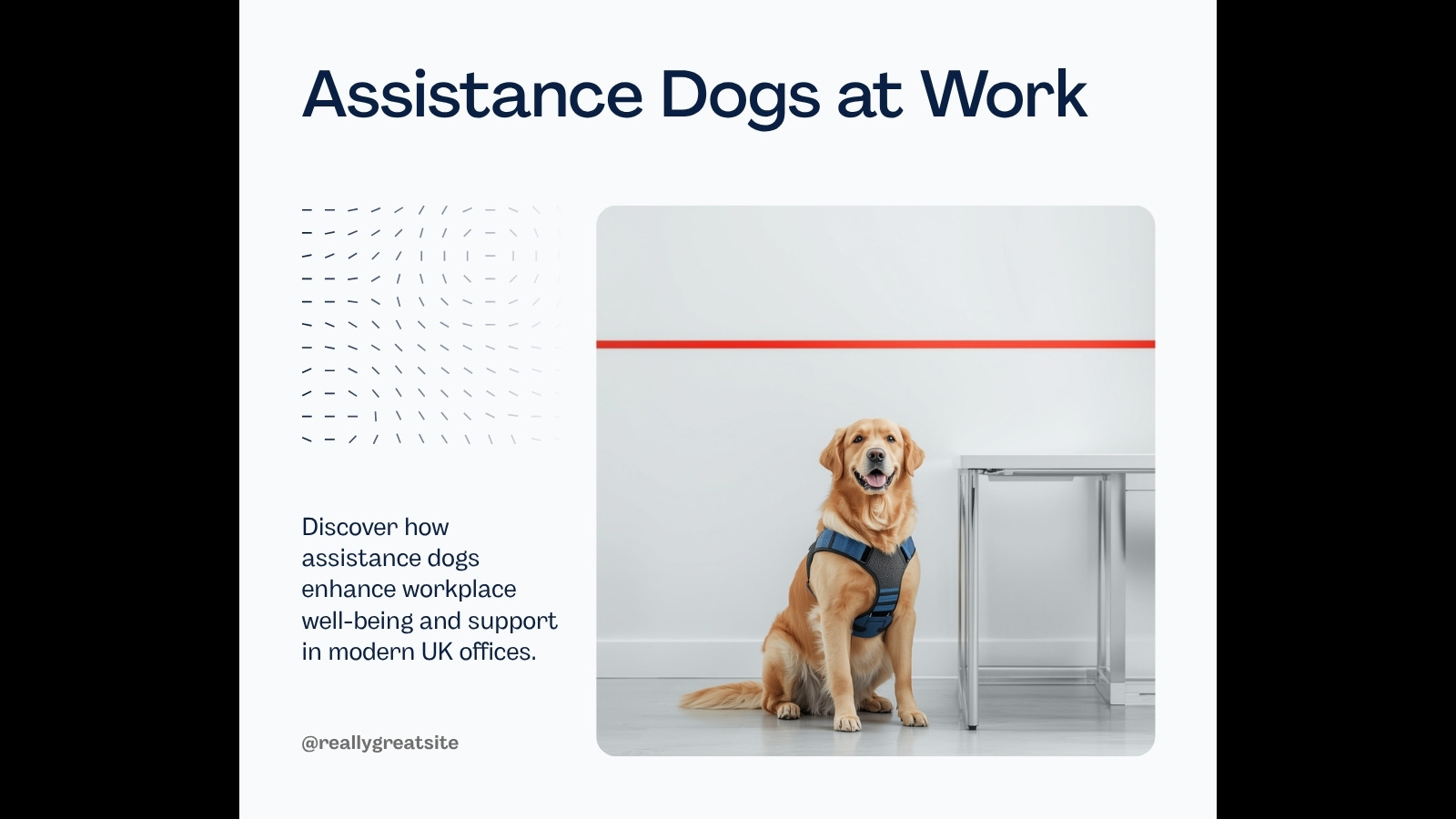
A practical guide for HR teams, line managers, and equality leads — Equality Act 2010 duties, step-by-step onboarding, free template pack.
Updated April 2026. Free to use and adapt.
An employee walks in with an assistance dog. Nobody had a process. HR improvised. The manager asked the wrong question. The employee felt like a problem before they'd even sat down.
It happens in offices, warehouses, hospitals, councils, and shops across the UK every week. Not because employers are unkind. Because they never had to think about it before.
The legal starting point is not a "no dogs" building rule. It is the Equality Act 2010. Employers must not unlawfully discriminate against disabled applicants or employees, and they must consider reasonable adjustments where a disabled person would otherwise be placed at a substantial disadvantage. The EHRC Employment Statutory Code is the key reference.
Real employers are already formalising this. Cotswold District Council's Dogs at Work Policy (September 2025) treats assistance dogs separately from general workplace rules and links the approach explicitly to Equality Act reasonable adjustments.
The Equality Act 2010 frame
Most employers ask the wrong question. They ask: "Do we allow dogs?"
The right question is: "What reasonable adjustment is needed here, and how can we implement it proportionately?"
Under the Equality Act 2010, employers must not discriminate against disabled people in recruitment or employment, and they have a duty to consider reasonable adjustments. Whether an adjustment is reasonable depends on practicality, effectiveness, cost, disruption, and the employer's size and resources.
A workplace "no dogs" rule does not automatically settle the issue. A blanket refusal carries legal risk. Employers need to assess the actual circumstances, avoid reflex refusal, and document the reasoning behind whatever arrangement they put in place.
The same principle applies in recruitment. Applicants are protected too. An employer should not use an assistance dog as a disguised reason to reject a disabled applicant.
Owner-trained dogs have equal legal standing
Many employers wrongly assume that only dogs from one familiar charity route "count." That is not a legally safe position. In the UK, there is no single official register or mandatory proof document for assistance dogs. As ADUK's own guidance on registration and proof acknowledges, no official or mandatory scheme exists.
Assistance dogs in UK workplaces may have been:
The important questions are: whether the disabled employee relies on the dog, what the dog is trained to do, and whether the arrangement can be managed safely and reasonably in that workplace.
No official UK certificate exists
Many employers think they need to see a specific certificate, charity card, or official-looking document before they can proceed. There is no official registration or certification process for assistance dogs in the UK, so there is no single legal proof document employers can insist on as the gateway to workplace access.
Policies such as these are poor policy wording and create unnecessary legal risk:
A better approach is to focus on what information is reasonably needed to plan the workplace arrangement: the dog's working role, how the dog assists the employee, what practical adjustments are needed, and expected behaviour standards.
Where ADR helps
Assistance Dog Registry provides optional practical tools that reduce friction: registration records, public profile pages, ID materials, and employer-facing documentation. These are not "official proof" — no such standard exists. They are practical planning tools that make workplace conversations easier and more structured.
A written policy does three important things. First, it stops HR and managers improvising under pressure. Second, it helps the organisation respond consistently. Third, it reduces the chance of the employee being challenged repeatedly by different people inside the organisation.
A good policy does not need to be long. It needs to say: what the general position on animals is, that assistance dogs are considered separately under equality obligations, how requests are handled, what the onboarding process looks like, what standards apply, and how concerns are managed. That is enough.
Most workplace friction comes from ambiguity, not from the dog itself.
Where possible, the employee tells HR or their manager in advance that they rely on an assistance dog and that workplace arrangements will be needed — before a start date, during recruitment, after a role change, or when an existing employee begins working with a dog.
Meet with the employee to discuss what the dog does, what the employee needs to work effectively, what practical arrangements are required, and whether any workplace-specific issues need to be planned for.
Assess the workplace for operational issues: rest space, water access, toileting arrangements, movement through the building, meeting rooms, shared spaces, reception and security awareness, and emergency evacuation.
Record the agreed arrangement. A short assistance-dog plan is usually enough — daily working arrangements, interaction rules, emergency procedures, and a review date. The free template pack below includes a ready-to-use checklist.
Where colleagues need to know, tell them in advance. Brief, calm, factual. What colleagues should and should not do — and how to raise any genuine concerns privately. A template email is included in the free pack below.
Reception, line managers, and relevant staff should be ready. The goal is not to create a performance around the dog. It is to make day one operationally smooth and unremarkable.
A short review catches small issues early. Twenty minutes with the handler and HR is usually enough. Update the individual plan if anything has changed.
The two most common concerns are allergies and fear of dogs. Both should be taken seriously. Neither is an automatic reason to exclude the disabled employee.
EHRC guidance on assistance dogs supports a practical balancing approach. If there is a real allergy issue or another genuine concern, employers should look at proportionate ways to manage it rather than defaulting to refusal — seating in different areas, agreed routes through the building, keeping the dog's rest area away from a colleague's workstation, controlled introductions, or other practical separation measures.
Manage the conflict. Do not turn the disabled employee into the problem.
A dog should not be judged by who trained it. A dog should be judged by behaviour, control, hygiene, safety, and workplace practicality. That is the fair standard.
If a dog is repeatedly out of control, aggressive, not toilet-trained, creating a hygiene issue, or creating a genuine safety concern that cannot reasonably be managed, the employer may be justified in reviewing or withdrawing workplace access. Published assistance-dog workplace guidance supports that behaviour-and-risk-based approach. Employers should stay proportionate — one minor incident should not trigger automatic exclusion.
"The organisation will assess assistance dogs on behaviour, safety, hygiene, and workplace practicality — not on whether the dog was trained by a particular provider. Where a dog creates a genuine and unmanageable risk or serious operational issue, workplace access may be reviewed or withdrawn on a case-by-case basis."
Can an employer insist on one specific certificate or ID?
No. There is no single official register or mandatory proof document for assistance dogs in the UK. Focus on the workplace arrangement and the employee's actual needs — not on invented paperwork thresholds.
Can an employer ask questions at all?
Yes. Employers can ask questions reasonably connected to planning adjustments, workplace safety, and practical implementation. What they should avoid is rigid gatekeeping based on one specific provider or document.
What if the office has a "no dogs" policy?
That does not automatically answer the Equality Act issue. Employers still need to consider reasonable adjustments in the actual circumstances. A blanket refusal carries legal risk.
What if the dog is owner-trained or independently trained?
That does not automatically make the dog invalid. Focus on the disabled employee's needs, the dog's function, and workplace practicality — not the training route.
Can an employer ask for the dog to be removed?
Potentially yes, but only where there is a genuine behaviour, hygiene, safety, or operational issue that cannot reasonably be managed. The decision should be based on actual risk and conduct — not on the dog's provider or paperwork.
Free Download
Assistance Dogs at Work policy template · Onboarding checklist · Manager briefing notes · Team announcement template. Four documents. Free. Adapt before use.
⬇ Download the free Policy Pack
4 documents · PDF · 213 KB · Adapt for your organisation before use
Many of the people most affected are the very people most likely to be misunderstood. Owner-trained and independently trained assistance-dog handlers are often left explaining themselves repeatedly to employers who assume only one narrow route is valid. That creates delay, frustration, and unnecessary exclusion.
A good workplace policy fixes that without lowering standards. It does not say anything goes, any dog counts, or behaviour does not matter. It says: UK law matters, reasonable adjustments matter, genuine behaviour and workplace standards matter, and myths about "official-only" proof should not drive employer decisions. That is the fairer and more professional standard.
Further reading and sources
This article is provided as general guidance only and does not constitute legal advice. Employment cases are fact-specific. For advice on a specific situation, consult an employment solicitor or refer to the EHRC's employment guidance. Last updated: April 2026.
Last week, a handler wrote to us about a trip to her local coffee shop. She'd been going there for months. Same staff, same routine. Her dog, Bailey, curled quietly at her feet while she worked on her laptop.
Then a new manager started.
"Sorry — no pets." That was the first line. Then came the harder one: "Is that a real assistance dog?"
She froze. She knew her rights. She'd read the Equality Act. But in the moment, with other customers looking, she couldn't find the words. She packed up and left.
That evening, she sat in her car and cried. Not because of the coffee shop. Because she thought she'd been prepared, and she wasn't.
If you've ever had a version of that day, this guide is for you.
Five new sections for 2026. Everything else from 2025, updated where the law moved.
One side lists your protections under the Equality Act 2010 in plain English. The other side gives you the exact wording to use if someone challenges you. Sized to fit any card wallet or lanyard holder. Print once. Stop remembering.
We asked handlers across the UK what they wished they'd said. Then we wrote it down. Specific scripts for:
Each script is short. Kind. Firm. You can read it straight off your phone if you need to.
If your dog helps you with anxiety, PTSD, autism, or another mental health condition, the conversation at the door is often harder. The new guide has a section just for you, with task-training notes specific to mental health assistance — deep pressure therapy, interruption, perimeter scanning, sensory support, meltdown prevention.
If your current landlord is pushing back, there's a copy-paste letter in the guide. It cites the Equality Act 2010 and the Housing Act. It's polite. It's firm. It's designed to end the conversation.
For when you need to bring your assistance dog to work and HR doesn't know what to do. Includes the reasonable-adjustment framing, the escalation path through ACAS, and what to do if your employer refuses.
A4 PDF. Print at home or keep it on your phone. No sign-up required.
5.8 MB · Print-ready · Works on phone or desktop
It's for you if any of these sound familiar:
Under the Equality Act 2010, your assistance dog is protected in almost every setting where the public has access. Shops, cafés, restaurants, pubs, hotels, taxis, buses, trains, planes, workplaces, hospitals, schools, GP surgeries, dentists, hairdressers. The law doesn't distinguish between a charity-trained dog and one you've trained yourself.
But knowing the law and using the law are two different things. Most handlers lose the argument at the door not because they're wrong — but because the staff are faster. Staff are trained to ask certain questions. Most handlers don't have a script.
This guide gives you the counter-script. It's not a replacement for a registration card — it's the words to go with the card. The combination stops most conversations in ten seconds.
Registration is voluntary and separate from the guide. The guide is free whether you register or not.
£29.50/year
Digital-only. Your dog's profile, a registered ADR ID number, and a public verification page. No physical kit.
£59.50/year
Membership plus the full physical kit — 2× NFC Smart ID cards, 3× personalised plastic ID tags, hi-vis "Do Not Pet" vest, leather card holder, branded lanyard. Free replacements if lost.
£129.50 once
Everything in Premium, plus a dedicated handler card and handler hi-vis vest. You pay once. You never renew.
We've registered thousands of UK dogs since we started. Many were trained by the handlers themselves — at home, with patience, sometimes over years. Handlers come to us with a wide range of disabilities, visible and invisible. Most have been questioned at least once in public. Some of them have cried in a car park afterwards.
None of that is fair. The law is clear. The reality, sometimes, isn't.
What we can do is make it harder for the reality to win. That's what this guide exists for.
Your dog works for you. We're here to make sure the rest of the world knows it.
— The team at the Assistance Dog Registry

 Reload document
  Open in new tab