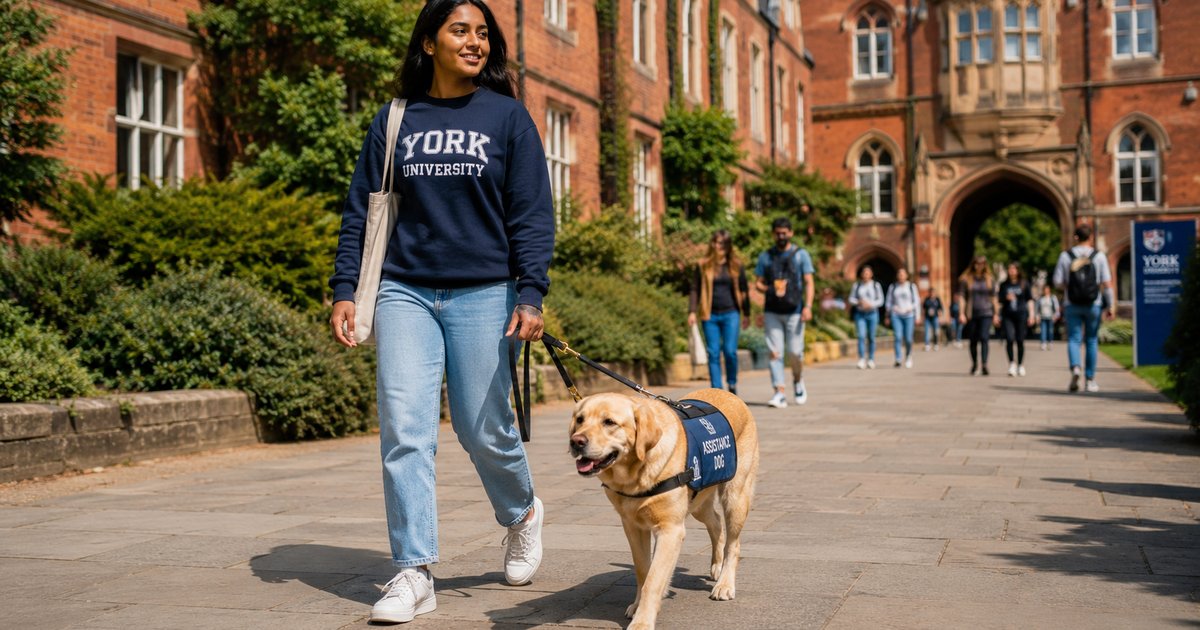
A university refusing your assistance dog because it is not ADUK accredited is almost certainly breaking the law. Here is exactly what the law says, what you can do today, and why accommodation teams need to take note.
The short answer is almost certainly not. A university that refuses a disabled student's assistance dog from on-campus accommodation is almost certainly committing unlawful disability discrimination under the Equality Act 2010. The longer answer is that thousands of students and their families do not know this, accommodation offices sometimes do not know this, and that information gap causes real harm.
We received a call from a student currently living through exactly this situation. Their university accommodation team told them that only dogs trained and accredited by Assistance Dogs UK (ADUK) would be permitted in halls. The student's dog is owner-trained. The student is disabled and relies on the dog daily. The university told them they could not stay.
That decision is legally wrong. This article explains why, what the student can do, and what university accommodation teams need to understand before they make decisions like this again.
"There is no UK statute, regulation or statutory instrument that requires an assistance dog to be trained by an ADUK member in order to have legal protection in education or housing. ADUK itself says this on its own website."
University accommodation is not a grey area under UK equality law. The Equality Act 2010 is explicit.
Section 91 of the Act places obligations directly on the "responsible body" of a higher education institution. That responsible body must not discriminate against a student or prospective student in the way it affords them access to a benefit, facility or service. On-campus accommodation is a benefit, facility or service. There is no serious legal argument that it is not.
Section 20 sets out the three-part reasonable adjustments duty. A university must change any provision, criterion or practice that puts a disabled student at a substantial disadvantage compared to non-disabled students. A blanket no-dogs policy applied without any consideration of whether the dog is an assistance animal needed by a disabled student is precisely such a provision. It places the disabled student at a substantial disadvantage: they either go without their dog or they go without housing.
Section 21 makes this unmistakeable: a failure to comply with the reasonable adjustments duty is itself a form of discrimination. There is no general justification defence for a failure to adjust.
Section 149 — the Public Sector Equality Duty — applies to universities as public bodies. They must have due regard to the need to eliminate discrimination and advance equality of opportunity for disabled people. A written policy that categorically excludes owner-trained assistance dogs from halls is very difficult to reconcile with that duty.
The EHRC's own technical guidance on further and higher education makes one additional point that many universities miss: the reasonable adjustments duty is anticipatory. A university cannot wait until a student with an assistance dog knocks on the accommodation office door and then scramble to work something out. Policies and procedures must be in place in advance. A university with no clear assistance dog policy for halls may already be in breach of the Act before any individual student has even applied.
One of the most common and damaging misunderstandings in this area is the belief that only charity-trained or ADUK-accredited dogs have legal rights as assistance animals. This is false.
Under the Equality Act 2010, the relevant question in an education or housing context is whether the person is disabled within the meaning of section 6 of the Act, and whether the dog is an auxiliary aid that mitigates the effects of that disability. Training organisation plays no role in answering either of those questions.
A dog trained by its handler over three years to detect a medical episode carries the same legal protection under Parts 3 and 6 of the Equality Act as a dog trained by a charity. The law does not distinguish between them. A university that treats them differently is applying a distinction the law does not make.
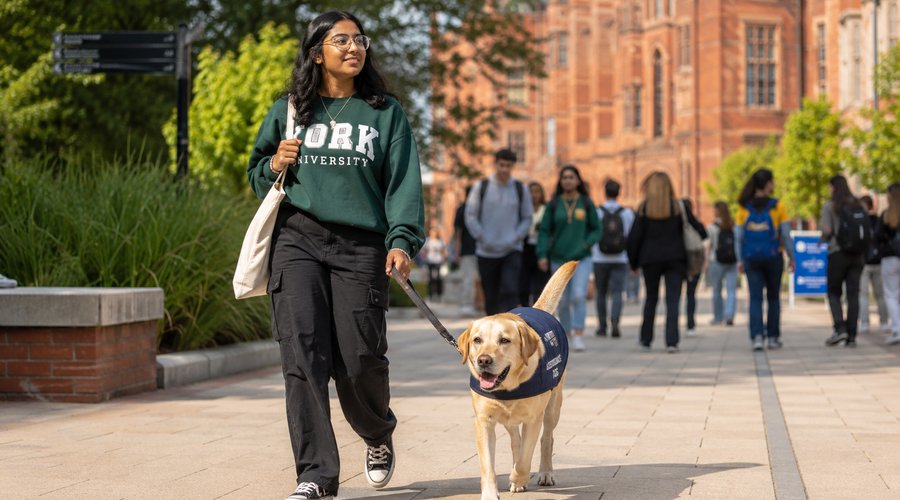
Waiting times for charity-trained assistance dogs in the UK are commonly two to three years. Many students with a genuine need for an assistance dog will arrive at university with an owner-trained dog, not because they chose an easier route, but because the alternative was to wait through their entire degree. The law accounts for this reality. University policies must too.
Many organisations that wrongly demand ADUK accreditation point to section 173 of the Equality Act 2010 as their justification. It is worth being precise about what that section actually does.
Section 173 defines "assistance dog" for the purposes of Part 12 of the Act only. Part 12 covers transport: taxis, private hire vehicles and public transport. Within that narrow context, section 173 names a list of prescribed charities whose dogs receive specific protections in taxi licensing law.
That definition does not apply to Parts 3 or 6 of the Act, which govern services and education. It does not define which dogs have any assistance animal protection in shops, restaurants, hotels, universities or housing. It is a transport-specific clause, and using it to justify a blanket "ADUK-only" policy in halls is a fundamental misreading of the statute.
There is one further irony. ADUK itself is explicit on this point. ADUK's own published guidance states that disabled people are not legally required to carry identification for their assistance dog, and that ADUK does not restrict public access rights to its member partnerships. A university demanding ADUK accreditation is going further than ADUK itself asks. The accrediting body has said the restriction is not required. The university imposing it anyway has no legal basis for doing so.
"ADUK has stated publicly that disabled people are not required to carry ID for their assistance dog and that ADUK does not restrict access to its member partnerships only. A university demanding ADUK accreditation is going further than ADUK itself asks."
The EHRC confirmed the same principle in early 2026 when it formally warned JD Wetherspoon that its policy of requiring ADUK photo ID before admitting assistance dogs may breach the Equality Act 2010. A university with a written policy that does the same thing faces identical legal exposure.
This is not a theoretical argument. A tribunal has already considered the exact issue and found against the organisation imposing an ADUK-only criterion.
In 2023, the First-tier Tribunal for Scotland (Health and Education Chamber) decided case reference FTS/HEC/AC/23/0199. An education authority had adopted a blanket policy that only dogs trained by ADUK or an ADUK-accredited body would be considered. The tribunal found that this approach was itself unlawful. By adopting a blanket criterion, the responsible body had made it impossible to ever actually investigate whether a dog was capable of performing assistance tasks. The policy prevented a fair assessment from taking place. That failure was the breach.
The Equality Act 2010 applies across England, Scotland and Wales. The principle the tribunal applied is not confined to Scotland. A university in any part of the UK that adopts the same blanket approach is exposed to the same finding.
If your university accommodation team has refused your assistance dog, or has told you that your dog must be ADUK accredited, take these steps in order.
Step 1: Get the refusal in writing. Do not accept a verbal decision. Email the accommodation office and ask them to confirm in writing the reason for the refusal and the specific policy they are applying. This creates the paper trail you need for every step that follows. Keep every email, letter and note of phone conversations.
Step 2: Contact the Disability Office. Your university's disability or student services team may not be aware of what the accommodation office has done. Contact them in writing. Request a formal reasonable adjustments assessment under section 20 of the Equality Act 2010. Send the template letter below.
Step 3: Use the internal complaints procedure. Every UK university must have a formal student complaints process. A refusal to accommodate your assistance dog is a disability discrimination complaint. Submit it formally, in writing, citing section 91 and section 20 of the Equality Act 2010. Ask the university to issue a Completion of Procedures letter when the internal process concludes. You need this letter before you can escalate externally.
Step 4: The Office of the Independent Adjudicator (OIA). Once you have your Completion of Procedures letter, you can bring a complaint to the OIA within 12 months. The OIA is free, independent and covers all member universities in England and Wales. It can require universities to pay compensation and change their policies. If it finds in a student's favour, the finding is published.
Step 5: The Equality and Human Rights Commission. The EHRC has statutory enforcement powers. It can issue compliance notices, conduct formal investigations and require organisations to change their practices. If your situation involves what appears to be a systemic policy rather than an individual mistake, contact the EHRC directly.
Step 6: County court. A county court claim for disability discrimination under the Equality Act 2010 does not require a solicitor to initiate. Damages are uncapped in principle. The Vento guidelines set bands for injury to feelings: the middle band currently runs from £12,600 to £37,700 and the upper band from £37,700 to £62,900 for the most serious cases. Financial losses, such as costs of alternative accommodation or missed education, are claimable separately. Citizens Advice and Disability Rights UK can both provide initial guidance at no cost.
Copy and adapt this letter. Send it by email and keep a copy. Replace the bracketed sections with your own details.
Dear [Name / Accommodation Services Team],
I am writing to formally request a reasonable adjustment under section 20 of the Equality Act 2010 regarding your decision to refuse my assistance dog from university accommodation.
I am a disabled person within the meaning of section 6 of the Equality Act 2010. My dog is an assistance animal that I rely on to mitigate the effects of my disability. The dog is owner-trained. There is no provision of UK law that requires an assistance dog to be trained by an ADUK member or any other specific organisation in order to benefit from legal protections under Parts 3 and 6 of the Equality Act 2010. The definition at section 173 of the Act applies only to Part 12 transport provisions and does not govern education or housing.
University accommodation is a benefit, facility or service within the meaning of section 91 of the Act. A blanket policy requiring ADUK accreditation as a precondition for accommodation constitutes a provision, criterion or practice that places me at a substantial disadvantage compared to non-disabled students. This is indirect discrimination unless the university can demonstrate it is a proportionate means of achieving a legitimate aim. I respectfully submit that it cannot.
I ask you to confirm in writing within five working days whether you will revise this decision. If you do not, I will escalate this matter through the university's formal complaints procedure, the Office of the Independent Adjudicator and, if necessary, the county court.
Yours sincerely,
[Your full name]
[Student number]
[Course and year]
[Date]
If you work in a university accommodation office, disability services team or student welfare role, this section is written directly for you. Please read it carefully before the next request from a student with an assistance dog lands on your desk.
We understand that many accommodation teams are acting in good faith. Some have been told by management or legal teams that ADUK accreditation is a reasonable requirement. Some have inherited policies written years ago by people who were not specialists in equality law. Some are worried about how to verify that a dog is genuinely trained. These are real concerns, and they deserve a real answer.
But the answer to those concerns cannot be a blanket "ADUK only" rule. That rule is almost certainly unlawful. And the consequences of applying it to a student who then pursues their legal rights are far more disruptive and expensive than the process of getting your policy right now.
Here is what the law requires you to do.
When a student with an assistance dog requests accommodation, you must assess their request individually. You must consider whether the dog is an auxiliary aid that the student needs to mitigate the effects of their disability. You must make any reasonable adjustment that would allow the student to access accommodation on an equal basis with non-disabled students. ADUK accreditation is not a proxy for this assessment. It is a voluntary quality standard that some organisations have achieved. It tells you nothing about whether this student needs this dog in this accommodation.
ADUK has published a quick guide specifically for further and higher education providers titled "Welcoming Students with Assistance Dogs in FE and HE." It is free and available from the ADUK website. It explicitly states that students are not required to have ADUK-registered dogs. If you have not read it, read it today. ADUK itself is telling you that your ADUK-only policy goes beyond what is required or appropriate.
It is important to be precise here, because this is not a one-sided picture. Universities do have legitimate interests and the law recognises them.
What a university cannot do:
What a university can legitimately do:
The key distinction is this: a university can manage the process of accommodating an assistance dog. It cannot use process as a reason to refuse. If a dog is genuinely not behaving as a trained assistance dog, if it is aggressive, uncontrolled or presents a real risk to other students, there is a legitimate basis for acting on that behaviour. But the dog's training organisation is not evidence of its behaviour, and the absence of ADUK accreditation is not evidence of danger.
Your legal rights on one card. Show it to accommodation teams, landlords, cafes and anyone who challenges you. Wallet-sized and QR-linked.
University legal teams should be aware that the exposure from an unlawful refusal of an assistance dog in halls is not trivial.
Office of the Independent Adjudicator (OIA). The OIA reviews complaints from students at member institutions in England and Wales after the internal complaints process has concluded. It can find against a university and require it to pay financial compensation to the student, change its policies and provide evidence of compliance. OIA findings are published, even if the student's identity is anonymised. A published finding that a university discriminated against a disabled student over an assistance dog would attract significant attention.
Equality and Human Rights Commission (EHRC). The EHRC has formal enforcement powers under the Equality Act 2006. It can conduct formal investigations, issue compliance notices and enter binding agreements. Where a university policy is systemic rather than an individual error, the EHRC is in a position to require institution-wide change. Its warning to JD Wetherspoon in early 2026 demonstrates its willingness to engage with exactly this type of blanket accreditation requirement.
County court. A student who has been unlawfully refused accommodation can bring a county court claim for disability discrimination. Injury to feelings damages under the Vento guidelines currently reach up to £62,900 in the most serious cases. Add financial losses (cost of private accommodation, travel, disruption to studies), and potential psychiatric harm if the situation has caused a mental health impact, and the potential award becomes significant. Legal costs may also be awarded against the university. There is no cap on the overall award.
Office for Students (OfS). The OfS regulates English universities and has the power to take action where registered providers fail in their obligations to students. A pattern of failures to support disabled students is within scope of OfS scrutiny.
Reputational damage. In the current environment of heightened public and media attention on assistance dog discrimination, a named university would face considerable reputational consequences. Student unions, disability charities, national press and social media would all engage with a story of a disabled student forced out of halls over a dog they legally have the right to keep.
"The cost of revising a university accommodation policy is a few hours of staff time. The cost of defending an unlawful refusal in the county court, OIA and public scrutiny is far greater. The right decision is also the straightforward one."
An ADR registration gives you a QR-linked online profile, smart ID card and NFC tag that accommodation teams, landlords and access checkers actually respond to. Thousands of UK handlers are already registered.
Waiting times for charity-trained assistance dogs in the UK range from 18 months to three years or more. The demand for assistance dogs continues to grow. The number of people who are owner-training their dogs, either independently or with the support of training organisations that are not ADUK members, is increasing year on year.
The students arriving at UK universities over the next five years will include many more people with owner-trained assistance dogs than universities have seen before. Universities that have not thought carefully about their policies now will face these situations repeatedly, and the legal framework will not change to accommodate policies that exclude owner-trained dogs. Those policies are already unlawful.
The universities that are getting this right are worth noting. Newcastle University has a published assistance dog policy for halls that grounds any refusal only in genuine health and safety concerns and requires individual assessment. Bangor University explicitly acknowledges owner-trained assistance dogs in its campus animal policy. These are not unusual positions. They are the legally correct ones, and they protect both the student and the institution.
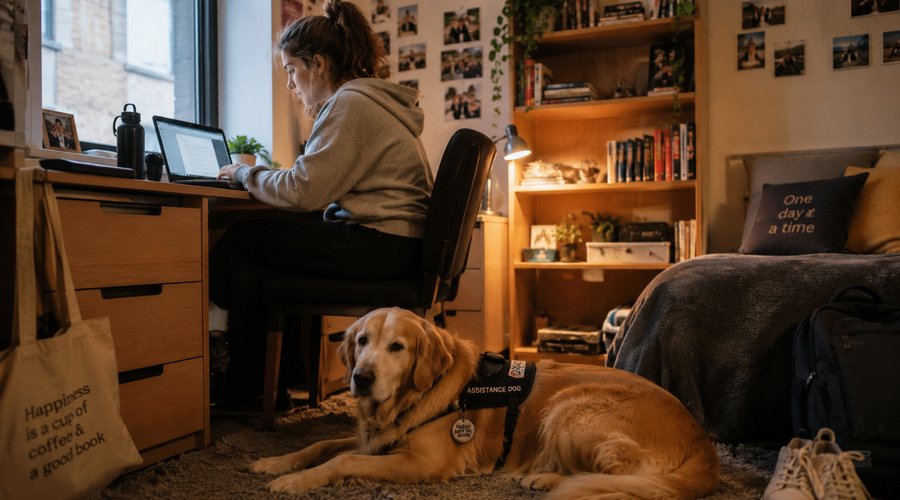
If you are a student starting university and you have an owner-trained assistance dog, you do not need to accept a refusal. The law is on your side. Use it.
If you are an accommodation professional reading this, you now have everything you need to review your policy and get it right. The time to do that is before the next student asks, not after.
Was this article helpful?
This article was researched using published tribunal decisions, EHRC guidance, parliamentary committee evidence and official university policy documents. All legal citations have been checked against legislation.gov.uk. We update our articles when the law or official guidance changes.
If you spot anything that needs updating, contact us here.
Assistance Dog Registry has supported thousands of UK assistance dog handlers since 2020, supplying 20,000+ ID cards. Articles reviewed against UK primary legislation and official EHRC, GOV.UK, Citizens Advice and NHS guidance. About ADR
This article provides general information, not legal advice. The law in this area involves individual facts and circumstances. What applies in one situation may not apply in another.
If your access to accommodation is at risk, seek advice from Citizens Advice, Shelter, the Equality and Human Rights Commission (helpline: 0808 800 0082), or a qualified solicitor specialising in disability discrimination.