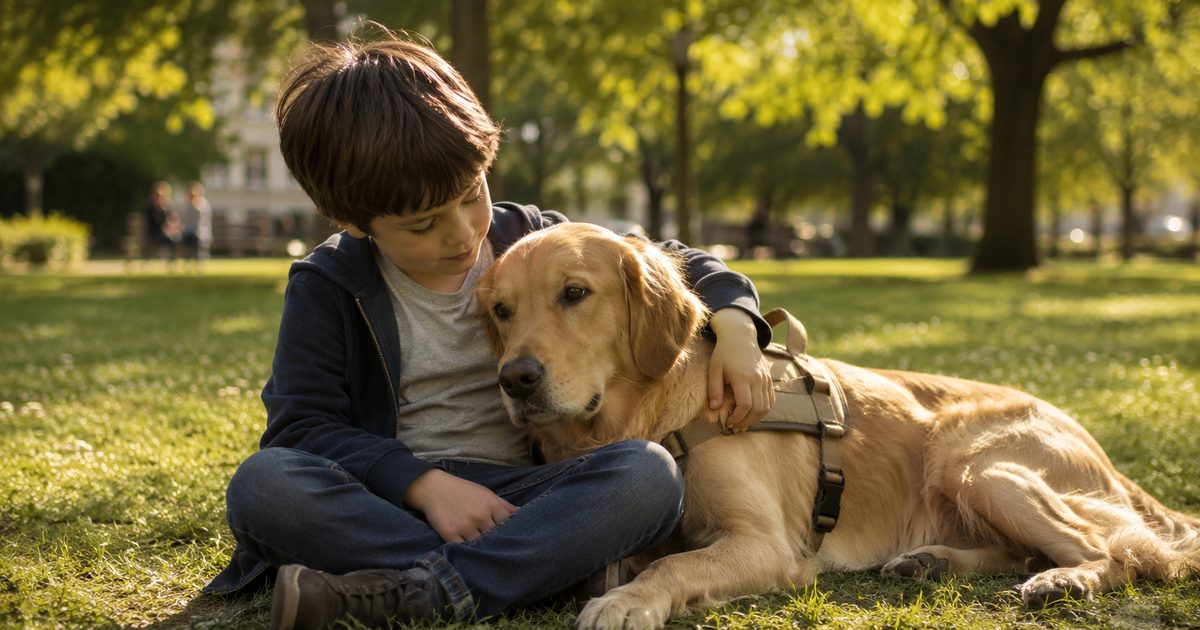
Autism assistance dogs are fully legal in the UK, owner-training is the primary realistic route for most families. Here is everything you need to know about tasks, legal rights, training, and how ADR registration protects you in public.
The term "autism assistance dog" covers a wide spectrum of trained behaviours. Unlike guide dogs, which perform a narrow and well-understood set of tasks, autism assistance dogs are trained to the specific needs of the individual, which is why the work they do varies significantly from handler to handler.
That said, there are six categories of task that recur consistently across autistic handlers of all ages. Understanding these tasks matters not only for families considering a dog, but for anyone who might challenge an autism assistance dog in a public setting. These dogs are not pets performing cute tricks: they are performing safety-critical work.
Grounding during sensory overwhelm or anxiety. The dog applies physical pressure, typically nudging, leaning against, or placing a paw on the handler, at the onset of anxiety or sensory overload. The physical sensation interrupts the escalating cycle and redirects the handler's nervous system. Many autistic people describe this as their dog providing a reliable, non-verbal anchor that words or instructions cannot replicate.
Interrupting meltdowns and self-injurious behaviour. Trained autism dogs learn to recognise early cues, behavioural and physiological, that precede a meltdown or self-injurious episode. The dog intervenes at this early stage: nudging, licking, pawing, or applying body pressure. In many cases the intervention prevents full escalation. This task requires the dog to have learned an individual's specific warning signals, which is one reason personal familiarity between dog and handler is a significant advantage for owner-trained dogs.
Tracking and preventing bolting. For families of autistic children who bolt, a serious and potentially life-threatening behaviour, a trained dog on a fixed-length tether can prevent a child from running into traffic or becoming lost. Some dogs are also trained to track a child who has already bolted, using scent discrimination. This application is almost exclusively relevant to younger children.
Tethering for children. A specially designed harness connects the child to the dog at all times when in public. The dog is trained to walk beside the child, providing both a physical anchor and a source of sensory comfort. The child focuses on the dog rather than on overwhelming environmental stimuli, which reduces the likelihood of a bolting incident. Tethering requires the dog to be large enough to provide a meaningful counterweight, typically a medium to large breed.
Deep pressure therapy (DPT). The dog lies across or against the handler, providing sustained firm pressure. This activates the parasympathetic nervous system and reduces cortisol levels. DPT is used both as a preventive measure during high-stress environments and as an intervention during or after a distressing episode. It is particularly effective for autistic handlers who find physical touch from humans difficult but respond well to animal contact.
Preventing bolting and providing a safe focus. Beyond tethering, dogs can be trained to walk at a consistent pace, stop at kerbs, and wait at entrances, cues that autistic children and adults can read and follow more reliably than verbal instructions from a human. The dog's presence also provides a structured, predictable social anchor in unpredictable environments like shopping centres, transport hubs and school corridors.
"An autism assistance dog does not need to perform a dramatic rescue to qualify under UK law. A dog that consistently prevents sensory overwhelm from becoming a crisis is performing a genuinely life-changing assistance task."
Under UK law, there is no formal gatekeeping process that determines whether a person qualifies for an autism assistance dog. The relevant legal test is set out in the Equality Act 2010: a person qualifies as disabled if they have a physical or mental impairment that has a substantial and long-term adverse effect on their ability to carry out normal day-to-day activities. Autism spectrum condition (ASC) meets this test for a great many autistic people, though the Act assesses each person individually.
Importantly, the law covers both adults and children. There is no minimum age requirement. A family with an autistic child who needs a tethered dog for bolting prevention has the same legal basis for an assistance dog as an autistic adult who uses a dog for sensory grounding at work.
The practical question is less about legal qualification and more about readiness: whether the individual can engage with a dog safely, whether the household can support a working dog, and whether the dog has been trained to a standard that genuinely mitigates the individual's specific needs.
There is also no requirement that an autism diagnosis come from a particular type of clinician, or that it be formally verified before a dog can be used as an assistance animal. What matters, if anyone ever challenges your dog's status, is that you can explain clearly what tasks the dog performs and how those tasks relate to the effects of your or your child's disability.
Families researching autism assistance dogs will encounter two routes: applying to a charity for a trained dog, or training a dog themselves with professional support. Neither route is inherently superior, but the practical realities of each are very different, and most families are not given an accurate picture of the charity route when they begin their search.
The charity route involves applying to one of a small number of UK charities that place dogs with autistic people. These charities assess the applicant, select and train a dog over one to two years, and then carry out a placement process that includes follow-up support. The dogs are trained to a high standard by experienced professionals.
The drawbacks are significant. Waiting lists run from three to five years from initial application to placement. Selection is highly competitive, and many applicants are declined. The cost to the charity of providing a dog is over £25,000 per placement, which means that charitable funding cycles, volunteer availability and demand all affect how many dogs can be placed each year. Families cannot choose the breed or individual dog. And because placement priority is often given to children, autistic adults may find the waiting time even longer.
The owner-training route involves the family selecting a dog with suitable temperament and working with a qualified assistance dog behaviourist to train the dog to perform specific tasks. This process typically takes 12 to 24 months of consistent, structured training. It is demanding, but it is the route that most families who end up with an autism assistance dog actually take, not because they preferred it on paper, but because the alternative meant waiting years for a child who needed help now.
Owner-trained dogs carry identical legal rights to charity-trained dogs in shops, restaurants, public transport, schools and workplaces under the Equality Act 2010. The training organisation is legally irrelevant. An owner-trained dog that has been properly socialised, task-trained and is under control in public has the same protections as a dog that cost a charity £25,000 to produce.
| Factor | Charity-trained | Owner-trained |
|---|---|---|
| Waiting time | 3–5 years | 12–24 months training |
| Cost to family | Free (charity-funded) | Dog + behaviourist fees |
| Dog selection | Chosen by charity | Family's choice |
| Task customisation | Standard programme | Fully tailored to individual |
| Legal rights | Full (Equality Act) | Full (Equality Act) |
| Availability | Highly selective | Open to all who can commit |
Assistance Dogs UK (ADUK) is a coalition of UK assistance dog charities that have achieved accreditation through Assistance Dogs International or the International Guide Dog Federation. ADUK accreditation represents a genuine quality standard, and the charities within the coalition do important work.
But the numbers tell a sobering story about capacity.
There are fewer than 10 ADUK-accredited charities in the UK that work with autistic people. Combined, these organisations place approximately 100 dogs per year across all types of autism assistance placement. The diagnosed autism population in the UK is over 700,000 people, and rising as diagnostic criteria improve and access to assessment widens.
The arithmetic is stark. Even if every one of those 100 annual placements went to someone who had never had a dog before, it would take seven thousand years to reach every autistic person in the UK who might benefit. In practice, placements are concentrated on those with the highest documented need, children are often prioritised over adults, and many applicants are declined after waiting years.
Owner-training, supported by a qualified canine behaviourist, is therefore not a fallback or a lesser option. It is the route that the system's capacity makes necessary, and it is a route that the law explicitly supports. The Equality Act 2010 does not define an assistance dog by reference to its training organisation. It asks whether the dog performs tasks that mitigate the effects of a disability. An owner-trained dog that does this is an assistance dog in the eyes of the law, period.
The legal basis for an autism assistance dog's public access rights in the UK rests on the Equality Act 2010. The Act is broad in scope and applies to virtually every public-facing setting. What follows is a plain-English breakdown of how the law applies in the settings most relevant to autistic handlers and their families.
In schools. A school, whether state, academy, free school or independent, is a provider of education and a service. Under Part 6 of the Equality Act, schools must not discriminate against a disabled pupil and must make reasonable adjustments. A head teacher who refuses an autism assistance dog at the school gates is not exercising a general discretion: they are potentially committing unlawful disability discrimination. The school does not need to accept the dog unconditionally, they can ask about the dog's tasks, ask for evidence of training, and make reasonable operational arrangements, but a blanket refusal without individual assessment is almost certainly unlawful.
In shops and restaurants. Part 3 of the Equality Act covers service providers, which includes every shop, restaurant, cafe, supermarket and leisure venue in the UK. A business that refuses entry to an assistance dog handler is refusing to provide a service on grounds that relate to the person's disability. This is direct discrimination. There is no "no dogs" exemption for food businesses: health and hygiene legislation in the UK contains specific exceptions for assistance dogs, and businesses that refuse entry using hygiene as a pretext are relying on a misunderstanding of that legislation.
On public transport. Buses, trains, trams and the London Underground are all covered. While section 173 of the Equality Act defines assistance dogs for taxi licensing purposes only (using ADUK-charity dog definitions), the broader anti-discrimination provisions of Parts 3 and 12 still apply. A rail operator that refuses a passenger with an autism assistance dog is refusing to provide a service to a disabled person and must demonstrate a proportionate justification to avoid liability.
In workplaces. Part 5 of the Equality Act covers employment. An autistic employee who uses an assistance dog has the right to request that reasonable adjustments be made to allow the dog into their workplace. An employer who refuses without considering the adjustment individually is likely failing the reasonable adjustments duty. The duty is anticipatory: employers should have considered this possibility in their disability inclusion policies, not just when it first arises.
In rented accommodation and hotels. Part 4 of the Act covers premises. A landlord who includes a "no pets" clause in a tenancy agreement must still consider whether refusing an assistance dog amounts to a failure to make a reasonable adjustment for a disabled tenant. The Equality and Human Rights Commission's guidance makes clear that blanket pet bans are difficult to apply without individual assessment where the animal concerned is an assistance dog.
Owner-training an autism assistance dog is a significant commitment. Most families who approach it realistically and with professional support succeed, but it helps to know what the journey looks like before you begin.
Choosing the right dog (weeks 0–8). Breed and individual temperament matter enormously. Assistance dog work requires a dog that is calm in novel environments, resilient to loud or unpredictable behaviour, willing to work closely with a person who may be distressed, and food or play motivated enough to train consistently. Labrador Retrievers, Golden Retrievers, and Standard Poodles are frequently used for autism assistance work, but breed is less important than individual character. Work with a behaviourist from the beginning to assess candidate dogs before you commit.
Foundation socialisation (months 2–6). Before any task training begins, the dog must be thoroughly socialised: supermarkets, school corridors, public transport, busy streets, restaurants. The dog must learn to remain calm, focused and controllable in every environment the handler uses. This phase cannot be rushed. A dog that is task-trained but not reliably public-access ready is not yet an assistance dog.
Public access training (months 4–12). Loose-lead walking, sustained attention, ignoring food on the ground, ignoring other dogs, settling calmly in restaurants and waiting rooms, riding in lifts, all of these must be trained to a reliable standard. Many behaviourists use the ADUK public access test criteria as a benchmark, even for owner-trained dogs.
Task training (months 6–18). Once the dog is solid in public, task training begins in earnest. Tasks are built in small, consistent increments. Grounding behaviours, for example, are typically trained by marking and rewarding any physical contact the dog initiates during moments of arousal or distress, then shaping this into a reliable and deliberate behaviour.
Consolidation and real-world reliability (months 12–24). A task trained in the living room must be generalised to every environment the handler uses. This takes time and deliberate practice. The dog should be performing all trained tasks reliably across a range of environments before being considered ready for full working status.
Registration and ongoing support. Once working, the dog can be registered with the Assistance Dog Registry, providing documented evidence of the dog's assistance role and the handler's disability. Ongoing training is important: tasks should be maintained and refreshed regularly, and new tasks can be added as the handler's needs evolve.
There is no legal requirement to register your autism assistance dog with any organisation. Your rights under the Equality Act do not depend on it. So why does registration matter?
The honest answer is: not in law, but in practice.
When a shop manager tells you that you cannot bring your dog in, or a school secretary calls you to say the head teacher has decided the dog cannot be on the premises, you are in a real-time confrontation where paperwork matters. In that moment, the person in front of you does not know your rights, does not know your dog's training history, and may be acting on nothing more than a vague sense that "you need special documentation" to have an assistance dog.
ADR registration gives you something to show. Your dog's registration card and certificate document the dog's name, registration number, trained tasks, and your status as a handler. This does not create legal rights that did not exist before, but it resolves most disputes on the spot, before they escalate into formal complaints or tribunal proceedings.
ADR's register is open to all assistance dogs regardless of training route. An owner-trained autism assistance dog that has been properly task-trained is eligible to register. The process involves submitting your dog's details and trained tasks, and the registry provides documentation that you can carry at all times.
For families whose children use autism assistance dogs at school, an ADR registration card can be particularly valuable. It gives the school something to note on file, something to reference when questions arise about public access on school trips, and something to show supply teachers or unfamiliar staff who may not be aware of the arrangement.
Open to all owner-trained and charity-trained dogs. Provides documented evidence of your dog's assistance role regardless of how they were trained.
Was this article helpful?
This article was researched using published Equality Act guidance, EHRC technical guidance, National Autistic Society resources, ADUK published materials, and first-hand accounts from UK families and self-advocates. All legal citations have been checked against legislation.gov.uk. We update our articles when the law or official guidance changes.
If you spot anything that needs updating, contact us here.
Assistance Dog Registry has supported thousands of UK assistance dog handlers since 2020, supplying 20,000+ ID cards. Articles reviewed against UK primary legislation and official EHRC, GOV.UK, Citizens Advice and NHS guidance. About ADR
This article provides general information, not legal advice. The law in this area involves individual facts and circumstances. What applies in one situation may not apply in another.
If you face a public access dispute or a refusal that is not resolved quickly, seek guidance from Citizens Advice, the Equality and Human Rights Commission (helpline: 0808 800 0082), or a solicitor specialising in disability discrimination.