We’re excited to share that Assistance Dog Registry is currently in discussions with a senior solicitor from a well-respected Human Rights law firm. While we can’t reveal names just yet, the focus of this potential collaboration is to bring stronger legal support and advocacy for individuals with owner-trained assistance dogs across the UK.
Why is this important?
Because every week, we hear from people who are denied entry into shops, taxis, or public spaces, even though they have a fully trained assistance dog and are protected by law under the Equality Act 2010.
What to Do If You’ve Been Illegally Refused Entry
Sadly, we’re hearing from more and more of you about being refused access to shops, taxis, cafés, housing, or other services simply for having an owner-trained assistance dog.
This is not just frustrating it may be illegal. Under the Equality Act 2010, disabled people who rely on assistance dogs are protected from discrimination in most public settings. The law doesn’t require your dog to be trained by a charity. Owner-trained dogs are equally valid.
If you’re ever refused service, here’s what to do:
✅ Step-by-Step: If Someone Refuses You Entry
1. Stay calm and document the incident. Take note of the time, location, business name, and who you spoke to. If possible, discreetly record video or audio. This can help later.
2. Politely explain your legal rights. Let them know your dog is an assistance dog under the Equality Act 2010, and that you’re protected from discrimination regardless of where your dog was trained.
You can show your Assistance Dog Profile, tags, or support cards especially those linked to our registry.
3. Request the manager or owner. In many cases, the staff simply don’t know the law. Speaking to someone higher up may resolve it.
4. Follow up in writing. Send an email or letter to the business explaining what happened and referencing the Equality Act. Ask for a response. This creates a paper trail.
5. Report it. You can report discrimination to:
Your local council (especially for taxis, housing, or public venues)
The Equality Advisory Support Service (EASS)
Citizens Advice
In some cases, the police (if you’re threatened or harassed)
Our Assistance Dog Registry offers smart, professional tools to help you:
Instantly show your dog’s role and legal rights with Smart ID Cards
Provide staff with proof via a QR Code linked to the Equality Act 2010
Wear your support gear with confidence (lanyard, dog tags, vest)
Enjoy the benefits of voluntary registration that supports your rights without replacing or contradicting the law
🔗 Need Help Explaining the Law?
That’s exactly why we offer our Assistance Dog Info Cards, QR tags, and online profiles — to help you explain your rights quickly and clearly.
As we develop new partnerships, our goal is to give you even more legal power in your corner. Until then, keep standing strong — and remember, you’re not alone.What You Can Do Now
Know your rights: You are protected under the Equality Act 2010.
Be prepared: Don’t wait for a refusal to wish you had documentation.
Register today: Our lifetime or monthly options come with everything you need to make public access smoother and less stressful.
Stay Confident This Summer
You deserve peace of mind when you're out enjoying the sunshine. With proper registration and public-friendly ID tools, you can confidently navigate the spaces where others still need educating.
Register your assistance dog today and enjoy every sunny moment without setbacks.
2. Why is socialization important for assistance dogs?
Proper socialization ensures assistance dogs remain calm, focused, and well-behaved in various public settings, enabling them to perform their duties effectively.
3. At what age should I start socializing my assistance dog?
It's beneficial to begin socialization during puppyhood; however, with patience and consistent training, dogs of any age can learn to navigate public environments confidently.
4. How long does it take to socialize an assistance dog?
The duration varies based on the dog's temperament, previous experiences, and the consistency of training. Regular, positive exposure to different environments is key.
5. Can I socialize my assistance dog if they are older?
Yes, older dogs can be socialized successfully. While it may require more time and patience, with positive reinforcement, they can adapt to new situations.
6. What should I do if my assistance dog shows fear in public?
If your dog exhibits fear, calmly remove them from the situation and gradually reintroduce the stimulus at a comfortable distance, rewarding calm behavior.
7. How do I handle public distractions during training?
Teach focus commands like "watch me" to redirect your dog's attention. Gradual exposure to distractions, paired with positive reinforcement, can improve focus.
8. Are there specific public places ideal for socialization?
Begin with quiet areas like parks, then progress to busier environments such as cafes, public transport, and shopping centres as your dog becomes more comfortable.
9. How can I ensure my assistance dog behaves appropriately around other animals?
Controlled introductions and rewarding calm behaviour are essential. Consistent training helps your dog remain focused on their tasks, even around other animals.
10. What are the legal requirements for assistance dogs in public places?
In many regions, assistance dogs are permitted in public areas to support their handlers. It's important to familiarize yourself with local laws and regulations regarding assistance dogs.
Learn More – Additional Assistance Dog Letter Templates
If you found this travel guide useful, you may also benefit from these other essential assistance dog letter templates we’ve published:
📌 Housing Accommodation Request Letter– Need to request reasonable accommodation from your landlord? This template ensures your rights under the Equality Act 2010 are respected.
📌 Workplace Assistance Dog Request Letter – If you need accommodations to bring your assistance dog to work, this letter outlines your legal rights and reasonable adjustments your employer should consider.
🔹 More templates are coming soon! Let us know if you have specific needs, and we’ll create more resources to support assistance dog handlers.
ADR
Written & reviewed by the ADR Team Assistance Dog Registry, supporting UK assistance dog handlers since 2020
We're a UK-based team dedicated to assistance dog handlers. Since 2020 we've supplied 20,000+ assistance dog ID cards and supported thousands of handlers, owner-trained and charity-trained alike. Our guidance on the Equality Act 2010 and assistance dog access rights is referenced in UK public-sector accessibility policy and relied on by NHS staff, employers and carers. We're not a government body: registration is voluntary, and we'll always tell you so honestly. Learn more about us → | [email protected]
What Conditions Qualify for an Assistance Dog in the UK?
The Equality Act 2010 does not publish a list. Here is what the law actually tests, which conditions meet that test, and what evidence protects you at the point of challenge.
📖 12 min read·By the ADR Team·Updated May 2026
Listen on Spotify |
Open in app
| Or read the full guide below.
Key takeaways
There is no official government list of qualifying conditions. The Equality Act 2010 uses a functional test: does your physical or mental impairment have a substantial, long-term adverse effect on normal day-to-day activities? If yes, your condition qualifies.
Autism, PTSD, epilepsy, diabetes, anxiety, ADHD, PoTS and physical disabilities all qualify when they meet that functional test. So do hundreds of other conditions.
Your dog does not need a certificate, ADUK accreditation, or any registration to have legal rights. What matters under UK law is what the dog is trained to do, not which organisation trained it.
Owner-training is the realistic route for most people. Charity waiting lists run three to five years. Owner-trained dogs carry identical legal rights under the Equality Act 2010.
ADR registration gives you documented evidence of your dog's assistance role: a verified online profile, accessible from any mobile phone, that businesses, landlords and transport staff can check instantly. Higher plans include physical ID cards, NFC tags and a dog vest.
Uses your device's built-in voice. No data sent externally.
Three steps from "does my condition qualify?" to protected in public
No certificate needed. No waiting list required.
1
Check the legal test (not a list)
Your condition qualifies if it substantially and long-term limits your day-to-day activities under the Equality Act 2010.
2
Train your dog to mitigate that effect
Identify specific tasks your dog performs that directly reduce the impact of your disability: grounding, alerting, retrieval, guiding, or safety tasks.
3
Register and carry evidence
ADR registration gives you an ID card, QR-linked profile. Higher plans add physical ID cards, an NFC tag and a dog vest. All plans give you something to show at the door.
What does "qualifying condition" mean under UK law?
One of the most common misconceptions about assistance dogs is that there is an official government list of conditions that qualify. There is not. If you have been told that only guide dogs, hearing dogs and a handful of medical conditions are covered, or that only ADUK-accredited dogs have legal rights, you have been given inaccurate information.
The Equality Act 2010 defines disability functionally, not diagnostically. Under Schedule 1, a person is disabled if they have a physical or mental impairment that has a substantial and long-term adverse effect on their ability to carry out normal day-to-day activities. That is the entire test. The word "substantial" means more than minor or trivial. The word "long-term" means the condition has lasted, or is expected to last, for at least 12 months. There is no list of approved conditions, no minimum severity score, and no requirement to hold a particular certificate or diagnosis from a specific type of clinician.
The law then goes a step further. An assistance dog earns its legal right of access not by being registered, certified or accredited. It earns its right of access by being trained to perform tasks that directly mitigate the effects of the handler's disability. This is what separates an assistance dog from a pet. A dog trained to alert before a seizure, interrupt a panic attack, retrieve medication, open doors for a wheelchair user, or prevent a child from bolting into traffic is performing disability-mitigating work. That work is what the law protects.
"The Equality Act 2010 does not ask 'what condition do you have?' It asks: does your condition substantially limit your day-to-day life, and has your dog been trained to reduce that limitation? If both answers are yes, you have legal protection."
Which specific conditions qualify for an assistance dog in the UK?
Because the Equality Act 2010 uses a functional test rather than a diagnostic list, the number of conditions that can qualify is very large. The conditions below are those most commonly associated with assistance dogs in the UK, and for which ADR has the most registered handlers. Every one of them regularly meets the Equality Act's substantial-and-long-term test. The detailed guides linked below explain the specific tasks dogs perform for each condition and the legal access rights that follow.
Task-interruption to break hyperfocus, tactile grounding, preventing impulsive exits in public.
Dedicated guide coming soon
🤼
PoTS, EDS, fibromyalgia and chronic illness
Pre-syncope alerting, retrieval tasks, bracing for balance, fatigue-related mobility support.
Dedicated guide coming soon
👁
Visual impairment
Obstacle avoidance, kerb-finding, pedestrian crossing guidance. Typically charity-trained via Guide Dogs UK.
See: guidedogs.org.uk
🔇
Hearing impairment
Sound alerting (doorbell, fire alarm, baby crying, name being called). Charity or owner-trained.
See: hearingdogs.org.uk
♻
Physical disabilities and mobility conditions
Retrieval, door-opening, bracing for balance, pulling wheelchairs, carrying items, activating lift buttons. Conditions include muscular dystrophy, MS, spinal injury, stroke disability and many others.
An assistance dog performing a grounding task in a public setting, demonstrating the trained behaviour that gives it legal right of access under the Equality Act 2010.
What if my condition is not on any official list?
Because there is no official list, this question slightly misframes the issue, but it is still worth answering clearly, because many handlers with less common conditions are refused entry and told their dog "does not count."
The correct question is not "is my condition on a list?" but "does my condition substantially limit my day-to-day activities, and has my dog been trained to directly reduce that limitation?" If both answers are yes, your dog qualifies as an assistance dog under the Equality Act 2010, regardless of whether the doorman, taxi driver or café owner has heard of your condition.
Conditions that have come before Employment Tribunals and courts and been found to qualify as disabilities under the Equality Act include Crohn's disease, irritable bowel syndrome, complex regional pain syndrome, lupus, chronic fatigue syndrome (ME), Lyme disease, borderline personality disorder, obsessive-compulsive disorder, and many others. The functional test is deliberately broad, because Parliament did not want to create a system where new conditions had to be lobbied onto a list before disabled people could receive protection.
Use this wording if challenged
"My dog is a trained assistance dog under the Equality Act 2010. He performs specific tasks that directly mitigate the effects of my disability. I do not need to disclose my medical condition under that Act, and you are not legally permitted to ask me for a certificate or proof of registration. Refusing entry may constitute a failure to make reasonable adjustments."
Can I just say my dog is an assistance dog?
This is one of the most searched questions about assistance dogs in the UK, and the answer is more nuanced than most guides admit.
Technically, UK law does not require you to prove anything to enter a premises. There is no certification system you must belong to, no government register you must appear on, and no document you are required to show. The Equality Act 2010 gives you the right to be accompanied by your assistance dog, and a business refusing entry may be discriminating.
In practice, the question matters because the law also requires your dog to be genuinely trained to perform disability-mitigating tasks. A pet presented as an assistance dog, with no task training, does not have legal rights, regardless of what its owner says. The legal protection attaches to the dog's training, not to the label.
What this means in the real world: any handler can assert that their dog is an assistance dog, but only a dog that has actually been task-trained has the legal rights that assertion implies. Businesses that have been refused assistance to genuinely-trained dogs sometimes use this ambiguity as a reason to refuse entry to all dogs. That is why documentary evidence matters so much in practice. Not because the law requires it, but because it stops arguments before they start.
If your dog is genuinely task-trained for your disability, you have every right to access public spaces. The challenge is proving it quickly in a situation where you are already anxious and under pressure. That is precisely what ADR registration solves.
Does my condition need a formal diagnosis?
You do not need a formal diagnosis to have an assistance dog, and you are not legally required to disclose your diagnosis to any business, landlord or transport operator. The Equality Act 2010 contains a specific provision (Section 20(6)) that prohibits service providers from asking a disabled person to prove their disability as a condition of access.
That said, a formal diagnosis is practically helpful in some circumstances, particularly if a landlord formally challenges an assistance dog under a "no pets" clause, or if a school or employer disputes your dog's access rights and the matter reaches a formal process. In those situations, medical evidence from a GP or specialist supports your case.
For the vast majority of day-to-day access, entering a shop, taking a taxi, eating in a restaurant or staying in a hotel, you do not need to produce any diagnosis, certificate or registration. What you need is a dog that is genuinely task-trained, well-behaved in public, and identifiable as a working dog. That identification is what ADR's ID card and vest provide.
Charity route or owner-training: which is right for me?
For most conditions covered in this guide, there are two realistic routes to an assistance dog. Understanding the genuine difference between them (not the version charities sometimes present) matters before you commit several years to a waiting list.
The charity route provides a dog that has been professionally trained over 12 to 24 months, placed after careful matching, and supported with follow-up from the charity. The dogs are trained to a high standard. The cost to the family is zero. The drawbacks: waiting lists of three to five years, selective eligibility criteria, no choice of breed or individual dog, and for conditions not covered by major charities, sometimes no charity route at all. Several of the conditions listed above, including ADHD, anxiety and PoTS, are not currently served by any major UK assistance dog charity.
The owner-training route means you select a dog with appropriate temperament and, working with a qualified assistance dog behaviourist, train it to perform your specific tasks. This takes 12 to 24 months of structured training. It requires investment of time and money. It also means you get the right breed for your needs, you know the dog from puppyhood, and you can start the process now rather than in several years. Owner-trained dogs carry identical legal rights to charity-trained dogs under the Equality Act 2010.
The assistance dog charities in the UK currently provide approximately 600 to 700 dogs per year in total, across all conditions, all ages, all of the UK. The number of people who would benefit from an assistance dog is estimated in the hundreds of thousands. Owner-training is not a second-best option. It is the realistic option for most people.
Owner-training with a qualified behaviourist: the route most UK handlers actually take, and one that carries identical legal rights to a charity-trained dog.
How ADR registration protects you at the point of challenge
Registration with the Assistance Dog Registry does not create a legal right you did not already have. What it does is resolve challenges before they escalate, and that distinction matters enormously when you are standing at the entrance to a supermarket, being asked by a manager to leave.
Every ADR plan gives you a verified online profile for your dog, accessible from any smartphone via a shareable link. A business owner, landlord or transport staff member can open it instantly to see your dog's name, photo and the tasks it is trained to perform. Higher subscription plans include physical add-ons: a handler ID card and dog ID card for your wallet, an NFC tag for your dog's harness that any phone can tap, and a hi-vis dog vest. Together, these make the situation clear without you having to explain anything: this is a working dog, this handler is registered, this is not a situation worth arguing about.
Most challenges end before they begin when a handler produces an ADR ID card. The café owner or train conductor does not need to understand the Equality Act 2010 in depth. They see professional documentation and decide that refusing entry is not worth the risk. This is the practical reality that thousands of ADR-registered handlers have found.
ADR registration also gives you a permanent online profile for your dog that follows them for life. There are no renewal fees. Your registration does not expire. If the law changes or you move, the profile updates.
Ready to register?
Get your Lifetime Pack: cards, vest, NFC tag, no renewal fees
Everything your dog needs to be recognised as a working assistance dog in any setting in the UK.
Does anxiety qualify for an assistance dog in the UK?
Yes. Anxiety disorders can qualify under the Equality Act 2010 if they substantially and long-term limit your ability to carry out normal day-to-day activities, for example preventing you from leaving the house alone, travelling on public transport, or managing social situations. A dog trained to alert before a panic attack begins, apply deep pressure during an episode, or create physical space in crowded environments is performing disability-mitigating tasks that the law protects.
Can I have an assistance dog for ADHD in the UK?
Yes. ADHD can qualify as a disability under the Equality Act 2010 where it substantially limits day-to-day activities, particularly concentration, organisation, impulsive behaviour and safety in public. Dogs trained for ADHD typically perform task-interruption (breaking hyperfocus), tactile grounding during emotional dysregulation, and safety tasks such as preventing the handler from impulsively leaving safe spaces. The legal position is identical to any other assistance dog.
Is an ADUK-accredited dog the only type that qualifies legally?
No. Assistance Dogs UK (ADUK) accreditation is a voluntary quality standard held by a small number of major UK charities. It is not a legal requirement and it does not determine whether a dog has rights under the Equality Act 2010. An owner-trained dog with no ADUK connection has exactly the same legal right of access as a charity-placed dog. What matters is whether the dog is task-trained to mitigate a disability.
Can a business ask what my disability is?
No. Under Section 20(6) of the Equality Act 2010, a service provider cannot require a disabled person to prove their disability as a condition of access. A business may ask what tasks your dog performs (that is a reasonable question to establish that the animal is genuinely an assistance dog), but they cannot ask for your medical records, diagnosis, or a certificate.
Do I need to register my dog to have legal rights?
No. Registration is voluntary and does not create legal rights that did not already exist. An unregistered, task-trained assistance dog has the same legal rights as a registered one. The value of ADR registration is practical: it provides instant-verification documentation that stops most challenges before they escalate, without requiring you to explain the Equality Act 2010 while standing at a door.
What is the difference between an assistance dog and an emotional support animal in the UK?
In UK law, there is no legally recognised category called an "emotional support animal." The Equality Act 2010 recognises assistance dogs: dogs trained to perform specific tasks that mitigate a disability. A dog whose sole role is providing comfort or emotional support, without any specific trained task, does not meet that test and does not have the same legal right of access. This is one of the most important distinctions in UK assistance dog law. See our full guide on ESA vs assistance dogs in the UK for a detailed breakdown.
Found this useful? Share it with someone who needs it.
This page is the conditions hub for the Assistance Dog Registry UK knowledge base. It is reviewed and updated whenever UK case law, EHRC guidance, or Equality Act 2010 interpretations change. It references primary legislation directly and links to dedicated condition guides for in-depth information. It is maintained by the ADR editorial team and reviewed for legal accuracy against current EHRC guidance.
ADR
ADR Editorial TeamVerified
Content reviewed for legal accuracy against the Equality Act 2010, EHRC Code of Practice and current UK case law. ADR has supported thousands of assistance dog handlers in the UK.
This guide provides general information, not legal advice. Assistance dog law is applied case by case and outcomes depend on individual circumstances. If you are facing a formal refusal, tribunal proceedings or housing dispute, please contact Citizens Advice, the Equality Advisory and Support Service (EASS) on 0808 800 0082, Shelter, or a qualified solicitor who specialises in disability discrimination.
Key terms explained
Equality Act 2010
The primary UK statute protecting disabled people from discrimination in employment, housing and access to services. Assistance dog rights flow from this Act, not from any separate registration or certification scheme.
Reasonable adjustment
A change a service provider, employer or landlord must reasonably consider to ensure a disabled person is not placed at a substantial disadvantage. Permitting an assistance dog is typically a reasonable adjustment.
Assistance dog
A dog trained to perform specific tasks that directly mitigate the effects of a handler's disability. Not a generic companion animal. The dog's trained tasks, not its breed or registration, determine its legal status.
Owner-trained assistance dog
An assistance dog trained by its handler, usually with support from a qualified behaviourist, rather than by a charity. Carries identical legal rights under the Equality Act 2010 to charity-trained dogs.
ADUK accreditation
A voluntary quality standard held by member charities of Assistance Dogs UK. It is not a legal requirement and does not determine whether a dog has legal rights. Approximately 600 to 700 ADUK-placed dogs are produced per year in the UK.
Substantial adverse effect
Under the Equality Act 2010, an effect on daily activities that is more than minor or trivial. The test is functional, not diagnostic. What matters is the impact on daily life, not the name of the condition.
ESA vs Assistance Dog UK: The Legal Difference Handlers Get Wrong
📖 10 min read·By the ADR Team·Updated May 2026
Thousands of UK dog owners believe they have an Emotional Support Animal with legal rights. The law disagrees entirely. Here is what the Equality Act 2010 actually says, why the confusion exists, and what it means for your dogs recognition and access rights.
Key takeaways
ESAs have NO public access rights in the UK. An Emotional Support Animal is a concept rooted in US law. It has no legal standing under UK legislation. A shop, restaurant, hotel or transport service can legally refuse an ESA.
Only trained assistance dogs have public access rights. Under the Equality Act 2010, a dog must be trained to assist a disabled person with a specific disability-related task to benefit from legal protection in services and housing.
ADUK accreditation is NOT legally required. Neither charity training nor ADUK membership is necessary for a dog to qualify as an assistance dog under UK law. The only standard that matters is whether the dog is trained to assist a disabled person.
The Equality Act 2010 is the only legal standard that matters. There is no separate UK "ESA law," no ESA register and no ESA certification with legal weight. Any website selling ESA certificates or badges in the UK is selling something without legal basis.
ADR registration is valid for all properly trained assistance dogs. Whether your dog was trained by a charity, an independent trainer or yourself, if it is trained to assist your disability, ADR registration gives it and you equal recognition.
Uses your devices built-in voice. No data sent externally.
Assistance Dog vs ESA: at a glance
The four legal differences that affect your dogs rights in the UK
Assistance Dog
Emotional Support Animal
Public Access
✓ Full legal rights under the Equality Act 2010
Public Access
✗ No legal rights, businesses can refuse entry
Legal Basis
Equality Act 2010, Parts 3, 6 & 12
Legal Basis
None in UK law, US concept only (Air Carrier Access Act)
Training Required
Yes, must be trained to assist with a specific disability
Training Required
No specific task training, companion/comfort role only
What They Do
Perform specific tasks: medical alerts, mobility aid, psychiatric response
What They Do
Provide emotional comfort and companionship
UK law does not recognise the "ESA" category. Only trained assistance dogs have legal public access rights.
What is an assistance dog in UK law? The Equality Act 2010 definition
The starting point for any serious conversation about dog rights in the UK is the Equality Act 2010. It is the only legislation that matters here, and it is not ambiguous.
In the context of services, premises and education, the situations where public access questions actually arise, the Equality Act does not use a single prescriptive definition of "assistance dog." Instead, it uses the concept of an auxiliary aid. Under section 20(5), a service provider must provide an auxiliary aid where doing so would remove a substantial disadvantage faced by a disabled person. A dog trained to assist a disabled person is an auxiliary aid. The law does not specify who trained the dog, what organisation certified it, or what kind of disability is involved.
For transport specifically, section 173 of the Act does provide a narrower definition: it names certain prescribed charity organisations whose dogs have particular protections in taxi and private hire licensing. But this transport-specific clause does not define which dogs have protection in shops, restaurants, housing, hotels or universities. Those settings are governed by the broader auxiliary aid framework, and in that framework, the test is simply whether the dog is trained to assist the disabled person in front of you.
This is the legal foundation on which every assistance dogs rights in the UK rests. It is not complicated, but it is widely misunderstood, often to the detriment of handlers who have done everything right.
"The Equality Act 2010 does not require a dog to be trained by a charity, registered with ADUK or certified by any body. It requires the dog to be trained to assist a disabled person. That is the only legal standard that exists."
What is an Emotional Support Animal, and why the UK has never heard of it in law
The term "Emotional Support Animal", almost always abbreviated to ESA, comes from the United States. In the US, it has a specific legal history. The Fair Housing Act allows ESAs in certain rental accommodation with landlord approval, and until 2021 the Air Carrier Access Act required airlines to accept ESAs in the cabin. Many US states have their own additional ESA protections.
None of this applies in the United Kingdom. The UK has never passed any legislation using the term "Emotional Support Animal." There is no UK regulation, statutory instrument, government policy or case law that creates a legal category called ESA. The term does not appear in the Equality Act 2010. It does not appear in any housing legislation. It does not appear in any transport regulation.
An ESA, in the context that the phrase is most commonly understood, a dog that provides emotional comfort and companionship to its owner, without performing specific trained tasks, is simply a pet in UK law. It is a well-loved pet. It may provide real and meaningful emotional support to a person with a mental health condition. But it does not have legal access rights to shops, restaurants, transport, hotels or most rental accommodation under UK law.
This distinction is not a technicality. It has real consequences for the thousands of UK dog owners who have purchased ESA certificates from websites, attached ESA badges to their dogs harnesses, and genuinely believed they were entitled to take their animal into spaces that do not permit pets. They were not. The certificates they purchased have no legal standing in the UK. The businesses that turned them away were almost certainly acting within their rights.
The critical difference: public access rights
The single most important difference between a trained assistance dog and an ESA in the UK is this: one has the right to go almost anywhere with its handler; the other has no such right.
A trained assistance dog accompanying a disabled person is protected under the Equality Act 2010. A service provider, a restaurant, supermarket, taxi, hotel, shop, gym, hospital, that refuses entry to a properly trained assistance dog is almost certainly committing unlawful disability discrimination. The handler does not need to carry paperwork. They do not need to show certification. The dog does not need to wear a vest, though many handlers choose to use one for practical reasons. The legal right exists regardless.
An ESA in the UK has none of these protections. A coffee shop that refuses an ESA is not discriminating unlawfully. A landlord who declines to allow an ESA on a no-pets tenancy is not breaching the Equality Act in the way a landlord refusing a trained assistance dog might be. A taxi driver who declines an ESA is not committing a criminal offence, whereas a driver who refuses a trained assistance dog in some circumstances may well be.
The difference is task training. An assistance dog is trained to do something specific: detect a drop in blood glucose, interrupt a self-harm behaviour, guide its handler around obstacles, retrieve medication, provide deep pressure during a dissociative episode. Those trained responses are what the law recognises and protects. An ESAs comfort and presence, while genuinely valuable to its owner, does not attract the same legal protection because it does not meet the threshold of trained assistance.
Practical impact: what this means in real situations
A trained assistance dog can enter a supermarket with its handler. An ESA can be refused.
A trained assistance dog can board a taxi with its handler. An ESA has no equivalent right (and the driver commits a potential offence only when refusing an assistance dog).
A trained assistance dog can stay in most rental properties even on a no-pets tenancy, with a reasonable adjustments request. An ESA is far less likely to succeed on the same basis.
A trained assistance dog can attend university with its handler, including in lectures and accommodation. An ESA has no equivalent protection.
A trained assistance dog can travel on public transport. Guidance protects it. ESAs have no equivalent statutory protection.
Why the confusion exists: US influence, social media and fake certification sites
Given how clear the legal picture is, the persistence of ESA confusion in the UK requires an explanation. There are three main sources.
US influence. The United States has a detailed, multi-layered system of animal-assisted support law that distinguishes between service animals, ESAs and therapy animals, each with different rights in different settings. American television, films, social media accounts and news outlets are consumed widely in the UK. When a US creator explains ESA rights, UK viewers absorb that content without necessarily understanding it describes a different legal system entirely.
Social media. Short-form video content about ESAs is enormously popular. Most of it is created in the United States and much of it is legally accurate for that jurisdiction. But content about "how to get your ESA registered" or "ESA rights in public places" regularly reaches UK audiences who apply the information to their own situation, where it is simply wrong.
Commercial certification websites. A significant and growing industry sells "ESA certificates," "ESA letters," "ESA ID cards" and "ESA registration" to UK consumers. These products are sold as though they confer legal rights. They do not. The websites that sell them operate in a legal grey area that is not technically fraudulent, they often include small-print disclaimers, but the marketing implies a legitimacy the products do not have. Someone who pays £40 for an ESA certificate and a branded vest is not breaking any law, but they are paying for something with no legal effect in the UK. If they then attempt to enter a venue relying on that certificate, they may find themselves in a confrontation and ultimately be refused.
"ESA certificates sold by UK websites have no legal basis. There is no UK register of ESAs, no government body that issues ESA letters and no certification that gives an ESA legal access rights in the UK. Paying for one gives you a piece of paper, not a legal right."
Assistance dog vs ESA: the full picture
Understanding where the lines fall matters for every handler trying to navigate access challenges. The comparison below covers the most common questions handlers ask when trying to understand where their dog sits legally.
Full legal comparison
Assistance Dog vs ESA, how UK law treats each
All comparisons based on the Equality Act 2010 and current UK law.
Shops & restaurants
Assistance dog: Protected. Refusal is likely unlawful discrimination. ESA: No protection. Business may refuse.
Taxis & transport
Assistance dog: Section 173 protections for taxis; broader Equality Act on transport. ESA: No legal protection. Driver may refuse.
Rental housing
Assistance dog: Strong grounds for reasonable adjustment on no-pets tenancy. ESA: Very limited. Landlord can usually refuse.
University & education
Assistance dog: Full protection under Parts 3 and 6 of the Equality Act. ESA: No equivalent protection. Institution may refuse.
The key question in every setting is whether the dog is trained to assist a disabled person, not what label is attached to it.
What this means for registration, ADUK, owner-training and ADR
Here is where many handlers encounter a second layer of confusion, even after they understand the ESA question. They know their dog is a trained assistance dog, not just an ESA, but then they encounter the suggestion that only ADUK-accredited dogs are "real" assistance dogs.
This is incorrect, and it matters enormously for the majority of UK assistance dog handlers.
Assistance Dogs UK (ADUK) is an umbrella organisation representing a small number of UK charities that train assistance dogs and have achieved accreditation through Assistance Dogs International or the International Guide Dog Federation. The organisations within ADUK include Guide Dogs, Hearing Dogs for Deaf People, Dogs for Good and a handful of others. They train excellent dogs and do important work.
But ADUK represents a very small slice of the UK assistance dog community. Waiting lists for charity-trained assistance dogs commonly run to two or three years. Owner-trained assistance dogs, dogs trained by their handlers, often with support from independent trainers or training organisations that are not ADUK members, are now the majority of UK assistance dogs in active use. They are trained to perform specific tasks. Their handlers are disabled. Their rights under the Equality Act 2010 are identical to those of charity-trained dogs.
ADUK accreditation is often wrongly cited as proof of legitimacy, but the law only requires the dog to be trained to assist a disabled person. ADUK represents a small number of charities and does not cover the majority of UK assistance dog handlers. Any business, landlord or institution that demands ADUK accreditation before permitting an assistance dog is applying a standard the law does not require, and in many cases is committing unlawful discrimination by doing so.
What ADR registration provides is different from ADUK accreditation. ADR is a registry, a formal record of a handlers assistance dog, open to all properly trained assistance dogs regardless of who trained them. Whether your dog was trained by Guide Dogs, by an independent trainer or by you over three years, if it is trained to assist your disability, ADR registration gives you and your dog equal recognition, a QR-linked public profile and an ID card that clearly communicates your dogs status to any business, landlord or authority that challenges you.
🐾 Register your assistance dog with ADR
ADR registration is open to all properly trained assistance dogs, charity-trained, owner-trained, independently trained. Get a QR-linked profile, smart ID card and NFC tag that access checkers actually respond to. Thousands of UK handlers are already registered.
Yes, and this is one of the most important things to understand for handlers who currently think of their dog as an ESA.
If your dog currently provides emotional support and companionship but does not perform specific trained tasks, it is, in the strict legal sense, an ESA. It does not have public access rights in the UK. But this is not a permanent or fixed category. It describes the dogs current training level, not its potential.
Many dogs that started as companions have been trained to perform specific psychiatric assistance tasks and have crossed the threshold from emotional support animal into legally recognised assistance dog. The tasks involved in psychiatric assistance dog work include:
Grounding interruptions, the dog responds to cues indicating a panic attack, dissociative episode or self-harm urge and physically interrupts the behaviour
Room searches, the dog checks a space before its handler enters, reducing anxiety in people with PTSD
Medication reminders, the dog is trained to alert its handler at a set time
Creating personal space, the dog positions itself to prevent strangers approaching closely, assisting handlers with hypervigilance
Deep pressure therapy, the dog applies weight to calm its handler during a crisis response
If a dog is trained to perform even one of these tasks reliably and on cue, it has crossed the legal threshold from companion animal to trained assistance dog under UK law. The handler becomes entitled to the full protections of the Equality Act 2010. The dogs status changes not through registration or certification, but through training.
This is why the question "Is my dog an ESA or an assistance dog?" is best answered by asking a different question: Has my dog been trained to do something specific that assists my disability? If yes, it is an assistance dog under UK law, regardless of what anyone has called it previously. If no, it is not, but the path from one to the other is open.
"The distinction between an ESA and an assistance dog is not about the dogs breed, temperament or even the handlers diagnosis. It is about one thing: has the dog been trained to perform a specific task that assists the handlers disability? If yes, the law protects it. If no, the law does not."
Get UK assistance dog law updates
Join thousands of UK handlers. We email when the law changes. No spam, no renewal fees.
Frequently asked questions
Is an ESA certificate legal in the UK?
No. There is no UK government-recognised ESA certificate. Websites that sell ESA certificates, ESA letters or ESA registration in the UK are selling products that have no legal standing under UK law. The Equality Act 2010, the only legislation that matters here, does not recognise the ESA category. Purchasing a certificate will not give your dog legal access rights in the UK.
Can my dog be an assistance dog if it is not ADUK accredited?
Yes. ADUK accreditation is not a legal requirement for an assistance dog to have public access rights in the UK. The Equality Act 2010 requires only that the dog is trained to assist a disabled person with a specific disability-related task. ADUK represents a small number of charities and does not cover the majority of UK assistance dog handlers. Owner-trained assistance dogs have identical legal rights to charity-trained dogs in services, housing and education contexts.
Can an ESA go into a shop or restaurant in the UK?
Not as of right. A shop or restaurant can refuse an ESA because the ESA category has no legal standing under UK law. If the dog is a pet, even a beloved and genuinely beneficial companion for someone with a mental health condition, the business is legally permitted to apply its no-pets policy. Only trained assistance dogs, performing specific disability-related tasks, carry the legal protection that makes such refusals potentially unlawful discrimination.
What tasks does an assistance dog need to perform to have legal rights?
The law does not specify a list of tasks. It requires the dog to be trained to assist a disabled person, meaning it performs a specific behaviour or response that mitigates the effects of the persons disability. Common tasks include medical alerts (detecting seizures, blood glucose changes), psychiatric assistance behaviours (grounding, interruption of self-harm, room searches), guide work, hearing alerts and mobility assistance. The task must be trained and reliable, not simply the dogs natural calming presence.
How do I register my trained assistance dog?
You can register your trained assistance dog with the Assistance Dog Registry UK regardless of who trained your dog. ADR registration gives you a QR-linked online profile, a smart ID card and an NFC tag that helps you communicate your dogs status clearly. Registration is open to charity-trained, owner-trained and independently trained assistance dogs. Register at assistancedogregistry.co.uk/register/.
📄
Free: Assistance Dog Law Card
Your legal rights on one card. Show it to shops, transport staff, landlords and anyone who challenges your dogs access rights. Wallet-sized and QR-linked.
If your dog provides emotional support rather than trained disability assistance, visit ESA Support UK, the UKs dedicated resource for ESA documentation, handler ID cards and guidance on what emotional support animals can and cannot do in the UK.
This article was researched using the Equality Act 2010, EHRC published guidance, official ADUK documentation and UK government policy materials. All legal citations have been checked against legislation.gov.uk. We update our articles when the law or official guidance changes.
Assistance Dog Registry has supported thousands of UK assistance dog handlers since 2020, supplying 20,000+ ID cards. Articles reviewed against UK primary legislation and official EHRC, GOV.UK, Citizens Advice and NHS guidance. About ADR
This article provides general information, not legal advice. The law in this area involves individual facts and circumstances. What applies in one situation may not apply in another.
If your access rights are being challenged, seek advice from Citizens Advice, the Equality and Human Rights Commission (helpline: 0808 800 0082), or a qualified solicitor specialising in disability discrimination.
Key terms explained
Assistance dog (UK law)
A dog trained to perform specific tasks that mitigate the effects of a persons disability. Under UK equality law (outside narrow transport provisions), this includes owner-trained dogs as well as those from charity or accredited organisations. ADUK accreditation is not required.
Emotional Support Animal (ESA)
A term from US law describing an animal that provides emotional comfort and companionship to a person with a mental health condition. The ESA category has no legal standing in UK legislation. An ESA in the UK is legally a pet and has no public access rights under the Equality Act 2010.
Auxiliary aid
Under section 20(5) of the Equality Act 2010, a service or device, including a trained assistance dog, that a service provider must provide where doing so would remove a substantial disadvantage faced by a disabled person. This is the legal mechanism through which assistance dogs have public access rights.
ADUK (Assistance Dogs UK)
A voluntary coalition of UK assistance dog charities that have achieved accreditation through Assistance Dogs International or the International Guide Dog Federation. ADUK accreditation is a quality standard held by a small number of charities. It is not a legal requirement for public access or housing rights and does not cover the majority of UK assistance dog handlers.
Reasonable adjustment
A change a service provider or institution must make to remove a substantial disadvantage faced by a disabled person. The duty to make reasonable adjustments under section 20 of the Equality Act 2010 is anticipatory and ongoing.
Owner-trained assistance dog
An assistance dog trained by its handler, either independently or with support from a non-ADUK trainer. Owner-trained assistance dogs carry identical legal protections to charity-trained dogs under the Equality Act 2010 in services, housing and education settings.
Section 173 (Equality Act 2010)
The transport-specific definition of "assistance dog" in the Equality Act 2010. It applies only to Part 12 of the Act (taxis, private hire vehicles and public transport) and names certain prescribed charities. It does not define which dogs have legal protection in shops, housing, education or services, a common and consequential misreading of the statute.
Assistance Dogs in University Accommodation: Your Rights, Their Obligations and What Happens When Halls Get It Wrong
📖 12 min read·By the ADR Team·Updated May 2026
A university refusing your assistance dog because it is not ADUK accredited is almost certainly breaking the law. Here is exactly what the law says, what you can do today, and why accommodation teams need to take note.
Key takeaways
No law requires ADUK accreditation. There is no UK statute, regulation or statutory instrument that says an assistance dog must be trained by an ADUK member to have legal protection in education or housing.
Owner-trained assistance dogs have identical rights. Under Parts 3 and 6 of the Equality Act 2010, what matters is whether the person is disabled and whether the dog is an auxiliary aid they need. Training organisation is irrelevant.
University halls are covered by the Equality Act. On-campus accommodation is a benefit, facility or service. A university that refuses a disabled student's assistance dog may be committing unlawful indirect discrimination under section 91.
A tribunal has already decided this. In 2023, a Scottish tribunal ruled that demanding ADUK accreditation as a blanket condition was itself unlawful. The Equality Act 2010 applies across the UK.
The consequences for a university are serious. County court damages, an Office of the Independent Adjudicator finding, EHRC investigation and significant reputational damage are all possible outcomes.
Uses your device's built-in voice. No data sent externally.
Refused in halls? Here is what to do.
Three steps to take immediately if your university has refused your assistance dog
1
Get the refusal in writing
Ask the accommodation team to confirm in an email exactly why your dog has been refused and which policy they are applying. This is your evidence.
2
Contact the Disability Office and send the letter below
Escalate to student services in writing. Use the template letter in this article. Cite section 91 and section 20 of the Equality Act 2010 specifically.
3
If the university does not respond correctly, escalate externally
The Office of the Independent Adjudicator, the EHRC and the county court are all available routes. You do not need a solicitor to begin.
Can a UK university legally refuse your assistance dog in halls of residence?
The short answer is almost certainly not. A university that refuses a disabled student's assistance dog from on-campus accommodation is almost certainly committing unlawful disability discrimination under the Equality Act 2010. The longer answer is that thousands of students and their families do not know this, accommodation offices sometimes do not know this, and that information gap causes real harm.
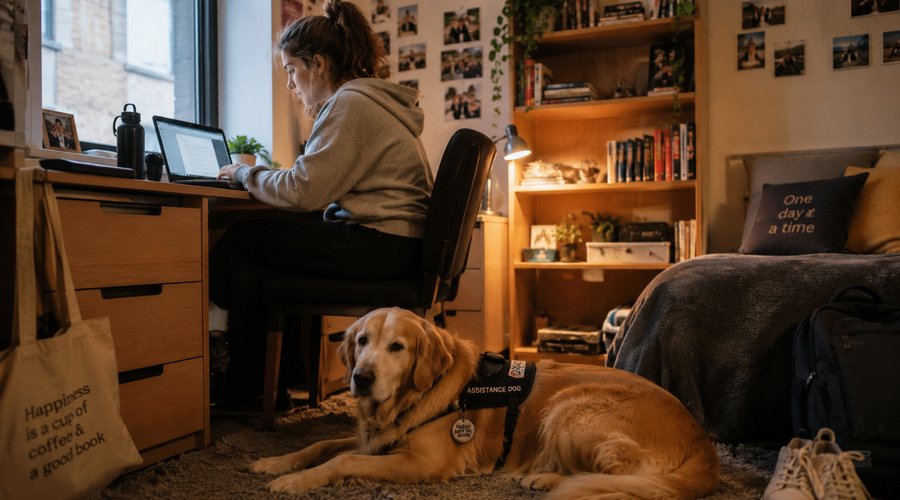
We received a call from a student currently living through exactly this situation. Their university accommodation team told them that only dogs trained and accredited by Assistance Dogs UK (ADUK) would be permitted in halls. The student's dog is owner-trained. The student is disabled and relies on the dog daily. The university told them they could not stay.
That decision is legally wrong. This article explains why, what the student can do, and what university accommodation teams need to understand before they make decisions like this again.
"There is no UK statute, regulation or statutory instrument that requires an assistance dog to be trained by an ADUK member in order to have legal protection in education or housing. ADUK itself says this on its own website."
What the Equality Act 2010 actually says about university accommodation
University accommodation is not a grey area under UK equality law. The Equality Act 2010 is explicit.
Section 91 of the Act places obligations directly on the "responsible body" of a higher education institution. That responsible body must not discriminate against a student or prospective student in the way it affords them access to a benefit, facility or service. On-campus accommodation is a benefit, facility or service. There is no serious legal argument that it is not.
Section 20 sets out the three-part reasonable adjustments duty. A university must change any provision, criterion or practice that puts a disabled student at a substantial disadvantage compared to non-disabled students. A blanket no-dogs policy applied without any consideration of whether the dog is an assistance animal needed by a disabled student is precisely such a provision. It places the disabled student at a substantial disadvantage: they either go without their dog or they go without housing.
Section 21 makes this unmistakeable: a failure to comply with the reasonable adjustments duty is itself a form of discrimination. There is no general justification defence for a failure to adjust.
Section 149 — the Public Sector Equality Duty — applies to universities as public bodies. They must have due regard to the need to eliminate discrimination and advance equality of opportunity for disabled people. A written policy that categorically excludes owner-trained assistance dogs from halls is very difficult to reconcile with that duty.
The EHRC's own technical guidance on further and higher education makes one additional point that many universities miss: the reasonable adjustments duty is anticipatory. A university cannot wait until a student with an assistance dog knocks on the accommodation office door and then scramble to work something out. Policies and procedures must be in place in advance. A university with no clear assistance dog policy for halls may already be in breach of the Act before any individual student has even applied.
Legal framework at a glance
The Equality Act 2010: four sections that protect you
All four apply to university accommodation. None require ADUK accreditation.
§91
Higher Education
University accommodation is a benefit, facility or service. Refusing a disabled student access to it is discrimination.
§20
Reasonable Adjustments
Universities must change any policy that puts a disabled student at a substantial disadvantage. A blanket no-dogs rule is exactly this.
§21
Duty to Adjust
Failing to make a reasonable adjustment is itself a form of discrimination. There is no general justification defence.
§149
Public Sector Duty
Universities must advance equality for disabled people. This duty is anticipatory — policies must be ready before a student even asks.
Training organisation — ADUK or otherwise — is irrelevant to every one of these sections.
Owner-trained assistance dogs: identical rights, a widespread misunderstanding
One of the most common and damaging misunderstandings in this area is the belief that only charity-trained or ADUK-accredited dogs have legal rights as assistance animals. This is false.
Under the Equality Act 2010, the relevant question in an education or housing context is whether the person is disabled within the meaning of section 6 of the Act, and whether the dog is an auxiliary aid that mitigates the effects of that disability. Training organisation plays no role in answering either of those questions.
A dog trained by its handler over three years to detect a medical episode carries the same legal protection under Parts 3 and 6 of the Equality Act as a dog trained by a charity. The law does not distinguish between them. A university that treats them differently is applying a distinction the law does not make.
Owner-trained assistance dogs carry the same legal protections as charity-trained dogs in UK universities.
Waiting times for charity-trained assistance dogs in the UK are commonly two to three years. Many students with a genuine need for an assistance dog will arrive at university with an owner-trained dog, not because they chose an easier route, but because the alternative was to wait through their entire degree. The law accounts for this reality. University policies must too.
The ADUK accreditation myth: where it comes from and why it is wrong
Many organisations that wrongly demand ADUK accreditation point to section 173 of the Equality Act 2010 as their justification. It is worth being precise about what that section actually does.
Section 173 defines "assistance dog" for the purposes of Part 12 of the Act only. Part 12 covers transport: taxis, private hire vehicles and public transport. Within that narrow context, section 173 names a list of prescribed charities whose dogs receive specific protections in taxi licensing law.
That definition does not apply to Parts 3 or 6 of the Act, which govern services and education. It does not define which dogs have any assistance animal protection in shops, restaurants, hotels, universities or housing. It is a transport-specific clause, and using it to justify a blanket "ADUK-only" policy in halls is a fundamental misreading of the statute.
There is one further irony. ADUK itself is explicit on this point. ADUK's own published guidance states that disabled people are not legally required to carry identification for their assistance dog, and that ADUK does not restrict public access rights to its member partnerships. A university demanding ADUK accreditation is going further than ADUK itself asks. The accrediting body has said the restriction is not required. The university imposing it anyway has no legal basis for doing so.
"ADUK has stated publicly that disabled people are not required to carry ID for their assistance dog and that ADUK does not restrict access to its member partnerships only. A university demanding ADUK accreditation is going further than ADUK itself asks."
The EHRC confirmed the same principle in early 2026 when it formally warned JD Wetherspoon that its policy of requiring ADUK photo ID before admitting assistance dogs may breach the Equality Act 2010. A university with a written policy that does the same thing faces identical legal exposure.
The tribunal case that already decided this
This is not a theoretical argument. A tribunal has already considered the exact issue and found against the organisation imposing an ADUK-only criterion.
In 2023, the First-tier Tribunal for Scotland (Health and Education Chamber) decided case reference FTS/HEC/AC/23/0199. An education authority had adopted a blanket policy that only dogs trained by ADUK or an ADUK-accredited body would be considered. The tribunal found that this approach was itself unlawful. By adopting a blanket criterion, the responsible body had made it impossible to ever actually investigate whether a dog was capable of performing assistance tasks. The policy prevented a fair assessment from taking place. That failure was the breach.
The Equality Act 2010 applies across England, Scotland and Wales. The principle the tribunal applied is not confined to Scotland. A university in any part of the UK that adopts the same blanket approach is exposed to the same finding.
What to do if your university refuses: a step-by-step guide for handlers
If your university accommodation team has refused your assistance dog, or has told you that your dog must be ADUK accredited, take these steps in order.
Step 1: Get the refusal in writing. Do not accept a verbal decision. Email the accommodation office and ask them to confirm in writing the reason for the refusal and the specific policy they are applying. This creates the paper trail you need for every step that follows. Keep every email, letter and note of phone conversations.
Step 2: Contact the Disability Office. Your university's disability or student services team may not be aware of what the accommodation office has done. Contact them in writing. Request a formal reasonable adjustments assessment under section 20 of the Equality Act 2010. Send the template letter below.
Step 3: Use the internal complaints procedure. Every UK university must have a formal student complaints process. A refusal to accommodate your assistance dog is a disability discrimination complaint. Submit it formally, in writing, citing section 91 and section 20 of the Equality Act 2010. Ask the university to issue a Completion of Procedures letter when the internal process concludes. You need this letter before you can escalate externally.
Step 4: The Office of the Independent Adjudicator (OIA). Once you have your Completion of Procedures letter, you can bring a complaint to the OIA within 12 months. The OIA is free, independent and covers all member universities in England and Wales. It can require universities to pay compensation and change their policies. If it finds in a student's favour, the finding is published.
Step 5: The Equality and Human Rights Commission. The EHRC has statutory enforcement powers. It can issue compliance notices, conduct formal investigations and require organisations to change their practices. If your situation involves what appears to be a systemic policy rather than an individual mistake, contact the EHRC directly.
Step 6: County court. A county court claim for disability discrimination under the Equality Act 2010 does not require a solicitor to initiate. Damages are uncapped in principle. The Vento guidelines set bands for injury to feelings: the middle band currently runs from £12,600 to £37,700 and the upper band from £37,700 to £62,900 for the most serious cases. Financial losses, such as costs of alternative accommodation or missed education, are claimable separately. Citizens Advice and Disability Rights UK can both provide initial guidance at no cost.
Template letter to send to your accommodation team
Copy and adapt this letter. Send it by email and keep a copy. Replace the bracketed sections with your own details.
USE THIS WORDING
Dear [Name / Accommodation Services Team],
I am writing to formally request a reasonable adjustment under section 20 of the Equality Act 2010 regarding your decision to refuse my assistance dog from university accommodation.
I am a disabled person within the meaning of section 6 of the Equality Act 2010. My dog is an assistance animal that I rely on to mitigate the effects of my disability. The dog is owner-trained. There is no provision of UK law that requires an assistance dog to be trained by an ADUK member or any other specific organisation in order to benefit from legal protections under Parts 3 and 6 of the Equality Act 2010. The definition at section 173 of the Act applies only to Part 12 transport provisions and does not govern education or housing.
University accommodation is a benefit, facility or service within the meaning of section 91 of the Act. A blanket policy requiring ADUK accreditation as a precondition for accommodation constitutes a provision, criterion or practice that places me at a substantial disadvantage compared to non-disabled students. This is indirect discrimination unless the university can demonstrate it is a proportionate means of achieving a legitimate aim. I respectfully submit that it cannot.
I ask you to confirm in writing within five working days whether you will revise this decision. If you do not, I will escalate this matter through the university's formal complaints procedure, the Office of the Independent Adjudicator and, if necessary, the county court.
Yours sincerely, [Your full name] [Student number] [Course and year] [Date]
Get UK assistance dog law updates
Join thousands of UK handlers. We email when the law changes. No spam, no renewal fees.
An open letter to university accommodation teams
If you work in a university accommodation office, disability services team or student welfare role, this section is written directly for you. Please read it carefully before the next request from a student with an assistance dog lands on your desk.
We understand that many accommodation teams are acting in good faith. Some have been told by management or legal teams that ADUK accreditation is a reasonable requirement. Some have inherited policies written years ago by people who were not specialists in equality law. Some are worried about how to verify that a dog is genuinely trained. These are real concerns, and they deserve a real answer.
But the answer to those concerns cannot be a blanket "ADUK only" rule. That rule is almost certainly unlawful. And the consequences of applying it to a student who then pursues their legal rights are far more disruptive and expensive than the process of getting your policy right now.
Here is what the law requires you to do.
When a student with an assistance dog requests accommodation, you must assess their request individually. You must consider whether the dog is an auxiliary aid that the student needs to mitigate the effects of their disability. You must make any reasonable adjustment that would allow the student to access accommodation on an equal basis with non-disabled students. ADUK accreditation is not a proxy for this assessment. It is a voluntary quality standard that some organisations have achieved. It tells you nothing about whether this student needs this dog in this accommodation.
ADUK has published a quick guide specifically for further and higher education providers titled "Welcoming Students with Assistance Dogs in FE and HE." It is free and available from the ADUK website. It explicitly states that students are not required to have ADUK-registered dogs. If you have not read it, read it today. ADUK itself is telling you that your ADUK-only policy goes beyond what is required or appropriate.
What universities are actually allowed to do (and what they are not)
It is important to be precise here, because this is not a one-sided picture. Universities do have legitimate interests and the law recognises them.
What a university cannot do:
Apply a blanket policy that only ADUK-accredited dogs are permitted
Refuse a dog without any individual assessment of the student's disability-related need
Refuse a dog solely because it is owner-trained
Refuse to consider a reasonable adjustments request without engaging substantively with the evidence
What a university can legitimately do:
Ask the student to describe, in their own words, what tasks the dog performs for them — but cannot require the student to produce medical evidence, a diagnosis, or documentation of their disability as a condition of accessing accommodation
Work with the student on practical arrangements: designated dog-relief areas, flooring considerations, communal space protocols
Act swiftly if a dog displays genuinely dangerous behaviour, causes a health and safety hazard or is persistently disruptive in ways not related to the student's disability
Work with the student to find alternative accommodation arrangements if a specific halls building genuinely cannot accommodate the dog, provided equivalent accommodation is offered
The key distinction is this: a university can manage the process of accommodating an assistance dog. It cannot use process as a reason to refuse. If a dog is genuinely not behaving as a trained assistance dog, if it is aggressive, uncontrolled or presents a real risk to other students, there is a legitimate basis for acting on that behaviour. But the dog's training organisation is not evidence of its behaviour, and the absence of ADUK accreditation is not evidence of danger.
FOR ACCOMMODATION STAFF: What to do when a student arrives with an assistance dog
Do not ask whether the dog is ADUK registered. Ask whether the student has a disability-related need for the dog.
Ask the student to provide a brief written statement describing what the dog does to assist them. Do not require a letter from a GP, specialist or healthcare provider — students cannot be required to produce medical documentation of their disability to access accommodation. If a student volunteers supporting evidence, you may note it, but it cannot be a condition.
Treat the request as a reasonable adjustments request under section 20 of the Equality Act 2010 and follow your university's existing adjustments procedure.
If your university has no such procedure for assistance dogs in halls, escalate to your disability services team and legal team today. The absence of a procedure is itself a risk.
Document the assessment and the outcome in writing and share it with the student.
If you are uncertain, the EHRC helpline (0808 800 0082) and ADUK's own HE guidance are available free of charge.
📄
Free: Assistance Dog Law Card
Your legal rights on one card. Show it to accommodation teams, landlords, cafes and anyone who challenges you. Wallet-sized and QR-linked.
The consequences of getting this wrong: OIA, EHRC and the county court
University legal teams should be aware that the exposure from an unlawful refusal of an assistance dog in halls is not trivial.
Office of the Independent Adjudicator (OIA). The OIA reviews complaints from students at member institutions in England and Wales after the internal complaints process has concluded. It can find against a university and require it to pay financial compensation to the student, change its policies and provide evidence of compliance. OIA findings are published, even if the student's identity is anonymised. A published finding that a university discriminated against a disabled student over an assistance dog would attract significant attention.
Equality and Human Rights Commission (EHRC). The EHRC has formal enforcement powers under the Equality Act 2006. It can conduct formal investigations, issue compliance notices and enter binding agreements. Where a university policy is systemic rather than an individual error, the EHRC is in a position to require institution-wide change. Its warning to JD Wetherspoon in early 2026 demonstrates its willingness to engage with exactly this type of blanket accreditation requirement.
County court. A student who has been unlawfully refused accommodation can bring a county court claim for disability discrimination. Injury to feelings damages under the Vento guidelines currently reach up to £62,900 in the most serious cases. Add financial losses (cost of private accommodation, travel, disruption to studies), and potential psychiatric harm if the situation has caused a mental health impact, and the potential award becomes significant. Legal costs may also be awarded against the university. There is no cap on the overall award.
Office for Students (OfS). The OfS regulates English universities and has the power to take action where registered providers fail in their obligations to students. A pattern of failures to support disabled students is within scope of OfS scrutiny.
Reputational damage. In the current environment of heightened public and media attention on assistance dog discrimination, a named university would face considerable reputational consequences. Student unions, disability charities, national press and social media would all engage with a story of a disabled student forced out of halls over a dog they legally have the right to keep.
"The cost of revising a university accommodation policy is a few hours of staff time. The cost of defending an unlawful refusal in the county court, OIA and public scrutiny is far greater. The right decision is also the straightforward one."
🐾 Protect your rights with a registered profile
An ADR registration gives you a QR-linked online profile, smart ID card and NFC tag that accommodation teams, landlords and access checkers actually respond to. Thousands of UK handlers are already registered.
The bigger picture: owner training is growing and this will become more common
Waiting times for charity-trained assistance dogs in the UK range from 18 months to three years or more. The demand for assistance dogs continues to grow. The number of people who are owner-training their dogs, either independently or with the support of training organisations that are not ADUK members, is increasing year on year.
The students arriving at UK universities over the next five years will include many more people with owner-trained assistance dogs than universities have seen before. Universities that have not thought carefully about their policies now will face these situations repeatedly, and the legal framework will not change to accommodate policies that exclude owner-trained dogs. Those policies are already unlawful.
The universities that are getting this right are worth noting. Newcastle University has a published assistance dog policy for halls that grounds any refusal only in genuine health and safety concerns and requires individual assessment. Bangor University explicitly acknowledges owner-trained assistance dogs in its campus animal policy. These are not unusual positions. They are the legally correct ones, and they protect both the student and the institution.
If you are a student starting university and you have an owner-trained assistance dog, you do not need to accept a refusal. The law is on your side. Use it.
If you are an accommodation professional reading this, you now have everything you need to review your policy and get it right. The time to do that is before the next student asks, not after.
Universities that get this right protect both the student and the institution. The law is clear — get the policy right before the next request arrives.
Was this article helpful?
About this guide
This article was researched using published tribunal decisions, EHRC guidance, parliamentary committee evidence and official university policy documents. All legal citations have been checked against legislation.gov.uk. We update our articles when the law or official guidance changes.
Assistance Dog Registry has supported thousands of UK assistance dog handlers since 2020, supplying 20,000+ ID cards. Articles reviewed against UK primary legislation and official EHRC, GOV.UK, Citizens Advice and NHS guidance. About ADR
This article provides general information, not legal advice. The law in this area involves individual facts and circumstances. What applies in one situation may not apply in another.
A dog trained to perform specific tasks that mitigate the effects of a person's disability. Under UK equality law (outside narrow transport provisions), this includes owner-trained dogs as well as those from charity or accredited organisations.
ADUK (Assistance Dogs UK)
A voluntary coalition of UK assistance dog charities that have achieved accreditation through Assistance Dogs International or the International Guide Dog Federation. ADUK accreditation is a quality standard, not a legal requirement for public access or housing rights.
Reasonable adjustment
A change a service provider or education institution must make to remove a substantial disadvantage faced by a disabled person. The duty to make reasonable adjustments under section 20 of the Equality Act 2010 is anticipatory and ongoing.
Indirect discrimination
Under section 19 of the Equality Act 2010, a provision, criterion or practice that puts a disabled person at a particular disadvantage compared to non-disabled people, which cannot be justified as a proportionate means of achieving a legitimate aim.
OIA (Office of the Independent Adjudicator)
The independent body that reviews student complaints against higher education providers in England and Wales after internal processes have concluded. Free to use, with powers to require compensation and policy change.
EHRC (Equality and Human Rights Commission)
The statutory body responsible for enforcing equality and human rights law in Great Britain. It has powers to investigate organisations, issue compliance notices and bring legal proceedings. Helpline: 0808 800 0082.
Public Sector Equality Duty (PSED)
Under section 149 of the Equality Act 2010, public bodies including universities must have due regard to the need to eliminate discrimination and advance equality of opportunity for disabled people in everything they do.
To provide the best experiences, we use technologies like cookies to store and/or access device information. Consenting to these technologies will allow us to process data such as browsing behavior or unique IDs on this site. Not consenting or withdrawing consent, may adversely affect certain features and functions.
Functional
Always active
The technical storage or access is strictly necessary for the legitimate purpose of enabling the use of a specific service explicitly requested by the subscriber or user, or for the sole purpose of carrying out the transmission of a communication over an electronic communications network.
Preferences
The technical storage or access is necessary for the legitimate purpose of storing preferences that are not requested by the subscriber or user.
Statistics
The technical storage or access that is used exclusively for statistical purposes.The technical storage or access that is used exclusively for anonymous statistical purposes. Without a subpoena, voluntary compliance on the part of your Internet Service Provider, or additional records from a third party, information stored or retrieved for this purpose alone cannot usually be used to identify you.
Marketing
The technical storage or access is required to create user profiles to send advertising, or to track the user on a website or across several websites for similar marketing purposes.