
Can Shops Refuse Assistance Dogs in the UK? Your Legal Rights Explained

Can a Business Legally Refuse an Assistance Dog in the UK?

Your Rights Under the Equality Act 2010

If you rely on an assistance dog, one of the most stressful situations you can experience is being challenged in public.

You walk into a café, shop, or restaurant and a member of staff suddenly says:

“Sorry, no dogs allowed.”

People look at you. You feel embarrassed, frustrated, and unsure how to respond.

Many assistance dog handlers experience this at some point. The problem is that many businesses simply do not understand the law.

So the question is:

Can a business legally refuse an assistance dog in the UK?

In most situations, the answer is no.

Understanding your legal rights can make these situations much easier to handle.


The Law: The Equality Act 2010

The legal protection for assistance dog handlers in the UK comes from the Equality Act 2010.

Under this law, businesses must make reasonable adjustments so disabled people can access services in the same way as everyone else.

For many disabled people, an assistance dog is an essential part of daily life. These dogs perform important tasks such as:

  • guiding people with visual impairments
  • alerting to medical conditions
  • providing mobility support
  • assisting with psychiatric or neurological disabilities

Because of this, refusing entry to someone simply because they are accompanied by an assistance dog can amount to disability discrimination.

This means businesses should usually allow assistance dogs into places such as:

  • shops
  • cafés and restaurants
  • taxis and public transport
  • hotels and accommodation
  • supermarkets
  • public buildings

Even if a business normally has a “no dogs” policy, assistance dogs are generally an exception.


Do Assistance Dogs Need to Be Registered in the UK?

This is one of the most common misunderstandings.

Under the Equality Act 2010, assistance dogs do not need to be officially registered with any government organisation.

The law does not require:

  • registration
  • ID cards
  • special jackets or vests
  • certification from a particular training organisation

Many assistance dogs in the UK are owner-trained, and they can still be protected under the Equality Act as long as they assist a disabled person with tasks related to their disability.

However, misunderstandings still happen because many businesses are not fully aware of how the law works.


What Businesses Are Allowed to Ask

Although businesses should not refuse access simply because of the dog, staff may ask reasonable questions to understand the situation.

For example, they may ask:

  • Is this an assistance dog required because of a disability?
  • What tasks does the dog help you with?

These questions help staff understand that the dog is working and not simply a pet.

However, businesses should not demand medical proof or detailed personal information about your disability.

You are not required to disclose private medical details in order to access services.


What To Do If You Are Refused Entry

If a business refuses your assistance dog, the situation can feel upsetting and confrontational. However, staying calm often helps resolve the issue quickly.

Here are some practical steps you can take.

Stay calm and explain politely

Many staff members simply do not understand the law. Calmly explaining that your dog is an assistance dog protected under the Equality Act can often resolve the situation.

Ask to speak with a manager

Managers are usually more familiar with policies and may resolve the issue quickly.

Briefly explain the Equality Act

You can explain that refusing access because of an assistance dog may be considered disability discrimination under the Equality Act 2010.

Document the incident if necessary

If the problem continues, you may wish to note the business name, location, and what happened. This information can be useful if you decide to make a complaint later.

Most situations resolve quickly once staff understand the legal position.


Why Some Handlers Carry Identification

Although identification is not legally required, many assistance dog handlers choose to carry tools that help avoid misunderstandings.

These may include:

These tools can help staff quickly understand the situation and often prevent uncomfortable confrontations.

Many handlers find that clear identification helps make everyday interactions smoother.


Optional Registry Profiles for Assistance Dog Handlers

Some handlers choose to create a profile in the Assistance Dog Registry to make communication easier when questions arise.

A registry profile can include:

  • handler and dog information
  • optional identification cards
  • an online profile that can be shown if requested

While registration is not required by law, many handlers find that having clear information available helps avoid misunderstandings in public places.


Lifetime Membership With Payment Plans

For handlers who want long-term access to their registry profile and identification tools, the Lifetime Partner Membership offers a permanent option.

This can include:

  • a permanent registry profile
  • a personalised assistance dog ID card
  • a handler and dog information page
  • optional identification accessories

To make this easier for handlers, the Lifetime membership can also be purchased using payment plan options such as Klarna or Clearpay. This allows the cost to be split into smaller payments rather than paying everything upfront.


Final Thoughts

Being challenged in public with an assistance dog can be frustrating, especially when you know your dog is helping you live independently.

The important thing to remember is that under the Equality Act 2010, businesses are generally required to make reasonable adjustments for disabled people. This usually includes allowing assistance dogs to enter premises even if pets are normally not allowed.

Understanding your rights can help you handle these situations calmly and confidently.

At the same time, many handlers choose to carry identification or maintain a registry profile to make everyday interactions easier and avoid unnecessary conflict.

As awareness improves, situations like these should become less common. Until then, having clear information available can make a big difference.

Legal Information Disclaimer

This article is provided for general informational purposes only and does not constitute legal advice.

While every effort has been made to ensure the information is accurate at the time of writing, laws and regulations may change and individual circumstances can vary.

Nothing in this article should be taken as professional legal advice. If you require advice regarding your specific situation, you should contact a qualified legal professional or a relevant support organisation.

For independent guidance on disability rights in the UK, you may contact the Citizens Advice consumer service or seek advice from a qualified solicitor specialising in disability discrimination law.

ACAS Helpline:
📱 0300 123 1100 — Monday to Friday, 8am–6pm (standard UK call rates apply)

Text Relay (for people who are deaf or have speech impairments):
☎️ 18001 0300 123 1100

Register your assistance dog today and enjoy every sunny moment without setbacks.

🎟️ Sign Up for the Lifetime Package Today

💡 Click here to learn more & register


Frequently Asked Questions

Can a business legally refuse entry to an assistance dog in the UK?

In almost all cases, no. Under the Equality Act 2010, refusing a disabled person with an assistance dog is unlawful discrimination unless there is a genuine, objective health or safety reason.

Are there any situations where an assistance dog can be refused?

Rarely. A refusal may be lawful only where there is a specific, evidenced risk, for example certain sterile hospital areas, and the business should still try to make a reasonable adjustment.

Does a “no dogs” policy apply to assistance dogs?

No. A general no dogs policy does not override the Equality Act 2010. Assistance dogs are exempt from such policies.

What should I do if a business refuses my assistance dog?

Calmly explain your rights under the Equality Act 2010, ask for a manager, and record what happened. You can raise a complaint and, if needed, seek advice from the EHRC or Citizens Advice.

Do I need to show certification before entering?

No. There is no legal requirement to prove certification. Voluntary ID can help avoid confrontation but is not required by law.

Sources

Learn more about our Lifelong Partner Package

Learn More – Additional Assistance Dog Letter Templates

If you found this travel guide useful, you may also benefit from these other essential assistance dog letter templates we’ve published:

📌 Housing Accommodation Request Letter – Need to request reasonable accommodation from your landlord? This template ensures your rights under the Equality Act 2010 are respected.

📌 Workplace Assistance Dog Request Letter – If you need accommodations to bring your assistance dog to work, this letter outlines your legal rights and reasonable adjustments your employer should consider.

📌 Medical Confirmation of Need for an Assistance Dog – A doctor’s letter template to confirm your need for an assistance dog for public access, travel, and daily life.

🔹 More templates are coming soon! Let us know if you have specific needs, and we’ll create more resources to support assistance dog handlers.

ADR
Written & reviewed by the ADR Team
Assistance Dog Registry, supporting UK assistance dog handlers since 2020

We're a UK-based team dedicated to assistance dog handlers. Since 2020 we've supplied 20,000+ assistance dog ID cards and supported thousands of handlers, owner-trained and charity-trained alike. Our guidance on the Equality Act 2010 and assistance dog access rights is referenced in UK public-sector accessibility policy and relied on by NHS staff, employers and carers. We're not a government body: registration is voluntary, and we'll always tell you so honestly. Learn more about us →  |  [email protected]

Related Post

More Helpful Guides for Handlers

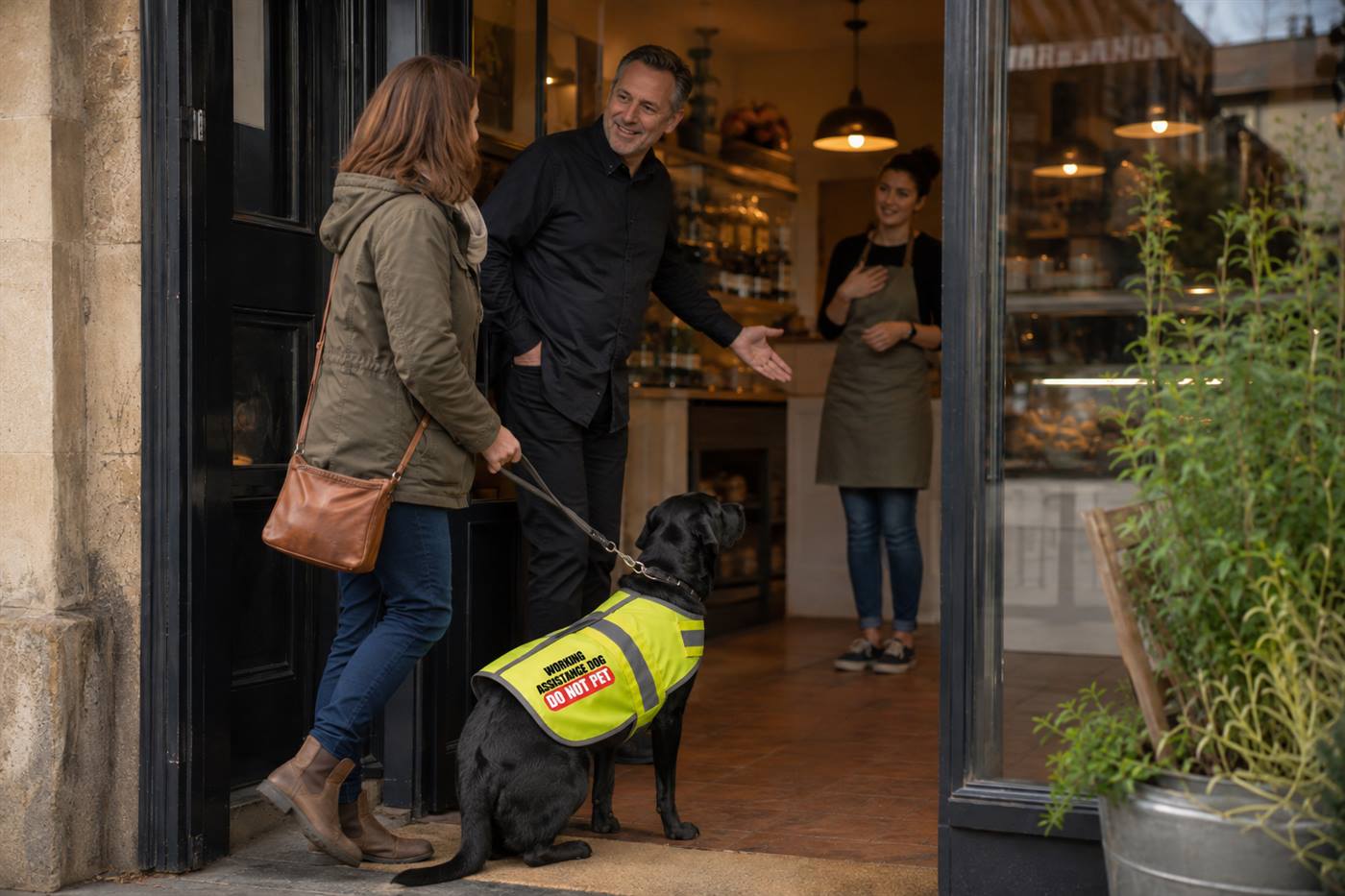
Handler with her black Labrador assistance dog in a hi-vis vest speaking with an uncertain member of staff at a cafe doorway
Est. Reading: 8 minutes

What To Say When a Shop Challenges Your Assistance Dog (UK Guide)

Handler with her black Labrador assistance dog in a hi-vis vest speaking with an uncertain member of staff at a cafe doorway

Takeaway first: if a shop, cafe or taxi challenges your assistance dog, the law is already on your side. You do not need to win an argument. You need a calm thirty seconds, three sentences, and something quick to show. This guide gives you all three.

The moment nobody prepares you for

It usually happens fast. You are halfway through the door, thinking about your shopping list, and someone in a uniform says the sentence every handler dreads: "Sorry, no dogs allowed."

Your heart rate goes up. People are looking. And in that moment, the law, your rights and every article you have ever read seem very far away.

This post is about exactly that moment. Not the theory, the moment. What is actually happening, what to say, and how it usually ends when you handle it calmly. If you want the full legal background first, our complete guide to your rights as an assistance dog owner covers it in depth. This page is the field version.

First, know what is actually happening

Here is the thing that changes how the whole conversation feels: the person challenging you is almost never hostile. They are usually wrong, and usually trainable.

Most refusals come from a staff member who has been told "no dogs" as a hygiene rule and has never been taught the exception. They are not enforcing a considered policy. They are repeating a sentence. Which means your job is not to fight them. Your job is to give them a reason to change their mind that they can defend to their own manager.

It also helps to be clear about what your dog is in the eyes of the law. If you are ever unsure where your dog stands, our guide to what counts as an assistance dog in the UK explains it plainly, including the fact that owner-trained dogs qualify.

The three sentences that end most challenges

Handlers tell us the same pattern works again and again. Calm voice, no lecture, three steps:

1. Name what the dog is.
"This is my assistance dog. She is trained to support my disability."

2. Name the law, once.
"Under the Equality Act 2010, assistance dogs are allowed to accompany their handlers in places like this. Refusing us would be disability discrimination."

3. Move it up, politely.
"If you are not sure, could you check with your manager? I am happy to wait a moment."

That third sentence matters more than people expect. It takes the decision away from the most junior person in the building, who has the least authority to say yes, and gives it to someone who can. Managers say yes far more often than doorstaff, because managers know what a discrimination complaint costs.

Cafe manager smiling and welcoming a handler and her black Labrador assistance dog inside after being asked to check
The third sentence at work: the decision reaches someone with the authority to say yes.

Do not take our word for it

Check the law yourself. The duty to make reasonable adjustments for disabled people is in section 20 of the Equality Act 2010. Taxis and private hire vehicles have their own separate duties in section 168 and section 170, both titled "Assistance dogs". The Equality and Human Rights Commission guide for businesses (PDF) spells out the same duties in plain English, and it is written for the very people who might be challenging you. You will notice none of these mention a certificate, a card or a register. Your rights come from your disability and your dog's training, not from any document.

We say this on every page we write, because it is true and because you deserve to know it: no card grants rights, including ours. If you want the full picture of who can and cannot certify an assistance dog in this country, we wrote about it honestly in Who can certify your assistance dog in the UK? You already have the right. Everything below is about making that right quick and painless to use.

Why the argument still happens, and how to shorten it

Here is the honest gap in the system. The Equality Act gives you the right, but it does not give the shop worker any way to recognise it in five seconds. There is no official badge, no government card, nothing a busy staff member can glance at. The government gave you the right. Nobody gave you the tools.

So the conversation at the door becomes a trust exercise between two strangers, and that is exactly where it goes wrong. The staff member is not asking "does this person have rights". They are asking "how do I know, and what do I tell my boss".

That is the gap handlers fill in practical ways:

  • Something visible on the dog. A vest or lead slip that says assistance dog answers the question before it is asked. Most challenges never happen when the dog is clearly identified.
  • Something quick to show. Many handlers carry a card stating the dog is an assistance dog and citing the Equality Act. Staff respond to it not because it is official, but because it gives them something concrete to point to when they wave you through. The card is for them, not for you.
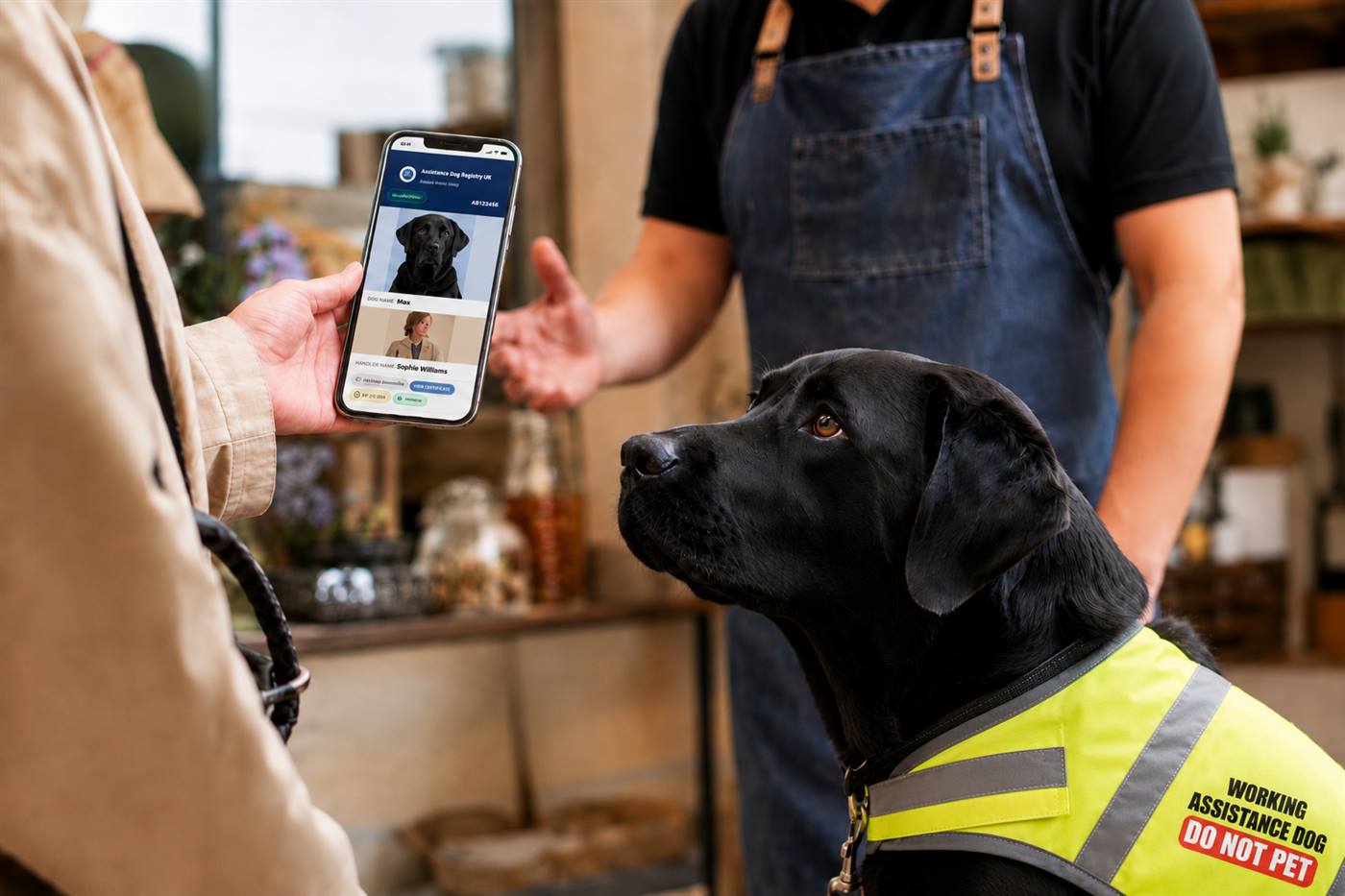
  • Something they can check. A QR code that opens a live profile showing your dog's details lets a doubtful manager satisfy themselves in ten seconds without anyone raising their voice.
Handler showing a shop worker a live assistance dog registry profile on a smartphone while the black Labrador in a hi-vis vest looks up calmly
Ten seconds, no argument: a live profile answers the question staff are actually asking.

None of these are legally required. All of them shorten the moment. That is their entire job. Our pocket guide to UK assistance dog rights is built for the same purpose: the law, condensed to what you can actually use standing in a doorway.

Special cases worth knowing

Dogs in training. The protections read differently while your dog is still learning. Our guide to assistance dogs in training and your rights covers that stage honestly.

Pubs and restaurants. Food premises are where "hygiene" gets used as a refusal reason most often, and it is wrong: food hygiene law explicitly permits assistance dogs in customer areas. We took apart a real case in what UK law really says when a pub refuses an assistance dog.

Work and housing. The same Equality Act reasoning extends to your job and your tenancy. See your assistance dog rights at work and, if you rent, the Renters' Rights Act and no-pets clauses.

If they still refuse

Sometimes the answer stays no. When it does, do not escalate at the door. Do this instead:

  • Ask for the refusal in writing, or the name of the person refusing and the reason. Most refusals evaporate right here, because nobody wants to sign their name to discrimination.
  • Leave calmly and keep your evidence. Date, time, place, names, what was said. A photo of the shopfront helps.
  • Complain to the business in writing, citing the Equality Act 2010. Head offices take these seriously, and most respond with an apology and staff retraining.
  • For taxis, report to the local licensing authority. Refusing an assistance dog can cost a driver their licence, and licensing authorities do act on it. Government guidance for taxi licensing backs this up.
  • The Citizens Advice guide to the duty of reasonable adjustments explains the formal routes if you want to take it further, including court action for discrimination.

What this looks like when it works

A member called us recently from a bingo hall, mid refusal. She was flustered, the staff member was firm, and the evening was about to be ruined. The advice was the three steps above: name the dog, name the law once, ask for the manager. Two minutes later she was inside, with an apology. Nothing about her rights changed in those two minutes. What changed was that the decision reached someone with the authority to make it.

That is the pattern. The law does the heavy lifting. You just need to stay calm long enough for it to arrive.

Make the moment shorter

If you want the practical tools handlers use at the door, they are what we make:

And if you only take one thing from this page, take the three sentences. They cost nothing, and they end most challenges before they start.

The Assistance Dog Registry team


Handler showing an identity card to cafe staff with an assistance dog in a plain black harness
Est. Reading: 8 minutes

Who Can Certify Your Assistance Dog in the UK?

Handler showing an identity card to cafe staff with an assistance dog in a plain black harness
UK Assistance Dog Law

Who Can Certify Your Assistance Dog in the UK?

Nobody can. Not the government, not ADUK, and not us. Here is who actually has authority over assistance dogs in the UK, why the yellow booklet became a myth, and what the law really asks of you at a door.

📖 5 min read·By the ADR Team·Updated August 2026

Key takeaways
  • There is no official register of assistance dogs in the UK. No government body licenses them and no certificate carries legal weight.
  • ADUK is a coalition of charities, not a regulator. It has no statutory role and no authority over any handler.
  • The legal test is what your dog does, not who trained it. Owner-trained assistance dogs have the same rights as charity-trained ones.
  • A voluntary registry cannot give you rights, but it can give you a fast way to show them. That is the whole of what it is for.
  • We cannot certify your dog either. Nothing we issue creates a right you did not already have under the Equality Act 2010.

Somebody stops you at a door and asks to see proof that your dog is an assistance dog. You reach for something. The question is what, and who decided it counts.

The short answer is that nobody decided, because nobody can. There is no organisation in the United Kingdom with the authority to certify an assistance dog. Not a government department, not a charity, not a coalition of charities, and not us.

That sentence surprises people, so it is worth going through slowly.

There is no official register of assistance dogs in the UK

No government body licenses assistance dogs. No department maintains a list. There is no application, no inspection, and no certificate that carries legal weight, because Parliament never created one.

What Parliament created instead was a right. The Equality Act 2010 protects disabled people who use assistance dogs, and it places duties on service providers, employers and landlords. Those duties exist whether or not anyone has ever seen a piece of paper.

This matters more than it sounds. If the law required certification, whoever issued the certificates would hold enormous power over disabled people. The law does not work that way, and that is deliberate.

So what is a voluntary registry actually for?

If nobody can certify your dog, the fair question is what any registry is for. The honest answer is that it is not there to give you rights. You already have those.

What the Equality Act does not give you is a quick way to demonstrate those rights while somebody is standing in front of you and a queue is building behind you. That moment is the problem. You are being asked to explain your disability to a stranger, in public, while your dog waits and people watch.

Do not take our word for it. The Equality Act 2010 is free to read in full on the government's own website. Shops, restaurants and other service providers have a duty to make reasonable adjustments under section 20, and subsection 5 of it covers what the Act calls an auxiliary aid.

Taxis and private hire vehicles have their own separate duties, in section 168 and section 170. Both are titled "Assistance dogs". Neither mentions a booklet, a card or a register. For what this means in practice, see our guide to whether a business can legally refuse an assistance dog.

Man reading the Equality Act on a laptop at home with his assistance dog beside him
The Equality Act is free to read in full. You do not need anyone's permission to check what it says about you and your dog.

A voluntary registry gives you something to hand over instead. A card, a tag, a profile the other person can look at and check for themselves. It does not make your dog more legitimate than it already was. It ends the conversation in seconds rather than minutes, and it moves the burden off you.

Put simply, the card is not for you. It is for them. You already know your dog is an assistance dog. The card exists so the person at the door can stop asking.

The same is true of the free things. A pocket guide with the actual wording of the law, a step by step kit for a refusal, and ready made letters for a landlord or an employer all work whether or not you ever register anything. They exist because knowing what to say is often worth more than anything you can hold up.

What Assistance Dogs UK actually is

Assistance Dogs UK, usually shortened to ADUK, is a coalition of assistance dog charities. It is a membership body. Organisations join it, and it sets standards that its member organisations agree to work to.

That is a legitimate and useful thing to be. What it is not is a regulator.

ADUK has no statutory role. It was not created by legislation, it has no powers granted by Parliament, and it has no authority over anyone who is not a member of it. It cannot license a dog, it cannot refuse to license a dog, and it cannot rule on whether any particular animal is or is not an assistance dog in law. It is an association of charities, not a licensing authority.

So when a business asks to see an ADUK booklet, they are asking for something that a handful of charities issue to people who trained through those charities. They are not asking for a legal document, because no legal document exists.

Why so many people believe otherwise

The belief did not appear from nowhere, and the people who hold it are not being unreasonable.

Most assistance dogs that the public encounters were trained by large, well known charities. Those dogs often carry a distinctive booklet or an identity card. Over time, staff in shops, restaurants and taxis learned to look for that booklet, because in their experience the dogs that had one were the genuine article.

That is a reasonable pattern to notice. The mistake is turning a pattern into a rule. The booklet became, in the public mind, the thing that made the dog real, when in law it was only ever evidence that one particular charity had trained one particular dog.

Everyone who does not fit that route gets caught by the gap. That includes people who trained their own dog, which is entirely lawful in the UK, and people whose disability is served by a task no charity currently trains for.

What the law actually asks

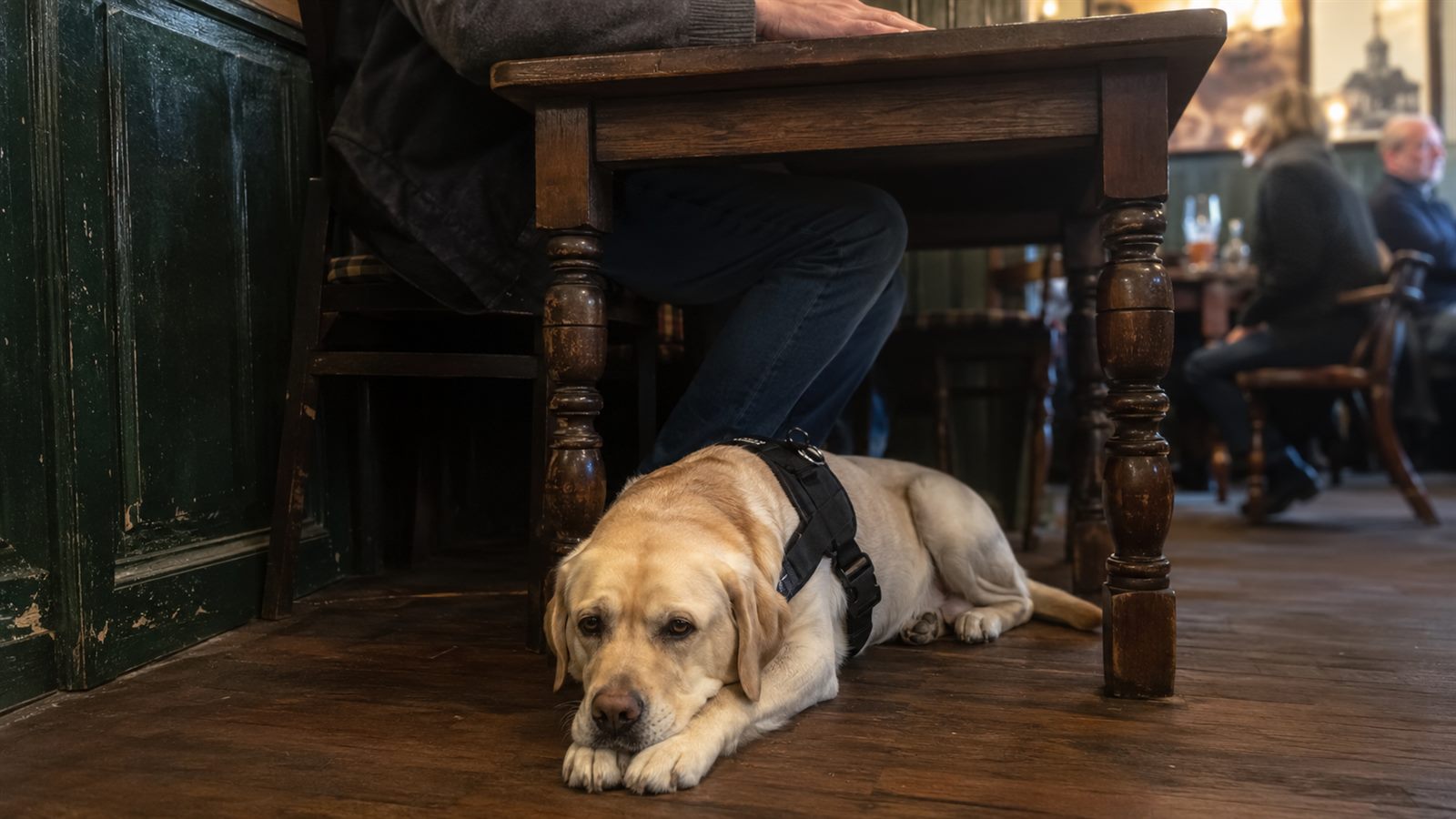
Assistance dog settled quietly under a table in a British pub
This is the actual test. A dog that settles quietly and stays out of the way in a busy room is showing exactly what the law cares about, and no paperwork can demonstrate it for them.

The test in UK law is about what the dog does, not who trained it or who vouched for it. An assistance dog is trained to perform tasks that mitigate the effects of a person's disability. The training route is not the test. The paperwork is not the test.

Owner-trained assistance dogs have the same rights as charity-trained ones. We have written about this before in whether a business can legally refuse an assistance dog and in our guide to what conditions qualify.

A business is entitled to form a view about whether a dog is under control and whether it appears to be a working animal. That is very different from demanding a document, and in practice a great many refusals come down to a member of staff asking for something the law never required.

The part where we hold ourselves to the same test

It would be easy to stop here, having explained that the other lot cannot certify your dog. That would be dishonest by omission, so let us be plain about our own position.

The Assistance Dog Registry cannot certify your assistance dog either. Nobody can. We are a private registry. We are not a regulator, we are not appointed by anyone, and nothing we issue creates a legal right that you did not already have.

What we do is the narrower thing described above. Our cards, tags and profiles are not evidence of authority, because there is no authority to be evidence of. They are a practical tool for a difficult moment, and they should be judged on whether they work in that moment rather than on anything they claim to prove.

That is why our most used resources cost nothing. The UK Assistance Dog Rights Pocket Guide, the letter templates and the refusal kit all work perfectly well whether or not anyone ever buys anything from us. A business selling fake official status would have no reason to give away the thing that makes official status unnecessary.

What to do when you are asked for proof

Being right does not always help in the moment, so here is what tends to work.

  • Stay on the task, not the paperwork. Explain what your dog is trained to do for you. That is the legal test, and it is also the thing most likely to be understood.
  • Do not accept the premise. If someone asks for a certificate, it is fair and calm to say that no such certificate exists in UK law, and that assistance dogs are not licensed in this country.
  • Have something to hand. Not because you are obliged to, but because producing something ends the exchange faster than arguing does.
  • Ask for the decision, politely. If you are being refused, ask whether you are being refused entry, and ask for the person's name. Most refusals evaporate at that point.
  • Write it down afterwards. Our guide on what to say when you are refused entry covers the steps in detail.
Things worth having to hand, none of which cost anything

The UK Assistance Dog Rights Pocket Guide, with the wording to use when you are challenged. The Access Refusal Kit, step by step. Six letter templates for landlords, employers, schools, colleges, hotels and businesses. A free printable ID card and certificate with your dog's name and photo.

Open a free account

No payment, no card details, nothing that turns into a bill later.

The short version

No government body certifies assistance dogs in the UK. ADUK is a coalition of charities, not a regulator, and it has no authority over handlers or over anyone else. We are a private registry and we have no authority either. Your rights come from the Equality Act 2010, they depend on what your dog is trained to do, and they belong to you whether or not anybody has approved of them.

Anyone who tells you differently is either mistaken or selling something. Including, if we ever tell you differently, us.

Est. Reading: 14 minutes

Asked for an ADUK Yellow Booklet at Wetherspoon? What Owner-Trained Assistance Dog Handlers Should Know

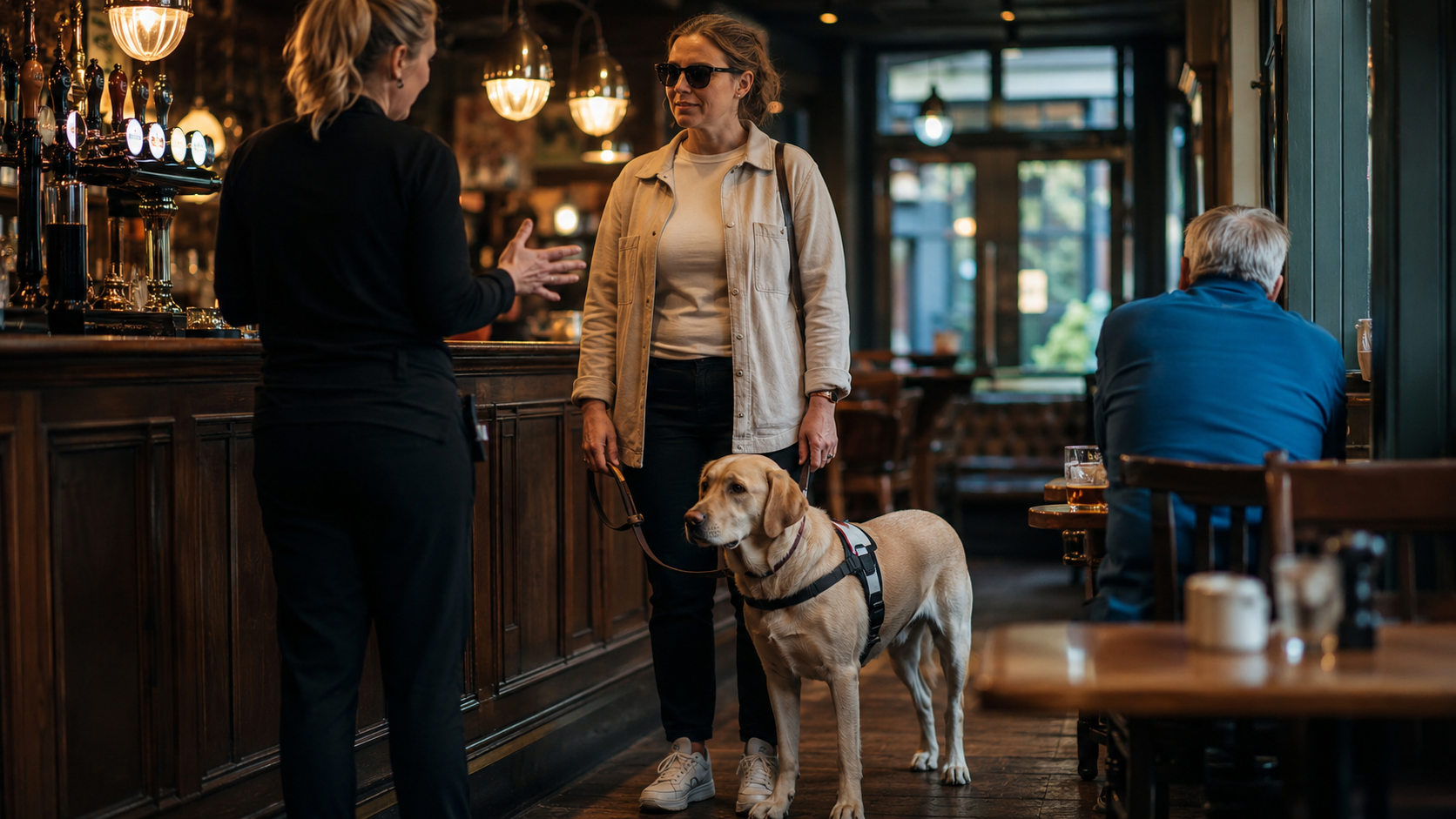
An assistance dog handler talks calmly with bar staff inside a traditional British pub, her Labrador at heel
UK Assistance Dog Law

Asked for an ADUK Yellow Booklet at Wetherspoon? What Owner-Trained Assistance Dog Handlers Should Know

Not all assistance dogs are ADUK-trained, and an ADUK yellow booklet is not the only way handlers organise their information. Here is what the guidance actually says.

📖 8 min read·By the ADR Team·Updated 24 July 2026

📄
Free: Assistance Dog Access Refusal Guide
What to say, what to ask, and what to record if you are challenged or refused entry. Read it online or download the free PDF for your phone.
Get the free guide →
Update · July 2026
The equality watchdog has stepped in

This is no longer just a doorway dispute. The Equality and Human Rights Commission has written to JD Wetherspoon, saying it is concerned the policy may not comply with UK law. A spokesperson said the Commission is “aware that a significant number of disabled people with assistance dogs have been refused entry from JD Wetherspoon venues because they aren’t carrying formal identification.”

Assistance Dogs UK — the charity whose booklet the policy relies on — has said it believes the policy is discriminatory, and that its identification is not a legal requirement. Its chief executive said Wetherspoon approached the charity for guidance before introducing the policy, but “sadly they didn’t take on board any of the advice we provided.”

The charity Guide Dogs said it had received 27 complaints about Wetherspoon from people challenged or refused entry. An MP, Steve Darling, was challenged for ID last August. Wetherspoon maintains its position, saying it considers requiring ADUK-accredited training “a reasonable adjustment,” and citing an increase in dog bites.

What this means for owner-trained handlers

Most coverage has focused on guide dog owners who had the booklet and were still stopped. There is a second group barely mentioned: handlers of owner-trained assistance dogs, who cannot obtain an ADUK booklet at all, because ADUK accredits dogs trained by its member organisations. Under a policy that accepts only ADUK accreditation, a lawful owner-trained team is excluded by design, not by behaviour.

Being straight about the law: it is genuinely unsettled. The Equality Act 2010 requires service providers to make reasonable adjustments and not to treat disabled people less favourably, but it does not set training standards for assistance dogs, and it does not state outright that they must be admitted. Only a court can decide whether a specific policy is unlawful. What is clear is that no UK law requires you to carry ID for an assistance dog.

And straight about us: an ADR card is not ADUK accreditation and will not satisfy this policy. We are a voluntary register, not a government body and not an accreditation scheme. What we can help with is being prepared and knowing exactly what to say, which is why the refusal kit on this page is free and needs no sign-up.

Key takeaways
  • ADUK has publicly said JD Wetherspoon misrepresented its position (statement, 11 February 2026), and that the Equality Act 2010 does not require disabled people to carry ID or documentation for an assistance dog.
  • An ADUK yellow booklet is not a legal requirement. ADUK itself states the booklet is not proof required by law, and not every assistance dog is ADUK-trained.
  • Owner-trained assistance dogs are recognised in UK guidance. An assistance dog does not have to be trained by a charity or an Assistance Dogs UK member organisation.
  • EHRC guidance says a dog needs no jacket, harness or ID book by law. A handler should not be refused simply for lacking documentation.
  • Refusing access only because there is no ADUK booklet may raise Equality Act 2010 concerns, but the dog's behaviour still matters in every case.
  • Ask for the reason in writing. A calm written request turns a doorway misunderstanding into a complaint a venue must answer.
Uses your device's voice. No data sent to anyone.
Asked for a yellow booklet? 3 steps
A calm reply when a venue asks for ADUK ID.
1
Explain calmly
"Not all assistance dogs are ADUK-trained, and an ADUK booklet is not a legal requirement."
2
Ask the right question
"Are you refusing access only because I don't have an ADUK booklet? Please confirm in writing."
3
Record it and follow up
Note venue, time, staff and words. Ask for their assistance dog policy afterwards.
📋 Table of contents (click to expand)
  1. 1. Why this issue keeps happening
  2. 2. What Wetherspoon said, and how ADUK replied
  3. 3. What ADUK says about yellow booklets
  4. 4. What EHRC guidance says about owner-trained dogs
  5. 5. What to say if asked for an ADUK booklet
  6. 6. What to ask for if refused
  7. 7. The behaviour and safety point
  8. 8. Where ADR fits

If you have ever been stopped at a pub door and asked to produce an "ADUK yellow booklet" for your assistance dog, you are not alone, and you have not done anything wrong. It is one of the most common access problems UK handlers report to us, and it lands hardest on people with invisible disabilities and owner-trained assistance dogs, who often have no charity paperwork to wave at a doorway.

This guide explains, calmly and factually, what an ADUK yellow booklet actually is, what Assistance Dogs UK and the Equality and Human Rights Commission (EHRC) really say about it, and exactly what to say if a member of staff insists on seeing one. We are not here to attack any pub chain. We are here to make sure you walk in knowing the facts.

Why this issue keeps happening

Most front-of-house and security staff have a simple mental model: guide dog equals "real" assistance dog, everything else is a pet. That model is decades out of date, but it is sticky, and it causes the same painful scene to play out again and again.

  • Many pubs and venues understand guide dogs but genuinely misunderstand owner-trained assistance dogs, which are trained by the disabled handler rather than a charity.
  • Handlers report being asked specifically for an ADUK yellow booklet, as if it were a national licence, which it is not.
  • This creates real fear and humiliation for people with invisible disabilities such as PTSD, autism, epilepsy or anxiety, whose need for an assistance dog is not visible at a glance.

The result is that a lawful, well-trained assistance dog team can be turned away at the door for the sole reason that they do not carry a particular charity's booklet. Understanding why staff get this wrong is the first step to correcting it without a confrontation.

What Wetherspoon said, and how ADUK replied

In early 2026 this stopped being a quiet doorway-by-doorway problem and became a national talking point. JD Wetherspoon introduced a policy that, in practice, can ask assistance dog handlers for evidence of training before granting access, and its wording referred to Assistance Dogs UK (ADUK). Assistance Dogs UK then published a statement responding directly to it.

Update · 11 February 2026

ADUK has publicly stated that JD Wetherspoon misrepresented ADUK and its position. In its statement, ADUK says Wetherspoon implied that its new policy reflects ADUK policy and legal advice, and that "this is not the case". ADUK also restates that, under the Equality Act 2010, disabled people are not required to carry identification or documentation for their assistance dog, and that ADUK does not tell service providers to restrict access only to dogs trained by ADUK member organisations.

This matters for you as a handler. The very body whose booklet staff so often demand has now said, in public, that requiring proof of training as a condition of entry does not reflect its policy or the law. We are still not making our own finding that any single refusal was unlawful, because policies vary and individual staff get things wrong. But you no longer have to take our word for the central point: ADUK has said it too.

Always check a venue's current published accessibility statement for yourself, because these policies are updated over time, sometimes in response to exactly this kind of feedback.

A venue expecting an ADUK booklet is common. It does not change the fact that, under UK guidance, the booklet is not a legal requirement.

What ADUK says about yellow booklets

Here is the part that surprises most people, including the staff asking for it. The yellow booklet comes from Assistance Dogs UK (ADUK), an umbrella body for a group of assistance dog charities. ADUK-trained handlers may be issued a yellow booklet, an ID card or an app as a courtesy, to make day-to-day life smoother.

But ADUK's own guidance is clear on two things that matter enormously here:

  • The yellow booklet is not a legal requirement and is not legally required "proof". It is a convenience for handlers trained by ADUK member charities.
  • ADUK guidance recognises that not every assistance dog is trained by an ADUK member organisation or a charity. Owner-trained assistance dogs exist and are legitimate.

In other words, the very organisation whose booklet staff are demanding does not claim that the booklet is compulsory, nor that its absence means a dog is not a genuine assistance dog. That is a powerful, fair point to make calmly at a doorway.

What EHRC guidance says about owner-trained assistance dogs

The Equality and Human Rights Commission (EHRC) is the body that publishes official guidance for businesses on the Equality Act 2010. Its guidance for businesses is helpful and clear on the points handlers most often need:

  • EHRC guidance recognises owner-trained assistance dogs. A dog does not have to be trained by a particular charity to be an assistance dog.
  • EHRC states that assistance dogs do not legally need to wear a harness or jacket.
  • EHRC says a disabled person should not be refused simply because they cannot produce an identification book.

Read together with ADUK's own position, the picture is consistent: documentation can be handy, but it is not the legal test. Refusing a disabled handler purely because they have no ADUK booklet is exactly the kind of situation that may raise Equality Act 2010 concerns.

What to say if asked for an ADUK booklet

You do not need to argue or quote statutes. One calm, complete sentence does most of the work. Say it slowly and only once, then ask your question.

Use this wording

"I understand you may be used to seeing ADUK yellow booklets. However, not all assistance dogs are ADUK-trained or charity-trained, and an ADUK booklet is not a legal requirement. My dog is trained to assist with my disability and is calm and under control. Please can you confirm whether you are refusing access because I do not have an ADUK booklet?"

That final question does something important: it gently asks the staff member to state, out loud, that the refusal is based on missing paperwork rather than on anything your dog has done. Most reasonable staff will pause at that point, and many will let you in. If they do not, you now have a clear, fair account of what happened.

What to ask for if refused

If the conversation does not resolve and you are still being refused, switch into record-and-follow-up mode. Stay polite, protect yourself, and gather what you need for a written complaint. Ask the venue to:

  • Bring the duty manager to the conversation.
  • Provide a copy of their assistance dog policy.
  • Confirm whether owner-trained assistance dogs were considered.
  • Confirm whether the refusal was based on your dog's actual behaviour or only on a lack of ADUK documentation.
  • Provide the refusal reason in writing.

For the full set of words, questions and details to capture in the moment, our companion guide, Refused Entry With an Assistance Dog? What to Say, What to Ask, and What to Do Next, walks through the whole sequence and includes a copy-paste complaint email.

Get UK assistance dog law updates

Join 4,600+ UK handlers. We email when the law or guidance changes. No spam.

The behaviour and safety point

A credible guide has to be honest about the other side, and being clear about this actually strengthens your hand. None of the above gives any dog a free pass on behaviour. An assistance dog is expected to be calm, clean and under control in public, and no booklet, card, registry or profile changes that.

If a dog is unsafe, disruptive, aggressive, not toilet trained or genuinely out of control, that is a separate issue from disability discrimination, and a venue may need to act. When you make a complaint, the fact that your dog was settled and well-behaved removes the most common defence a business will reach for, so a well-trained dog is your strongest evidence as well as your right.

The booklet question is about paperwork. Behaviour is about safety. Keep the two separate, and never let a paperwork dispute become a behaviour dispute.

Where ADR fits

Let us be completely clear about what the Assistance Dog Registry (ADR) is and is not. ADR does not replace ADUK, ADAA, the EHRC or legal advice. It is not a government register, it is not legally required, and it does not certify disability or training or guarantee access anywhere.

What ADR is, is a voluntary information platform for handlers who simply want their assistance dog details organised and ready, especially owner-trained handlers who have no charity booklet to show. A membership gives you a live online profile, an ADR number, a QR and NFC lookup that a nervous manager can scan to see your information presented neutrally, plus an ID card, dog tags and optional vest. It is a tidy way to present information, not a substitute for the law. You can read more about your protections on our assistance dog rights page.

📄

Free download: Assistance Dog Access Refusal Kit

What to say, what to ask, and what to record if you are challenged for an ADUK booklet or refused entry. Keep it on your phone, ready for the doorway.

Download the free refusal guide

🐾 Keep your assistance dog information ready

A permanent live profile, smart ID card, dog tags and QR-linked information you can present at the door: voluntary, handler-controlled, and especially useful for owner-trained teams.

See the Lifelong Partner plan →

Quick handler checklist

  • ☐ Stay calm; an ADUK booklet is not legally required
  • ☐ Say the one calm line; ask if refusal is only about the booklet
  • ☐ Ask for the duty manager and the assistance dog policy
  • ☐ Ask whether owner-trained dogs were considered
  • ☐ Ask for the refusal reason in writing
  • ☐ Keep your dog calm; behaviour is a separate issue

Copy-paste complaint email

Dear [Venue] team,On [date] at approximately [time], I was challenged / refused entry at [venue, address] with my trained assistance dog because I did not have an ADUK yellow booklet. The staff member involved was [name/description]. My dog was calm and under control throughout.I understand an ADUK booklet is not a legal requirement, and that not all assistance dogs are ADUK-trained or charity-trained. Please could you: (1) review this incident; (2) send me a copy of your assistance dog policy; (3) confirm whether owner-trained assistance dogs were considered; and (4) confirm whether the refusal was based on my dog's behaviour or only on the lack of an ADUK booklet.I would welcome confirmation that staff will receive assistance dog awareness training. I look forward to your reply.Kind regards, [Your name]

About this guide

This guide was written by the Assistance Dog Registry UK team and checked against current EHRC guidance for businesses, Assistance Dogs UK (ADUK) public information, and the Equality Act 2010. It reflects the ADUK-booklet refusals UK handlers most often report to us, particularly owner-trained teams.

If you spot anything that needs updating, contact us.

ADR
The Assistance Dog Registry UK Team Verified

Founded by Norbert Szeverenyi · Thousands of UK handlers supported · Materials reviewed against UK statute and official EHRC, Shelter and GOV.UK guidance.

Disclaimer

This article is general information, not legal advice. ADR registration is voluntary and does not, by itself, create a legal right of access. References to any named venue describe common handler experiences and publicly available positions, not a finding of unlawful conduct.

If your access is at risk, please seek specialist advice from the Equality Advisory and Support Service, Citizens Advice, the EHRC, or a qualified solicitor.

Key terms explained

ADUK (Assistance Dogs UK)
An umbrella body for a group of UK assistance dog charities. ADUK-trained handlers may carry a yellow booklet, but it is not a legal requirement.
ADUK yellow booklet
A courtesy identification booklet issued to some ADUK-trained handlers. It is not government-issued and not legally required proof of an assistance dog.
Owner-trained assistance dog
An assistance dog trained by its disabled handler rather than a charity. It is recognised in UK guidance and need not be ADUK-trained.
Equality Act 2010
The UK law protecting disabled people from discrimination in services, work and housing across England, Scotland and Wales.
Reasonable adjustment
A change a business must reasonably consider so a disabled person is not disadvantaged, including admitting an assistance dog.

Sources

Keep reading

1 2 3 12
Assistance Dog Registryusertagcalendar-fullclock
linkedin facebook pinterest youtube rss twitter instagram facebook-blank rss-blank linkedin-blank pinterest youtube twitter instagram