A Guide to the UK’s Assistance Dog Laws and Regulations
Assistance dogs provide critical support for individuals with disabilities, offering them increased independence and the ability to navigate the world more freely. In the United Kingdom, there are specific laws and regulations that safeguard the rights of assistance dog users, ensuring they can access public spaces and services without facing unnecessary barriers or discrimination. This guide explores the key legislation and rules that govern assistance dogs in the UK, with a focus on the legal protections offered to both the dogs and their handlers.
Equality Act 2010: The Legal Foundation
The Equality Act 2010 serves as the cornerstone for assistance dog laws in the UK. This legislation protects individuals from discrimination based on disability, and it recognizes assistance dogs as a crucial auxiliary aid for disabled individuals. Under this act, disabled individuals who rely on assistance dogs are granted specific rights that protect their access to public places, goods, services, and facilities.
The Equality Act requires businesses and service providers to make "reasonable adjustments" to accommodate disabled individuals. These adjustments extend to allowing assistance dogs into places where pets are typically prohibited, such as restaurants, retail stores, public transportation, and educational institutions. The act ensures that assistance dog users are not unfairly treated or denied services simply because they rely on an animal for support.
Public Access Rights: Where Assistance Dogs Can Go
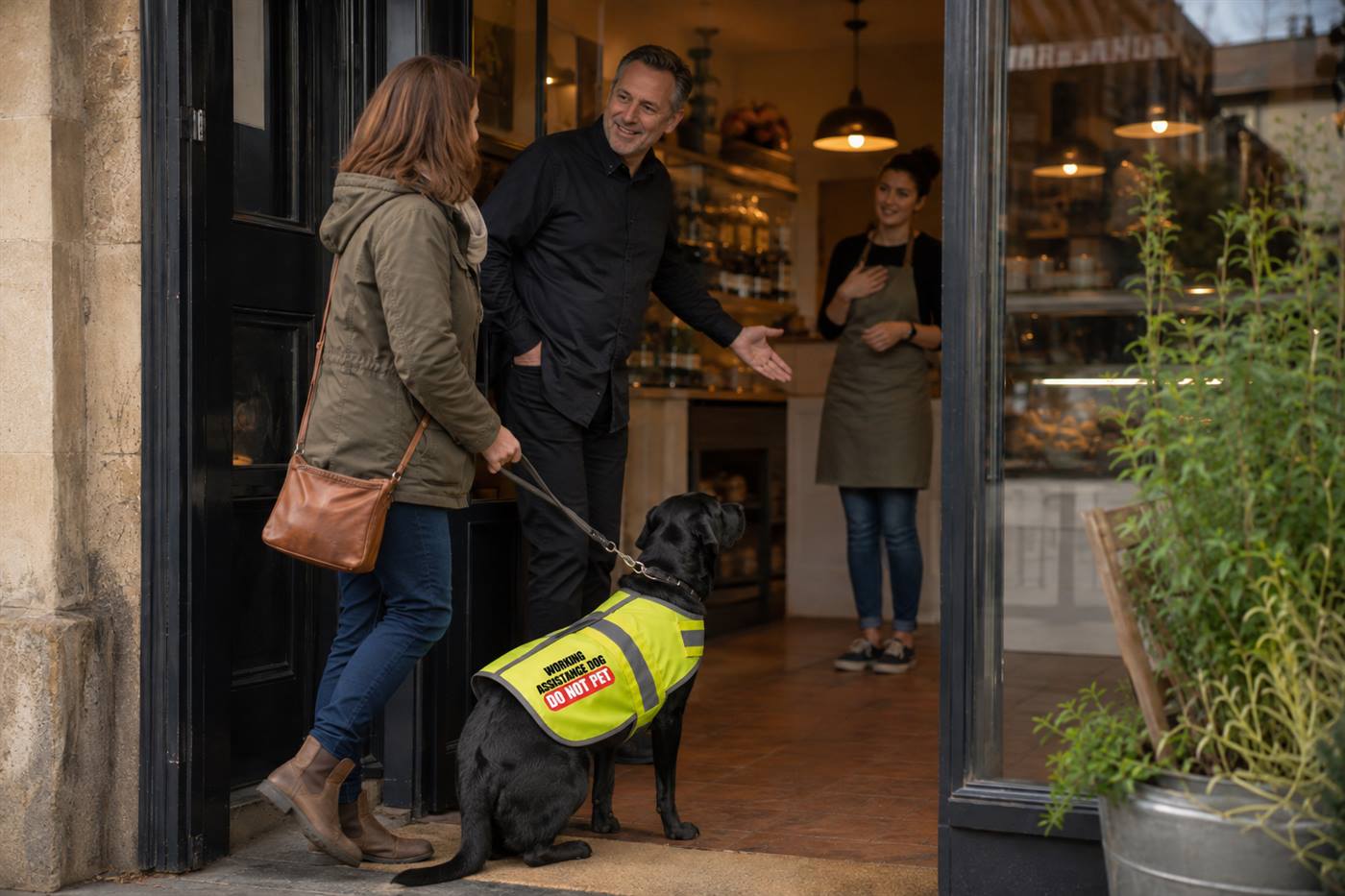
One of the most important legal protections afforded to assistance dog users is the right to access public spaces with their dogs. This means that assistance dogs must be allowed to accompany their handlers into virtually all public areas, including:
- Shops and Retail Stores: Assistance dogs must be permitted in all types of stores, from large supermarkets to small boutiques, even if the store has a strict "no pets" policy.
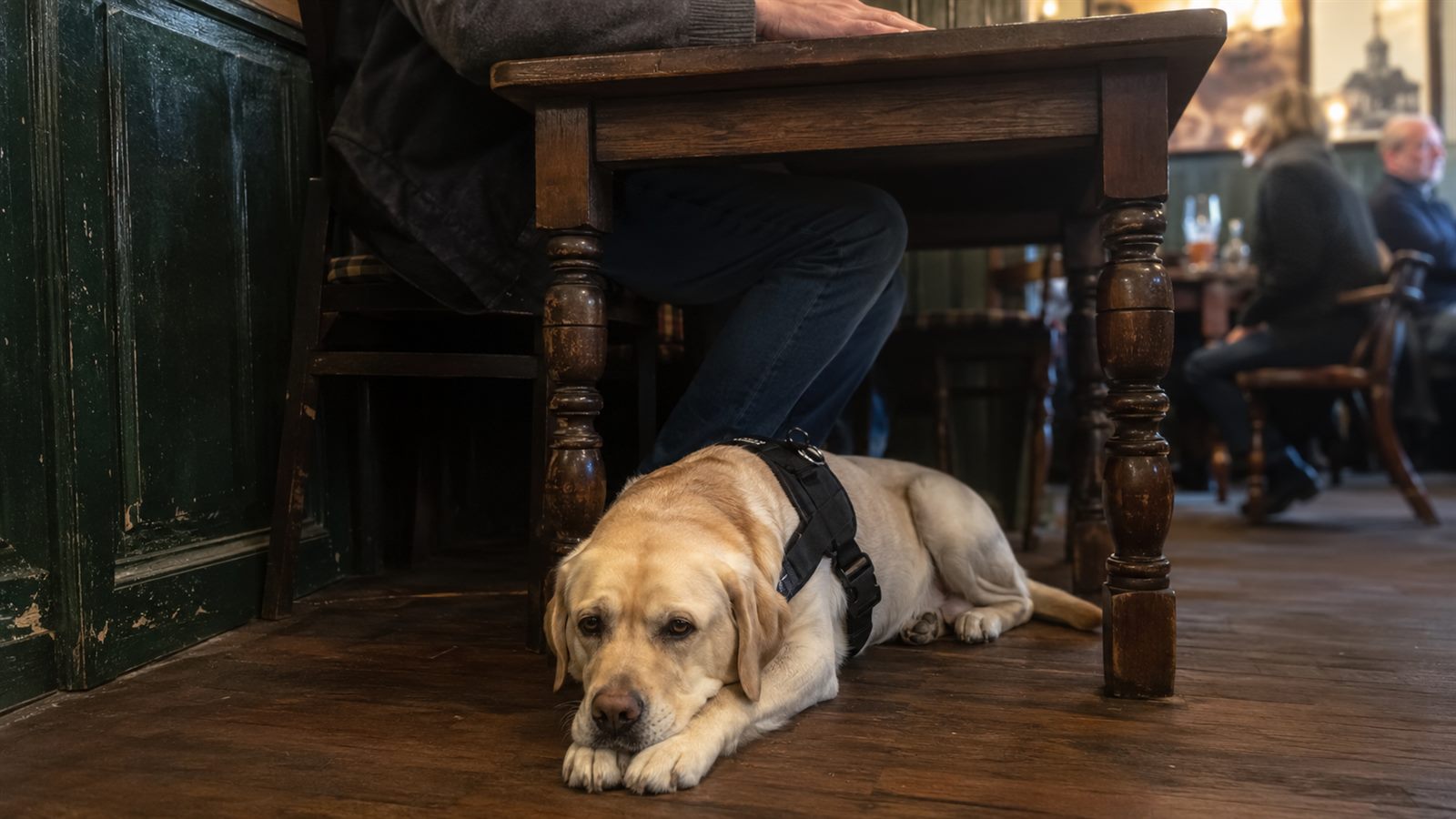
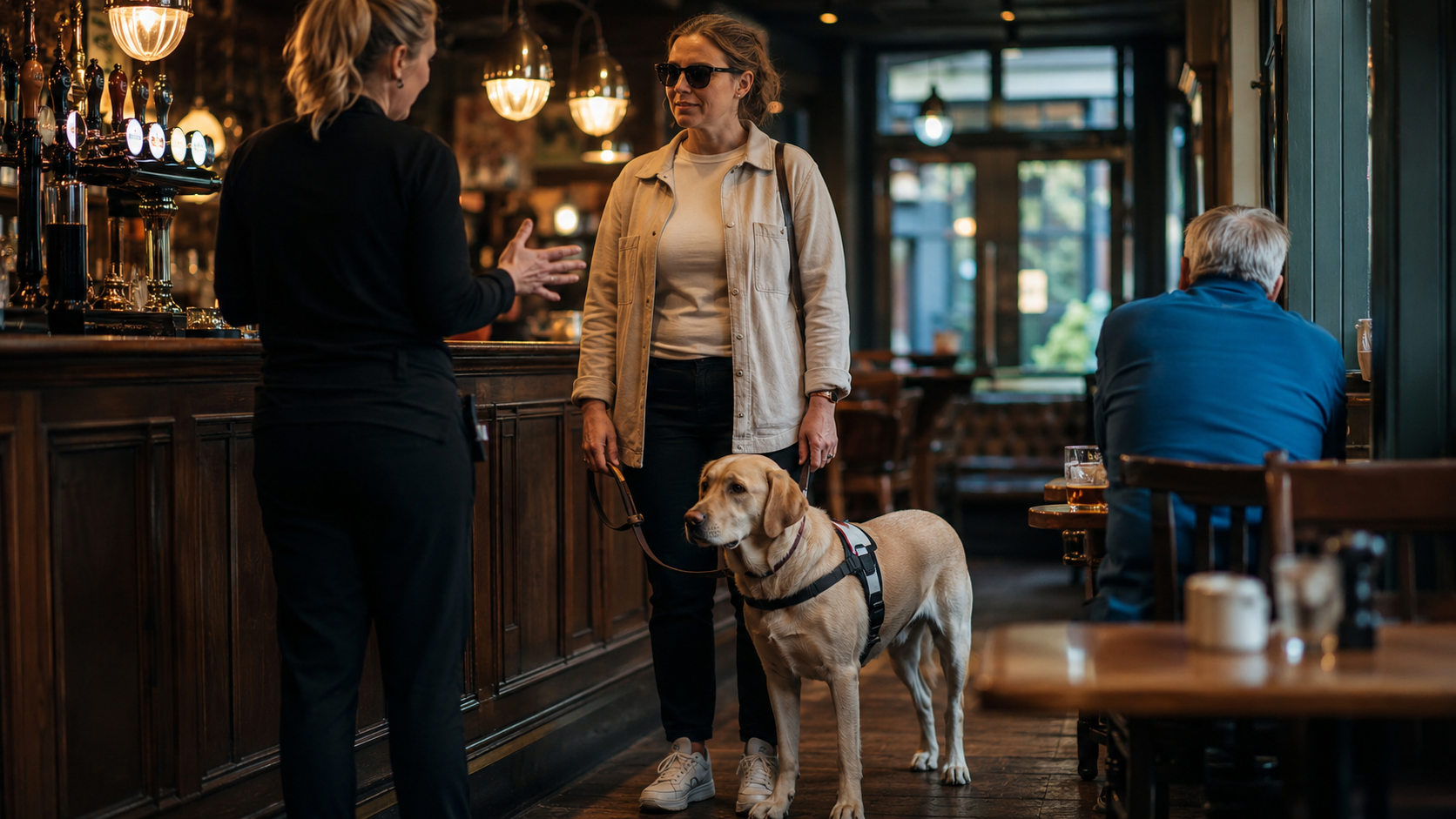
- Restaurants, Cafes, and Pubs: Food establishments cannot refuse entry to assistance dogs. They must accommodate the handler and their dog, even in spaces where pets are normally prohibited.
- Hotels and B&Bs: Hotels and accommodation providers are legally required to allow assistance dogs to stay with their handlers, and they cannot charge additional fees for the dog’s stay.
- Public Transport: Assistance dogs are allowed on all forms of public transport, including buses, trains, trams, taxis, and planes.
- Healthcare Facilities: Assistance dogs must be granted access to hospitals, clinics, and other healthcare facilities, though there may be specific areas (like operating rooms) where access is restricted for health and safety reasons.
It is important to note that refusing entry to an assistance dog without a legitimate reason is considered a form of discrimination under the Equality Act. Businesses and service providers that violate these rules could face legal consequences, including fines and compensation claims from affected individuals.
Owner-Trained Assistance Dogs: A Unique Aspect of UK Law
A distinctive feature of the UK’s assistance dog laws is the recognition that assistance dogs can be trained by their owners, rather than exclusively through accredited organizations. This is significant because it broadens access to assistance dogs for individuals who may not be able to afford or access formal training programs.
Owner-trained assistance dogs can be just as effective as those trained by organizations, provided they meet high standards of behavior and are able to perform tasks that assist their handler’s specific needs. The process of training an assistance dog typically involves teaching them to perform tasks such as retrieving items, guiding their handler, alerting them to sounds, or providing physical support. In the case of owner-trained dogs, it is the responsibility of the handler to ensure that the dog is well-behaved in public, responds to commands reliably, and does not pose a threat or nuisance to others.
Reasonable Adjustments for Assistance Dog Handlers
The concept of "reasonable adjustments" is central to the protections provided by the Equality Act. For assistance dog users, these adjustments ensure that they can access services without facing unnecessary challenges. Some examples of reasonable adjustments include:
- Allowing Assistance Dogs in Pet-Free Zones: Whether it's a retail store, hotel, or public transport, businesses and service providers must permit assistance dogs, even in areas where pets are normally forbidden. This is because assistance dogs are recognized as auxiliary aids, not pets, under the law.
- Providing Additional Support: In some cases, additional assistance may be required, such as helping the handler navigate within a building or offering alternative services if certain areas are inaccessible to the dog.
- Training Staff to Handle Requests Appropriately: Businesses are encouraged to train their staff to recognize and accommodate assistance dog users. This includes understanding the rights of the handler and knowing how to provide appropriate assistance without causing embarrassment or inconvenience.
Businesses’ Responsibility and Legal Consequences
It is essential for businesses and service providers to comply with the legal requirements set out by the Equality Act. Failure to do so can result in legal action being taken against them. If a business refuses entry to an assistance dog or discriminates against the handler, the individual affected can file a complaint or seek legal recourse.
In addition to fines, businesses may be required to pay compensation for any distress, humiliation, or inconvenience caused by their failure to accommodate the assistance dog and its handler. The law aims to ensure that disabled individuals are able to participate fully in society without facing undue hardship or discrimination.
Assistance Dogs in Schools and Workplaces
The legal protections for assistance dog users also extend to educational institutions and workplaces. Schools, colleges, and universities must make reasonable adjustments to allow assistance dogs on their premises, ensuring that students with disabilities can fully participate in educational activities. Similarly, employers are required to accommodate assistance dogs in the workplace, provided that the presence of the dog does not pose a risk to health and safety.
In both educational and employment settings, the process of accommodating an assistance dog often involves creating a support plan that outlines how the dog will be integrated into the environment, what support the handler will need, and any potential challenges that may need to be addressed.
Conclusion
The UK’s laws and regulations surrounding assistance dogs provide strong protections for individuals with disabilities, ensuring they have equal access to public spaces, services, and employment opportunities. The Equality Act 2010 serves as the foundation for these protections, requiring businesses and service providers to make reasonable adjustments to accommodate assistance dog handlers.
Whether the assistance dog is owner-trained or professionally trained, the law recognizes the essential role these animals play in the lives of disabled individuals. By understanding and complying with these laws, both assistance dog users and businesses can help create a more inclusive society that supports the rights and needs of all individuals.
“Service Dog” or “Assistance Dog”? UK vs US Terminology
Many people search for service dog laws UK or UK service dog requirements, but “service dog” is the American term. In the United States, service dogs are covered by the Americans with Disabilities Act (ADA). In the UK, the correct term is assistance dog, and the relevant law is the Equality Act 2010.
The distinction matters, because a great deal of the advice online is American and does not apply here:
- UK: assistance dog, Equality Act 2010, no official government register, no mandatory certification.
- US: service animal, ADA, staff may ask two specific questions, also no official register.
If you are in the UK and searching for “service dog rules” or “service dog requirements”, the UK answers are on this page. The terms are used interchangeably in everyday speech, but only assistance dog appears in UK guidance.
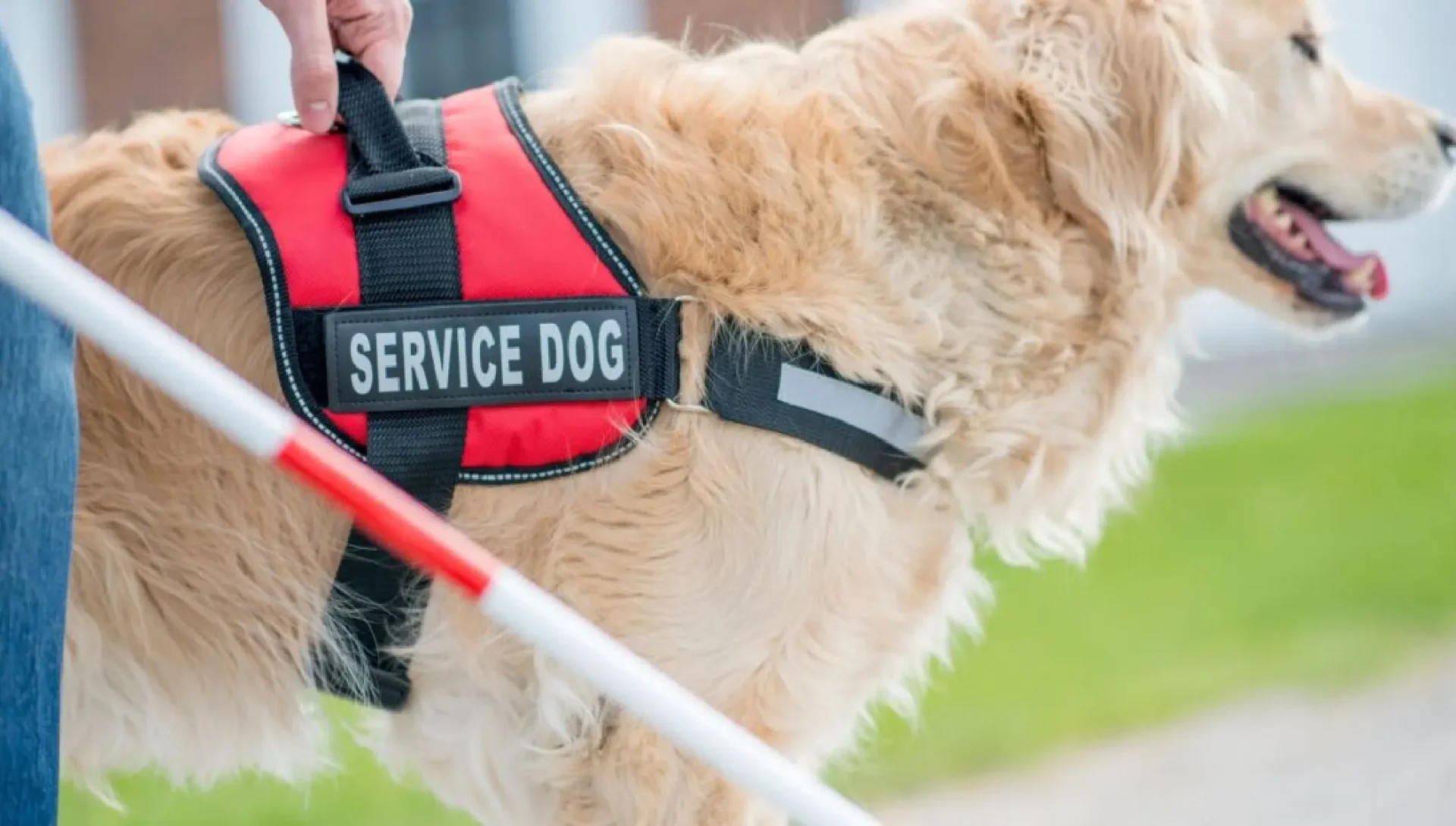
Do Assistance Dogs Have to Wear a Vest, Jacket or Harness in the UK?
No. There is no legal requirement for an assistance dog to wear a vest, jacket, harness or any identifying equipment in the UK. This is one of the most common misunderstandings, and it causes a large share of access refusals.
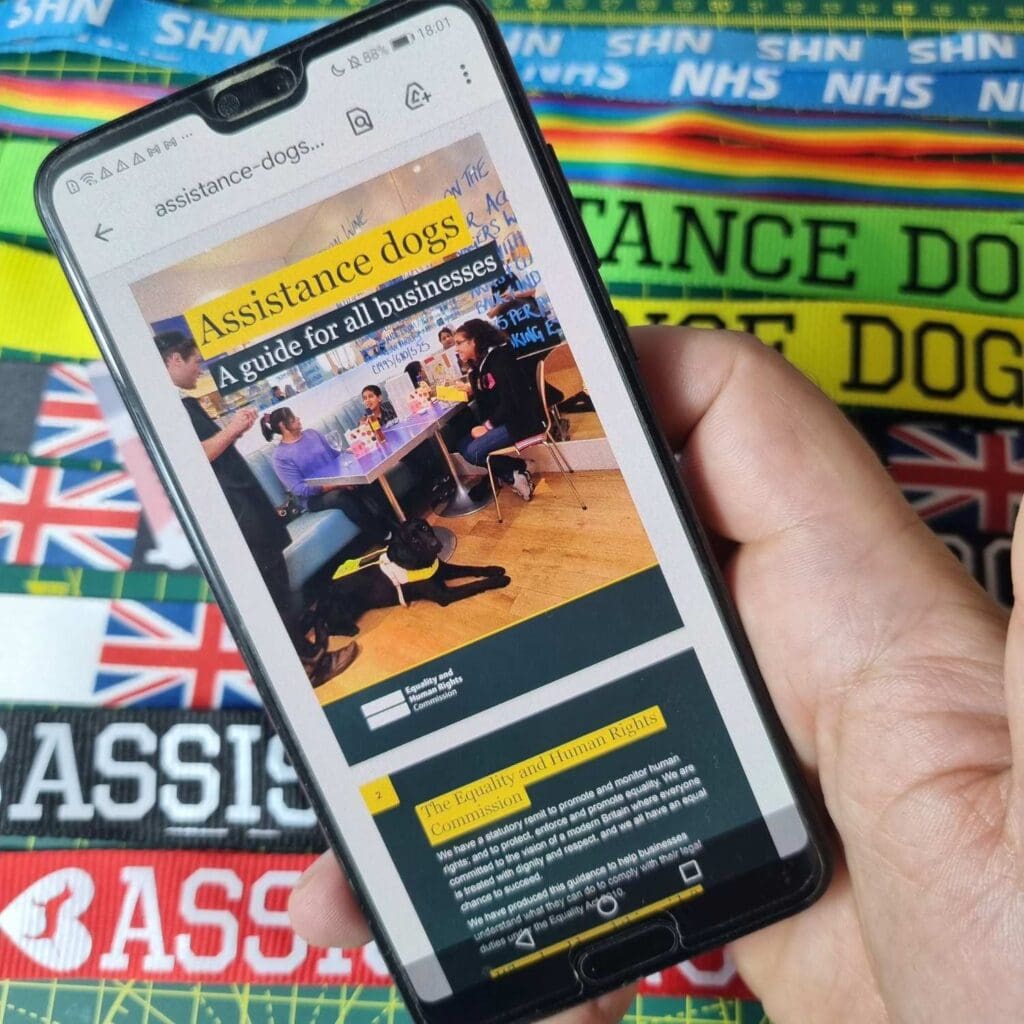
Equality and Human Rights Commission (EHRC) guidance for businesses is explicit that assistance dogs do not legally need to wear a harness or jacket, and that a disabled person should not be refused entry simply because they cannot produce an identification book.
So why do so many handlers use one?
- It prevents conversations before they start. Staff who see a marked dog usually do not challenge at all.
- It signals to the public not to distract the dog while it is working.
- It reduces anxiety for the handler, particularly for people with invisible disabilities who are challenged more often.
A vest is therefore a practical tool, not a legal one. Wearing one does not make a dog an assistance dog, and not wearing one does not stop a dog being one. If you are refused entry because your dog has no jacket, that refusal is not based on the law.
Are Assistance Dogs Allowed Everywhere? Where They Can Be Excluded
Assistance dogs have very broad access rights in the UK: shops, supermarkets, restaurants, pubs, cafés, hotels, taxis, buses, trains, cinemas, leisure centres, GP surgeries and most workplaces. Refusing access is usually unlawful discrimination under the Equality Act 2010.
But “almost everywhere” is not “everywhere”, and an honest guide has to say so. There are limited situations where a dog can lawfully be excluded:
- Sterile clinical areas: operating theatres, intensive care, some treatment and isolation rooms, where infection control genuinely requires it.
- Commercial food preparation areas: behind the counter or in a working kitchen, though the dining area itself is not restricted.
- Genuine health and safety zones: for example certain industrial or laboratory settings.
- Where the dog is out of control: if a dog is aggressive, disruptive, unclean or not under control, a venue may act. That is a behaviour issue, not a discrimination issue.
Crucially, a business cannot simply declare an area off limits for convenience. The exclusion must be justified, and the business should still consider a reasonable adjustment, such as offering an alternative space or bringing a service to you, rather than turning you away outright.
“No dogs” policies, allergy concerns from other customers, religious objections and a lack of paperwork are not lawful reasons to refuse an assistance dog.
What Qualifies a Dog as an Assistance Dog in the UK?
There is no official test, licence, exam or government approval. Under UK law, a dog is an assistance dog when it is trained to perform tasks that help a disabled person with their disability. That is the substance of it.
In practice, the accepted expectations are:
- The handler is a disabled person as defined in section 6 of the Equality Act 2010.
- The dog is trained to perform specific tasks that mitigate that disability, for example medical alert, retrieving items, guiding, balance support, interrupting harmful behaviour or waking from night terrors.
- The dog is safe and under control in public: calm, clean, toilet trained and not disruptive.
Note what is not on that list: there is no minimum number of training hours, no approved trainer list, no certificate and no registration requirement. The dog may be trained by a charity or by the disabled handler themselves. Comfort and companionship alone, without trained tasks, do not meet the standard.
Assistance Dogs in Training: What the Law Says
This is an area where UK law is genuinely weaker than many handlers expect, so it is worth being clear rather than reassuring.
The Equality Act 2010 protects disabled people and their assistance dogs. A dog that is still in training does not automatically carry the same guaranteed access rights as a fully trained assistance dog. Access for a dog in training is often granted by the goodwill of the business rather than by a legal duty.
Some points that help:
- Many businesses will admit a dog in training if you explain the situation calmly and the dog is well behaved.
- Charity-trained puppies in a recognisable training jacket are usually admitted without question, which is a matter of custom, not law.
- If you are owner-training, progress is gradual: as your dog reliably performs tasks that help your disability and behaves properly in public, it moves toward being an assistance dog in the legal sense.
Being upfront that a dog is in training tends to work better than overstating its status, and it protects your credibility if you later need to make a complaint.
Guide Dogs and Other Types of Assistance Dog
Guide dogs are the assistance dogs the public recognises most readily, which is precisely why other types are so often challenged. In law, all assistance dogs have the same rights: a guide dog has no greater legal standing than a medical alert dog or an autism assistance dog.
Recognised types of assistance dog in the UK include:
- Guide dogs for blind and partially sighted people.
- Hearing dogs for deaf people.
- Medical alert dogs for diabetes, epilepsy, cardiac conditions and severe allergies.
- Mobility and physical support dogs for retrieving, opening doors and balance.
- Autism assistance dogs, for adults and children.
- PTSD and psychiatric assistance dogs, including for anxiety-related disabilities where the dog performs trained tasks.
The rule staff most often get wrong is assuming “guide dog equals real, everything else equals pet”. That mental model is decades out of date and is the single biggest cause of access refusals for handlers with invisible disabilities.
Emotional Support Animals: Why UK Law Treats Them Differently
Searches for emotional support animal laws UK are common, and the honest answer is not what many people hope.
Emotional support animals do not have assistance dog access rights in the UK. The Equality Act 2010 protects assistance dogs that are trained to perform tasks for a disabled person. An animal that provides comfort by its presence alone, without trained task work, does not meet that definition, however genuine and important that comfort is.
Two clarifications that matter:
- This is about tasks, not about the condition. A dog trained to perform specific tasks for a person whose disability is anxiety, PTSD or depression can be an assistance dog. The question is always whether the dog is trained to do something.
- Housing and travel are separate matters. Landlords and airlines have their own policies, and some will accommodate an emotional support animal even though there is no automatic right of public access.
The UK does not follow the US model here, and no UK register, certificate or ID card can convert an emotional support animal into an assistance dog. Anyone who tells you otherwise is not being straight with you.
Can a Business Legally Ask You to Prove Your Dog Is an Assistance Dog?
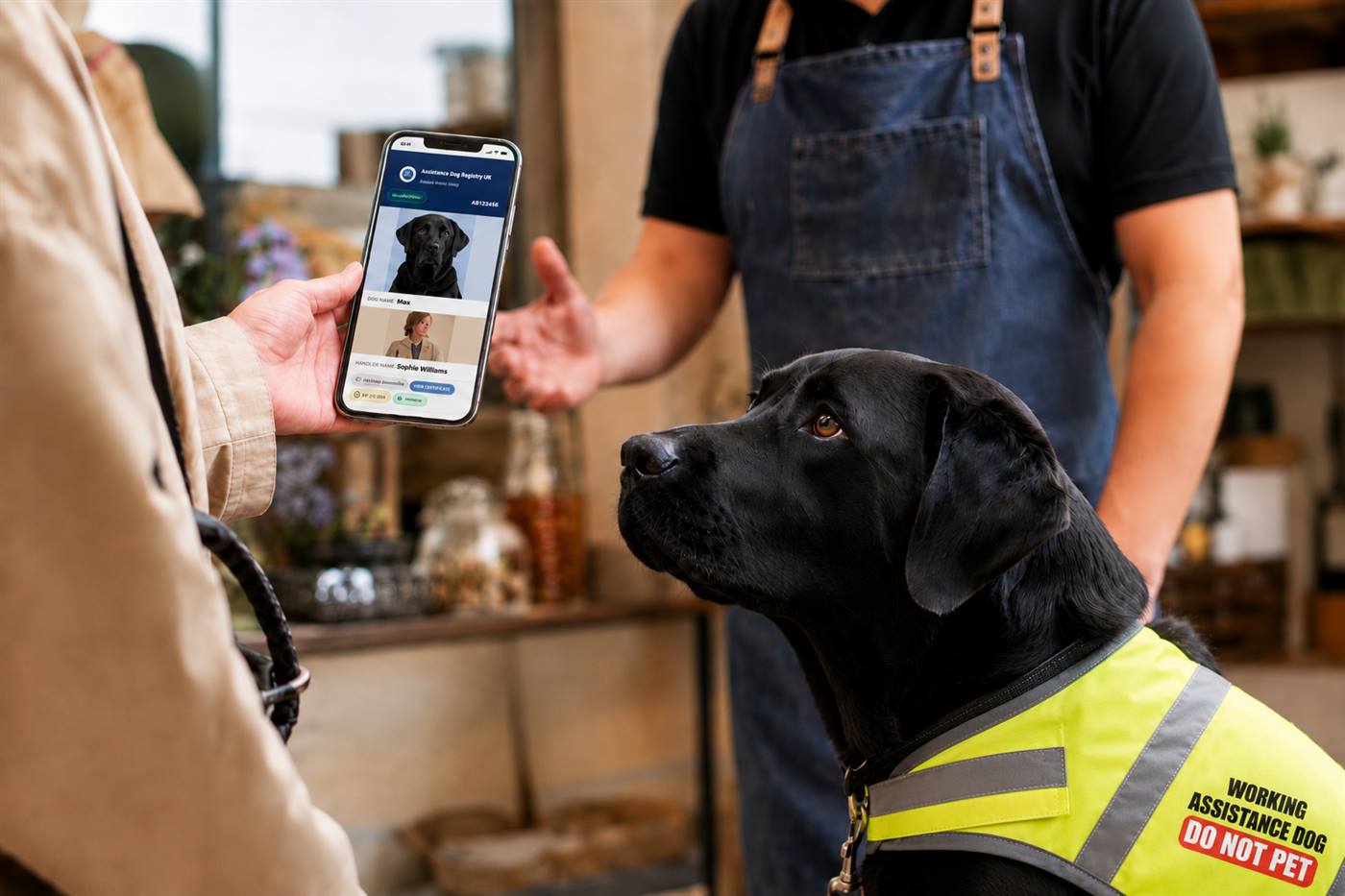
A business is allowed to ask. You are not legally required to carry or produce documentation, and no official government assistance dog ID exists in the UK to produce in the first place.
This is the practical gap handlers live with every day: the law gives you rights, but hands you nothing simple to demonstrate them at a doorway. EHRC guidance is clear that a disabled person should not be refused simply because they cannot show an identification book.
What tends to work in the moment:
- Say calmly: “This is my trained assistance dog. Under the Equality Act 2010 he accompanies me, and there is no legal requirement for me to carry certification.”
- Ask whether the refusal is based on your dog’s behaviour, or only on a lack of paperwork. That single question resolves many refusals.
- Ask for the duty manager and a copy of their assistance dog policy.
Many handlers choose to carry voluntary ID, a card or an online profile, simply because presenting something often ends the conversation faster than a legal explanation. To be clear: voluntary ID has no legal force, it is not a licence, and it does not certify disability or training. It is a practical convenience, nothing more, and any provider claiming otherwise should be treated with caution.
Frequently Asked Questions
What law protects assistance dogs in the UK?
The Equality Act 2010. It makes refusing access to a disabled person with an assistance dog unlawful discrimination, and requires service providers, employers and landlords to make reasonable adjustments.
Do assistance dogs have a legal right of access to shops and restaurants?
Yes. Under the Equality Act 2010, assistance dogs may accompany their handler into shops, restaurants, public transport and other services. Refusing them is usually unlawful discrimination.
Is there a legal requirement to register or certify an assistance dog in the UK?
No. There is no official government register or mandatory certification. A dog qualifies by being trained to help with a disability, whoever trained it.
Can a business ask for proof that a dog is an assistance dog?
A business can ask, but you are not legally required to carry certification. Many handlers carry voluntary ID to make access smoother, although it has no legal force of its own.
Are owner-trained assistance dogs covered by UK law?
Yes. The Equality Act 2010 does not require a dog to be trained by a charity. Owner-trained assistance dogs have the same access rights, provided the dog is trained to help with a disability and behaves appropriately.