Always carry fresh, cool water for your dog—whether you're out for errands, training, or just a walk. 💧 Pro tip: Use a collapsible water bowl for easy access.
2️⃣ Watch Out for Hot Surfaces
Pavements and sand can burn your dog’s paws. Test the surface with your hand: if it’s too hot for you, it’s too hot for them. 🐾 Try walking during cooler hours—early mornings or evenings.
3️⃣ Keep Cool Indoors
Ensure your dog has a shady, well-ventilated space at home. Fans, cooling mats, or damp towels can help. ❄️ Never leave your dog in a parked car—temperatures rise fast, even with windows cracked.
4️⃣ Sun Protection Matters
Light-coloured or short-haired dogs can get sunburnt. Pet-safe sunscreen on their nose, ears, and belly can prevent burns.
5️⃣ Watch for Signs of Heatstroke
Be alert for:
Excessive panting or drooling
Lethargy
Vomiting
Weakness If you spot any of these, seek vet care immediately.
🎒 Don’t Forget Identification
Always make sure your dog wears their ID tag and carries their Assistance Dog ID Card.
Emergencies can happen, and proper identification helps keep your team together.
✅ Quick Checklist for Summer Outings:
🧴 Water & collapsible bowl
🐶 Cooling vest or mat
🦴 Treats (heat-safe)
🪪 Assistance Dog ID & Emergency Info
🧢 Optional: Dog-safe sunscreen & paw balm
💡 Final Tip:
Every dog is different. Monitor your dog closely and adjust your plans based on their needs and the day’s conditions.
Our Assistance Dog Registry offers smart, professional tools to help you:
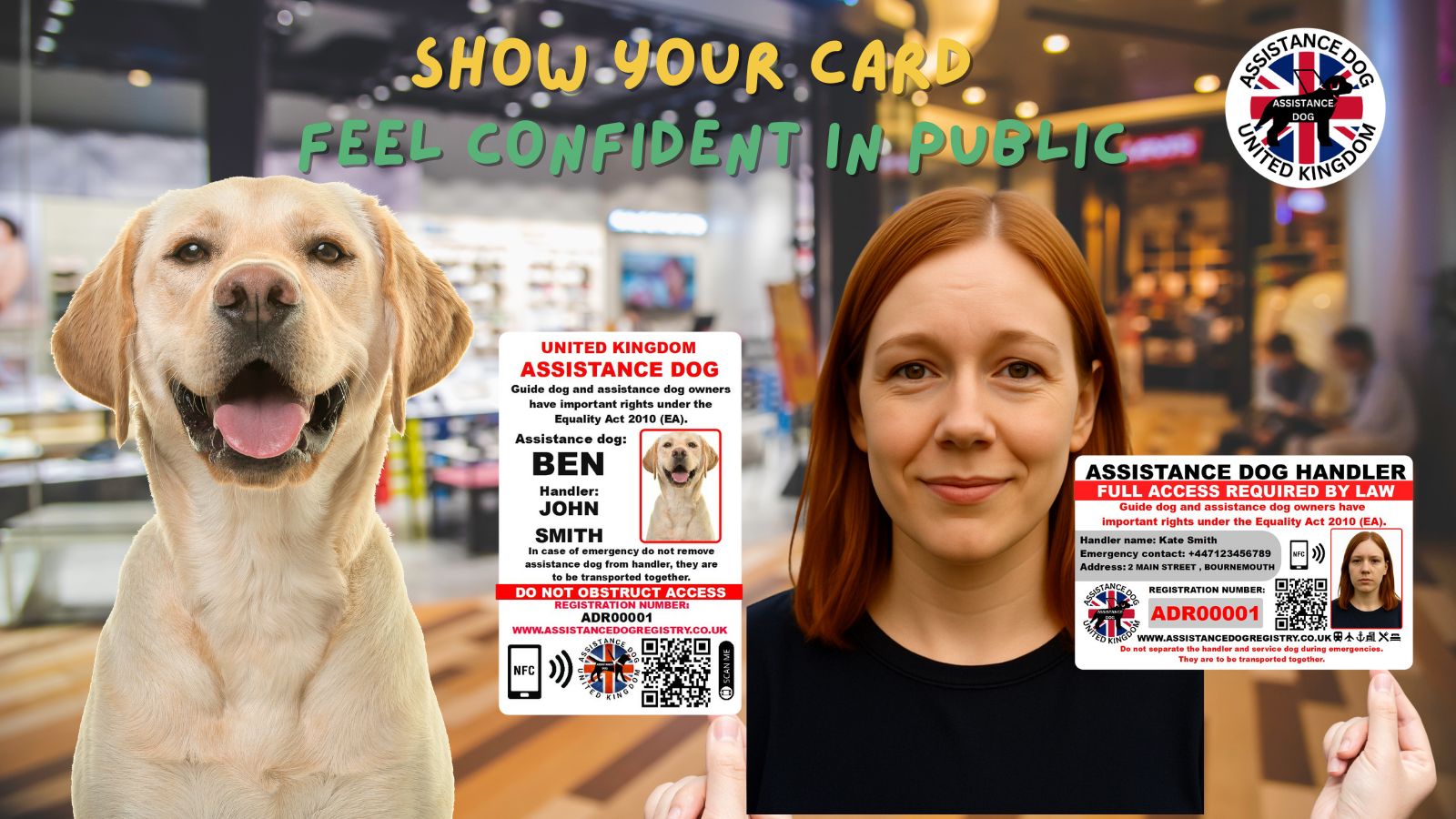
Instantly show your dog’s role and legal rights with Smart ID Cards
Provide staff with proof via a QR Code linked to the Equality Act 2010
Wear your support gear with confidence (lanyard, dog tags, vest)
Enjoy the benefits of voluntary registration that supports your rights without replacing or contradicting the law
Stay Confident This Summer
You deserve peace of mind when you're out enjoying the sunshine. With proper registration and public-friendly ID tools, you can confidently navigate the spaces where others still need educating.
Register your assistance dog today and enjoy every sunny moment without setbacks.
2. Why is socialization important for assistance dogs?
Proper socialization ensures assistance dogs remain calm, focused, and well-behaved in various public settings, enabling them to perform their duties effectively.
3. At what age should I start socializing my assistance dog?
It's beneficial to begin socialization during puppyhood; however, with patience and consistent training, dogs of any age can learn to navigate public environments confidently.
4. How long does it take to socialize an assistance dog?
The duration varies based on the dog's temperament, previous experiences, and the consistency of training. Regular, positive exposure to different environments is key.
5. Can I socialize my assistance dog if they are older?
Yes, older dogs can be socialized successfully. While it may require more time and patience, with positive reinforcement, they can adapt to new situations.
6. What should I do if my assistance dog shows fear in public?
If your dog exhibits fear, calmly remove them from the situation and gradually reintroduce the stimulus at a comfortable distance, rewarding calm behavior.
7. How do I handle public distractions during training?
Teach focus commands like "watch me" to redirect your dog's attention. Gradual exposure to distractions, paired with positive reinforcement, can improve focus.
8. Are there specific public places ideal for socialization?
Begin with quiet areas like parks, then progress to busier environments such as cafes, public transport, and shopping centres as your dog becomes more comfortable.
9. How can I ensure my assistance dog behaves appropriately around other animals?
Controlled introductions and rewarding calm behaviour are essential. Consistent training helps your dog remain focused on their tasks, even around other animals.
10. What are the legal requirements for assistance dogs in public places?
In many regions, assistance dogs are permitted in public areas to support their handlers. It's important to familiarize yourself with local laws and regulations regarding assistance dogs.
Learn More – Additional Assistance Dog Letter Templates
If you found this travel guide useful, you may also benefit from these other essential assistance dog letter templates we’ve published:
📌 Housing Accommodation Request Letter– Need to request reasonable accommodation from your landlord? This template ensures your rights under the Equality Act 2010 are respected.
📌 Workplace Assistance Dog Request Letter – If you need accommodations to bring your assistance dog to work, this letter outlines your legal rights and reasonable adjustments your employer should consider.
If you’ve ever been refused entry to a shop, café, taxi, or doctor’s office because of your assistance dog this guide is for you.
Under the Equality Act 2010, you’re protected from discrimination. But the sad truth is: many people, including staff and business owners, don’t know the law. That’s why we created the 2025 Assistance Dog Rights Guide to give you clear, printable answers when you need them most.
✅ What's Inside the Free Guide:
What the Equality Act 2010 actually says
Answers for common public access challenges
How to handle staff or businesses that say “no dogs”
Wear your support gear with confidence (lanyard, dog tags, vest)
Enjoy the benefits of voluntary registration that supports your rights without replacing or contradicting the law
🔗 Need Help Explaining the Law?
That’s exactly why we offer our Assistance Dog Info Cards, QR tags, and online profiles — to help you explain your rights quickly and clearly.
As we develop new partnerships, our goal is to give you even more legal power in your corner. Until then, keep standing strong — and remember, you’re not alone.What You Can Do Now
Know your rights: You are protected under the Equality Act 2010.
Be prepared: Don’t wait for a refusal to wish you had documentation.
Register today: Our lifetime or monthly options come with everything you need to make public access smoother and less stressful.
Stay Confident This Summer
You deserve peace of mind when you're out enjoying the sunshine. With proper registration and public-friendly ID tools, you can confidently navigate the spaces where others still need educating.
Register your assistance dog today and enjoy every sunny moment without setbacks.
2. Why is socialization important for assistance dogs?
Proper socialization ensures assistance dogs remain calm, focused, and well-behaved in various public settings, enabling them to perform their duties effectively.
3. At what age should I start socializing my assistance dog?
It's beneficial to begin socialization during puppyhood; however, with patience and consistent training, dogs of any age can learn to navigate public environments confidently.
4. How long does it take to socialize an assistance dog?
The duration varies based on the dog's temperament, previous experiences, and the consistency of training. Regular, positive exposure to different environments is key.
5. Can I socialize my assistance dog if they are older?
Yes, older dogs can be socialized successfully. While it may require more time and patience, with positive reinforcement, they can adapt to new situations.
6. What should I do if my assistance dog shows fear in public?
If your dog exhibits fear, calmly remove them from the situation and gradually reintroduce the stimulus at a comfortable distance, rewarding calm behavior.
7. How do I handle public distractions during training?
Teach focus commands like "watch me" to redirect your dog's attention. Gradual exposure to distractions, paired with positive reinforcement, can improve focus.
8. Are there specific public places ideal for socialization?
Begin with quiet areas like parks, then progress to busier environments such as cafes, public transport, and shopping centres as your dog becomes more comfortable.
9. How can I ensure my assistance dog behaves appropriately around other animals?
Controlled introductions and rewarding calm behaviour are essential. Consistent training helps your dog remain focused on their tasks, even around other animals.
10. What are the legal requirements for assistance dogs in public places?
In many regions, assistance dogs are permitted in public areas to support their handlers. It's important to familiarize yourself with local laws and regulations regarding assistance dogs.
Learn More – Additional Assistance Dog Letter Templates
If you found this travel guide useful, you may also benefit from these other essential assistance dog letter templates we’ve published:
📌 Housing Accommodation Request Letter– Need to request reasonable accommodation from your landlord? This template ensures your rights under the Equality Act 2010 are respected.
📌 Workplace Assistance Dog Request Letter – If you need accommodations to bring your assistance dog to work, this letter outlines your legal rights and reasonable adjustments your employer should consider.
We’re excited to share that Assistance Dog Registry is currently in discussions with a senior solicitor from a well-respected Human Rights law firm. While we can’t reveal names just yet, the focus of this potential collaboration is to bring stronger legal support and advocacy for individuals with owner-trained assistance dogs across the UK.
Why is this important?
Because every week, we hear from people who are denied entry into shops, taxis, or public spaces, even though they have a fully trained assistance dog and are protected by law under the Equality Act 2010.
What to Do If You’ve Been Illegally Refused Entry
Sadly, we’re hearing from more and more of you about being refused access to shops, taxis, cafés, housing, or other services simply for having an owner-trained assistance dog.
This is not just frustrating it may be illegal. Under the Equality Act 2010, disabled people who rely on assistance dogs are protected from discrimination in most public settings. The law doesn’t require your dog to be trained by a charity. Owner-trained dogs are equally valid.
If you’re ever refused service, here’s what to do:
✅ Step-by-Step: If Someone Refuses You Entry
1. Stay calm and document the incident. Take note of the time, location, business name, and who you spoke to. If possible, discreetly record video or audio. This can help later.
2. Politely explain your legal rights. Let them know your dog is an assistance dog under the Equality Act 2010, and that you’re protected from discrimination regardless of where your dog was trained.
You can show your Assistance Dog Profile, tags, or support cards especially those linked to our registry.
3. Request the manager or owner. In many cases, the staff simply don’t know the law. Speaking to someone higher up may resolve it.
4. Follow up in writing. Send an email or letter to the business explaining what happened and referencing the Equality Act. Ask for a response. This creates a paper trail.
5. Report it. You can report discrimination to:
Your local council (especially for taxis, housing, or public venues)
The Equality Advisory Support Service (EASS)
Citizens Advice
In some cases, the police (if you’re threatened or harassed)
Our Assistance Dog Registry offers smart, professional tools to help you:
Instantly show your dog’s role and legal rights with Smart ID Cards
Provide staff with proof via a QR Code linked to the Equality Act 2010
Wear your support gear with confidence (lanyard, dog tags, vest)
Enjoy the benefits of voluntary registration that supports your rights without replacing or contradicting the law
🔗 Need Help Explaining the Law?
That’s exactly why we offer our Assistance Dog Info Cards, QR tags, and online profiles — to help you explain your rights quickly and clearly.
As we develop new partnerships, our goal is to give you even more legal power in your corner. Until then, keep standing strong — and remember, you’re not alone.What You Can Do Now
Know your rights: You are protected under the Equality Act 2010.
Be prepared: Don’t wait for a refusal to wish you had documentation.
Register today: Our lifetime or monthly options come with everything you need to make public access smoother and less stressful.
Stay Confident This Summer
You deserve peace of mind when you're out enjoying the sunshine. With proper registration and public-friendly ID tools, you can confidently navigate the spaces where others still need educating.
Register your assistance dog today and enjoy every sunny moment without setbacks.
2. Why is socialization important for assistance dogs?
Proper socialization ensures assistance dogs remain calm, focused, and well-behaved in various public settings, enabling them to perform their duties effectively.
3. At what age should I start socializing my assistance dog?
It's beneficial to begin socialization during puppyhood; however, with patience and consistent training, dogs of any age can learn to navigate public environments confidently.
4. How long does it take to socialize an assistance dog?
The duration varies based on the dog's temperament, previous experiences, and the consistency of training. Regular, positive exposure to different environments is key.
5. Can I socialize my assistance dog if they are older?
Yes, older dogs can be socialized successfully. While it may require more time and patience, with positive reinforcement, they can adapt to new situations.
6. What should I do if my assistance dog shows fear in public?
If your dog exhibits fear, calmly remove them from the situation and gradually reintroduce the stimulus at a comfortable distance, rewarding calm behavior.
7. How do I handle public distractions during training?
Teach focus commands like "watch me" to redirect your dog's attention. Gradual exposure to distractions, paired with positive reinforcement, can improve focus.
8. Are there specific public places ideal for socialization?
Begin with quiet areas like parks, then progress to busier environments such as cafes, public transport, and shopping centres as your dog becomes more comfortable.
9. How can I ensure my assistance dog behaves appropriately around other animals?
Controlled introductions and rewarding calm behaviour are essential. Consistent training helps your dog remain focused on their tasks, even around other animals.
10. What are the legal requirements for assistance dogs in public places?
In many regions, assistance dogs are permitted in public areas to support their handlers. It's important to familiarize yourself with local laws and regulations regarding assistance dogs.
Learn More – Additional Assistance Dog Letter Templates
If you found this travel guide useful, you may also benefit from these other essential assistance dog letter templates we’ve published:
📌 Housing Accommodation Request Letter– Need to request reasonable accommodation from your landlord? This template ensures your rights under the Equality Act 2010 are respected.
📌 Workplace Assistance Dog Request Letter – If you need accommodations to bring your assistance dog to work, this letter outlines your legal rights and reasonable adjustments your employer should consider.
With spring and summer in full swing, there's no better time to enjoy the outdoors with your assistance dog. Whether it’s a trip to a festival, a stroll through the garden centre, or a coffee in the sun at your local pub, the warmer weather opens up a world of possibility. But sadly, not every place is as welcoming as it should be.
While the Equality Act 2010 protects your right to access public spaces with an assistance dog, many venues and businesses still misunderstand or overlook this law. That misunderstanding can turn a peaceful day into a stressful confrontation.
Common Places Where Handlers Still Face Refusals
Even in 2025, assistance dog handlers continue to be refused access in places like:
Outdoor Cafés & Beer Gardens (e.g., Wetherspoons)
Garden Centres & Plant Nurseries
High Street Clothing Stores
Supermarkets & Small Convenience Shops
Food Stalls with "No Dogs" Signs
Open-Air Events or Local Community Fairs
Train & Bus Services with Uninformed Staff
Campsites & Caravan Parks
These are all places where public access should be granted, yet misunderstandings persist. Being caught off guard can be upsetting — especially if you're just trying to enjoy a normal day out.
You Shouldn't Have to Choose Between Fresh Air and Your Support
Your assistance dog is essential to your independence. You’ve put in the time and training, and you shouldn’t have to justify yourself at every door. That’s where proof of registration and legal clarity can make all the difference.
Many people still believe that assistance dogs must be trained by a charity or organization. However, in the UK, owner-trained assistance dogs are fully legal and protected under the Equality Act 2010, as long as the dog is trained to mitigate a disability.
To support handlers of owner-trained assistance dogs, we offer a voluntary registration service that gives you the tools you need to help educate others and avoid unnecessary confrontations. Our registry does not certify or license dogs, because that is not required by UK law. Instead, it provides helpful documentation and smart identification tools that make life easier for handlers.
Our Assistance Dog Registry offers smart, professional tools to help you:
Instantly show your dog’s role and legal rights with Smart ID Cards
Provide staff with proof via a QR Code linked to the Equality Act 2010
Wear your support gear with confidence (lanyard, dog tags, vest)
Enjoy the benefits of voluntary registration that supports your rights without replacing or contradicting the law
What You Can Do Now
Know your rights: You are protected under the Equality Act 2010.
Be prepared: Don’t wait for a refusal to wish you had documentation.
Register today: Our lifetime or monthly options come with everything you need to make public access smoother and less stressful.
Stay Confident This Summer
You deserve peace of mind when you're out enjoying the sunshine. With proper registration and public-friendly ID tools, you can confidently navigate the spaces where others still need educating.
Register your assistance dog today and enjoy every sunny moment without setbacks.
2. Why is socialization important for assistance dogs?
Proper socialization ensures assistance dogs remain calm, focused, and well-behaved in various public settings, enabling them to perform their duties effectively.
3. At what age should I start socializing my assistance dog?
It's beneficial to begin socialization during puppyhood; however, with patience and consistent training, dogs of any age can learn to navigate public environments confidently.
4. How long does it take to socialize an assistance dog?
The duration varies based on the dog's temperament, previous experiences, and the consistency of training. Regular, positive exposure to different environments is key.
5. Can I socialize my assistance dog if they are older?
Yes, older dogs can be socialized successfully. While it may require more time and patience, with positive reinforcement, they can adapt to new situations.
6. What should I do if my assistance dog shows fear in public?
If your dog exhibits fear, calmly remove them from the situation and gradually reintroduce the stimulus at a comfortable distance, rewarding calm behavior.
7. How do I handle public distractions during training?
Teach focus commands like "watch me" to redirect your dog's attention. Gradual exposure to distractions, paired with positive reinforcement, can improve focus.
8. Are there specific public places ideal for socialization?
Begin with quiet areas like parks, then progress to busier environments such as cafes, public transport, and shopping centres as your dog becomes more comfortable.
9. How can I ensure my assistance dog behaves appropriately around other animals?
Controlled introductions and rewarding calm behaviour are essential. Consistent training helps your dog remain focused on their tasks, even around other animals.
10. What are the legal requirements for assistance dogs in public places?
In many regions, assistance dogs are permitted in public areas to support their handlers. It's important to familiarize yourself with local laws and regulations regarding assistance dogs.
Learn More – Additional Assistance Dog Letter Templates
If you found this travel guide useful, you may also benefit from these other essential assistance dog letter templates we’ve published:
📌 Housing Accommodation Request Letter– Need to request reasonable accommodation from your landlord? This template ensures your rights under the Equality Act 2010 are respected.
📌 Workplace Assistance Dog Request Letter – If you need accommodations to bring your assistance dog to work, this letter outlines your legal rights and reasonable adjustments your employer should consider.
Imagine relying on your assistance dog to manage daily life, only to be refused entry to a pub. Sadly, this scenario happens more often than it should — and recent incidents involving Wetherspoon pubs have highlighted a troubling pattern. But what does the law actually say? When is a refusal illegal? And most importantly, what can you do if this happens to you?
In this post, we’ll break down the legal rights of assistance dog owners, use Wetherspoon as a case study, and give you practical steps to take when you're faced with an unlawful refusal.
What the Equality Act 2010 Says The Equality Act 2010 is the main piece of legislation protecting disabled individuals in the UK. It clearly states that service providers — including pubs, shops, and restaurants — must make "reasonable adjustments" to ensure people with disabilities can access their services. This includes allowing assistance dogs.
Crucially, the law does not require assistance dogs to be trained by a charity or Assistance Dogs UK (ADUK) member. Owner-trained assistance dogs are equally protected under the Equality Act. Denying access based on where a dog was trained is legally irrelevant.
Refusing entry to someone with a legitimate assistance dog can be classed as disability discrimination, which is illegal. In most cases, there are no valid exceptions.
Wetherspoon's Policy: Where They Get It Wrong Wetherspoon’s official website claims they only allow assistance dogs trained by ADUK-accredited charities. They state:
"The exceptions to the policy are trained guide dogs and also assistance dogs with Assistance Dogs UK-accredited training."
This wording is problematic because it excludes a significant number of owner-trained assistance dogs — dogs that are fully protected under UK law. This has led to multiple incidents where handlers have been refused service, even after explaining their rights.
One reported case involved a 13-year-old with fibromyalgia and PTSD being denied entry while using a registered assistance dog. In another case, a mental health support dog was refused and the handler was escorted out. These are not just unfortunate mistakes — they may be illegal actions.
How a Refusal Affects Assistance Dog Handlers Being denied access can be deeply distressing for someone who relies on an assistance dog. It can:
Trigger anxiety or PTSD symptoms
Cause public humiliation
Limit social inclusion
Reinforce stigma and misunderstanding
More than that, it shows a complete lack of understanding of the Equality Act. These refusals suggest that some businesses prioritize internal policy over legal rights — a dangerous and discriminatory approach.
What You Can Do If You Are Refused If you’re ever refused entry to a pub, including a Wetherspoon location, follow these steps:
Stay calm and ask to speak to a manager.
Explain that your dog is an assistance dog and the refusal may be unlawful under the Equality Act.
Carry supporting proof.
While not legally required, an ID card, QR code linked to your online profile, or vest that says "Assistance Dog" can help clarify things.
Ask the manager to review the Equality Act.
Many are simply uninformed, and a polite reminder of the law may resolve the situation.
Document the refusal.
Record names, times, and what was said. Take photos if needed. Ask for written confirmation of the refusal.
File a formal complaint.
Contact the head office of the company in writing. Detail the event and cite the Equality Act.
Report it to the Equality Advisory Support Service (EASS).
The EASS provides free legal advice and may help escalate the issue.
Seek public support if necessary.
Social media attention often prompts quicker responses. Use it strategically, not emotionally.
Your Rights as an Owner-Trained Assistance Dog Handler Wetherspoon’s reliance on ADUK accreditation is misleading. Many owner-trained dogs meet or exceed the standards of charity-trained dogs. They are trained to assist with real disabilities and have the same public access rights.
You do not need a dog trained by Guide Dogs UK, Dogs for Good, or any other charity to have legal protection.
You do not need to carry a license, registration, or official certificate. The law is based on need and function, not paperwork.
Our Position at Assistance Dog Registry We believe every legitimate handler should be treated with dignity and equality. That’s why our registration platform supports owner-trained teams with:
Smart ID cards with QR code links to a secure handler profile
Custom dog tags, lanyards, and vest options
Educational content on public access laws
Our goal is not to “police” access, but to empower you with tools that promote understanding and reduce conflict.
Final Thoughts: It’s Time for Change When big brands like Wetherspoon misinterpret the law, they put vulnerable individuals at risk. Refusing an assistance dog is not just an inconvenience. It’s discriminatory and potentially unlawful.
If you’ve experienced a refusal, know that you have rights. Use your voice, document your experience, and demand better. The Equality Act is on your side — and so are we.
2. Why is socialization important for assistance dogs?
Proper socialization ensures assistance dogs remain calm, focused, and well-behaved in various public settings, enabling them to perform their duties effectively.
3. At what age should I start socializing my assistance dog?
It's beneficial to begin socialization during puppyhood; however, with patience and consistent training, dogs of any age can learn to navigate public environments confidently.
4. How long does it take to socialize an assistance dog?
The duration varies based on the dog's temperament, previous experiences, and the consistency of training. Regular, positive exposure to different environments is key.
5. Can I socialize my assistance dog if they are older?
Yes, older dogs can be socialized successfully. While it may require more time and patience, with positive reinforcement, they can adapt to new situations.
6. What should I do if my assistance dog shows fear in public?
If your dog exhibits fear, calmly remove them from the situation and gradually reintroduce the stimulus at a comfortable distance, rewarding calm behavior.
7. How do I handle public distractions during training?
Teach focus commands like "watch me" to redirect your dog's attention. Gradual exposure to distractions, paired with positive reinforcement, can improve focus.
8. Are there specific public places ideal for socialization?
Begin with quiet areas like parks, then progress to busier environments such as cafes, public transport, and shopping centres as your dog becomes more comfortable.
9. How can I ensure my assistance dog behaves appropriately around other animals?
Controlled introductions and rewarding calm behaviour are essential. Consistent training helps your dog remain focused on their tasks, even around other animals.
10. What are the legal requirements for assistance dogs in public places?
In many regions, assistance dogs are permitted in public areas to support their handlers. It's important to familiarize yourself with local laws and regulations regarding assistance dogs.
Learn More – Additional Assistance Dog Letter Templates
If you found this travel guide useful, you may also benefit from these other essential assistance dog letter templates we’ve published:
📌 Housing Accommodation Request Letter– Need to request reasonable accommodation from your landlord? This template ensures your rights under the Equality Act 2010 are respected.
📌 Workplace Assistance Dog Request Letter – If you need accommodations to bring your assistance dog to work, this letter outlines your legal rights and reasonable adjustments your employer should consider.
Every day across the UK, thousands of disabled people rely on their assistance dogs for independence, support, and safety. These dogs are more than companions — they are a vital part of daily life. But too often, handlers face confusion or even discrimination from businesses that don’t understand the law.
That’s why we’ve made an important upgrade to every Assistance Dog Registry ID card: a built-in QR code linking directly to the official Equality and Human Rights Commission guide, “Assistance Dogs: A Guide for All Businesses.”
This blog explains:
What’s inside that guide
Why we linked it to every card
How this empowers handlers
And why ID cards and vests — while not legally required — remain essential tools for real-world access
🧾 What Is the PDF Guide?
This downloadable PDF, created by the Equality and Human Rights Commission, explains in plain terms how businesses must treat assistance dog handlers under the Equality Act 2010.
It’s designed for staff at shops, restaurants, hotels, taxis, banks, and more. It explains their legal obligations and what happens when those aren’t met.
We know from experience that even well-trained assistance dogs are sometimes challenged in public spaces. Many business owners still falsely believe that:
Only guide dogs are legally recognized
Assistance dogs must be trained by a charity
An ID card or vest is required for legal access
All of this is incorrect. But we also know that the burden of educating others shouldn't fall on you in stressful moments.
That’s why we embedded this official guide into your card with a QR code. One quick scan — and you can show the business exactly what the law says.
🔍 What the Guide Actually Says
Let’s break down the most important sections of the Equality and Human Rights Commission’s official guide — and how they affect you.
✅ 1. Owner-Trained Assistance Dogs Are Legal
“Assistance dogs can also be owner trained and the owner selects their own dog to fit their own requirements.” (Page 5)
You are not legally required to use an Assistance Dogs UK (ADUK) member charity to train your dog. Owner-trained dogs — provided they are trained to behave properly in public — are equally protected under the Equality Act.
This is essential for people with non-visible disabilities, PTSD, mobility needs, or complex conditions not supported by charity waitlists.
✅ 2. ID Cards and Vests Are Optional — But Still Valuable
“The law does not require the dog to wear a harness or jacket... Some users carry ID books... Again, this is not a legal requirement and assistance dog users should not be refused a service simply because they do not possess an ID book.” (Page 5)
Here’s the truth: the law doesn’t require you to wear a vest or carry a card. But reality is different. Without visual identification, you may be challenged more often — leading to awkward or confrontational moments.
That’s why most handlers still choose to carry:
An ID card to show their rights
A high-visibility vest for clarity in public
Dog tags and QR links to make education easier
These aren’t legal requirements — they’re tools for smoother, stress-free experiences.
✅ 3. “No Dogs” Policies Are Not Valid
“A ‘no dogs’ policy will have a worse impact on disabled people using assistance dogs and could be indirect discrimination unless the policy can be objectively justified.” (Page 9)
This is one of the most misunderstood parts of the law. A business cannot use a “no dogs allowed” policy to refuse your entry. If they do, they could face legal claims under disability discrimination law.
Even if someone inside is allergic or has cultural concerns, the business must make reasonable adjustments — like separating seating — not banning you entirely
.
✅ 4. Emotional and Psychological Support Is Valid
“Assistance dogs... can also provide emotional and psychological wellbeing and improve the confidence of disabled people who use them.” (Page 12)
Mental health matters. Whether your dog helps with panic attacks, PTSD, autism, anxiety, or another condition — you are protected.
There is no law stating that emotional support is not valid if it relates to a diagnosed disability that impacts your daily life.
🛡️ How Our Cards and Vests Help
Limited Time: Save £30 on the Premium Assistance Dog Plan
Today, we honour the courage, sacrifice, and resilience of all who fought for freedom. VE Day reminds us that strength often comes in silence — and in the loyal companionship of those who walk beside us, human or canine. 🐾 To mark this important day, we're offering a special VE Day Discount for our Lifetime Assistance Dog Registration Package — a small way to honour big sacrifices. Use code VICTORY30 at checkout.
valid until:10thof May 2025
Now that you understand what’s legally required — here’s why thousands of handlers still choose our tools.
2. Why is socialization important for assistance dogs?
Proper socialization ensures assistance dogs remain calm, focused, and well-behaved in various public settings, enabling them to perform their duties effectively.
3. At what age should I start socializing my assistance dog?
It's beneficial to begin socialization during puppyhood; however, with patience and consistent training, dogs of any age can learn to navigate public environments confidently.
4. How long does it take to socialize an assistance dog?
The duration varies based on the dog's temperament, previous experiences, and the consistency of training. Regular, positive exposure to different environments is key.
5. Can I socialize my assistance dog if they are older?
Yes, older dogs can be socialized successfully. While it may require more time and patience, with positive reinforcement, they can adapt to new situations.
6. What should I do if my assistance dog shows fear in public?
If your dog exhibits fear, calmly remove them from the situation and gradually reintroduce the stimulus at a comfortable distance, rewarding calm behavior.
7. How do I handle public distractions during training?
Teach focus commands like "watch me" to redirect your dog's attention. Gradual exposure to distractions, paired with positive reinforcement, can improve focus.
8. Are there specific public places ideal for socialization?
Begin with quiet areas like parks, then progress to busier environments such as cafes, public transport, and shopping centres as your dog becomes more comfortable.
9. How can I ensure my assistance dog behaves appropriately around other animals?
Controlled introductions and rewarding calm behaviour are essential. Consistent training helps your dog remain focused on their tasks, even around other animals.
10. What are the legal requirements for assistance dogs in public places?
In many regions, assistance dogs are permitted in public areas to support their handlers. It's important to familiarize yourself with local laws and regulations regarding assistance dogs.
Learn More – Additional Assistance Dog Letter Templates
If you found this travel guide useful, you may also benefit from these other essential assistance dog letter templates we’ve published:
📌 Housing Accommodation Request Letter– Need to request reasonable accommodation from your landlord? This template ensures your rights under the Equality Act 2010 are respected.
📌 Workplace Assistance Dog Request Letter – If you need accommodations to bring your assistance dog to work, this letter outlines your legal rights and reasonable adjustments your employer should consider.
Have you ever wondered whether you can register your dog as an assistance dog in the United Kingdom?
You’re not alone. Many people—especially those living with invisible disabilities—rely on their dogs for daily support but don’t know where to start when it comes to formal recognition.
The good news is, the UK legal system already supports you more than you might think. And while there’s no official government register for assistance dogs, you can take steps to validate your dog’s role and protect your rights when accessing public places, shops, transport, and services.
In this blog, we’ll walk you through how to register your dog as an assistance dog, the legal framework behind it, and why many owners choose voluntary ID and registration options for peace of mind.
Understanding Assistance Dog Rights Under UK Law
Let’s start with the foundation: the Equality Act 2010. This legislation protects people with disabilities from discrimination and ensures they have equal access to goods, services, and facilities—including with their assistance dog.
Under this law:
You are not required to get your dog from a specific charity or organization.
There is no legal requirement to pass a formal test or certification.
You have a right to train your own dog, as long as it performs tasks that support your disability.
This may surprise some people. A lot of misinformation floats around online, and even some businesses believe only guide dogs or charity-issued dogs are legitimate. That’s simply not true under UK law.
Can I Train My Own Assistance Dog?
Yes, absolutely. In fact, many owners train their dogs themselves or work with professional dog trainers to create a plan tailored to their specific needs.
You know your condition better than anyone else. Whether your dog is trained to interrupt panic attacks, alert to sounds, assist with mobility, or provide grounding during episodes of PTSD—what matters is that they perform a task that directly helps you manage your disability.
There’s no government-issued test or license. What matters is the dog’s behaviour andtraining—especially in public.
So... No Certification At All?
Correct. There’s no official registry run by the government. But that doesn’t mean carrying proof isn’t helpful.
Many owners opt to use voluntary assistance dog ID cards, high-visibility vests, and NFC/QR code-linked profiles from reputable registries like ours at assistancedogregistry.co.uk. These tools provide:
Peace of mind when accessing public places
An easy way to explain your dog’s role to businesses or the public
A sense of security, especially for those with social anxiety or hidden disabilities
Emergency contact information, medical notes, and verification features linked to your dog’s profile
What Makes a Dog an “Assistance Dog”?
In the UK, an assistance dog is defined as a dog that has been trained to help a person with a disability. This help can be physical (mobility support), sensory (hearing or sight alerts), mental health-based (emotional regulation, panic interruption), or even a combination.
Examples of trained tasks include:
Picking up dropped items
Interrupting flashbacks or meltdowns
Providing balance or mobility support
Alerting to sounds or medical events
If your dog performs tasks that directly help you manage your condition, they can qualify as an assistance dog under the Equality Act.
Step-by-Step: How to Register with a Voluntary Registry
Since there’s no government-run process, the steps below explain how to take the most meaningful action to validate your dog’s status:
✅ Step 1: Make Sure Your Dog Is Well-Trained
Even without a formal test, you want to make sure your dog is calm, non-aggressive, responsive to commands, and well-behaved in public.
If you're still in training, that's okay too—as long as you're actively working on it.
A private profile that stores information like emergency contact details, tasks performed, and medical notes
Optional high-visibility vest
Lifetime Assistance Dog Package
✅ Step 3: Complete the Online Application
This includes uploading your dog’s photo, adding your details, and describing the tasks your dog performs. You don’t need to submit medical records, but you’ll be asked to agree to a declaration that confirms your dog meets the legal criteria.
✅ Step 4: Choose a Package
You can select from digital-only options to physical packages including ID cards, tags, and lanyards. Many users choose the lifetime package to avoid recurring fees and benefit from free replacement cards if needed.
Why Register If It’s Not Required?
Great question. While not required by law, registration can:
Prevent confrontation: Business owners are more likely to respect your rights if you present clear identification.
Support training: Many public access issues arise during the training phase. An ID helps explain your dog’s role.
Assist in emergencies: Emergency personnel can access your NFC/QR profile if something happens to you.
Offer peace of mind: Especially for hidden disabilities like autism, anxiety, or PTSD, simply avoiding uncomfortable conversations can be worth it.
What If My Dog Is Still Young or in Training?
You can still register! Many owners register young dogs to help raise awareness early and ease access during the training period. It’s important that you continue working with your dog to ensure they remain well-behaved and responsive, but there’s no need to wait years before you get started.
Just be honest in your registration, and make sure your dog is wearing appropriate gear when in public.
Final Thoughts
Navigating assistance dog rights in the UK can be confusing—especially when businesses themselves aren’t fully informed. But don’t let that stop you. You have rights, and your dog plays a vital role in your independence and wellbeing.
At the Assistance Dog Registry, we’re here to support you with ID cards, tools, and resources that help bridge the gap between what the law allows—and what society expects.
Start your registration today and give your assistance dog the visibility they deserve.
✅ Ready to Register Your Dog?
Start your journey here-Create your profile. Order your card. Walk into public spaces with your head high.
2. Why is socialization important for assistance dogs?
Proper socialization ensures assistance dogs remain calm, focused, and well-behaved in various public settings, enabling them to perform their duties effectively.
3. At what age should I start socializing my assistance dog?
It's beneficial to begin socialization during puppyhood; however, with patience and consistent training, dogs of any age can learn to navigate public environments confidently.
4. How long does it take to socialize an assistance dog?
The duration varies based on the dog's temperament, previous experiences, and the consistency of training. Regular, positive exposure to different environments is key.
5. Can I socialize my assistance dog if they are older?
Yes, older dogs can be socialized successfully. While it may require more time and patience, with positive reinforcement, they can adapt to new situations.
6. What should I do if my assistance dog shows fear in public?
If your dog exhibits fear, calmly remove them from the situation and gradually reintroduce the stimulus at a comfortable distance, rewarding calm behavior.
7. How do I handle public distractions during training?
Teach focus commands like "watch me" to redirect your dog's attention. Gradual exposure to distractions, paired with positive reinforcement, can improve focus.
8. Are there specific public places ideal for socialization?
Begin with quiet areas like parks, then progress to busier environments such as cafes, public transport, and shopping centres as your dog becomes more comfortable.
9. How can I ensure my assistance dog behaves appropriately around other animals?
Controlled introductions and rewarding calm behaviour are essential. Consistent training helps your dog remain focused on their tasks, even around other animals.
10. What are the legal requirements for assistance dogs in public places?
In many regions, assistance dogs are permitted in public areas to support their handlers. It's important to familiarize yourself with local laws and regulations regarding assistance dogs.
Learn More – Additional Assistance Dog Letter Templates
If you found this travel guide useful, you may also benefit from these other essential assistance dog letter templates we’ve published:
📌 Housing Accommodation Request Letter– Need to request reasonable accommodation from your landlord? This template ensures your rights under the Equality Act 2010 are respected.
📌 Workplace Assistance Dog Request Letter – If you need accommodations to bring your assistance dog to work, this letter outlines your legal rights and reasonable adjustments your employer should consider.
If your dog helps with your mental health, the Equality Act may already protect you — here's how to make sure.
Sometimes, Healing Comes on Four Legs
Imagine this: You’re walking into a shop, dog by your side, heart racing. You’re not trying to cause a scene. You’re just trying to get groceries, maybe some fresh air, maybe take your mind off the panic that’s been sitting in your chest since 9am.
Then someone says, “Sorry, dogs aren’t allowed.”
Your hands go clammy. You stammer. You know your dog helps — with your anxiety, your PTSD, your depression — but how do you prove it?
Here’s the truth many people don’t realise:
If your dog supports your mental health in a way that helps manage a disability, it may already qualify as an assistance dog under the Equality Act 2010.
Let’s break it down.
🧠 What Is an Emotional Support Animal (ESA)?
An Emotional Support Animal (ESA) provides comfort and companionship that helps relieve symptoms of a mental health condition. While the UK doesn’t have a formal ESA legal status (unlike the USA), that doesn’t mean your dog has no protection.
In fact, in many cases, ESAs can meet the legal criteria of an assistance dog — as long as they’re trained to help you manage your condition.
📜 What the Equality Act 2010 Really Says
The Equality Act 2010 protects people with disabilities — including mental health conditions like:
Anxiety disorders
Depression
PTSD
Autism
OCD
Bipolar disorder
And many others
If your condition is long-term and has a substantial impact on daily life, it is legally recognised as a disability.
And here’s the key:
The law doesn’t restrict assistance dogs to guide dogs or those trained by charities. You can train your dog yourself. And emotional support tasks can count.
🐕 When an ESA Becomes an Assistance Dog
If your dog is trained — even by you — to assist with your disability, then under UK law, it may be considered an assistance dog.
That means:
✅ You have a right to bring them into shops, cafés, public transport, and taxis ✅ Landlords can’t ban them under "no pets" rules ✅ You’re protected from discrimination
Examples of ESA tasks that qualify:
Grounding you during anxiety attacks
Interrupting harmful behaviours (like picking or panic spirals)
Providing deep pressure therapy by lying across your lap
Waking you from night terrors
Helping you stay calm in crowded public places
These aren’t “just comforting.” These are active support tasks — and they qualify under the law.
🎯 The Problem: Public Confusion and Lack of ID
Unfortunately, most businesses don’t know this.
They often assume only dogs from big-name charities like Guide Dogs are legitimate. This leads to:
Refusals at entrances
Embarrassing confrontations
Stress that defeats the purpose of the support dog
That’s why many ESA owners are choosing to register their dog as an assistance dog — and carry ID cards and supporting materials.
It’s not about “official registration” (because no government database exists). It’s about educating others and protecting yourself.
2. Why is socialization important for assistance dogs?
Proper socialization ensures assistance dogs remain calm, focused, and well-behaved in various public settings, enabling them to perform their duties effectively.
3. At what age should I start socializing my assistance dog?
It's beneficial to begin socialization during puppyhood; however, with patience and consistent training, dogs of any age can learn to navigate public environments confidently.
4. How long does it take to socialize an assistance dog?
The duration varies based on the dog's temperament, previous experiences, and the consistency of training. Regular, positive exposure to different environments is key.
5. Can I socialize my assistance dog if they are older?
Yes, older dogs can be socialized successfully. While it may require more time and patience, with positive reinforcement, they can adapt to new situations.
6. What should I do if my assistance dog shows fear in public?
If your dog exhibits fear, calmly remove them from the situation and gradually reintroduce the stimulus at a comfortable distance, rewarding calm behavior.
7. How do I handle public distractions during training?
Teach focus commands like "watch me" to redirect your dog's attention. Gradual exposure to distractions, paired with positive reinforcement, can improve focus.
8. Are there specific public places ideal for socialization?
Begin with quiet areas like parks, then progress to busier environments such as cafes, public transport, and shopping centres as your dog becomes more comfortable.
9. How can I ensure my assistance dog behaves appropriately around other animals?
Controlled introductions and rewarding calm behaviour are essential. Consistent training helps your dog remain focused on their tasks, even around other animals.
10. What are the legal requirements for assistance dogs in public places?
In many regions, assistance dogs are permitted in public areas to support their handlers. It's important to familiarize yourself with local laws and regulations regarding assistance dogs.
Learn More – Additional Assistance Dog Letter Templates
If you found this travel guide useful, you may also benefit from these other essential assistance dog letter templates we’ve published:
📌 Housing Accommodation Request Letter– Need to request reasonable accommodation from your landlord? This template ensures your rights under the Equality Act 2010 are respected.
📌 Workplace Assistance Dog Request Letter – If you need accommodations to bring your assistance dog to work, this letter outlines your legal rights and reasonable adjustments your employer should consider.
Even though it’s not a legal requirement to register your assistance dog in the UK, thousands of handlers still choose to do it every year.
Here’s why:
✅ Proof you can show instantly — With ID cards, dog tags, and NFC-enabled profiles, you never have to explain everything from scratch again.
✅ Feel more confident in public — Many handlers say that having a professionally printed ID card with legal references gives them peace of mind when questioned.
✅ No need to rely on a charity — Especially for owner-trained dogs, our voluntary registry gives you recognition and support.
✅ Linked to real legal rights — Every card references the Equality Act 2010 and comes with a QR profile that handlers can update anytime.
✅ Peace of mind for carers, parents, and vulnerable users — If anything happens, your dog's info and emergency contacts are accessible.
✅ It's voluntary, ethical, and transparent — We make it clear that this is not a legal requirement. We’re here to support, not mislead.
So no — you don’t have to register. But here’s why doing so can help you take control of difficult public situations and feel more prepared.
Let’s break it down:
🚫 Is Registration Legally Required in the UK?
The short answer: No.
Under the Equality Act 2010, disabled people in the UK have the right to be accompanied by their assistance dog without needing any certificate, license, or official registration.
Your rights are based on your need — not a piece of paper.
However, this law is often misunderstood — by shop staff, security, taxi drivers, and even some local councils.
So even if you're fully protected under the law, you may still be challenged.
That's where registration can help, even if it’s not legally required.
😕 Why So Much Confusion?
Many handlers report things like:
“The restaurant manager asked for a certificate or ID card.”
“The bus driver said my dog needed to be charity-trained.”
“My GP said I need to register the dog with the council.”
These situations can be frustrating and emotionally draining.
And while you don’t have to show any proof, let’s be honest —
Sometimes it’s easier to show something than to argue your rights every single time.
That’s why so many people choose to register voluntarily — not to earn their rights, but to stand by them with more confidence.
✅ What You Get When You Register Voluntarily
At AssistanceDogRegistry.co.uk, we offer:
Four high-quality ID cards (for the dog + handler)
Three custom dog tags with QR codes
Assistance dog lanyard and card holders
HI viz vets for handler and assistance dog
Online profile you can update any time
NFC tap technology — show proof without logging in
Your rights printed clearly on the cards (Equality Act 2010)
Free replacement card if one is lost or damaged
A clear record in case of emergency
This is all part of our Lifetime Package, designed for handler-trained dogs and their real-life needs.
🧠 Real Reasons Handlers Choose to Register
Here’s what our users often say:
🗣️ “People used to question me all the time. Now they just see the badge and move on.”
🗣️ “I trained my own dog. I didn’t go through a charity. This gives me something that feels official — and it’s backed by law.”
🗣️ “I’ve had issues at airports and shops. With the tag and card, I’ve had fewer problems.”
🗣️ “Even though I know the law, I get less anxiety when I carry something with me.”
🗣️ “Having the QR code means if anything happens to me, emergency staff know what to do.”
🔍 Watch Out: Not All ‘Registries’ Are Equal
Unfortunately, some websites:
🚫 Mislead people into thinking registration is mandatory 🚫 Sell generic “service dog” badges with no UK legal basis 🚫 Don’t offer any actual profile or data backup 🚫 Aren’t transparent about what you're getting
We’re different:
We explain the law up front.
We don’t use scare tactics.
We offer real value — no gimmicks.
We operate from the UK and follow UK laws.
✉️ Real-World Example
A recent customer wrote to us saying:
“I was told by a council officer I needed to register. When I challenged them, they backed down — but it left me shaken. I signed up here because it gives me confidence to walk into public spaces again.”
Others have shared similar stories:
Denied access to taxis
Confronted by shop staff
Struggled to explain medical conditions
They didn’t need to register — but they’re glad they did.
🐾 Especially Useful for:
Owner-trained assistance dogs (no charity paperwork)
Autistic children and families needing quick recognition
Handlers with PTSD or invisible disabilities
People tired of being asked invasive questions
💬 In Summary: No, You Don’t Have To. But Here’s Why You Might Want To.
Registering your assistance dog with a voluntary service like ours is not about proving yourself.
It’s about protecting your peace.
It’s about avoiding confrontations.
And it’s about being ready, so your focus stays where it matters — on your own safety and wellbeing.
2. Why is socialization important for assistance dogs?
Proper socialization ensures assistance dogs remain calm, focused, and well-behaved in various public settings, enabling them to perform their duties effectively.
3. At what age should I start socializing my assistance dog?
It's beneficial to begin socialization during puppyhood; however, with patience and consistent training, dogs of any age can learn to navigate public environments confidently.
4. How long does it take to socialize an assistance dog?
The duration varies based on the dog's temperament, previous experiences, and the consistency of training. Regular, positive exposure to different environments is key.
5. Can I socialize my assistance dog if they are older?
Yes, older dogs can be socialized successfully. While it may require more time and patience, with positive reinforcement, they can adapt to new situations.
6. What should I do if my assistance dog shows fear in public?
If your dog exhibits fear, calmly remove them from the situation and gradually reintroduce the stimulus at a comfortable distance, rewarding calm behavior.
7. How do I handle public distractions during training?
Teach focus commands like "watch me" to redirect your dog's attention. Gradual exposure to distractions, paired with positive reinforcement, can improve focus.
8. Are there specific public places ideal for socialization?
Begin with quiet areas like parks, then progress to busier environments such as cafes, public transport, and shopping centres as your dog becomes more comfortable.
9. How can I ensure my assistance dog behaves appropriately around other animals?
Controlled introductions and rewarding calm behaviour are essential. Consistent training helps your dog remain focused on their tasks, even around other animals.
10. What are the legal requirements for assistance dogs in public places?
In many regions, assistance dogs are permitted in public areas to support their handlers. It's important to familiarize yourself with local laws and regulations regarding assistance dogs.
Learn More – Additional Assistance Dog Letter Templates
If you found this travel guide useful, you may also benefit from these other essential assistance dog letter templates we’ve published:
📌 Housing Accommodation Request Letter– Need to request reasonable accommodation from your landlord? This template ensures your rights under the Equality Act 2010 are respected.
📌 Workplace Assistance Dog Request Letter – If you need accommodations to bring your assistance dog to work, this letter outlines your legal rights and reasonable adjustments your employer should consider.
To provide the best experiences, we use technologies like cookies to store and/or access device information. Consenting to these technologies will allow us to process data such as browsing behavior or unique IDs on this site. Not consenting or withdrawing consent, may adversely affect certain features and functions.
Functional
Always active
The technical storage or access is strictly necessary for the legitimate purpose of enabling the use of a specific service explicitly requested by the subscriber or user, or for the sole purpose of carrying out the transmission of a communication over an electronic communications network.
Preferences
The technical storage or access is necessary for the legitimate purpose of storing preferences that are not requested by the subscriber or user.
Statistics
The technical storage or access that is used exclusively for statistical purposes.The technical storage or access that is used exclusively for anonymous statistical purposes. Without a subpoena, voluntary compliance on the part of your Internet Service Provider, or additional records from a third party, information stored or retrieved for this purpose alone cannot usually be used to identify you.
Marketing
The technical storage or access is required to create user profiles to send advertising, or to track the user on a website or across several websites for similar marketing purposes.