Assistance Dog Letter Templates

Why Every Assistance Dog Handler Needs These Letters

If you own an assistance dog, you’ve likely encountered situations where you needed to explain your rights. Whether it’s accessing public places, securing housing, or requesting accommodations at work, having the right documentation can make all the difference.

To help you, we’ve created three essential Assistance Dog Letter Templates that you can download and customize for your needs. These letters can:

✅ Ensure smooth public access experiences
✅ Help you request reasonable accommodations at work
✅ Prevent housing discrimination by landlords


1.1. Confirmation of Need for an Assistance Dog Letter

Many individuals with disabilities require an assistance dog for support in their daily lives, but they often face challenges when proving their legitimate need for one. A formal letter from a doctor can help validate this need and provide documentation that can be used when accessing public spaces, housing, and workplace accommodations.

This letter serves to:

  • Confirm the medical necessity of an assistance dog based on the individual's condition.
  • Support accessibility and accommodations in public places and housing situations.
  • Help navigate potential challenges from landlords, employers, and businesses that may question the legitimacy of an assistance dog.

Loader Loading...
EAD Logo Taking too long?

Reload Reload document
| Open Open in new tab

2. Housing Accommodation Request Letter

Under UK law, landlords cannot refuse tenancy to someone simply because they have an assistance dog. However, some may not be aware of this, leading to unnecessary complications. This letter:

  • Cites the relevant legal protections for assistance dog owners
  • Requests reasonable accommodation from the landlord
  • Provides a professional and structured format to increase effectiveness
Loader Loading...
EAD Logo Taking too long?

Reload Reload document
| Open Open in new tab


3. Workplace Accommodation Request Letter

If you need to bring your assistance dog to work, this letter helps you formally request accommodations under the Equality Act 2010. It includes:

  • A formal request for workplace adjustments
  • An explanation of how the assistance dog supports your daily functions
  • Legal references supporting your rights
Loader Loading...
EAD Logo Taking too long?

Reload Reload document
| Open Open in new tab
Lifetime Access
Need these letters plus official ID tools and full support?
🎟️ Sign Up for the Lifetime Package Today

How to Use These Templates

  • Customize the template with your name, dog’s details, and any specific requirements.
  • Print or email the letter when needed.
  • Keep a copy with you for reference in case of disputes.

Having the right documents on hand can save you time, frustration, and unnecessary legal challenges.

🔹 Need more assistance? Consider upgrading to our Lifetime Package, which includes additional resources, ID cards, and ongoing support.

Help Others – Share This Resource!

If you found these templates useful, share this post with other assistance dog handlers who may need them. Let’s work together to ensure equal access and fair treatment for all!

Ready to learn more about how the Assistance Dog Registry can support your partnership?

Learn more about our Lifelong Partner Package

FAQ

1. What is an assistance dog?

An assistance dog is trained to perform specific tasks to aid individuals with disabilities, enhancing their independence and quality of life.

Wikipedia

2. Why is socialization important for assistance dogs?

Proper socialization ensures assistance dogs remain calm, focused, and well-behaved in various public settings, enabling them to perform their duties effectively.

3. At what age should I start socializing my assistance dog?

It's beneficial to begin socialization during puppyhood; however, with patience and consistent training, dogs of any age can learn to navigate public environments confidently.

4. How long does it take to socialize an assistance dog?

The duration varies based on the dog's temperament, previous experiences, and the consistency of training. Regular, positive exposure to different environments is key.

5. Can I socialize my assistance dog if they are older?

Yes, older dogs can be socialized successfully. While it may require more time and patience, with positive reinforcement, they can adapt to new situations.

6. What should I do if my assistance dog shows fear in public?

If your dog exhibits fear, calmly remove them from the situation and gradually reintroduce the stimulus at a comfortable distance, rewarding calm behavior.

7. How do I handle public distractions during training?

Teach focus commands like "watch me" to redirect your dog's attention. Gradual exposure to distractions, paired with positive reinforcement, can improve focus.

8. Are there specific public places ideal for socialization?

Begin with quiet areas like parks, then progress to busier environments such as cafes, public transport, and shopping centers as your dog becomes more comfortable.

9. How can I ensure my assistance dog behaves appropriately around other animals?

Controlled introductions and rewarding calm behavior are essential. Consistent training helps your dog remain focused on their tasks, even around other animals.

10. What are the legal requirements for assistance dogs in public places?

In many regions, assistance dogs are permitted in public areas to support their handlers. It's important to familiarize yourself with local laws and regulations regarding assistance dogs.
Learn more about our Lifelong Partner Package

ADR
Written & reviewed by the ADR Team
Assistance Dog Registry, supporting UK assistance dog handlers since 2020

We're a UK-based team dedicated to assistance dog handlers. Since 2020 we've supplied 20,000+ assistance dog ID cards and supported thousands of handlers, owner-trained and charity-trained alike. Our guidance on the Equality Act 2010 and assistance dog access rights is referenced in UK public-sector accessibility policy and relied on by NHS staff, employers and carers. We're not a government body: registration is voluntary, and we'll always tell you so honestly. Learn more about us →  |  [email protected]

Related Post

More Helpful Guides for Handlers

Est. Reading: 11 minutes

ADR Live ID: Your Assistance Dog Profile, Ready on Your Phone

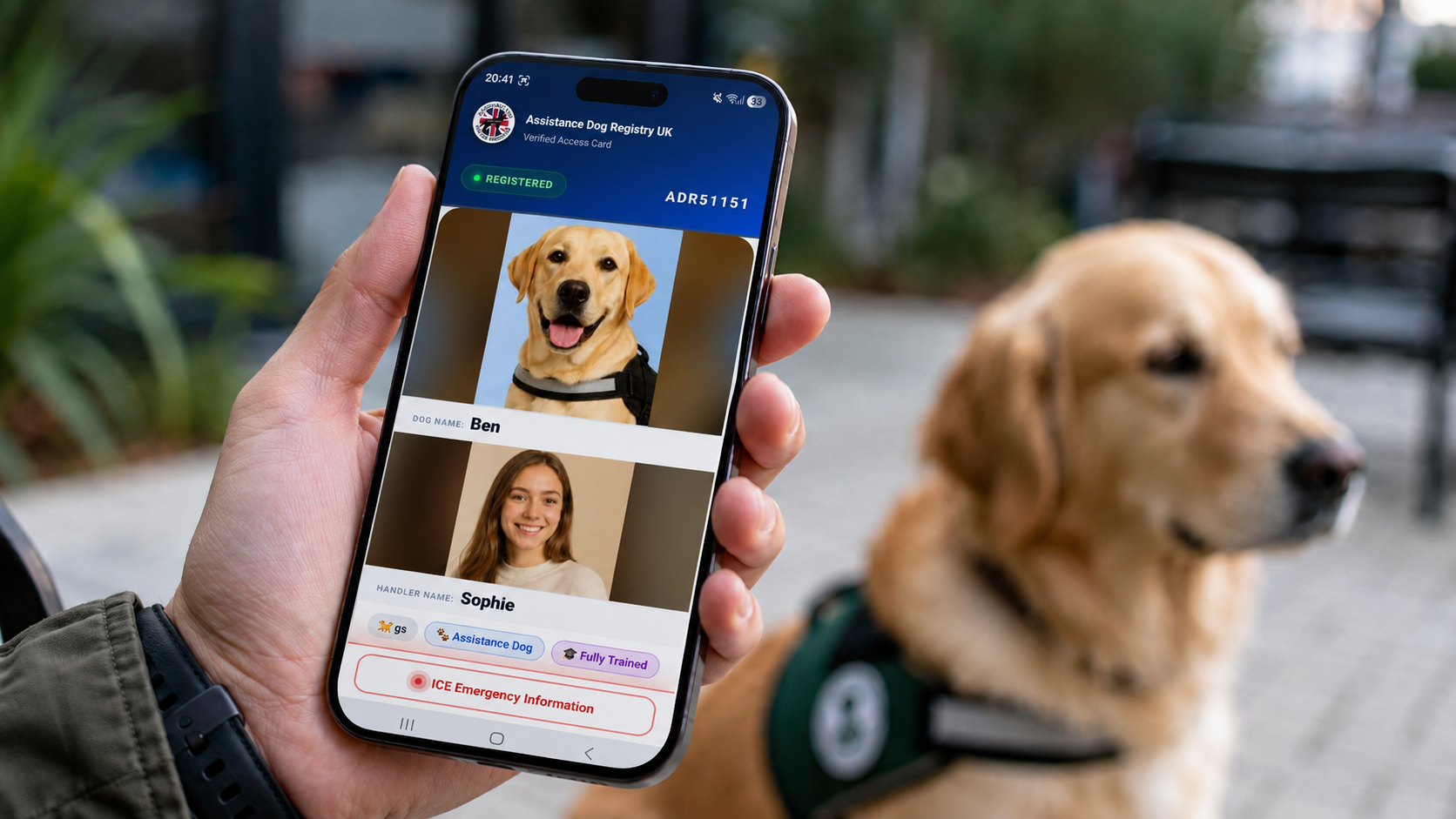
A hand holds a smartphone showing an ADR Live ID assistance dog profile, with a golden retriever blurred behind
Registration & Documentation

ADR Live ID: Your Assistance Dog Profile, Ready on Your Phone

A live assistance dog profile, not just a plastic card. Linked to your online profile, QR lookup and support information, ready for the doorway moment.

📖 8 min read·By the ADR Team·Updated 27 June 2026

Key takeaways
  • ADR Live ID puts your voluntary assistance dog profile on your phone. It links to your live online profile and QR lookup, ready for the doorway moment.
  • Live beats static. A plastic card cannot change once printed; a live profile can be checked and updated, and shows current information.
  • It helps the venue too. Letting staff scan to check your profile gives a nervous manager a calm, neutral thing to do instead of an interrogation at the door.
  • It is voluntary, not official. ADR Live ID is not government-issued, not legally required, and does not certify disability, training or guarantee access.
  • Activate it from your ADR account using "Add to Google Wallet" where available. Apple Wallet support is coming soon.
Uses your device's voice. No data sent to anyone.
ADR Live ID: 3 steps to your phone
From account to wallet pass in minutes.
1
Log in to your ADR account
Open your dashboard on the ADR UK site.
2
Add to Google Wallet
Tap "Add to Google Wallet" where available. Apple Wallet coming soon.
3
Show it at the door
Present the pass; staff can scan the QR to see your live profile neutrally.
📋 Table of contents (click to expand)
  1. 1. The doorway problem
  2. 2. Introducing ADR Live ID
  3. 3. Why live beats static
  4. 4. Let them verify you
  5. 5. What ADR Live ID can show
  6. 6. Add it to Google Wallet
  7. 7. Privacy and emergency information
  8. 8. What ADR Live ID does not do
  9. 9. How to activate it

Most conversations about digital ID get the emotion completely wrong. They talk about features like wallet passes, QR codes and NFC chips, when the thing that actually matters to a disabled handler is the few seconds at a café, shop, pub, hotel or venue door when you are challenged and have to explain yourself under pressure, often in front of a queue of strangers.

That is the moment ADR Live ID is built for. It is not really about technology at all. It is about walking up to a doorway with something calm, live and scannable to show, so the situation can be shorter, quieter and more dignified. This guide explains what ADR Live ID is, why a live profile beats a printed card, and exactly how to activate it.

The doorway problem

Ask any assistance dog handler about their worst access experiences and they rarely describe a courtroom or a complaint form. They describe a doorway. A member of staff steps across, the queue behind you goes quiet, and suddenly you are being asked to justify your disability and your dog to a stranger who holds the door.

The painful part is not a lack of paperwork. It is being forced to explain something private, quickly, under pressure, when you are just trying to buy a coffee or check into a hotel. For people with invisible disabilities, that pressure can trigger anxiety, PTSD or a meltdown. ADR Live ID is designed for precisely that moment: to give you a calm, ready way to present your information so you do not have to perform your disability on demand.

ADR Live ID does not sell you a digital ID. It gives you relief from the doorway moment: confidence, dignity, and something live to show instead of an argument.

Introducing ADR Live ID

ADR Live ID lets eligible Assistance Dog Registry UK members keep their voluntary assistance dog profile ready on their phone. Instead of relying only on a plastic card that lives in a drawer or a wallet, your assistance dog information travels with you, in the place you always have to hand.

The pass links straight to your live ADR profile and QR lookup, so the information a venue sees is the current version, not a snapshot frozen at the moment a card was printed. ADR Live ID is currently available for ADR UK members. It is part of ADR's wider toolkit of voluntary information tools, alongside the online profile, ID card, dog tags and optional vest.

Why live beats static

A plastic card can absolutely be useful, and many handlers like having something physical to hand over. ADR ID cards even carry a QR that links to your live profile. But the printed face of a card is static: the moment it is printed, the photo, details and status on it stop being able to change, and the card itself can be left at home, lost or stuck in a drawer.

ADR Live ID keeps that same live profile on the phone you almost always have with you. The pass display stays current, and it gives staff a neutral object to look at: a screen, not a confrontation. That small shift, from "prove it to me" to "here, you can check this", is what takes the heat out of so many doorway encounters.

A card is a photograph of a moment. A live profile is a window that always shows the current view.

Let them verify you

This is the part most handlers do not expect, and it is the most powerful angle of all. The QR code on your ADR Live ID is not only for you; it is genuinely useful for the venue too. A nervous manager who is unsure what to do suddenly has a simple, low-conflict way to check information, rather than feeling they have to interrogate a disabled customer.

When you turn the moment into "here, you can verify this yourself", you hand the staff member a graceful exit. They are no longer the person who has to make a judgement about your body; they are just someone scanning a code. A line that works well is below.

Use this wording

"This is my voluntary ADR profile. It helps present my assistance dog information clearly, and you are welcome to scan it."

What ADR Live ID can show

The pass and the live profile it links to are designed to show the right amount of information: enough to be useful at a doorway, without oversharing. Depending on your settings, ADR Live ID can present:

  • Your ADR number
  • Your dog's name
  • A dog photo or profile image
  • A handler-facing profile link
  • A QR lookup for staff to scan
  • A link to a support / rules page
  • Your profile validity or status, where applicable

Add it to Google Wallet

ADR Live ID is live now on Google Wallet, the app already built into most Android phones. Instead of carrying yet another plastic card, your voluntary assistance dog pass sits next to your boarding passes and loyalty cards, ready in a tap. Apple Wallet support is coming soon.

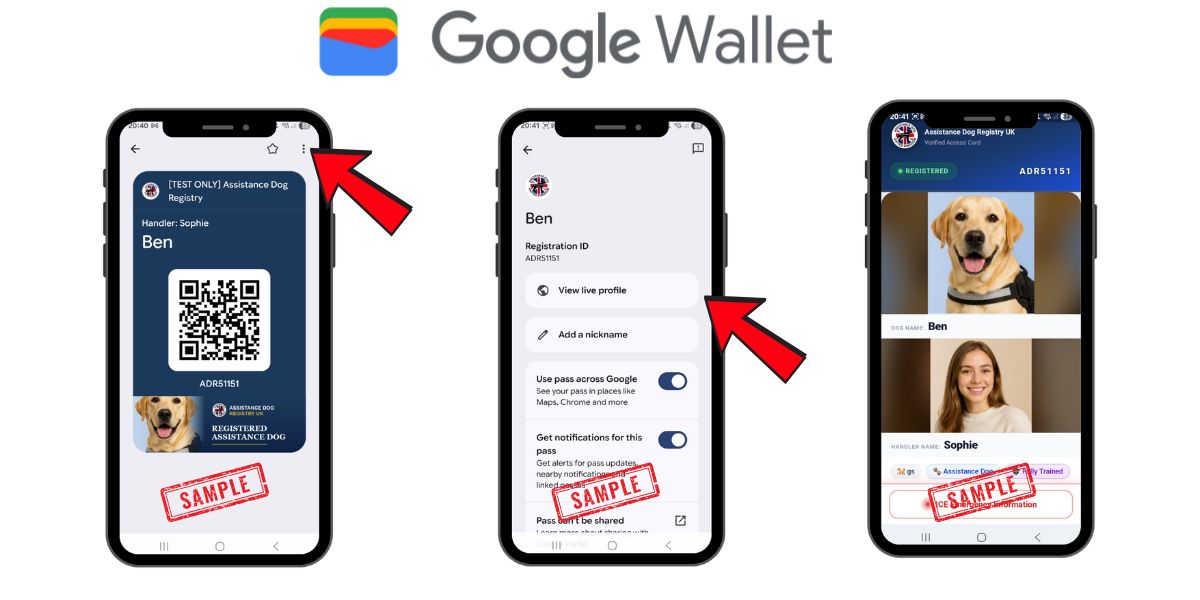
ADR Live ID assistance dog pass shown in Google Wallet: wallet pass with QR code, pass settings, and the linked live profile

Here is why handlers like having it in Google Wallet:

  • Always on your phone. No app to download and no login to fumble at the door, the pass is right there in Google Wallet.
  • One tap, no searching. Open Wallet, show the pass. Staff see a tidy, neutral screen instead of a confrontation.
  • Scannable QR. A venue can scan the code and view your live profile themselves, so they verify rather than interrogate.
  • Always current. The pass links to your live profile, so what a venue sees is the up to date version, not a printed snapshot.
  • You stay in control. The pass is not shared with anyone unless you show it, and sensitive details stay controlled through your profile.

Getting the pass takes seconds:

  1. Log in and open your dog's live ADR profile on your phone.
  2. Scroll down the profile page.
  3. Tap Add to Google Wallet.
  4. The pass saves to your phone, ready to show at any doorway.

That is it. From then on, your assistance dog information travels with you in the one thing you always have to hand. Remember that ADR Live ID is a voluntary support tool: it is not government issued, not legally required, and it does not guarantee access. Its job is to help you present your information calmly and confidently.

Get UK assistance dog updates

Join 4,600+ UK handlers. We email when tools, the law or guidance change. No spam.

Privacy and emergency information

Because an assistance dog profile can touch on health, privacy is built into how ADR Live ID is designed to be used. The guiding principle is simple: show what is helpful at a doorway, and keep sensitive details controlled and minimal.

  • Sensitive medical information should not be displayed unnecessarily on the wallet pass itself.
  • Emergency contact details and optional emergency instructions are controlled through your ADR profile and shown only where appropriate, not splashed across a public pass.
  • Detailed medical conditions should not be placed directly into the wallet pass unless the implementation is specifically built to comply with Google's rules and data-protection requirements.

In short, the wallet pass is a calm front door to your information, not a medical record on display. You stay in control of what is visible and to whom.

What ADR Live ID does not do

Honesty is part of the point here, so let us be completely clear about the limits. ADR Live ID is a voluntary support tool, and it is important not to overstate it, both because it is the truth and because overstating it could put you in a weaker position at a doorway. ADR Live ID:

  • is not government issued;
  • is not legally required;
  • does not certify disability;
  • does not certify training;
  • does not guarantee access anywhere;
  • does not override behaviour or safety concerns. A calm, controlled dog still matters in every setting.

What it does do is help you present voluntary information clearly and confidently. For the legal background on your actual protections, see our assistance dog rights page, and for what to say if you are challenged, read Refused Entry With an Assistance Dog? and our guide on ADUK yellow booklets and owner-trained dogs.

How to activate it

Getting set up takes a couple of minutes if you already have an ADR membership:

  • Log in to your ADR account.
  • Open your dog's live profile on your phone and scroll down.
  • Tap Add to Google Wallet to save the pass (see Add it to Google Wallet above for the full walkthrough).
  • Apple Wallet support is coming soon. Keep an eye out if you are on iPhone.

🐾 Activate ADR Live ID

Cards and tags are useful, but ADR also gives you a live profile, QR/NFC lookup, emergency contact tools and ADR Live ID, so your assistance dog information is ready when challenged.

Create your live assistance dog profile →

Quick setup checklist

  • ☐ Log in to your ADR account
  • ☐ Check your dog name, photo and profile are up to date
  • ☐ Add ADR Live ID to Google Wallet
  • ☐ Review what is visible vs kept private
  • ☐ Practise the calm "you're welcome to scan it" line
  • ☐ Remember: voluntary tool, behaviour still matters

About this guide

This guide was written by the Assistance Dog Registry UK team. ADR Live ID is a voluntary information tool. We have written it to be clear about what it does and does not do, in line with EHRC guidance, the Equality Act 2010 and data-protection good practice.

If you spot anything that needs updating, contact us.

ADR
The Assistance Dog Registry UK Team Verified

Founded by Norbert Szeverenyi · 6,000+ UK handlers supported · Materials reviewed against UK statute and official EHRC, Shelter and GOV.UK guidance.

Disclaimer

This article is general information, not legal advice. ADR Live ID and ADR registration are voluntary and do not, by themselves, create a legal right of access, certify disability or training, or guarantee entry anywhere. "Add to Google Wallet" is a delivery mechanism; Google Wallet is a trademark of Google LLC.

If your access is at risk, please seek specialist advice from the Equality Advisory and Support Service, Citizens Advice, the EHRC, or a qualified solicitor.

Key terms explained

ADR Live ID
A voluntary digital assistance dog profile for ADR UK members, kept on your phone and linked to your live online profile and QR lookup.
Live profile
An online assistance dog profile that can be checked and updated, so the information shown is current rather than fixed at print time.
QR lookup
A scannable code linking to your ADR profile, giving staff a neutral way to view your assistance dog information.
Google Wallet
A phone app that stores passes and cards. It is the delivery mechanism for ADR Live ID, not the product itself.
Voluntary information tool
A tool that helps present assistance dog information by choice. It is not government-issued, legally required, or proof of disability.

Sources

Keep reading

Est. Reading: 4 minutes

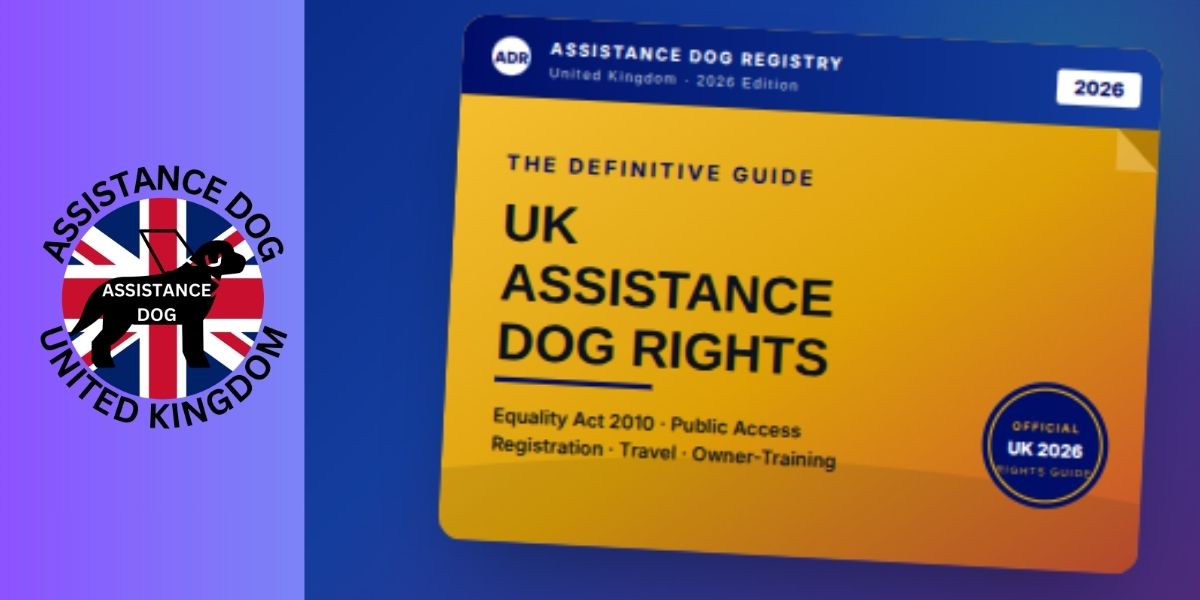
The UK Assistance Dog Rights Pocket Guide 2026 — Your Free Download

🇬🇧 2026 Edition · Free

A plain-English guide, a printable pocket card, and five response scripts for the next time someone questions your dog.

16 pages. Updated for 2026. Free. Yours to keep, print, or share.

Nobody should have to defend their dog at the door of a café

Last week, a handler wrote to us about a trip to her local coffee shop. She'd been going there for months. Same staff, same routine. Her dog, Bailey, curled quietly at her feet while she worked on her laptop.

Then a new manager started.

"Sorry — no pets." That was the first line. Then came the harder one: "Is that a real assistance dog?"

She froze. She knew her rights. She'd read the Equality Act. But in the moment, with other customers looking, she couldn't find the words. She packed up and left.

That evening, she sat in her car and cried. Not because of the coffee shop. Because she thought she'd been prepared, and she wasn't.

If you've ever had a version of that day, this guide is for you.

What's in the 2026 Pocket Guide

Five new sections for 2026. Everything else from 2025, updated where the law moved.

New for 2026 · 01

A pocket rights card you can print and carry

One side lists your protections under the Equality Act 2010 in plain English. The other side gives you the exact wording to use if someone challenges you. Sized to fit any card wallet or lanyard holder. Print once. Stop remembering.

New for 2026 · 02

Five response scripts for real confrontations

We asked handlers across the UK what they wished they'd said. Then we wrote it down. Specific scripts for:

  • Being turned away at a shop, café, or restaurant
  • A landlord saying "no pets" at a viewing
  • A taxi driver refusing the ride
  • A colleague or manager questioning you at work
  • A stranger who decides to educate you in public

Each script is short. Kind. Firm. You can read it straight off your phone if you need to.

New for 2026 · 03

A dedicated section for mental health handlers

If your dog helps you with anxiety, PTSD, autism, or another mental health condition, the conversation at the door is often harder. The new guide has a section just for you, with task-training notes specific to mental health assistance — deep pressure therapy, interruption, perimeter scanning, sensory support, meltdown prevention.

New for 2026 · 04

A landlord letter template

If your current landlord is pushing back, there's a copy-paste letter in the guide. It cites the Equality Act 2010 and the Housing Act. It's polite. It's firm. It's designed to end the conversation.

New for 2026 · 05

An employer accommodation template

For when you need to bring your assistance dog to work and HR doesn't know what to do. Includes the reasonable-adjustment framing, the escalation path through ACAS, and what to do if your employer refuses.

Download · Free · 16 pages

Download your 2026 Pocket Guide

A4 PDF. Print at home or keep it on your phone. No sign-up required.

⬇ Download the free PDF

5.8 MB · Print-ready · Works on phone or desktop

Who this guide is for

It's for you if any of these sound familiar:


  • You've trained your own dog, or are still training, and you're not sure if you "count"

  • You're a mental health handler whose dog's role isn't visible to strangers

  • You've been refused somewhere in the last year

  • You're thinking of registering your dog but haven't yet

  • You already carry an ADR card and want the pocket reference

  • You know another handler who could use it — forward freely

Your rights haven't changed. Your language can.

Under the Equality Act 2010, your assistance dog is protected in almost every setting where the public has access. Shops, cafés, restaurants, pubs, hotels, taxis, buses, trains, planes, workplaces, hospitals, schools, GP surgeries, dentists, hairdressers. The law doesn't distinguish between a charity-trained dog and one you've trained yourself.

But knowing the law and using the law are two different things. Most handlers lose the argument at the door not because they're wrong — but because the staff are faster. Staff are trained to ask certain questions. Most handlers don't have a script.

This guide gives you the counter-script. It's not a replacement for a registration card — it's the words to go with the card. The combination stops most conversations in ten seconds.

The three tiers, briefly

Registration is voluntary and separate from the guide. The guide is free whether you register or not.

Basic Yearly

£29.50/year

Digital-only. Your dog's profile, a registered ADR ID number, and a public verification page. No physical kit.

Most chosen

Premium Yearly

£59.50/year

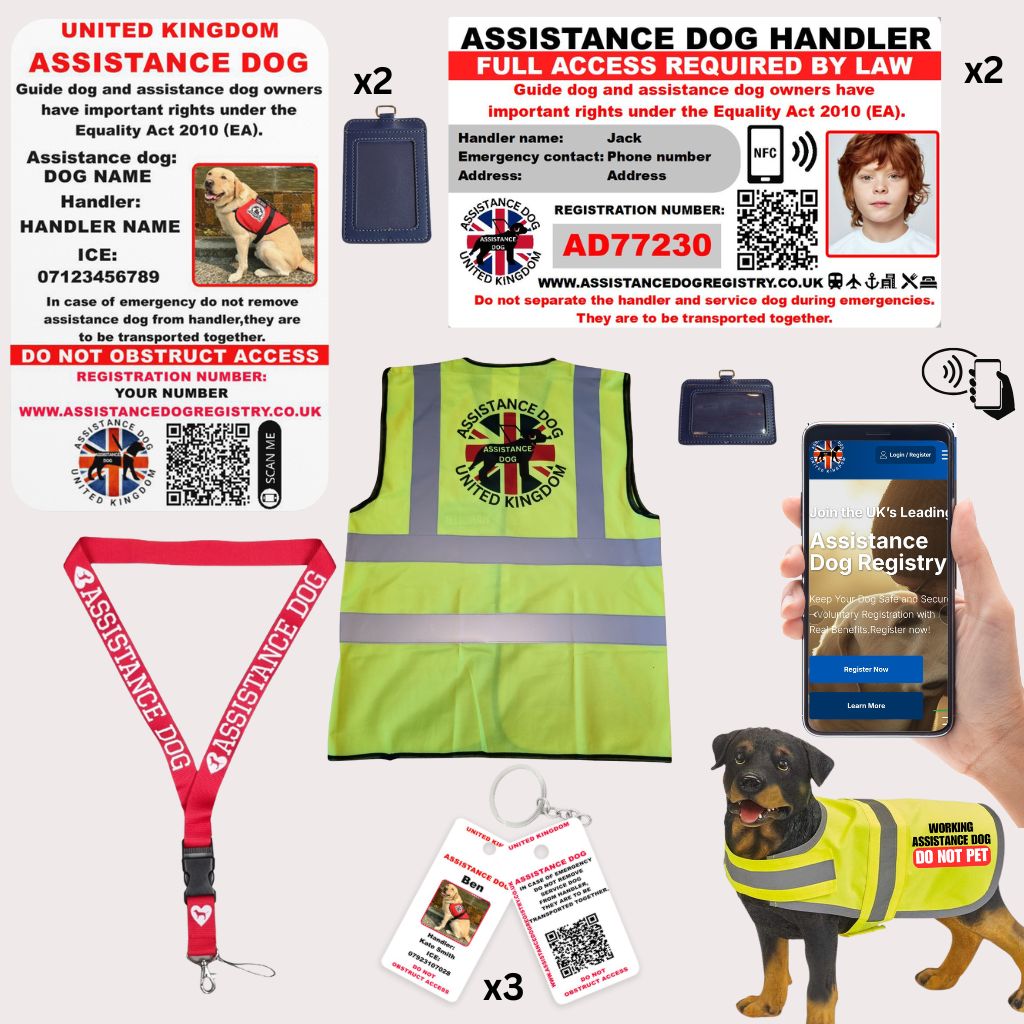
Membership plus the full physical kit — 2× NFC Smart ID cards, 3× personalised plastic ID tags, hi-vis "Do Not Pet" vest, leather card holder, branded lanyard. Free replacements if lost.

Lifelong Partner

£129.50 once

Everything in Premium, plus a dedicated handler card and handler hi-vis vest. You pay once. You never renew.

A note from us

We've registered thousands of UK dogs since we started. Many were trained by the handlers themselves — at home, with patience, sometimes over years. Handlers come to us with a wide range of disabilities, visible and invisible. Most have been questioned at least once in public. Some of them have cried in a car park afterwards.

None of that is fair. The law is clear. The reality, sometimes, isn't.

What we can do is make it harder for the reality to win. That's what this guide exists for.

Your dog works for you. We're here to make sure the rest of the world knows it.

— The team at the Assistance Dog Registry

Est. Reading: 6 minutes

Do Assistance Dogs Need Proof of Training?

What Businesses and Handlers Need to Know in the UK

There is often confusion about the legal requirements for assistance dogs in the United Kingdom.
Do assistance dogs need proof of training? Can a business legally refuse entry without certification? What happens if the dog is not behaving appropriately?

This article explains the Equality Act 2010, addresses common misconceptions, and outlines what both dog handlers and businesses need to know.

In This Article, You Will Learn:

  1. Whether assistance dogs in the UK need proof of training under the Equality Act 2010.
  2. When and why a business can legally refuse entry to an assistance dog.
  3. The responsibilities of handlers vs. businesses in public access situations.
  4. How voluntary registration helps reduce disputes and provide reassurance.

Do Assistance Dogs Need Proof of Training in the UK?

The Equality Act 2010 makes it clear: assistance dogs do not need proof of training or certification to have public access rights.

  • Handlers are legally allowed to train their own dog.
  • There is no legal requirement for charity or third-party training.
  • Businesses cannot demand medical proof of a disability.

Voluntary assistance dog registries exist to provide supportive tools such as ID cards, online profiles, tags, and vests. These are not legal certificates but help reduce disputes and provide reassurance in everyday situations.


Can a Business Refuse Entry to an Assistance Dog?

In most cases, refusing access to an assistance dog would be considered disability discrimination under the Equality Act 2010.

However, businesses do have rights and responsibilities. They may refuse entry or ask a handler to remove their dog if the dog:

  • Is not under control
  • Shows aggressive or disruptive behaviour
  • Poses a genuine health or safety risk
  • Causes hygiene concerns, such as not being house-trained

The law protects access for well-trained and well-behaved assistance dogs, but it does not require businesses to accept unsafe behaviour.


Comparison of Responsibilities: Handlers and Businesses

Handlers (Dog Owners)Businesses / Service Providers
May train their own assistance dog (charity training not required).Must allow access for assistance dogs in line with the Equality Act 2010.
Do not need to show proof of training or disability.Cannot demand medical evidence or certification of training.
Must ensure the dog is well-behaved, calm, and safe in public.May ask a dog to leave if it is disruptive, unsafe, or unhygienic.
Responsible for the dog’s health and welfare (vaccinations, parasite treatments, veterinary care).Can set reasonable rules around behaviour, while ensuring compliance with disability rights law.
Can use voluntary registries to obtain ID cards, tags, and vests for reassurance.Can accept ID cards or vests as supportive evidence, but these are not mandatory under the law.

Lifetime Assistance Dog Package

Why More Handlers Are Registering Voluntarily

Voluntary registration is especially helpful for:

  • Owner-trained assistance dogs
  • Handlers with invisible disabilities
  • People who face regular public access issues
  • Anyone who wants to avoid confrontation or stress

Your dog’s rights don’t change,but the way others treat you can.


Real Feedback from UK Handlers

“Before I registered, I was challenged everywhere. Now, I just show my card or let them scan the tag—problem solved.”
Alex, Autism Assistance Dog Handler

“The lifetime option paid off within a month. I’ve never had to argue with shop staff again.”
Melanie, Chronic Illness Handler

“I feel safer knowing if something happens to me, people can scan Max’s tag and see his ICE contact and allergy notes.”
James, PTSD Handler


Assistance Dog Registry UK Plans Which One’s Right for You?

We offer three flexible options:

🟩 Lifetime Package (Most Popular)

  • One-time payment
  • 4 Smart ID Cards (Dog + Handler)
  • 3 QR-Enabled Dog Tags
  • 2 Card Holders
  • Hi-Vis Dog & Handler Vests
  • Full Profile Access + Emergency Info
  • Free Replacement Card

🟨 Annual Premium

  • Renewed each year
  • Includes cards, tags, lanyard, and profile access
  • Flexible updates anytime

🟧 Monthly Premium

  • Budget-friendly monthly option
  • All the same tools spread the cost
  • Cancel anytime

👉 View Lifetime Package
👉 Compare All Plans


Do You Really Need to Register? Final Thoughts

Voluntary registration is not legally required but it offers powerful benefits:

✅ Faster public access
✅ Fewer arguments
✅ Emergency protection
✅ Peace of mind

If you're tired of being questioned, explaining yourself, or worrying in public spaces registration can be your daily support system.


Register once. Reduce stress forever.
Join the growing number of UK handlers who’ve said:
"It’s not about proving your right it’s about making life easier."


Our Assistance Dog Registry offers smart, professional tools to help you:

  • Instantly show your dog’s role and legal rights with Smart ID Cards
  • Provide staff with proof via a QR Code linked to the Equality Act 2010
  • Present your custom dog profile and handler details in seconds
  • Wear your support gear with confidence (lanyard, dog tags, vest)
  • Enjoy the benefits of voluntary registration that supports your rights without replacing or contradicting the law

Stay Confident This Summer

You deserve peace of mind when you're out enjoying the sunshine. With proper registration and public-friendly ID tools, you can confidently navigate the spaces where others still need educating.

Register your assistance dog today and enjoy every sunny moment without setbacks.

🎟️ Sign Up for the Lifetime Package Today

💡 Click here to learn more & register


Frequently Asked Questions

Do assistance dogs need proof of training in the UK?

No. There is no legal requirement to hold or show proof of training. A dog qualifies under the Equality Act 2010 by being trained to help with a disability, however that training was done.

Can a business demand certification or training documents?

A business may ask, but you are not legally obliged to provide certification. Many handlers carry voluntary ID for convenience, not because the law requires it.

Is there an official training standard for assistance dogs?

No single mandatory government standard exists. Assistance dogs must simply be trained to perform tasks for a disability and behave appropriately in public.

Does my dog need to be trained by a charity?

No. Owner-trained assistance dogs are equally valid under UK law, provided the dog performs disability-related tasks and is well behaved.

What can I use instead of formal certification?

A voluntary ID card or profile can help explain your dog's role and reduce confrontation, although it carries no legal status of its own.

Sources

Learn more about our Lifelong Partner Package

Learn More – Additional Assistance Dog Letter Templates

If you found this travel guide useful, you may also benefit from these other essential assistance dog letter templates we’ve published:

📌 Housing Accommodation Request Letter – Need to request reasonable accommodation from your landlord? This template ensures your rights under the Equality Act 2010 are respected.

📌 Workplace Assistance Dog Request Letter – If you need accommodations to bring your assistance dog to work, this letter outlines your legal rights and reasonable adjustments your employer should consider.

📌 Medical Confirmation of Need for an Assistance Dog – A doctor’s letter template to confirm your need for an assistance dog for public access, travel, and daily life.

🔹 More templates are coming soon! Let us know if you have specific needs, and we’ll create more resources to support assistance dog handlers.

Assistance Dog Registryusertagcalendar-fullclock
linkedin facebook pinterest youtube rss twitter instagram facebook-blank rss-blank linkedin-blank pinterest youtube twitter instagram