A campsite told a handler she could not use the shower block because another guest was allergic to dogs. Here is what the law actually says, what to say at the door, and what to do afterwards.
📖 6 min read·By the ADR Team·Updated September 2026
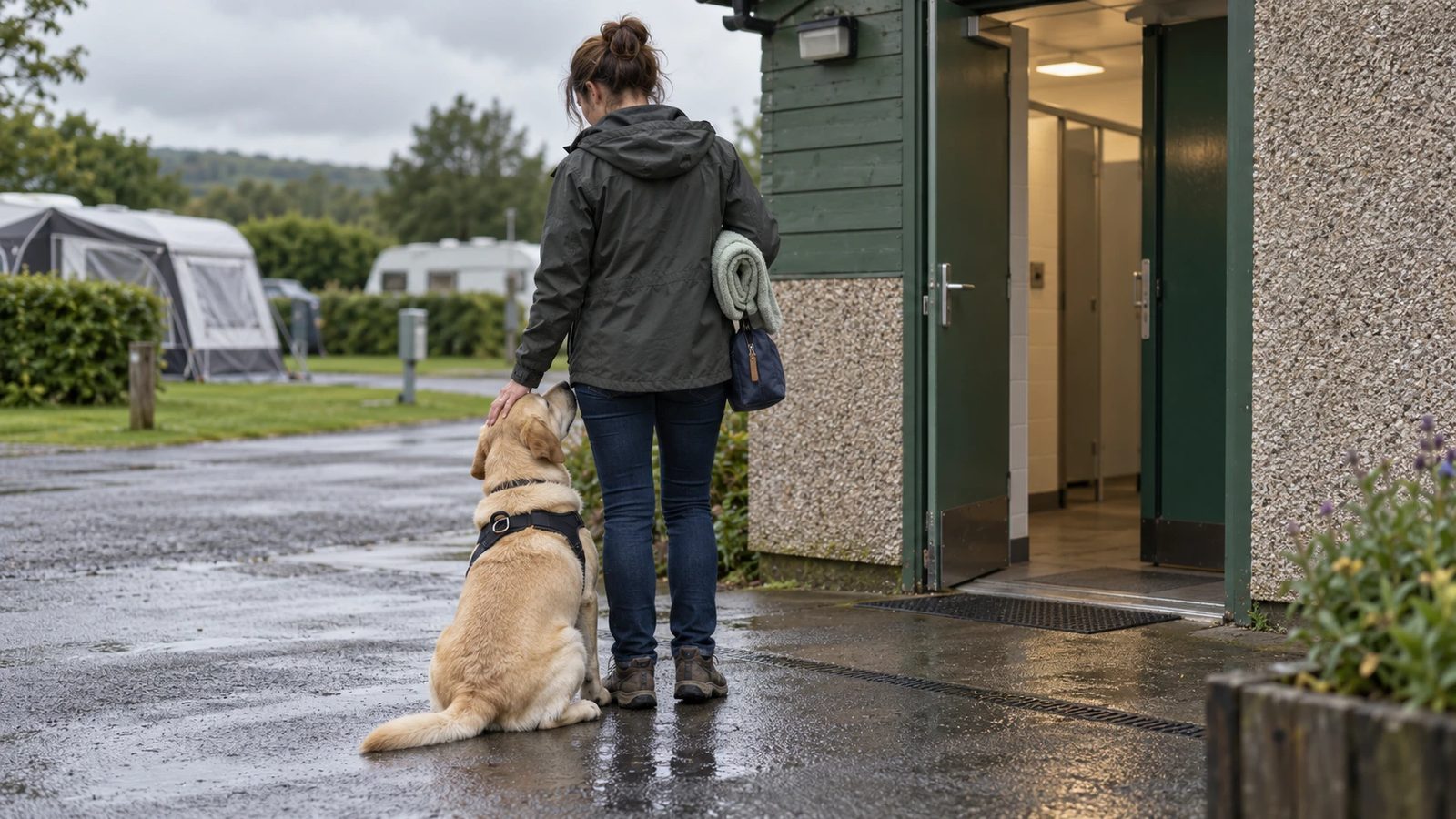
This week a handler asked us a question that had clearly been upsetting her for days. She had phoned ahead to a campsite, explained that she has an assistance dog, and been told she could not use the shared toilets and shower block, because another guest on the site was allergic to dogs.
She had not been told she could not come. Just that she could not wash.
If that has happened to you, here is what the law says, in plain terms.
A business cannot lawfully refuse you, or shut you out of part of its facilities, simply because someone else might be allergic to dogs.
The Equality and Human Rights Commission says this directly in its guidance for businesses. Refusing access because other people might be allergic is likely to be unlawful disability discrimination. Where there really is an allergic person on the premises, a business is expected to take reasonable steps so that person has minimal contact with the dog. The guidance then says something worth memorising:
reasonable steps are unlikely to include banning all assistance dogs
The Commission's guidance for tourism and hospitality goes further and answers almost exactly the campsite question. It deals with a provider who already has a booking from someone with a dog allergy, and says refusing the booking from the handler is unlawful discrimination. It also deals with a small bed and breakfast where the owner herself is allergic, and says plainly that there is no exception in the Equality Act 2010 to cover that situation.
This is the part almost nobody knows, and it matters.
An allergy is not automatically a disability. It counts only if it is an impairment with a substantial and long term adverse effect on normal day to day activities. A severe reaction to dog dander, or dander triggered asthma, may well meet that test. Itchy eyes does not.
And hay fever is specifically excluded by regulations from counting as a disability at all, unless it makes another condition worse.
So in the campsite case, nobody had established that the other guest's allergy was a disability. The business jumped straight from "another guest mentioned an allergy" to "you cannot use the facilities". That is not a balancing of two people's rights. That is one person being excluded on the basis of an assumption.
Your assistance dog is not a pet in law. She is closer to a piece of equipment you rely on, like a wheelchair or a hearing aid, and a "no dogs" policy is the textbook example of a barrier that has to be adjusted.
The statutory Code of Practice that courts must take into account was replaced in August 2026. It is worth knowing what the current version says, because it is unusually direct:
The Code also works through a case where staff ask another customer to move out of a wheelchair space, the customer refuses, and the staff give up. That may still breach the duty. The provider is expected to go further than asking once.
So the question is never "does someone else object". It is "what could this business reasonably have done so both people are looked after".
For the campsite, the honest list is short and obvious: different times for the shower block, the accessible facility, the second block if there is one, cleaning between uses, or moving the pitches apart. None of that is exotic. None of it involves excluding a disabled person from washing.
They exist, and they are narrow. The example the Commission gives is certain hospital wards, where sterile conditions genuinely cannot be maintained around a dog. A campsite shower block, a cafe, a shop or a hotel is not that.
Five lines, in this order. They work because each one is grounded in something real.
That last line changes the conversation more than any of the others. Businesses that are guessing rarely want to put the guess in writing. And if it ever goes further, a written refusal with a name on it is the single most useful thing you can hold.
Most of these conversations are not hostile. They are staff who have never been trained, reaching for a policy that was written with pets in mind.
That is why so many handlers carry something to show. Not because the law requires it, because it does not. There is no official UK register of assistance dogs, and nobody can lawfully demand paperwork from you. But a card in your hand moves the conversation from "is this allowed" to "how do we sort this out", and it does it without you having to explain your disability to a stranger at a doorway.
If you do not have anything yet, our free digital assistance dog law card sets out the relevant law on one screen. It costs nothing, it lives on your phone, and you can show it before a queue builds up behind you.
Handlers who would rather hand over something physical, with a photo, a QR code and an ID number a business can check for itself, use our registration plans. Again, not because the law asks for it. Because it ends the discussion faster.
The law does not ask you to prove anything. A card in your hand simply ends the conversation faster, without explaining your disability to a stranger. Our free digital law card puts the relevant law on your phone screen, at no cost and with no card details.
Get the free law cardPrefer something physical, with a photo and an ID number a business can check? See the registration plans.
The Equality Act 2010 does not apply in Northern Ireland. The Disability Discrimination Act 1995 does, and there are two differences that matter here.
First, the threshold for adjustments is whether the policy makes the service "impossible or unreasonably difficult" to use, rather than the Great Britain test.
Second, and importantly for allergy arguments, Northern Ireland law does allow a provider to justify its treatment where it genuinely and reasonably believes that it is necessary in order not to endanger anyone's health or safety. That is a demanding test, and a vague claim about an allergy with no evidence behind it would struggle. But it exists in Northern Ireland, and it does not exist in the rest of the UK, so do not rely on Great Britain guidance if you are here.
In Northern Ireland the body to contact is the Equality Commission for Northern Ireland, and claims go to the county court, usually within six months, extended by three months if the dispute goes to conciliation.
We looked for a decided UK case about an assistance dog being excluded because of somebody else's allergy, and there is not one that we could find. That does not weaken your position. It reflects how these disputes end: quietly, at the door, with the handler walking away and saying nothing.
Which is exactly why the written refusal, and the complaint afterwards, matters more than it feels like it does at the time.
Written for handlers in the UK. It is general information, not legal advice about your own situation. If you need advice on your own case, the Equality Advisory and Support Service is free.