Salons often turn assistance dogs away on hygiene grounds. No UK trade body tells them to, and where councils have written rules about animals they have carved assistance dogs out.
📖 5 min read·By the ADR Team·Updated September 2026
Someone typed a single phrase into our rights assistant this week: "Nail bars".
They did not need to write a sentence. Anyone who has been turned away from a salon knows the shape of that conversation. It is usually polite, usually apologetic, and usually wrong.
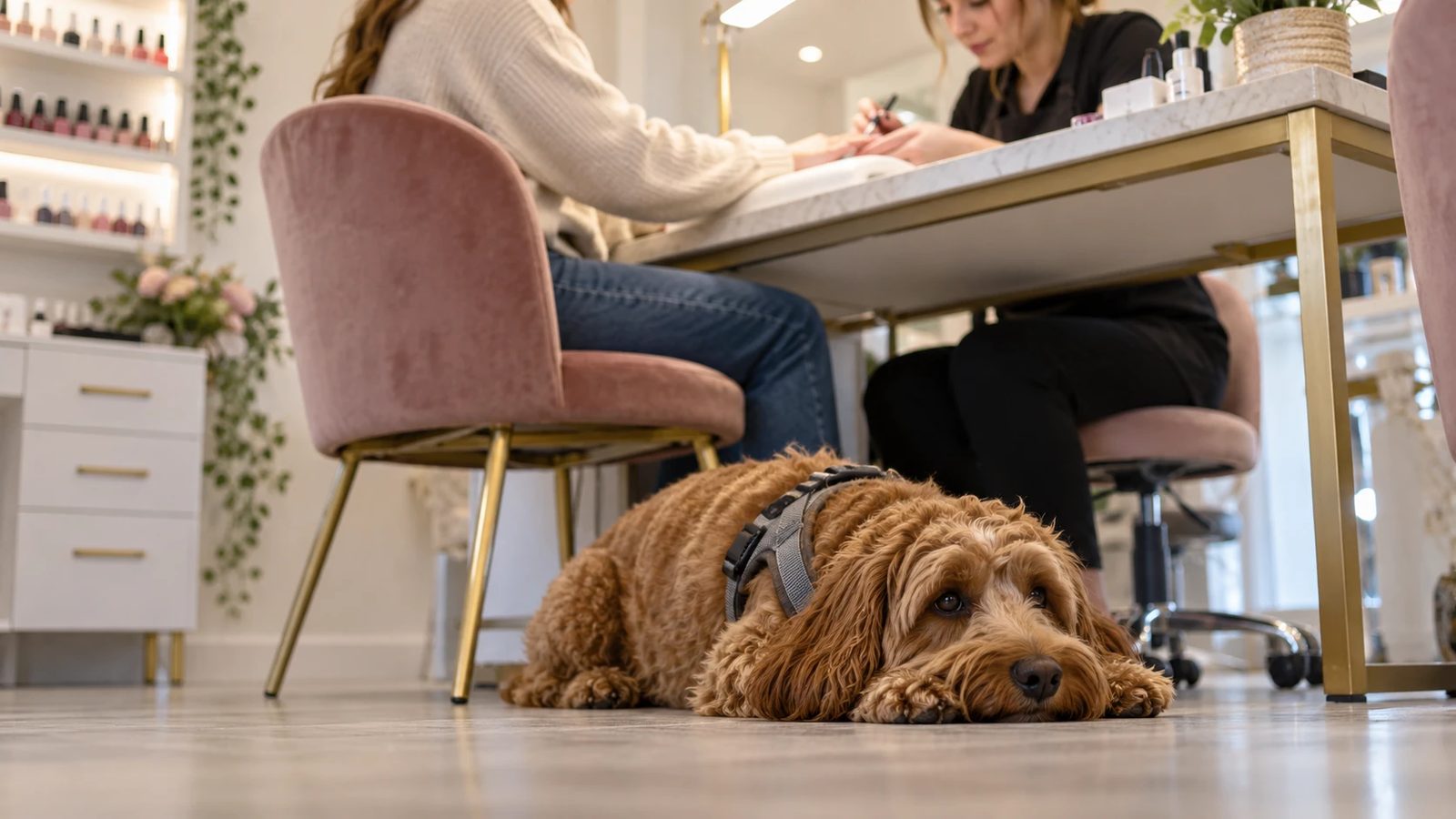
A nail bar, hair salon, barber shop, beauty clinic or tattoo studio is a service provider. It has the same duties as a shop or a cafe. A "no dogs" rule has to be adjusted for an assistance dog, and the cost of that adjustment falls on the business.
There is no special category for salons. There is no exemption for treatment rooms in the Equality Act.
This is the reason handlers are given nine times out of ten, so it is worth being precise.
In England, Wales and Scotland there is no general health and safety defence in this part of the Equality Act. The only health related exception concerns pregnancy. So "health and safety" is not a legal trump card. At most it is one factor in deciding what is reasonable.
The benchmark the Equality and Human Rights Commission uses is that refusing an assistance dog is unlawful except in the most exceptional circumstances, and the only example it gives is certain hospital wards. Genuinely clinical, sterile environments.
A nail bar is not a hospital ward. A hairdressing chair is not a sterile field.
Tattoo and piercing studios sit closer to the line, because there is a real sterile field around a procedure. Even there, the honest answer is about where the dog settles, not whether you are allowed in the building. The further from the sterile field, the weaker any hygiene argument gets, and a waiting area is not a sterile field at all.
We went looking for the guidance salons are supposedly following.
In other words, when a salon says "we're not allowed", there is usually no "not allowed" to point to.
One warning if you go searching yourself. Plenty of results say animals are banned from studios "except guide or service animals". Those are United States state rules. They are not UK law and do not apply here.
Some London boroughs license "special treatment" premises and do set conditions about animals. This is the one place animal rules genuinely appear. What is striking is how they are written.
In Kingston upon Thames, the standard licence conditions prohibit animals in treatment rooms except assistance animals. In Royal Greenwich, the conditions prohibit animals in treatment rooms and areas apart from assistance animals.
Other boroughs we checked have no animal clause at all.
These are individual councils, not a national rule, so do not quote them as if they applied everywhere. But the pattern is useful: where a licensing authority has actually thought about animals in treatment rooms, it has written the assistance dog exception in.
"Our insurance doesn't cover dogs" is the other standard line. We looked for evidence of it and found none: no insurer wording, no broker statement, no trade body statement saying public liability cover excludes assistance dogs. Neither the Commission's guidance nor the assistance dog sector's own guide to welcoming customers mentions insurance as a reason to refuse.
If a salon tells you this, it is reasonable to ask them to check the policy wording rather than repeat what they were told.
The useful question is never "can the dog come in", it is "where does the dog settle". Reasonable options include:
One thing the Code is clear about: offering a less effective alternative is not enough if a better reasonable adjustment exists. "Come back another day" is not automatically good enough, and neither is putting you somewhere that does not actually work for you.
And they cannot charge you for any of it. No dog fee, no extra cleaning charge.
Question four ends more of these conversations than any other, because there is usually nothing to show.
We could not find a single reported UK case or news story about a salon, barber or tattoo studio refusing an assistance dog. Not because it does not happen, clearly it does, but because handlers almost never take it further. They go home, rebook somewhere else, and the salon never learns it was wrong.
If it happens to you, a short written complaint afterwards genuinely does change what that business does next time.
The law does not ask you to prove anything. A card in your hand simply ends the conversation faster, without explaining your disability to a stranger. Our free digital law card puts the relevant law on your phone screen, at no cost and with no card details.
Get the free law cardPrefer something physical, with a photo and an ID number a business can check? See the registration plans.
None of this means you should have to argue at a reception desk while other customers listen.
Most handlers who carry a card do it for that reason alone. Nothing about it is official, and no salon can demand it. It just gets you past the first thirty seconds without discussing your disability in public.
Our free digital assistance dog law card puts the relevant law on your phone, at no cost. If you would rather hand over something physical with a photo and an ID number the business can check itself, that is what our registration plans are for.
Complain in writing to the business, with the date, what was said and who said it. For free advice in England, Wales and Scotland, use the Equality Advisory and Support Service. Claims go to the county court, or the sheriff court in Scotland, normally within six months of the incident.
Northern Ireland works under different legislation, including a health and safety justification that does not exist in the rest of the UK, so a Northern Irish studio has a stronger argument about a genuine sterile field than a mainland one. Get local advice there.
General information for UK handlers, not legal advice about your own case.