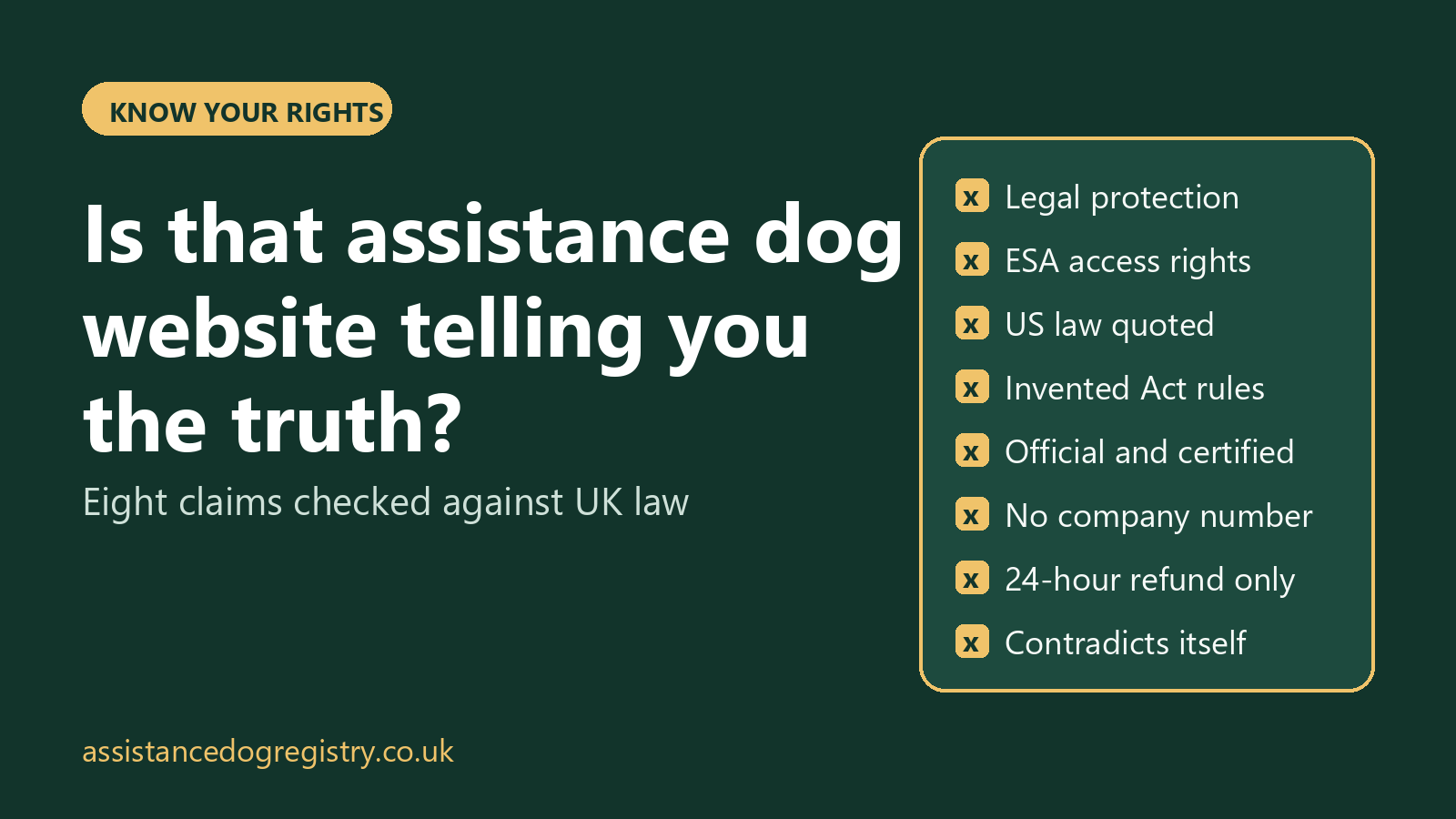
A site advertising on our own name promises "legal protection" for €99. We read every page, checked the law and the company register, and wrote down what we found. Use it as a checklist for any site that asks you to pay.
📖 7 min read·By the ADR Team·Published 4 November 2026
Over the last week a website called uksupportdog.com has been buying Google adverts on the search "register assistance dog uk" and on our name. People have started asking us whether it is the same thing as the Assistance Dog Registry. It is not, and we think you should see what it says before you pay anyone €99.
So on 4 November 2026 we read every page of that site, and we did what we would want anyone to do to us: we put each claim next to the law and next to the public record. Everything quoted below is on their pages today. Our job here is not to call anyone names. It is to show you the eight things to check on any website that wants your money for an assistance dog card, including ours.
Not a government one, not a charity one, not a private one. Not ours. The Equality Act 2010 protects a disabled person, and a dog that has been trained to assist that person. No card, certificate or database changes that in either direction. Any website that says registering your dog gives you "legal protection" has told you, in its first sentence, how carefully to read the rest.
This is the headline on their home page. Lower down the same site, in a paragraph headed Registration Disclaimer, it says: "there is no official or government-maintained registry for assistance dog and emotional support animals in the UK or EU. You are not obligated to register your assistance dog". Both sentences cannot be true. The second one is the law.
Their register page sells an emotional support dog registration with that promise. Their own FAQ, question 3, says emotional support dogs "are not protected under the UK laws so far". That second statement is correct. An emotional support animal has no public access right in the UK, and no card changes that.
This is American law. The United States has a Fair Housing Act rule for emotional support animals. The UK has nothing like it. A UK landlord or council is not bound by an ESA letter, a card or a register.
That is their FAQ, question 7. None of it is in the Act. The Equality Act 2010 sets no registration, insurance, assessment, collar or tag requirement for an assistance dog. It is worth noticing that the invented requirements are exactly the things the site sells.
The Disability Discrimination Act 1995 was repealed in England, Scotland and Wales in 2010, when the Equality Act replaced it. It still applies in Northern Ireland only. The Mental Health Act 1983 is about assessment, detention and treatment. Neither Act gives anyone a right to bring a dog into a shop.
The two-question rule is from the American ADA. It does not exist in UK law. And no UK airline has carried emotional support animals since 2021, nor does any airline recognise a private registry for assistance dogs. A "verification for airlines" page verifies nothing an airline will ask for.
No body in the UK certifies assistance dogs. The United States has no certification at all. The EU has no common assistance dog law. And 195,125 people enrolled on a €349 course would be more than €60 million of sales, from a site that, by public traffic estimates, gets a few thousand visits a month.
The footer says the site is run by "Psychiatric Service Dog Association Limited". We searched Companies House on 4 November 2026. There is no company of that name on the UK register. The postal address given is in Dublin. There is no phone number; "Contact us 24/7" is an email form. The terms and conditions refer to "the age of majority in your state or province", say "international orders do not come with tracking", and allow a refund only within 24 hours of paying. The same registration is priced at €99 on one page, "89.00 GBP or 99 EUR" on another, and €199.99 struck through on a third.
The Assistance Dog Registry is a voluntary register run by a UK business. We are not a government body, not a charity and not an accreditation scheme. An ADR card does not give you rights you do not already have, and we will never tell you it does. What it does is practical: it ends the conversation at a door in seconds instead of minutes, it carries a public profile a doorman can check on his phone, and it comes with plain-English guides about what the law actually says. If you are not sure whether you need a card at all, read the free guides first and decide in your own time. Nobody at a door can demand one.
If you have already paid a site like the one above, you have not broken any law and you have not lost any rights. You simply bought a card that promised more than any card can. Keep the receipt, ask for a refund in writing, and if the refund is refused and you paid by card, your bank's chargeback process exists for exactly this.
Three things end most doorway conversations: a calm sentence ("She is my assistance dog, she is trained to help me with my disability"), a well-behaved dog, and something quick to show that explains who to call. The free refusal guide covers the first. An ADR card with its public profile covers the third, and the guide works without one.
Read the free refusal guide →Every quotation above was taken from uksupportdog.com on 4 November 2026 and can be checked on that site. Company information from Companies House, searched the same day. This article explains the law in general terms and is not legal advice.