If you have been searching for how to register your dog as a service dog in the UK, you have not done anything wrong. The UK simply uses a different word. Here is what it is, what the law actually asks of you, and a 60-second check to see where your dog stands.
📖 6 min read·By the ADR Team·Updated September 2026
Type "how do I register my dog as a service dog" into Google from anywhere in the UK and you will find plenty of websites happy to sell you a certificate. Before you pay anyone anything, it helps to know two things.
The first is that the UK does not use the word service dog the way American television does. The second is that there is nothing official to register with. Neither of those is bad news. Once the word is sorted out, the law here is simple, and it is on your side.
In the United States, a dog trained to help a disabled person is called a service dog. Most of the films, TV shows and social media videos about working dogs come from there, so the word has travelled.
In the UK, the same kind of dog is called an assistance dog. Guide dogs, hearing dogs, medical alert dogs, autism assistance dogs and psychiatric assistance dogs are all assistance dogs. So is a dog you trained yourself, as long as it is trained to do tasks that help with your disability.
If you have been calling your dog a service dog, nothing is lost. The word just does not match what shops, landlords and the law in this country are used to hearing. "Assistance dog" is the phrase that gets recognised at a door.
In British law, the phrase service animal already means something else. The Animal Welfare (Service Animals) Act 2019, known as Finn's Law, was named after a police dog who was stabbed on duty. It protects animals such as police dogs and police horses. It has nothing to do with disability.
So when you say service dog in Britain, some people will picture a police dog or a military dog, not a dog that helps you with a disability. That is one more reason the UK word works better in the moment that matters.
Not in any official sense. There is no government register of service dogs or assistance dogs in the UK. No department licenses them, and no certificate carries legal weight. We explain who does and does not have authority in who can certify your assistance dog in the UK.
The same is true in the United States, where the word comes from. The US Department of Justice says its disability law does not require registration or certification, and that certificates sold online do not convey any rights.
So if a website offers to make your dog an official service dog for a fee, be careful. Nobody can do that, in either country. Including us.
What you can do is voluntary. A registry like ours gives you an ID card, a registration number and a profile that someone can check for themselves. It does not create a right. It gives you a quick way to show the right you already have, so the conversation at the door takes seconds instead of minutes. Our step by step guide on how to register your dog as an assistance dog in the UK covers how that works.
The Equality Act 2010 does not keep a list of approved dogs. In practice it comes down to two things.
On top of that, a working dog is expected to behave like one. A dog that is out of control in a shop or a cafe is unlikely to be treated as an assistance dog, whatever paperwork it has.
Who trained the dog is not the test. Owner-trained assistance dogs have the same rights as charity-trained ones. There is more detail in what counts as an assistance dog in the UK and in our guide to what conditions qualify.
Do not take our word for it. The Equality and Human Rights Commission, the body that enforces the Equality Act, publishes a guide on assistance dogs for businesses. It says the law does not require an assistance dog to wear a harness or jacket, that assistance dogs can be trained by their owners, and that nobody should be refused service simply because they do not carry an ID book.
Answer three questions and we will tell you where your dog most likely stands, and what to read next. Nothing is saved or sent anywhere.
1. Do you have a disability or long-term health condition that affects your day-to-day life?
2. What does your dog do for you?
3. How does your dog behave in busy places like shops and cafes?
General information, not legal advice. Your answers stay in your browser.
Here is the same check as a flowchart you can save, print or share.
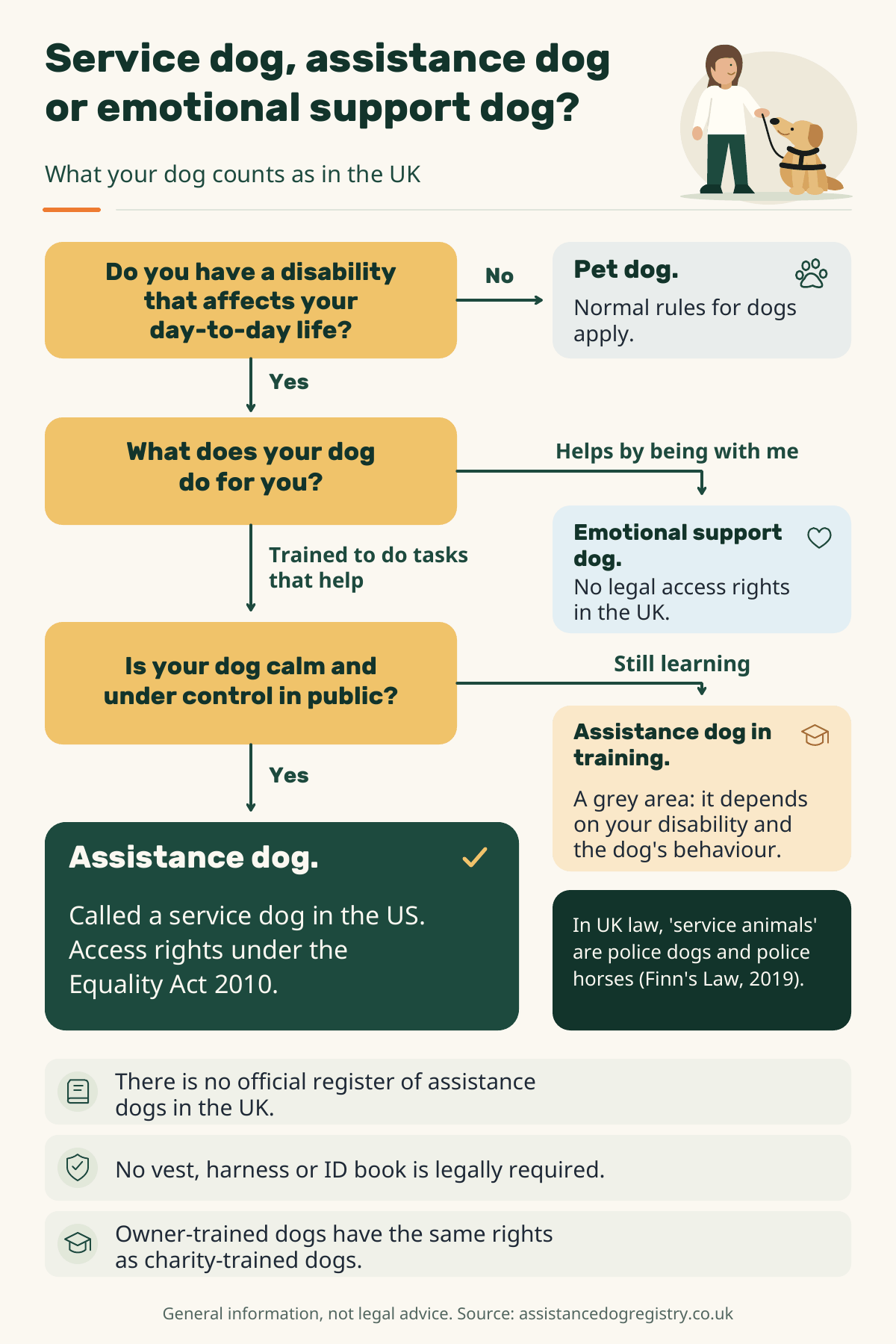
Share this infographic on your website
Charities, trainers, bloggers and support groups are welcome to use it for free. Copy the code below and keep the credit link with it.
And here it is as a table, if you prefer to see all the options side by side.
| What it is | What the dog does | Access rights in the UK |
|---|---|---|
| Assistance dog (US: service dog) | Trained to do tasks that help with a disability | Yes, through the Equality Act 2010 |
| Assistance dog in training | Learning those tasks | A grey area. It depends on your disability and the dog's behaviour |
| Emotional support dog | Helps by being with you | No legal access rights. Entry is up to the venue |
| Service animal in UK law | Police dogs and police horses | Protected by Finn's Law, a different law |
| Pet dog | A companion | Normal rules for dogs apply |
Yes, if two things are true. Your anxiety counts as a disability, meaning it has a substantial and long-term effect on your daily life. And your dog is trained to do specific things that help, such as interrupting a panic attack, applying deep pressure on cue, or leading you out of a crowded space.
A dog that makes you feel calmer simply by being there is doing something valuable. In UK law, though, that is emotional support rather than assistance, and emotional support dogs do not have legal access rights. Our guide to the legal difference between an ESA and an assistance dog goes through it in detail.
The difference is not how much you need your dog. It is what the dog has been trained to do.
No. The law does not require an assistance dog to wear a vest, a jacket or a harness, and it does not require an ID book either. The Equality and Human Rights Commission says so in its guidance for businesses.
In practice, a vest and an ID card help for the same reason a name badge helps at work. People recognise them, so fewer people stop you in the first place. That is a convenience, not a legal requirement, and you should never be told otherwise.
If you would like both in one go, that is what our Lifelong Partner Pack is for.
Knowing the law helps. Knowing what to say in the moment helps more.
The UK Assistance Dog Rights Pocket Guide, with the wording to use when you are challenged. The Access Refusal Kit, step by step. Letter templates for landlords, employers, schools and businesses. A free printable ID card and certificate with your dog's name and photo.
Open a free accountNo payment, no card details, nothing that turns into a bill later.
What Americans call a service dog, the UK calls an assistance dog. There is no official register in either country, so nobody can sell you official status. In the UK your rights come from the Equality Act 2010: a disability, and a dog trained to do tasks that help with it.
Everything else, including anything we offer, is there to make the moment at the door easier. It is not there to make your dog legitimate. Your dog already is.