The old "multiply by seven" trick is charming, memorable, and wrong. Here is how dogs really age, why size matters more than most people realise, and what it means when your dog works as an assistance dog.
📖 7 min read·By the ADR Team·Updated July 2026
If your dog is one year old, they are not the equivalent of a seven-year-old human. In physical terms they are far more grown up than that. Dogs pack most of their ageing into the first two years of life, then settle into a slower pace that depends heavily on their size. A practical, modern way to estimate your dog's age counts the first year as about 15 human years, the second year as about nine more (reaching roughly 24), and then adds four to seven human years for every year after that, depending on whether your dog is small, medium, large or giant.
If you would rather not do the sums, our free Dog Age Calculator works it out instantly once you enter your dog's age and size.
A one-year-old dog is closer to a human teenager than to a seven-year-old child. That single fact is why the "times seven" rule falls apart.
The idea that one dog year equals seven human years has been repeated for generations, but its origins owe more to memorable maths than to biology. The simplest version of the story is that someone once divided a typical human lifespan of around 70 years by a typical dog lifespan of around 10, arrived at a tidy ratio of seven to one, and the phrase stuck because it was so easy to remember.
The trouble is that it treats ageing as a straight line, as if a dog gains the same amount of maturity every single year from birth to old age. Real dogs do nothing of the sort. A puppy reaches sexual maturity, adult size and most of its adult behaviour within roughly the first year or two, something no seven-year-old child has done. Then, once that early sprint is over, ageing slows to a gentler pace that varies from breed to breed. The seven-year rule captures neither the early sprint nor the later variation, which is why vets have long since moved past it.
Modern veterinary guidance describes ageing in life stages rather than as a flat annual multiplier. Frameworks used widely in practice, including the American Animal Hospital Association (AAHA) Canine Life Stage Guidelines and material from the American Veterinary Medical Association (AVMA), group dogs into puppy, young adult, mature adult and senior phases, with the boundaries shifting according to size and breed.
Research has taken it further. A 2019 study published in the journal Cell Systems compared chemical changes in the DNA of dogs and humans, effectively reading a biological "clock" written into the genome. The authors found that dogs age rapidly early in life and then far more slowly, and they proposed a curved, non-linear formula rather than a simple multiplier. The details of any single formula are less important than the headline it confirms: dog ageing is front-loaded and size-sensitive, and the old rule of thumb simply does not reflect it.
None of this replaces your own vet. Averages and calculators describe populations, not the individual dog asleep at your feet. Breed, weight, diet, dental health, exercise and genetics all shift the picture, so treat any estimate as a helpful guide rather than a diagnosis.
This chart shows the estimated human-age equivalent for common ages, using the same size-based model as our calculator. Read it as a guide to converting dog years to human years, not as a medical measurement.
| Dog age | Small | Medium | Large | Giant |
|---|---|---|---|---|
| 1 year | 15 | 15 | 15 | 15 |
| 2 years | 24 | 24 | 24 | 24 |
| 3 years | 28 | 29 | 30 | 31 |
| 5 years | 36 | 39 | 42 | 45 |
| 7 years | 44 | 49 | 54 | 59 |
| 10 years | 56 | 64 | 72 | 80 |
| 12 years | 64 | 74 | 84 | 94 |
| 15 years | 76 | 89 | 102 | 115 |
Want the exact figure for your own dog, including part-years in months? Use the free tool.
Open the Dog Age Calculator →
Here is the part the old rule misses entirely: a small dog and a giant dog of the same age are usually not at the same life stage. In general, smaller dogs tend to live longer and age more gently in their later years, while large and giant breeds often reach old age sooner. That is why, once a dog is past two, we add fewer human years for a small dog and more for a giant one.
Exactly why large dogs age faster is still being studied, but shorter average lifespans in bigger breeds are well documented. Body size, growth rate and breed all play a part, alongside individual health and lifestyle. The practical takeaway is simple: judge your dog's stage by its size and condition, not by a one-size-fits-all number.
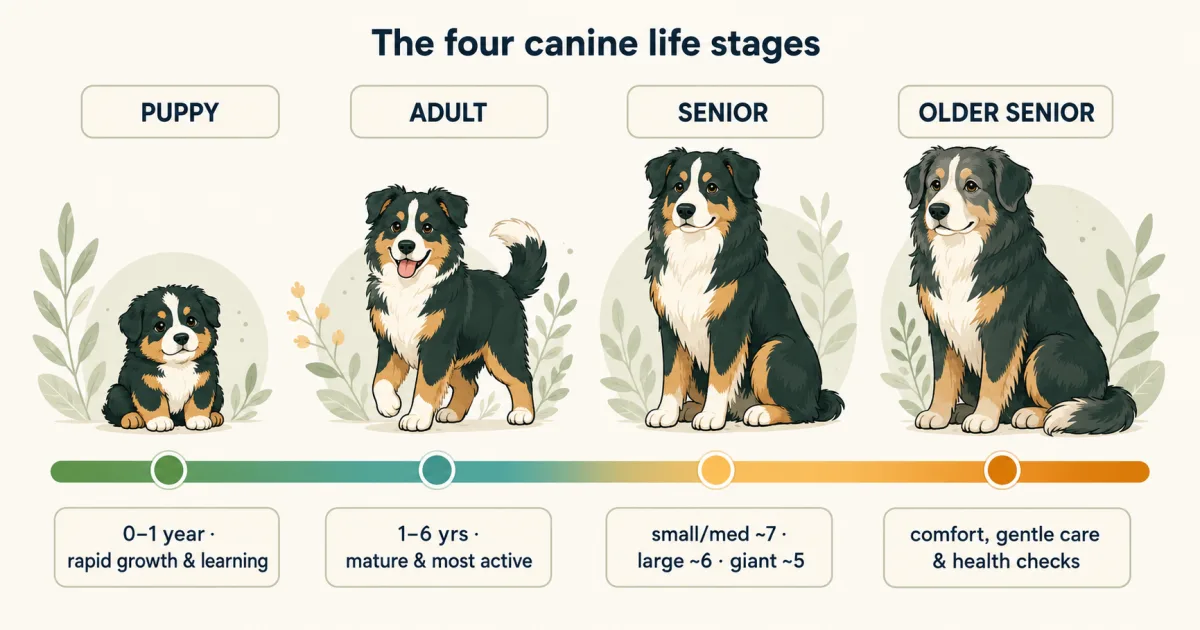
Most dogs move through four broad life stages, and larger dogs tend to reach the senior stage earlier than small ones.
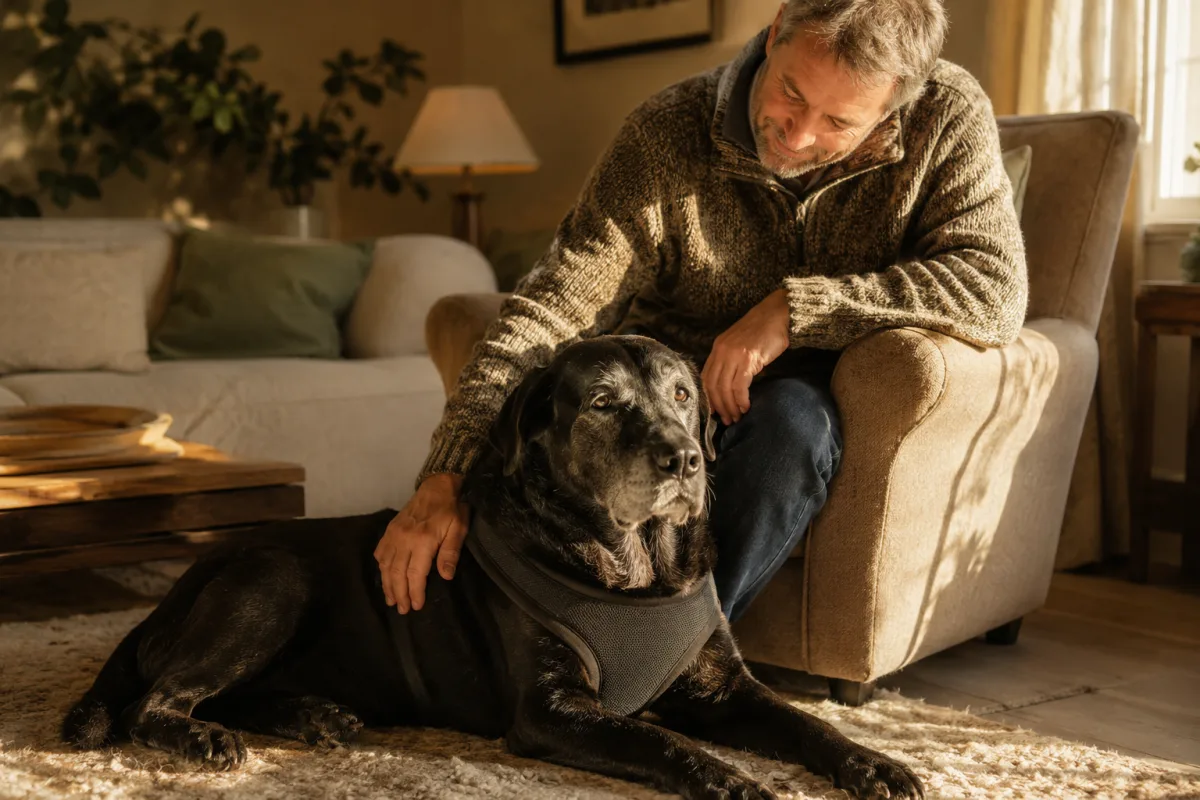
For handlers who rely on an assistance dog, a dog's real life stage is practical information, not just a talking point. Assistance dogs can work at very different ages depending on their health, temperament, training and the tasks they perform. A younger dog may still be learning its role and building reliability, while an older dog may take on fewer or lighter duties and need more rest between them.
Understanding where your dog sits on that curve helps you plan sensibly: how much to ask of them on a long day out, when to build in recovery time, and when to start thinking about a successor so there is no sudden gap in support. If you are new to all of this, our overview of assistance dog registration in the UK is a good starting point, and our free digital assistance dog law card is a simple everyday tool to have on your phone.
Enter your dog's age and size for an instant estimate in human years, plus their life stage. No sign-up needed.
Calculate your dog's age →Yes, in some cases. If a dog is healthy, well trained, comfortable, safe and genuinely able to perform the tasks its handler needs, age by itself is not a barrier. Plenty of experienced assistance dogs continue to provide valuable support well into their later years.
What matters is being honest about comfort and workload. An older assistance dog may do fewer tasks, work shorter days or need adaptations to keep it comfortable, and thoughtful handlers plan ahead for retirement and, eventually, a successor dog. Age is one input into that planning, never the whole decision.
Assistance Dog Registry is a voluntary registry and support service. Age alone does not automatically prevent a dog from being registered. What matters is that the dog is trained to assist with a disability-related need, is under control and is suitable for the role. ADR does not decide legal status and does not issue legal certification; it provides a practical way to hold and share your assistance dog's information, including an online profile, QR and NFC verification tools and optional ID cards.
The law gives you rights. ADR gives you the tools to explain them.
If your dog assists you with a disability-related need, ADR can help you create a clear online profile, QR and NFC verification tools and optional ID cards to present your assistance dog information more confidently.
Register your assistance dog →A permanent profile, smart ID cards, dog tags and clear QR-linked information for landlords, agents and public access situations. The law gives you rights; ADR gives you the everyday tools to explain them.
See the Lifelong Partner plan →The age figures here use a practical, size-based model consistent with veterinary life-stage guidance and research into canine ageing. They are estimates for general guidance and are not a substitute for advice from your own vet. Written and reviewed by the ADR team against reputable veterinary sources.
If you spot anything that needs updating, contact us.
Founded by Norbert Szeverenyi · Thousands of UK handlers supported · Materials reviewed against reputable veterinary and official guidance.
This article is general information, not veterinary advice. Age estimates are approximate and vary by breed, health and individual dog.
For advice about your dog's health, ageing or fitness to work, please speak to your own vet or a suitable veterinary charity such as PDSA or Blue Cross.