Not all assistance dogs are ADUK-trained, and an ADUK yellow booklet is not the only way handlers organise their information. Here is what the guidance actually says.
📖 8 min read·By the ADR Team·Updated 24 July 2026
This is no longer just a doorway dispute. The Equality and Human Rights Commission has written to JD Wetherspoon, saying it is concerned the policy may not comply with UK law. A spokesperson said the Commission is “aware that a significant number of disabled people with assistance dogs have been refused entry from JD Wetherspoon venues because they aren’t carrying formal identification.”
Assistance Dogs UK — the charity whose booklet the policy relies on — has said it believes the policy is discriminatory, and that its identification is not a legal requirement. Its chief executive said Wetherspoon approached the charity for guidance before introducing the policy, but “sadly they didn’t take on board any of the advice we provided.”
The charity Guide Dogs said it had received 27 complaints about Wetherspoon from people challenged or refused entry. An MP, Steve Darling, was challenged for ID last August. Wetherspoon maintains its position, saying it considers requiring ADUK-accredited training “a reasonable adjustment,” and citing an increase in dog bites.
Most coverage has focused on guide dog owners who had the booklet and were still stopped. There is a second group barely mentioned: handlers of owner-trained assistance dogs, who cannot obtain an ADUK booklet at all, because ADUK accredits dogs trained by its member organisations. Under a policy that accepts only ADUK accreditation, a lawful owner-trained team is excluded by design, not by behaviour.
Being straight about the law: it is genuinely unsettled. The Equality Act 2010 requires service providers to make reasonable adjustments and not to treat disabled people less favourably, but it does not set training standards for assistance dogs, and it does not state outright that they must be admitted. Only a court can decide whether a specific policy is unlawful. What is clear is that no UK law requires you to carry ID for an assistance dog.
And straight about us: an ADR card is not ADUK accreditation and will not satisfy this policy. We are a voluntary register, not a government body and not an accreditation scheme. What we can help with is being prepared and knowing exactly what to say, which is why the refusal kit on this page is free and needs no sign-up.
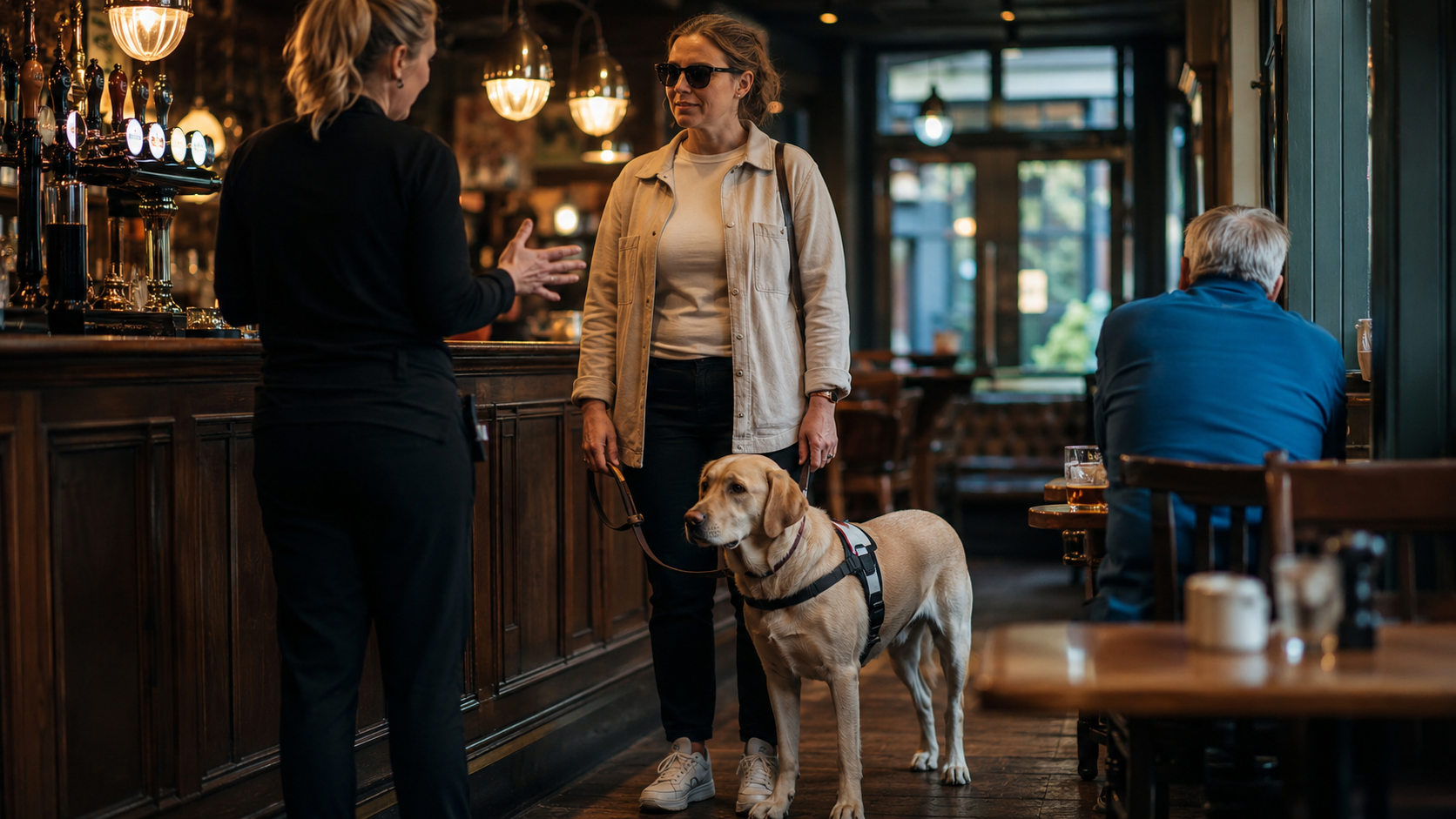
If you have ever been stopped at a pub door and asked to produce an "ADUK yellow booklet" for your assistance dog, you are not alone, and you have not done anything wrong. It is one of the most common access problems UK handlers report to us, and it lands hardest on people with invisible disabilities and owner-trained assistance dogs, who often have no charity paperwork to wave at a doorway.
This guide explains, calmly and factually, what an ADUK yellow booklet actually is, what Assistance Dogs UK and the Equality and Human Rights Commission (EHRC) really say about it, and exactly what to say if a member of staff insists on seeing one. We are not here to attack any pub chain. We are here to make sure you walk in knowing the facts.
Most front-of-house and security staff have a simple mental model: guide dog equals "real" assistance dog, everything else is a pet. That model is decades out of date, but it is sticky, and it causes the same painful scene to play out again and again.
The result is that a lawful, well-trained assistance dog team can be turned away at the door for the sole reason that they do not carry a particular charity's booklet. Understanding why staff get this wrong is the first step to correcting it without a confrontation.
In early 2026 this stopped being a quiet doorway-by-doorway problem and became a national talking point. JD Wetherspoon introduced a policy that, in practice, can ask assistance dog handlers for evidence of training before granting access, and its wording referred to Assistance Dogs UK (ADUK). Assistance Dogs UK then published a statement responding directly to it.
ADUK has publicly stated that JD Wetherspoon misrepresented ADUK and its position. In its statement, ADUK says Wetherspoon implied that its new policy reflects ADUK policy and legal advice, and that "this is not the case". ADUK also restates that, under the Equality Act 2010, disabled people are not required to carry identification or documentation for their assistance dog, and that ADUK does not tell service providers to restrict access only to dogs trained by ADUK member organisations.
This matters for you as a handler. The very body whose booklet staff so often demand has now said, in public, that requiring proof of training as a condition of entry does not reflect its policy or the law. We are still not making our own finding that any single refusal was unlawful, because policies vary and individual staff get things wrong. But you no longer have to take our word for the central point: ADUK has said it too.
Always check a venue's current published accessibility statement for yourself, because these policies are updated over time, sometimes in response to exactly this kind of feedback.
A venue expecting an ADUK booklet is common. It does not change the fact that, under UK guidance, the booklet is not a legal requirement.
Here is the part that surprises most people, including the staff asking for it. The yellow booklet comes from Assistance Dogs UK (ADUK), an umbrella body for a group of assistance dog charities. ADUK-trained handlers may be issued a yellow booklet, an ID card or an app as a courtesy, to make day-to-day life smoother.
But ADUK's own guidance is clear on two things that matter enormously here:
In other words, the very organisation whose booklet staff are demanding does not claim that the booklet is compulsory, nor that its absence means a dog is not a genuine assistance dog. That is a powerful, fair point to make calmly at a doorway.
The Equality and Human Rights Commission (EHRC) is the body that publishes official guidance for businesses on the Equality Act 2010. Its guidance for businesses is helpful and clear on the points handlers most often need:
Read together with ADUK's own position, the picture is consistent: documentation can be handy, but it is not the legal test. Refusing a disabled handler purely because they have no ADUK booklet is exactly the kind of situation that may raise Equality Act 2010 concerns.
You do not need to argue or quote statutes. One calm, complete sentence does most of the work. Say it slowly and only once, then ask your question.
"I understand you may be used to seeing ADUK yellow booklets. However, not all assistance dogs are ADUK-trained or charity-trained, and an ADUK booklet is not a legal requirement. My dog is trained to assist with my disability and is calm and under control. Please can you confirm whether you are refusing access because I do not have an ADUK booklet?"
That final question does something important: it gently asks the staff member to state, out loud, that the refusal is based on missing paperwork rather than on anything your dog has done. Most reasonable staff will pause at that point, and many will let you in. If they do not, you now have a clear, fair account of what happened.
If the conversation does not resolve and you are still being refused, switch into record-and-follow-up mode. Stay polite, protect yourself, and gather what you need for a written complaint. Ask the venue to:
For the full set of words, questions and details to capture in the moment, our companion guide, Refused Entry With an Assistance Dog? What to Say, What to Ask, and What to Do Next, walks through the whole sequence and includes a copy-paste complaint email.
A credible guide has to be honest about the other side, and being clear about this actually strengthens your hand. None of the above gives any dog a free pass on behaviour. An assistance dog is expected to be calm, clean and under control in public, and no booklet, card, registry or profile changes that.
If a dog is unsafe, disruptive, aggressive, not toilet trained or genuinely out of control, that is a separate issue from disability discrimination, and a venue may need to act. When you make a complaint, the fact that your dog was settled and well-behaved removes the most common defence a business will reach for, so a well-trained dog is your strongest evidence as well as your right.
The booklet question is about paperwork. Behaviour is about safety. Keep the two separate, and never let a paperwork dispute become a behaviour dispute.
Let us be completely clear about what the Assistance Dog Registry (ADR) is and is not. ADR does not replace ADUK, ADAA, the EHRC or legal advice. It is not a government register, it is not legally required, and it does not certify disability or training or guarantee access anywhere.
What ADR is, is a voluntary information platform for handlers who simply want their assistance dog details organised and ready, especially owner-trained handlers who have no charity booklet to show. A membership gives you a live online profile, an ADR number, a QR and NFC lookup that a nervous manager can scan to see your information presented neutrally, plus an ID card, dog tags and optional vest. It is a tidy way to present information, not a substitute for the law. You can read more about your protections on our assistance dog rights page.
What to say, what to ask, and what to record if you are challenged for an ADUK booklet or refused entry. Keep it on your phone, ready for the doorway.
Download the free refusal guideA permanent live profile, smart ID card, dog tags and QR-linked information you can present at the door: voluntary, handler-controlled, and especially useful for owner-trained teams.
See the Lifelong Partner plan →Dear [Venue] team,On [date] at approximately [time], I was challenged / refused entry at [venue, address] with my trained assistance dog because I did not have an ADUK yellow booklet. The staff member involved was [name/description]. My dog was calm and under control throughout.I understand an ADUK booklet is not a legal requirement, and that not all assistance dogs are ADUK-trained or charity-trained. Please could you: (1) review this incident; (2) send me a copy of your assistance dog policy; (3) confirm whether owner-trained assistance dogs were considered; and (4) confirm whether the refusal was based on my dog's behaviour or only on the lack of an ADUK booklet.I would welcome confirmation that staff will receive assistance dog awareness training. I look forward to your reply.Kind regards, [Your name]
This guide was written by the Assistance Dog Registry UK team and checked against current EHRC guidance for businesses, Assistance Dogs UK (ADUK) public information, and the Equality Act 2010. It reflects the ADUK-booklet refusals UK handlers most often report to us, particularly owner-trained teams.
If you spot anything that needs updating, contact us.
Founded by Norbert Szeverenyi · Thousands of UK handlers supported · Materials reviewed against UK statute and official EHRC, Shelter and GOV.UK guidance.
This article is general information, not legal advice. ADR registration is voluntary and does not, by itself, create a legal right of access. References to any named venue describe common handler experiences and publicly available positions, not a finding of unlawful conduct.
If your access is at risk, please seek specialist advice from the Equality Advisory and Support Service, Citizens Advice, the EHRC, or a qualified solicitor.