The Renters' Rights Act changed pet requests in England from 1 May 2026. But assistance dogs are not ordinary pets. Here is what handlers, landlords and letting agents need to understand.
📖 9 min read·By the ADR Team·Updated 8 May 2026
If you rely on an assistance dog because of a disability, a landlord or letting agent should not treat your dog like an ordinary pet.
The new renting rules in England mean private tenants can ask to keep a pet, and landlords must consider the request fairly. That is good news for renters generally. But assistance dogs sit in a different category. They are connected to disability rights and reasonable adjustments under the Equality Act 2010.
So if a tenancy agreement says "no pets", that does not automatically settle the matter.
For an assistance dog handler, the better question is:
Is allowing the assistance dog a reasonable adjustment so the disabled tenant can live in the property without being disadvantaged?
In many cases, the answer will be yes.
This article explains the difference between pets and assistance dogs, what changed from 1 May 2026, what to put in writing, and how voluntary ID, a QR-linked profile and clear documentation can make the conversation easier.
This is general information, not legal advice. If you are at risk of losing your home or being refused a tenancy, speak to Citizens Advice, Shelter, a housing adviser or a qualified legal professional.
The Renters' Rights Act changed private renting rules in England from 1 May 2026.
One of the changes is that private tenants can ask to keep a pet in the property. GOV.UK says tenants can ask to keep a pet and the landlord must consider the request. GOV.UK also says the landlord should give a reason if they refuse.
For ordinary pets, the new process matters because it gives tenants a clearer route than before. A landlord can no longer simply ignore the request or refuse without a fair reason.
But this is where assistance dog handlers need to be careful:
An assistance dog is not just a lifestyle pet request.
An assistance dog supports a disabled person. It may help with mobility, medical alert, psychiatric tasks, autism support, seizure response, or another disability-related task. The dog is part of the handler's ability to live safely and independently.
That means the Equality Act conversation still matters.
The new pet rules help ordinary renters ask for permission to keep a pet.
Shelter's 2026 guidance is clear: assistance dogs are recognised under the Equality Act. The new pet rules do not replace that position. Shelter notes that where a tenant needs an assistance dog, the landlord may need to make reasonable adjustments.
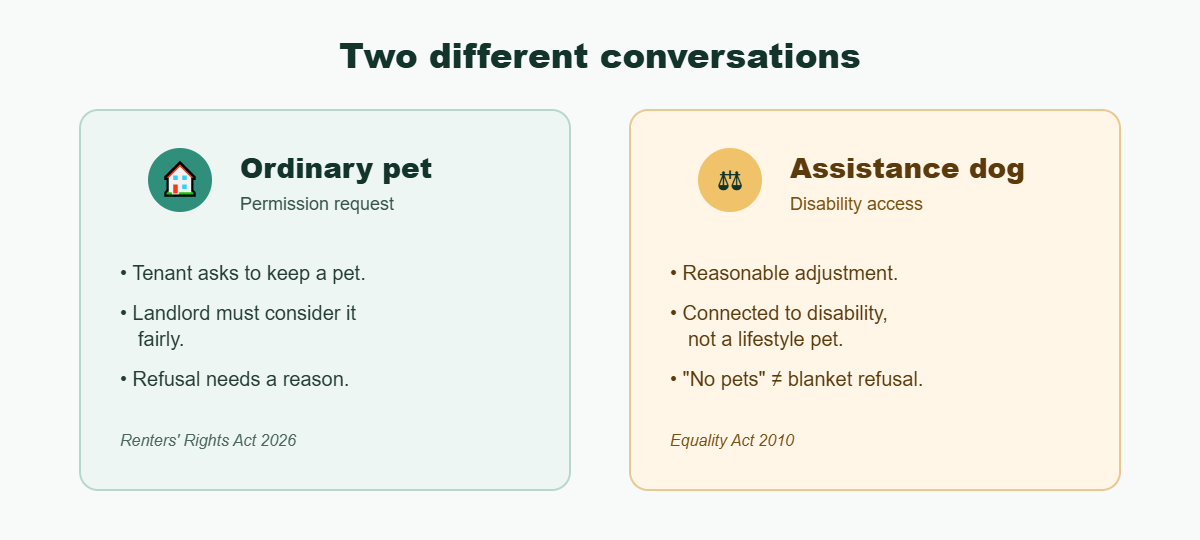
In plain English:
This does not mean every situation is automatic. The exact facts still matter: the property, the dog, the tenant's needs, any genuine health and safety issue, and whether the request is reasonable.
But it does mean a landlord should not simply say:
"The tenancy says no pets, so no."
That answer is too shallow when the dog is an assistance dog.
Ask for a reasonable adjustment in writing.
Keep the message calm, short and factual. You do not need to explain your full medical history. You only need to explain enough for the landlord or letting agent to understand that:
Here is a simple version:
I am requesting a reasonable adjustment under the Equality Act 2010. I am a disabled person and I rely on my assistance dog, [DOG NAME], to support me with disability-related needs. I am asking that any "no pets" clause or pet restriction is adjusted to allow my assistance dog to live with me at the property.
If your dog is registered with Assistance Dog Registry, you can add:
My dog also has a voluntary assistance dog profile and ID record, which I can share by QR link if helpful. I understand registration is not a legal requirement, but it gives clear information about my dog's role and emergency details.
That is the right tone: transparent, practical and legally accurate.
A landlord or agent may not understand assistance dogs. Many still think only guide dogs count, or that every assistance dog must come from a charity. That is not a safe assumption.
Helpful information can include:
You do not need to disclose private medical details beyond what is necessary.
A calm reply:
I understand the property has a no-pets rule. My request is different because this is an assistance dog connected to my disability. I am asking you to consider this as a reasonable adjustment under the Equality Act 2010, rather than as an ordinary pet request.
If they still refuse, ask for the decision in writing:
Please can you confirm the reason for refusal in writing, including whether you have considered the request as a disability-related reasonable adjustment?
This matters because a written refusal gives you something concrete to take to an adviser.
There is no government-run assistance dog register in the UK.
Handlers should be careful with language. Registration is useful but voluntary. It does not create the legal right. The legal right comes from disability law and reasonable adjustments.
A good response is:
There is no official UK government register for assistance dogs. My dog's voluntary registration and ID are provided to make communication easier, not because registration is legally required. The legal issue is that I rely on an assistance dog because of my disability.
This keeps you honest and avoids giving the landlord the wrong impression.
5-page printable pack — the difference, what to include, copy-paste landlord email, and a refusal record sheet.
Download the PDF (free)Your rights do not come from a card.
Real life is not a calm legal seminar. It is emails, viewings, agents, rushed phone calls — and people who do not know the difference between pets and assistance dogs.
That is why many handlers choose the Lifelong Partner package. It gives you:
It does not replace the Equality Act. It supports the conversation around it.
For housing, that can be especially helpful because a landlord or letting agent often wants clear, tidy information they can understand quickly.
Keep everything in writing where possible.
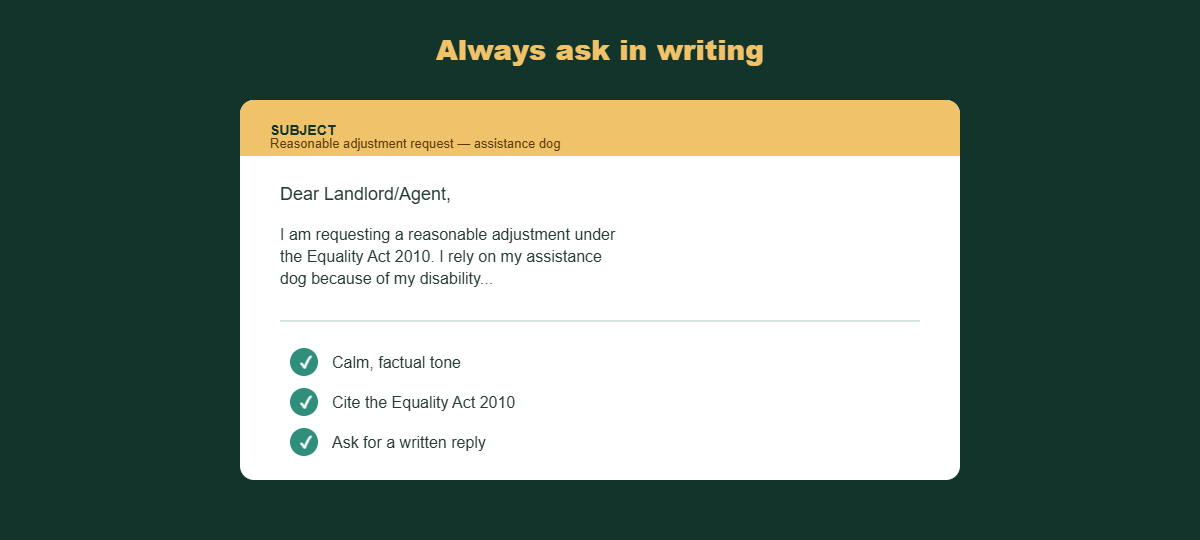
Subject: Reasonable adjustment request — assistance dog
Dear [Landlord/Agent Name],
I am writing to request a reasonable adjustment under the Equality Act 2010.
I am a disabled person and I rely on my assistance dog, [DOG NAME], to support me with disability-related needs. [DOG NAME] is trained/being trained to assist me and is not an ordinary pet.
I understand the property/tenancy includes a "no pets" rule. I am asking you to adjust that rule so that my assistance dog can live with me at the property.
[DOG NAME] is house-trained, kept under control, and I am happy to provide a brief profile with practical information about their role, behaviour and emergency details.
Please confirm in writing that this request has been considered as a disability-related reasonable adjustment.
Kind regards,
[YOUR NAME]
The 2026 renting changes are a step forward for pet-owning tenants in England.
But if you are an assistance dog handler, do not let anyone flatten your situation into a basic "pet permission" question.
Your dog is not just a pet.
Your dog is part of how you access daily life, safety and independence.
A good landlord should understand that. A good letting agent should know how to handle it. And if they do not, clear written information can make the next step easier.
Help another handler avoid a "no pets" headache. One click sends it.
A permanent profile, smart ID cards, dog tags and clear QR-linked information for landlords, agents and public access situations.
See the Lifelong Partner plan →The Assistance Dog Registry UK team has spent years supporting owner-trained and charity-trained handlers across the UK. We only publish materials that are carefully researched against the latest UK statutes (Equality Act 2010, Renters' Rights Act 2026), official guidance from GOV.UK, Shelter and the Equality and Human Rights Commission, and the day-to-day experiences of thousands of UK handlers we have helped.
If you spot anything that needs updating, contact us — we revise our guides as the law and guidance evolve.
Assistance Dog Registry has supported thousands of UK assistance dog handlers since 2020, supplying 20,000+ ID cards. Articles reviewed against UK primary legislation and official EHRC, GOV.UK, Citizens Advice and NHS guidance. About ADR
This article is general information, not legal advice. Every renting situation depends on the specific tenancy, property, dog and handler circumstances. Nothing on this page creates a solicitor-client relationship between you and Assistance Dog Registry UK.
If your housing is at risk, you have been refused a tenancy, or you face discrimination, please seek specialist advice from Citizens Advice, Shelter, the EHRC, a qualified housing adviser, or a solicitor regulated by the SRA.
Got a question or experience to share? Comments are reviewed before they appear — usually within a day.
Loading comments…
More UK assistance dog law guides from the ADR team.