Fewer than 20 ADUK-accredited diabetic alert dogs are trained in the UK each year. Against 400,000 people with Type 1 diabetes, that makes owner-training the only realistic route for most handlers, and under the Equality Act 2010, a self-trained DAD carries exactly the same public access rights.
A diabetic alert dog, commonly referred to as a DAD, is an assistance dog trained to detect the physiological changes associated with dangerous blood sugar events and alert their handler before the situation becomes a medical emergency. The mechanism is rooted in chemistry, not intuition.
When blood glucose drops significantly, the body's response triggers a cascade of metabolic changes. One measurable result is a rise in isoprene, a volatile organic compound detectable in breath and sweat. During hypoglycaemia unawareness, a condition affecting many people with Type 1 diabetes where the body no longer produces the usual warning signs of a low, this chemical signal may be the only early indicator available. Dogs, with their extraordinary olfactory sensitivity, can be trained to detect this signal reliably.
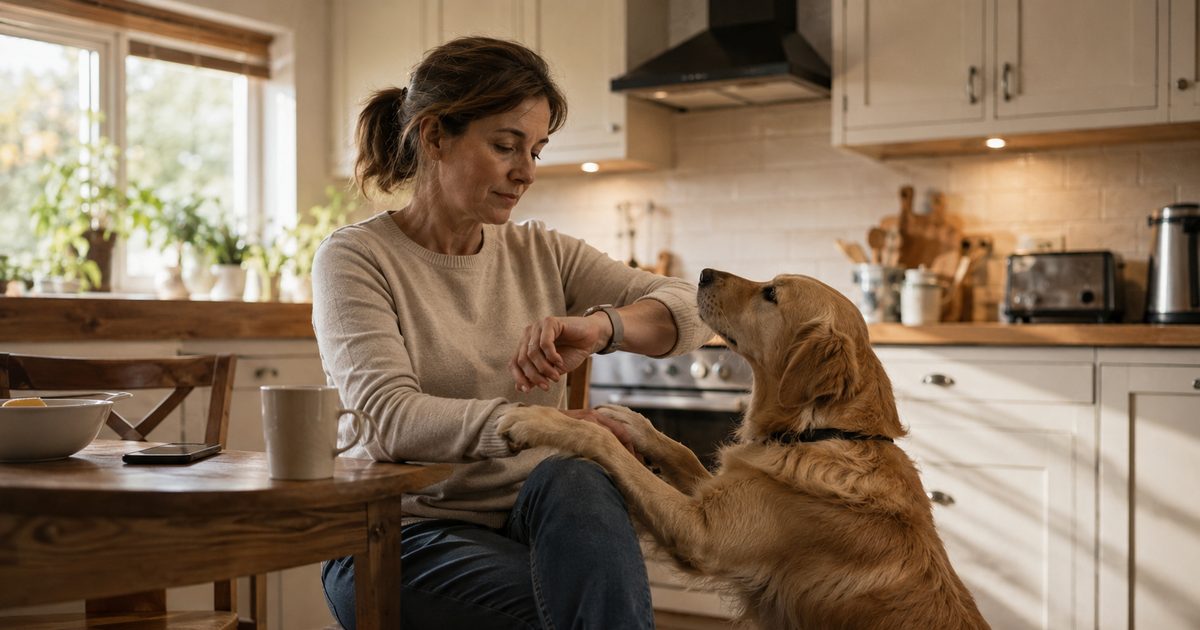
The alert itself is a trained behaviour, not a spontaneous reaction. Handlers and trainers work to shape a specific, consistent response: commonly persistent pawing at the handler's hand or leg, nose-nudging, staring, barking, or retrieving a specific object such as a glucose testing kit or phone. The goal is an alert that is unambiguous, repeatable, and performed at the earliest point of scent detection, ideally before a CGM device would have triggered an alarm.
"Many handlers report their dog alerts five to fifteen minutes before their CGM device. For someone with hypoglycaemia unawareness, that window is not a convenience, it is the difference between a conscious treatment and a medical emergency."
While any person with diabetes could theoretically benefit from a trained alert dog, the evidence for meaningful impact is strongest in three groups: people with Type 1 diabetes, people with brittle diabetes, and people with hypoglycaemia unawareness.
Type 1 diabetes involves total dependence on exogenous insulin, which creates an inherent risk of hypoglycaemia, particularly overnight, during physical activity, or during illness. The unpredictability of insulin sensitivity makes low blood sugar events difficult to anticipate. A DAD adds a biological early-warning layer on top of whatever technology a handler uses.
Brittle diabetes refers to a particularly unstable form of Type 1 where blood glucose levels fluctuate wildly and unpredictably despite best management efforts. People with brittle diabetes may experience multiple severe episodes per week. A DAD can provide a degree of safety net that technology alone cannot fully replicate.
Hypoglycaemia unawareness is the condition where the body has lost its natural early-warning response to low blood sugar, the shaking, sweating and anxiety that most people experience. Without these cues, a person can become severely hypoglycaemic with no subjective warning at all. A DAD trained to detect the early scent signature of a hypo can provide that warning in place of the body's lost signalling system.
People with Type 2 diabetes who manage their condition with insulin may also benefit, particularly if they have developed hypoglycaemia unawareness as a result of long-term insulin therapy. For those managing Type 2 with diet or non-insulin medication alone, the risk of severe hypoglycaemia is minimal and the case for a DAD is correspondingly weaker.
Scientific study of diabetic alert dogs has grown substantially over the past decade. The picture that emerges is encouraging, though researchers are careful to note that study designs vary and that real-world performance depends heavily on training quality and the individual dog.
A 2016 study published in PLOS ONE by researchers at the University of Cambridge confirmed that trained dogs could reliably detect breath samples from people experiencing hypoglycaemia at significantly above-chance accuracy. The researchers identified isoprene as the key VOC associated with hypo detection, establishing for the first time the likely chemical basis for the behaviour that DAD handlers had been reporting anecdotally for years.
A 2019 systematic review published in Diabetic Medicine examined evidence from multiple countries. It found that handlers of medical alert dogs generally reported reductions in severe hypoglycaemic episodes, improvements in HbA1c levels, and improvements in quality of life, including reduced anxiety and greater confidence in undertaking daily activities. Limitations noted included reliance on self-report data and small sample sizes.
Research into hyperglycaemia alerting is less advanced. Dogs appear to detect high blood sugar events through acetone-related VOCs associated with ketosis, though the reliability data for hyper alerts is less consistent than for hypo detection. Most training programmes prioritise hypo alerting for this reason, treating hyper alerts as a secondary and useful addition rather than a primary function.
Assistance Dogs UK (ADUK) is the voluntary coalition of UK assistance dog charities that have achieved accreditation through Assistance Dogs International or the International Guide Dog Federation. In the context of diabetic alert dogs specifically, ADUK accreditation represents an extraordinary bottleneck.
Only two ADUK-accredited charities in the UK currently train diabetic alert dogs. Their combined annual output is fewer than 20 dogs. Against a UK Type 1 diabetes population of around 400,000, this makes the charitable route effectively inaccessible for the vast majority of people who might benefit. Waiting lists at these organisations run to three to five years, and applicants must meet strict eligibility criteria that many people with well-managed diabetes may not satisfy.
This is not a criticism of those charities. Training a reliable medical alert dog takes two to three years, requires specialist expertise, and costs between £30,000 and £50,000 per dog. The economics of scaling that model to meet demand simply do not work without a fundamental change in funding. That change has not happened.
The result is that owner-training, either completely independently or with the support of a professional dog trainer or clinical animal behaviourist, has become the primary pathway for handlers who need a diabetic alert dog. This is not a compromise or a workaround. It is a legitimate, legal and well-established route that carries the same rights under UK law as a charity-trained dog.
"Only two ADUK-accredited charities in the UK train diabetic alert dogs, and their combined annual output is fewer than 20 dogs. Against a UK Type 1 population of around 400,000, this makes owner-training the only realistic route for most handlers. Legally, a self-trained or independently trained diabetic alert dog carries exactly the same public access rights."
Under the Equality Act 2010, the question is not who trained the dog. The question is whether the handler is disabled within the meaning of the Act, and whether the dog is an auxiliary aid that mitigates the effects of that disability. A person with Type 1 diabetes and hypoglycaemia unawareness qualifies as disabled under section 6. A dog trained to detect and alert to blood sugar events is an auxiliary aid. Training organisation is irrelevant to both questions.
An ADR registration gives you a QR-linked online profile, smart ID card and NFC tag that shops, restaurants and transport providers respond to. Your dog's role is verified. Your access rights are documented. Thousands of UK handlers are already registered.
Training a diabetic alert dog is a structured, multi-stage process. It is not simply a matter of exposing a dog to blood glucose changes and hoping it learns what to do. Each stage builds on the last, and the process typically takes 18 months to three years to complete to a reliable standard.
Stage 1: Scent sample collection. The handler collects saliva or breath samples during confirmed blood glucose events, ideally at the point of a hypo or hyper, before treatment. These samples, usually collected onto gauze and frozen in airtight containers, form the training material. Getting this right is critical: the scent must be collected at the point of the event, not after glucose has been taken.
Stage 2: Scent imprinting. The dog is introduced to the scent samples using positive reinforcement. The dog learns to identify and select the correct scent from an array, initially in controlled conditions. This phase can take several months, depending on the dog's aptitude and the consistency of training sessions.
Stage 3: Alert behaviour shaping. Once the dog reliably identifies the target scent, a specific alert behaviour is introduced and reinforced. The behaviour must be one the dog can perform clearly regardless of the setting, at home, in a supermarket, in a car, during the night. Common choices include pawing, a specific nose-touch, or retrieving a designated object.
Stage 4: Proofing in real life. The dog must learn to perform the alert behaviour in every environment it will encounter, busy streets, shops, transport, offices, schools. This is the longest and most demanding stage. The dog must maintain its alerting behaviour reliably regardless of distractions.
Stage 5: Public access training. Any assistance dog working in public spaces must behave impeccably. This means walking calmly on a lead, settling quietly in public places, ignoring food and other dogs, and not approaching strangers without permission. Public access behaviour is not optional, it is what distinguishes an assistance dog from a pet in a public space.
Working with a professional dog trainer or clinical animal behaviourist throughout this process is strongly recommended, even if the handler is doing most of the day-to-day training themselves. A professional can identify problems early, assess progress objectively, and ensure the alert behaviour is being shaped correctly. Organisations such as the Association of Pet Behaviour Counsellors (APBC) and the Animal Behaviour and Training Council (ABTC) maintain registers of accredited practitioners.
A diabetic alert dog is a powerful tool, but it is not a flawless one. Setting realistic expectations before embarking on the training journey is important for the handler, the dog, and the handler's clinical team.
No dog alerts correctly 100 per cent of the time. Miss rates occur, particularly as a dog ages, if its training is not maintained, or during periods of illness or stress in the dog itself. Environmental factors, strong competing scents, changes in the handler's diet, or changes in the specific VOC signature of the handler's events over time, can also affect reliability.
False positives, alerts when blood glucose is actually within range, are common in the early stages of training and should diminish with experience. A high false-positive rate in an established DAD may indicate that training maintenance is needed, or that the dog is alerting to emotional or environmental cues rather than the metabolic scent.
The relationship between a DAD and CGM technology is complementary, not competitive. Most experienced handlers use both. The CGM provides objective data; the DAD may alert earlier and can also alert when a device is not worn, has failed, or is out of range. Many handlers also report that the dog alerts during overnight hypos, a situation where a CGM alarm may be missed by someone who sleeps deeply.
The psychological benefit of a DAD is also significant and should not be underestimated. Many handlers with hypoglycaemia unawareness describe living in a state of chronic anxiety, unable to drive, sleep alone, or exercise without fear of a severe episode. A reliable DAD can restore a degree of independence and confidence that medication and technology alone cannot provide.
A diabetic alert dog that is trained to mitigate the effects of its handler's disability is an assistance dog under UK equality law. The handler has full public access rights under the Equality Act 2010. This is not a grey area.
Under Part 3 of the Act, service providers, including shops, restaurants, hotels, transport operators, cinemas, leisure centres and any other business or organisation that provides services to the public, must not discriminate against a disabled person. Refusing entry or service to a handler with an assistance dog, without an objective justification unrelated to the dog's trained role, is unlawful disability discrimination.
Crucially, no law in the UK requires an assistance dog to be ADUK-accredited in order to have these rights. The definition of "assistance dog" in section 173 of the Equality Act 2010 applies only to Part 12 of the Act, taxi and private hire vehicle licensing. Outside that narrow transport context, the legal test is functional: is the handler disabled, and does the dog mitigate the effects of that disability? An owner-trained or independently trained DAD passes that test.
A service provider who refuses entry to a DAD handler on the grounds that the dog is not ADUK-accredited, is not wearing a specific vest, or does not carry a particular ID card, may be committing unlawful indirect discrimination. A handler who is refused access can report the incident to the Equality Advisory and Support Service (EASS), seek conciliation, or bring county court proceedings.
Registering your DAD with the Assistance Dog Registry provides documentation that many venues and transport operators find reassuring, a verified online profile with QR code, a professional ID card and NFC tag. This documentation does not legally change your rights, but in practice it often prevents confrontations before they arise.
Training and working with a diabetic alert dog is a significant undertaking that should be discussed with your diabetes care team, your consultant endocrinologist, diabetologist or diabetes specialist nurse, from the outset.
Your clinical team can help assess whether a DAD is appropriate for your specific situation. They can document your diagnosis and the impact of your diabetes on daily life, documentation that may be needed when registering your dog, applying for training support, or asserting your rights with a service provider. For people with hypoglycaemia unawareness, clinical documentation of that condition specifically can strengthen any access rights assertion.
Your team should also be aware that a DAD may influence how you manage your diabetes day to day. Some handlers become more confident undertaking exercise or reducing overnight alert thresholds on their CGM in the presence of a reliable DAD. These decisions should be made collaboratively with clinical input, not unilaterally.
Diabetes UK, the charity, has published guidance for people considering an alert dog and can provide signposting to training resources and support organisations.
Yes, in many cases. There is no requirement to start with a specific breed or a puppy. Dogs of many breeds and mixed breeds have been successfully trained as DADs. The key factors are temperament (calm, focused, eager to work with the handler), olfactory ability, and willingness to perform a trained behaviour reliably. Some adult dogs with an established bond with the handler have an advantage in scent imprinting because they are already highly attuned to the handler's body chemistry. A professional assessment by a clinical animal behaviourist can help determine whether your dog has the right attributes before committing to the training process.
Yes. Any dog trained to perform a specific task that mitigates the effects of a handler's disability qualifies as an assistance dog for the purposes of the Equality Act 2010, outside the narrow transport provisions of section 173. Diabetes, particularly Type 1 with hypoglycaemia unawareness, typically qualifies as a disability under section 6 of the Act. A dog trained to detect and alert to blood glucose events is performing a task that mitigates the effects of that disability. ADUK accreditation is not required.
The full training process, from scent imprinting through to reliable public access behaviour, typically takes 18 months to three years. Scent imprinting alone can take several months, and proofing the alert behaviour across all environments takes considerably longer. Training is never truly complete: maintenance training is essential throughout the dog's working life to keep alert reliability high. Most handlers work with a professional trainer at least periodically throughout the process rather than undertaking it entirely alone.
Not lawfully, unless the service provider can demonstrate an objective justification that is proportionate and unrelated to your dog's trained assistance role. Refusing a diabetic alert dog handler entry because the dog is not ADUK-accredited, is not wearing a vest, or does not have a specific ID card is not a lawful justification. If you are refused access, note the details, ask for the refusal in writing, and report it to the Equality Advisory and Support Service (EASS) on 0808 800 0082. An ADR registration card and profile can help prevent confrontations in the first place.
No, and it should not be treated as a replacement. A DAD and a CGM serve complementary functions. The CGM provides objective, real-time blood glucose data and is accurate within measurable tolerances. A DAD may alert earlier to developing events and can provide an alert when a device is not worn or has failed. Most experienced handlers use both simultaneously. Clinical decisions about target ranges, alarm thresholds and insulin dosing should always be made in consultation with your diabetes care team regardless of whether you have a DAD.
Was this article helpful?
This article was researched using peer-reviewed scientific literature, EHRC guidance, Diabetes UK publications, and official UK legislation. All legal citations have been checked against legislation.gov.uk. We update our articles when the law or official guidance changes.
If you spot anything that needs updating, contact us here.
Assistance Dog Registry has supported thousands of UK assistance dog handlers since 2020, supplying 20,000+ ID cards. Articles reviewed against UK primary legislation and official EHRC, GOV.UK, Citizens Advice and NHS guidance. About ADR
This article provides general information, not medical or legal advice. Diabetic alert dogs are not a substitute for clinical diabetes management. The law in this area involves individual facts and circumstances.
For medical decisions, always consult your diabetes care team. For legal questions, contact the Equality Advisory and Support Service (0808 800 0082), Citizens Advice, or the Equality and Human Rights Commission.